
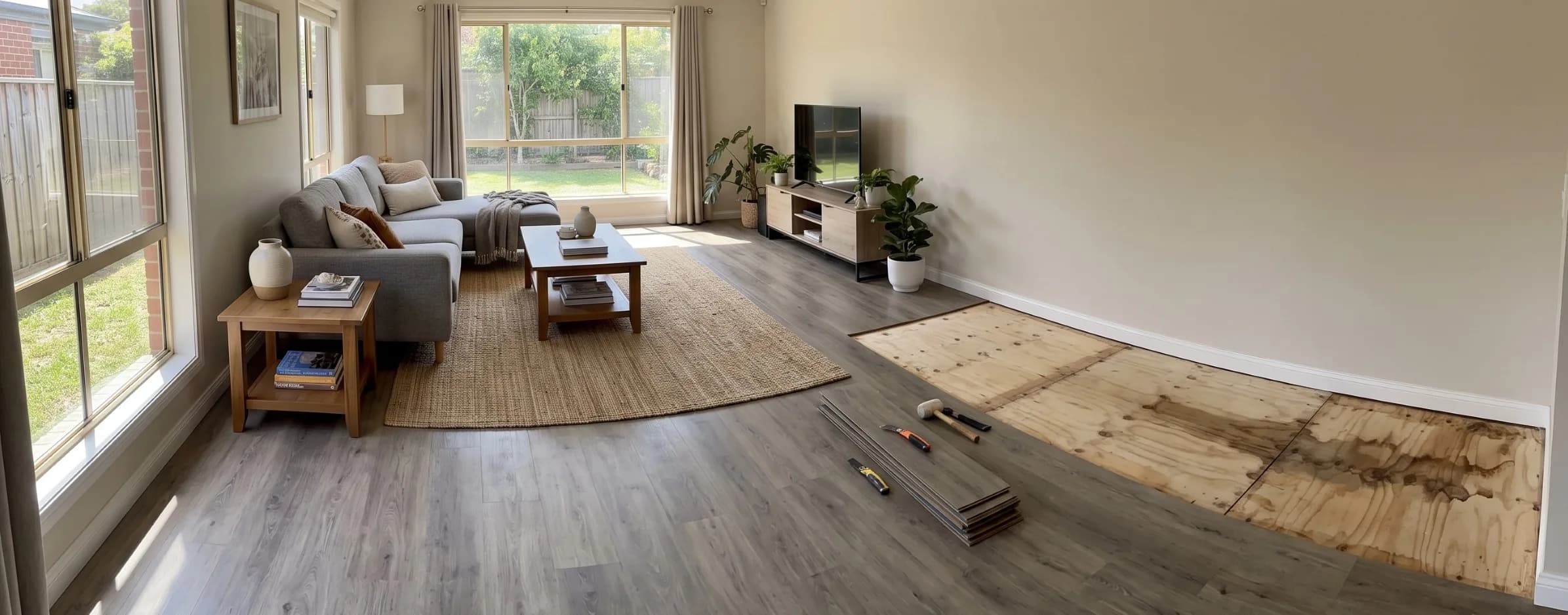

Water damaged subfloor is one of the harder calls a homeowner has to make, because the damage sits underneath the floor you can actually see. A stain on drywall or a swollen board on a hardwood floor is visible the day it happens. A wet subfloor is not, and by the time it announces itself through a soft spot or a musty smell, the wood underneath may have been absorbing water for days.
ANSI/IICRC S500, the industry standard water damage restoration companies follow, treats the subfloor as one of the structural materials that determines whether a job is a straightforward dry-out or a demolition and rebuild. A subfloor is the structural layer of plywood, OSB, or concrete that sits beneath a home's finished flooring and directly on top of the floor joists, and it's that layer S500 is referring to when it distinguishes a material that can be dried in place from one that has to be replaced.
Key insights
- Location matters more than material. A subfloor under a bathroom or kitchen fails faster than the same material under a living room, because the water source is closer and repeat exposure is more common.
- The 24 to 48 hour window is real. Wood that dries within that window has a real chance of being saved. Wood that sits wet past it is far more likely to need cutting out.
- OSB and plywood do not fail the same way. OSB swells permanently at its edges. Plywood tends to delaminate in layers, which is sometimes partially reversible if caught early.
- New flooring over an undried subfloor is the single most common mistake. A moisture meter reading, not a visual check, is what confirms the subfloor is actually ready.
- Squeaks and soft spots are different problems. A squeak alone is usually a loose fastener. A soft spot, give underfoot, or a musty smell with no visible stain is what points to actual water damage.
- Joist involvement changes everything. Once the framing underneath the subfloor is affected, the job moves from a flooring repair to a structural one.
What is a subfloor
A subfloor is the structural layer of a floor system that sits directly on top of the floor joists and underneath the finished flooring, the tile, hardwood, carpet, laminate, or vinyl a homeowner actually walks on. In most homes built after the 1950s, that layer is either plywood or oriented strand board, commonly called OSB, cut into 4-foot by 8-foot panels and fastened directly to the joists, though basements and slab-on-grade homes often use a poured concrete slab instead.
 Panels like these are fastened on 6 to 8 inch centers per manufacturer span ratings, the same baseline a technician compares a wet reading against months or years later.
Panel thickness itself is set by APA, The Engineered Wood Association, the industry group whose span rating standards manufacturers use for structural wood panels, and most residential subfloors run 5/8 to 3/4 inch thick depending on joist spacing. That thickness is what gives a floor its stiffness, and a subfloor that has absorbed water loses that stiffness long before it looks visibly damaged, which is why a floor can feel spongy weeks after a leak even though nothing on the surface has changed.
The International Residential Code sets a matching baseline in Section R503, requiring a minimum panel thickness and fastening pattern for floor sheathing regardless of which product a builder chooses. Builders and inspectors both work from that same minimum, which is part of why a subfloor that's meaningfully thinner or spongier than it should be stands out to a technician right away.
Homeowners rarely see this layer directly. It is only exposed when tile or hardwood floors are pulled up, when a section of carpet and padding is removed, or when a technician cuts an access opening to check for hidden moisture. That is the central challenge with subfloor water damage: confirming it usually requires removing or opening the flooring on top, not just looking at the surface.
Signs your subfloor has water damage
Subfloor water damage shows up as changes in how the floor feels and sounds, not as a visible stain, since the surface flooring is usually still covering it. The most reliable signs are give or bounce underfoot, squeaking or popping fasteners that are new rather than long-standing, and a musty smell in a room with no obvious leak in sight.
 A joint that stays raised after pressing, rather than flexing back down, means the subfloor underneath is still holding moisture, not just the surface board.
None of these signs point to a single fixed spot the way a stain does, which is part of why subfloor damage gets missed. A homeowner might notice a squeak near the kitchen for months before connecting it to the dishwasher leak that caused it, simply because the two don't look related from above.
| Sign | What it feels or sounds like | What it usually means |
|---|---|---|
| Bounce or give | The floor flexes noticeably when you walk across a specific spot | The panel has absorbed water and lost stiffness |
| Squeaking or popping | A new sound at one location, not throughout the room | Fasteners have loosened as the panel swells or shrinks unevenly |
| Musty odor | Present even with no visible stain on the floor above | Moisture and early microbial growth trapped below the surface |
| Cupping that won't resolve | Hardwood or laminate stays crowned or dished after the surface has dried | The subfloor underneath is still holding moisture |
| Loose or hollow tile | A hollow sound when tapped, or a tile that shifts underfoot | The subfloor has swollen or delaminated under the tile bed |
| Cracked grout in a pattern | Cracking that follows a line rather than a single tile | The subfloor is flexing along a seam or joist |
A stain-age test does not apply here the way it does with drywall or a ceiling, since there is usually no stain to look at from above. Instead, the check that matters is a direct one: press firmly on the suspected area with your foot, and if it depresses more than the surrounding floor or makes a soft, hollow sound, water has likely reached the subfloor.
A musty odor with no visible source is worth taking seriously rather than dismissing. The CDC notes that mold can begin growing on a damp surface within roughly one to two days, and a subfloor that stays enclosed under flooring gives it exactly the dark, low-airflow conditions it needs.
Plywood vs OSB vs concrete
Plywood tends to delaminate under water, OSB swells permanently at its edges, and concrete does not rot but can trap moisture for weeks. Plywood is layers of wood veneer glued under pressure, so it tends to absorb water more slowly and fail by delaminating, the layers separating from each other, rather than swelling uniformly.
 Plywood fails in layers while OSB swells at the edges and rarely returns to its original thickness, the reason a technician treats the two materials differently once either has been wet.
OSB is made from compressed wood strands bonded with resin, and it behaves differently under water than plywood does. It absorbs moisture fastest at its cut edges and seams, where the resin barrier is broken, and those edges can swell to nearly double their original thickness. That swelling is largely permanent. Once an OSB panel has telegraphed a raised seam through the flooring above it, sanding or drying will not fully reverse it, and the panel typically needs replacement rather than repair.
Concrete slabs, common in basement water damage and in slab-on-grade homes, do not rot the way wood does, but they are not immune to water damage either. A slab can absorb and hold moisture for weeks after the surface appears dry, and that trapped moisture is what causes glued-down flooring, laminate, and hardwood to fail even after a homeowner assumes the problem is solved.
A crawl space home adds a second wrinkle, since the subfloor there is plywood or OSB exposed to ambient humidity and standing water from below, not just from spills or leaks above. Persistent crawl space moisture can soften a subfloor from underneath with no leak in the living space at all, which is why both drying directions matter, not just the one coming through the finished floor.
What causes subfloor water damage
The most common causes of subfloor water damage are appliance and fixture failures, plumbing leaks running under a floor, and larger events like flooding or sewage backups. The subfloor itself has no water source of its own, so damage always starts as a leak or flood event happening somewhere else in the home.
 A leak this size can sit under a cabinet toe kick for weeks before it surfaces, long enough to reach and swell the subfloor underneath.
Where the cause sits matters as much as what it is. A leak directly above the subfloor, like a dishwasher or a toilet, delivers water to one concentrated spot, while a slab or crawl space source can spread moisture across a much wider area before anyone notices a problem on the surface.
| Cause | Typical entry point | Notes |
|---|---|---|
| Appliance failure | Dishwasher, washing machine, refrigerator supply line | Often small volume but repeats over time if undetected |
| Bathroom fixture leak | Toilet wax ring, tub, or shower pan | Concentrated near one seam, common in older bathrooms |
| Supply line or pipe leak | Under a slab, inside a wall, or between floors | Can run for weeks before a stain appears above |
| Water heater failure | Tank rupture or fitting corrosion | Sudden volume, usually caught the same day |
| Roof or ceiling leak | Travels down through an upper floor | Reaches subfloor from above rather than below |
| Flooding or sewage backup | Groundwater, storm surge, or sewer line | Contaminated water, subfloor almost always requires replacement |
A dishwasher leak and a burst supply pipe tend to produce the two extremes of this problem. An appliance leak is small and slow, sometimes running for weeks under a cabinet toe kick before anyone notices, while a burst pipe delivers a large volume of water all at once but is usually caught and shut off the same day.
Both can reach the subfloor, but the slow leak is often the more damaging of the two. Prolonged low-level saturation gives wood more time to swell, delaminate, and support microbial growth than a single fast burst pipe event that gets extracted quickly.
Can a water damaged subfloor be saved
A water damaged subfloor can often be saved if the wood is still firm to the touch, the water was clean, and drying started within roughly a day of the leak. Once the wood has gone soft, delaminated, or sat wet for more than 48 hours, the odds shift toward cutting out and replacing the affected section rather than drying it in place, a timeline that lines up with the EPA's guidance on how quickly mold can begin growing on wet building materials.
 Wood that gives or feels soft under this kind of pressure has already lost the stiffness a subfloor needs, even when the surrounding panel still looks intact.
No single factor decides this on its own. A technician weighs how long the wood was wet, what condition it's in now, and whether the water itself was clean or contaminated together, rather than treating any one of those as the deciding vote.
| Condition | Likely outcome |
|---|---|
| Firm, damp, caught within 24 hours, clean water | Can usually be dried and saved |
| Soft or spongy to the touch | Replacement, drying will not restore stiffness |
| Visible swelling or delamination | Replacement of the affected panel |
| Contaminated (Category 2 or 3) water | Replacement, porous material cannot be sanitized reliably |
| Musty odor with no confirmed source | Requires inspection before a decision is made |
| Persistent elevated moisture reading after drying | Extended drying or replacement, depending on the trend |
Whether the water fell under IICRC S500's Category 1, 2, or 3 classification matters here as much as how long it sat. Clean, Category 1 water from a supply line gives a subfloor a real chance at drying and being saved. Category 2 or 3 water, from a sewage backup or a source that sat long enough to degrade, generally rules out drying the material in place, since a porous wood panel that has absorbed contaminated water cannot be reliably sanitized the way a hard surface can.
Joist and framing damage is the other factor that changes the outcome. A subfloor panel is a relatively simple material swap once it's confirmed damaged, but the joists underneath are load-bearing, and softened or rotted framing is structural water damage rather than a flooring repair. Signs worth flagging to a contractor include a floor that visibly sags between joists, wood that a screwdriver sinks into with light pressure, or a repair that was already sistered once and is showing the same signs again.
How professionals assess damage
Professionals confirm subfloor water damage with a moisture meter, not a visual inspection, since the panel is almost always still covered by flooring at the time of the assessment. A pin-type meter reads moisture content directly inside the wood, while a pinless meter scans through the surface material without puncturing it, and technicians typically use both to cross-check a reading before deciding whether a section needs to come up.
Readings get compared against an unaffected reference point in the same room rather than a single fixed number, since ambient humidity varies by house and by season. A subfloor reading that sits close to that reference point is considered dry. One running several points above it, even if the surface flooring feels dry to the touch, is treated as still wet and gets more drying time or an opening cut for direct access.
This is the same water damage categories system used to classify water everywhere else in a restoration job. A technician typically assigns it at the same visit as the moisture reading, going by the water's source rather than a lab test.
The companion water damage classes system tells a technician how hard that drying will be. A Class 3 or 4 loss, where a large volume of water has been absorbed into flooring, subfloor, and framing all at once, takes considerably longer to dry and carries a higher chance that the subfloor itself gets replaced rather than dried, simply because so much moisture has to leave the material before a safe reading is possible.
DIY vs professional subfloor repair
A small, caught-early, clean-water spot under an accessible section of flooring is realistically DIY territory for a homeowner comfortable with basic carpentry. Anything involving contaminated water, a room-sized area, or any sign the joists are affected is a professional job.
 Removed boards this size, still intact, can go back down once the subfloor underneath is confirmed dry, which is why prying rather than cutting is worth the extra time on a small, contained spot.
The line between the two comes down to five factors, and it only takes one of them landing in the "call a professional" column to change the recommendation for the whole job. Water source and framing condition tend to carry the most weight of the five when they conflict with each other.
| Factor | DIY-appropriate | Call a professional |
|---|---|---|
| Water source | Clean, Category 1 | Category 2 or 3, or unknown |
| Area affected | A few square feet, one accessible spot | A full room or multiple rooms |
| Moisture reading | Confirmed dry or lightly elevated | Meaningfully elevated with no clear trend down |
| Framing | Joists visibly sound | Any softness, sag, or prior sistering |
| Flooring above | Easily removed and reinstalled (carpet, some vinyl) | Tile, hardwood, or glued material requiring skilled removal |
How to repair it yourself
A caught-early spot repair follows the same five-step sequence whether it's plywood or OSB, from confirming the wood is actually dry through fastening the replacement panel back in.
1. Confirm the subfloor is actually dry
Take moisture meter readings at the damaged spot and at an unaffected reference point elsewhere in the room. The damaged area needs to read within a few points of that reference, not just feel dry to the touch, before any cutting or patching starts.
2. Mark and cut out the damaged section
Outline the soft or discolored area and extend the cut lines to the center of the nearest joists on each side, so the new patch has solid framing to attach to rather than an unsupported edge.
3. Remove the damaged panel and inspect the joists underneath
Pry out the cut section and check the exposed joists for softness, discoloration, or give when pressed with a screwdriver. Stop and call a professional if the framing itself is compromised.
4. Cut and fit a matching replacement panel
Match the new panel's thickness and type to the surrounding subfloor, plywood to plywood or OSB to OSB, and dry-fit it before fastening so the seams sit flush with the existing floor.
5. Fasten, seal the seams, and confirm dryness one more time
Screw or nail the patch to the joists on 6 to 8 inch centers, run a final moisture check, and hold off on new flooring until every reading in and around the patch matches the rest of the room.
If the job is beyond what's reasonable to handle yourself, whether because of the water source, the area involved, or the flooring on top, choosing a water damage restoration company with IICRC certification is worth doing before, not after, a small problem turns into a larger one. Even confirmed-DIY jobs benefit from the same moisture-meter verification a professional would use rather than judging dryness by feel, since a subfloor that looks and feels dry on the surface can still be holding water a quarter inch below where your hand can tell.
Who to call
A subfloor repair can involve up to three different specialists depending on what's damaged: a water damage restoration company for the extraction and drying, a flooring contractor for removing and reinstalling whatever sits on top, and a structural contractor or engineer if the joists themselves are compromised. Most jobs only need the first two, and a restoration company already handling the broader water damage restoration job can sometimes cover both on its own.
A restoration company's job is confirming the water source is stopped, extracting standing water, drying the subfloor to a verified baseline, and cutting out and replacing any section that can't be saved. Checking a technician's certifications before hiring is worth doing here specifically, since deciding whether a section of wood can be dried or needs to come out is a judgment call, not a routine extraction.
Structural work is the exception that changes who's in charge. If a technician flags soft or sagging joists, that part of the job shifts to a structural contractor or engineer, and the subfloor replacement itself typically happens after that framing work is signed off, not before it. A short set of questions to ask a water damage restoration company upfront can confirm whether a company coordinates that structural handoff themselves or expects the homeowner to line up a separate contractor.
How access changes the job
Where a subfloor can be reached from changes both how it gets dried and how much of the finished floor has to come up. A subfloor reachable only from above has to be dried and repaired entirely through the flooring on top, while one reachable from below, through an open crawl space or unfinished basement ceiling, can sometimes be dried or even patched without disturbing the finished floor at all.
Injection drying is the main advantage of below access. A technician can perform structural drying by drilling small holes into the underside of the subfloor from a crawl space or basement ceiling and forcing dry air directly into the material, which can save a section of flooring that would otherwise have to be torn out just to dry the panel underneath it. This isn't always an option, since joist spacing, insulation, ductwork, and general crawl space accessibility all affect whether a technician can actually get equipment and airflow where it needs to go.
Subfloor repair and replacement
Subfloor repair and replacement follow one of two paths: drying the material in place if it's still structurally sound, or cutting out and replacing the damaged section if it isn't. Both paths start the same way, with the flooring above removed or opened enough to access the subfloor directly.
 The new panel gets cut back to the center of the joists on each side, giving it solid framing to fasten to rather than an unsupported edge.
Extraction and access
Standing water gets removed first, and any flooring covering the subfloor, carpet, tile, or a section of hardwood, gets pulled back or removed to expose the panel underneath. Professional water extraction at this stage focuses on the subfloor itself, not just the visible surface, since water pools and travels along the top of a panel even after a room looks dry.
Drying, if the panel is salvageable
Air movers and dehumidifiers run continuously, sometimes for several days, with moisture readings taken daily to confirm the panel is trending toward its dry baseline rather than holding steady. On a job with crawl space or basement access, this is also the stage where injection drying happens, if it's an option for that room.
Cutting out and replacing, if the panel is not
The damaged section gets cut back to the center of the nearest joists on each side, so the replacement panel has solid framing to attach to rather than an unsupported edge. A new panel matching the original material and thickness is fastened in, and any affected joists get sistered with new lumber alongside the old before the new subfloor goes down.
Confirming dryness before new flooring goes back
The single most common mistake in this process is skipping this step. A final moisture reading, not a visual check, has to confirm the subfloor and any surrounding framing are at or near baseline before new flooring, adhesive, or underlayment goes down, since sealing in residual moisture is what turns a contained repair into a repeat failure a few months later.
What happens to your flooring
Whether your finished floor gets fully torn out or just cut back locally depends on how far the water traveled, not on the subfloor repair itself. A small, contained subfloor patch usually only requires removing flooring in the immediate area, while a full-room subfloor replacement generally means the entire floor covering in that room has to come up and go back down.
Carpet and some click-lock vinyl are the easiest to work around in this scenario. Pulled-back carpet can usually be relaid over a small patch, and floating vinyl plank can often be unlocked, patched, and clicked back into place without a full tear-out.
Glued-down and grouted flooring are the least forgiving of the group. A tile and grout floor generally has to be broken out over the damaged section and reset from scratch, since there's rarely a way to lift a single tile cleanly enough to reuse it.
Matching old flooring to new is the other cost driver worth expecting going in, particularly with an older tile run or a discontinued plank color that's no longer in production. A close but not identical match is common enough that it's worth raising with a contractor before the work starts, not after the new section is already installed.
Subfloor water damage cost
Subfloor water damage repair typically costs $300 to $20,000 or more, depending on whether it's a small caught-early patch or a full room replacement that also involves the joists. Material and access are the two biggest cost drivers: OSB is generally cheaper than plywood, and a subfloor under tile or hardwood costs more to reach than one under carpet.
 A quote for a job this size should account for the full room's flooring removal and reinstallation, not just the subfloor material itself, since labor is what drives most of the cost.
The scenario, not the square footage alone, is usually the better way to estimate where a job will land, since two rooms of the same size can cost thousands of dollars apart depending on how much of the floor above has to come up first. A quote that only asks for room dimensions and skips the flooring type and access question is missing a real input.
| Scenario | Typical cost | What's included |
|---|---|---|
| Small spot repair, caught early | $300–$800 | Localized patch, minimal flooring removal |
| Partial room, one section | $800–$3,000 | Cut-out, patch panel, matching flooring reinstalled |
| Full room replacement | $1,500–$6,000 | Full plywood or OSB replacement, materials and labor |
| Full room plus joist sistering | $4,000–$12,000 | Structural reinforcement in addition to the subfloor |
| Multi-room or contaminated-water loss | $10,000–$20,000+ | Extensive demolition, drying, and structural rebuild |
Labor tends to outweigh materials on most jobs. Plywood and OSB panels themselves run a few dollars per square foot, but the work of removing flooring, cutting out damaged sections, matching thickness, and reinstalling whatever was on top is what pushes a job from a few hundred dollars to several thousand.
That labor share is also why a subfloor repair rarely shows up as its own line item on a water damage restoration cost estimate. It's usually folded into the broader mitigation and repair scope instead.
A per-square-foot quote from a contractor should still reflect the labor-heavy split described above. A number that looks unusually low for a full-room job is worth double-checking against what it actually includes.
Does insurance cover subfloor damage
Homeowners insurance typically covers subfloor water damage when the water source was sudden and accidental, since the subfloor is part of the home's structure under a standard HO-3 policy, the same way drywall or framing is. A burst supply line, a water heater failure, or an appliance hose that let go without warning generally qualifies.
What usually does not qualify is damage from a slow leak the homeowner reasonably should have caught, such as a supply line under a sink that's been dripping for months before the subfloor finally gave way. Insurers distinguish between these two situations the same way they do for any other homeowners insurance covers water damage claim, and a subfloor claim tends to get more scrutiny than a surface-level one, since the delay between the leak starting and the damage being discovered is often longer and harder to pin down.
Preventing subfloor water damage
Preventing subfloor water damage comes down to catching leaks fast, checking the fixtures most likely to cause one, and confirming a subfloor is actually dry before anything gets installed over it. None of these require professional help, just a consistent habit.
 A quick check like this twice a year catches a slow drip before it has weeks to work its way into the subfloor underneath the cabinet.
Respond to leaks the same day, not the same week
A supply line or appliance connection that's dripping slowly does more damage to a subfloor over three weeks of small exposure than a burst pipe does in an hour, since the subfloor never gets a chance to dry between drips. A quick shutoff and a few hours of airflow the same day a leak is found is often the difference between a five-minute fix and a torn-out panel.
Check under appliances and fixtures twice a year
Pull out the dishwasher, refrigerator, and washing machine periodically to inspect hoses and connections, since these are the leaks most likely to run unnoticed directly onto a subfloor for weeks. A toilet's wax ring and a bathroom vanity's supply lines deserve the same periodic check, since both sit directly over a subfloor with almost no visible warning before they fail.
Keep crawl spaces and basements ventilated or conditioned
A subfloor exposed to chronic humidity from below ages faster than one that only sees the occasional leak from above, even without a single dramatic water event. Running a dehumidifier in a damp crawl space or basement keeps ambient moisture from slowly working into the panel over years rather than days.
Confirm moisture readings before any new flooring installation
A subfloor moisture check before any new flooring installation catches a slow-developing problem before it's sealed under new material. That check matters just as much when finishing a basement as it does when replacing worn flooring anywhere else in the house. Skipping this step is how a homeowner ends up tearing out brand-new flooring a year later to fix a subfloor issue that was already there.
Frequently asked questions
Can a water damaged subfloor be saved without replacing it?
Yes, if the wood is still firm, the water was clean, and drying started within a day or two. A subfloor that has gone soft, delaminated, or sat wet for several days almost always needs the damaged section cut out and replaced rather than dried.
How long does a subfloor normally last?
A subfloor typically lasts 50 to 100 years under normal conditions, about as long as the framing around it. Repeated moisture exposure, even without one dramatic flood, can cut that down to roughly 20 to 30 years, since each cycle of dampness and drying weakens the wood a little more than the last.
How do I know if my subfloor is water damaged?
Look for give or bounce underfoot, squeaking or popping fasteners, a musty smell with no visible stain, or flooring above that stays cupped or lifted after the surface has dried. Any of these point to moisture in the layer below the finished floor, not just on top of it.
How long does it take for a wet subfloor to dry out?
A lightly damp plywood or OSB subfloor can dry in 3 to 5 days with air movers and a dehumidifier running continuously. A subfloor that stayed wet for more than 48 hours, or a higher water damage classes loss where more water has soaked into the surrounding materials, often takes 1 to 2 weeks and may not fully recover even with extended drying.
Does OSB or plywood hold up better to water?
Plywood generally holds up better. It absorbs water more slowly and tends to warp or delaminate in layers, which is sometimes reversible if caught early. OSB absorbs water faster at its edges, swells permanently at the seams, and rarely returns to its original thickness once soaked.
Which is more common, plywood or OSB?
OSB is more common in new construction today, mainly because it costs less than plywood on a typical home. Plywood remains more common in custom builds, DIY projects, and certain regions where builders have stuck with it, plus under tile or stone flooring specifically, where its stiffness performs better.
Can I just put new flooring over a damp subfloor?
No. Installing flooring over a subfloor that has not been confirmed dry traps the remaining moisture, which leads to mold, adhesive failure, and repeat damage to the new flooring within months. A moisture meter reading at or near the dry baseline for the material is required before any new floor covering goes down.
How do I know if the floor joists are also damaged?
Signs include a floor that visibly sags or deflects when you walk across it, sistered lumber already present from a prior repair, or wood that has softened enough to probe with a screwdriver. Joist damage is a structural water damage question that needs a contractor or engineer, not just a subfloor material swap.
Is a squeaky floor always a sign of water damage?
No. Squeaking is most often a loose fastener or a subfloor panel that has shifted slightly from normal seasonal movement, not water. It becomes a water-damage concern when the squeak is new, localized to one area near a known plumbing line or appliance, and paired with a musty smell or soft spot.
What if my subfloor already has mold on it?
At that point, the job involves mold remediation as well as water damage restoration, not just a subfloor repair. The mold typically has to be addressed under its own protocol before or alongside the subfloor work, since a dried panel with active growth on it isn't safe to seal back under new flooring.
Can a concrete subfloor be water damaged?
Yes, indirectly. Concrete itself will not rot, but it can trap moisture that ruins whatever is glued or nailed to it, including hardwood, laminate, and vinyl adhesive, a common issue in basement water damage and slab-on-grade homes. A slab also needs to test dry with a calcium chloride or relative humidity probe before new flooring goes down, since a visually dry slab can still be releasing moisture from underneath.
What does subfloor repair typically cost?
A small, caught-early spot repair typically runs $300 to $800. A full room of plywood or OSB replacement, materials and labor included, typically runs $1,500 to $6,000, and a job that also requires joist sistering or reaches multiple rooms can run $10,000 or more.
Does homeowners insurance cover a water damaged subfloor?
Usually yes, if the water source was sudden and accidental, such as a burst supply line or an appliance hose failure, since the subfloor is part of the dwelling structure under a standard HO-3 policy. Damage from a slow, long-term leak the homeowner should have caught is the most common reason a subfloor claim gets denied or reduced.
Do I have to disclose a repaired subfloor when selling my house?
In most states, yes, if the damage was ever significant enough to need repair, since a past subfloor issue is typically treated as a material defect even after it's fixed. Exactly what has to be disclosed and for how long varies by state.
What's the difference between a subfloor problem and a washing machine leak?
A washing machine leak is the cause, the source of the water. Subfloor damage is one possible consequence of that leak if the water reached the layer beneath the flooring rather than being stopped and dried before it traveled that far.
Sam Hickerson is the founder of RestoreAdvisor and writes consumer guides on mold remediation, water damage restoration, inspection, testing, and home recovery. His work focuses on helping homeowners understand costs, risks, and when to call a professional. He draws on guidance from the EPA, CDC, IICRC, and other authoritative sources to make complex home issues easier to navigate.