
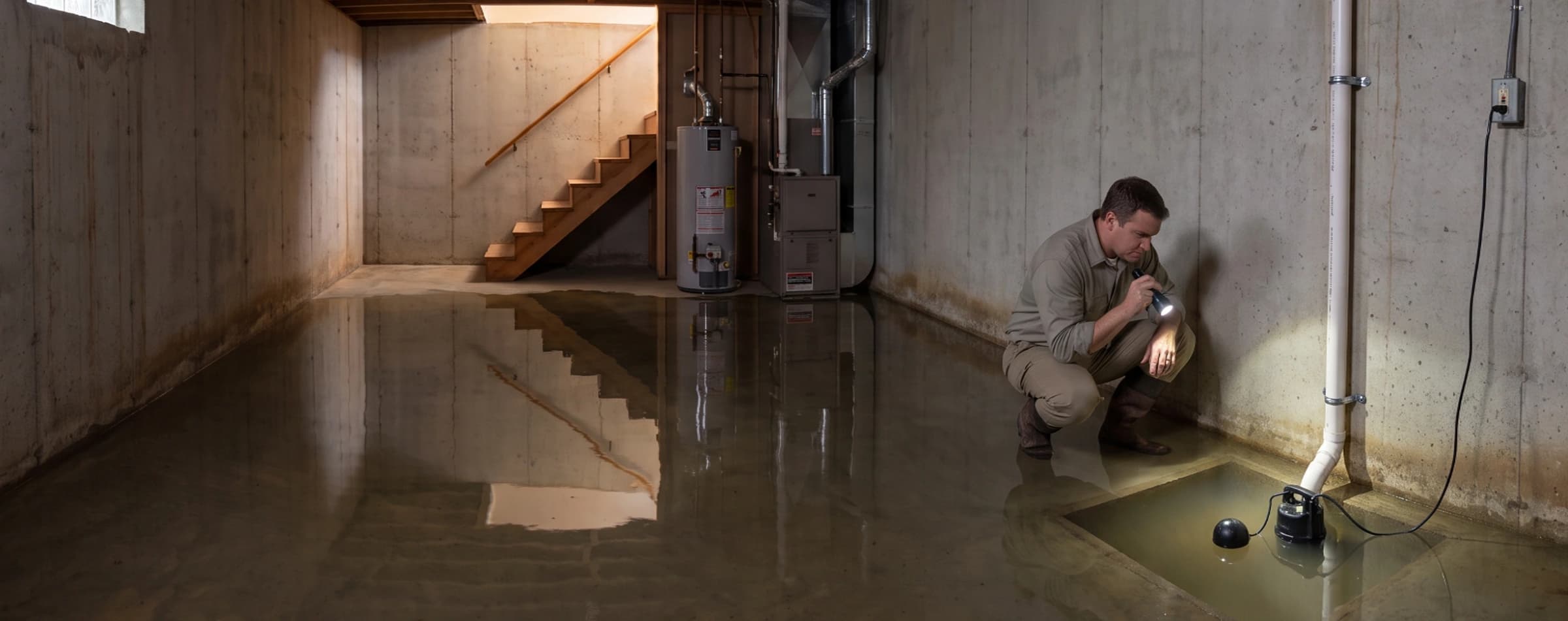

A dead sump pump during a storm can turn a dry basement into standing water within an hour, and the first few minutes matter more than almost anything that follows. Cutting power safely, starting extraction, and calling the right people, in that order, keeps a bad afternoon from turning into a five-figure repair. A sump pump failure is a water intrusion event in which the pump responsible for clearing a basement or crawl space sump pit stops removing water, letting it rise past the pit and spread across the floor; restoration companies assess the result under IICRC S500, the industry standard that classifies water by contamination level and the surfaces it has touched, the same framework applied to a burst pipe or a roof leak.
Most sump pump failures start with clean or lightly contaminated groundwater rather than sewage, but that classification changes if the water sits for more than a day or if the same pit also handles a combination line that carries wastewater during heavy rain. Power outages and a stuck float switch account for most failures, and a battery or water-powered backup pump addresses both without requiring the primary system to be replaced.
Key insights
- Category 1 to 2, usually. Sump pump failure water starts as clean or lightly contaminated groundwater under IICRC S500, but standing water reclassifies to Category 2 within 24 to 48 hours.
- Insurance rarely covers it by default. A standard homeowners policy typically excludes sump pump failure and groundwater seepage; a water backup endorsement, usually $50 to $250 a year for $5,000 to $50,000 in coverage, closes that gap.
- Cleanup runs $1,500 to $7,000 for a typical basement flood that reaches drywall or flooring, more if the water stands for several days or the basement is finished.
- Power outages and a stuck float switch cause most sump pump failures, not a worn-out motor.
- Most pumps need replacement every 7 to 10 years. A pump older than that window carries meaningfully higher failure risk during a heavy storm.
- Extraction and drying should start within 24 to 48 hours of the event to limit mold growth on wet materials.
Sump pump not working but no water yet
A sump pump that's silent doesn't always mean it's failed. Check the outlet, the float, and the breaker before assuming the worst, since several of the most common issues take under five minutes to rule out and don't require calling anyone.
 A float that doesn't trigger the pump within a few seconds of being lifted by hand usually points to a jammed switch rather than a dead motor.
Check the outlet and the GFCI
Many sump pump outlets sit on a GFCI circuit that trips on its own, especially in a damp basement, so press the reset button on the outlet itself before assuming the pump is dead.
Confirm the breaker hasn't tripped
A dedicated circuit for the sump pump can trip during a storm surge separately from the rest of the house, so check the breaker panel even if other basement outlets still have power.
Look at the float switch's range of motion
The float needs to rise freely inside the pit without catching on the pit wall, a discharge pipe, or debris. Gently lift it by hand and listen for the pump to kick on.
Listen for a hum with no water movement
A pump that hums when the float is lifted but doesn't move water usually has a clogged intake screen or a jammed impeller rather than a dead motor, and clearing debris from the intake often solves it on the spot.
Check the discharge line outside
If the pump runs but nothing exits the discharge point outside the home, the line is clogged or frozen rather than the pump itself.
If all five checks come back normal and the pump still won't run, call a plumber the same day, since a pump that fails these checks typically needs professional diagnosis or replacement rather than a homeowner fix. Most same-day pump replacements run $300 to $1,200 installed, well below the cost of a flood that develops while the search for parts drags on.
What to do right now if your sump pump fails
Cut power to the pump and any submerged outlets first, then start removing standing water by hand while you call for help. Acting within the first hour keeps water from spreading past the immediate area around the pit and reaching drywall, baseboards, and stored belongings.
 Look for a breaker labeled sump pump specifically, since a shared or mislabeled circuit can trip without any obvious connection to the pump itself.
1. Cut power to the affected area
If the outlet or breaker panel is dry and reachable, shut off power to the sump pump circuit and any outlets near the standing water before doing anything else. Standing water and live electrical outlets are a serious shock hazard, and OSHA's flood response guidance calls for de-energizing circuits before entering an area with water contact.
2. Start removing water by hand
If the power is out or the pump won't restart, a wet/dry shop vacuum, a hand pump, or a gas-powered trash pump will buy time until a plumber or backup system takes over. A bucket works for a small amount, but it won't keep pace with an actively rising pit.
3. Move belongings off the floor
Cardboard boxes, furniture legs, and anything stored directly on a basement floor should move to a dry area immediately, since porous materials left in contact with water start absorbing it within minutes.
4. Photograph the damage before cleanup
Wide shots of the flooded area and close-ups of the water line on walls, boxes, and furniture give an insurer a clear record of how far the water spread before drying began.
5. Call a sump pump specialist and a restoration company at the same time
A plumber or sump pump specialist addresses the mechanical failure while a certified water damage restoration company handles extraction and drying. Calling both at once, rather than waiting to see which is needed first, keeps the water exposure window as short as possible.
If water is actively rising with no sign of slowing, treat it as an emergency and follow the same immediate safety sequence used for any emergency water damage restoration situation, including the reentry precautions for standing water near an electrical panel. Most restoration companies dispatch within 30 to 60 minutes in urban areas for an active flood call, faster than waiting to see whether the water levels off on its own.
What not to do after a sump pump failure
Skip the shortcuts that make a sump pump failure worse, since several common instincts either damage equipment further or delay the point where drying actually starts. Each mistake below either burns out equipment that could have been repaired or turns a same-day extraction into a multi-day job that requires removing drywall or flooring.
Don't keep restarting the pump without checking it
A pump that hums but doesn't move water is often jammed or airlocked, and repeatedly cycling power to it risks burning out the motor before a technician gets a chance to diagnose the actual problem.
Don't ignore water that has stopped rising
A pit that's no longer overflowing doesn't mean the event is over. Water sitting on a basement floor or inside baseboards for more than a day reclassifies from Category 1 to Category 2 under IICRC S500, and the EPA recommends starting extraction and drying within 24 to 48 hours to limit mold growth.
Don't wait on your insurer before starting mitigation
Most policies require the homeowner to take reasonable steps to prevent further damage regardless of when a claim is filed, and delaying extraction to wait for adjuster approval typically increases the loss rather than protecting the claim.
Once the pump itself is no longer the immediate concern, the same extraction-through-documentation sequence used in any water damage restoration checklist applies, starting with confirming the water has actually stopped rising before drying equipment goes in. Running dehumidifiers and air movers against water that's still entering the pit wastes the first day of equipment rental on a job that isn't ready for it yet.
Is it really the sump pump, or something else
A sump pump failure is only one of several reasons a basement floods, and the fix differs depending on which one actually happened: a jammed float switch, a foundation crack, and a backed-up sewer line each leave a different signature. All three can look identical within the first few minutes, which is why checking the signal before calling anyone saves a wasted trip.
 A hairline crack seeping water even while the pump runs normally points to groundwater entering through the foundation itself, a separate repair from anything involving the pump.
Getting this distinction right before calling for help changes who shows up first, since a plumber can't fix a cracked foundation and a waterproofing contractor can't repair a sump pump motor. Homeowners who call the wrong specialist first often lose the better part of a day before the actual source gets addressed.
| Signal | Likely cause | What it means |
|---|---|---|
| Water rising from inside the pit itself, pump silent | True pump failure, power loss, a stuck switch, or a mechanical jam | Follow the immediate response steps and call a specialist |
| Water seeping up through the floor away from the pit, pump running normally | Foundation crack or slab seepage, not the pump | The pump may be working correctly but can't keep up with the entry point |
| Water backing up through a floor drain with a sewage odor | Combined sewer or septic backup, not groundwater | A different contamination level and cleanup process than a routine pump failure |
| Pump humming or vibrating but no water moving | Clogged impeller, frozen or blocked discharge line, or an airlock | A mechanical clog rather than a dead pump, often fixable without replacement |
A pump that's silent while the pit fills nearly always points to power loss or a stuck float switch, the two most common ways a pump actually fails. A pump that's audibly running but not clearing water usually means the discharge line or impeller is blocked rather than the motor itself, a fix simple enough to fall under DIY water damage cleanup territory for the water itself, even if the pump repair still needs a plumber.
Water classification: is sump pump failure water clean or contaminated
Sump pump failure water starts as Category 1 under IICRC S500 in most homes, meaning it's groundwater with no known contamination, since it enters the pit from the soil around the foundation rather than from a plumbing fixture or sewer line. That classification changes if the water sits for more than 24 to 48 hours or if the same pit also receives water from a combination drain that carries wastewater.
A restoration company confirms category with the same water damage categories system used for a burst pipe or roof leak, not a separate standard for groundwater specifically. If the basement floor drain backs up sewage at the same time the pump fails, a scenario more common in older homes with combined sewer lines, the water carries far greater contamination risk and needs professional-grade PPE and disposal rather than routine groundwater extraction.
Who to call after a sump pump failure
Call a plumber or a sump pump specialist for the mechanical failure and a certified water damage restoration company for the water at the same time, rather than one after the other. Waiting to see how bad the water gets before calling a restoration company is one of the costlier delays homeowners make.
 Calling a plumber and a restoration company in the same call, rather than waiting to see which one turns out to be needed, keeps the water exposure window as short as possible.
A licensed plumber can usually diagnose and replace a failed pump the same day, and many carry standard submersible pumps on the truck for exactly this situation. For the water itself, confirm the company you call carries water damage restoration certifications such as WRT, since that credential covers moisture mapping and category classification, not just equipment operation.
If the failure knocked out power to more than the pump, such as a tripped whole-house breaker or a damaged outlet near the pit, an electrician should confirm the circuit is safe before anyone resets it. Resetting a breaker that tripped because of water contact, rather than a simple overload, can re-energize a circuit that's still wet and create a second shock hazard.
Confirming licensing, insurance, and payment terms with each company before work starts avoids surprises later, and the exact questions to ask a water damage restoration company for that conversation depend on whether it's the plumber, the restoration crew, or both. A company that hesitates to answer basic licensing questions over the phone is worth skipping before an in-home estimate ever gets scheduled.
What causes a sump pump to fail
Most sump pump failures trace back to one of six mechanical or electrical points rather than the pump simply wearing out. Power loss and a stuck float switch cause the majority of failures, but clogs, sizing mismatches, and age all show up regularly in service calls.
 Power loss and a stuck float switch account for most failures, while the other four causes tend to surface only after months or years of normal wear.
Most homes never diagnose the cause themselves, since the pit and pump sit hidden under a lid in a corner of the basement most people rarely open. A five-minute inspection during a dry stretch, checking the float's range of motion and confirming water actually exits the discharge line outside, catches most of these causes before they lead to a failure.
| Cause | Why it happens | What to check |
|---|---|---|
| Power outage | The pump runs on household electricity, so a storm-related outage disables it exactly when it's needed most | Whether a battery or water-powered backup is installed |
| Stuck or worn float switch | The float switch tells the pump when to turn on; if it's tangled, tilted, or worn out, the pump never gets the signal | Free movement of the float inside the pit, with no debris or tilting |
| Clogged or frozen discharge line | The pipe carrying water away from the house can clog with debris or freeze shut in cold weather, backing pressure into the pump | Whether water exits the discharge point outside the home when the pump runs |
| Undersized or mismatched pump | A pump rated below what the pit's inflow requires runs constantly and burns out faster, or can't keep pace during heavy rain | The pump's horsepower against the pit's typical inflow rate |
| Pump age past 7 to 10 years | Seals, bearings, and switches wear out gradually, and most pumps are rated for that service life | The pump's install date or any sticker with a manufacture date |
| Overwhelmed capacity during a major storm | Even a working pump can fall behind if inflow exceeds its gallons-per-minute rating during an extreme rain event | Whether a secondary or higher-capacity pump makes sense for the property |
A pump that's less than five years old and still fails usually points to installation rather than age, most often a pit that's too small for the pump's cycle rate or a check valve installed backward. A licensed plumber can typically identify which of these six points failed within a few minutes of pulling the pump.
Battery backup vs. water-powered backup: which sump pump backup makes sense
A battery backup and a water-powered backup both keep water moving out of the pit when the primary pump can't, and the better fit depends on how often the power goes out and whether the home is on municipal water. Either option solves the single most common failure point: a power outage during the exact storm that's filling the pit.
 The primary pump plugs into the wall outlet while the backup pump draws power through the monitor unit instead, so it keeps running off the battery even if the outlet itself loses power.
Neither backup replaces the primary pump, and both are built to run for a limited window rather than indefinitely. Choosing between them usually comes down to one practical question: does the home have reliable municipal water pressure, or does it rely on a well pump that also needs electricity to run?
| Backup type | How it works | Installed cost | Best for |
|---|---|---|---|
| Battery backup pump | A second pump runs off a deep-cycle marine battery and takes over automatically when line power drops | $400–$1,200 | Homes with frequent short outages and easy battery access for periodic testing |
| Water-powered backup pump | Municipal water pressure creates suction through a venturi valve, clearing the pit without electricity or a battery | $500–$1,200 | Homes on municipal water with reliable pressure, not homes on a private well |
| Portable generator | A gas or battery generator powers the primary pump, plus other essentials, during an outage | $500–$2,000, not sump-specific | Homeowners willing to be present to set it up when the power drops |
| Secondary pump in the same pit | A second pump set to trigger at a higher water level than the primary, providing mechanical redundancy | $150–$500 in parts plus installation | Homes where mechanical failure, not power loss, is the bigger risk |
A battery backup needs its battery tested and typically replaced every three to five years to stay reliable, since a dead backup battery defeats the purpose the same way a dead primary pump does. Homes that lose power for more than a day during major storms should treat a battery backup as a bridge rather than a permanent solution, since even a large marine battery eventually drains under continuous pumping.
How much does sump pump failure cleanup cost
Cleanup after a sump pump failure typically costs $1,500 to $7,000 for a basement flood that reaches drywall or flooring, with the total driven mainly by how long the water stood before extraction started. A contained puddle caught within the first hour costs far less than the same amount of water left standing overnight.
 Removing drywall and insulation and running equipment for several days is what pushes a cleanup from the low end of the cost range toward the high end, not the water itself.
Response time affects the final number more than almost any other factor, since water extracted within the first hour rarely soaks past the surface of flooring and baseboards. A flood left standing overnight, by contrast, usually means cutting into drywall and pulling padding that a faster response would have saved.
| Scenario | Typical cost | What drives it |
|---|---|---|
| Contained puddle, caught within an hour, no materials removed | $300–$1,500 | Extraction and drying time only |
| Moderate flood, several inches across part of the basement | $1,500–$7,000 | Drywall and flooring removal, several days of equipment |
| Severe flood, standing water for 24+ hours, finished basement | $10,000–$25,000+ | Structural drying, contents restoration, mold remediation add-on |
These figures cover water damage cleanup only, not the sump pump itself. A standard pump replacement typically runs $300 to $1,200 installed, and adding a battery or water-powered backup at the same time adds another $400 to $1,200, both far less than a single severe flood cleanup.
The same water damage restoration cost factors, category, class, and room, apply here too, since a finished basement with removed drywall costs meaningfully more per square foot than an unfinished one with a concrete floor. An unfinished basement with only exposed framing and a concrete slab often needs extraction and drying alone, without the drywall and flooring replacement that drives the higher end of the range.
Does insurance cover sump pump failure water damage
No, not by default. A standard HO-3 homeowners policy treats sump pump failure the same way it treats groundwater seepage, as an excluded peril, unless the policy carries a separate water backup endorsement.
That endorsement, sometimes labeled sewer backup, water backup, or sump pump overflow coverage, typically costs $50 to $250 a year for $5,000 to $50,000 in coverage, consistent with what the NAIC outlines for optional homeowners coverages. Without it, a homeowner pays the full cleanup and pump replacement cost out of pocket regardless of how quickly they responded.
Insurers do draw a line between mechanical failure and neglect. A pump that failed because the switch stuck during a storm is treated differently than one that hadn't worked in months and was never tested, since ordinary maintenance is generally the homeowner's responsibility under any policy. Deductible math and the claim-filing sequence work the same way regardless of which cause triggered the claim, and the full mechanics behind homeowners insurance and water damage apply here without any sump-pump-specific exception.
Signs your sump pump is about to fail
A sump pump rarely fails without warning signs in the weeks before a total breakdown, and catching them early is far cheaper than a flooded basement. Short-cycling, unusual noise, and a musty smell are the three most reliable early indicators.
 Short-cycling and unusual noise are the two signs most likely to show up weeks before a full failure, giving the most warning before a storm actually tests the pump.
The pump runs constantly or short-cycles
A healthy pump turns on when the float rises and shuts off once the pit drains; one that never fully shuts off or clicks on and off within seconds usually has a failing switch or a pit that's undersized for normal groundwater flow.
Grinding, rattling, or a new vibration
A quiet hum is normal; a grinding or rattling noise usually means a worn bearing or debris caught in the impeller, either of which leads to a full failure without repair.
Rust-colored water or visible sediment in the pit
Corrosion inside an aging pump housing shows up in the discharge water before the pump stops working altogether.
A musty smell near the sump pit between rain events
Standing water at the bottom of the pit that never fully drains points to a pump that's losing capacity, even if it still runs, and the CDC notes that persistent dampness is one of the conditions mold needs to establish itself.
The pump is past its 7 to 10 year service life
Age alone doesn't guarantee failure, but a pump older than that window warrants testing before the next major storm rather than after it fails.
These signs are specific to the pump itself. General signs of water damage elsewhere in the home, like a musty smell in a room far from the sump pit, may point to a separate problem entirely.
Discovering a sump pump failure while away from home
A sump pump failure often goes unnoticed until someone returns home, since basements get checked less often than any other part of a house, and many failures happen during a storm that also knocks out power while no one's there. The longer water sits undiscovered, the more likely it reclassifies from Category 1 to Category 2 and reaches materials that would have been salvageable with a same-day response.
A neighbor, property manager, or house sitter with a spare key can check a basement far sooner than a homeowner returning from a weeklong trip, and a quick photo of the sump pit sent by text confirms whether the pump is running normally. Smart water sensors placed directly in or near the sump pit send a phone alert the moment water rises above a set level, often catching a failure within minutes rather than days, well before it reaches the point of needing a full restoration crew.
If a failure is discovered after several days away, treat the water as Category 2 by default rather than assuming it's still clean groundwater. A restoration company can authorize mitigation to begin the same day even if the homeowner is still traveling, provided access is arranged through a neighbor or property manager and photos are shared for documentation.
How to prevent another sump pump failure
Testing the pump quarterly, keeping the discharge line clear, and installing a backup power source prevent the large majority of repeat failures. None of these take more than a few minutes each, and all three catch a developing problem before the next storm finds it.
 Pouring a few gallons directly into the pit and watching for the pump to start within a minute is the single fastest way to catch a failing switch before a storm does.
Test the pump every three months
Pour a few gallons of water directly into the pit until the float rises and triggers the pump; if it doesn't start and drain the pit within a minute, it needs service before the next storm.
Keep the discharge line clear and unfrozen
Check the exterior discharge point for debris, and in cold climates confirm the line has enough slope and insulation to avoid freezing shut during a winter storm.
Install a battery or water-powered backup
Either option keeps water moving during the power outages that cause most failures, without requiring the primary pump to be replaced.
Replace the pump proactively at the 7 to 10 year mark
Waiting for a pump to fail costs far more than replacing it on a schedule, since a scheduled swap happens on a dry day rather than during an active storm.
The same habits extend to plumbing, appliances, and the roof under a full water damage prevention routine, worth setting up once the pump itself is handled. A single seasonal walkthrough covering all of them takes less time than the quarterly pump test alone once it's built into a routine.
Frequently asked questions
Does homeowners insurance cover a sump pump failure?
No, not under a standard policy, and a separate flood insurance policy doesn't cover it either since NFIP flood coverage applies to external flooding, not internal mechanical failure. The fix is a water backup endorsement, typically $50 to $250 a year for $5,000 to $50,000 in coverage.
How much does it cost to fix a broken sump pump?
Between $300 and $1,200 installed for a standard replacement, depending on pump type and labor. Adding a battery or water-powered backup at the same time typically adds another $400 to $1,200.
Why does my sump pump run but not pump water?
Usually a clogged or frozen discharge line, an airlock inside the pump housing, or a jammed impeller. All three let the motor run without moving water, and a plumber can often clear the blockage without replacing the pump.
How long can a sump pump run before it needs to be replaced?
Most sump pumps last 7 to 10 years under normal use. Heavy annual rainfall, an undersized pump running constantly, or a pump that's been submerged in contaminated water can shorten that lifespan.
Can I clean up sump pump flooding myself?
Yes, for a small, contained puddle caught within an hour, with a wet/dry vacuum and fans. Standing water that's covered more than a few hundred square feet or sat for over 24 hours needs professional extraction and drying; how long water damage restoration takes for a comparable basement flood helps set expectations for either path.
How fast can mold grow after a sump pump failure?
Within 24 to 48 hours on wet materials, and often faster in a basement, since basements already run more humid than the rest of the house even before a flood adds standing water. That's why extraction and drying need to start the same day the pump is fixed rather than after.
What happens when the restoration crew arrives after a sump pump failure?
A quick walkthrough to confirm the water's category and class, followed by extraction and equipment placement during that same first visit. Whether to stay home while equipment runs is usually decided on the spot, one of several first-day calls that come up during what to expect from water damage restoration.
What's the difference between a sump pump failure and a flooded basement from heavy rain?
A sump pump failure means the pump itself stopped working while groundwater kept entering the pit normally. A flooded basement from heavy rain can happen even with a fully functional pump if inflow exceeds the pump's capacity, which points toward a higher-capacity or secondary pump rather than a repair.
Is a battery backup, a water-powered backup, or a generator the better choice?
A battery backup works for any home but needs periodic battery testing and replacement every 3 to 5 years. A water-powered backup needs no battery and runs as long as municipal water pressure holds, but only works on a municipal water supply, not a private well. A generator works for either setup but requires someone present to start it.
How does sump pump cleanup cost compare to other water damage causes?
Similarly, once category and class are accounted for. A water damage restoration cost per square foot figure applies the same way regardless of whether a burst pipe, a roof leak, or a failed sump pump caused the flooding, since the drying process itself doesn't change by cause.
Sam Hickerson is the founder of RestoreAdvisor and writes consumer guides on mold remediation, water damage restoration, inspection, testing, and home recovery. His work focuses on helping homeowners understand costs, risks, and when to call a professional. He draws on guidance from the EPA, CDC, IICRC, and other authoritative sources to make complex home issues easier to navigate.