
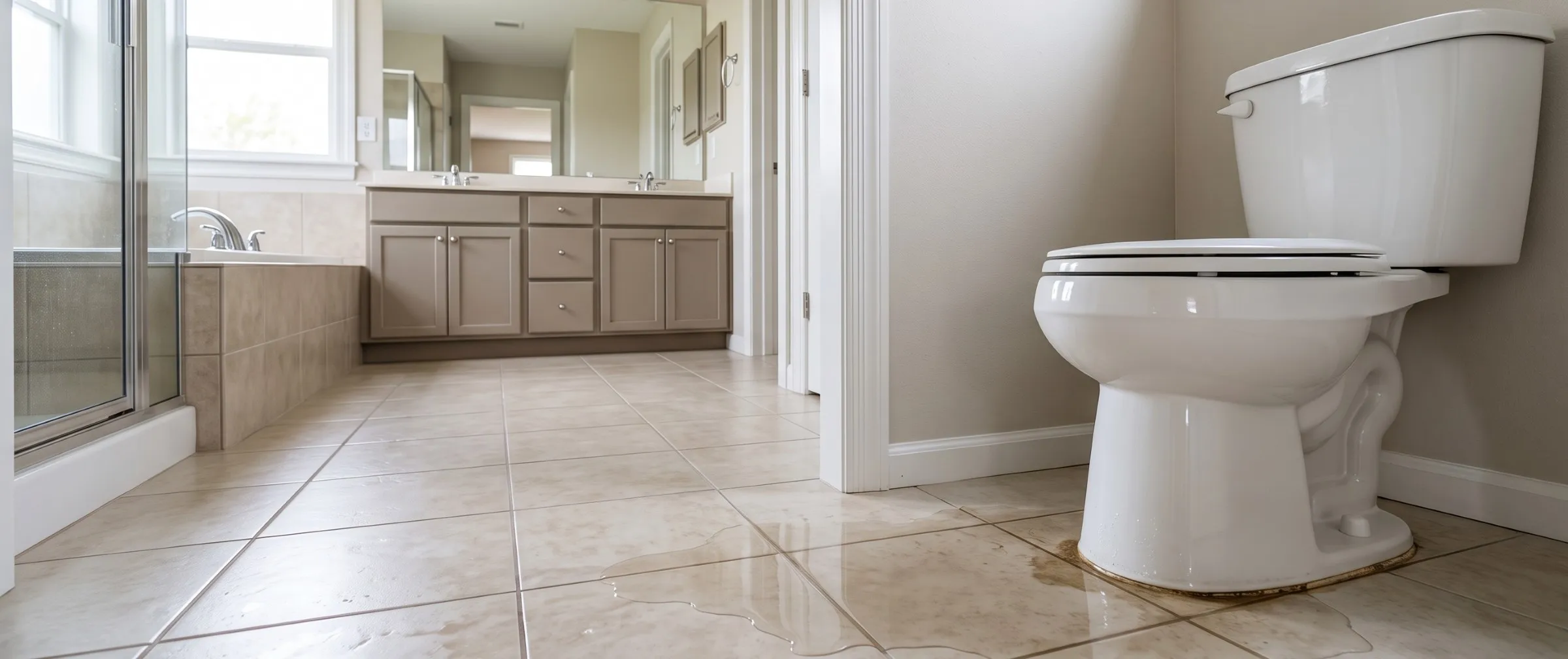

A toilet overflowing onto the bathroom floor is one of the more common home plumbing emergencies, and it's also one of the more confusing ones, since the exact same fixture can push out perfectly clean water or genuine waste depending on what caused it. Stopping the water and identifying which kind you're dealing with both come before anything else, since one determines how urgent the cleanup is and the other determines how far you can safely go without a professional.
Water damage restoration follows the ANSI/IICRC S500 standard, which classifies water by contamination level rather than by which fixture it came from. That distinction matters more for a toilet overflow than for almost any other cause of water damage, since the same fixture can produce water that's perfectly clean or genuinely hazardous depending on what triggered the overflow.
Key insights
- Not all overflow water is equal. A stuck fill valve produces clean, Category 1 water under IICRC S500, while urine or waste in the bowl makes it Category 2 or 3.
- The clock matters. Clean overflow water left standing can degrade toward Category 2 within 24 to 48 hours, per the EPA's guidance on mold risk after water intrusion.
- Cost ranges widely. A caught-early overflow on tile runs $150 to $500, while one that reaches carpet, subfloor, or a ceiling below can run $1,500 to $7,000 or more.
- A single overflow usually isn't a sewage backup. One clogged toilet is a local, contained event; water backing up into multiple fixtures at once points to the main sewer line instead.
- Insurance usually covers a one-time accident, not a known problem. A sudden clog is typically covered; a slow tank leak or a chronic clog you ignored usually isn't.
- Carpet is the material least likely to survive. Tile and vinyl can often be dried in place, but carpet and padding exposed to contaminated water for more than a few hours are rarely worth keeping.
What to do right now
Stop the water at the supply valve behind the toilet before doing anything else, since a valve you can reach in five seconds beats a mop that only buys you a few minutes. A toilet overflow that's still rising, has reached an outlet, or is spreading into more than one room has moved past routine territory into emergency water damage, where calling for help takes priority over anything else.
 Shutting off the supply valve stops the overflow at its source, faster than any towel or mop can contain the spread.
1. Stop the water at the source
Reach behind the toilet and turn the supply valve clockwise until it stops, or lift the float inside the tank if the valve is hard to reach.
2. Keep people and pets out of the area
Treat any standing water as contaminated until you've confirmed otherwise, and don't let children or pets walk through it.
3. Contain and remove standing water
Use old towels, a wet/dry shop vacuum rated for liquids, or a mop to pull water away from baseboards and adjoining rooms before it spreads further.
4. Photograph the damage before cleaning
Take wide shots of the room and close-ups of the water line on cabinets, baseboards, and flooring for your records and any insurance claim.
5. Start airflow and call for help if needed
Run a fan and open a window if the bathroom has one. Call a plumber for the clog itself, and bring in a certified water damage restoration company if the water reached carpet, drywall, or a room beyond the bathroom.
What not to do
A few common reactions to a toilet overflow make the damage worse rather than better, since they either add more water to the floor or spread contamination further than the original overflow did. Repeated flushing is the most common mistake and also one of the most damaging, since each additional flush adds roughly another gallon and a half straight onto the floor.
Don't keep flushing to force it down
Each additional flush adds more water to an already overflowing bowl and pushes contaminated water further across the floor.
Don't use a household vacuum
A standard vacuum isn't built for liquids and can short out or spread contaminated water through its exhaust.
Don't touch standing water with bare skin
Wear gloves and, if the water contains waste, boots, since Category 2 and 3 water can carry bacteria that enter through a cut or broken skin.
Don't ignore an outlet near the water
Cut power to any outlet the water reached before touching it, following OSHA's flood response protocol on electrical shock hazard around standing water.
Clean or contaminated overflow water
Toilet overflow water falls into one of three water damage categories depending on what caused it, and the category determines how the water gets treated. Water from a malfunctioning fill valve or a cracked tank is Category 1 clean water. Water from a bowl clog that pushed up urine-only water is Category 2. Water containing fecal matter, toilet paper residue from below the trap, or a backup from the building's drain line is Category 3.
 Color alone does not reliably indicate contamination level, which is why IICRC S500 classifies overflow water by its source rather than its appearance.
How much water actually ends up on the floor depends on the toilet itself as much as the cause. A standard low-flow toilet holds about 1.6 gallons per flush, while an older tank can hold 3 to 5 gallons, so the same clog produces a far larger spill in an older home than in one with newer fixtures.
| Source | IICRC category | Cleanup urgency | Materials at risk |
|---|---|---|---|
| Stuck fill valve or tank crack | Category 1 (clean) | Dry within 24–48 hours to prevent it degrading | Flooring finish, cabinet base if left standing |
| Bowl clog, urine only | Category 2 (gray) | Extract and disinfect within hours | Porous flooring, grout, baseboards |
| Fecal matter or drain backup | Category 3 (black) | Treat as a biohazard immediately | Carpet, drywall below the flood cut line, subfloor |
A single flush that overflows because the bowl was clogged with waste and paper is almost always Category 2 at minimum, since it's carrying whatever was in the bowl at the time. The clean-water scenario is narrower than most homeowners assume: it only applies when the overflow comes from the tank itself, before anything has been flushed, or from a supply line connection rather than the bowl.
Health risks of contaminated water
Contaminated toilet overflow water can carry bacteria, viruses, and parasites capable of causing real illness, which is why Category 2 and 3 water gets treated as a health hazard rather than just a cleanup job. Organisms including E. coli, Salmonella, and hepatitis A can be present in water that's come into contact with waste, and exposure happens through direct skin contact, an open cut, or inhaling aerosolized particles kicked up during cleanup.
Children, older adults, and anyone with a compromised immune system face the highest risk from this kind of exposure, according to CDC guidance on cleaning safely after a disaster involving contaminated water. Keep them out of the affected room until the area has been extracted, disinfected, and dried, a standard that applies with even more urgency when the water source turns out to be a full sewage backup rather than a single toilet overflow.
What causes a toilet to overflow
Most toilet overflows trace back to a blockage somewhere between the bowl and the main sewer line, though a tank malfunction can produce an overflow with no clog at all. A working toilet moves waste through gravity and a controlled amount of water, so anything that disrupts either the flow path or the water supply can push the bowl past its capacity.
 A flapper that fails to seal lets the fill valve run continuously, which is one of the few overflow causes that produces clean, Category 1 water rather than contaminated water.
Some causes point to a problem inside the bathroom, like a stuck flapper, while others point to a problem in the plumbing system that extends well beyond the toilet itself, like a blocked vent stack or a sewer line issue. That distinction is worth confirming early, since a plumber who only checks the bowl can miss a blockage further down the line that keeps causing the same overflow.
| Cause | What's happening | Typical water type |
|---|---|---|
| Clogged drain or trap | An object, excess paper, or waste blocks the trap below the bowl | Category 2–3 |
| Stuck-open fill valve or flapper | The tank keeps refilling and overflows past the tank lid or bowl rim | Category 1 |
| Blocked vent stack | Trapped air pressure pushes water and waste back up instead of draining | Category 2–3 |
| Sewer line blockage or backup | The main line is obstructed, so water has nowhere to go but back up | Category 3 |
| Tree root intrusion in the lateral line | Roots grow into the underground pipe and slow or stop the flow | Category 3 |
| Overloaded or failing septic system | The tank or drain field can't absorb any more water | Category 3 |
A blocked vent stack is the cause homeowners are least likely to recognize, since the symptom (a toilet that gurgles or overflows on flush) looks identical to a simple clog. The difference shows up when plunging clears the bowl but the overflow happens again on the next flush, which points to a pressure problem further down the line rather than an obstruction in the bowl itself.
If the toilet keeps overflowing
A toilet that overflows once from a clog you can identify and clear is a contained, one-time event. A toilet that overflows repeatedly, especially if a sink or shower drain in the same bathroom starts backing up at the same time, is a different problem entirely.
Recurring overflow across multiple fixtures usually means the blockage sits in the main line rather than in the toilet itself, and that's the point where a sewage backup rather than a simple overflow is the more accurate description of what's happening. A plumber with a drain camera can usually tell within a single visit whether the problem stops at the toilet or extends further into the line, and that distinction changes both the repair and, in some cases, the insurance coverage that applies.
Where the water travels
Toilet overflow water spreads outward across the bathroom floor first, then follows the same path any other water damage does once it reaches an edge. It wicks under the toilet base and vanity toe kick, seeps through grout lines and any gap in the flooring, and travels under a threshold into a hallway or bedroom if the bathroom door was open.
If the bathroom sits on a floor above the ground level, water heavy enough to soak through the subfloor can stain the ceiling in the room below within a few hours. A bathroom on a concrete slab behaves differently, since water tends to pool on the surface rather than wicking downward, which buys more time for extraction but doesn't eliminate the risk to nearby drywall and cabinetry.
Discovering an overflow after the fact
A toilet overflow you don't discover until hours or days later, after returning from a trip or noticing a stain, needs to be treated as more contaminated and more urgent than one caught in the moment. Time is the deciding factor: water that's been sitting for more than a day or two has likely already started to degrade, and materials that soaked longer are less likely to be salvageable.
A musty smell, a stain that's already dry around the edges, or other signs of water damage near the toilet are what point to a delayed discovery rather than a fresh event. In that scenario, treat the water as contaminated by default rather than assuming it's still Category 1, and call a restoration company for an assessment rather than trying to gauge dryness by touch alone.
Materials and cleanup
What gets removed versus dried in place depends on the material and how long it sat wet. Hard, non-porous surfaces like tile, vinyl, and sealed grout can typically be cleaned, disinfected, and dried without removal. Porous materials that absorbed contaminated water are a different story.
 Drywall along the baseboard can wick water several inches above the visible line even when the surface paint looks dry, which is why a moisture meter reading matters more than a visual check.
The type of water matters as much as the material, since carpet exposed to clean tank water for twenty minutes has a real chance of survival, while the same carpet exposed to contaminated water for the same amount of time usually doesn't. Vinyl and laminate flooring sit in between: both resist water better than carpet, but a seam that's sat in contaminated water for several hours is still a candidate for replacement rather than disinfection.
| Material | Clean water (Category 1) | Contaminated water (Category 2–3) |
|---|---|---|
| Tile and grout | Wipe, dry, no removal needed | Disinfect surface; check for gaps letting water reach the subfloor |
| Vinyl or laminate flooring | Dry in place if caught quickly | Lift and inspect the subfloor underneath |
| Carpet and padding | Extract and dry within 24 hours | Padding removed; carpet often removed if soaked more than a few hours |
| Cabinet base or vanity toe kick | Dry with airflow | Remove swollen toe kick; check inside cabinet for wicking |
| Drywall | Dry in place if caught within 24–48 hours | Cut and remove drywall below the waterline |
Tile and grout that let contaminated water reach the subfloor underneath need the subfloor checked separately, since a dry-looking tile surface doesn't confirm the plywood or OSB beneath it is dry too. The same applies to drywall along the baseboard, which can wick water several inches above the visible waterline even when the surface paint looks untouched.
The 24 to 48 hour window matters here because it's the point the EPA cites for mold risk to begin in sustained moisture, a timeline the CDC also ties to the fastest mold growth in damp materials. It's also roughly the window a health department or restoration company will use to decide whether porous material is still worth saving.
How to disinfect after a toilet overflow
Disinfecting after a toilet overflow means treating every surface the water touched, not just the spot that's still visibly wet, since bacteria can linger on a surface well after it looks dry. Extraction has to come first, since scrubbing a surface that's still sitting in contaminated water just spreads it further rather than removing it.
 Most disinfectants need several minutes of contact time to kill bacteria and viruses, so wiping the surface immediately after spraying undoes the point of applying it.
Use an EPA-registered disinfectant, not just soap and water
A general household cleaner removes grime but isn't formulated to kill the bacteria and viruses in contaminated water; a bleach solution of about 1 cup of bleach per gallon of water is the standard fallback if a registered disinfectant isn't on hand.
Disinfect beyond the visible waterline
Wipe down baseboards, the toilet base, and the underside of the vanity even where the surface looks dry, since splashing travels further than the puddle does.
Let the disinfectant sit before rinsing
Most products need several minutes of contact time to actually kill pathogens, so wiping it off immediately undoes the point of applying it.
Dispose of anything that can't be fully disinfected
Porous items like a bath mat or toilet paper that contacted the water should be bagged and thrown out rather than washed and reused.
For anything beyond a light Category 2 overflow, professional-grade disinfection reaches materials and cavities that a household product can't, which is one of the reasons DIY cleanup has real limits once contamination is confirmed. If you're handling a smaller, contained overflow yourself, the DIY water damage cleanup sequence covers the disinfectant dwell times and general technique that apply beyond just a toilet.
DIY vs professional cleanup
A toilet overflow is one of the more common causes of bathroom water damage, and one a homeowner can often handle alone, provided the water is clean and the area is small. The line moves quickly once contamination or spread enters the picture.
 A mop and bucket are enough for a small, contained spill of clean water, but they are not appropriate for water carrying waste, which needs extraction equipment and disinfection rather than a mop.
Confidence in classifying the water source matters more here than confidence with a mop, since a homeowner who wrongly assumes the water was clean can end up scrubbing contaminated water into flooring rather than removing it. When in doubt, treating the water as contaminated is the safer default.
| Factor | DIY-appropriate | Call a professional |
|---|---|---|
| Water source | Tank leak or fill valve, no waste | Bowl clog, backup, or unknown source |
| Area affected | Bathroom floor only | Carpet, hallway, or adjoining bedroom |
| Materials involved | Tile, vinyl, sealed surfaces | Carpet, drywall, subfloor, cabinetry |
| Confirmed dryness | Visibly dry within a day, no odor | Musty smell or a moisture reading above 17% after drying |
If more than one row in the "call a professional" column applies, that's a strong sign the job has moved past a simple mop-and-dry situation into one where a certified technician's water extraction equipment and antimicrobial treatment protect against a problem that isn't visible yet. Even a single failed row, like a musty smell that shows up two days later, is worth a professional moisture check before considering the job finished.
Who to call
A plumber and a water damage restoration company solve two different problems, and a toilet overflow often needs both at once rather than one or the other. The plumber addresses the clog, the failed valve, or the line blockage that caused the overflow in the first place. The restoration company addresses the water that already escaped, extracting it from flooring and materials before it causes secondary damage.
Call both at the same time rather than waiting for the plumber to finish first, since every hour the water sits is an hour closer to the point where carpet or drywall stops being salvageable. When vetting a restoration company for a contaminated overflow specifically, confirm they carry IICRC certification and have handled Category 2 or 3 water before, since the disinfection protocol differs meaningfully from a clean-water job.
Cost of toilet overflow cleanup
Toilet overflow cleanup costs $150 to $7,000 or more, with the total driven almost entirely by two factors: how far the water spread and whether it was contaminated. A same-day, contained overflow on a hard floor sits at the low end; one that reaches carpet, a subfloor, or a ceiling below climbs quickly.
 Labor for disinfection and material removal, not the materials themselves, is usually the largest line item on a contaminated-water estimate.
Contaminated water usually costs more to clean up than clean water even when the visible spread looks identical, since Category 2 and 3 water require disinfection and, in many cases, removal of porous materials rather than simple drying. A plumber's bill for clearing the clog is also typically separate from the restoration company's invoice for the water damage, so a single overflow can show up as two distinct charges rather than one combined estimate.
| Scenario | Typical cost | What drives it |
|---|---|---|
| Caught immediately, tile or vinyl only | $150–$500 | Mop-up and drying, no material removal |
| Bathroom floor soaked, no subfloor damage | $300–$1,500 | Extraction, disinfection, drying equipment |
| Carpet in an adjoining room, padding replaced | $500–$3,000 | Carpet/padding removal and disposal, drying |
| Subfloor or drywall affected | $1,500–$7,000 | Material removal, antimicrobial treatment, rebuild |
| Multi-room spread or ceiling below | $3,000–$15,000+ | Extended drying, structural repair, ceiling repair |
Labor, not materials, is usually the biggest line item on a contaminated-water job, since the disposal and disinfection protocol for Category 3 water takes considerably longer than a comparable clean-water job. Homeowners comparing an estimate against a general benchmark can check it against water damage restoration cost per square foot figures for the affected square footage, though a small bathroom job will often carry a minimum service charge that a per-square-foot rate doesn't capture well.
Insurance coverage
Most homeowners insurance policies cover toilet overflow damage when the event was sudden and accidental, which is the standard insurers apply under a typical HO-3 policy, per NAIC consumer guidance on how homeowners coverage works. A one-time clog that caused an unexpected overflow generally qualifies. A slow tank leak you knew about for months, or a toilet that's clogged repeatedly without being fixed, generally doesn't, since insurers treat both as a maintenance failure rather than a sudden loss.
A true sewage backup from the main line is treated differently still, and that scenario is commonly excluded from a standard policy unless you carry a separate water backup endorsement. Review your policy's homeowners coverage before assuming a repeat overflow is covered.
Put together thorough documentation of the water line, the timeline, and the plumber's invoice, since that's what separates a sudden accident from a known, unaddressed problem in an adjuster's eyes. Insurers weigh how quickly you documented and reported the loss almost as heavily as the loss itself, so this step often matters more to the outcome than the size of the estimate.
Renters and condos
In most states, a landlord is responsible for a toilet overflow caused by a mechanical failure, a worn part, or a plumbing defect, while a tenant is typically responsible for one caused by something flushed down the toilet. The specifics vary enough by state that it's worth checking how these situations are typically handled where you live.
The situation gets more complicated for condo owners. When a toilet on an upper floor overflows into the unit below, the responsibility for water damage in a condo usually splits between the unit owner's HO-6 policy and the association's master policy, depending on exactly where the damage lands.
Prevention
Most toilet overflow prevention comes down to controlling what goes into the bowl and catching a slow-draining toilet before it becomes a full clog. These habits take only a few minutes each and don't require any special tools or professional help.
 Replacing a flapper at the first sign of wear costs little and prevents the continuous-run overflow that a fully failed flapper eventually causes.
Avoid flushing wipes, paper towels, or feminine products
These materials don't break down the way toilet paper does and are one of the most common causes of a downstream clog.
Don't hold the handle down on a slow flush
Holding the handle sends more water into a system that's already struggling to drain, which is what turns a slow flush into an overflow.
Know where the shutoff valve is before you need it
A valve you've located ahead of time saves the ten or fifteen seconds that separate a small puddle from a soaked floor.
Replace an old flapper or fill valve at the first sign of trouble
A flapper or fill valve that's starting to stick is a cheap fix now and a Category 1 overflow later if it fails completely.
Address a recurring clog with a plumber's snake, not repeated flushing
A toilet that clogs more than once every few months has an underlying blockage that a plunger alone won't clear, and a professional snake or camera inspection is worth the cost before it turns into a full backup.
Frequently asked questions
Is toilet overflow water considered black water?
Sometimes. Water from a stuck fill valve or a tank leak is clean, Category 1 water under IICRC S500. An overflow that carries urine or waste is Category 2 or Category 3, and only fecal contamination or a backup from the sewer line counts as true black water.
How much does it cost to clean up a toilet overflow?
Most toilet overflows cost $150 to $1,500 to clean up when the water stays on tile or vinyl and is caught the same day. Cost climbs to $1,500 to $7,000 or more once carpet, subfloor, drywall, or a ceiling below the bathroom is involved.
Does homeowners insurance cover toilet overflow damage?
Usually, if the overflow was sudden and accidental, such as a one-time clog or a mechanical failure you didn't know about. Insurers typically deny claims tied to a known, ignored clog or a slow tank leak left unaddressed for months, so it's worth reviewing your homeowners insurance coverage for water damage before assuming a repeat overflow is included.
Can toilet overflow water cause mold?
Yes, within 24 to 48 hours of the area staying wet, according to the EPA. Fast extraction and drying, not just mopping up the visible puddle, is what actually prevents mold from starting in the subfloor or baseboards.
Should I remove the carpet after a toilet overflow?
It depends on the water source and how long it soaked. Carpet exposed to clean tank water for a short time can often be extracted and dried, but carpet and padding exposed to urine or waste for more than a few hours are rarely worth saving.
What do I do if the toilet keeps overflowing after I plunge it?
Stop flushing and shut off the water at the supply valve. A toilet that overflows repeatedly even after plunging usually points to a blockage further down the line, such as a clogged vent stack or a sewer line problem, which needs a plumber with a drain snake or camera rather than another attempt with the plunger.
Is toilet overflow water damage the same as a sewage backup?
Not always. A single toilet overflowing from its own clog is a contained, local event. A sewage backup means waste water is pushing up from the main line into multiple fixtures at once, which is a larger contamination event with its own cleanup protocol.
Who is responsible if a toilet overflows in a rental?
It depends on the cause. A landlord is typically responsible for a toilet that overflowed due to a mechanical failure or a plumbing defect, while a tenant is usually responsible for one caused by something flushed down the toilet, and photos taken right after the overflow are often what settles which side that argument lands on. State law on water damage in a rental varies enough that it's worth confirming the specifics for where you live.
Can I clean up toilet overflow water myself?
Yes, if the water came from the tank or a single flush with no waste, the area is small, and you can dry it within a day. Any overflow containing waste, or water that reached carpet, drywall, or an outlet, is a job for a restoration company.
How long does it take to dry out a bathroom after a toilet overflow?
A hard-surface bathroom floor typically dries in one to three days with fans and a dehumidifier running. Drying extends to five days or longer if water reached carpet, the subfloor, or a wall cavity.
Is toilet overflow water safe to touch once it's dried?
Not necessarily. Dried residue from contaminated water can still harbor bacteria, so any surface that touched Category 2 or 3 water should be disinfected even after it looks and feels dry, not just wiped down.
What if the overflow reached an electrical outlet?
Cut power to that circuit at the breaker before touching anything near it, and have an electrician inspect the outlet before using it again. Water and corrosion inside an outlet can create a shock or fire risk even after the area looks dry.
How do I get rid of the smell after a toilet overflow?
Confirm the area is fully dry first, since a lingering smell usually means moisture is still trapped somewhere rather than an odor problem on its own. Once everything is dry, an enzymatic cleaner or a diluted disinfectant on hard surfaces typically clears the smell within a day or two.
Sam Hickerson is the founder of RestoreAdvisor and writes consumer guides on mold remediation, water damage restoration, inspection, testing, and home recovery. His work focuses on helping homeowners understand costs, risks, and when to call a professional. He draws on guidance from the EPA, CDC, IICRC, and other authoritative sources to make complex home issues easier to navigate.