
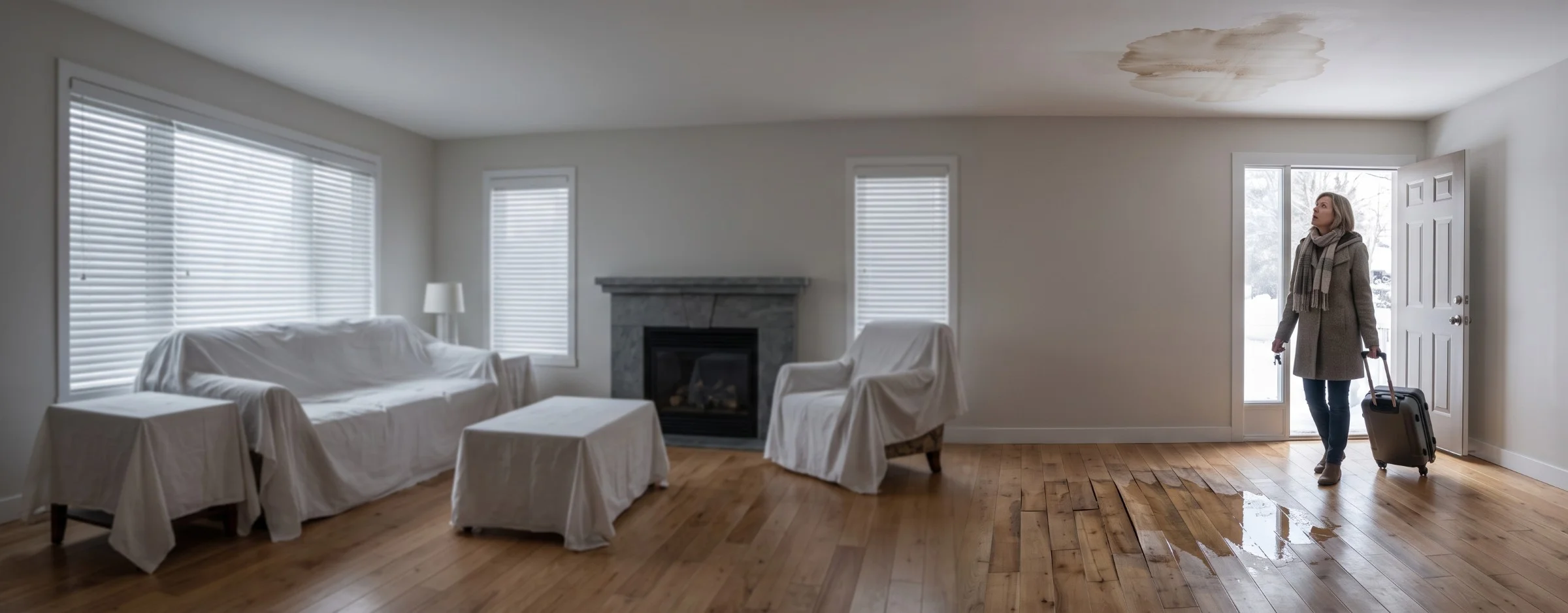

Walking into a second home, a house you've listed for sale, or a late parent's property and finding soaked carpet or a stained ceiling is a hard moment, made worse by not knowing how long the water has been running. The damage can be repaired, and you need three things right now: a safe way to stop it, a record that protects your claim, and a clear read on whether the vacancy clause in your policy applies.
Vacant home water damage is water intrusion in a property no one is living in, and because nobody is there to shut off the source, it usually runs longer and reaches a higher damage class under ANSI/IICRC S500, the standard that governs water damage restoration, than the same leak in an occupied home. The Insurance Information Institute reports that about one in 60 insured homes has a water damage or freezing claim each year, and it identifies water damage as one of the most common and expensive problems in unoccupied homes. A vacancy doesn't automatically void coverage, though, and whether the claim gets paid often turns on details you can still document today, such as whether furniture was in the home, whether the heat was on, and how long it had been since anyone visited.
Key insights
- Stop the water, then document. Shut off the main valve first, then photograph everything before cleaning, including the thermostat, the furniture in place, and which utilities are on, since those details decide how an insurer classifies the home.
- The 60 day clock. The standard HO-3 policy stops covering vandalism and building glass breakage once a dwelling has been vacant for more than 60 consecutive days, and many carriers restrict water and freeze losses on a similar clock.
- Vacant is not unoccupied. Insurers treat a vacant home, with no people and no furnishings, more strictly than an unoccupied one that is still furnished, has utilities on, and has an owner who plans to return.
- Freeze damage needs proof of care. A standard HO-3 excludes freeze damage to plumbing unless the owner used reasonable care to keep the heat on or shut off the water and drain the system.
- Time drives the cost. The Insurance Information Institute puts burst pipe repairs in an unoccupied home at $10,000–$70,000 or more, depending on how long the leak goes unnoticed.
- Visits plus sensors. A weekly visit combined with a leak sensor or an automatic shutoff valve shortens the gap between a failure and someone stopping it, and that gap controls the size of the loss.
What to do when you find water damage
When you find water damage in a home that has been empty, shut off the main water supply, confirm the space is safe, and document the scene before you clean or move anything. Those actions stop the loss from growing and preserve the evidence an insurer uses to decide whether the vacancy clause applies.
 A timestamped photo of the thermostat taken before anything is touched is evidence the heat was maintained, which a standard HO-3 policy requires for freeze damage in an empty home to be covered.
The order matters more here than in an occupied home, because the photos you take before anything moves are the only record of how the home looked while no one was there. Work through these steps in sequence, even if the damage looks minor.
1. Check for hazards before you walk in
Look for a sagging or bulging ceiling, standing water near outlets or appliances, and any smell of gas before stepping inside. If water has reached outlets or the electrical panel, or a ceiling is visibly bowing, stay out and call the utility company and a crew that handles emergency water damage restoration rather than wading in.
2. Shut off the main water valve
Close the main shutoff, usually where the water line enters the house or at the meter box near the street, then open a low faucet to drain the remaining pressure. Turn off power or gas to the water heater too, since a tank that has lost water can burn out its heating element if the power stays on.
3. Photograph the home exactly as you found it
Take wide shots and close-ups of every affected room, plus the thermostat reading, the furniture and belongings in place, and any open or broken window. Those extra shots go beyond standard documenting water damage for insurance because they establish whether the home was vacant or unoccupied, one of the first things an adjuster assesses.
4. Trace the source if you safely can
Common origins in an empty home are a failed toilet or sink supply line, a leaking water heater, a frozen pipe along an exterior wall, and a roof leak above the attic. Note what you find without taking anything apart, because the failed part is evidence of whether the loss was sudden or a slow leak.
5. Report the loss to your insurer the same day
Give the insurer the facts you know: when you last visited, whether heat and power were on, and when you found the damage. If you don't know how long the water ran, say so rather than guessing, and ask the water utility for daily usage history, since many meters can show the day flow spiked.
6. Get extraction and drying started
Call a restoration company for extraction and structural drying rather than waiting for the adjuster, since standard policies require you to take reasonable steps to prevent further damage. Water that sat for more than a day or two has usually wicked into drywall, subfloor, and insulation, so expect some materials to be removed rather than dried in place.
What not to do after finding the damage
The most damaging mistakes after finding water damage in an empty home are turning the water back on to find the leak, throwing out damaged items before they're photographed, making permanent repairs before the adjuster inspects, and misstating how long the home sat empty. Each of these mistakes either makes the damage worse or gives an insurer a reason to reduce the claim.
 Water behind a stained wall is often still spreading inside the wall cavity, so the main valve should stay closed until a plumber isolates the failed line and pressure tests the system.
Don't turn the water back on to find the leak
Restoring pressure to locate a failed fitting or a burst pipe sends more water into walls and ceilings that are already saturated. Leave the valve closed and let a plumber pressure test the lines once the standing water is gone.
Don't throw anything away yet
Damaged carpet, furniture, and belongings are part of the claim, and an adjuster may want to see them. Photograph and list each item before it goes to the curb, and keep a sample of flooring or carpet if the pile is large.
Don't make permanent repairs before the adjuster sees it
Temporary protective steps such as tarping a roof, boarding a broken window, or running drying equipment are expected, and the receipts are usually reimbursed. Replacing drywall or flooring before the inspection removes the evidence the adjuster needs to price the loss.
Don't describe the home inaccurately
Calling a home occupied when no one was living in it, or understating how long it sat empty, can void the entire claim for misrepresentation rather than just the vacancy portion. Give the insurer the real dates, even the ones that don't help your case.
Don't crank the heat to dry it out
Raising the temperature in a closed, wet house speeds mold growth rather than drying the structure. Drying needs air movement and dehumidification, which is what restoration equipment provides.
Is vacant home water damage covered?
Homeowners insurance usually covers sudden water damage in a home that is temporarily empty, but coverage narrows once the home counts as vacant under the policy, typically after 30–60 consecutive days. The standard HO-3 form published by ISO (Insurance Services Office) stops paying for vandalism and building glass breakage after 60 consecutive days of vacancy, excludes freeze damage to plumbing unless heat was maintained or the system was shut off and drained, and many carriers add their own vacancy limits on water losses.
 The vacancy clock counts consecutive days with no one living in the home, so a furnished home whose owner plans to return is often treated as unoccupied and may not trigger these limits at all.
The Insurance Information Institute notes that even policies written for vacant homes still generally cover sudden events such as a pipe bursting in a freeze, but insurers typically require proof that the owner took reasonable steps to maintain the property. A home with an automatic fire sprinkler system carries an extra condition on a standard HO-3: the owner is expected to keep both the water supply and the heat on for freeze coverage to apply.
| Situation | Classification | Coverage outcome |
|---|---|---|
| Supply line bursts, home furnished, owner visits every two weeks | Unoccupied | Generally covered as a sudden loss |
| Pipe freezes after the furnace fails, thermostat was set at 55°F | Unoccupied or vacant | Often covered if the owner can show heat was maintained and monitored |
| Pipe freezes, heat was off and water was left on | Unoccupied or vacant | Freeze exclusion usually applies |
| Emptied estate home, water left on, leak found after 90 days | Vacant beyond 60 days | High risk of denial or limits under the vacancy clause |
| Toilet fill valve leaked slowly for several months | Any | Excluded as gradual damage |
| Home covered by a vacancy permit or vacant home policy | Vacant, disclosed to insurer | Covered under the endorsement or policy terms |
These vacancy rules sit on top of the ordinary requirement that a loss be sudden and accidental, the same test that decides whether homeowners insurance covers water damage in an occupied home. A supply line that bursts overnight is sudden no matter who lives there, while a slow drip that rotted a subfloor over months is excluded as gradual damage, and an empty home makes the second outcome more likely because no one is there to notice the drip.
Vacant vs. unoccupied homes
A vacant home is one with no one living in it and none of the furnishings or belongings needed for normal living, while an unoccupied home still has furniture, working utilities, and an owner who plans to return. Insurers apply vacancy clauses to vacant homes, so a furnished seasonal home that sits empty for three months is usually treated more favorably than an emptied house listed for sale.
 A home emptied of furniture and belongings is usually classified as vacant rather than unoccupied, and the 60 day vacancy count on a standard HO-3 policy generally starts once the last occupant moves out.
Policy language controls, and court decisions interpreting these terms have not been uniform, so the definitions in your own policy's conditions section matter more than any general rule. Some policies define vacancy by the absence of people alone, and some use a 30 day threshold instead of 60.
| Status | What it looks like | Policy treatment |
|---|---|---|
| Occupied | Someone lives in the home day to day | Full policy terms apply |
| Unoccupied | Furnished, utilities on, owner away but returning | Usually full terms, though the freeze condition still applies |
| Vacant | Emptied of people and most belongings | Vacancy clause limits apply after 30–60 consecutive days |
| Under construction | Contractors working, no one living there | Not considered vacant under the standard HO-3 wording |
The evidence that supports an unoccupied classification is ordinary but easy to lose: furniture and clothing in place, utility accounts in your name with ongoing usage, mail forwarding or delivery holds, and a record of regular visits. Keeping basic furnishings and active utility accounts in place is the simplest way to hold that classification through a long absence.
How to prove you took reasonable care
Proving reasonable care, the standard the HO-3 freeze exclusion applies, means showing the insurer, with dated records, that the heat was on or the water was shut off and drained, and that someone checked the home at regular intervals. Without them, a freeze loss in an empty home is easy for an insurer to deny.
 These records carry the most weight when they show a pattern, such as steady gas usage through the whole absence or visit dates spaced no more than a week apart, rather than a single entry.
Adjusters give the most weight to evidence created before the loss, and the same records anchor an appeal of a denied water damage insurance claim if the insurer rejects it on vacancy grounds. Gather these records now, before the adjuster asks, because some app histories and utility portals only keep data for a limited time.
Utility bills showing continuous use
Gas or electric bills with steady usage through the absence show the heating system was running. A sharp drop in usage partway through can also pin down when the furnace or power failed.
Smart thermostat history
Many connected thermostats log indoor temperature by the hour and send an alert when it drops. A screenshot of that history is some of the strongest evidence that heat was maintained up to the failure.
A dated visit log
A simple log with the date, the name of the person who checked the home, and a few photos from each visit shows regular monitoring. Text messages from a neighbor or caretaker after each visit serve the same purpose.
Winterization and service invoices
An invoice from a plumber who drained the lines, or from an HVAC contractor who serviced the furnace before the season, is independent proof of the steps you took. Keep the copy that shows the service date and the technician's notes on what was drained or adjusted.
Sensor and shutoff valve records
Leak sensors and automatic shutoff valves keep an event history in their apps. That record shows when water was first detected and when the valve closed, which helps establish both the start of the loss and your response to it.
If an insurer still denies the claim on vacancy grounds, lead the appeal with these records and a written, point by point response to the reason cited in the denial letter. Send copies rather than originals, and keep a log of every call with the insurer from the day of the loss forward.
What vacant home water damage costs
Vacant home water damage typically costs $3,000–$45,000 to restore, based on RestoreAdvisor estimates drawn from Triple-I claim data and national restoration pricing, and the biggest factor is how long the water ran before someone found it. The Insurance Information Institute puts the most expensive common case, a burst pipe in an unoccupied home, at $10,000–$70,000 or more, depending on how long the leak goes unnoticed.
 Flood cuts, full carpet and pad removal, and several days of structural drying are typical once water has sat for weeks, and that added scope is what pushes a vacant home loss from a few thousand dollars into five figures.
Longer exposure changes what the job includes as well as how many rooms it covers. After a day, drying equipment can save most drywall and flooring; after a week, restoration usually means flood cuts, subfloor replacement, and mold remediation billed as a separate line item, and that added scope is what pushes a vacant home loss well past the typical water damage restoration cost for an occupied home.
| When found | Typical scope | Typical cost |
|---|---|---|
| Within 24 hours, from a sensor alert or visit | Extraction and drying, minor trim or carpet pad replacement | $500–$3,000 |
| 2–7 days | Drying plus removal of lower drywall, padding, and some flooring | $3,000–$15,000 |
| 1–4 weeks | Several rooms, subfloor and cabinet replacement, likely mold remediation | $15,000–$45,000 |
| A month or longer | Structural drying, framing and ceiling repair, full mold remediation, contents losses | $40,000–$100,000+ |
Contaminated water from a sewer backup or storm flooding costs more at every stage of discovery, because porous materials have to be removed rather than dried. The gap is widest on carpet pad, drywall, and insulation, which can often be dried after a clean water leak but are removed after a sewage or floodwater loss no matter how quickly it's found.
Mold risk after a long vacancy
Mold is likely whenever water sits in an empty home for more than a couple of days, since the EPA advises that wet materials not dried within 24–48 hours can begin to grow mold. A leak discovered after a two week absence usually needs mold remediation alongside drying and repair.
Anyone with asthma, allergies, or a weakened immune system should stay out of a home with visible growth or a heavy musty smell, since the CDC identifies these groups as more sensitive to mold exposure. Many homeowners policies also cap mold coverage with a separate sublimit, often in the $1,000–$10,000 range, so the mold portion of a vacant home claim may pay less than the water portion.
Drywall, carpet pad, and insulation that stayed wet for weeks are usually removed rather than cleaned, and the timeline for mold after water damage depends on the material and the indoor temperature while the home sat closed. Hard surfaces such as tile, metal, and sealed wood can usually be cleaned and kept.
Why damage is worse in an empty home
Water damage in an empty home is larger mainly because of time: a leak that an occupant would notice in minutes can run for days or weeks. IBHS estimates that a crack of about 1/8 inch in a supply pipe can release up to 250 gallons of water a day, which adds up to 3,500 gallons over a two week absence.
 IBHS estimates a crack about 1/8 inch wide in a supply pipe can release up to 250 gallons a day, so a leak that starts right after the owner leaves can run for the entire absence.
The sources are the same ones found in any house, but several become more likely when nobody is home. A furnace can shut down with no one to notice the temperature dropping, and frozen pipes along exterior walls are often the first result, while rubber supply hoses on toilets and washers hold full line pressure the entire time the water is left on.
| Water source | Why it's riskier | Where to look |
|---|---|---|
| Frozen pipe | Heat fails or is set too low with no one there to notice | Exterior walls, crawl spaces, sink cabinets |
| Toilet or sink supply line | Constant pressure, and no one hears running water | Bathroom floor, ceiling of the room below |
| Water heater | A corroding tank leaks without anyone checking the base | Utility closet, garage, basement |
| Roof leak or ice dam | Storms and snowmelt go unobserved for weeks | Attic, top floor ceilings |
| Sump pump failure | A storm outage stops the pump with no one to run a backup | Basement floor and walls |
| HVAC condensate overflow | AC left running for humidity control with a clogged drain line | Ceilings under attic air handlers, closets |
| Washing machine or ice maker line | Lines left pressurized between visits | Laundry room, kitchen flooring |
A water heater leak often starts as a slow drip from a corroded tank and becomes a steady flow once the tank wall fails, which is why adjusters on an empty home claim usually ask how old the unit was. A tank more than 10 years old that failed during a long absence is more likely to be argued as wear and tear than a newer unit that ruptured without warning.
Empty homes also attract theft, and the Insurance Information Institute notes that copper piping, appliances, and fixtures are common targets in unoccupied properties. A thief who cuts copper supply lines while the main valve is open can flood a home within hours, and if the home has been vacant for more than 60 consecutive days, the resulting claim can run into the same vacancy exclusions that apply to vandalism.
Winter and summer vacancy risks
Seasonal homes face different water risks depending on when they sit empty: cold climate homes left for the winter face frozen pipes and roof ice, while southern homes left for the summer face humidity, storms, and air conditioning problems. The core precaution differs by season: heat held at 55°F or drained plumbing for a winter absence, and indoor humidity kept below 60 percent for a summer one.
Homes left empty through a northern winter face two separate threats: pipes freezing when heat fails or is set too low, and ice dams forming at the eaves when attic heat melts snow that refreezes at the colder roof edge. Both can develop for weeks, and an ice dam leak often shows up only as a stained top floor ceiling long after the thaw.
Homes left empty through a southern summer face the opposite problem. Turning off the air conditioning to save money lets indoor humidity climb above the EPA's ideal range of 30–50 percent, and mold can then grow on walls, furniture, and cabinets even when no pipe ever leaks.
Leaving the AC running controls humidity but creates its own exposure, since a clogged condensate line on an unattended air handler can overflow into the ceiling below for weeks, a common route to HVAC water damage from condensation in a closed up home. Hurricane season overlaps with most summer absences too, so closed shutters, cleared gutters, and a working sump pump belong on the departure list for coastal homes.
Common vacant home situations
Most vacant homes fall into one of five situations, and each carries its own insurance and water damage risks: a home listed for sale, an inherited or estate property, a rental between tenants, a seasonal condo, and a home under renovation. Homes that stay furnished with utilities on are usually classified as unoccupied, while homes emptied for a sale, an estate, or a tenant turnover are the ones most likely to cross into vacancy.
 A lockbox gives agents, contractors, and caretakers access to an empty home, so confirm in writing who is responsible for checking the heat and plumbing on each visit.
Homes listed for sale
A home emptied for staging or after a move often crosses from unoccupied to vacant without the owner noticing, and a listing that runs past 60 days can trigger the vacancy clause. Agent showings are not maintenance visits, so arrange separate checks, and remember that water damage found during the listing generally has to be disclosed to buyers.
Inherited and estate homes
Utility companies can shut off service once a deceased owner's account stops being paid, and an estate home with no gas or electric has no heat. Keep the utility accounts active in the estate's name, and have the plumbing winterized if the home will sit through a winter before it sells.
Rentals between tenants
Landlords typically insure rentals on a dwelling fire policy, which carries its own vacancy terms that start counting when the last tenant moves out. Turnover periods also leave appliances and fixtures untested for weeks, so run every fixture and check under sinks before the next tenant arrives.
Seasonal condos
A leak in an empty condo rarely stays in one unit, and many associations require owners to shut off their unit's water before leaving for the season. Florida's condominium statute, Chapter 718, gives associations an irrevocable right of access to units to prevent damage to the common elements or other units, and liability for a leak that spreads follows the same rules that govern water damage in a condo year round.
Homes under renovation
During a renovation, open walls and disconnected fixtures leave plumbing exposed, and a contractor who leaves the water on overnight can turn a loose fitting into a flooded room. Confirm whether the contractor carries builder's risk coverage and who is responsible for shutting off the water at the end of each workday.
Insurance options for a vacant home
Owners of a home that will sit empty past the policy's vacancy threshold can keep coverage by notifying the insurer and adding a vacancy permit endorsement, switching to a vacant home policy, or moving a rental to a dwelling fire policy. A vacancy permit fits a set period such as a pending sale, a vacant home policy fits an emptied home with no end date, and a dwelling fire policy fits a rental between tenants.
 Ask whether a vacancy permit restores water and freeze coverage specifically, since some endorsements lift only part of the vacancy restrictions and leave those losses limited.
The National Association of Insurance Commissioners' consumer guide to home insurance explains that policies differ in which perils they cover and exclude, which is why a planned vacancy belongs in a conversation with the agent before it starts. Calling ahead also gives you time to add an endorsement or switch policies before the vacancy clock runs out.
| Option | Best for | What to check |
|---|---|---|
| Vacancy permit endorsement | An owner's home empty for a set period during a sale or move | How long the permit lasts and whether water and freeze losses are restored |
| Vacant home policy | Emptied homes for sale, estate homes, long term vacancies | Named perils only, required inspections, heat or winterization conditions |
| Secondary or seasonal home policy | A furnished home used part of the year | The occupancy definition, freeze conditions, and visit requirements |
| Dwelling fire policy (DP-1, DP-2, DP-3) | A rental between tenants | DP-3 is the broadest form, and vacancy terms still apply |
| Flood insurance | Any home in a flood prone area | A separate policy with its own waiting period |
Flooding is excluded from homeowners, vacant home, and dwelling fire policies regardless of occupancy, so a seasonal home near a coast or river needs separate flood insurance. Buy it well before the season, since National Flood Insurance Program policies generally take effect 30 days after purchase.
Vacant home coverage costs more than a standard policy, and insurers and insurance marketplaces commonly quote it at about 50%–60% above a comparable homeowners premium, with a wider range of 25%–150% depending on location, dwelling value, and how long the home will sit empty. Many vacant home policies are written for shorter terms, such as six months, and require the premium up front, so ask whether unused months are refunded if the home sells early.
How to prepare a home to sit empty
Preparing a home for a vacancy comes down to one decision: either keep the heat reliably on or shut off and drain the water system, then protect the appliances and fixtures that fail most often. Heat alone won't protect lines in crawl spaces, garages, and exterior wall cavities during a long cold snap, which is why many owners facing a full winter away drain the system instead.
 On most gas water heaters, the vacation setting keeps the pilot lit and holds the tank at a low temperature, around 50°F to 60°F, so the burner isn't heating water no one is using.
Shut off and drain the water, or keep it on with protection
Closing the main valve and opening the faucets to drain the lines removes the largest risk for most absences. A home with a fire sprinkler system is the exception, since shutting off the water disables it, and a home that will be unheated through a hard winter needs a plumber to blow out the lines and add nontoxic antifreeze to toilets, sink traps, and floor drains. A home heated by a hot water or steam boiler needs a heating contractor to winterize that system, since shutting off the supply can leave the boiler without makeup water.
Set the water heater to vacation mode or turn it off
Most tank heaters have a vacation setting that holds the water just warm enough to prevent freezing. For a long absence with the water shut off, turn off its power or gas as well.
Close the valves behind appliances and toilets
Washing machines, ice makers, dishwashers, and toilets each have a small supply valve. Closing them adds a second layer of protection if the main valve is left on for a caretaker or irrigation.
Set heat or air conditioning for the climate
In cold climates, the American Red Cross recommends leaving the heat on and setting the thermostat no lower than 55°F while you are away, and opening sink cabinet doors on exterior walls lets warm air reach the pipes. In humid climates, leave the air conditioning or a dehumidifier running to hold humidity below 60 percent.
Clear gutters and check the roof
Clogged gutters send water against the foundation and help ice dams form. A quick roof check before leaving catches loose shingles and failed flashing before the next storm.
Install an automatic shutoff valve
A flow monitoring valve on the main line closes by itself when it detects a leak or unusual use, which turns a loss that could run for weeks into a small one. Leak sensors only send an alert; a shutoff valve actually closes the main.
Supply hoses older than about five years, water pressure above 80 psi, and a sump pump that hasn't been tested in a year raise the odds of a failure during the absence, and fixing them before the season starts is the most effective part of water damage prevention for a seasonal home. A plumber can check all three in a single visit before you leave, usually for the price of a standard service call.
How often to check on the property
Someone should physically check a vacant or seasonal home at least once a week, and daily during a hard freeze, a major storm, or a power outage. Many vacant home policies set their own inspection requirement, and a missed visit can become the reason a claim is disputed.
 Recording the date and a quick photo of each check turns the visit into the dated log an insurer looks for if a freeze or leak claim is filed later.
Remote monitoring shortens the time between a failure and a response but doesn't replace visits, since sensors can't see a roof leak developing in the attic or a window broken by a storm. The most useful devices report water, temperature, and power loss to your phone.
| What to check | What to look for |
|---|---|
| Thermostat and heating system | Set temperature holding, furnace or boiler running |
| Ceilings and walls | New stains, bubbling paint, sagging drywall |
| Under sinks and behind toilets | Damp cabinet floors, drips at supply valves |
| Water heater and utility area | Pooling water, rust, a damp base |
| Basement and sump pit | Water on the floor, pump cycling, backup battery charge |
| Water meter | Dial movement with every fixture turned off |
| Exterior | Clogged gutters, roof debris, broken windows, open doors |
Power loss alerts matter most in homes with a sump pump, since a storm outage is a common trigger for sump pump failure and nobody will be there to start a generator or check the battery backup. A caretaker who receives the same alerts you do can often reach the home hours before you could.
Hiring a home watch service
A home watch service is a paid, scheduled visual inspection of an unoccupied home, the arrangement the National Home Watch Association describes as checking for obvious problems and reporting them to the owner right away. Rates commonly run $30–$100 per visit for an average home, or about $150–$300 a month for weekly visits, with larger and waterfront homes costing more.
Ask for a written report with timestamped photos after every visit, since those reports double as the dated visit log an insurer wants to see after a freeze or leak claim. Confirm the company carries liability insurance and bonding, and agree in writing on what it's authorized to do if it finds water, such as closing the main valve and calling a restoration company without waiting for your approval.
How to reopen a seasonal home
Reopening a seasonal home safely means restoring water pressure slowly with every fixture closed, refilling the water heater before its power or gas comes back on, and checking each fixture for drips before you settle in. Many seasonal home leaks start on the first day back, when fittings, washers, and supply hoses that sat dry for months are suddenly put back under full pressure.
 Plumbers winterize unheated homes by filling drain traps and toilets with nontoxic RV antifreeze, so run water through every drain for about a minute when you return.
Plan to spend about an hour on the sequence before unpacking, and keep a flashlight and towels close by for the first walkthrough. If a plumber winterized the home, the same company can usually reverse it and pressure test the lines in one visit.
1. Walk the home before turning anything on
Look for new ceiling stains, damp flooring, and signs of pests or a break-in before restoring any utilities. Damage you find now is easier to document and report than damage discovered after the water is back on.
2. Close every faucet and fixture valve
Make sure faucets, the water heater drain valve, and outdoor spigots are closed, since they were opened to drain the system. Leave one faucet on the lowest floor slightly open so air can escape as the lines refill.
3. Open the main valve slowly
Turn the main a quarter turn at a time and listen for running water where there shouldn't be any. Once the lines are full, watch the water meter for a few minutes, and if the dial keeps moving with every fixture closed, shut the main and look for the leak.
4. Refill the water heater before restoring power or gas
Open a hot water faucet and wait until water flows steadily without sputtering, which means the tank is full. Only then turn the breaker or gas back on, since firing an empty or partially filled tank can burn out the heating element.
5. Run each fixture and check underneath
Run every faucet, shower, and toilet, and put the dishwasher and washing machine through a short cycle while you watch the connections, since a rubber supply hose that sat dry all season is a common source of a washing machine leak on the first load. If the traps were filled with RV antifreeze, run water into each drain for about a minute to flush it out.
6. Reset heat, air conditioning, and monitoring
Return the thermostat to its normal settings, and in humid climates run the air conditioning for a day before judging whether the home smells musty. Turn leak sensors and the automatic shutoff valve back on so the home is protected the next time it sits empty.
A faint musty smell, a stain that wasn't there last season, or flooring that feels soft underfoot are the signs of water damage that point to a leak that ran while the home was closed. Report any of these to your insurer before starting repairs, even if the source has already dried out.
Frequently asked questions
How long can a house sit empty before a vacancy clause applies?
Usually 30 or 60 consecutive days, depending on the policy form. Short visits from a neighbor or agent generally don't reset that count, because most policies look at whether anyone is actually living in the home, so ask your insurer how it defines occupancy before relying on visits.
What should I do if water damage comes with signs of a break-in?
Call the police before going inside. A police report documents the break-in, which insurers typically require for a theft or vandalism claim, and it helps establish when the damage started if an intruder cut pipes or left water running. Once officers clear the home, shut off the main water valve and photograph the damage before anything is cleaned or moved.
Who pays if water damage happens after the home goes under contract?
Usually the seller. The seller's homeowners policy stays responsible until closing, and most standard purchase contracts keep the risk of loss with the seller until the deed transfers. Notify the buyer and your insurer right away, since many contracts let the buyer renegotiate or cancel if the damage is significant.
Is a second home insured the same way as a primary home?
Not always. Many insurers write second homes on a separate seasonal form, and some won't write one at all if the home sits empty for more than a set number of months each year. Premiums also tend to run higher, because a leak in a home used part of the year usually goes unnoticed longer.
Can I start restoration if I live far from the property?
Yes. Ask a neighbor or caretaker to close the main valve and photograph the damage first, then authorize a restoration company by phone and email; most send photos and moisture readings as they work and can coordinate access through a lockbox. Vet the company the same way you would when choosing a water damage restoration company in person, since remote owners are a common target for inflated invoices.
Will a smart water shutoff valve lower my insurance premium?
Sometimes. Some insurers offer a discount for a monitored automatic shutoff valve, and a few require one on high value or seasonal homes. A leak sensor alone usually earns little or no discount because it alerts you but doesn't stop the water.
What if the power went out while the home was empty?
It's usually still covered, as long as you can show reasonable care to keep the heat on. Insurers generally treat an outage that shuts down the furnace, and the frozen pipes that follow, as a sudden cause, but they will ask what you did to maintain heat. A power loss alert, a backup heat source, or a visit soon after the outage are the kinds of evidence that support a freeze claim after an outage.
Who is responsible for water damage in an inherited home before probate closes?
The estate generally is. The executor or administrator acts for the estate, so that person should notify the insurer of the owner's death and confirm the policy stays in force during probate, since some policies limit how long coverage continues on a deceased owner's home.
Can I rent out a seasonal home part of the year on a homeowners policy?
Not always. Many homeowners policies exclude or limit coverage when the home is rented to others, including short term rentals, which can affect a water claim that happens during or after a rental period. A home sharing endorsement or a landlord policy closes that gap.
- IICRC S500: Standard for Professional Water Damage Restoration
- Triple-I: When No One's Home: Understanding the Role of Vacancy Insurance
- Triple-I: Facts + Statistics: Homeowners and Renters Insurance
- IBHS: Insurance Institute for Business & Home Safety
- American Red Cross: Preventing and Thawing Frozen Pipes
- EPA: Flood Cleanup to Protect Indoor Air and Your Health
- EPA: A Brief Guide to Mold, Moisture, and Your Home
- CDC: Basic Facts About Mold
- NAIC: A Consumer's Guide to Home Insurance
- Florida Statutes: Chapter 718, Condominiums
Sam Hickerson is the founder of RestoreAdvisor and writes consumer guides on mold remediation, water damage restoration, inspection, testing, and home recovery. His work focuses on helping homeowners understand costs, risks, and when to call a professional. He draws on guidance from the EPA, CDC, IICRC, and other authoritative sources to make complex home issues easier to navigate.