
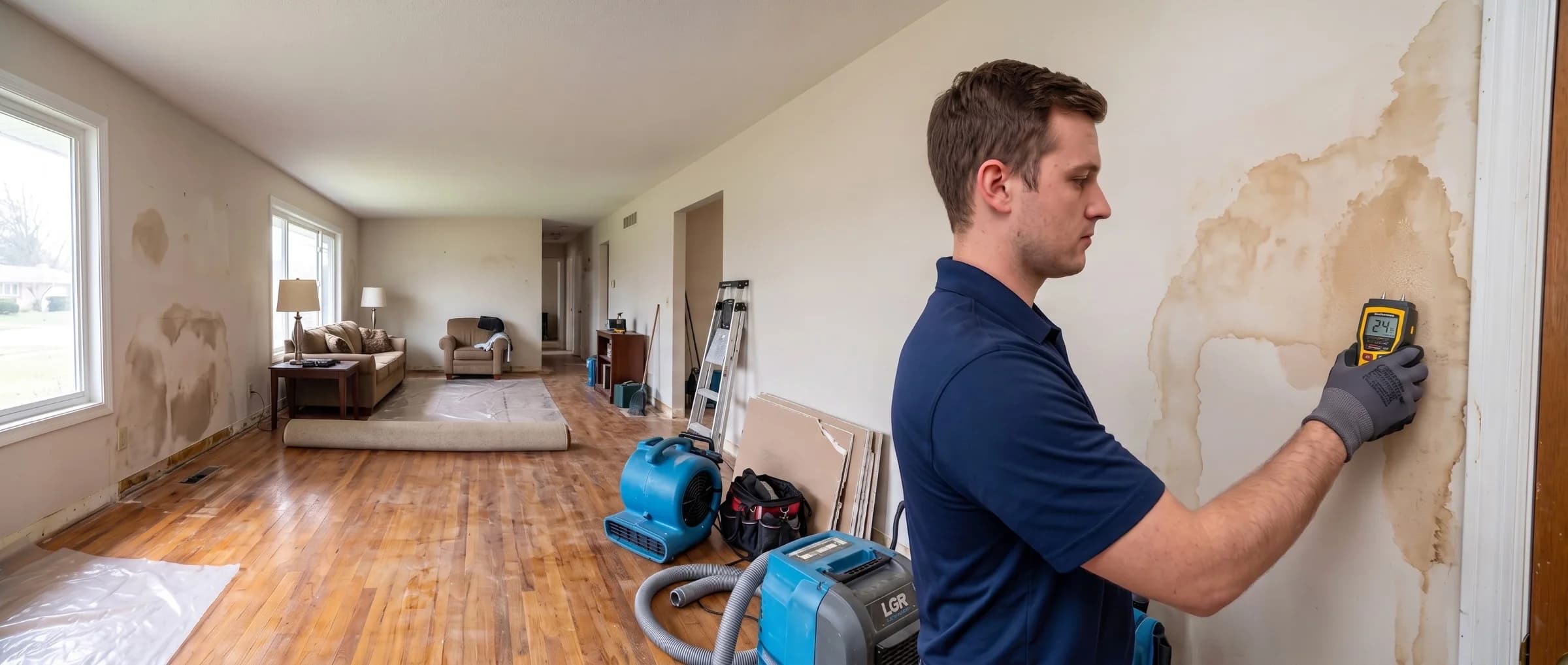

Water damage doesn't automatically mean you need a mold specialist, but figuring out which service applies, or whether both do, isn't always obvious. Water damage restoration is the extraction, drying, and repair process governed by IICRC S500.
Mold remediation is a separate process, governed by the companion IICRC S520 standard, for removing mold growth and correcting the moisture source that fed it. The two services solve different problems, follow different standards, and are sometimes handled by different companies, even though the same water event can require both. What actually determines which one you need is whether mold has started growing, not simply whether water was involved.
Key insights
- Different standards. Water damage restoration follows IICRC S500 and covers water extraction, drying, and repair. Mold remediation follows IICRC S520 and covers mold removal and moisture correction.
- Mold isn't automatic. Most water damage that's extracted and dried within roughly 24 to 48 hours never progresses to a mold problem at all.
- Sequence matters. When both are needed, water damage restoration comes first. Drying the structure is what stops mold remediation from having to start over.
- Separate credentials. A technician's WRT water damage certification and AMRT mold remediation certification are two different qualifications, not one.
- Different cost logic. Water damage restoration nationally runs $1,500 to $7,000 depending on category, class, and scope. Mold remediation is priced separately, scaled to the affected square footage.
- Insurance treats them differently. A sudden water loss is typically covered outright, while mold coverage is usually capped at a policy sublimit and can be denied if the water sat too long before anyone responded.
What's the difference
Water damage restoration removes water and repairs whatever it damaged, following the IICRC S500 standard. Mold remediation removes mold growth and the moisture source behind it under the separate IICRC S520 standard, and it only becomes necessary once mold is actually present, not just because water was involved.
 Sealing the doorway isolates the room under IICRC S520 before any mold removal starts, keeping spores from spreading to unaffected parts of the home.
The distinction sounds simple, but the two terms get used interchangeably by homeowners, and even by some contractors. At its core, water damage restoration is a structural and mechanical process: extract standing water, dry the materials, clean and sanitize, then repair or rebuild whatever couldn't be saved. Mold remediation is a biological containment process: isolate the contaminated area, remove materials that can't be cleaned, treat what remains, and verify the space meets a clearance standard before it's reopened.
A single incident, a burst pipe, a slow roof leak, a flooded basement, can require one service, the other, or both, depending entirely on how quickly it was caught and how thoroughly it was dried. Response time decides which service a given situation actually needs.
What water damage restoration covers
Water damage restoration covers everything needed to extract water, dry a structure, and repair the damage it caused, under the IICRC S500 standard, from the first walkthrough through the final moisture check. It follows a defined sequence rather than a single task, running through five stages at a high level.
 IICRC S500 treats extraction as the first phase because removing standing water quickly is what keeps materials inside the 24 to 48 hour window before mold becomes a separate concern.
Inspection and classification
A technician assesses the source, assigns a water category and class under IICRC S500, and maps out which materials are affected.
Water extraction
Standing water is pumped or vacuumed out using submersible pumps and truck-mounted extractors, the fastest way to stop material saturation from spreading.
Drying and dehumidification
Air movers and dehumidifiers run for several days to bring affected materials back to a normal moisture content, the phase most responsible for preventing mold.
Cleaning and repairs
Surfaces are cleaned and sanitized, and unsalvageable materials like soaked drywall or padding are removed and replaced.
Final inspection
A technician confirms moisture readings match an unaffected reference point before the job closes out.
Each of those five stages carries its own equipment and timing, though a full professional job runs closer to eight distinct steps once inspection, monitoring, and final verification are broken out in the water damage restoration process. None of those stages is mold-specific: a water damage restoration crew dries and repairs, but it doesn't remove mold contamination as a matter of course.
What mold remediation covers
Mold remediation covers containment, removal, and treatment of mold growth under the IICRC S520 standard, plus correcting the moisture problem that caused it, and it closes with a clearance check, a verification that the space is safe to reoccupy, rather than a repair estimate. It's a narrower, more specialized process than water damage restoration.
 IICRC S520 calls for negative air pressure and HEPA filtration during removal, not just wiping down a surface, since airborne spores can resettle without active air scrubbing.
A typical mold remediation job isolates the contaminated area with plastic sheeting and negative air pressure, removes porous materials that can't be cleaned, such as soaked drywall or carpet padding, physically cleans the remaining surfaces with EPA-registered antimicrobial products, and runs HEPA air scrubbers to capture airborne spores. The technician then verifies the moisture source has actually been fixed, since remediating mold without correcting the underlying dampness just invites it back. A visual inspection, sometimes paired with air or surface sampling, confirms the space has returned to a normal condition before the containment comes down.
Mold remediation and water damage restoration are often triggered by the same event, but most restoration companies that handle both keep the two scopes of work separate on paper. Extraction and drying get billed one way, and mold containment and removal get billed another, even when the same crew or company performs both.
Water damage vs. mold at a glance
Water damage restoration and mold remediation differ on almost every practical point: the standard each follows, what triggers the work, how it's priced, and which certification the technician needs. A job that's purely water intrusion, caught and dried fast, never touches the mold side of any of those differences at all, while a job with active growth touches both sides at once, the water event triggers restoration, and the growth it left behind triggers remediation on top of it. Cost, certification, and standard all shift the moment mold enters the picture, and homeowners often end up with only one of the two services without realizing the other applies too.
| What it is | Water damage restoration | Mold remediation |
|---|---|---|
| Governing standard | IICRC S500 | IICRC S520 |
| Primary goal | Extract water, dry the structure, repair damage | Remove mold growth, correct the moisture source |
| Triggers | Any water intrusion event | Confirmed or visible mold growth |
| Typical timeline | 3 to 7 days to dry, longer for repairs | 1 to 5 days depending on affected area |
| Typical cost | $1,500 to $7,000 nationally | Priced separately, scaled to square footage |
| Technician certification | WRT (Water Damage Restoration Technician) | AMRT (Applied Microbial Remediation Technician) |
| Ends with | A final moisture reading and repair sign-off | A clearance inspection or clearance sample |
Signs of a mold problem
The clearest signs that water damage has crossed into needing mold remediation are a musty odor that doesn't fade once an area is dry, and discoloration that looks fuzzy, speckled, or splotchy rather than a flat water stain. Either one on its own is worth a closer look.
 A fuzzy, speckled patch like this is a confirmed sign, not a risk factor, and it's the point where a musty smell or a spreading stain has crossed into needing an actual mold remediation call.
Beyond those two, a few other indicators matter. Visible growth on drywall, wood framing, insulation, or inside HVAC ductwork is a direct confirmation rather than a warning sign. A water event that went undried for more than 48 hours is a strong risk factor even without visible growth yet, since the EPA's mold-growth timing window has likely already passed.
Allergy-like symptoms, coughing, or headaches that ease when someone leaves the affected room point toward airborne spores rather than a purely structural problem. A water stain that keeps changing shape or color days after the leak was stopped, a detail unrelated to mold entirely, is one of the signs of water damage still worth a second look.
If any of these show up, the next step is confirming the water source has actually been stopped before anyone touches the mold itself. Removing mold without fixing what's feeding it is a temporary fix at best, according to CDC guidance. Response speed matters more in a household with young children, an older adult, or anyone with a respiratory condition, since those groups are more sensitive to the effects of mold exposure.
Do you need both?
Most water damage on its own only needs restoration. Mold remediation becomes necessary in addition to, not instead of, restoration once mold growth is confirmed or the water sat unaddressed long enough for it to be likely.
You likely need water damage restoration alone
If the water was caught within about a day, there's no musty smell, and no discoloration beyond a clean water stain, drying and repair is usually the full job. A burst pipe discovered the same day it happens is the typical example.
You likely need mold remediation as well
If there's a musty odor, visible discoloration in a fuzzy or speckled pattern, or the water sat for more than 48 hours before anyone caught it, mold has had time to establish. A sewage backup or a slow leak found weeks later both raise this risk.
You need both, in sequence
If water is still present or the source hasn't been stopped, water damage restoration goes first regardless of visible mold. Remediating mold in a space that's still wet just means doing it again once the source is finally fixed.
When it's genuinely unclear which category a situation falls into, a restoration company's initial inspection, not a guess based on smell alone, is the fastest way to settle it. The EPA's 10-square-foot mold threshold and the 24 to 48 hour drying window are the two clearest reference points for judging a borderline case.
Common scenarios
The service that applies depends on the specific situation, and response time is the single biggest predictor across nearly all of them: the faster water is extracted and dried, the less likely mold remediation becomes. A handful of scenarios cover most of what homeowners run into, and each falls fairly cleanly under one service, both, or neither.
 A basement flood that sits for a week before anyone finds it almost always needs both services, since the standing water triggers restoration and the delay makes mold growth likely by the time it's discovered.
That holds whether the cause was a flooding event or something as contained as a dishwasher leak, since the deciding factor is how long the water sat, not how it arrived. A same-day catch usually keeps a job on the restoration side alone, while a delay of days or weeks tends to pull mold remediation into the job as well.
| Situation | Water damage restoration | Mold remediation |
|---|---|---|
| Burst pipe, extracted and dried the same day | Yes | Usually no |
| Basement flood discovered after being away a week | Yes | Yes |
| Sewage backup with standing water present | Yes | Often, given Category 3 water |
| Slow leak under a sink found after several weeks | Yes | Yes |
| Musty smell with no known leak or water event | No | Yes |
| Roof leak stopped and dried within 24 hours | Yes | Usually no |
A roof leak caught and dried fast can close out without mold ever entering the picture, while a musty smell with no known leak can require a mold remediation call with no water damage restoration involved at all. Those two cases matter most because they're the ones people get wrong, assuming the two services always travel as a pair when they often don't.
How IICRC S500 and S520 work together
IICRC S500 and S520 are companion standards, not competing ones. S500 governs the water damage side of a loss, and S520 governs the mold side, and the two are designed to hand off to each other on the same job when a water event has already produced mold contamination.
The sequence matters because of the biology involved. Mold can begin colonizing porous, wet materials within roughly 24 to 48 hours under favorable temperature and humidity conditions, according to EPA guidance on flood cleanup. That timing is the reason water damage restoration is always the first call, even on a job everyone already suspects has mold: a S520 crew working in a space that's still saturated is fighting a moisture source that hasn't been addressed, and the mold typically returns.
In practice, a company that's certified in both S500 and S520 work will run extraction and drying first, confirm moisture levels are back to a dry baseline, then bring in the mold-specific containment and removal process if contamination is already present. A company certified in only one standard should say so directly rather than treating the other as an extension of its own scope.
Mold remediation without water damage
Yes. Mold remediation can stand on its own, with no water damage restoration involved at all, when the moisture comes from chronic humidity, condensation, or poor ventilation rather than a specific water event.
A bathroom with no exhaust fan, a crawl space that stays damp year-round, or ductwork that sweats from a poorly insulated HVAC run can all grow mold without a burst pipe, a leak, or a water damage restoration company ever getting involved. In those cases, the fix on the water side is prevention and ventilation work rather than extraction and drying, since there's no standing water or saturated material to remove in the first place.
The reverse holds just as often, and it's the more common outcome of the two. A water event that's caught fast, extracted, and dried within the standard window can go through the entire restoration process and close out without a single mold remediation call.
Cost differences
Water damage restoration nationally runs $1,500 to $7,000, priced against water category, class, and repair scope, while mold remediation is billed separately, scaled primarily to the square footage of visible contamination. The two are billed as separate line items even on a combined job.
 A slow vanity leak that produces both water damage and mold typically shows up as two separate line items on the same estimate, since IICRC S500 drying work and IICRC S520 mold removal are priced independently.
On the water side, water damage restoration cost is driven by how contaminated the water was, how much material had to be removed, and how many rooms were affected. Mold remediation is priced differently: a small, contained area costs far less than a multi-room contamination, and the biggest cost driver is usually containment size and the amount of porous material that has to be removed and replaced rather than the water event itself. A restoration company quoting a combined job should break the two scopes out separately on the written estimate, not bundle them into one number, so the homeowner can see what each part actually costs.
A contained bathroom job illustrates the split: a slow leak under a vanity might run $800 to $1,500 for water extraction and drywall repair, plus a separate $500 to $1,200 for mold containment and removal if the leak went unnoticed long enough to produce growth. Both scopes land on the same invoice, billed as two separate line items.
Insurance coverage differences
Homeowners insurance treats water damage restoration and mold remediation differently, and the gap between them is one of the most common places a claim falls short. A sudden, accidental water event is typically covered under a standard policy's dwelling coverage, while mold coverage is usually capped at a separate, much smaller sublimit.
The distinction comes down to timing and cause. Whether homeowners insurance covers water damage generally comes down to the sudden-and-accidental standard: a burst pipe or a sudden appliance failure is covered, while gradual seepage or a known, unaddressed leak isn't. Mold coverage adds a second test on top of that: even a covered water event can leave an insurer denying the mold portion of the claim if there's evidence the water sat too long before it was reported or dried.
That's part of why documenting the timeline matters so much when filing a water damage insurance claim, since the same photos and moisture logs that support the water damage portion of a claim are often what determines whether the mold portion gets paid at all. A moisture reading taken the day water was found, and another taken once the area was confirmed dry, does double duty as evidence for both halves of a combined claim.
Who to call and DIY limits
Call a water damage restoration company first if water is present or was recently present, and add a mold remediation company, or confirm your restoration company holds both certifications, only once mold is actually confirmed. Calling in the wrong order usually means paying for a second inspection.
 A quick phone call to confirm whether the technician on site holds WRT, AMRT, or both is worth making before dispatch, since one credential doesn't guarantee the other.
For water damage, DIY cleanup is reasonable for a small, clean-water spill caught immediately: extract the standing water, then run fans and a dehumidifier until the material reads dry, the same core sequence in DIY water damage cleanup. For mold, the EPA sets a rough line at about 10 square feet on a non-porous surface: below that, with no household member having a respiratory condition, a homeowner can usually handle it with basic protective equipment. Above that threshold, behind a wall, or inside ductwork, a certified mold remediation technician is the safer call regardless of how the visible portion looks.
The two skill sets don't overlap much in practice. Someone comfortable extracting a small water spill and running a fan isn't necessarily equipped to contain and remove mold safely, and the reverse is just as true.
When choosing a water damage restoration company, ask directly whether the technician on site holds WRT certification, mold-specific AMRT certification, or both, rather than assuming a company that handles one automatically handles the other. A written restoration checklist that names both scopes separately is a quick way to confirm the plan actually covers each part of the job.
Either credential can be confirmed directly rather than taken on the company's word. The IICRC Global Locator searches by individual technician name and lists which certifications are active, which catches a lapsed credential or a technician who was never actually certified in the first place.
Frequently asked questions
Is mold remediation the same as water damage restoration?
No. Water damage restoration extracts water and dries and repairs a structure under IICRC S500. Mold remediation removes mold growth and corrects the moisture source under the separate IICRC S520 standard, and it's only needed once mold is actually present.
Can the same company do both water damage restoration and mold remediation?
Yes, many restoration companies hold both IICRC certifications, WRT for water damage and AMRT for mold remediation. Confirm both credentials separately rather than assuming one covers the other.
How long after water damage does mold start growing?
Within 24 to 48 hours under favorable temperature and humidity conditions, according to EPA guidance. That window is the reason a fast, properly documented drying response is the single biggest factor in whether mold remediation becomes necessary at all.
Is mold remediation more expensive than water damage restoration?
Not necessarily. Water damage restoration typically runs $1,500 to $7,000 depending on category, class, and scope, while mold remediation is usually billed as a separate line item scaled to the affected square footage, and a small, contained area costs far less than a multi-room water loss.
Does homeowners insurance cover both water damage restoration and mold remediation?
It depends on the cause and how fast you responded. A sudden, accidental water event is typically covered under a standard policy, but most policies cap mold coverage at a sublimit, often a few thousand dollars, and can deny mold claims tied to a delayed report or ongoing leak.
Can I do mold remediation myself instead of hiring a professional?
Sometimes, if the visible mold covers less than about 10 square feet on a non-porous surface and no household member has a respiratory condition, per EPA guidance. Anything larger, hidden behind a wall, or affecting HVAC ductwork calls for a certified mold remediation technician.
What's the difference between IICRC S500 and S520?
S500 covers extraction, drying, and structural repair. S520 covers containment, mold removal, and clearance verification. A technician can hold either certification without the other, so ask which one applies to your job specifically.
Do I need a mold inspection before mold remediation?
Not always. Visible mold growth with an identifiable moisture source usually doesn't need a lab test before remediation starts, but hidden or ambiguous cases, or a post-remediation clearance check, often call for an independent mold assessor rather than the remediation company itself.
How do I know mold remediation actually worked?
Through a clearance check, either a visual inspection confirming no growth or staining remains, or air and surface sampling compared against an unaffected reference point in the home. For anything beyond a small, straightforward job, an independent third-party assessor rather than the remediation company itself gives a more reliable result, since the company that did the work isn't the one confirming its own outcome.
Will drying out water damage prevent mold?
In most cases, yes. Extracting standing water and drying affected materials within the EPA's 24 to 48 hour window is the primary defense against mold growth, and it's why water damage restoration is the first call even when mold is already a concern.
Sam Hickerson is the founder of RestoreAdvisor and writes consumer guides on mold remediation, water damage restoration, inspection, testing, and home recovery. His work focuses on helping homeowners understand costs, risks, and when to call a professional. He draws on guidance from the EPA, CDC, IICRC, and other authoritative sources to make complex home issues easier to navigate.