
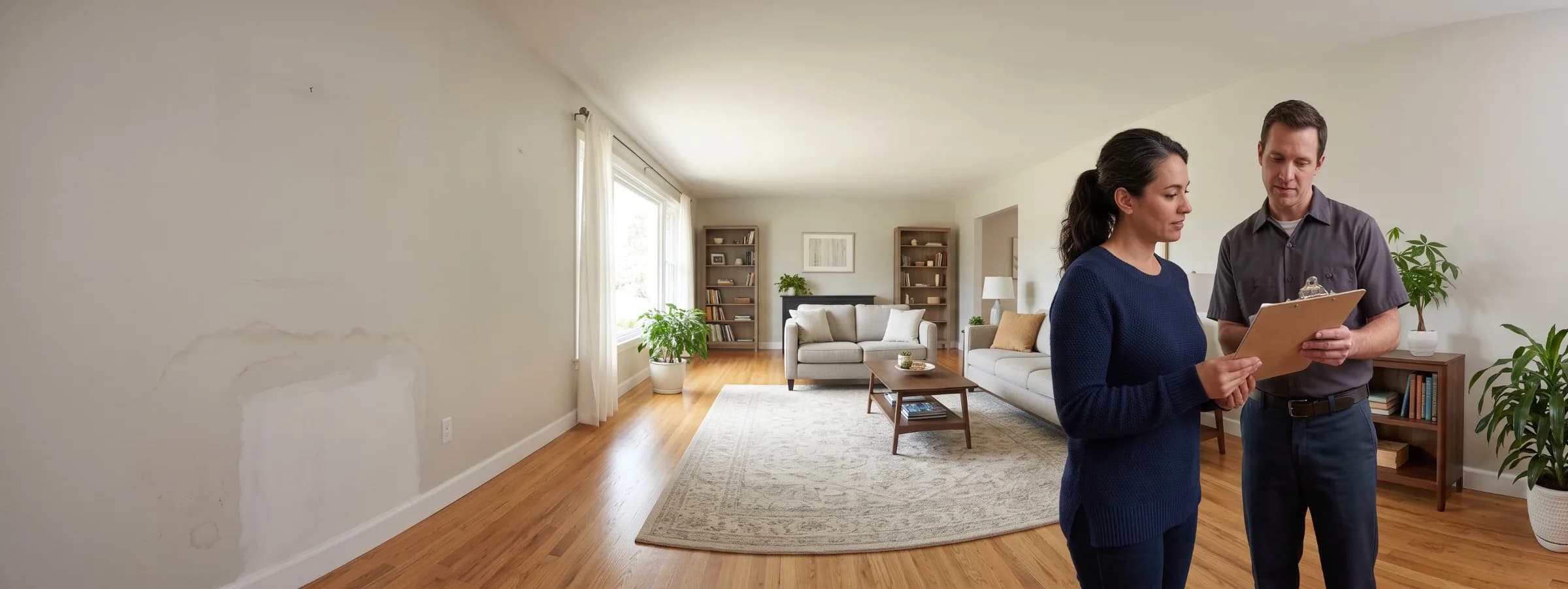

You just had water damage restoration work finished, and the paperwork mentions a warranty without spelling out what it actually protects. A water damage restoration warranty is a written promise from the company that performed the mitigation and repairs to fix defects in its own labor for a set period, separate from any manufacturer warranty on the materials installed and separate from a home warranty on your home's systems and appliances. Under the FTC: Magnuson-Moss Warranty Act, a written warranty tied to a service costing more than five dollars has to spell out its actual terms rather than leave a homeowner guessing, the same standard worth holding a restoration company's own promise against before you sign anything.
For a typical water damage restoration job, drying, extraction, and any drywall or flooring repair the crew completed themselves, that promise usually runs one to five years and covers the labor rather than the water event itself. A repeat leak from a different pipe six months later is not a warranty claim; a drywall seam that cracks along the same repair the crew made last spring usually is.
Key insights
- Typical length. Most residential restoration warranties run 1 to 2 years on labor, with some companies offering up to 5 years; materials usually carry a separate, often shorter, manufacturer warranty.
- What it actually covers. A restoration warranty protects against defects in the company's own workmanship, not against water damage from a new or unrelated cause.
- Mold is rarely included. Because mold regrowth usually depends on humidity the homeowner controls after the job ends, most warranties exclude it or limit it to a short recheck window.
- Unauthorized work voids it. Letting another contractor touch the repaired area, or failing to disclose a pre-existing condition, typically ends the warranty on that section of work.
- Transfer is not automatic. Whether a warranty follows the house to a new owner depends entirely on the contract's own wording; federal law does not require it to transfer.
- Get it in writing. A verbal promise carries little weight in a dispute; ask for the warranty's exact terms, length, and exclusions before you sign the authorization form.
What a restoration warranty covers
A water damage restoration warranty covers defects in the labor the company performed, not the underlying water event itself. That typically means drywall repairs that crack along a taped seam, a subfloor patch that flexes underfoot, or drying equipment that was removed before a wall stud actually reached a safe moisture range.
 IICRC S500 treats a reading like this, still elevated weeks after the repair, as grounds for a no cost recheck visit rather than a new service call.
The extraction and drying phase usually carries its own promise: if a same-day emergency water damage restoration visit pulls equipment out and a moisture recheck days later still shows an elevated reading in the same spot, most companies will send a technician back to finish the job at no extra charge rather than treat it as a new service call. Most companies document that recheck with a dated moisture-reading printout or photo, giving the homeowner a paper record that the follow-up actually happened.
Repairs beyond drying, replaced drywall, refinished flooring, a repainted ceiling, are typically covered under the same labor warranty as the extraction work, even though a different technician or subcontractor may have completed each piece. A company that subcontracts the reconstruction phase to a separate contractor should still stand behind that work under its own warranty, or name the subcontractor's warranty explicitly in the paperwork.
Confirming a structure has actually dried out isn't a matter of how a wall looks or feels: IICRC S500 is the industry standard restoration companies use to verify a structure has reached a dry, pre-loss moisture range before equipment comes out, and that reading, not a visual impression, is what determines whether a recheck visit is finished. Technicians typically compare the reading against an unaffected reference room in the same house rather than a single fixed number, since normal moisture content varies by climate and by the specific materials involved.
A concrete example: a company replaces a section of drywall, tapes the seam, and repaints it, and eight months later that same seam cracks along the tape line. Under a typical one to two year workmanship warranty, the company would send a technician back to re-tape, re-mud, and repaint that specific section at no charge, since it is the identical repair failing in the identical spot rather than a new problem.
Types of restoration warranties
A restoration warranty, a home warranty, and a manufacturer warranty cover three different things, and confusing them is the most common reason homeowners feel misled after a claim is denied. Only the restoration warranty is tied to the specific mitigation and repair work a company performed on your home after a water event.
 Only the restoration warranty is tied to the mitigation work actually performed, so a denied claim under one type does not affect eligibility under the other two.
Each one also comes from a different party and gets triggered by a different kind of failure, which is why a single leak can touch all three without any of them actually overlapping. The restoration company stands behind its own labor, the home warranty provider stands behind the mechanical system that failed, and the material's manufacturer stands behind the product itself, so a claim denied by one is not evidence that the other two won't pay.
| Type | Who provides it | What it covers | Typical length |
|---|---|---|---|
| Restoration warranty | The restoration company | Defects in that company's own labor on the specific job | 1–5 years |
| Home warranty | A separate home warranty provider | Mechanical breakdown of systems and appliances from normal wear, not the resulting water damage | 1 year, renewable |
| Manufacturer warranty | The maker of the material or product installed | Defects in the physical product itself, such as flooring or drywall | Varies by product, often 1–10 years |
A leaking water heater illustrates how the three interact: a home warranty might pay to replace the failed tank itself, a manufacturer warranty might cover a defective heating element inside it, and the restoration company's own warranty covers only the drywall, flooring, and drying work it performed to fix the resulting water damage. Applying the same due diligence you would use when choosing a water damage restoration company in the first place, asking which of the three a specific problem falls under before you file any claim saves a round of phone calls that go nowhere.
Warranty on insurance-paid work
Yes, a restoration warranty applies the same way whether your insurance company paid for the job or you paid out of pocket. The warranty is a promise between you and the restoration company about its own labor, and it does not depend on who wrote the check. Whether homeowners insurance covers water damage in the first place is governed by an entirely different set of rules, separate from anything the restoration company promises about its own labor.
An adjuster's approval of a scope of work and a company's warranty on that same work are two separate things, and a claim being closed on the insurance side does not close the warranty period on the restoration side. A company sometimes references its own warranty language when negotiating a supplemental claim for a problem the insurer initially declined to pay for.
The NAIC: A Consumer's Guide to Home Insurance notes that a contractor's own workmanship guarantee sits outside the insurance policy entirely, which is why a denied insurance claim and a valid warranty claim can exist on the same repair at the same time. An adjuster has no authority to waive or extend the contractor's own warranty terms, since that decision belongs to the company that wrote them, not to the insurer paying for the underlying repair.
How long a restoration warranty lasts
Most residential water damage restoration warranties run 1 to 2 years on workmanship, with some companies extending to 3 or 5 years on larger jobs. A longer stated term is not automatically better if the exclusions underneath it are broad enough to make the coverage meaningless in practice. Many restoration and remodeling companies set their own defect thresholds against the NAHB: Residential Construction Performance Guidelines, the reference most of the industry uses to define what counts as a legitimate workmanship failure versus normal settling or wear.
 One to two years is the typical range for workmanship coverage, with three to five years reserved for larger structural or full room repairs.
A drywall crack that falls within the guideline's tolerance for minor seasonal movement, for instance, generally is not a covered defect even inside an active warranty period. Larger jobs with structural repairs, subfloor replacement, or full-room reconstruction tend to carry longer warranty terms than a same-day extraction-only visit, partly because there is simply more workmanship to stand behind on a bigger job.
The water damage restoration cost of a job is one useful indicator of that scope, since a company willing to write a longer warranty on an expensive, extensive repair has more to lose if that repair fails than one offering the same term on a routine extraction. An unusually low quote paired with an unusually long warranty term is a mismatch to ask about directly, since the two don't typically move in the same direction.
What a written warranty should include
A written water damage restoration warranty should name the specific work covered, state a start date and length, and spell out what voids it, who to contact to file a claim, and how quickly the company has to respond. A warranty missing any of these elements is harder to enforce than one that spells all of them out, regardless of how long the stated term is.
 A document worth signing states its own start date, exclusions, and claims process in writing rather than leaving any of them to be assumed later.
A description of the exact work covered
The warranty should name the specific rooms, materials, or repairs it applies to, drywall in the affected bedroom, the drying of the subfloor, the reinstalled baseboard, rather than a blanket phrase like "all work performed," which gives a company room to argue later that a given repair was never covered in the first place.
A start date and a stated length
The warranty period should begin on a specific date, usually the date the job was completed and signed off, not the date the estimate was written or the insurance claim was filed. A warranty with no clear start date effectively has no enforceable end date either.
What voids the coverage
A legitimate warranty lists its own exclusions rather than leaving them unstated. If the document only lists what it covers with nothing about what ends coverage, that gap usually gets resolved in the company's favor later.
How to file a claim and how fast the company has to respond
The document should name a phone number, email, or claims contact separate from the original sales rep, along with a stated response window, often a few business days to schedule an inspection. No stated response time means no way to hold the company to a timeline if a callback gets ignored.
Whether it transfers, and to whom
The warranty should state directly whether it transfers to a future owner at all, and if so, what paperwork formalizes that transfer.
How to verify a warranty
Verifying a warranty before you sign means getting its length, scope, and exclusions in writing rather than relying on a sales conversation. A handful of checks, done before any authorization form is signed, catch most of the vague or unenforceable warranties homeowners run into.
 A verbal answer over the phone is not enforceable on its own; the specific terms need to show up in writing before you sign anything.
Match what you were given against the specifics that should be in it
If the estimate or authorization form is missing a start date, an exclusions list, or a named claims contact, ask for those specific items before signing rather than accepting a vague assurance that it's covered.
Confirm the company is a licensed, verifiable business
Checking a company's standing with the BBB Accreditation Standards, including its complaint history and how those complaints were resolved, gives a quick read on whether a company actually honors the warranties it writes.
Check for IICRC Certified Firm status
A company holding water damage restoration certifications at the firm level, not just an individual technician's credential, has more institutional accountability behind a multi-year warranty promise. The IICRC's own locator tool confirms a firm's certification status directly rather than taking a sales rep's word for it.
Ask what happens if the company closes
A warranty is only as good as the company standing behind it. Ask directly whether the warranty is backed by a third-party warranty program or insurance-backed guarantee, since a company that closes leaves an unbacked warranty worth nothing.
Bring a written list of questions to the estimate
Working from a prepared list of questions to ask a water damage restoration company, including warranty-specific questions, keeps the conversation from skipping past the terms that matter most once the crew is scheduled and the pressure to sign is on.
What a warranty typically excludes
A restoration warranty typically excludes new damage from an unrelated cause, normal wear and tear, and any condition that existed before the company started work. It also usually excludes cosmetic issues, such as a slight color variation between old and new paint, that do not affect the repair's function.
 A warranty covers the patched section on the right; a new stain like the one on the left is a separate problem, not a claim against the original repair.
A new or unrelated leak
A repaired burst pipe fitting failing again because of a second, unrelated part is a new problem, not a warranty claim on the original repair. If the same fix made the first time fails in the same spot, that is usually covered; if a different section of pipe fails, it is not.
Pre-existing conditions
Rot, prior water staining, or a foundation issue that existed before the company arrived generally falls outside the warranty, even if it becomes more visible once the visible water damage is dried and repaired.
Acts of nature
A second flood, storm, or unrelated plumbing failure that causes new damage to an already-repaired area is treated as a new loss for insurance purposes, not a defect in the original workmanship.
Homeowner modifications
Painting over, drilling into, or otherwise altering the repaired section after the job is done typically ends warranty coverage on that specific area, since the company can no longer verify its own work was left intact.
Normal wear and tear
Minor settling, seasonal expansion and contraction, and gradual fading are excluded from nearly every workmanship warranty in the construction industry, restoration included.
Does a warranty cover returning mold
A restoration warranty rarely covers mold that grows back after the job, because mold recurrence usually traces to humidity or moisture the homeowner controls after the crew leaves rather than to a defect in the drying work itself. Some companies offer a short recheck window, often 30 to 90 days, where they will return and verify moisture readings if a musty smell or visible growth reappears in the exact area that was treated.
Water damage restoration and mold remediation are two different services governed by two different IICRC standards, S500 for the water side and S520 for the mold side, and a warranty on one does not automatically extend to the other. Confirming which service, and which warranty, applies to a given callback should come before assuming either one covers it; the distinction between water damage restoration and mold remediation matters just as much for warranty purposes as it does for the initial scope of work.
What can void your warranty
A water damage restoration warranty is typically voided by unauthorized repairs, undisclosed pre-existing damage, or a failure to maintain the property in a way that lets the same problem recur. Most of these conditions are listed explicitly in the warranty paperwork itself, which is one more reason to read it before signing.
 Once a second contractor touches the repaired section, the original company can no longer verify its work was left intact, voiding that part of the warranty.
Hiring a second contractor to touch the same repaired area, even for something unrelated like a kitchen remodel, commonly voids the warranty on that section since the original company can no longer verify its own work was not altered. Skipping a recommended follow-up moisture check, or failing to run a dehumidifier the company left in place for the requested drying period, can also void coverage if the resulting problem is traceable to that gap rather than the original repair.
Keeping the original scope of work, moisture logs, and any signed addendum on file, the same records that matter when documenting water damage for insurance, makes it far easier to prove a later problem traces to the original repair rather than something that happened afterward. A photo of the invoice and the signed scope of work, stored somewhere that survives a phone upgrade or a change of email address, is usually enough on its own.
Is a warranty transferable at sale
Sometimes, and only if the warranty contract explicitly says so, since there is no general rule that makes a restoration warranty transferable by default. Some companies write their warranties as transferable with written notice within a set window after closing; others state plainly that the warranty ends when the original homeowner sells.
A seller who benefited from a warrantied repair still generally has to disclose water damage when selling the property, separate from whether the warranty itself transfers, since most state disclosure laws focus on the underlying damage and its history rather than on paperwork attached to fixing it. Whether that past repair needs to appear on a disclosure form usually turns on whether the seller had actual knowledge of it, not on whether a warranty happened to cover the fix.
If the warranty is set to transfer, ask the restoration company for written confirmation naming the new owner, since an unregistered transfer can leave a buyer unable to prove the coverage exists at all. A short letter or an updated certificate from the company, kept with the closing documents, is enough to settle a dispute later without digging through years-old estimates.
Protection with no written warranty
Yes, most states recognize some form of implied warranty of workmanlike construction even when a restoration company never provides anything in writing, though the exact standard and its name vary from state to state, and it is far harder to enforce than an explicit written promise. The Magnuson-Moss Warranty Act itself acknowledges this category, defining an implied warranty as one that arises under state law rather than from anything a company writes down, which is why this protection exists independently of whatever paperwork, if any, you were actually given.
 A handshake still carries an implied duty to do the work competently, though proving that without anything in writing is far harder.
This is a different legal concept from the implied warranty of habitability that governs a landlord's baseline obligation to a tenant; the implied warranty of workmanlike construction applies to the contractor's labor itself, regardless of who owns or rents the property, and it generally requires the work to meet the basic standard a reasonably skilled technician in that trade would meet. Without a written warranty to point to, proving a defect falls under this implied protection usually means showing the repair failed to meet a recognized industry benchmark, such as NAHB's Residential Construction Performance Guidelines, rather than simply arguing the work looks wrong.
A restoration company's own certifications and its standing with an organization like the BBB become the best evidence you have of a workmanlike-construction claim when there is no signed warranty document to reference, since a licensed, certified firm carries a higher baseline duty of care than an unlicensed one. Many states also require licensed contractors to carry a surety bond, and filing a claim against that bond is a separate option when a company won't honor an implied warranty and no other paperwork exists to fall back on.
What to do if a problem recurs
If a covered problem shows up after the crew has left, document it immediately and contact the restoration company in writing rather than waiting to see if it resolves on its own. Most warranties require notice within a specific window, often 30 days from when you first notice the issue, so an early written notice protects your claim even if the company takes weeks to schedule a return visit.
Photograph the problem area, note the date, and reference the original invoice or scope of work when you reach out, the same documentation habit that matters when a follow-up moisture check during structural drying confirms a wall never fully dried the first time. If the company disputes that the problem falls under the warranty, ask for that determination in writing along with the specific reason, since a vague verbal denial is far harder to challenge than a written one you can push back on point by point.
Red flags of a weak warranty
The clearest red flags are a warranty with no written terms, exclusions that are never mentioned anywhere in the paperwork, a stated length that doesn't match the actual scope of the job, and pressure to sign before you've had a chance to read it. Any one of these on its own is reason enough to ask more questions before the job starts, not after.
 A company that pushes for a signature before the warranty terms have actually been explained is one of the clearer signs the coverage is not worth much.
No written terms at all
If a company can only describe the warranty verbally or points to a vague line on the invoice like "guaranteed work," treat that as no warranty at all.
A term that sounds too long for the job
A "lifetime" warranty on a same-day extraction visit with no repair work attached is a marketing phrase, not a meaningful guarantee, since there is little workmanship left to warranty once the drying equipment is packed up.
No mention of what voids it
A legitimate warranty spells out its exclusions. One that only lists what it covers, with nothing about what ends coverage, usually means the exclusions get decided after the fact, in the company's favor.
Refusal to name the warranty provider
If the warranty is backed by a third party rather than the restoration company itself, the company should name that provider directly and give you a way to verify it independently.
Pressure to sign before reading it
A company that rushes you past the warranty section of an authorization form, especially during an emergency visit, is a signal to slow down before you commit to that section of the paperwork.
A "satisfaction guarantee" presented as a warranty
A satisfaction guarantee is a marketing phrase, not an enforceable term, since it rarely states a covered defect, a length, or a claims process the way a real workmanship warranty does. If a company leans on that phrase instead of naming specific terms, ask directly whether an actual warranty exists behind it.
Frequently asked questions
Do water damage restoration companies offer warranties?
Yes, most water damage restoration companies offer some form of workmanship warranty, typically covering the labor performed for one to five years. Ask for the specific term and exclusions in writing rather than assuming a standard length applies.
How long does a typical water damage restoration warranty last?
Most run one to two years on workmanship, with some companies extending to three or five years on larger repair jobs. Materials installed during the repair, such as drywall or flooring, usually carry a separate manufacturer warranty with its own term.
Does a water damage restoration warranty cover mold?
Rarely, and only in a limited form. A short recheck window of 30 to 90 days is common, but ongoing mold prevention depends on humidity control the homeowner manages after the job, which most warranties exclude.
What voids a water damage restoration warranty?
Unauthorized repairs by another contractor, undisclosed pre-existing damage, and skipped follow-up steps like a recommended moisture recheck are the most common ways a warranty gets voided. The specific list should be spelled out in the warranty document itself.
Is a water damage restoration warranty transferable to a new homeowner?
Sometimes, depending entirely on how the company wrote the warranty contract. Some warranties transfer with written notice after a sale, and others state plainly that coverage ends when the original homeowner sells.
Does insurance-paid restoration work still come with a warranty?
Yes, the warranty applies the same way regardless of who paid for the job. It is a separate promise between the homeowner and the restoration company, not a condition of the insurance claim itself.
What is the difference between a restoration warranty and a home warranty?
A restoration warranty covers defects in the labor a restoration company performed on a specific water damage job. A home warranty is a separate product that covers mechanical breakdown of home systems and appliances from normal wear, and it does not cover water damage cleanup or repair at all.
Do I need the warranty in writing?
Yes, and a verbal promise should never be treated as equivalent to a written one. Ask for the term, scope, and exclusions printed on the estimate or a standalone warranty document before signing an authorization form.
What happens if the restoration company goes out of business?
An unbacked warranty from a company that has closed is generally unenforceable, since there is no one left to honor it. Ask before hiring whether the warranty is backed by a third-party program or insurance-backed guarantee that survives the company closing.
Does a restoration warranty cover a new leak in a different part of the house?
No, a new leak from an unrelated cause is treated as a new event, not a warranty claim on a previous repair. The warranty only covers defects in the specific labor the company performed.
Should I pay extra for an extended warranty?
It depends on the scope of the repair rather than a blanket rule. An extended warranty is worth more on a job with significant structural or drywall repair than on a simple extraction-only visit, since there is more workmanship for a longer term to actually protect.
Does a restoration warranty in a condo cover shared walls or common areas?
It depends on which unit or system the repair covered. Water damage in a condo often splits responsibility between the HOA's master policy and the unit owner's own coverage, and the restoration company's warranty follows whichever party hired and paid for that specific piece of work.
Should I ask about a property's past restoration warranties before buying it?
Yes, since a still-active warranty on a prior repair can be a genuine asset that transfers with the sale. Asking about it fits alongside the other checks worth making when buying a house with water damage history, including requesting the original invoice and any transfer paperwork from the seller.
What should a written water damage restoration warranty include?
It should name the specific work covered, state a start date and length, spell out what voids it, and name who to contact and how quickly the company has to respond to a claim. A warranty missing any of these is harder to enforce regardless of its stated length.
Is there any protection if a restoration company never put its warranty in writing?
Yes, most states recognize an implied warranty of workmanlike construction even with no written document, though it is far harder to enforce than an explicit written promise. It generally requires the work to meet the basic standard a reasonably skilled technician in that trade would meet.
Sam Hickerson is the founder of RestoreAdvisor and writes consumer guides on mold remediation, water damage restoration, inspection, testing, and home recovery. His work focuses on helping homeowners understand costs, risks, and when to call a professional. He draws on guidance from the EPA, CDC, IICRC, and other authoritative sources to make complex home issues easier to navigate.