
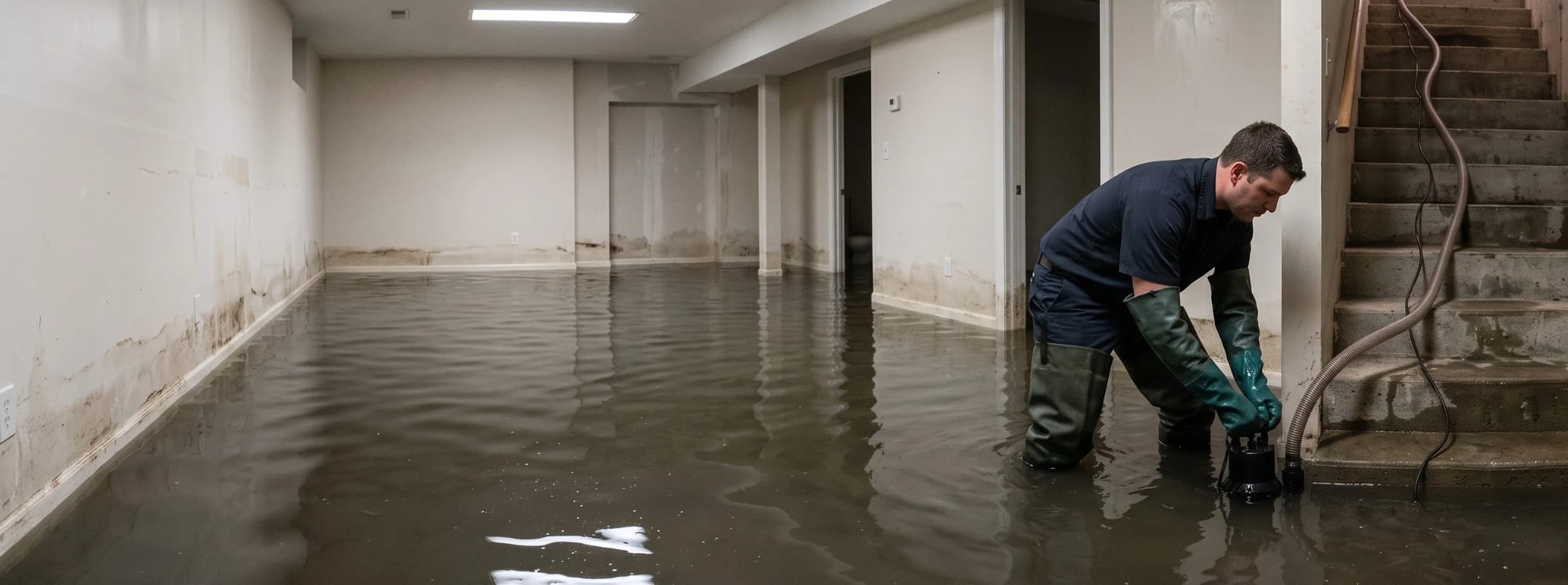

Standing water spreading across a floor after a pipe break, an appliance overflow, or a storm turns into a race against the clock. What happens in the next few hours decides how much of the flooring, drywall, and cabinetry gets saved and how much gets torn out later. Here's how professional water extraction actually works: the equipment technicians use, how they decide which tool fits a given situation, and what the service typically costs, so you can tell whether a company's approach matches the standard and whether an estimate lines up with the job in front of you.
Water extraction is the removal of standing and absorbed water from a structure using pumps, vacuums, and specialized extraction tools. It's the first physical mitigation step under the water damage restoration standard published by the Institute of Inspection, Cleaning and Restoration Certification, known as IICRC S500, and it happens before any drying equipment goes in. Pulling liquid water out mechanically is faster and far cheaper than waiting for it to evaporate, which is why extraction always comes first.
Key insights
- Extraction removes liquid water, not moisture in the air. Pumps and extractors pull out standing water; the drying phase that follows uses air movers and dehumidifiers to remove what's left in materials and the air.
- Equipment is matched to water depth and material, not just volume. Submersible pumps handle water deeper than about two inches, while portable extractors and weighted wands handle shallow water and saturated carpet.
- Water category changes the method, not only the cost. A Category 3 loss requires PPE and controlled disposal that a Category 1 leak doesn't, regardless of how much water is on the floor.
- Bulk extraction is usually finished within hours, not days. A single flooded room typically finishes in two to six hours; full moisture verification and drying add several more days.
- Extraction alone typically costs $300 to $3,500. That range covers the extraction visit itself, not the drying equipment rental, material removal, or repairs that follow.
- A wet/dry shop vacuum only covers small, contained spills. Anything beyond a few gallons, or any water that's been sitting for hours, calls for commercial-grade equipment.
When extraction is needed
Professional water damage restoration calls for extraction once standing water covers more than a small, contained area, once it's had time to soak into carpet padding or a subfloor, or once the water itself is contaminated. A spilled glass calls for a towel; water covering several square feet, or water that's already touched a subfloor, carpet pad, or the base of a wall, calls for equipment a household vacuum can't match.
 Water stains running along the baseboards on multiple walls, not just one corner, are a sign the room had standing water in it rather than a single contained spill.
Timing changes the outcome as much as volume does. The EPA notes that mold can begin developing within 24 to 48 hours of a water intrusion, so extraction that starts the same day limits how much material has to be replaced rather than simply dried in place. Every source produces the same basic problem once water is loose in a structure: it spreads faster than it can evaporate on its own, and it keeps traveling until something removes it or it's absorbed to the point of stopping.
If the situation is still active, water still spreading, a shutoff you can't reach, or any risk of an electrical hazard near standing water, treat it as a genuine emergency rather than something to assess on your own first. Cutting power at the breaker, not by touching anything wet, is the one step safe to take before help arrives.
A technician dispatched for emergency water damage restoration can start extraction the same visit, before the loss has a chance to reach a second room or a floor below. Extraction itself is the opening move in the larger process, and every other phase, drying, cleaning, and any repair work, waits on it being done thoroughly, since equipment placed over water that's still trapped underneath just prolongs the job.
DIY vs. professional extraction
DIY extraction works for a small, contained spill under about half an inch of water, roughly a few gallons total, that you can remove within an hour using a wet/dry shop vacuum and towels. Beyond that threshold, the water volume, the equipment needed, or the contamination level usually puts the job outside what a homeowner can safely or effectively handle alone.
 A towel and a mop handle a spill measured in gallons; once water reaches carpet padding or a subfloor, the job shifts from a DIY task to one needing commercial equipment.
Two factors that don't show up on a simple checklist are electrical risk and structural access. Standing water anywhere near an outlet, appliance, or electrical panel turns a DIY job into a safety call regardless of volume, an electrical hazard OSHA specifically warns about during flood response. Water that's already reached a wall cavity or subfloor is also effectively invisible to someone working from the surface with a shop vacuum.
| Factor | DIY-appropriate | Call a professional |
|---|---|---|
| Water depth | Less than half an inch, a few gallons total | More than half an inch, or water still actively spreading |
| Water category | Category 1, clean supply-line or appliance water | Category 2 or 3, any water with contamination risk |
| Area affected | A single small room or a contained spot | Multiple rooms, or any area larger than roughly 10 by 10 feet |
| Materials involved | Hard flooring only, nothing under carpet or drywall | Carpet, padding, subfloor, or drywall already wet |
A wet/dry shop vacuum and dry towels are all DIY water damage cleanup actually requires for a spill that fits that first column. Once any of the professional-side criteria applies, the gap in equipment and training becomes the deciding factor: a shop vacuum simply can't move the volume a submersible pump or truck-mounted extractor handles in the same amount of time, and it can't verify moisture levels the way a calibrated meter can.
Emergency water extraction
Emergency water extraction means a technician can be on site and actively pumping within about an hour of the call, at any hour, rather than scheduled for the next business day. The label gets used loosely across the industry, so it's worth knowing what separates a company that actually offers it from one that just answers the phone after hours.
A live dispatcher who can confirm a truck is already en route is a stronger signal than a recorded message promising a callback. In dense urban areas, a genuine 24-hour crew typically arrives within 30 to 60 minutes of the call; rural response can run longer simply because of drive time between jobs. That speed carries a cost: after-hours or weekend dispatch commonly adds $150 to $500 on top of the extraction fee itself.
The extraction process, step by step
Professional extraction follows a consistent sequence regardless of the source: classify the water, remove the bulk of it, extract from absorbent materials, check hard-to-reach spaces, and confirm the readings before moving to drying. Each step is part of the larger water damage restoration process, and skipping one usually means redoing work in the next.
 Once bulk standing water is gone, a weighted wand pulls the water that remains inside carpet fibers and padding, a step pumps alone cannot reach.
1. Assess and classify the water
A technician identifies the source, measures the affected square footage, and assigns a water category before deploying any equipment, since that classification determines the personal protective equipment and disposal method used for the rest of the visit.
2. Remove bulk standing water
A submersible pump or truck-mounted extractor pulls out the free-standing water first, typically starting at the deepest point in the room and working outward toward the edges.
3. Extract from carpet, padding, and other porous materials
Once the floor is clear of standing water, the crew switches to a portable extractor with a weighted wand or carpet tool to pull residual water out of carpet, padding, and other absorbent flooring materials.
4. Address wall cavities and hard-to-reach areas
Water trapped behind baseboards, inside wall cavities, or under cabinetry gets checked with a moisture meter and, when needed, removed through small drilled weep holes or targeted extraction rather than a full pump-out.
5. Verify moisture levels before drying begins
A final round of moisture readings across affected materials confirms extraction pulled out everything it reasonably can before air movers and dehumidifiers are staged for the drying phase.
The order matters more than the individual steps. Skipping straight to drying equipment without full extraction leaves liquid water trapped under flooring or inside a wall cavity, where it keeps feeding moisture back into the space no matter how many air movers are running. Treating extraction and drying as one combined action rather than two sequential ones is a common mistake worth watching for on any restoration checklist.
Water extraction equipment
Professional extraction relies on five main types of equipment: submersible pumps, truck-mounted extractors, portable extractors, weighted extraction wands, and wet/dry shop vacuums, each suited to a different water depth, material, or job size. A technician typically uses more than one on the same visit, moving from bulk removal tools to finer extraction tools as the water level drops.
 A truck-mounted extractor delivers more continuous suction than any portable unit, which is why it's the standard choice once a loss spans more than a room or two.
Which pieces show up on a call depends on how the water is entering the space and how far a hose or cord has to reach. A finished basement with a single stairwell entry point usually gets a portable extractor and a submersible pump run together, while an open first-floor room with easy outside access is a better fit for a truck-mounted unit's longer hose reach and higher capacity.
| Equipment | Best for | Typical output |
|---|---|---|
| Submersible pump | Standing water deeper than about 2 inches, flooded basements, crawl spaces | Commonly rated 1,500–3,000 gallons per hour |
| Truck-mounted extractor | Large-scale or whole-floor jobs, saturated carpet across multiple rooms | High continuous suction, large onboard waste tank |
| Portable extractor | Room-by-room work, tighter spaces a truck-mounted unit can't reach | Moderate suction, self-contained tank |
| Weighted extraction wand | Pulling residual water from carpet and padding after bulk water is gone | Surface-level extraction, not bulk removal |
| Wet/dry shop vacuum | Small, contained spills a homeowner can handle without professional help | A few gallons at a time |
Truck-mounted extractors offer the highest suction and the largest capacity of the group, which makes them the standard choice once a loss spans more than a room or two. Portable extractors trade some of that power for the ability to work in a hallway, a small bathroom, or up a flight of stairs a hose from a truck-mounted unit can't reach as easily. A technician certified through the IICRC's WRT program is trained on this equipment tradeoff directly, from when a submersible pump beats a portable unit to when a wand alone won't cut it.
Category and class effects
Water category determines the safety equipment and disposal process for an extraction job, down to the protective gear required under OSHA's Bloodborne Pathogens Standard once water reaches Category 3, while water class determines how much material the extraction has to reach. The two systems work together but answer different questions, and both change what a technician does before the first pump turns on.
 Category is determined by contamination level, not appearance alone, but murky or dark water like this is a visual cue that full protective gear is warranted before extraction begins.
A loss that starts out Category 1 doesn't always stay that way. Clean water left standing more than 48 to 72 hours can pick up contaminants from the flooring, insulation, or building materials it's sitting in, which is why a technician re-checks classification rather than assuming the reading taken at first contact still holds by the time extraction wraps up.
| Category | Contamination level | Extraction approach |
|---|---|---|
| Category 1 | Clean water from a supply line or appliance | Standard equipment, water can often drain to a sewer or outside the structure |
| Category 2 | Gray water with some contamination | Gloves and eye protection, closer monitoring of who's in the space during extraction |
| Category 3 | Grossly contaminated water, sewage, or floodwater | Full PPE under OSHA's Bloodborne Pathogens Standard for Category 3 handling, controlled disposal, equipment decontamination before reuse |
How much of a room's materials have absorbed water, rather than how contaminated it is, is what water damage class measures, and that distinction shapes how long extraction takes rather than what protective gear a crew wears. A Class 1 loss confined to a small, low-absorption area finishes extraction quickly, while a Class 4 loss involving concrete, hardwood, or plaster that's absorbed water deeply can require specialty extraction equipment and repeat passes before a technician moves on to drying. Both numbers get assigned during the initial walkthrough, before extraction starts, since water damage classes and category each determine a different part of the equipment and approach that follows.
How extraction differs by cause
Clean water and contaminated water get extracted differently even at the same volume. A burst pipe's clean water needs only standard equipment and can often drain to a sewer or outside the structure, while a sewage backup's water starts at Category 3 by default and requires full protective gear and controlled disposal before extraction can even begin.
A burst pipe extraction typically moves fastest of any cause, since a technician doesn't have to pause and suit up before starting the pump, and a single crew can often clear a room in two to three hours without a containment setup slowing them down. Once the supply line is shut off, the water stops arriving entirely, so extraction is working against a fixed volume rather than a source that keeps adding more.
Extraction after a sewage backup adds real time before any water actually moves: a technician has to put on a respirator, gloves, and an impermeable suit first, and the pump or extractor used on that water can't touch a clean-water job again until it's been fully decontaminated. That setup and cleanup overhead is why a sewage extraction visit commonly runs longer than a clean-water job of the same size, even before drying begins.
Extraction by material
A weighted wand pulls water from carpet, a pump or extractor removes surface water from concrete since the material itself doesn't absorb it, and hardwood needs low-moisture extraction with drying mats rather than aggressive pumping to avoid warping the boards. Different flooring and building materials hold water differently, so a technician adjusts technique by material rather than applying one method to an entire room.
 Hardwood gets pulled dry from underneath with a grid of low-moisture mats rather than pumped or wanded directly, since aggressive surface extraction on solid boards risks warping them.
Most rooms combine more than one material in the same footprint, so a single visit often shifts technique several times within a small area. A tiled bathroom that opens onto a carpeted hallway calls for straightforward surface extraction on one side of the threshold and a weighted wand on the other, sometimes within the same few square feet.
| Material | Extraction method | What to expect |
|---|---|---|
| Carpet and padding | Weighted wand or carpet tool pulls water from the surface; carpet is sometimes floated to extract underneath | Padding soaked more than 24–48 hours is usually replaced even when the carpet is saved |
| Hardwood flooring | Low-moisture extraction, often followed by specialty drying mats rather than aggressive surface pumping | Boards can cup if water sits too long before extraction starts |
| Concrete or slab | Straightforward surface extraction since the material itself doesn't absorb water | Moisture can still be trapped underneath carpet or sealed flooring on top of the slab |
| Wall cavities and subfloor | Moisture meter check followed by weep holes or injection extraction rather than bulk pumping | A cavity that stays wet after surface extraction usually needs a longer drying period, not more pumping |
A finished basement is a common setting for this kind of mixed-material extraction, since basement water damage often reaches carpet, a concrete slab underneath, and drywall along the base of the walls in the same small footprint. Carpet gets particular attention here because padding soaked for more than a day or two rarely survives even when the surface fibers come through fine.
Confirming extraction is complete
Extraction is considered finished once no more free-standing water can be pulled from a surface and moisture meter readings on the surrounding materials fall at or near a dry baseline, commonly under 15 percent for wood-based materials, rather than the 17 percent or higher reading that signals water is still trapped. That confirmation step is what separates a thorough extraction from one that just moves visible water out of sight.
Technicians use pin or pinless moisture meters, and sometimes a thermal imaging camera, to check readings against a dry baseline for that specific material rather than relying on how a surface looks or feels. A carpet that looks dry to the touch can still register elevated moisture underneath, and a drywall section that appears fine at eye level can be saturated a foot up inside the wall cavity. Those readings get logged and factor into the overall timeline, since a job that starts with thorough extraction typically moves through drying faster than one where hidden moisture keeps resurfacing.
Signs of incomplete water extraction
A few signs point to water extraction that missed something rather than a new problem developing on its own. These typically show up within the first one to two weeks, once whatever was left behind has had time to become noticeable again.
 A thermal camera can reveal a cooler, damp patch beneath flooring that looks and feels dry to the touch, the difference between a surface that was wiped down and one that was actually extracted.
- A musty odor that shows up two or three days after drying equipment is removed, in a space that smelled fine at pickup
- Flooring that looked dry during the visit but starts cupping, buckling, or separating at the seams within a week
- A moisture reading that comes back elevated in a spot marked dry on the technician's final report
- Staining that reappears on a wall or ceiling in the same location it was treated
- A soft or spongy spot underfoot that wasn't there before the crew left
Any one of these is worth a callback to the same company rather than waiting to see if it resolves on its own. These overlap with the broader list of signs of water damage, but symptoms resurfacing in a spot that was already treated point specifically at incomplete extraction rather than a new source.
Water extraction cost
Water extraction alone, separate from drying equipment rental, material removal, or repairs, typically costs $300 to $3,500 depending on the affected square footage, water depth, and how accessible the space is. A small, contained job runs at the low end of that range, while a multi-room loss with deep standing water runs closer to the top.
 A minimum service call, commonly $150 to $300, applies the moment equipment is dispatched, regardless of how small the job turns out to be.
Most quotes for extraction cover labor and equipment time for the visit itself rather than a flat per-gallon rate. A company that charges a minimum service call, commonly $150 to $300, applies that minimum even to a small job, which is one reason a spill under 100 square feet can sometimes cost more per square foot than a moderate one.
| Scope | Extraction cost |
|---|---|
| Single small room, shallow water | $150–$500 |
| Multiple rooms or 200–800 sq ft | $500–$1,500 |
| Whole floor, 800–2,000 sq ft | $1,500–$3,500 |
| Severe loss, deep water or Category 3 contamination | $3,500–$10,000+ |
Accessibility drives cost as much as square footage. A crawl space or a finished basement with limited entry points takes longer to extract than an open first-floor room of the same size, since equipment has to be carried in and hoses run further to reach it.
An after-hours or weekend dispatch typically adds a separate emergency fee on top of the extraction itself, which is one reason a same-day call once water is discovered tends to cost less than waiting until the next business day. These figures cover extraction specifically; for the full mitigation job including drying and repairs, water damage restoration cost benchmarks the complete scope.
Who to call for water extraction
Call a plumber first if the water is still actively flowing from a fixture or pipe, since stopping the source has to happen before extraction can make lasting progress. Call a restoration company for the extraction itself, and for any water damage beyond what a household vacuum can reach.
For anything beyond a minor spill, confirm the company sending a crew is an IICRC Certified Firm and that the technician holds a Water Damage Restoration Technician credential, the same verification worth doing when choosing a water damage restoration company for a larger job. A company that shows up with only a shop vacuum for a flooded room, rather than a pump or portable extractor, is a sign to call someone else.
Frequently asked questions
How long does professional water extraction take?
Most extraction visits take two to six hours to remove bulk standing water and pull moisture from carpet, padding, and other porous surfaces. A single flooded room is often finished in under three hours, while a multi-room loss with deep standing water can take a full day of active extraction before the crew shifts into the drying phase, which runs several days longer.
Can I extract water myself with a wet/dry vacuum?
Yes, for a small, contained spill of a few gallons or less that you can reach and remove within an hour or two. A wet/dry shop vacuum cannot match the suction or capacity of a submersible pump or truck-mounted extractor, so anything covering more than a small area, water that's been standing for hours, or any Category 2 or 3 water is a job for commercial equipment.
What's the difference between water extraction and water mitigation?
Extraction is one step within mitigation. Extraction is the physical removal of standing and absorbed water using pumps and extractors. Mitigation is the broader set of actions, extraction plus drying, cleaning, and removing unsalvageable materials, aimed at stopping the damage from getting worse before repairs begin.
How much water can a submersible pump remove?
Roughly 1,500 to 3,000 gallons per hour for a typical commercial submersible pump used in residential extraction, depending on the model and how deep the water sits. A pump that size can clear several inches of standing water from an average basement well within an hour once it's positioned and running.
Does insurance cover the cost of water extraction?
Often yes, when the underlying cause is covered. Extraction is typically billed as part of the mitigation phase of a claim, and most standard policies that pay for sudden and accidental water damage extend that same protection to the extraction needed to stop the loss from spreading, subject to your deductible and policy limits. Whether homeowners insurance covers water damage depends on the cause, so confirming coverage before extraction begins is worth the extra few minutes on the phone.
How do technicians know when extraction is finished?
Extraction is considered complete once no more free-standing water can be pulled from the surface and moisture meter readings on affected materials confirm the remaining moisture is something drying equipment can handle rather than liquid water still trapped in a cavity or under flooring. Readings below that threshold get logged before the crew moves into the drying phase, giving a documented baseline to compare against if the space needs a recheck later.
Does carpet always need to be removed during extraction?
No, not always. Carpet exposed to Category 1 water and extracted within a few hours is often floated, lifted, extracted from underneath, and reinstalled once the pad and subfloor are dry. Carpet that's soaked for more than 24 to 48 hours, or that's touched contaminated water, usually needs the padding replaced even when the carpet itself is salvageable.
Is extraction billed separately from drying on a restoration invoice?
Sometimes, though many companies bundle extraction into the first day of a mitigation line item rather than itemizing it on its own. Ask your technician to break out the extraction visit specifically if you want a clear before-and-after picture for an insurance adjuster, or check water damage restoration cost per square foot for a size-based benchmark to compare quotes against.
What happens if extraction is delayed?
Delayed extraction lets water spread further into subflooring, wall cavities, and cabinetry than it would have reached on its own, and it shortens the window before mold becomes a realistic risk, since the CDC notes mold can grow on almost any material that stays damp, not just carpet or drywall. A job that could have been a same-day extraction and a few days of drying can turn into a multi-week job involving material removal once water sits that long.
Where does the extracted water go?
Clean, Category 1 water is typically pumped to a floor drain, sump pit, or directly outside the structure. Contaminated water from a sewage backup or flood event is handled differently, disposed of through the sanitary sewer system or hauled off in line with local wastewater rules, and any equipment used on that water is decontaminated before it touches a clean-water job.
Sam Hickerson is the founder of RestoreAdvisor and writes consumer guides on mold remediation, water damage restoration, inspection, testing, and home recovery. His work focuses on helping homeowners understand costs, risks, and when to call a professional. He draws on guidance from the EPA, CDC, IICRC, and other authoritative sources to make complex home issues easier to navigate.