
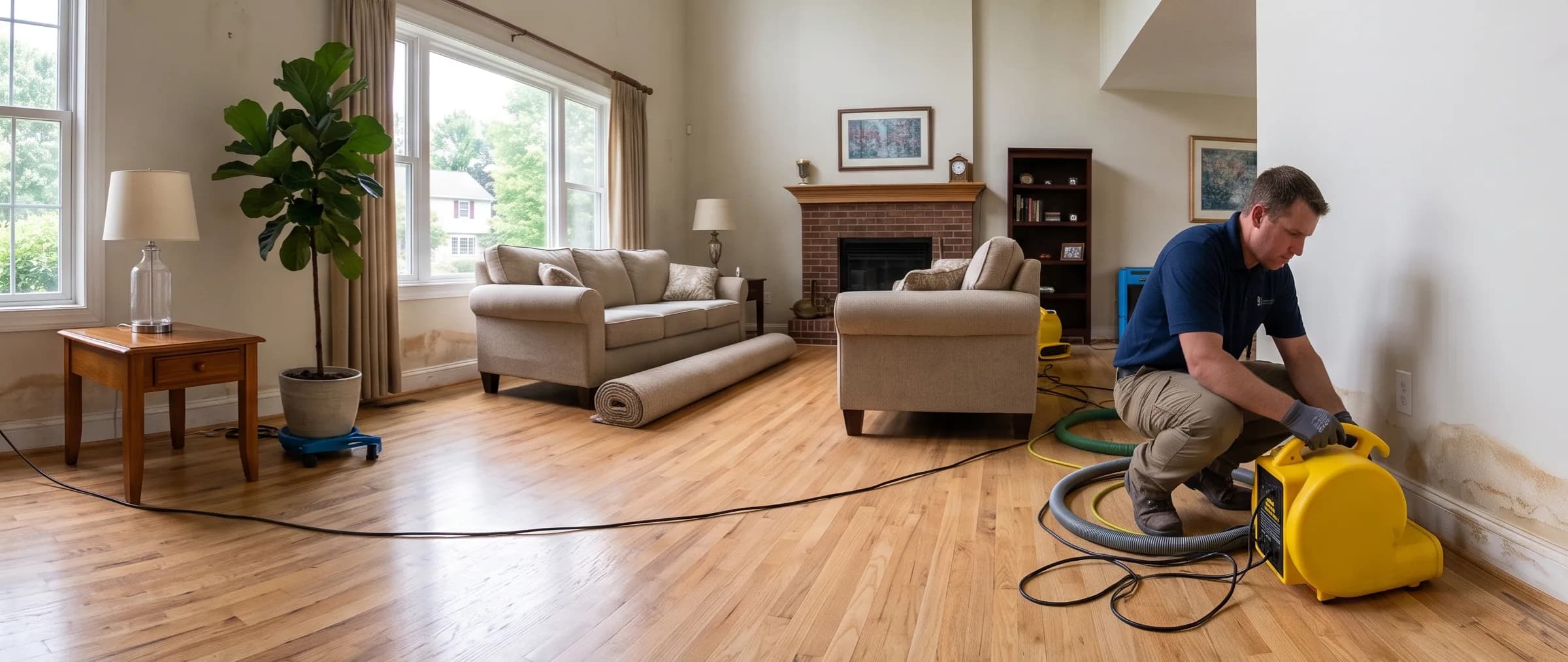

Water damage restoration disrupts daily life in ways that go beyond the repair work itself. Equipment runs around the clock, technicians move through your home on a schedule you don't fully control, and you'll be asked to make decisions about your property while you're still adjusting to the damage itself, whether this started as a slow leak or full-blown emergency water damage. Knowing what's coming lets you plan around it instead of reacting to it as it happens.
Water damage restoration is the professional process of extracting standing water, drying affected materials, and repairing structural damage in a home, carried out under the ANSI/IICRC S500 standard. Each phase of the water damage restoration process involves specific equipment and timelines that a technician manages from start to finish. Living through that process is a separate experience: your schedule, your access to rooms, and the decisions you'll be asked to make along the way.
Key insights
- Equipment runs for days, not hours. Drying equipment typically stays on continuously for 3 to 5 days, and turning it off early lets moisture return to materials that were starting to dry.
- The noise is louder than most people expect. Air movers and dehumidifiers commonly produce 70 to 75 decibels, below OSHA's 85-decibel occupational action level but still loud enough to disrupt sleep and conversation in nearby rooms.
- Rooms with equipment running get noticeably warmer. Dehumidifier exhaust typically runs 20°F to 30°F above room temperature, which can push an affected room into the mid-90s even with air conditioning running.
- Whether you can stay home depends on category, class, and containment. Contained, single-room damage with clean water is usually livable; sewage, lost utilities, or damage spread across multiple rooms usually isn't.
- You'll approve key decisions within the first day or two. Materials handling, cleaning method, and drying scope are typically decided during or right after the first visit, and each affects both cost and timeline.
- A moisture reading, not a visual check, ends the job. Technicians compare readings in the affected area against an unaffected reference room, and equipment stays in place until those readings match.
Preparing your home and family before work begins
Preparing for a water damage crew mainly means documenting the damage yourself and clearing the affected area of anything you don't want a crew handling, both done before extraction starts. A few minutes of prep before the first visit protects what matters most and speeds up the work once technicians arrive, so it helps to work through a short water damage restoration checklist before that first knock on the door.
 Photos taken before extraction give homeowners independent documentation for an insurance claim, separate from whatever records the restoration company keeps for its own file.
Photograph the damage before anything gets moved
Take wide shots of each affected room and close-ups of visible damage before extraction starts, since materials that get removed or discarded can't be photographed afterward. These photos support your own insurance claim independently of whatever documentation the restoration company keeps for its records.
Clear a path to the affected area
Technicians will be carrying equipment and hauling out wet materials, so a clear path from the front door to the damage speeds up the first visit considerably.
Set aside anything irreplaceable
Photos, documents, and sentimental items should be moved by you, not left for a crew that doesn't know their significance.
Arrange for pets to be elsewhere on the first visit
Open doors, unfamiliar equipment, and strangers moving through the house create stress for pets and safety risks for technicians working around them.
Note your Wi-Fi password and any door codes for the crew
If you won't be present for every visit, sharing access details upfront avoids delays and repeated phone calls during the drying period.
If you're not yet certain the damage is significant enough to call a professional, checking for signs of water damage like staining, soft spots, or a musty smell first is worth the extra few minutes.
What happens when the restoration crew arrives
A restoration crew's first visit focuses on stopping further damage and documenting what happened, not on repairs. Expect an inspection, photos, moisture readings, and the start of water extraction, usually within a few hours of the call. The technician walks the affected areas with a moisture meter, notes which materials are wet versus soaked, and sets a plan for what gets removed, what gets dried in place, and what needs replacing later.
 IICRC S500 assigns a water category at this stage based on contamination level, which sets the PPE and containment measures used for the rest of the job.
You'll likely be asked to sign a work authorization before equipment goes in, since most companies won't begin extraction without one. This is also a good time to confirm the company's licensing and water damage restoration certifications if you haven't already checked them. The crew typically moves furniture and belongings out of the wet area themselves, though you may be asked to help clear anything fragile or particularly heavy first.
Extraction with a truck-mounted or portable pump usually starts on the same visit, before the crew leaves, since standing water left overnight adds cost and risk. Dry areas nearby generally stay untouched during this first pass; the crew focuses equipment and attention on whatever is actually wet.
The category and class assigned during this first walkthrough set the baseline for the entire job, including how much water damage restoration equipment gets deployed and how long it runs. A small, contained leak and a multi-room flood start with the same first visit, but everything that follows scales differently from there.
Deciding whether to stay in your home or relocate
Whether you can stay home during restoration depends on where the damage is, how contaminated the water is, and how much of the house the drying equipment needs to reach. Single-room damage with clean water is usually livable, while sewage, lost utilities, or damage spread across multiple rooms usually isn't.
 Category 2 or 3 water typically triggers a full containment barrier and negative air pressure, while Category 1 losses usually only need equipment placed in the open room.
The water's water damage categories affects the health risk of staying nearby while cleanup is underway. Category 1 water comes from a clean source like a supply line, while Category 2 and 3 water carry contamination that changes what protective measures the crew uses around you and your family.
When damage is contained to one room, most companies seal it off with plastic sheeting and set up negative air pressure to keep dust, moisture, and odor from spreading into the rest of the house. That containment is usually enough to keep the rest of your home functional while the affected room dries.
The water's water damage classes affects how much equipment gets deployed and how many rooms it runs in. A Class 1 loss confined to one wall might need a single air mover and a dehumidifier, while a Class 3 or 4 loss can mean equipment running through several rooms at once, which makes staying home a lot harder to manage day to day.
The water involved a sewage backup or Category 3 contamination
Health risk, not comfort, drives this one. A sewage backup or other Category 3 water requires more protective equipment for anyone in the area, and prolonged exposure isn't worth the savings on a hotel stay.
The home has lost running water, electricity, or a working bathroom
A home without basic utilities isn't functional regardless of how the restoration work is going, and most policies treat this as an automatic uninhabitability trigger.
Drywall or flooring removal spans more than one room
Once demolition moves beyond a single contained area, dust, debris, and open wall cavities make normal daily routines difficult to maintain safely.
A household member is very young, elderly, or has a respiratory condition
The CDC identifies these groups as more sensitive to air quality changes in a home that's still damp, even before any mold is visible.
The affected area is a bedroom or the home's only bathroom
Losing access to a bedroom or your only bathroom for several days is usually enough on its own to justify temporary relocation, separate from any health consideration.
Most homeowners insurance policies include additional living expenses coverage, sometimes called loss of use, which pays for a hotel and meals when a covered loss makes the home unfit to live in, separate from whether homeowners insurance covers water damage itself. Coverage usually requires the home to be documented as uninhabitable rather than simply inconvenient, so photos of the damage and a written note from the restoration company on why relocation was necessary help support the claim. Check your policy's ALE limit and time cap before booking a long-term stay, since the coverage doesn't renew automatically if the job runs longer than expected.
What the noise, heat, and air quality will actually be like
Restoration equipment is loud and it runs continuously, not intermittently. Air movers and dehumidifiers commonly produce 70 to 75 decibels while operating, and most companies leave them running 24 hours a day for the full 3 to 5 day drying period, since shutting them off overnight slows drying and can let moisture return to materials that were starting to dry.
 Dehumidifier exhaust runs 20 to 30 degrees warmer than room temperature, which is why an actively drying room feels noticeably hotter even with air conditioning on.
For comparison, OSHA sets 85 decibels as the action level requiring hearing protection for workers exposed over a full 8-hour shift. Equipment in the 70 to 75 decibel range sits below that threshold, but it's still loud enough to disrupt sleep and conversation in nearby rooms, especially at night when background noise drops.
Dehumidifier exhaust typically runs 20°F to 30°F warmer than the surrounding air, so a room with equipment running can climb into the mid-80s to mid-90s even with air conditioning working against it. This is intentional. Warmer, moving air pulls moisture out of materials faster, and turning equipment down to cool the room slows the entire drying timeline.
Dust and particulates increase in the air as materials dry, especially once drywall or flooring gets cut out, and EPA guidance recommends N-95 respirator use during flood cleanup for exactly this reason. Anyone with asthma, allergies, or another respiratory condition should plan to spend less time in rooms where materials are actively being removed.
| What's happening | Normal, or worth a call |
|---|---|
| Equipment running loudly around the clock | Normal |
| Room temperature climbing into the high 80s or low 90s while drying is active | Normal |
| A musty smell that fades gradually over several days | Normal |
| A musty or sewage odor that gets stronger after day two or three | Call your company |
| Equipment shutting off on its own or tripping breakers | Call your company |
| New staining, dripping, or standing water appearing | Call your company |
| Technicians entering outside scheduled visits without notice | Call your company |
Decisions you'll be asked to make during the job
You'll be asked to approve four main decisions within the first day or two: whether damaged materials get dried in place or removed, whether your belongings get cleaned on-site or packed out, which rooms get drying equipment, and how the job gets billed. Each one affects both the final cost and how long the job takes, so get the choice in writing before work proceeds.
 A written scope of work at this stage should specify whether materials get dried in place or removed, since that single decision affects cost more than any other factor on the job.
The biggest decision is usually whether damaged materials get dried in place or removed and replaced, a call that affects water damage restoration cost more than almost any other factor on the job. Carpet padding and insulation are rarely salvageable once soaked, but drywall and some flooring can sometimes be dried rather than cut out, depending on how long the material was wet.
You'll also decide between on-site cleaning of your belongings and a full pack-out, where contents are removed to an off-site facility for cleaning and storage until the space is ready. Pack-out adds coordination time but can be the better option when a large portion of a room needs to be gutted.
Drying scope, which rooms actually get equipment, usually tracks the water's category and class rather than which rooms look wet to the eye, since moisture can travel into adjoining rooms through shared walls and subfloor. Payment path is worth settling early too: ask whether the company bills your insurer directly or expects you to pay and seek reimbursement, since that changes what you owe out of pocket up front.
Confirming these details before authorizing work is part of choosing a water damage restoration company: a written scope of work and a clear mitigation-versus-reconstruction split protect you from disputes over what was actually approved.
What it looks like when the job is finished
The job isn't finished when the equipment gets picked up. It's finished when a technician's moisture meter confirms the affected materials have returned to a normal, dry reading, not when the space simply looks and feels dry.
 A reading that matches an unaffected reference room, not a visual check, is what confirms a wall is fully dry and ready to close out the job. Residual staining like this often remains after drying is complete and typically just needs a stain-blocking primer rather than removal.
Expect a final walkthrough where the technician takes reference readings in an unaffected room and compares them against readings in the areas that were drying, since materials can look dry days before they actually are. If any reading is still elevated, expect equipment to stay in place a bit longer rather than being removed on schedule.
Before signing off, it's worth confirming what was actually done matches what was authorized, and questions to ask a water damage restoration company includes several specific to closing out a job, including what documentation you should receive for your own records and your insurer.
Frequently asked questions
Do I need to be home when technicians come?
No, you don't need to be present for every visit once the initial walkthrough is done and the equipment is running. Most companies only need access, a door code or a hidden key works, and will document each visit with photos and moisture readings you can review afterward.
Can I turn off the drying equipment if it's too loud?
No, turning equipment off, even overnight, slows drying and lets moisture move back into materials that were starting to dry out. If the noise is a problem, ask the crew about repositioning units farther from bedrooms instead of shutting them down.
Will the equipment run overnight?
Yes, air movers and dehumidifiers typically run 24 hours a day for the full drying period, usually 3 to 5 days. Continuous airflow is what keeps the drying timeline on schedule.
How many technicians will be in my home at once?
Usually one to three technicians for a residential job, depending on the size of the loss. A single-room leak might involve one technician for most visits, while a multi-room loss can bring a larger crew for extraction and setup on the first day.
Can I use my kitchen and bathroom during restoration?
Yes, in most cases, unless the damage is located in one of those specific rooms. Containment barriers around the affected area are designed to keep the rest of the home, including plumbing and appliances, fully functional.
Will I need to move my own furniture?
Not usually. Furniture inside the wet area typically gets moved by the crew as part of extraction, and large or bulky pieces are often left in place on blocks or plastic sheeting rather than carried out. You'll mainly be asked to clear a path so equipment can get through, not to lift anything yourself.
What happens if mold is discovered during the drying process?
Work usually pauses in that area while the company assesses the scope, since mold changes the containment and PPE requirements for anyone working nearby. Depending on the extent, this can mean bringing in a mold remediation specialist before drying resumes.
What if I'm not satisfied with how the crew is treating my home?
Raise it with the crew lead or project manager directly and as soon as it happens, not after the job is finished. A legitimate company will document the issue and adjust; if it isn't resolved, escalate to the office managing your job before the final walkthrough.
What's different if I'm renting?
Your landlord typically makes the hiring and authorization decisions on a job like this, since the property and its insurance policy belong to them, not you. You can still document damage to your own belongings for a renters insurance claim, and ask for regular updates on the timeline even though you won't be the one approving the work.
Do water stains need to be removed, or can they just be painted over?
Painted over, in most cases. A water stain by itself doesn't mean the material is still wet or compromised, it's tannin or mineral residue left behind by the water, not a sign of hidden moisture. If the drywall was dried in place rather than removed, a stain-blocking primer followed by regular paint typically covers it for good. Removal only becomes necessary if the material failed to dry properly, was contaminated by Category 2 or 3 water, or shows other damage like warping or crumbling.
Sam Hickerson is the founder of RestoreAdvisor and writes consumer guides on mold remediation, water damage restoration, inspection, testing, and home recovery. His work focuses on helping homeowners understand costs, risks, and when to call a professional. He draws on guidance from the EPA, CDC, IICRC, and other authoritative sources to make complex home issues easier to navigate.