
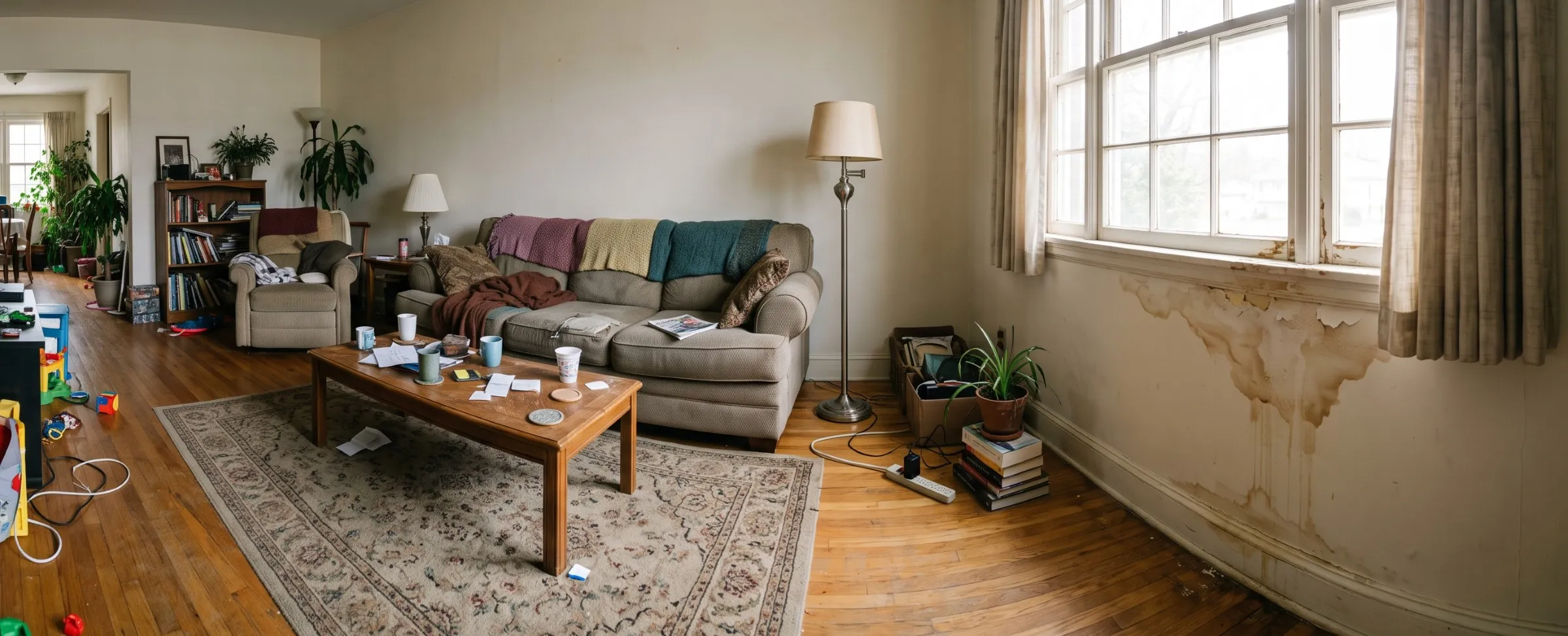

Water pooling at the base of a window, or a damp line creeping across the floor by an exterior door, almost never means the glass or the door panel itself is broken. It means the seal around the opening has failed somewhere, and water is finding its way through a gap that used to be sealed. Finding exactly where that gap is comes first, since it determines how to respond in the next few minutes and what repair and restoration will actually cost. Water intrusion at a window or door opening is water damage under IICRC S500, the industry standard for water damage restoration, and the fix almost always starts at the seal, the flashing, or the threshold rather than the window or door itself.
The International Residential Code requires flashing at every exterior window and door opening specifically because this junction between the wall and the opening is one of the most common places water gets into a house. Under IRC Section R703.4, flashing at these openings has to direct water back to the exterior wall finish or the water-resistive barrier behind it, and when that flashing fails, ages, or was never installed correctly, water travels along the same path the code was designed to prevent.
Key insights
- Most window and door leaks are maintenance failures, not accidents. A leak traced to worn caulk, a torn door sweep, or aging flashing is usually treated as gradual damage that a standard homeowners policy excludes rather than a sudden, covered loss.
- Water usually enters at the seams, not through the glass or the door panel. Failed sealant, flashing, weep holes, and threshold gaps account for most intrusion points on both windows and doors.
- A leak can run for a year before a stain appears. Water travels down inside the wall cavity and along the sill before it reaches a visible surface, so the framing and insulation are often wetter than the drywall suggests.
- The mold-risk window starts fast. The EPA's 24 to 48 hour timeframe for mold growth begins the moment water reaches a porous material, typically the drywall, insulation, or subfloor beneath the opening, not when a stain becomes visible.
- A window or door specialist and a water damage restoration company solve two different problems. One stops the water from getting in again. The other dries out and repairs what the water already reached.
- Fixing the seal usually costs far less than the water damage it caused. Resealing or replacing weatherstripping runs $150 to $600, while the resulting drywall, insulation, or subfloor repair can run into the thousands once a leak has gone unnoticed for months.
What to do right now
Contain the water first, then work outward from the opening to find and slow the source before it spreads further into the wall or floor. Move quickly if the leak is active, since a small trickle during a storm can soak drywall and framing in a matter of hours.
 A towel or shallow container only holds a few minutes' worth of water before it needs wringing out, so a wet or dry shop vacuum is worth keeping on hand for anything more than a light drip.
Contain the water
Set down towels or a shallow container at the sill or threshold, and move anything nearby, rugs, boxes, furniture, off the floor so it doesn't wick up moisture.
Stop what you can from the outside
If it's safe to do so and rain is actively driving the leak, a strip of painter's tape or a taped-down sheet of plastic over an obvious gap can slow the flow until a proper repair happens.
Cut power to a nearby outlet if water is close to it
Switch the breaker off for any outlet or fixture the water is reaching or could reach. Never touch a wet outlet or switch plate directly to test it.
Photograph the damage before cleaning it up
Take wide shots of the room and close-up photos of the stain, the frame, and any standing water. This record matters if you end up filing a water damage insurance claim later.
Start airflow and call for an assessment
Run a fan on the affected area and call a window or door specialist to address the leak itself. If drywall, insulation, or flooring has already been soaked, bring in a restoration company at the same time rather than waiting to see how bad it gets.
What not to do
Painting over a stain, ignoring a dry spell, and delaying documentation are the most common mistakes that turn a small window or door leak into a larger repair. Each one either hides the moisture or gives it more time to spread before anyone addresses it.
Don't just paint or caulk over a stain
A stain that looks dry on the surface can still sit above wet framing or insulation. Sealing over it without confirming dryness traps the moisture in place.
Don't assume a single dry spell means the leak stopped
Many window and door leaks only show up during wind-driven rain or heavy storms. A dry week doesn't rule out an active problem.
Don't ignore soft or spongy drywall near the opening
Pressing gently on the wall below or beside a window is a fast way to catch hidden saturation before it spreads further or the drywall fails outright.
Don't wait on your insurer before drying the area
Most policies require you to take reasonable steps to prevent further damage, and delaying extraction and drying can itself become grounds for a reduced payout.
Who to call
A window or door leak involves two different specialists, and calling the right one first saves time. A window and door installer, a handyman, or a carpenter fixes the seal, flashing, threshold, or frame itself. A water damage restoration company handles what happens after the water already got in: extraction, drying, and repairing drywall, insulation, or flooring.
 A reading of 23.4 percent this close to a window frame is well above the roughly 17 percent threshold that signals the cavity behind the wall is still wet.
A restoration company confirms hidden moisture the same way it does for any other water damage cause: with a moisture meter for an exact reading behind the wall, and often a thermal imaging camera to spot a cooler, damp patch that hasn't reached the surface yet. That step matters for a window or door leak in particular, since it's one of the easier causes of water damage to under-diagnose from a stain alone.
For a leak that's been going on for a while or where the extent of the damage is unclear, it's worth calling both at once rather than waiting for one to finish before starting the other. A restoration company can also confirm whether hidden moisture remains behind a wall even after the seal itself has been fixed. If a company is coming out for the water damage side, it's reasonable to ask the same questions to ask a water damage restoration company that apply to any other cause.
Is it a leak, or something else
Not every damp patch near a window or door is an active leak. Condensation, a nearby roof problem, and irrigation spray hitting the wall can all look similar at first glance but each points to a different fix.
 Condensation only affects the glass itself and clears within an hour or two as the room warms, while water reaching the sill or the surrounding wall points to an actual seal failure.
A stain centered on the window head that spreads upward toward the ceiling usually isn't the window's fault at all. That pattern points to a roof leak higher up the wall, since water finds the same route down through the same wall cavity regardless of which opening it started near.
| Lookalike | What it looks like | How to tell the difference |
|---|---|---|
| Condensation | Beads of water on the inside glass surface, sometimes running down onto the sill | Clears within an hour or two as the room warms; only affects the glass, never the wall below it |
| Roof or flashing leak above | A stain centered on the window head that spreads upward toward the ceiling | Trace the stain up the wall; if it runs toward the ceiling rather than down from the frame, the source is likely a roof leak rather than the window itself |
| Sprinkler or irrigation spray | Staining low on an exterior wall, worse on one side of the house, tied to a watering schedule | Check whether an irrigation head or hose is aimed at the wall; damage clusters near ground level rather than around the frame |
| Interior plumbing above or beside the opening | A stain that appears regardless of weather | A leak that shows up on dry days as readily as wet ones usually isn't coming from outside at all |
A simple two-person water test can confirm which one you're dealing with before opening up a wall. One person sprays a garden hose in a light, steady pattern starting at the sill and working upward while a second person watches from inside; water that shows up within the first minute at the sill points to the threshold or weep system, while water that only appears after several minutes at the top of the frame points to flashing higher up.
A window or door that never leaks in a light rain can still take on water during a storm, since horizontal wind pressure forces water into gaps that a straight-down rain would simply run past. If leaking only happens during high-wind events, that pattern points toward a sealing or flashing gap on the windward side of the opening rather than a chronic failure, and it's the same mechanism behind storm and hurricane water damage.
A leak at a window or door becomes a form of water damage restoration the moment it soaks drywall, insulation, or flooring, even though the fix for the opening itself belongs to a different trade entirely. Treating the two halves of the job separately, rather than assuming one contractor handles both, is what keeps a small leak from turning into a bigger repair bill.
Signs of window and door water damage
A window or door leak typically shows up first as discoloration or a stain near the frame, peeling or bubbling paint on the trim, or a musty odor with no visible spot at all. These signs often appear before any dramatic puddle, since water usually travels down inside the wall for a while before enough of it reaches a visible surface.
 Paint that bubbles rather than just discolors means water has been sitting behind it long enough to break the paint's bond with the wall, not merely wick through the surface.
How far a sign has spread usually says more about severity than how dark it looks. A tight, coin-sized stain right at the corner of a frame is a minor, contained leak, while discoloration or softness that has traveled a foot or more along the wall or baseboard means water has already been moving through the cavity for a while.
| Sign | Where it shows up | What it usually means |
|---|---|---|
| Discoloration or a ring-shaped stain | Wall below or beside the frame, or the ceiling above a door | Water has been tracking along the same path repeatedly |
| Peeling or bubbling paint | Interior trim, the sill, or the wall surface near the opening | Moisture is pushing through from behind the finish |
| Soft or spongy drywall | Directly under a window or beside a door frame | The drywall paper has absorbed enough water to lose its rigidity |
| Musty odor with no visible stain | Near the opening, especially in a closed room | Hidden moisture inside the wall cavity, often before a stain has surfaced |
| Warped or swollen trim | Window sill, door casing, or the door itself | Wood has absorbed water repeatedly over time |
| Rising or unexplained increase in the water bill | Not directly tied to the window or door, but worth ruling out | Confirms the source is a leak rather than condensation or spray |
Cross-checking a suspected leak against the broader signs of water damage is worthwhile if more than one area of the home shows staining. A window or door is only one of several common entry points, and staining in an unrelated room usually means a second source is involved.
Common causes of window and door leaks
Windows and doors fail at different points, but both usually fail at the seams rather than at the material itself. Failed caulk, damaged flashing, a misaligned threshold, and blocked drainage account for most window and door leaks, and the mechanics unique to each are broken down separately afterward.
 Exterior caulk typically fails from the inside out within three to five years, so a bead that still looks intact on the surface can already have separated from the frame underneath.
Failed or missing caulk and sealant
Caulk shrinks, cracks, and separates from the surrounding surface as it ages, typically within three to five years outdoors, opening a direct path for water at the joint between the frame and the wall.
Damaged or improperly installed flashing
Flashing above an opening is supposed to direct water down and away from the frame per the IRC's flashing standard. When it was installed in the wrong sequence, is corroded, or was never installed at all, water runs behind the siding instead of over it.
A threshold set below the door's seal
If the threshold sits even slightly lower than the door's bottom seal, water running down the face of the door skips over the seal entirely and flows straight in, especially during wind-driven rain.
A worn or torn door sweep and weatherstripping
The rubber or vinyl gasket at the bottom and sides of a door compresses and cracks with age and use, and once it stops making full contact, it stops doing its job.
Blocked or missing weep holes
Weep holes let water that gets behind the window drain back out. When they're painted over, caulked shut, or clogged with debris, that water has nowhere to go but inward.
A failed glazing seal on an older window
On older single or dual-pane windows, the seal or glazing compound around the glass itself can fail, letting water in around the pane rather than around the frame.
Grading or hardscape sloping toward the opening
A patio, walkway, or section of yard that slopes toward a door or ground-level window sends water directly at the opening every time it rains, regardless of how sound the seal is. It's the same grading and drainage issue behind foundation water damage more broadly, since water pooling against the house doesn't care which opening it reaches first.
Window-specific failure points
Windows fail primarily at three locations: the sealant joint where the frame meets the wall, the flashing above the opening, and the weep system built into the frame itself. Each fails for a different reason and points to a different fix.
 Flashing above an opening is required under IRC Section R703.4 to direct water back out over the siding, and a gap here sends water down inside the wall cavity instead of onto the sill.
The top of the frame is usually the most consequential failure point, since a gap there lets water run down inside the wall cavity behind the siding rather than simply dripping onto the sill. Sides and bottoms tend to fail from caulk shrinkage and are often easier to diagnose because water shows up close to where it entered. A window that leaks from multiple sides at once usually points to damaged sealant along the full perimeter rather than one isolated gap.
| Window type | Where it leaks | Diagnostic tip |
|---|---|---|
| Double-hung | The meeting rail where the upper and lower sash overlap, and the bottom track | Check whether the sash latches fully closed; a sash that doesn't lock tight lets rain past the meeting rail |
| Casement or awning | The hinge corner where the sash swings open, and the crank mechanism seal | Leaks concentrate at the top hinge corner rather than spreading evenly around the frame |
| Sliding or horizontal | The bottom track and its weep holes | Debris in the track is the most common cause; clear it before assuming the seal itself has failed |
| Bay or bow | The seams where the individual window units join, and the roof or head flashing above the projection | A leak here often traces to the small roof over the bay rather than to the windows themselves |
Older wood-frame windows carry an added risk that vinyl and fiberglass frames don't: the wood itself absorbs water and can begin to rot at the sill or the lower corners of the frame, which is where paint failure and softness typically show up first. A double-pane window that's fogging between the panes is a separate problem from a leak; that's a failed gas seal inside the glass unit itself, not water intrusion into the home, and it doesn't call for the same response.
Door-specific failure points
Exterior doors fail primarily at the threshold, the door sweep, and the side jambs, and diagnosing which one is responsible usually comes down to where the water first appears on the floor. Water pooling directly under the door, spread evenly across the threshold, points to the sweep or the threshold's fit. Water tracking in along one side and following the baseboard away from the door points to jamb flashing instead.
 Once a door sweep stops making full contact along its whole length, it stops shedding water the way it's designed to, even though it can still look intact from a few feet away.
Sliding patio doors add a track system to the equation. Debris, dirt, or a damaged weep channel in the track can trap water that's supposed to drain back outside, and a track that looks clean on top can still be clogged underneath. French doors and double doors introduce a second failure point at the astragal, the strip where the two doors meet, which needs its own weatherstripping and seal separate from the outer frame.
| Door type | Where it leaks | Diagnostic tip |
|---|---|---|
| Hinged or swing door | Threshold and the hinge-side jamb | Water pooling evenly across the threshold points to the sweep or the threshold's fit rather than the jamb |
| Sliding patio door | The track and the weep channel underneath it | A track that looks clean on top can still be clogged underneath, trapping water that's supposed to drain out |
| French doors or double doors | The astragal where the two doors meet, and both side jambs | Water tracking in from the center of the opening rather than one side usually means the astragal seal has failed |
| Storm or screen door | Drainage holes in the bottom rail | A clogged storm door can trap water against the primary door behind it, producing a leak that looks like it's coming from the main door |
A door that drags on its threshold, sits visibly out of square, or has developed a gap wide enough to see daylight through usually isn't a sealing problem at all. That pattern points to the frame or the surrounding structure shifting, which calls for a structural assessment rather than a second round of caulk.
Window wells and basement window leaks
A leaking basement or ground-level window is usually a window well problem rather than a window problem. The well outside collects rainwater and groundwater against the foundation, and once it can't drain that water away fast enough, the excess finds its way in around the frame or through the foundation wall beside it.
Three failure points account for most window well leaks: a cracked or missing well liner that lets soil and water sit directly against the foundation, a drain at the bottom of the well that has silted shut, and a missing or flat well cover that lets rain collect faster than it can drain. A well packed with leaves and debris every fall loses whatever drainage capacity it had even when the drain itself is still intact.
This kind of leak behaves more like a below-grade water problem than a typical window leak. It produces the same staining, musty odor, and hidden moisture that any other basement water damage source does, and it's worth ruling out a wider foundation drainage problem rather than assuming the well itself is the only thing at fault.
Where the water travels
Once water gets past the seal, it typically follows gravity down through the wall cavity rather than staying near the point of entry. From the top or sides of a window frame, water runs down inside the cavity and soaks the insulation, the sill plate, and the framing before it ever reaches the interior drywall. From a door threshold, water spreads across the subfloor first and can wick sideways under baseboards and into adjoining rooms before a visible stain appears anywhere.
 Insulation and the sill plate absorb most of the water before it ever reaches the interior drywall, which is why a small surface stain often means a much larger area is already wet underneath.
Under IICRC S500, the industry's water damage restoration standard, this is classified the same way as any other water intrusion. The water damage categories system covers contamination level, and window and door leaks are almost always Category 1, since the water is rainwater or condensation rather than contaminated.
How hard the resulting damage is to dry, and how much material has absorbed water, falls under the separate water damage classes system. A window or door leak caught early is usually a Class 1 or 2, affecting a limited area and a couple of material types, while a leak that's been running for months can push into Class 3 or 4 as it spreads into framing, subfloor, and multiple rooms.
A ground-level door with a compromised threshold and no visible drainage path can direct enough water into a subfloor to cause structural concerns over time. At that point, an engineer's opinion carries more weight than a contractor's estimate, since the question is no longer just cosmetic.
Repair or replace
Whether a leaking window or door needs a repair or a full replacement comes down to the condition of the frame and how many times the seal has already failed. Fixing the seal is almost always the right first move; replacement becomes necessary once the underlying material has been compromised.
 Old caulk needs to come out completely before resealing, since new sealant bonds poorly to old caulk and can trap any moisture already behind it.
A rough rule of thumb: if resealing or a targeted repair would cost more than about a third of a full replacement, replacement is usually the better long-term value. A repair on a compromised frame rarely holds as long as fixing sound material would, so the cheaper fix now often becomes the more expensive one within a year or two.
| Condition | Repair usually works | Replacement is usually needed |
|---|---|---|
| Frame and sash or door panel | Solid, no soft spots or visible rot | Soft, crumbling, or visibly rotted at the sill or corners |
| Number of past repairs | First time resealing this opening | Same spot has needed resealing more than once or twice |
| Glazing or glass seal | Clear, no fogging between panes | Fogged double-pane unit, indicating a failed gas seal |
| Threshold and hardware | Level and intact, just worn weatherstripping | Warped, cracked, or set at the wrong height for the door |
| Cause of the leak | Caulk, flashing, or weatherstripping failure alone | Frame out of square or structural settling behind the opening |
DIY vs professional
A contained leak with no visible damage beyond the immediate area is generally DIY-safe to reseal. Removing old caulk with a utility knife, cleaning the joint, and applying a fresh bead of exterior-grade sealant is a manageable weekend project for most homeowners, as is replacing a torn door sweep.
 A reading like 15.6 percent, under the roughly 17 percent elevated threshold, is the confirmation to look for before sealing the wall back up with paint or trim.
A basic moisture meter, generally $30 to $50, is worth having even for a DIY repair. It confirms the wall behind the opening has actually dried before you close it back up with paint or trim, rather than relying on how the surface looks or feels.
| Factor | DIY-appropriate | Call a professional |
|---|---|---|
| Extent of visible damage | Surface staining only, drywall firm to the touch | Soft drywall, visible mold, or damage across more than one opening |
| Duration | Recently noticed, first occurrence | Recurring leak or unknown duration |
| Materials affected | Caulk, sealant, or weatherstripping only | Framing, subfloor, or insulation |
| Confidence in diagnosis | Source is clearly identified | Source is unclear or seems to come from multiple points |
If a moisture meter reading behind the drywall stays above roughly 17 percent after the leak has stopped, that's a sign the cavity hasn't dried and a professional assessment is worth the call before closing the wall back up. Sealing drywall or trim over a cavity that's still elevated is one of the more common reasons a repair has to be redone within the same year.
Window or door leak cost
The cost of a window or door leak splits into two separate categories that are easy to confuse: fixing the seal itself, and repairing whatever water damage resulted. Sealing or replacing weatherstripping typically runs $150 to $600, while a full window or exterior door replacement runs $600 to $2,500 depending on size and material. The water damage restoration side is priced separately.
 Reaching a second-story opening for the exterior repair adds equipment rental or scaffolding cost before the interior water damage work even starts.
Upper-floor and hard-to-reach openings typically add to the total before the interior water damage work even starts. Scaffolding or lift rental for the exterior repair itself can add several hundred dollars on a second-story window, on top of whatever the restoration side ends up costing.
| Scenario | Restoration cost | Notes |
|---|---|---|
| Caught early, surface staining only | $150–$500 | Cleaning and drying, no material replacement |
| Localized drywall or insulation, one opening | $500–$2,500 | One section of wall cut out and replaced |
| Multiple openings or hidden cavity saturation | $2,500–$8,000 | Extends into adjoining wall sections or the subfloor |
| Long-term leak with framing or structural involvement | $8,000–$20,000+ | Sill plate, jack studs, or subfloor replacement required |
Labor to access the damage, not materials, tends to be the biggest driver of cost here. Cutting into a finished wall, drying a cavity properly, and matching existing paint, trim, or flooring all add time beyond the material cost itself.
Does insurance cover it
Sometimes, but this is one of the more commonly denied categories of water damage claims. Under a standard homeowners policy, coverage generally hinges on whether the damage was sudden and accidental or developed gradually over time, and a window or door leak traced to worn caulk, aging flashing, or deteriorated weatherstripping is close to the textbook definition of gradual, maintenance-related damage that most policies exclude.
There's an important exception. A single, sudden event, a storm that drives rain through a window during unusually severe wind, or a door blown open and left exposed during a storm, can shift the determination toward covered rather than excluded, since the cause was a discrete event rather than years of wear. An adjuster will typically look at how long the interior evidence suggests the leak has been occurring, since months of staining and buildup point toward a gradual cause even if the immediate trigger was a single storm.
Maintenance-related exclusions are, according to NAIC, one of the most common reasons water damage claims get denied overall. Window and door leaks sit squarely in that category more often than most other water damage causes, since the underlying cause is almost always years of wear rather than a single event.
The same sudden-versus-gradual standard applies to water damage claims generally, not just this cause. Reviewing how that determination gets made before filing, rather than after a denial, is the more useful order to do it in.
Renters, landlords, and condos
Responsibility for a leaking window or door falls on the landlord in a rental, and on either the owner or the association in a condo depending on how the governing documents classify the opening. Both situations turn on who is responsible for maintaining the building envelope itself, not on who happened to notice the leak first.
In a rental, windows, exterior doors, and their seals and flashing are structural components of the building, covered under the implied warranty of habitability in nearly every state, so repairing them is the landlord's obligation once notified, not the tenant's. Documenting the leak, notifying the landlord in writing, and following up if there's no response works the same way here as it does for water damage in a rental generally, since nothing about a window or door leak changes a tenant's rights or the landlord's timeline.
Condo ownership adds a wrinkle. Some governing documents classify windows and exterior doors as limited common elements maintained by the association rather than the unit owner, while others assign that responsibility to the individual owner. Checking the declarations before assuming either way is worth the time, since the same association-versus-owner determination that governs any other water damage in a condo situation applies here too.
Preventing window and door leaks
Preventing a window or door leak comes down to catching worn caulk, weatherstripping, and drainage points before they fail completely. A short annual check at each opening catches most of these before they let water through during the next heavy rain.
 A weep hole clogged with paint or debris traps water behind the frame instead of letting it drain back out, turning a working drainage system into a hidden leak point.
Inspect and replace caulk on a schedule
Check exterior caulk around every window and door once a year, and plan to replace it every three to five years regardless of how it looks, since it fails from the inside before it fails visibly.
Replace door sweeps and weatherstripping before they fail completely
A sweep that's compressed, cracked, or no longer making full contact with the threshold is a cheap, easy swap that prevents a much more expensive repair later.
Clear weep holes at least twice a year
Run a thin wire or pipe cleaner through window weep holes during regular cleaning to make sure paint, caulk, or debris hasn't sealed them shut.
Grade the ground and hardscape away from openings
Confirm the soil, patio, or walkway near any ground-level door or window slopes away from the house rather than toward it.
Watch ground-level and below-grade openings after storms
A basement window well or a walkout door takes on far more water pressure during heavy rain than an upper-floor opening, so check those spots first after any significant storm.
These window and door-specific habits work alongside the broader water damage prevention checklist covering plumbing, appliances, and the roof. Catching a failed seal before the next heavy rain is consistently cheaper than repairing what it lets in, since the repair itself rarely costs more than a few hundred dollars.
Frequently asked questions
Do I need a professional for a window or door leak, or can I fix it myself?
Yes, if the damage is limited to the seal itself. Cleaning out old caulk and applying a fresh bead, or swapping a worn gasket, takes an afternoon and basic tools. Once water has soaked into the framing, insulation, or subfloor, drying and rebuilding those layers correctly calls for equipment and verification most homeowners don't have on hand.
Does homeowners insurance cover water damage from a leaking window or door?
Sometimes, but often no. Insurers cover sudden, accidental damage and deny most of what they classify as gradual wear, which is where a slow window or door leak usually falls under standard homeowners insurance and water damage policies. A single storm or wind event that caused the leak improves the odds of coverage, since that's a discrete cause rather than years of a worn seal.
How can I tell if water is coming from the window itself or from the roof above it?
Look at where the discoloration sits relative to the frame. If it's spreading upward toward the ceiling from above the window, the water is most likely coming down from the roof or the flashing over it. If it's confined to the sill or the sides of the opening, the window's own seal is the more likely source.
What does it cost to fix water damage from a window or door leak?
Most jobs run $150 to $2,500 for a single opening caught before the leak reached the studs. Costs climb toward $8,000 or more when water has been getting in for months and framing, insulation, or subfloor across more than one room needs to come out.
Can a window or door leak cause mold?
Yes, and often before anyone notices the leak itself. Water that reaches drywall, insulation, or a wood sill can support mold growth within 24 to 48 hours, per the EPA, well before a visible stain forms on the surface. Visible mold at that point calls for a different specialist than the leak itself, and the distinction between water damage restoration and mold remediation determines which one to call first.
Is condensation on my window the same thing as a leak?
No, the two have different causes. Condensation is moisture from indoor air meeting a cold pane, and it fades on its own as the room warms up. An actual leak keeps depositing water at the sill or frame no matter how warm or dry the air inside is.
How long can a window or door leak go unnoticed?
A slow leak can run for a year or more before a stain appears on a finished surface. Water tracks down inside the wall cavity first, soaking insulation and framing long before it saturates enough drywall to show through the paint.
Should I replace the window or door, or just reseal it?
Reseal it as long as the underlying frame is still solid, since most leaks are a seal problem rather than a structural one. Once you're resealing the same spot for a second or third time, or the frame itself has started to soften, replacement stops being the more expensive option in practice.
Who is responsible for a leaking window or door in a rental?
The landlord almost always is. A window or door is part of the building itself, not something a tenant is expected to maintain, so a landlord who's been notified and doesn't act can be held to the same repair obligations as for any other structural issue, unless the tenant caused the damage.
Can a leaking door or window cause structural damage?
Yes, if the leak reaches the framing and goes uncorrected. Wood framing exposed to sustained moisture above roughly 20 percent can begin to decay, and a sill plate or jack stud that has stayed wet for months can weaken enough to need structural water damage repair rather than a simple patch.
Does a home warranty cover a leaking window or door?
Rarely for the window or door itself. Home warranties are built around mechanical systems and appliances, not building envelope components like windows, doors, caulk, and flashing, so a leak here is typically a homeowner or insurance matter rather than a warranty claim.
Do I have to disclose a past window or door leak when selling my home?
Yes, in nearly every state. A past window or door leak counts as a known material defect once it's been identified, and the same state-by-state disclosure rules that apply to disclosing water damage when selling a house apply here too, regardless of the leak's original cause.
Sam Hickerson is the founder of RestoreAdvisor and writes consumer guides on mold remediation, water damage restoration, inspection, testing, and home recovery. His work focuses on helping homeowners understand costs, risks, and when to call a professional. He draws on guidance from the EPA, CDC, IICRC, and other authoritative sources to make complex home issues easier to navigate.