
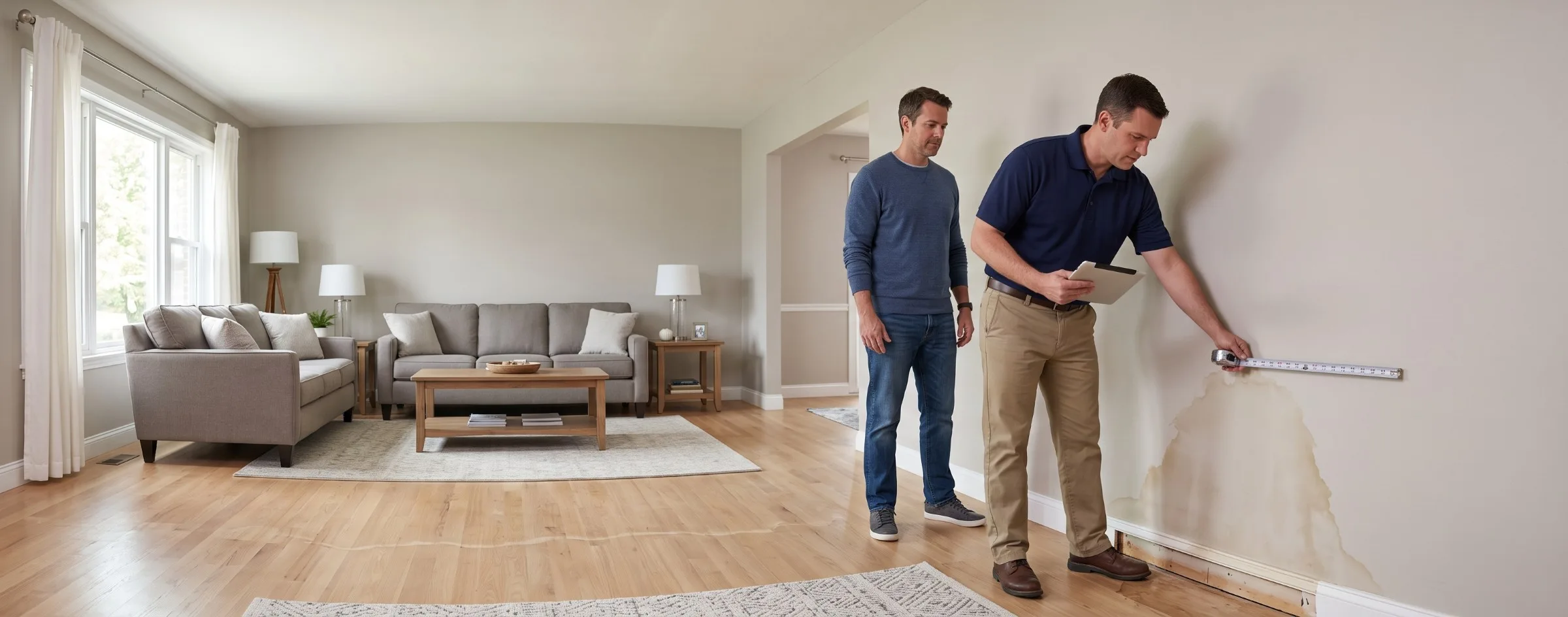

The adjuster's estimate for your water damage claim just arrived, and it runs 20 or 30 pages of codes like WTR DRY and WTR DHM, with a total well below the quote your restoration company gave you. Gaps like that are common, and most of the causes are printed right on the estimate. Knowing how Xactimate builds a price, which line items belong on a water damage job, and where estimates usually fall short lets you compare the insurer's number with your contractor's before you accept a settlement.
Xactimate is property claims estimating software, sold by Verisk through its Xactware unit, that prices repair work line by line from regional price lists updated at least monthly. On a water damage claim, it converts the category and class assigned under the ANSI/IICRC S500 standard into specific mitigation and rebuild line items, which is why its output shapes the settlement on most insured water damage restoration jobs.
Key insights
- Industry standard. Xactimate is insurance claims estimating software from Verisk, and adjusters, restoration contractors, and public adjusters all use it to price the same loss in the same format.
- Local, monthly prices. Each price list is tied to a ZIP code area and a month, and Verisk sets each unit price at the most common price recently submitted in that market.
- Equipment by the day. Air movers and dehumidifiers are billed per 24-hour period, so cutting drying days lowers the estimate even when every unit price is correct.
- Where gaps come from. Most differences between an insurance estimate and a contractor's quote come from missing scope, lower quantities, withheld depreciation, or missing overhead and profit rather than from unit prices.
- Overhead and profit. General contractor overhead and profit is customarily 10% plus 10%, and the three-trade threshold many adjusters apply is a rule of thumb that does not appear in standard policy language.
- Supplements work on evidence. You can request a supplement or reinspection for any line item you can support with photos, moisture logs, or an itemized contractor scope.
What is Xactimate?
Xactimate is property insurance claims estimating software, made by Verisk, that insurance adjusters and restoration contractors use to price repairs line by line from a regional price database. It is sold through Verisk's Xactware subsidiary, as the Xactimate product overview describes, and it runs on desktop, web, and mobile devices, so an adjuster can sketch your rooms on a tablet in your living room and finish an estimate with labor, materials, equipment, tax, and depreciation calculated automatically at a desk.
 Xactimate converts room measurements into the quantity for each line item, so a run measured a few feet short carries the same shortfall through the flooring, baseboard, and paint lines for that room.
Verisk's Xactimate Pricing Methodology Summary states that each price list contains roughly 13,000 line items covering structural repair, structural cleaning, mitigation, and hazardous material remediation, with separate price lists for about 430 areas of the United States. New price list data is generally available within the first week of each month, so an estimate written early in a month may still carry the prior month's prices.
Xactimate is widely used by U.S. property insurers, and restoration companies that handle insurance work adopt Xactimate so their invoices match the format the carrier reviews. That shared format lets both sides compare the same line items, but it also means the estimate in your hands was built for adjusters and contractors rather than for policyholders.
Who uses Xactimate on your claim
Three parties commonly write Xactimate estimates on the same water damage loss: the insurance company's adjuster, the restoration company doing the work, and a public adjuster if you hire one. Each uses the same software and price list structure, so differences between their estimates come down to what each estimator included, how many units they counted, and which prices they adjusted.
 In many states only a licensed public adjuster can negotiate a claim on your behalf, so a restoration company's estimate supports your claim while the negotiating stays with you or an adjuster you hire.
Insurers with preferred vendor programs often require participating restoration companies to bill in Xactimate at the published price list, which keeps those invoices close to the adjuster's own numbers. Companies outside those programs more often add line items the adjuster missed and document why each one is needed, and that back and forth is where most of the negotiation happens after filing a water damage insurance claim.
| Estimator | Works for | How the estimate is used |
|---|---|---|
| Staff or independent adjuster | The insurance company | Sets the insurer's settlement offer |
| Desk reviewer | The insurance company | Checks contractor estimates remotely against the price list |
| Restoration company estimator | The company doing the work | Bills mitigation and rebuild, supports supplement requests |
| Public adjuster | You, the policyholder | Builds a competing estimate to negotiate a higher settlement |
How Xactimate sets prices
Xactimate prices come from a market survey rather than any single contractor's rate card. According to Verisk's pricing methodology, Xactware collects prices from suppliers, contractors, subcontractors, and completed Xactimate estimates, identifies the largest cluster of submitted prices, and publishes a point within that range as the market price for each line item.
 Each Xactimate unit price combines material, labor, and equipment into one line item, so a supplier's shelf price for a sheet of drywall is only part of what an estimate pays to hang and finish it.
Price lists are specific to a ZIP code area and a month, and Verisk publishes them at least monthly. The Xactware help documentation on price lists notes that each area's list also carries local sales tax data, so the same flood cut priced in Denver and in Houston will come out differently.
| Setting | What it controls | Why it matters on your estimate |
|---|---|---|
| Price list (area and month) | Unit prices and sales tax for your location | An old month or the wrong area can underprice the whole estimate |
| Labor efficiency | Restoration, Service, and Remodel pricing versus New Construction pricing | New Construction assumes faster work and lowers labor cost on a partial water loss |
| Labor minimums | A minimum charge for small tasks in each trade | Missing minimums underpay short jobs, such as one outlet or a small patch |
| Overhead and profit | General contractor percentages added to the estimate | Often left off on jobs the adjuster considers simple |
| Depreciation | Reductions for age and condition | Part of the withheld amount is often recoverable after repairs |
Verisk's own methodology states that no published price can be certain to fit a specific contractor, repair, or structure, and that estimators can create or modify any cost to match the conditions of a job. That matters in a dispute, because an adjuster who says a price is locked by the software is describing their company's practice rather than a limit built into Xactimate.
Demand surge after a major storm is a common reason a price list runs behind local costs. When a hurricane, widespread flooding, or a regional freeze pushes labor and material prices up faster than the monthly list captures, Verisk can publish interim updates for the affected region as often as weekly, so after a regional event it's worth asking the adjuster to reprice the estimate on the most recent list for your ZIP code.
Why insurance estimates come in lower
An insurance company's Xactimate estimate usually comes in lower than a contractor's quote because of differences in scope and quantities, while the unit prices on the two are often close. Missing line items, shortened drying days, withheld depreciation, and missing overhead and profit account for most gaps, and each one can be found by comparing the two estimates line by line.
 Withheld depreciation is usually paid later under a replacement cost policy once repairs are documented, while the other four causes only close through a supplement request backed by photos, measurements, or moisture readings.
Some of the gap comes from how Xactimate prices are built. A contractor charging above the local market midpoint, or working on custom or historic finishes the database prices poorly, will quote more than the list allows, a limitation the consumer group United Policyholders says is most pronounced on homes that aren't standard tract construction.
Missing line items
The adjuster may leave out tasks that happened on site, such as content manipulation, baseboard detach and reset, or antimicrobial treatment. A line that isn't written can't be paid, so the first step is listing every task your contractor performed or will perform.
Shortened drying days
Equipment lines billed per 24 hours shrink quickly when an adjuster assumes three drying days and the moisture log shows five. Daily readings showing when each area reached its dry standard are the evidence that restores those days.
Lower quantities
Square footage, flood cut length, and equipment counts can differ between estimates even when both list the same task. Checking quantities against the sketch and your own measurements catches most of these.
Withheld depreciation
A replacement cost policy often pays actual cash value first and holds back depreciation until repairs are finished. The estimate may look short when part of the difference is recoverable later.
No overhead and profit
Adjusters frequently leave off general contractor overhead and profit on jobs they consider simple. On a multi-trade water loss, that omission alone can account for up to 20% of the gap.
Wrong labor setting or price list
A partial water loss priced with the New Construction labor efficiency, or with a price list from an earlier month or a neighboring area, runs low across nearly every line. Both settings are printed on the estimate and can be corrected.
Custom or high-end materials
Specialty flooring, plaster walls, and custom cabinetry often have no close match in the price list, and an estimator may substitute a standard grade. Invoices, product specifications, or a subcontractor bid support the actual material cost.
Adjusters revise estimates when a specific line item is backed by photos, measurements, or readings, so every disputed line needs its own supporting document. A national benchmark for water damage restoration cost is useful as a sanity check on the total, but it won't move an adjuster on any individual line.
Overhead and profit on your claim
Overhead and profit, usually shortened to O&P, is the markup a general contractor charges for coordinating a job, customarily 10% for overhead and 10% for profit on top of the direct job cost. On a $12,000 rebuild estimate, that adds $2,400 when both percentages are calculated on the subtotal, and Xactimate adds it at the estimate level, separate from the subcontractor overhead Verisk builds into its retail labor rates.
Many adjusters apply a three-trade rule, paying O&P only when three or more trades such as drywall, painting, and flooring are involved. The consumer group United Policyholders describes that threshold as a rule of thumb rather than a policy requirement, and a water loss that combines drywall, insulation, paint, and flooring replacement commonly qualifies under it anyway.
Mitigation estimates from a restoration company usually don't carry general contractor O&P, since the company performs the extraction and drying itself rather than coordinating other trades. The question comes up on the rebuild side, where one company schedules the drywall hanger, painter, and flooring installer, and that coordination is the cost O&P is meant to cover.
Depreciation, ACV, and RCV explained
Depreciation is the amount subtracted from a damaged item's replacement cost value (RCV) for age and condition, and what remains is its actual cash value (ACV). Xactimate calculates it from life expectancy data attached to each line item, using structural figures Verisk draws from the National Association of Home Builders, and an estimator can mark an item as heavy or light use, which multiplies its age by 1.4 or 0.6.
 An eight-year-old carpet can carry about 60% depreciation on an Xactimate estimate, so the age and condition the adjuster records set how much of the flooring the first payment actually covers.
The NAIC uses the same RCV and ACV terms in its consumer materials to compare replacement cost coverage with actual cash value coverage. On a typical claim with eight-year-old carpet and four-year-old paint, those finishes carry most of the depreciation, while drying equipment carries none.
| Line item | RCV | Depreciation | ACV |
|---|---|---|---|
| Carpet, 400 SF (8 years old) | $2,400 | $1,440 | $960 |
| Carpet pad, 400 SF | $400 | $240 | $160 |
| Paint walls (4 years old) | $900 | $360 | $540 |
| Air movers, 12 days | $360 | $0 | $360 |
| Total | $4,060 | $2,040 | $2,020 |
Rules on depreciating labor vary by state, and mitigation work such as extraction and drying equipment is rarely depreciated, so depreciation lands mostly on finish materials like carpet, pad, and paint. Whether withheld depreciation comes back depends on your policy type, since homeowners insurance covers water damage at either replacement cost or actual cash value. On an actual cash value policy, the depreciated figure is the final payment.
How to read an Xactimate estimate
An Xactimate estimate has four main parts: a cover page with claim and policy details, line items grouped by room, a summary that totals the claim, and a sketch of the affected rooms with measurements. The line items carry most of the information you need, and each row follows the same column layout regardless of who wrote the estimate.
 When two estimates disagree, start at the summary totals and trace the difference backward into the rooms and line items that produce it, since every summary figure is built from those lines.
Start with the price list code on the cover page, which names the region and the month the prices came from, then confirm the loss date, deductible, and coverage type match your policy. Mitigation and rebuild are often written as separate estimates, so an estimate that seems to leave out new drywall may simply be the emergency services half of the job.
| On your estimate | What it shows | What to check |
|---|---|---|
| Description | The task and material, such as tear out wet drywall per LF up to 2 feet tall | The scope matches what was actually removed |
| Quantity | Units such as SF, LF, EA, HR, or 24-hour periods | Matches room measurements and drying days |
| Unit price | Price per unit from the price list | Same price list area and month as your contractor's |
| Tax | Sales tax on materials or labor under state rules | Applied the way your state requires |
| O&P | Overhead and profit, if included | Present on multi-trade rebuild work |
| RCV | Replacement cost value of the line | Full cost before depreciation |
| Depreciation | Amount deducted for age and condition | Whether it is marked recoverable |
| ACV | RCV minus depreciation | The basis for the first payment on most claims |
Line items with a quantity you can't verify are the ones to question first. A dehumidifier line showing 3.00 EA, for example, means three dehumidifier days rather than three machines running for the whole job.
How the summary page adds up
The net claim on an Xactimate estimate equals the replacement cost value minus all depreciation minus your deductible, and recoverable depreciation is paid separately after repairs are documented. A claim with a $12,000 estimate, $1,800 of recoverable depreciation, $200 of non-recoverable depreciation, and a $1,000 deductible produces a first payment of $9,000, and completing the repairs brings the total paid to $10,800. That sequence is why the first check is smaller than the estimate total, even when every line item is approved.
| Summary line | Amount | What it means |
|---|---|---|
| Replacement cost value (RCV) | $12,000 | Full cost of every line item |
| Less recoverable depreciation | ($1,800) | Held back until repairs are documented |
| Less non-recoverable depreciation | ($200) | Deducted permanently |
| Actual cash value (ACV) | $10,000 | RCV minus all depreciation |
| Less deductible | ($1,000) | Your share of the loss |
| Net claim (first payment) | $9,000 | What the insurer pays now |
| Recoverable depreciation | $1,800 | Released once repairs are complete |
| Total paid after repairs | $10,800 | Net claim plus recovered depreciation |
How contents are priced
Belongings such as furniture, rugs, electronics, and stored items are priced separately from the structure, usually with Verisk's XactContents program rather than Xactimate itself. Verisk's methodology describes XactContents as drawing on two databases: brand and model pricing for millions of specific items, and a general good, better, best price list for items whose exact model isn't known.
Contents fall under the personal property portion of your policy, which carries its own limit, and they generally depreciate faster than building materials. Because the contents estimate is a separate document, it's easy to overlook during a claim review, so ask the adjuster whether one was written and check that every damaged item on the inventory you built while documenting water damage for insurance appears on it.
Common water damage line items
Water damage mitigation items sit under Xactimate's WTR category, which covers extraction, removal of wet materials, drying equipment, antimicrobial application, and protective equipment. Rebuild work such as new drywall, paint, flooring, and baseboard falls under separate trade categories, so a complete water damage claim usually carries line items from five or more categories.
 Each air mover and dehumidifier bills as its own 24-hour line item, so two air movers and one dehumidifier running for four days add up to 12 equipment days on the estimate.
Most drying equipment is billed per 24-hour period, and equipment lines marked "no monitoring" pay for the machine only, with setup, daily moisture readings, and takedown billed separately as technician hours. An estimate that lists equipment days but no monitoring hours is missing part of the drying cost.
| Line item | Unit | What it covers |
|---|---|---|
| Water extraction from floor or carpet | Square foot (SF) | Removing standing water with truck-mounted or portable units |
| Tear out wet drywall, cleanup, bag, per LF, up to 2 feet tall | Linear foot (LF) | A flood cut along the base of wet walls |
| Tear out wet non-salvageable carpet pad | Square foot (SF) | Removing and bagging saturated pad |
| Air mover, per 24-hour period, no monitoring | Each (EA) | One air mover running for one day |
| Dehumidifier, per 24-hour period, no monitoring | Each (EA) | One dehumidifier running for one day |
| Negative air fan or air scrubber, per 24-hour period | Each (EA) | HEPA air filtration, common on Category 2 and 3 jobs |
| Apply antimicrobial agent | Square foot (SF) | Treating exposed framing and subfloor |
| Equipment setup, take down, and monitoring | Hour (HR) | Technician labor for equipment and daily readings |
| Content manipulation | Hour (HR) | Moving furniture and belongings to reach wet areas |
Category 3 versions of the extraction and removal lines carry higher unit prices because they include extra containment, bagging, and protective equipment. An estimate for a sewage backup should show Category 3 extraction and removal lines plus separate PPE and air filtration items, and pricing it with Category 1 lines underpays the job.
How category and class change the scope
Water category and class, assigned under the IICRC S500 standard, decide which line items an estimate can include and how many units each one gets. Category measures contamination, from clean Category 1 water to grossly contaminated Category 3, while class measures how much water the materials absorbed and how difficult the space will be to dry.
Class drives equipment counts, since IICRC S500 sizes air movers and dehumidifiers from room dimensions and moisture load, and a Class 3 room with wet ceilings and walls needs more units than a Class 1 room with one damp corner of carpet. Estimators calculate those counts room by room, so an estimate that shows the same equipment total for a small bathroom and a large living room is worth questioning.
Category controls which version of each line applies and whether porous materials are dried in place or removed. An adjuster who downgrades a job from Category 2 to Category 1 without explanation removes lines such as antimicrobial application and pad removal along with it, which is why getting the water damage category written down on the first visit protects the scope.
A burst pipe estimate example
An adjuster's Xactimate estimate and a contractor's estimate for the same burst pipe loss can differ by $1,800 or more even when every unit price matches, because the gap comes from drying days, measurements, missed labor lines, and overhead and profit. Consider a burst pipe under a kitchen sink that soaked about 200 square feet of laminate flooring and the lower 2 feet of the surrounding walls, with Category 1 water caught within a few hours.
 Water from a sink base leak often travels under the toe kick and behind the cabinet back, so a moisture meter commonly finds more wet wall than the visible stain shows, which is where flood cut footage on two estimates starts to differ.
Both estimators use the same price list month and unit prices, so every dollar of the $1,830 difference traces to a quantity or a missing line. The rebuild also runs $200 higher because the contractor's longer flood cut means 12 more linear feet of wall to replace.
| Line item | Adjuster | Contractor | Why they differ |
|---|---|---|---|
| Water extraction | $180 (200 SF) | $180 (200 SF) | Same scope |
| Flood cut, wet drywall | $110 (24 LF) | $165 (36 LF) | Contractor found a third wall wet behind the cabinet |
| Air movers | $360 (12 days) | $600 (20 days) | Four movers for three days versus five days |
| Dehumidifier | $180 (3 days) | $300 (5 days) | Moisture log showed five days to reach the dry standard |
| Equipment monitoring | $140 (2 HR) | $280 (4 HR) | Monitoring hours follow the extra drying days |
| Content manipulation | $0 | $195 (3 HR) | Adjuster left out moving appliances and cabinets |
| Rebuild (drywall, paint, laminate, baseboard) | $4,200 | $4,400 | Extra 12 LF of wall to replace |
| O&P on rebuild | $0 | $880 | Four trades coordinated on the rebuild |
| Total | $5,170 | $7,000 | $1,830 gap |
Of that gap, the drying days and monitoring hours depend on the moisture log, the extra flood cut and content manipulation depend on photos, and the O&P depends on showing that multiple trades are coordinated on the rebuild. All of it comes down to documentation, so the unit prices themselves never have to be challenged.
How to compare estimates line by line
To compare the two, match the price list area and month first, then compare rooms and measurements, line items, quantities, and finally overhead and profit, tax, and depreciation. The comparison works best when both estimates are in Xactimate format, so ask your restoration company for its estimate as an Xactimate PDF and work through both documents in that same order.
 Ask your contractor to mark every line where their quantity differs from the adjuster's and note the photo or moisture reading behind it, since that marked copy becomes the core of your supplement request.
A contractor that doesn't use Xactimate can still provide an itemized scope with quantities and unit prices, which can be compared line by line in a way a lump sum bid can't. Experience writing insurance estimates is worth asking about when choosing a water damage restoration company, since a company fluent in the adjuster's format spends less time translating its numbers during negotiation.
1. Match the price list
Find the price list code on both cover pages and confirm the area and month match. If they differ, ask the author of the lower estimate to reprice using the current list for your ZIP code.
2. Compare rooms and measurements
Check that each estimate includes the same rooms and that square footage and linear footage agree with the sketch. A missing room or a smaller measurement lowers every line under it.
3. Compare line items row by row
Mark every line that appears on one estimate but not the other, working room by room. For each one, note the photo or record that shows the task was actually performed.
4. Compare quantities on shared lines
For lines both estimates include, compare the quantity column, especially equipment days and flood cut length. Match those numbers against the contractor's moisture log and photos.
5. Check O&P, tax, and depreciation
Confirm whether overhead and profit is included, whether sales tax follows your state's rules, and whether depreciation is marked recoverable. These settings move the total without changing any single line.
6. Put the differences in writing
List each disputed line with its quantity, the supporting document, and the dollar difference, then send it to the adjuster as a supplement request. Adjusters generally answer a written request in writing, which gives you a record if the dispute goes further.
For a rough check on overall scope, divide each estimate's mitigation total by the affected square footage and compare the result with typical water damage restoration cost per square foot. A figure far above or below that range points to a quantity or scope difference worth tracking down on the line items.
Getting an independent estimate
An independent Xactimate estimate is one written for you by an estimator who doesn't work for the insurer or for the company doing the repairs. United Policyholders recommends getting an estimate from a licensed construction professional trained in Xactimate, even one who doesn't price their own work with it, because an estimate in the insurer's format can be compared line by line.
Independent estimators and estimate review services typically charge a flat or hourly fee, while a public adjuster for a water damage claim takes a percentage of the settlement and handles the negotiation for you. That fee structure makes an independent estimate a practical middle option on mid-sized claims, where the gap is worth documenting but a percentage fee would take a large share of what you recover.
An independent estimate carries the most weight when the estimator inspected the property in person, used the same price list area and month as the adjuster, and attached photos and moisture readings for each disputed line. An estimate written only from the adjuster's paperwork tends to repeat whatever scope the adjuster missed.
How to dispute an Xactimate estimate
To dispute an Xactimate estimate, submit a written supplement request that names each disputed line and the evidence behind it, then move to a reinspection or your policy's appraisal clause if the adjuster won't revise it. A supplement adds or revises line items on the existing estimate without starting the claim over, and restoration companies submit them routinely when hidden damage appears after demolition or when drying runs longer than the adjuster assumed.
 Under a standard homeowners policy appraisal clause, each side pays its own appraiser and splits the umpire's fee, so appraisal makes the most sense when the dollar gap is large enough to justify those costs.
Supplements succeed on documentation: dated photos of each area before and after removal, daily moisture readings, equipment placement records, and an itemized scope that names each disputed line. Keeping those records from the first day prevents most of these disputes, since drying days logged daily are hard for an adjuster to cut.
If the adjuster won't revise the estimate, you can request a reinspection with your contractor present, ask for the adjuster's reasoning on each disputed line in writing, or invoke your policy's appraisal clause when the disagreement is over the dollar amount. Appraisal sends the valuation question to two appraisers and, if they can't agree, a neutral umpire, and the result is binding on the amount of loss. A dispute over coverage itself follows the appeal steps for a denied water damage insurance claim instead.
Bringing in a public adjuster makes the most sense when the gap is large or the loss is complex. A public adjuster writes a competing Xactimate estimate and negotiates it line by line, which is the same comparison you can do yourself on a smaller claim.
Who pays if the contractor charges more
If your contractor's final price is higher than the scope the insurer approves, you owe the difference unless a supplement closes the gap. The insurer's obligation is set by the approved estimate and your policy limits, while your obligation to the contractor is set by the contract you sign, and those two numbers aren't automatically the same.
Many restoration companies that do insurance work will agree in writing to accept the final approved insurance amount plus your deductible as payment in full. Asking for that language before you sign protects you from a balance bill if the adjuster never approves the contractor's higher numbers.
The deductible is always yours to pay. A contractor who offers to waive or absorb it has to recover that money from the claim, a practice some states prohibit and insurers treat as potential fraud.
Upgrades are the other common source of a balance. If you choose a better grade of flooring or cabinetry than what was damaged, the insurer pays for like kind and quality and the difference in material and labor is yours, so ask the contractor to list any upgrade as a separate line.
Should your contractor use Xactimate?
Yes, in most cases, since a restoration company that writes in Xactimate produces an estimate the adjuster can compare line by line with their own. Most restoration companies that do insurance work already use it, while rebuild contractors and remodelers are less likely to and often price from subcontractor bids, which can be accurate but are harder to line up against an insurance estimate.
 A dated moisture reading logged for each wet area is what supports the drying days, equipment lines, and material removal on a contractor's Xactimate estimate when the adjuster questions them.
A company that writes in Xactimate should still justify each line with its own photos and readings rather than relying on software defaults. How a company handles supplements and whether it bills the insurer directly belong on your list of questions to ask a water damage restoration company before signing, and the answers show how much of the estimate work will fall on you.
Frequently asked questions
Can homeowners buy or use Xactimate?
Yes, but it is priced for professionals, with a single user license costing more than $2,000 per year, and it takes training to use correctly. Most homeowners are better served by asking the adjuster and the restoration company for PDF copies of their estimates, which show every line item and the price list used.
Is Xactimate biased toward insurance companies?
Not by design, though its market midpoint pricing favors standard work. The business that sells Xactimate grew out of the Insurance Services Office, an organization originally formed by insurers. That history is why some policyholder attorneys argue the software favors insurers, though Verisk describes its figures as reported market prices that any estimator can adjust.
How accurate is Xactimate?
Accurate for common repairs in standard homes, less so for custom work. Routine drywall, paint, and carpet work lines up well with local market prices, while plaster, custom millwork, and pricing right after a storm surge tend to run low.
Do insurance companies have to use Xactimate?
No. Xactimate is a private software product rather than a regulatory requirement, and some insurers use other estimating programs. A contractor estimate in any format can support a claim if it is itemized with quantities and unit prices.
Does Xactimate include after-hours emergency pricing?
Yes. The price list includes separate after-hours versions of extraction and equipment setup lines at higher rates, which apply when a crew responds outside business hours for emergency water damage restoration.
How are drying days decided on an Xactimate estimate?
Drying days should match the moisture log, not a default assumption. The job is dry when readings in affected materials reach the dry standard measured against unaffected reference materials, and the number of 24-hour equipment periods on the estimate should equal the days it took to get there.
What if my insurer denies part of the Xactimate estimate?
Ask for the denial reason in writing, tied to specific line items and policy language. A partial denial follows the same appeal path as a fully denied claim, including a point by point written response, a second opinion, and a state insurance complaint if needed.
How do I cover the gap if the settlement stays below my contractor's price?
Negotiate the scope with your contractor first, then look at payment options. Some contractors will work to the final approved Xactimate scope, and for any remaining balance, water damage restoration financing options range from contractor payment plans to personal loans and home equity lines.
- IICRC S500: Standard for Professional Water Damage Restoration
- Verisk: Xactimate Property Claims Estimating Software
- Xactware: Differences in Price Lists by Area and Month
- Verisk: Xactimate Pricing Methodology Summary
- United Policyholders: Xactimate Demystified
- United Policyholders: What's UP with Overhead and Profit?
- NAIC: A Consumer's Guide to Home Insurance
Sam Hickerson is the founder of RestoreAdvisor and writes consumer guides on mold remediation, water damage restoration, inspection, testing, and home recovery. His work focuses on helping homeowners understand costs, risks, and when to call a professional. He draws on guidance from the EPA, CDC, IICRC, and other authoritative sources to make complex home issues easier to navigate.