
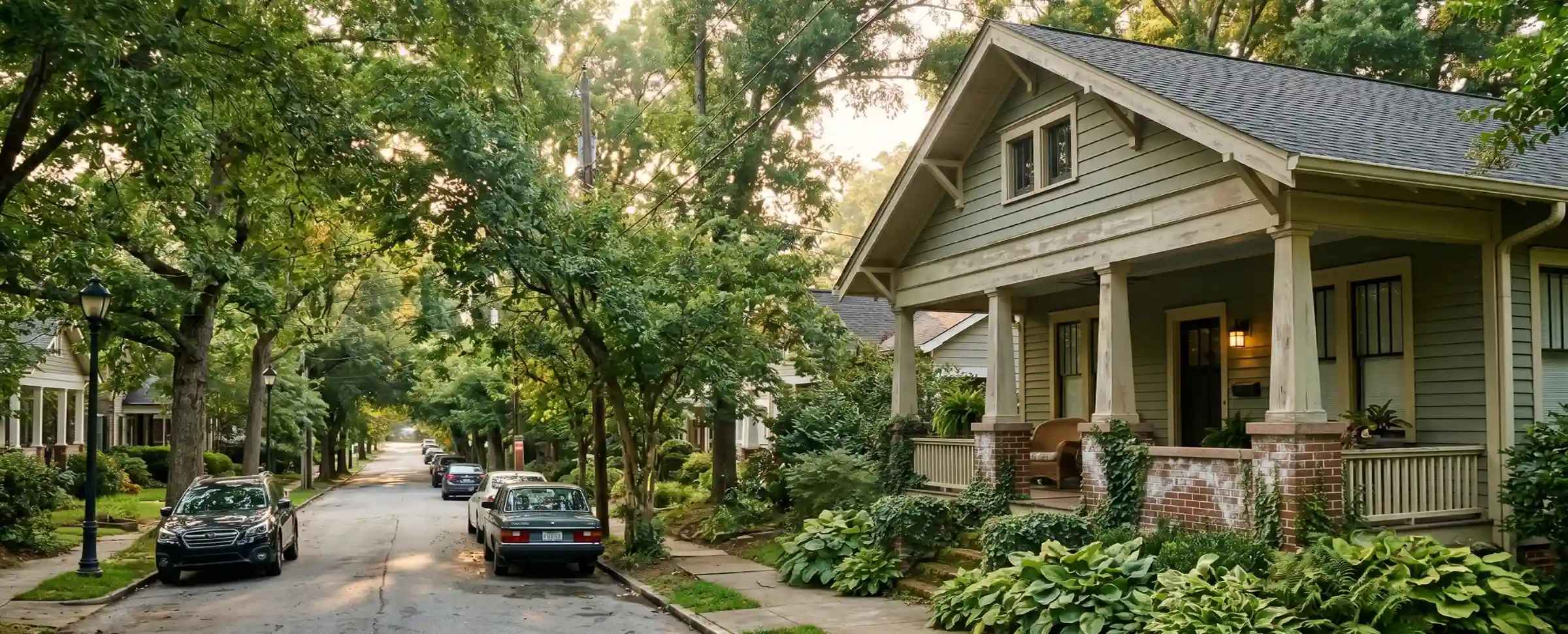

Mold in Atlanta compounds quickly, and red clay is the reason. The soil holds rain like a sponge, roughly 50 inches of it a year, and summer humidity regularly tops 70 percent from June through September. A large share of the housing stock, especially intown neighborhoods built before 1980, sits on crawl space foundations directly above that clay, which holds and conducts moisture year-round. After a thunderstorm soaks the ground around a Craftsman bungalow in Virginia-Highland or a ranch in Decatur, the water has nowhere obvious to go. It migrates through the soil, wicks up into the crawl space, and reaches the joists and subfloor well before any surface sign appears in the living areas.
Mold remediation in Atlanta is the containment, removal, and cleanup of mold growth following the ANSI/IICRC S520 standard, and Georgia has no state mold license, so the Secretary of State's licensing board oversees general contractors but no state authority licenses mold work. Any person can advertise the service without a competency or insurance check, which puts credential verification in the homeowner's hands before anything is signed.
Key insights
- No mold license in Georgia. Any contractor can legally offer mold remediation in Atlanta without a state-issued credential. IICRC AMRT certification and IICRC Certified Firm status are the main vetted substitutes, and both can be checked at iicrc.org before you sign anything.
- Typical cost. Most Atlanta jobs cost $1,300–$5,400, or $9–$22 per square foot. Crawl space and finished basement work run toward the higher end, and clearance testing is a separate $200–$500 that an independent party should perform.
- Clay under the bungalows. About 50 inches of yearly rain on dense red clay keeps crawl space humidity elevated year-round across Virginia-Highland, Grant Park, Inman Park, and Decatur, where the soil traps moisture against foundations.
- 2009 flood record. The September 2009 flooding affected more than 20,000 structures across Fulton, Cobb, Douglas, and Gwinnett counties. The National Weather Service described it as roughly a once-in-500-year event in parts of the metro, and the latent mold it left keeps surfacing during renovations and pre-purchase inspections.
- Separate the roles. Georgia law does not require it, but IICRC S520 calls for the inspector and the remediator to be different parties. The company that identifies the problem and writes the scope should not be the company profiting from it.
- Crawl spaces carry the most risk. Most intown homes built before 1980 sit on pier-and-beam foundations with absent or degraded vapor barriers. Ground moisture in clay reaches structural wood directly, and the mold typically goes undetected until a sale or renovation opens the floor.
- Wet for a day is enough. The CDC says mold can start growing within 24 to 48 hours of a moisture event, so drying matters more than the first phone call.
First 48 hours after water arrives
Stop the water, photograph the damage, and begin drying within 24 to 48 hours, because Atlanta's summer heat and humidity let mold start on wet drywall, insulation, and subfloor in about a day. What you do before a contractor arrives sets the size of the job.
Active water or damage across a wide area is a job for emergency mold removal, so the first call should go to a crew that handles extraction and drying together, not to a general handyman.
Shut off the source before anything else
Close the supply valve for a burst pipe or appliance line, and put a tarp over a roof opening after a storm. Pumping out standing water while the leak keeps running only resets the clock.
Photograph before you move anything
Take dated photos of stained ceilings, soaked insulation, and standing crawl space water before cleanup starts. Insurers and later buyers both ask for them, and the pictures show what the water reached.
Pull wet insulation and dry the cavity
Wet fiberglass in a crawl space or attic traps moisture against wood and gives mold something to eat. Remove it, run fans and a dehumidifier, and watch the room for the musty odor that marks the signs of mold from an older leak.
Test the wood, not the surface
A moisture meter reading above 19 percent in joists or sheathing means mold can still take hold even when the surface feels dry. Keep drying until readings fall below 16 percent.
Each extra day of wetness enlarges the area that has to be removed, and that area is what moves a job up the mold remediation cost range.
What Atlanta jobs cost by size
Most Atlanta mold remediation jobs cost $1,300–$5,400, and the mid-range is about $2,200. Crawl space work and finished basement remediation push local jobs toward the top of that range because of the volume of affected material and the clay conditions that drive recurring moisture. Crawl spaces and finished basements make up more of the Atlanta job mix than they do in slab-built markets.
The Bureau of Labor Statistics reported construction and extraction wages in the Atlanta metro at about 90 percent of the U.S. average in May 2025, and Atlanta prices are national figures scaled to that ratio.
 Work at this access level costs more than the equivalent square footage in a finished basement, since the clay soil moisture driving growth here never fully stops even after cleaning.
Square footage is the main driver, and the per-square-foot range of $9–$22 holds across sizes, with accessible surface growth at the low end and HVAC contamination, wall cavity work in older construction, and crawl space remediation that needs structural wood treatment at the high end.
| Project size | Estimates | Common Atlanta cause |
|---|---|---|
| Under 10 sq ft | $400–$1,300 | Bathroom ceiling, HVAC condensation spots |
| 10–100 sq ft | $700–$3,600 | Bedroom wall cavity, basement corner |
| 100–300 sq ft | $2,200–$8,100 | Attic after a roof leak, partial crawl space |
| 300–1,000 sq ft | $5,400–$18,000 | Full crawl space with new vapor barrier and joist treatment |
| Over 1,000 sq ft | $13,500–$27,000 | Whole-house envelope failure or duct contamination |
Where the mold sits changes the price as much as how much there is, and Atlanta's mix of crawl spaces and finished basements makes location the sharpest driver. A crawl space job costs more than the same square footage in a bedroom because the crew works in tight access over red clay, pulls out contaminated insulation, treats structural wood, and often has to correct the moisture path before the space can be sealed. A finished basement adds demolition and rebuild of drywall, trim, and flooring on top of the mold work, while an attic or bathroom job is usually smaller and easier to reach. HVAC and wall cavity work fall in between, since the hidden spread and the equipment involved set the scope.
| Location | Estimates | Why it shows up here |
|---|---|---|
| Crawl space | $1,800–$9,000 | Red clay moisture wicking, absent vapor barriers in pre-1980 homes, and high ground humidity year-round |
| Finished basement | $1,300–$6,300 | Georgia homes favor finished basements, material removal costs are substantial, and moisture source repair is often a separate job |
| Attic | $900–$4,500 | Summer thunderstorm roof damage and inadequate ridge venting in older homes |
| HVAC and ducts | $2,700–$9,000 | Condensate drain line blockages and evaporator coil contamination from humid summers |
| Bathroom | $400–$1,800 | Ventilation failures in the pre-1990s housing stock |
| Wall cavities | $1,800–$7,200 | Hidden moisture from crawl space migration or roof leaks, common in post-flood renovation |
A standalone mold inspection before the work gives you a written scope to price against, and it is billed separately from remediation.
A standalone inspection costs $300–$700 for homes under 4,000 square feet. Because Georgia has no licensing requirement, confirm the inspector holds an IICRC or ACAC credential before scheduling. Lab testing adds $300–$900, clearance testing adds $200–$500 as a line item of its own, and an inspection bundled with testing costs $400–$1,300. Rebuilding drywall, subfloor, or insulation after removal is a separate reconstruction line that can cost $400–$9,000 depending on what came out.
Red clay and the crawl space problem
Atlanta's mold problem starts underground. Red clay holds water against pier-and-beam foundations all year, and it sends that moisture into crawl spaces that most intown homes built before 1980 were never fitted to handle. The city gets roughly 50 inches of rain annually, summer humidity stays above 70 percent for much of June through September, and the clay underneath does not drain between events.
 Ivy crowding a pier like this traps moisture against the brick and blocks the airflow the crawl space needs, turning a landscaping choice into an active moisture management failure.
NIOSH Publication 2019-115 describes how dampness in buildings develops: when soil moisture and outdoor humidity stay higher than indoor conditions, vapor moves up through the soil into the crawl space and raises humidity enough to support mold on joists, subflooring, and insulation. Most intown Atlanta homes built before 1980 have no vapor barrier or one that has long since failed. The September 2009 flood accelerated that process across thousands of structures, but the more common version is the continuous clay moisture cycle that runs every week of every year. The mold goes unnoticed until a sale or a renovation opens the floor.
Atlanta's residential construction follows four distinct eras, each with moisture weak points that remain active today, and the era a home was built in is a reliable predictor of where mold will appear and what remediation will require.
| Era | Neighborhoods | Moisture weak points |
|---|---|---|
| Before 1950 | Virginia-Highland, Grant Park, Inman Park, Decatur, Candler Park, Poncey-Highland, Cabbagetown | Pier-and-beam and early concrete block foundations without vapor barriers; original plaster over wood lath with no moisture barrier; single-pane wood windows that create persistent condensation points; cast-iron plumbing prone to slow seepage at joints |
| 1950s–1970s | Early Sandy Springs, Brookhaven, Dunwoody, Chamblee, Doraville | Slab and early pier-and-beam ranch homes; ductwork in unconditioned attics or crawl spaces; fiberglass batts in crawl spaces that trap moisture and feed mold; original HVAC at or past the end of its design life |
| 1980s–early 1990s | Vinings, Smyrna, mid-era Marietta, early Alpharetta, Peachtree City | Paper-faced drywall in bathrooms and finished basements; HVAC near the end of its design life; degraded crawl space vapor retarders; undersized ridge ventilation without enough soffit intake |
| After 1995 | Newer Buckhead townhomes, West Midtown, Brookhaven, Alpharetta, Johns Creek, Roswell, Woodstock | Tight envelopes that trap indoor moisture when HVAC is undersized or short-cycles; OSB sheathing that absorbs moisture more readily than solid lumber; finished basements treated as conditioned space without independent moisture control |
Air conditioning adds a second source. Atlanta cooling systems run seven to eight months a year, and in aging housing where drain lines may never have been serviced, the condensate from continuous summer cooling becomes a chronic mold source. A line that no one has touched in a decade can drip into the cabinet or ceiling below for weeks. In older intown homes the HVAC system often sits in an unconditioned crawl space or attic, which puts the equipment in the dampest air in the house.
When mold is a DIY job in Atlanta
Mold is a DIY job in Atlanta only when the patch is under 10 square feet, sits on a hard, non-porous surface, and the moisture source has already been found and fixed. Georgia has no mold license and no state area threshold, so the 10 square foot figure in EPA guidance is the line that matters.
Red clay changes the math. A bathroom ceiling spot traced to a weak exhaust fan is a fair DIY job, but a patch of the same size on a crawl space joist is not, because the moisture comes from the soil below and cleaning the wood leaves the source untouched. A crawl space also puts you against structural wood, insulation, and soil vapor in tight quarters, with nowhere to contain spores and little ventilation for cleaning products.
| Situation | DIY or pro | Reason |
|---|---|---|
| Grout or caulk mold under 10 sq ft on tile | DIY with PPE | Hard surface, and the fix is better ventilation |
| Spots on an HVAC register | Pro check first | Spores may be in the ducts or drain pan |
| Any growth on crawl space joists | Pro | Soil moisture source, structural wood, tight access |
| Attic sheathing after a roof leak | Pro | A moisture meter is needed to find hidden spread |
| Wall cavity or finished basement wall | Pro | Opening the wall calls for containment |
| Any mold in a flood-affected home | Pro | Porous materials that got wet come out, not cleaned |
Homeowners who fit the first row can follow the steps for DIY mold removal, including protective gear and what to use on tile versus grout.
Hiring without a Georgia mold license
Georgia has no state mold remediation license, so any Atlanta contractor can legally take a mold job without meeting a competency or insurance threshold, and your own checks stand in for state oversight. General construction work above $2,500 falls under the Georgia Secretary of State's licensing board, but mold remediation is not regulated as a licensed trade.
 This lookup matters more in Georgia than in states with mold licensing; the IICRC Global Locator is effectively the only verification standing between a homeowner and an uncredentialed operator.
That sets Georgia apart from Florida and Texas, where state-issued mold credentials are required before work starts. Credentials you can verify are the substitute. IICRC AMRT (Applied Microbial Remediation Technician) covers individual technicians, and IICRC Certified Firm covers the company, and both are searchable at iicrc.org. For inspectors and assessors, the equivalents are ACAC's CIEC (Council-certified Indoor Environment Consultant) and CMI (Council-certified Microbial Investigator), searchable at acac.org. A firm holding professional mold remediation credentials you can verify has met documented training, examination, and continuing education requirements that state law does not impose.
The checks fall into three stages, because the risks change between the sales call and the final invoice.
Before the contract is signed
Because Georgia has no state licensing database, credential verification falls entirely on you. Five checks against the IICRC and ACAC systems take about half an hour and rule out most weak candidates.
Search the IICRC locator by address
Open iicrc.org/iicrcgloballocator and enter your city, zip code, or address with a mile radius. Results show each company's active certifications as badges, so you can see which firms hold Certified Firm status and which technicians carry the AMRT credential. A contractor who says they are IICRC certified but does not appear should give you an individual certification number that you verify directly with IICRC.
Read the status and expiration date
Look for AMRT as the relevant mold credential and confirm the status reads Active with a current expiration date. A lapsed credential means continuing education was not completed and the individual is no longer certified. WRT (Water Damage Restoration Technician) is a prerequisite credential, not a mold certification, so do not accept it as a substitute.
Look up Certified Firm status separately
Technician credentials and firm-level certification are separate listings, so return to iicrc.org and search the company under Certified Firms. A company can employ a certified technician without holding Certified Firm status itself, which means the company-level insurance and ethics requirements have not been met.
Check any assessor through ACAC
If you hire an assessor separately, which you should, search the inspector's name at acac.org and look for CIEC or CMI, the assessor-side equivalents of the IICRC AMRT. The inspector should be a different party from the remediator, since the company that writes the scope has a stake in how big it is.
Ask for the insurance certificate before anyone enters
Request a current certificate showing both general liability and pollution liability, with you named as an additional insured. Pollution liability specifically covers mold spore release during the work. A contractor who hesitates or promises to send it later is a red flag regardless of credential status.
Beyond the credentials, put seven questions to each bidder. Ask for the IICRC certification number, and expect one you can verify at iicrc.org within two minutes, not a brochure or a verbal assurance. Ask whether the company holds Certified Firm status, and get the company name to search separately. Ask whether the same company would do both the inspection and the remediation, and treat a yes as a flag. Ask for the liability and pollution liability certificate, and treat delays as a red flag. Ask for a written scope that lists affected areas, containment method, cleaning agents, and clearance standard before a tool comes out. Ask who performs clearance testing, and expect a separate inspector or testing firm, because a company signing its own clearance creates a conflict of interest nobody can resolve. Last, ask whether the crew has worked in crawl spaces in intown Atlanta neighborhoods, and listen for specific experience with clay soil conditions, pier-and-beam foundations, and the structural wood treatment methods used in that environment.
While the crew is on site
Crawl space and attic jobs run out of sight, so the crew's habits are your evidence. Containment barriers should be up before demolition, a HEPA air scrubber should run during removal, and wet material should be bagged before it leaves the work area. Ask for daily photos of the removal steps so you can match them to the written scope, and watch the remediation process against what the contractor promised.
Before the final payment
The last stage decides whether the work is finished or only looks finished. Independent clearance sampling, billed at the inspection cost of an outside assessor, is the check no contractor can supply for itself.
Who takes the clearance samples?
A named assessor or testing firm with no ownership tie to the remediator. A company that signs its own clearance creates a conflict of interest nobody can resolve.
Does the finished work match the written scope?
The contractor should be able to walk you through each affected area, containment method, cleaning step, and clearance standard listed in the scope, and point to the photos.
Where are the moisture readings for the wood?
A written reading for joists and subfloor, below 16 percent, shows the structure is dry and not just clean.
What does the warranty cover on the crawl space?
Look for written terms on regrowth, the length of coverage, and whether it depends on keeping the encapsulation and dehumidifier running.
Did anything change from the original scope?
Any added area or extra cost should appear as a signed change order, not as a surprise on the final invoice.
Before signing, check that the written scope lists the work, compare bids line by line, and read what the warranty covers, the basics of how to choose a mold remediation company.
How an Atlanta job runs
A typical Atlanta crawl space job takes 2 to 4 days of active work, 3 to 7 days of drying, and 1 to 3 days for lab clearance, so plan on one to three weeks from the first visit to sign-off. Bathroom and small surface jobs finish in 3 to 7 days.
The sequence follows IICRC S520. In an Atlanta crawl space that means a moisture reading on the joists first, a plastic containment barrier at the access hatch, a HEPA scrubber running under negative pressure, insulation out, the wood cleaned or abrasively treated, an antimicrobial pass, and drying to below 16 percent before an independent assessor takes clearance samples. Encapsulation is a follow-on project, and the red clay water path (downspouts, grading, a failed drain line) has to be fixed before the liner goes in.
| Job type | Active work | Drying | Lab clearance | Total |
|---|---|---|---|---|
| Bathroom spot | 1–2 days | 1–2 days | 1–3 days | 3–7 days |
| One room, drywall out | 2–3 days | 2–4 days | 1–3 days | 1–2 weeks |
| Crawl space | 2–4 days | 3–7 days | 1–3 days | 1–3 weeks |
| Attic after a leak | 2–4 days | 3–5 days | 1–3 days | 1–2 weeks |
| Several rooms or flood | 5–10 days | 7–14 days | 1–3 days | 3–6 weeks |
These are typical industry ranges, not Atlanta-specific data. Three things stretch an Atlanta schedule: summer humidity above 70 percent slows drying, grading or drain repairs that must finish before encapsulation, and lab turnaround for clearance. Rebuild work such as new subfloor or drywall is a separate contract with a general contractor, so add its schedule on top.
Georgia mold coverage and the NFIP gap
Georgia homeowners policies pay for mold only when it follows a sudden covered event, such as a burst pipe, an appliance overflow, or a roof opening from a single storm. Most policies cap mold at $5,000–$10,000, which covers a bathroom or attic remediation but falls short of a full crawl space at $1,800–$9,000 or a finished basement project at $1,300–$6,300. Gradual leaks, chronic humidity, neglected maintenance, and flooding fall outside a standard HO-3 policy.
Flood-related mold, including growth that followed the 2009 Atlanta flooding, needs a separate NFIP policy. NFIP pays for mold cleanup caused directly by a covered flood, but not for mold that grew because drying was slow afterward, and that gap is where claims turn into disputes once mold insurance coverage is questioned and the adjuster and homeowner disagree about the cause.
Molds found in Atlanta crawl spaces
Cladosporium, Aspergillus, Penicillium, and Alternaria make up most of what turns up in Atlanta homes, and Stachybotrys chartarum appears in crawl spaces and wall cavities only where prolonged saturation has occurred rather than routine ambient humidity. Each species favors a different place in the house.
Cladosporium is the dominant species in Atlanta air samples year-round, found consistently in crawl spaces, bathrooms, and HVAC return plenum areas where the clay-soil moisture cycle delivers the persistent damp it prefers. Aspergillus and Penicillium appear most often in HVAC systems, crawl space insulation, and bathroom ceilings, where moisture is moderate and continuous rather than episodic.
Stachybotrys, the species most associated with severe water damage, needs the kind of prolonged saturation that Atlanta's clay and degraded vapor barriers deliver in crawl spaces over years, and that the 2009 flood delivered inside wall cavities across affected neighborhoods. When lab results name it, black mold removal follows stricter containment than surface cleaning.
Alternaria appears most often in Atlanta attics after roof leaks, particularly in structures where inadequate ridge venting let moisture persist on the sheathing before the leak was found.
Aspergillus and Penicillium are visually indistinguishable from each other, so air sampling reports usually group them as Asp/Pen. Confirming the species takes lab analysis through mold testing, and the result rarely changes the cleanup.
Atlanta areas ranked by foundation
Foundation type and construction era predict Atlanta mold better than any flood zone map. The highest risk sits in the intown bungalow belt, where pre-1950 pier-and-beam homes over red clay deliver ground moisture directly to structural wood and were never built with vapor barriers. The 2009 flood added a contamination layer across Fulton, Cobb, Douglas, and Gwinnett counties that cuts across every construction era.
 A FEMA flood zone map wouldn't flag most of this block as high risk, but foundation type and construction era predict the actual mold exposure here far better than flood zone status does.
A property's FEMA flood zone designation tells you very little about its day-to-day mold risk here. Newer suburbs carry a different problem, with tight post-1995 envelopes that hold indoor humidity when HVAC underperforms. Finished lower levels in larger Buckhead and Sandy Springs homes are a basement mold pattern of their own, driven by clay pressing on walls that interior drains reroute but do not stop.
The seven areas below summarize the pattern from the oldest intown streets to the newest suburbs.
| Area | Main risk | Homeowner notes |
|---|---|---|
| Virginia-Highland, Poncey-Highland, Morningside | Pre-WWII piers, clay soil, heavy tree cover | Craftsman and Tudor bungalows from 1910–1945 with no vapor barrier; original plumbing at risk of slow seepage; the mature hardwood canopy keeps lots wetter and slower to dry after rain, so crawl space mold is routine rather than exceptional |
| Grant Park, Ormewood Park, Cabbagetown | Pre-war stock, Intrenchment Creek drainage, 2009 flooding | Lower sections along Intrenchment Creek flooded in 2009; original masonry foundations create hydrostatic pressure at basement walls; crawl spaces often show Stachybotrys from past saturation |
| Inman Park, Old Fourth Ward, Kirkwood | Restored bungalows beside newer BeltLine townhomes | Original bungalows carry the same crawl space weak points; newer townhomes along the BeltLine can show moisture when builders handled grading poorly on tight urban lots |
| Decatur, Avondale Estates | 1920s–1960s mix, DeKalb creek systems, mature canopy | Scott Creek and South Fork Peachtree Creek raise ground moisture for properties within about a quarter mile; crawl space problems appear in both bungalows and mid-century brick ranches |
| Buckhead, Sandy Springs | 1940s–1960s estates and newer infill with finished basements | Finished basements are common in larger Buckhead homes; hydrostatic pressure from clay keeps basement walls damp, and interior waterproofing only partly addresses it |
| Marietta, Smyrna, Vinings | Cobb creek systems, 1960s–1990s construction, 2009 flood exposure in the west | Western Cobb near Sweetwater Creek took significant 2009 flood damage; properties sold in the early 2010s in Mableton and Austell warrant a check for post-flood remediation records |
| Alpharetta, Roswell, Johns Creek | Post-1990 builds, high water table in places, finished basements | Tight construction traps indoor moisture when HVAC underperforms; finished basements show mold from hydrostatic wall seepage that interior drains reroute without stopping, and HVAC condensate is the secondary driver |
For mold after water damage in any of these corridors, professional extraction and structural drying should start within 24 to 48 hours. Health risks from mold vary by species and by household: immunocompromised people, children, and those with asthma face meaningfully higher exposure risk than healthy adults, so the first drying decisions matter most in homes where they live.
Closing on an Atlanta home with mold
Georgia requires sellers to disclose known material defects, including mold, but no law requires testing before a sale, so a seller who never opened the crawl space hatch has no obligation to report what is inside. Atlanta compounds the gap: no state mold registry exists to check a contractor against, standard home inspections skip mold, and the 2009 flood left a latent contamination burden across thousands of properties that sold without documented remediation.
 A standard home inspection wouldn't have opened this hatch at all; crawl space mold in pre-1980 Atlanta bungalows is exactly the kind of finding that only a separate licensed mold assessment catches.
Read the 2009 flood history
The September 2009 flooding affected more than 20,000 structures across Fulton, Cobb, Douglas, and Gwinnett counties, per NWS Atlanta. College Park, Mableton, Austell, and Lithia Springs took damage ranging from crawl space inundation to first-floor flooding. Many properties were dried to visible standards only, without professional moisture content verification or clearance testing, and then sold, and mold established in wall cavities and under flooring has kept growing slowly since. For a property with a 2009 purchase history in a flood-affected zip code, treat missing remediation records as a substantive gap, not a clerical oversight.
Ask for the crawl space paper trail
Request the most recent crawl space inspection, any prior remediation with clearance testing results, and the age and condition of the vapor barrier. For zip codes hit in 2009, pull the flood history through FEMA's flood map portal and cross-check it against the purchase timeline.
Book a mold inspection inside the contingency window
A standard home inspection does not assess for mold. Older Atlanta bungalows commonly hide crawl space mold below the living space, where visual-only inspections never reach. A $300–$700 mold inspection before the contingency ends is cheap protection on a property where full crawl space work can reach $9,000.
Keep the paperwork if you are selling
Georgia's disclosure framework requires sellers to report known material defects but creates no mandatory testing standard. Sellers who had remediation done should keep the written scope, clearance results, and contractor credentials as disclosure documentation. Independent clearance results make the cleanup verifiable and spare the buyer from taking the seller's word for it.
Renting in Atlanta with mold
Georgia renters have a habitability claim for mold that comes from the building, but the law is thin and works mostly through written notice and the courts. Since July 1, 2024, every residential lease signed or renewed in Georgia is treated as including a promise that the home is fit for human habitation, and landlords must keep the premises in good repair under O.C.G.A. 44-7-13. A lease cannot waive that promise.
The Safe at Home Act does not define fit for human habitation and does not name mold, so a leaking roof, failed plumbing, or crawl space moisture is the strongest case, and mold from a tenant's own moisture habits is the weakest. A lease signed before July 1, 2024 and never renewed falls under the older rules. The Georgia Appleseed bench card summarizes the Act for judges and is useful for tenants too.
Put the repair request in writing
Email or send certified mail describing the mold and the likely source, and keep a copy. A phone call leaves nothing to show a court.
Photograph it and take a reading
Take dated photos of the growth and the water stain, and ask a mold inspector for a moisture reading if the landlord disputes the source.
Keep paying rent while you wait
The Act does not give tenants rent withholding or repair-and-deduct rights, so holding back rent can hand the landlord an eviction case.
Escalate to code enforcement, then magistrate court
Ask the city or county code office to inspect, and if the landlord still does nothing, a tenant can sue in magistrate court. A tenant who must leave over unsafe conditions should talk to legal aid first about constructive eviction.
Know the retaliation rule
A landlord who files an eviction, ends the lease, cuts services, or raises rent within three months of a good-faith repair complaint may be retaliating under O.C.G.A. 44-7-24. The remedy can include dismissal of the case plus one month's rent and a $500 penalty.
Some metro governments add their own rules. Mableton, in Cobb County, has a Safe and Healthy Housing Ordinance that lists mold or moisture not remediated to EPA standards as a habitability problem. Documenting each complaint in writing is the first step in any dispute over mold in your rental, and escalation follows from there.
Keeping Atlanta crawl spaces dry
Preventing mold in Atlanta differs from storm-driven markets because the main source is not weather. It is the ground. Georgia's red clay holds moisture year-round and delivers it continuously to pier-and-beam foundations that most intown homes were never equipped to manage. Post-storm roof checks matter, but they come second to fixing the ground-to-wood moisture path under the floor.
 A single loose sheet of poly on the dirt below wouldn't survive Georgia's clay for long; the sealed pier pads and foundation vents shown here are what actually stop moisture migration rather than just slowing it.
Seal the crawl space fully
One sheet of polyethylene on dirt slows moisture but does not stop it. The EPA mold cleanup guidance and IICRC S520 both treat poor moisture control as a leading cause of crawl space mold in humid climates, and in Atlanta clay the fix is a sealed liner of 12 mil or heavier over the floor and pier pads, closed foundation vents, and a dehumidifier sized to the square footage. Half-measures consistently fail here because the clay keeps pushing moisture upward regardless of what sits on top of it. Confirm wood moisture content falls below 16 percent afterward, because a reading above 19 percent lets mold start on the joists above a brand-new liner.
Cut foundation plantings back 18 inches
Atlanta's lush intown lots create a problem coastal markets do not share: dense hostas, ivy, and overgrown shrubs trap moisture against brick piers and wooden lattice, create direct soil-to-wood contact, and block airflow where the crawl space needs to breathe. This is moisture management, not aesthetics. Clear an 18-inch strip, swap mulch for gravel inside it, and point downspouts at least four feet from the wall. Georgia clay does not drain, so every irrigation source within that perimeter eventually ends up against your foundation.
Flush condensate drains every 60 to 90 days
A seven-to-eight-month cooling season grows algae in drain lines several times over. A blocked line in July, with dewpoints above 70 degrees Fahrenheit, can soak an air handler cabinet and nearby drywall within hours. Flush with diluted bleach or an enzyme cleaner during the cooling season, change filters every 30 to 60 days, and schedule an annual professional coil cleaning with antimicrobial treatment of the drain pan. NIOSH Publication 2019-115 identifies HVAC systems as a primary indoor mold vector in high-humidity climates. The CDC notes mold can start within 24 to 48 hours of a moisture event, and a blocked drain is one.
Climb into the attic after summer storms
Atlanta's threat from above is summer thunderstorms, not hurricanes. They are frequent, short, and intense enough to lift starter strips, crack ridge cap sealant, or separate flashing at chimney penetrations while leaving the roof looking intact from the ground. After sustained winds above 30 mph or hail above half an inch, look for wet insulation, stains, and soft sheathing. A musty smell in the room below is among the earliest signs of mold from a leak that predates the last storm, and weak ridge ventilation lets the moisture sit on the sheathing for months before a ceiling stain appears.
Frequently asked questions
How much does mold remediation cost in Atlanta?
Most Atlanta jobs cost $1,300–$5,400, and the mid-range is about $2,200. Jobs under 10 square feet cost $400–$1,300, crawl space work costs $1,800–$9,000, and finished basements cost $1,300–$6,300. These are estimates based on national pricing adjusted for Atlanta labor costs.
Does Georgia require a license for mold remediation in Atlanta?
No. Georgia has no state mold remediation license, so any person or company can offer the work in Atlanta. IICRC AMRT certification for technicians and Certified Firm status for companies are the credentials you can verify at iicrc.org before signing.
How do I find a qualified mold contractor in Atlanta without a state license to check?
Search the IICRC Global Locator for technicians holding the Applied Microbial Remediation Technician credential, then check Certified Firm status separately. For inspectors, ACAC credentials such as CIEC and CMI are the equivalent and can be checked at acac.org. Get proof of general liability and pollution liability insurance and a written scope, and have a separate party do the clearance testing.
Why is Atlanta so prone to mold?
Red clay soil holds water against crawl space foundations while Atlanta gets roughly 50 inches of rain a year and summer humidity above 70 percent. Many intown homes built before 1980 sit on pier-and-beam foundations with missing or worn vapor barriers, so ground moisture reaches structural wood directly.
How soon after water intrusion should I call a mold inspector in Atlanta?
Within 24 to 48 hours. Atlanta's summer heat and humidity let mold start on wet building materials in about a day, and each added day of wetness widens the area that has to be removed.
Will my homeowners insurance cover mold remediation in Atlanta?
Possibly, if the mold follows a sudden covered event such as a burst pipe or storm roof leak. Georgia policies often cap mold payouts at $5,000–$10,000, and gradual leaks, chronic humidity, and flooding are generally excluded. Flood-related mold falls under a separate NFIP policy.
What are the most common mold species found in Atlanta homes?
Cladosporium, Aspergillus, and Penicillium lead in Atlanta air samples, mostly in crawl spaces, HVAC systems, and bathrooms. Stachybotrys chartarum shows up where wood stayed saturated for a long time, such as crawl spaces with failed vapor barriers and wall cavities from the 2009 flood. Alternaria is common in attics after roof leaks.
Can I do mold removal myself in Atlanta?
Yes, for patches under 10 square feet on hard, non-porous surfaces, following DIY mold removal steps. In Atlanta the bigger question is whether the crawl space or other moisture source has been found and fixed, because cleaning visible mold without fixing the clay-soil moisture brings it back within weeks.
What does a mold inspection cost in Atlanta?
A standalone inspection costs $300–$700 for homes under 4,000 square feet. Crawl spaces, large attics, or several HVAC systems push the price up, and clearance testing adds $200–$500 as its own line item.
Do I need a mold inspection when buying a home in Atlanta?
Yes, especially for pre-1980 homes in Virginia-Highland, Grant Park, Inman Park, Decatur, and similar intown neighborhoods. A standard home inspection does not test for mold, and crawl space mold in older bungalows is routinely missed by a visual walk-through, so a separate inspection before the contingency expires is worth the $300–$700.
Does a seller have to disclose mold when selling a home in Atlanta?
Yes, for mold the seller knows about. Georgia requires disclosure of known material defects, and any mold test results must be shared. Georgia does not require testing before a sale, so a seller who never opened the crawl space may have nothing to disclose, and a buyer should not read silence as a clean bill.
Why does mold keep coming back in my Atlanta home?
The moisture source was never fixed. The EPA's 10 square foot figure marks when mold remediation is required, not the scope of the repair, and a contractor who only wipes visible growth in an Atlanta crawl space leaves the wet soil, bad vapor barrier, or leaking drain line untouched.
- EPA: Mold Cleanup in Your Home
- CDC: Basic Facts About Mold
- IICRC S520: Standard for Professional Mold Remediation
- IICRC Global Locator
- NIOSH: Dampness and Mold in Buildings
- NWS Atlanta: September 2009 Flood Event
- Georgia Secretary of State: Contractor Licensing
- NOAA: Georgia State Climate Summary
- EPA: A Brief Guide to Mold, Moisture, and Your Home
- ACAC: American Council for Accredited Certification
- BLS: Occupational Employment and Wages in Atlanta, May 2025
Sam Hickerson is the founder of RestoreAdvisor and writes consumer guides on mold remediation, water damage restoration, inspection, testing, and home recovery. His work focuses on helping homeowners understand costs, risks, and when to call a professional. He draws on guidance from the EPA, CDC, IICRC, and other authoritative sources to make complex home issues easier to navigate.