
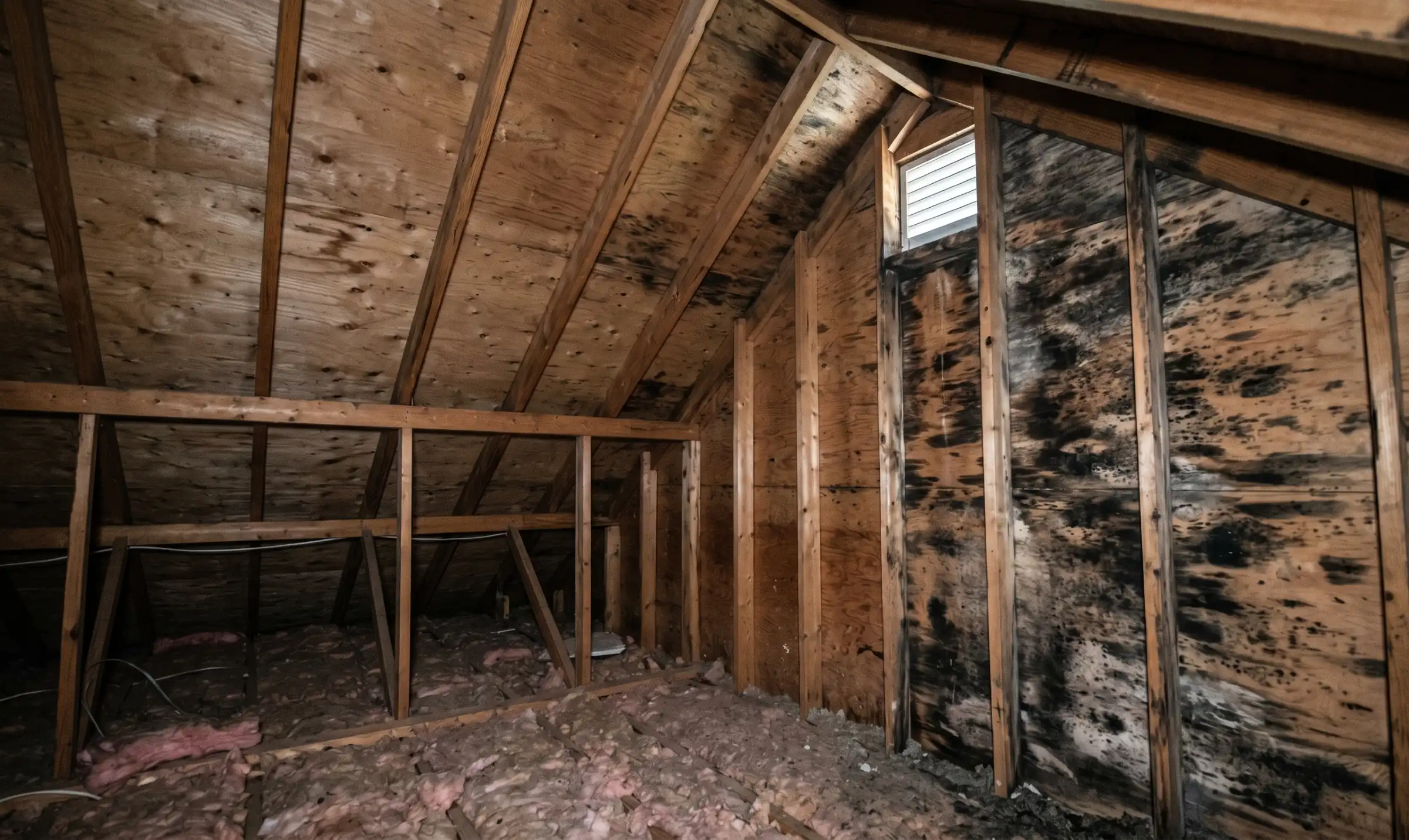

You found mold in your attic. Maybe you caught a glimpse of dark staining during a routine check, noticed a musty smell coming from the upstairs hallway, or an inspector flagged it during a home sale. Whatever brought you here, this article covers everything you need to make a clear decision: what caused it, whether you can handle it yourself, what a professional will do, and what it will cost.
Attic mold is fungal growth on roof sheathing, rafters, and insulation caused by sustained moisture exposure, most commonly from inadequate ventilation, misdirected exhaust fans, or roof leaks. Per IICRC S520 and EPA guidance, it is treated as a structural issue requiring source removal rather than surface treatment alone.
Key insights
- Mold grows fast. According to EPA guidance, mold can begin growing on wet surfaces within 24–48 hours under the right conditions.
- Attic mold is usually a structural concern. Because air rises through a home rather than falling, attic mold rarely affects indoor air quality directly. The primary risk is wood rot and roof sheathing deterioration.
- Most attic mold is caused by ventilation problems. Roof leaks are often blamed, but inadequate soffit-to-ridge airflow and misdirected exhaust fans are the most common culprits.
- Typical removal cost runs $1,500–$6,000. Larger jobs with insulation replacement or structural damage can reach $10,000–$15,000. These figures do not include roof repair costs.
- Treating mold without fixing the moisture source guarantees regrowth. Any quote that does not address the underlying cause is incomplete.
- The EPA recommends professional remediation for areas over 10 square feet. Attic mold almost always exceeds this threshold and requires specialized equipment. The CDC notes that mold exposure can trigger respiratory symptoms, asthma attacks, and allergic reactions, particularly in sensitive individuals.
Why attics are prone to mold
Attics create near-perfect conditions for mold growth because they combine organic food sources (wood sheathing, rafters, OSB, and insulation facing) with the moisture that inevitably migrates upward from occupied living space. The stack effect, the physical tendency of warm air to rise through a structure, continuously pushes humidity-laden air from bathrooms, kitchens, and laundry rooms toward the attic. When that warm, moist air contacts the colder surface of roof decking, it condenses. Without adequate ventilation to carry it back outside, moisture accumulates on the wood until conditions are right for mold to establish.
 IRC R806 sets the minimum net free vent ratio at 1:150, or 1:300 when intake and exhaust are properly balanced; falling short of either raises risk regardless of roof condition.
Most residential attic ventilation codes, following the International Residential Code (IRC) Section R806, call for a net free vent area ratio of 1:150 of attic floor area, with an exception permitting 1:300 when intake and exhaust are properly balanced between soffit and ridge. Homes that fall below these minimums, or where insulation has been installed in a way that blocks soffit vents, are at elevated risk regardless of whether a roof leak is present.
Condensation vs. roof leak: how to tell the difference
Condensation produces widespread, uniform mold across large sections of the roof deck; a roof leak produces localized mold concentrated near a specific entry point. The distinction matters because each requires a completely different fix, and treating the wrong source guarantees the mold returns.
 Coverage this uniform across the deck points to condensation, not a leak; water from a roof breach rarely spreads laterally far enough to stain an entire slope evenly.
Condensation typically produces diffuse mold coverage across large sections of the roof deck, often covering an entire north-facing slope or the full underside of sheathing uniformly. You may also see frost on nail heads in cold weather, an indicator that moisture is condensing on every cold metal surface in the space.
Roof leaks produce localized mold growth concentrated in a specific area, often with a visible entry point such as a gap between plywood sheets, darkening around a vent pipe boot, or staining directly below a valley or chimney flashing. A roof leak rarely causes mold across the entire attic because water does not travel far laterally through insulation before dripping straight down.
Once you have identified which pattern applies, the fix changes completely: condensation problems require ventilation and air-sealing corrections; roof leaks require a roofing contractor to address the entry point first.
What attic mold looks like
Attic mold most commonly appears as dark blotchy or fuzzy staining on the underside of roof sheathing and along rafters, per ANSI/IICRC S520 visual assessment criteria. The color varies by species and surface: growth on plywood often appears black, gray, or dark green; on OSB it may look lighter or more diffuse.
 The rust on these nail heads confirms repeated wetting and drying cycles, not a single event, which usually means the moisture source has been active for a full season or more.
Colonies can also appear as white, powdery patches in drier sections of the attic where moisture is less concentrated. If growth is dark, slimy, and concentrated in an area with a history of sustained moisture, confirmed black mold removal requires containment protocols beyond standard attic cleaning procedures. Other visual indicators include water stains on the sheathing surface, damp or discolored insulation, rusty nail heads from repeated wetting and drying cycles, and dark lines on top-floor ceilings that trace the pattern of the framing above.
A musty odor in the attic or in rooms directly below is often the first sign homeowners notice. Knowing all the signs of mold throughout the home helps you catch attic growth before it spreads to the point of structural damage.
Causes of attic mold
The most common causes of attic mold are inadequate soffit-to-ridge ventilation, exhaust fans that vent into the attic rather than outside, and roof leaks from damaged shingles or flashing, per ANSI/IICRC S520 and EPA moisture guidance. Air leaks through ceiling penetrations and insulation problems that block soffit vents are also frequent contributors, particularly in cold climates where condensation forms on cold roof decking.
Inadequate ventilation
The most common root cause of attic mold is insufficient airflow from soffit intakes to ridge exhaust. A healthy attic draws cool, dry outdoor air through soffit vents along the eaves and expels warm, humid air through ridge or gable vents near the peak. When this cycle is blocked, humid air stagnates against the cold roof deck and condensation forms. Common ventilation failures include blocked soffit vents covered by paint, debris, or insulation pushed against the eaves; unbalanced intake-to-exhaust ratios; and mismatched vent types that short-circuit airflow. A certified mold inspection that includes thermal imaging can identify exactly where airflow is failing before you invest in ventilation corrections.
Exhaust fans venting into the attic
Bathroom exhaust fans, kitchen range hoods, and dryer vents that terminate inside the attic rather than outside are among the most consistently overlooked causes of localized attic mold. Each shower dumps a concentrated load of warm, humid air directly onto cold roof sheathing. The result is a dense mold colony that forms right above the bathroom fan housing, sometimes within a single heating season. Per building codes, all mechanical exhaust must be ducted to a dedicated exterior vent cap. Accidentally disconnected duct connections, often disturbed during roofing work or insulation installation, are a frequent cause of this problem in otherwise well-maintained homes.
 A duct like this dumps every shower's humidity straight onto cold sheathing instead of outside, often building a dense colony directly above the bathroom within a single heating season.
Roof leaks
Water intrusion through damaged shingles, cracked step flashing around dormers and chimneys, deteriorated pipe boot seals, or ice dams along the eaves will soak wood and insulation directly. Even a small, slow leak that never shows up as a ceiling stain can sustain mold growth for years on the underside of sheathing. If the mold in your attic is concentrated in one area and you can trace a path upward to a specific roof feature, a leak is the likely cause. Roof repair must be completed before or concurrently with remediation; active mold after water damage situations require coordinating both contractors on the same timeline.
Air leaks from living space
Gaps around recessed lighting fixtures, plumbing chases, attic hatches, and top plates allow warm interior air to bypass insulation and flow directly into the attic. In cold climates, this creates chronic condensation on roof decking even in an otherwise well-ventilated attic. Air sealing the ceiling plane at the attic floor is often as important as improving roof ventilation, and the two strategies work together.
Insulation problems
Insulation that has been compressed into the eave space blocks soffit vent airflow, trapping humidity. Blown-in insulation installed without proper baffles to maintain an air channel from the soffits is a frequent cause of this problem. Insufficient insulation depth on the attic floor allows heat to escape into the attic space, which changes the thermal dynamics and can paradoxically increase condensation risk on super-insulated homes where the sheathing stays as cold as the outdoor air.
Attic mold removal process
Professional attic mold remediation follows the ANSI/IICRC S520 Standard for Professional Mold Remediation, which defines source removal as the fundamental principle: mold must be physically removed, not simply killed or painted over. A remediator who sprays a biocide and calls the job complete is not following S520 standards and should not be hired.
Moisture source correction first. Remediation should not begin until the cause of moisture has been repaired or is scheduled for concurrent correction. This may mean a roofing contractor fixing a leak while the mold crew works, or a ventilation contractor adding or unblocking soffit and ridge vents before the job starts. Any remediation company that proceeds without discussing the moisture source is cutting a critical corner.
Assessment and containment. The remediator inspects the attic with a moisture meter and may use thermal imaging to locate areas of elevated moisture that are not yet visibly moldy. Confirm any contractor holds current mold remediation certifications before signing a scope of work. Once the scope is mapped, the attic access is sealed with heavy-duty polyethylene sheeting and negative air machines are set up to draw airflow from the living space toward the attic and out through HEPA-filtered exhaust. This prevents disturbed spores from migrating downward into occupied rooms.
Insulation removal. Moldy, wet, or ventilation-blocking insulation is removed first and double-bagged for disposal. Blown-in insulation contaminated with mold cannot be cleaned and must be replaced.
Cleaning structural wood. Unlike drywall, which is porous and typically replaced when moldy, wood framing and roof sheathing are semi-porous. Per ANSI/IICRC S520, the approach depends on whether the material can be effectively cleaned. For structurally sound wood with surface mold, the process combines HEPA vacuuming, wire brushing or hand sanding, and antimicrobial wipe-down. For heavily contaminated attics or where time and thoroughness are priorities, media blasting is the preferred method.
 Soda blasting reaches into the wood grain the way surface wiping can't, though it leaves a residue that needs cleanup; dry ice blasting skips that step by sublimating on contact.
Soda blasting and dry ice blasting are the two most commonly used techniques for attic wood cleaning. Soda blasting uses baking soda as a mild abrasive, effectively removing surface mold without damaging the underlying wood, though it leaves a residue that requires cleanup. Dry ice blasting uses carbon dioxide pellets that sublimate on contact, leaving no secondary waste and achieving faster coverage than traditional scraping and brushing. Both methods reach into the grain of the wood in a way that surface wiping cannot.
Encapsulation. After cleaning, a breathable antimicrobial encapsulant is applied to treated surfaces. Encapsulation seals residual staining and spores that may remain in the wood grain and provides a barrier against regrowth if minor moisture events occur in the future. It is not a substitute for addressing the moisture source.
Drying and clearance testing. Industrial dehumidifiers and air movers reduce the attic's relative humidity below 50%. Once the attic is dry, mold testing confirms that spore counts in the attic air have returned to levels consistent with outdoor background concentrations. Most attics require two air samples, typically costing $150–$300 each. A written clearance report should be kept with the home's records.
Professional mold remediation follows these phases in every room type; the attic-specific factors are structural wood cleaning methods and the frequency with which insulation must be removed before the wood underneath can be reached.
The full technical breakdown of each phase from the homeowner perspective is covered under what to expect during mold remediation.
Cost of attic mold remediation
Attic mold removal typically costs $1,500–$6,000 for most homes, with a per-square-foot rate of $3–$10 for the affected area. Jobs involving insulation replacement, structural damage, or very large attics can reach $10,000–$15,000. These figures cover remediation only and do not include roof repair, ventilation upgrades, or insulation reinstallation; the EPA defines these as separate corrective actions that must accompany but are not part of the mold removal scope.
Cost by job scenario
| Scenario | Typical cost | Notes |
|---|---|---|
| Small area, accessible attic, no insulation removal | $800–$2,000 | Under 100 sq ft of affected sheathing |
| Mid-size attic, partial insulation removal | $2,000–$4,500 | 100–300 sq ft affected, standard ventilation correction |
| Large attic or full insulation removal | $4,500–$8,000 | Full remediation, insulation replacement, encapsulation |
| Structural damage to sheathing requiring replacement | $8,000–$15,000 | Rotten or delaminated panels replaced, full cleanup |
| Clearance testing (2 air samples) | $300–$600 | Separate from remediation, should always be included |
Several factors can push a final quote well above or below those scenario ranges. The method a contractor uses to clean structural wood is one of the biggest variables: soda or dry ice blasting adds $500–$1,500 over manual scrubbing but covers more area and penetrates the wood grain more thoroughly, making it the better value on larger jobs. Whether your insulation needs to come out is the other major cost driver, since blown-in cellulose or fiberglass cannot be cleaned and must be bagged, removed, and fully replaced. Roof repair and ventilation corrections are separate line items that no mold quote will include, but both must happen for the remediation to hold so factor them into your total project budget from the start.
Additional cost factors
| Factor | Cost impact | Why it matters |
|---|---|---|
| Insulation removal and replacement | $1,000–$3,500 | Blown-in insulation is expensive to remove and reinstall |
| Roof repair (separate contractor) | $350–$1,500+ | Must be corrected; not included in mold quotes |
| Soda or dry ice blasting vs. manual cleaning | $500–$1,500 premium | Faster, more thorough; justified on large jobs |
| Encapsulation | $300–$800 | Common on attic sheathing; inhibits regrowth |
| Clearance testing failure and re-treatment | $500–$1,500 | Rare but possible if containment was poor |
| Ventilation upgrades | $300–$2,000+ | Soffit baffles, ridge vent extension, new exhaust routing |
National mold remediation cost data covering all room types, scope levels, and mold types gives full context for how attic pricing compares to other spaces.
What affects price the most
Attic size and accessibility are the two biggest drivers. A finished, walk-up attic is faster to work in than a cramped, knee-wall attic accessed by a ceiling hatch. Labor rates reflect the difficulty of the space. Insulation type and condition matter because removing blown-in cellulose or fiberglass and re-insulating can add $1,000–$3,500 to a job. Whether structural wood must be replaced is the factor that separates a $3,000 job from a $12,000 one. Sheathing that has delaminated or lost integrity from prolonged moisture exposure cannot be cleaned; it must be replaced by a roofing or general contractor, which is a separate cost on top of remediation.
Insurance coverage
Mold resulting from a sudden, covered event such as storm-driven roof damage may be covered under the dwelling portion of your homeowners policy, subject to your deductible and exclusions. Mold resulting from long-term condensation, inadequate ventilation, or gradual seepage is typically excluded as a maintenance issue. Document the moisture source thoroughly before filing a claim and review your policy language before assuming coverage applies.
DIY or professional?
For attic mold, professional remediation is the right choice in almost every case. Attic mold almost always exceeds the EPA's 10-square-foot threshold for safe DIY cleanup, and it grows on structural wood framing that requires abrasive cleaning methods and HEPA containment equipment a homeowner cannot safely replicate.
Bleach, which many homeowners reach for first, is ineffective on porous wood surfaces: it is mostly water, which adds moisture to an already wet substrate, and it does not penetrate the wood grain to kill mold at the root. The CDC and OSHA do not recommend routine biocide use during mold remediation. NIOSH research on dampness and mold in buildings further supports that untrained remediation of large infestations can increase occupant exposure through spore dispersal.
Professional remediators bring equipment a homeowner cannot reasonably replicate: negative air machines with HEPA filtration, industrial-grade HEPA vacuums, moisture meters and thermal cameras, and media blasting capability. They also follow ANSI/IICRC S520 containment protocols that prevent cross-contamination to living space.
The one legitimate DIY role in attic mold situations is addressing the underlying cause: re-routing a bathroom exhaust fan to terminate outside, clearing blocked soffit vents, or sealing air gaps around ceiling penetrations. These are projects a capable homeowner can complete and that make professional remediation more likely to hold. The full PPE requirements and step-by-step process for DIY mold removal on smaller jobs elsewhere in the home apply when scope qualifies.
 A vent this clear is doing its job pulling cool air in; paint, debris, or insulation pushed against an opening like this is one of the most common and easiest to miss ventilation failures.
Before hiring, confirm any contractor holds a current IICRC Applied Microbial Remediation Technician (AMRT) credential or equivalent state-recognized certification. A written scope of work, before-and-after documentation, and a clearance test report are non-negotiable deliverables. Vetting a contractor properly before signing is covered under how to choose a mold remediation company.
Preventing attic mold from coming back
Attic mold will not return if the moisture source is permanently corrected, per IICRC S520 and EPA guidance. The three highest-impact actions are ensuring all exhaust fans vent to the exterior, maintaining clear soffit-to-ridge airflow, and keeping indoor relative humidity below 50% year-round. Any remediation that does not address at least one of these conditions is incomplete.
| Prevention action | Frequency | Why it works |
|---|---|---|
| Verify all bathroom, kitchen, and dryer exhausts vent to the exterior | Once; confirm after any roofing work | Eliminates the single most common source of localized attic mold |
| Clear and maintain soffit vents | Annually | Restores intake airflow; prevents condensation from accumulating on cold sheathing |
| Install or inspect attic baffles before adding insulation | At each insulation installation | Maintains a clear air channel from soffit vents to ridge, regardless of insulation depth |
| Keep indoor relative humidity below 50% | Year-round | Reduces the moisture load that rises into the attic through ceiling gaps |
| Inspect roof flashing, pipe boots, and shingles | Annually and after major storms | Catches leak sources before sustained moisture contact enables growth |
| Seal ceiling air gaps around recessed lights, plumbing chases, and attic hatches | Once, with periodic checks | Reduces warm, humid air infiltration into the attic at the most common leak points |
| Schedule a professional attic inspection after any roof work | After each roofing project | Reroofing frequently disconnects exhaust fan ducts and disturbs insulation baffles |
A roofing contractor or home energy auditor can verify whether your attic meets the IRC R806 ventilation minimums and identify exactly which of these conditions need correction. Decisions about when mold remediation is required versus preventive correction depend on whether active growth is present or whether moisture conditions alone are the concern.
 Baffles like these are what keep insulation from collapsing into the soffit opening and choking off the airflow path to the ridge.
Frequently asked questions
Attic mold is caused by sustained moisture on structural wood, most commonly from ventilation failures, misdirected exhaust fans, or roof leaks, and per ANSI/IICRC S520 it requires physical source removal rather than surface treatment alone.
What causes mold in an attic?
The three primary causes are poor ventilation that traps humid air against cold roof sheathing, roof leaks from damaged shingles or flashing, and exhaust fans that vent into the attic instead of outside. In cold climates, condensation alone can saturate roof decking without any roof leak present.
How much does attic mold removal cost?
Professional attic mold remediation typically costs $1,500–$6,000 for most homes, or roughly $3–$10 per square foot for the affected area. Larger jobs with structural damage or insulation replacement can reach $10,000–$15,000. These figures do not include roof repair, which is a separate line item averaging $350–$1,500.
Can I remove attic mold myself?
In most cases, no. The EPA recommends DIY mold cleanup only for areas under 10 square feet, and attic mold almost always exceeds that threshold. It also grows on structural wood that requires abrasive cleaning, negative air containment, and HEPA filtration equipment that most homeowners do not have. Most attic jobs need professional-grade tools and IICRC-trained technicians.
How long does attic mold remediation take?
Most professional attic mold jobs take 1–3 days for the remediation itself, plus 1–2 days of drying time before clearance testing. Larger attics or jobs involving full insulation removal and replacement can extend to 5–7 days total.
Will attic mold affect my indoor air quality?
Attic mold rarely affects indoor air quality in the living space below because the stack effect moves air upward through a home, not downward. The greater risk is structural: unchecked moisture will degrade roof sheathing and framing over time. The full health implications of mold exposure by population group are covered under is mold dangerous.
Does homeowners insurance cover attic mold removal?
Coverage depends on the cause. Mold resulting from a sudden covered event such as storm-driven roof damage may be covered under the dwelling portion of your policy, subject to your deductible. Mold from long-term condensation or inadequate ventilation is typically excluded. Document the moisture source carefully before filing a claim.
What is the best treatment for mold on attic plywood?
Structurally sound plywood or OSB with surface mold is cleaned by HEPA vacuuming, mechanical abrasion (wire brushing, sanding, or media blasting), and application of an EPA-registered antimicrobial treatment, followed by encapsulation. Sheathing that has delaminated or lost structural integrity must be replaced rather than cleaned. Bleach is not effective on porous wood and is not recommended by the EPA or OSHA for attic remediation.
Sam Hickerson is the founder of RestoreAdvisor and writes consumer guides on mold remediation, water damage restoration, inspection, testing, and home recovery. His work focuses on helping homeowners understand costs, risks, and when to call a professional. He draws on guidance from the EPA, CDC, IICRC, and other authoritative sources to make complex home issues easier to navigate.