
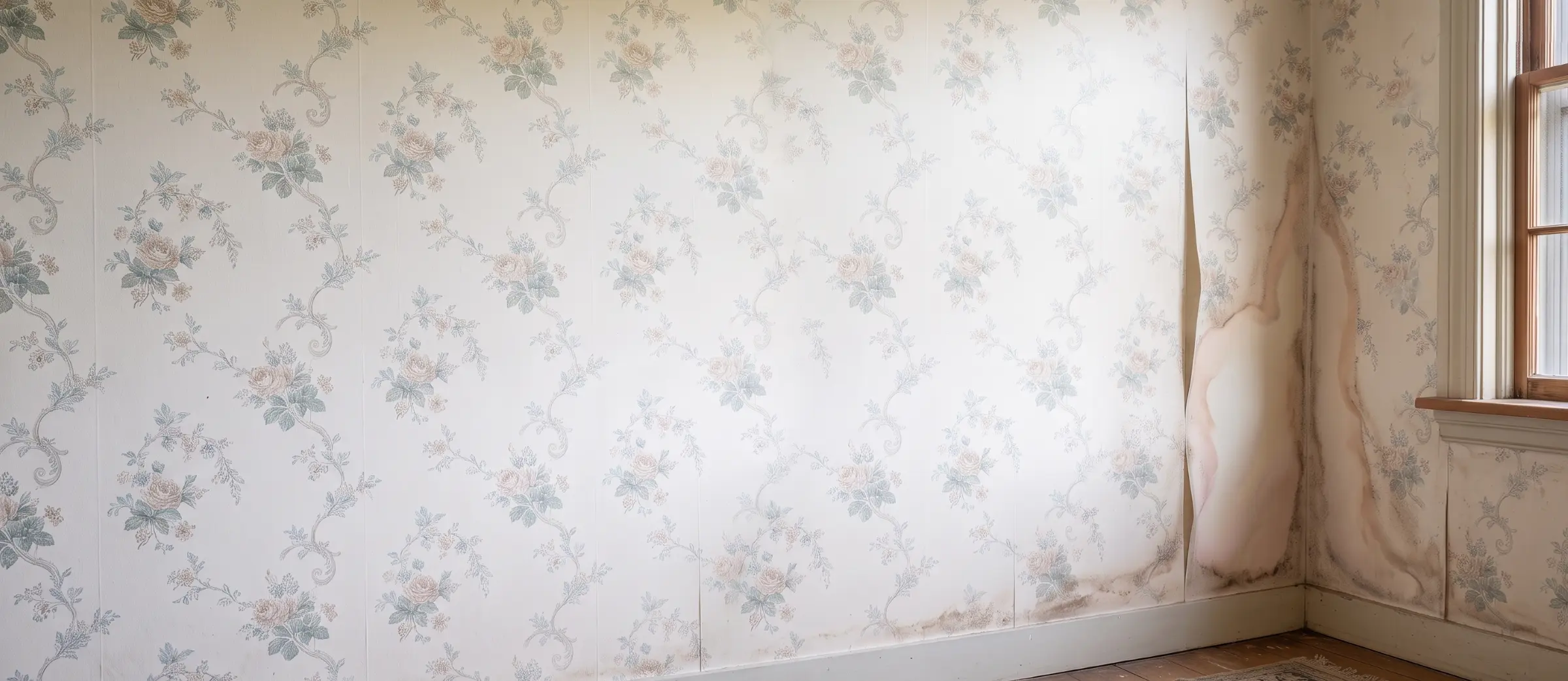

If you've found a pink, tan, or dark patch spreading along a wallpaper seam or window frame, it's natural to want to know exactly what you're looking at before you touch it. Identifying Aureobasidium mold with confidence, understanding the real health risks for your household, and deciding whether the spot in front of you is a quick wipe-down or a job for a professional all start with the same question: what kind of mold is this, and how far has it gone.
Aureobasidium is a genus of mold, most commonly the species Aureobasidium pullulans, that colonizes damp wallpaper, wood trim, painted walls, and window frames, recognized per CDC guidance as a common indoor allergen rather than a major toxin producer. It starts out cream or pink and darkens to brown or black as the colony ages, which is why it's frequently mistaken for black mold on sight alone.
Key insights
- Color changes with age. Aureobasidium starts cream, tan, or pink and darkens to brown or black over several weeks, so color alone won't confirm the species.
- Wallpaper is its favorite indoor surface. The paste and paper backing trap moisture against the wall, giving the mold both food and water in one spot.
- It's an allergen, not a major toxin producer. Aureobasidium pullulans is not recognized as a significant mycotoxin source, but it is a documented trigger for allergic and asthmatic symptoms.
- It's easy to confuse with bacteria. The pink slime in showers and toilets is usually Serratia marcescens, a bacterium, not Aureobasidium.
- Small patches are DIY-eligible. Under the EPA's 10-square-foot threshold, a contained patch on a cleanable surface can often be handled without a contractor.
- Removing moldy wallpaper without prep can backfire. Pulling paper off a wall where mold has grown underneath can release a sudden burst of spores into the room.
What is Aureobasidium mold
Aureobasidium gets its genus name from its asexual spore-forming structures, and NIOSH and CDC guidance both treat it as a common environmental mold rather than a regulated toxic species. What makes it unusual compared to most household molds is how little moisture it needs to survive once established: it can persist through dry spells that would kill off less hardy fungi, then resume active growth as soon as humidity returns, which is part of why a patch can seem to disappear and then come right back.
 At this mature stage, Aureobasidium is easily mistaken for Stachybotrys, even though CDC guidance does not classify it among the toxin-producing species.
Indoors, the same organism that produces pullulan, a biodegradable polysaccharide used in food and pharmaceutical packaging, is what's growing on a damp wall. That industrial use is part of why Aureobasidium pullulans has been studied more extensively than most household mold species, even though the indoor growth itself is a nuisance rather than a research subject.
The genus contains somewhere between 14 and 26 named species depending on the registry consulted, but only two are clinically relevant to homeowners: A. pullulans and A. melanogenum, distinguished mainly by environment, virulence traits, and how readily a lab can tell them apart.
| Species | Typical environment | Health relevance | Lab identification |
|---|---|---|---|
| A. pullulans | Soil, plants, wallpaper, wood trim | Allergen, low infection risk | Most common indoor isolate |
| A. melanogenum | Freshwater, damp indoor surfaces | Carries virulence traits absent in A. pullulans | Harder to distinguish without genetic sequencing |
A. melanogenum was only separated from A. pullulans as its own species once genomic sequencing showed clear differences between them, including the ability to grow at human body temperature and produce compounds that help it survive inside a host. Most home colonies are A. pullulans, but the two can look identical to the naked eye, which is one more reason visual inspection alone can't fully settle what's growing on a wall.
Where Aureobasidium mold grows in your home
Aureobasidium concentrates wherever a porous, moisture-holding surface stays damp for an extended period, most often wallpaper, wood trim, and window frames rather than tile or glass. The table below maps the locations where it shows up most, along with what typically causes it and whether the spot is usually a DIY job or one that needs a professional.
 Bubbling along a seam like this signals trapped moisture behind the paper, the exact condition that lets Aureobasidium establish before it spreads further across the wall.
Older homes with original wallpaper or single-pane windows see this pattern more often, since both create the sustained surface moisture the mold needs without requiring an active leak. A home with double-pane windows and painted drywall throughout will see Aureobasidium far less often, even at the same indoor humidity level, because there's less of the porous, moisture-retentive material it depends on. Catching it at this early stage, before it spreads across a full wall, is one of the more useful signs of mold to act on quickly.
| Location | Common cause | What to look for | DIY or pro |
|---|---|---|---|
| Wallpaper seams | Trapped condensation behind paper, adhesive moisture | Pink-to-brown discoloration along seams, bubbling paper | DIY if under 10 sq ft |
| Window frames and sills | Condensation from temperature differences | Soft, slimy patches on wood or painted trim | DIY |
| Painted drywall | Chronic humidity above 60%, slow leaks | Cream to pink blotches that darken over time | DIY if isolated |
| Bathroom caulk and grout | Standing moisture, poor ventilation | Pink to black film in corners and seams | DIY |
| Wood furniture and trim | High indoor humidity, poor airflow against walls | Discoloration that follows wood grain | Pro if structural |
| Behind vinyl wallcovering | Moisture trapped by an impermeable covering | Hidden growth, often found only when paper is removed | Pro if extensive |
Bathrooms and kitchens see Aureobasidium often enough that it's worth checking those rooms specifically. In a bathroom, it tends to settle into grout and caulk lines where humidity stays elevated longest, and the same damp corners around sinks and windows in a kitchen tend to collect condensation overnight.
How to identify Aureobasidium mold
Aureobasidium mold is identifiable by its color progression from cream or pink to brown or black, combined with a smooth, slimy texture rather than the fuzzy or powdery look common to other indoor molds. The transition typically happens over a period of weeks, not days, so a patch you noticed as faintly pink last month may already look closer to black mold by the time you decide to deal with it.
 Texture is the faster field check: fuzzy growth points to species like Cladosporium, while a smooth, slightly glossy surface points to Aureobasidium, though lab testing is the only way to confirm either with certainty.
Texture is the more reliable visual clue. Species like Cladosporium or Penicillium tend to look fuzzy or velvety under close inspection, while Aureobasidium reads as flat, smooth, and faintly glossy, almost like a thin film sitting on top of the surface rather than growing out of it. It also tends to spread in small, irregular patches that merge together over time rather than forming one solid circular colony from the start.
Because the color range overlaps with several other species, visual identification alone can't confirm what you're looking at with certainty. If the growth covers a significant area, sits near someone with asthma or a compromised immune system, or you simply want confirmation before deciding how to proceed, air sampling or surface testing can identify the species directly.
Lab confirmation matters more for Aureobasidium than for some other species, since it's part of a group of dark-pigmented fungi that direct microscopy alone can struggle to separate from one another, and distinguishing A. pullulans from A. melanogenum specifically often requires genetic sequencing rather than culture appearance. A surface swab or tape lift sent to an accredited lab is the more reliable method here, since this organism doesn't reliably show up in elevated counts on a routine air sample the way more aggressively airborne species do.
Aureobasidium vs. similar growths
Aureobasidium is most often confused with three other things: Serratia marcescens bacteria, true black mold, and ordinary efflorescence, each of which calls for a different response. The comparison below lays out how to tell them apart without lab testing.
Misdiagnosis has a direct cost. An antifungal product applied to a Serratia biofilm typically fails within days because the bacterium isn't affected by it, while a homeowner who assumes dark Aureobasidium is Stachybotrys often pays for full containment protocols a low-toxicity allergen never required.
| Growth | Organism type | Typical location | Key distinguishing trait |
|---|---|---|---|
| Aureobasidium | Fungus (mold) | Wallpaper, wood trim, window frames | Smooth texture, color darkens with age |
| Serratia marcescens | Bacteria | Showers, toilets, pet bowls | Slimy biofilm, almost never on wallpaper |
| Stachybotrys (black mold) | Fungus (mold) | Drywall, wood after sustained water exposure | Slimy black texture, requires prolonged moisture |
| Efflorescence | Mineral deposit | Concrete, masonry, basement walls | Powdery white, dissolves in water, never on wallpaper |
The Serratia comparison trips up the most people, since both organisms get called pink mold in casual conversation. The distinction matters for treatment: Serratia is a bacterium that responds to ordinary disinfectants, while Aureobasidium is a fungus that needs the same removal approach as any other mold. Showers and toilets are the more common site for pink mold, where the slimy bacterial film tends to concentrate instead of on wallpaper.
Is Aureobasidium mold dangerous?
For most healthy adults, Aureobasidium mold is a low-grade allergen and respiratory irritant rather than a serious toxic threat, and CDC guidance does not classify it among the small group of molds known for significant mycotoxin production. That said, low-grade does not mean harmless. Documented health effects include allergic reactions, asthma aggravation, and in occupational and case-study settings, hypersensitivity pneumonitis.
 Eye and respiratory irritation are the most common reactions, and symptoms can persist as long as the household keeps breathing the same air without addressing the source.
Hypersensitivity pneumonitis from Aureobasidium exposure has been documented most often in people with heavy, repeated contact, including specific occupational settings, though it can also develop from sustained indoor exposure. Symptoms include fatigue, fever, cough, and shortness of breath that can be mistaken for a lingering cold rather than a mold reaction, which is part of why it sometimes goes unaddressed for months. Population-specific risk factors beyond what's specific to this species, including pregnancy and chronic lung disease, also factor into whether mold is dangerous for a given household.
Allergic and respiratory symptoms
Sneezing, nasal congestion, watery or itchy eyes, sore throat, and skin irritation from direct contact are the most commonly reported effects, consistent with Aureobasidium's classification as a common allergen.
Asthma aggravation
People with existing asthma can see more frequent or more severe attacks with ongoing exposure, since Aureobasidium spores are a recognized trigger alongside other common indoor molds.
Hypersensitivity pneumonitis
This is an inflammatory lung reaction to repeated inhalation, presenting as flu-like fatigue, fever, and breathing difficulty. It's documented in PubMed case literature tied to Aureobasidium exposure, though it remains uncommon relative to simple allergic response.
Infection risk for immunocompromised individuals
In rare cases, almost always involving an existing medical vulnerability such as an indwelling catheter or significantly weakened immune system, Aureobasidium pullulans has caused opportunistic infections including skin, eye, and bloodstream infections documented in clinical case reports.
Healthy people without underlying conditions can usually handle small, contained patches without special precautions beyond basic PPE. The calculus changes for households with infants, elderly residents, asthma, allergies, or immune suppression, where even a contained patch is worth professional removal rather than DIY cleanup.
DIY removal or call a professional
A patch of Aureobasidium mold under about 10 square feet, on a cleanable nonporous or semi-porous surface, with no connection to a hidden water problem, is generally safe to handle yourself per the EPA's cleanup threshold. Anything larger, anything on porous material that can't be wiped clean, or any household with a health-vulnerable member shifts the calculation toward a professional. The supply list and step-by-step process for DIY mold removal apply here the same way they would for any species in this size range.
 A patch this size, on a paintable surface with no hidden water source, falls within the EPA's 10 square foot threshold for handling cleanup without a contractor.
The EPA's longstanding guidance treats roughly a 3-by-3-foot patch as the practical ceiling for safe DIY cleanup with basic protective gear and no specialized containment.
Surface is nonporous or lightly porous
Painted trim, vinyl wallcovering, and sealed wood respond well to cleaning. Unfinished wood, paper-backed wallpaper, and drywall paper facing often need more than surface cleaning to fully resolve.
No hidden water source is suspected
If the patch appeared without an obvious condensation or humidity explanation, there may be a leak behind the surface. That calls for inspection before cleanup rather than after.
No high-risk household members
Anyone with asthma, allergies, or a compromised immune system in the home is a reason to bring in a professional even for a small patch, given Aureobasidium's documented role in respiratory symptom flare-ups.
Mold keeps returning after cleaning
Recurrence after a proper cleanup usually means the underlying moisture source was never fixed, which is a sign the job needs a closer look than a repeat wipe-down.
A professional job for this species rarely needs the heavier containment protocols required for Stachybotrys or other toxin-producing molds, since Aureobasidium's main hazard is allergic irritation rather than airborne mycotoxin exposure. That keeps a typical Aureobasidium job closer to standard professional mold remediation timelines and costs than a black mold job of the same size.
Aureobasidium mold removal cost
Removing Aureobasidium mold typically costs between $300 and $3,500, with the final number driven mainly by surface type and whether wallpaper or drywall has to be replaced rather than just cleaned. A small patch on painted trim sits at the low end; a wallpapered wall with hidden growth behind it sits closer to the high end once paper removal and drywall repair are factored in.
Getting a written estimate before work begins matters more for this species than for some others, since the visible patch on wallpaper often understates what's underneath. A quote based only on the surface area you can see may need to be revised once the contractor pulls back the paper and finds the actual extent of the growth.
| Scope | Typical cost | What drives the price |
|---|---|---|
| Small patch, nonporous surface | $300–$600 | Cleaning supplies, minor labor |
| Wallpaper section, isolated | $500–$1,500 | Paper removal, surface treatment, partial repaste |
| Wallpaper with drywall damage | $1,200–$3,500 | Drywall replacement, repainting, disposal |
| Whole-room remediation | $2,000–$10,000 | Containment, multiple surfaces, moisture correction |
These ranges assume Aureobasidium specifically and don't include structural repairs tied to a major leak, which would add to the total separately. National averages for mold remediation cost vary by project size and mold type beyond this species alone.
Removing Aureobasidium mold from wallpaper
Wallpaper is the single most common indoor surface for Aureobasidium because the paste and paper backing trap moisture against the wall longer than bare drywall does, giving the mold both a stable food source and a sustained water supply in one place. That combination is also why wallpaper removal needs more care than people expect.
 Wetting the paper before peeling, rather than pulling it dry, keeps spores from becoming airborne when hidden growth like this is exposed.
Pulling wallpaper away from a wall where mold has colonized the underside or the adhesive layer can release a sudden, concentrated burst of spores into the room, a risk the EPA specifically addresses when investigating hidden mold. Opening a window, running an exhaust fan, and wearing an N95 respirator before peeling any affected paper reduces that exposure substantially.
Test a small section first
Peel back a corner in an inconspicuous spot to check whether mold has reached the wall surface underneath, not just the visible paper face.
Wet the paper before removing it
A water and mild detergent solution, or a commercial wallpaper removal spray, keeps spores from becoming airborne as the paper comes off, compared to dry peeling.
Clean the wall surface underneath
Once paper is removed, scrub the drywall or plaster with detergent and water per EPA cleanup guidance, then let it dry fully before repapering or repainting.
Decide on replacement vs. cleaning for the paper itself
Nonporous vinyl wallcovering can sometimes be cleaned and reused if the growth is limited to the surface. Paper-backed wallcovering with mold in the backing layer should be discarded rather than salvaged.
Address the moisture source before repapering
Repapering over an unresolved humidity or condensation problem guarantees the same patch returns, often faster the second time since the wall material has already been weakened.
For wallpaper sections where the drywall underneath is damaged rather than just damp, the clean-versus-replace decision follows the same logic used for any drywall mold situation: surface staining can often be cleaned, but soft or crumbling material needs to be cut out and replaced.
Preventing Aureobasidium mold from coming back
Aureobasidium needs sustained moisture to establish a colony, so keeping indoor relative humidity below the EPA's 60% threshold, ideally in the 30%–50% range, removes the conditions it depends on. Dehumidifier use and prompt condensation cleanup make the biggest difference, with the rest mattering more on a seasonal or occasional basis.
 Wiping condensation each morning keeps window frames below the moisture level Aureobasidium needs to establish, a faster habit than waiting for a dehumidifier to bring the whole room down.
Seasonal changes matter here more than people expect. Single-pane windows and uninsulated exterior walls are far more prone to condensation in colder months, which means the prevention habits that feel unnecessary in summer often become the ones that actually stop a colony from forming once the weather turns, whether in a bathroom, a kitchen, or any other moisture-prone room.
| Action | Frequency | Why it works |
|---|---|---|
| Run a dehumidifier in damp rooms | Continuous in humid months | Keeps surface moisture below the threshold mold needs to establish |
| Wipe condensation from window frames | After cold mornings | Removes the moisture wallpaper and trim would otherwise absorb |
| Check behind furniture against exterior walls | Monthly | Catches early growth in spots with reduced airflow |
| Inspect wallpaper seams for bubbling | Quarterly | Bubbling signals trapped moisture before visible mold appears |
| Use a hygrometer to track indoor humidity | Ongoing | Confirms whether humidity is staying in a safe range room by room |
Getting a precise read on your home's humidity levels, rather than guessing, is the single most useful habit for preventing recurrence. Exact threshold numbers by room and dehumidifier sizing for the space are part of the broader relationship between humidity and mold that applies across species, not just this one.
Frequently asked questions
Can I clean Aureobasidium mold myself?
Yes, if the affected area is smaller than about 10 square feet, on a nonporous or semi-porous surface, and not connected to a known water intrusion. Anything larger, on porous material like wallpaper backing or unfinished wood, or affecting someone with asthma or a compromised immune system should go to a professional.
How long does Aureobasidium mold take to grow on wallpaper?
A visible colony can establish within one to two weeks of sustained moisture, but the color change that makes it noticeable, from cream or pink to brown or black, often takes several additional weeks. By the time a patch looks dark enough to alarm most people, it has usually been growing far longer than its appearance suggests.
Does homeowners insurance cover Aureobasidium mold removal?
It depends on what caused the moisture, not the species. A sudden, accidental event like a burst pipe is typically covered under a standard policy subject to a mold sublimit, while damage from chronic condensation, old windows, or gradual humidity is usually excluded as a maintenance issue.
Can Aureobasidium mold spread to other rooms?
It can, but slowly compared to airborne species like Aspergillus or Penicillium. Aureobasidium spreads mainly through direct contact and surface moisture rather than heavy airborne spore release, so it tends to expand along a single wall or window before jumping to a separate room.
What's the difference between Aureobasidium and Cladosporium on wallpaper?
Texture is the giveaway. Cladosporium grows fuzzy or velvety and stays a consistent olive-to-brown color, while Aureobasidium starts smooth and pale, then darkens as it matures. Lab testing is the only way to confirm either with certainty, but the texture difference is the faster field check.
Is it safe to repaint over Aureobasidium mold instead of removing it?
No. Paint does not kill the colony underneath, and trapped moisture between the paint and the mold can accelerate growth rather than stop it. The surface needs to be cleaned or removed and fully dried before any new paint or paper goes on.
Sam Hickerson is the founder of RestoreAdvisor and writes consumer guides on mold remediation, water damage restoration, inspection, testing, and home recovery. His work focuses on helping homeowners understand costs, risks, and when to call a professional. He draws on guidance from the EPA, CDC, IICRC, and other authoritative sources to make complex home issues easier to navigate.