
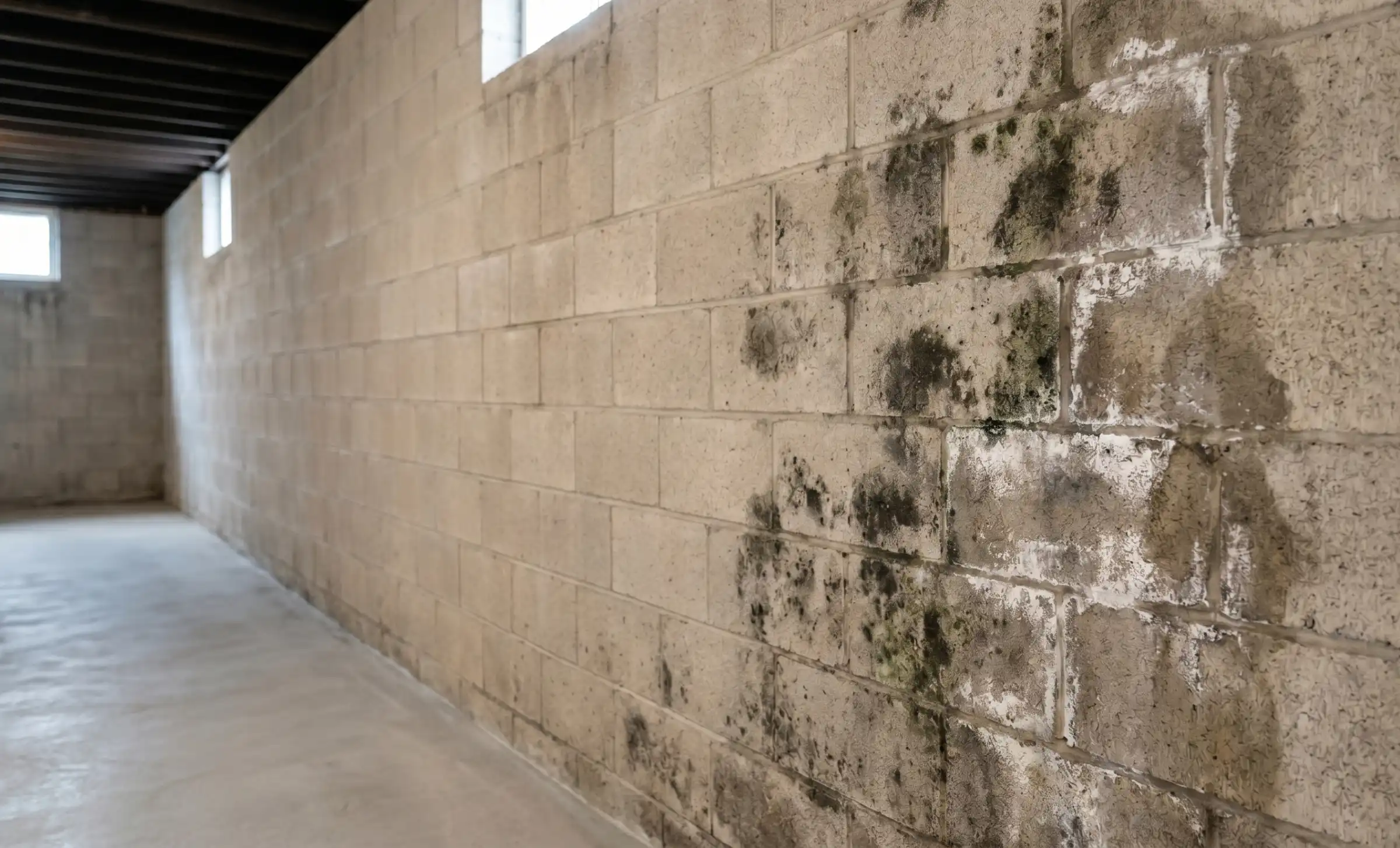

Basement mold is among the most extensive indoor mold problems in U.S. homes, affecting an estimated 60%–70% of basements according to NIOSH, and it is also one of the most treatable once you understand what caused it and what the job actually requires. This article covers causes, location-by-location identification, removal costs by scenario, the DIY threshold, and the prevention steps that stop it from returning.
Key insights
- Cost range. Basement mold removal costs $500–$6,000 for most jobs. Finished basements with drywall and flooring that must be removed can reach $10,000–$15,000.
- Humidity threshold. Mold requires relative humidity above roughly 60% to colonize surfaces. The EPA recommends keeping indoor humidity between 30%–50%.
- Growth timeline. Mold can begin colonizing wet surfaces within 24–48 hours of water exposure, per EPA guidance and the IICRC S520 standard.
- 10-square-foot rule. The EPA's guideline allows homeowner DIY removal for areas under 10 square feet on non-porous surfaces. Anything larger, or on structural wood or drywall, requires a professional.
- Efflorescence vs. mold. White powdery deposits on basement walls are often efflorescence (mineral salt deposits), not mold. But both signal an active moisture problem that must be addressed.
- Moisture is the root cause. Removing mold without fixing the moisture source guarantees recurrence. Professional remediation that does not address the underlying water problem is incomplete remediation.
Why basements are mold-prone
Basements develop mold more than any other room in a home because their below-grade position, limited natural ventilation, and direct contact with groundwater create chronic moisture conditions that mold requires to grow. Several structural and environmental factors converge to make them reliably damp.
 Vapor diffusion through concrete is constant even in well-built foundations, which is why staining like this can appear without any single leak event to point to.
Below-grade position. Basement walls and floors are surrounded by soil that retains water from rain, snowmelt, and irrigation. Even well-built foundations experience some degree of moisture vapor migration through concrete and masonry, a process called vapor diffusion. In older homes or homes with deteriorating waterproofing, liquid water intrusion through cracks is common.
Temperature differentials and condensation. In summer months, warm humid air enters the basement through windows, doors, and foundation vents. When that warm air contacts the cooler concrete walls and floor slab, it loses its ability to hold moisture and deposits water on those surfaces. This condensation cycle repeats every warm day without adequate dehumidification.
Limited air circulation. Basements rarely have the natural airflow that upper floors receive. Stagnant air at elevated humidity creates ideal conditions for mold to colonize wall surfaces, stored items, and structural wood.
Plumbing concentration. Water heaters, washing machines, utility sinks, and supply lines concentrate plumbing failures in the basement. Even a slow drip behind a wall can sustain mold growth for months before being noticed. The health effects of mold exposure are more pronounced in basements because the space is often less ventilated than upper floors, concentrating airborne spores.
Where mold grows in basements
Basement mold most commonly establishes on concrete and block walls, floor joists and rim joists, drywall in finished spaces, carpet and subfloor, and wood framing, per the location-specific guidance in ANSI/IICRC S520. Each location has a distinct moisture source and requires a different removal approach.
| Location | Primary moisture source | What mold looks like | DIY or pro |
|---|---|---|---|
| Concrete/block walls | Groundwater seepage, condensation | Black, gray, or white fuzzy patches; white powdery efflorescence | Small spots: DIY; spreading: pro |
| Floor joists and rim joists | Condensation, subfloor leaks from above | Black or green fuzzy growth on wood grain | Pro |
| Drywall (finished basements) | Slow leaks, flooding, chronic humidity | Discolored patches, bubbling paint, musty odor | Pro |
| Carpet and subfloor | Flooding, plumbing leaks | Visible discoloration; strong musty odor from below | Pro |
| Wood framing and beams | Condensation, water intrusion | Dark staining that follows wood grain | Pro |
| Storage items (cardboard, fabric) | Ambient humidity | Fuzzy growth on surfaces | Discard and replace |
| Sump pit area | Ground seepage, pump failure | Ring of mold around pit perimeter | Pro inspection |
| HVAC and ductwork | Condensation on cool duct surfaces | Visible growth at registers or musty air | HVAC specialist |
Floor joists and rim joists
Floor joists running across the basement ceiling and the rim joists at the perimeter where the floor system meets the foundation wall are particularly high-risk. They are made of dimensional lumber that readily absorbs moisture, they are dark, and they receive limited air circulation. Mold on floor joists is often the result of condensation accumulating over an entire summer season rather than a single water event. Per the IICRC S520 standard, structural wood mold requires professional remediation because surface cleaning alone does not address mold that has penetrated the wood grain.
 Growth following the wood grain like this usually built up over an entire humid season, not from one water event, which is why it's easy to miss until it's extensive.
Finished vs. unfinished basements
Unfinished basements expose the moisture problem: you can see wet concrete, damp insulation, and discolored wood directly. Mold is caught earlier and remediation is more straightforward.
Finished basements hide moisture behind drywall, drop ceilings, and flooring. By the time a musty odor or a soft spot in drywall appears, mold has often been growing behind the wall assembly for months. Remediation in finished basements almost always requires demolition to access the affected materials, which significantly increases cost and project duration. Basements that have experienced flooding face the most aggressive mold timeline; the mold after water damage response sequence covers what to do in the first 24–48 hours to limit colonization.
Common basement mold types
The most frequently confirmed basement mold species are Cladosporium, Aspergillus, Penicillium, Stachybotrys chartarum, Trichoderma, and Ulocladium, per CDC classification and ANSI/IICRC S520 guidance. Visual characteristics combined with location can narrow the likely candidates, but lab testing is the only way to confirm species identity.
| Mold type | Appearance | Common locations | Health category | Removal |
|---|---|---|---|---|
| Cladosporium | Olive-green to black, velvety | Walls, wood, carpet, HVAC | Allergenic | DIY (small areas); pro for large |
| Aspergillus | White, yellow, green, or brown | Drywall, insulation, stored items | Allergenic/ pathogenic | Pro recommended |
| Penicillium | Blue-green, powdery | Insulation, carpet, damp wood | Allergenic | Pro recommended |
| Stachybotrys (black mold) | Greenish-black, slimy, wet texture | Drywall, wood with chronic moisture | Toxigenic | Pro required |
| Trichoderma | White to green, rapid spreading | Wood framing, paper, damp fabric | Allergenic/ pathogenic | Pro recommended |
| Ulocladium | Black or dark brown | Walls after flooding, window trim | Allergenic | Pro recommended |
Stachybotrys chartarum (black mold)
Stachybotrys is the mold species that most homeowners are worried about when they find dark growth in the basement. It is a toxigenic mold that produces mycotoxins linked to respiratory irritation and, in high-risk populations, more serious health effects. The critical detail is that Stachybotrys requires sustained, prolonged moisture to establish itself, not just high humidity. It has a slimy, greenish-black appearance and often grows on chronically wet drywall and wood. Not all black-colored mold is Stachybotrys. Confirmed black mold removal requires containment protocols and professional testing that go beyond standard DIY cleaning.
Efflorescence is not mold
White powdery deposits on basement walls are usually efflorescence, not mold. Efflorescence is a mineral salt deposit left behind as water migrates through masonry and evaporates. It has no health effects on its own, but confirms an active moisture pathway that can support mold growth on nearby organic materials. The water spray and bleach field tests that distinguish efflorescence from mold on concrete surfaces are covered in detail separately.
 The white deposits on the left dissolve in water and crumble under pressure; the dark colonies on the right don't, which is the fastest field test to tell them apart.
Signs you have basement mold
Basement mold announces itself through several indicators even when the growth itself is not visible. The EPA notes that a persistent musty odor, visible discoloration, and health symptoms that improve away from home are the three most reliable early signals of indoor mold growth.
- Musty or earthy odor that is strongest near walls, carpet edges, or in closed-off areas. Mold produces volatile organic compounds (microbial VOCs) as it metabolizes organic material; the smell is often detectable before visible growth appears.
- Visible discoloration on walls, floors, or stored items in shades of black, green, gray, or white.
- Peeling or bubbling paint on drywall or masonry walls, indicating moisture behind the surface layer.
- Water stains with brown or rust-colored rings on walls or floors, showing repeated wetting cycles.
- Soft or spongy drywall that compresses under light pressure, a sign of moisture saturation and likely mold behind the surface.
- Health symptoms that improve when you leave the home, such as nasal congestion, coughing, or eye irritation. This pattern is a recognized indicator of indoor mold exposure.
Knowing what the signs of mold look like in different locations helps you catch growth before it spreads to structural materials.
If you find visible growth but are unsure of the extent, professional mold testing can determine species and whether hidden mold is present behind walls before you commit to a remediation scope.
Basement mold removal cost
Basement mold removal costs $500–$6,000 for the majority of residential jobs, with severe cases in finished basements reaching $10,000–$15,000. The EPA and IICRC S520 both note that finished basements requiring material removal drive costs significantly higher than unfinished spaces. The cost table below breaks down typical ranges by scenario.
| Scenario | Typical cost | What drives the price |
|---|---|---|
| Small spot (under 25 sq ft), unfinished | $500–$1,500 | Limited containment, minimal material removal |
| Moderate area (25–100 sq ft), unfinished | $1,500–$3,500 | Structural wood treatment, HEPA vacuuming, encapsulant |
| Large area (100+ sq ft), unfinished | $3,500–$6,000 | Extensive containment, possible joist treatment |
| Any size, finished basement (drywall present) | $3,000–$10,000+ | Drywall demo and disposal, flooring removal, reconstruction |
| Flooding-related, finished basement | $6,000–$15,000 | Category 2/3 water protocols, full material replacement |
| HVAC involvement added to any job | Add $1,000–$4,000 | Duct cleaning, coil treatment, register sanitation |
National mold remediation cost data covering all room types and scope levels gives context for how basement pricing compares to other spaces.
What affects cost in a basement specifically
 Damage like this behind a finished wall is usually months old by the time it surfaces, since drywall hides the moisture problem long after it starts.
Finished vs. unfinished construction is the dominant variable. Removing and replacing drywall, drop ceilings, and flooring is often as expensive as the remediation itself.
Structural wood involvement adds cost because lumber that has been penetrated by mold roots (hyphae) requires sanding, treatment with antimicrobial encapsulant, and sometimes replacement rather than simple surface cleaning.
Access difficulty for items like rim joists along the perimeter, areas behind utility systems, or confined sections near the sump pit can increase labor hours.
Waterproofing work is separate from remediation but almost always necessary. If water intrusion through the foundation is the root cause, remediation alone will not prevent recurrence. Foundation waterproofing typically costs $2,500–$7,000 depending on the extent of work. That is a separate contractor engagement, not included in mold remediation quotes.
Post-remediation clearance testing adds $200–$500 and is strongly recommended before reconstruction begins in a finished basement. The mold remediation cost per square foot breakdown explains how contractors price structural wood treatment and encapsulation separately from surface cleaning.
DIY vs. professional removal
The EPA's guideline for homeowner DIY mold removal is a contiguous affected area of 10 square feet or less on a non-porous surface. In a basement context, that translates to a small patch of mold on a concrete wall or block foundation that has not migrated to surrounding wood or drywall.
| Factor | DIY appropriate | Call a professional |
|---|---|---|
| Affected area | Under 10 sq ft | 10 sq ft or more |
| Surface type | Non-porous (concrete, sealed block) | Drywall, wood framing, floor joists |
| Location | Visible, accessible wall surface | Behind walls, under flooring, on structural members |
| Mold appearance | Single color, isolated spot | Greenish-black/slimy (possible Stachybotrys), multiple areas |
| Moisture source | Identified and fixed | Unknown or ongoing |
| Household health | No respiratory conditions or allergies | Anyone with asthma, allergies, or immune issues |
| History | First occurrence | Mold returned after previous cleaning |
For small non-porous surfaces that qualify for DIY treatment, DIY mold removal covers the PPE requirements, appropriate cleaning solutions, containment steps, and the three-condition completion test. Do not use bleach on porous surfaces: it kills surface growth but does not penetrate to the root system in wood or drywall, and the mold returns.
The professional removal process
Professional basement mold remediation follows the ANSI/IICRC S520 Standard for Professional Mold Remediation, the governing industry standard for residential and commercial mold work. A complete professional job includes these phases.
 The negative air setup exhausting through this window is what keeps spores disturbed during demolition from reaching the rest of the house.
1. Inspection and moisture assessment
A certified remediator identifies all affected areas, including hidden growth using moisture meters and sometimes thermal imaging cameras. The moisture source must be identified before work begins.
2. Containment setup
Affected areas are isolated with 6-mil polyethylene sheeting and negative air pressure is established using HEPA-filtered air scrubbers. This prevents spore dispersal to the rest of the home during demolition and cleaning.
3. Material removal
Porous materials that cannot be decontaminated (drywall, carpet, insulation, severely affected wood) are bagged in polyethylene, sealed, and removed. For floor joists and structural lumber that can be retained, crews use mechanical sanding or wire brushing followed by antimicrobial treatment and encapsulant coating.
4. Cleaning and treatment
All remaining surfaces are cleaned with HEPA vacuuming and EPA-registered antimicrobial solutions. Non-porous surfaces receive additional treatment and may be encapsulated.
5. Drying and verification
The space is dried to target moisture content levels using commercial dehumidifiers and air movers. Clearance testing (air sampling and/or surface sampling) confirms that spore counts are within normal background levels before containment is removed.
6. Clearance report
A written clearance report from a third-party industrial hygienist or certified indoor air quality professional documents that the remediation meets the IICRC S520 standard. This is important for insurance purposes and for any future home sale.
Professional mold remediation follows these phases regardless of room type; the basement-specific factors are structural wood protocols and the frequency of finished-wall demolition.
A full walkthrough of the homeowner experience at each phase is covered under what to expect during mold remediation.
When to call a pro
You need a professional mold remediation company whenever the job involves structural wood or finished walls, occurs after flooding, or affects a household member with a respiratory condition. The following conditions each independently require professional response rather than DIY cleanup.
- The visible mold covers an area larger than 10 square feet
- Mold is growing on floor joists, rim joists, wood framing, or structural beams
- Mold is behind finished drywall or under carpet and flooring
- The basement experienced flooding or sewage backup (Category 2 or Category 3 water requires different protocols than clean water)
- A household member has asthma, chronic respiratory illness, allergies, a weakened immune system, or is pregnant
- The mold is dark greenish-black and slimy in appearance (possible Stachybotrys)
- The mold returned after a previous cleaning attempt
- You cannot identify the moisture source
If you are unsure whether your situation requires a professional, a certified mold inspection can assess the extent of growth, identify hidden mold, and recommend an appropriate remediation scope before you spend money on removal.
The CDC recommends professional assessment for any suspected Stachybotrys or mold affecting high-risk household members.
For guidance on selecting and vetting a qualified remediation contractor, how to choose a mold remediation company covers the full hiring process including credential verification and bid comparison.
How to prevent mold in your basement
Basement mold prevention requires controlling moisture through three pathways: stopping water intrusion from outside, managing condensation from warm air, and preventing plumbing leaks from inside. Per the NIOSH report on dampness and mold in buildings, 60%–70% of basements have excess moisture, which means prevention is not optional maintenance but an ongoing requirement for most homes. None of these actions substitute for fixing an active water intrusion problem first.
| Prevention action | Frequency | Why it works |
|---|---|---|
| Run a dehumidifier sized for the basement | Continuously (summer); as needed (winter) | Keeps relative humidity below 50%, below the mold growth threshold |
| Check and clean gutters and downspouts | Twice yearly (spring and fall) | Directs roof runoff away from the foundation rather than into the soil beside it |
| Inspect foundation walls for cracks and seepage | Annually and after heavy rain | Early detection of water intrusion pathways before mold can establish |
| Confirm exterior grading slopes away from home | Annually | Soil that slopes toward the foundation directs surface water into the basement |
| Test sump pump operation | Before wet season; after any power outage | Pump failure during heavy rain is a leading cause of basement flooding |
| Inspect plumbing lines and connections | Annually | Slow leaks behind walls go undetected for months and sustain mold growth |
| Avoid storing cardboard and organic materials on basement floor | Ongoing | Cardboard and paper are primary mold food sources; elevate or use plastic bins |
| Insulate cold water pipes | One-time improvement | Prevents condensation from forming on pipe surfaces |
| Seal concrete walls with penetrating waterproof sealer | Every 5–10 years | Reduces vapor diffusion through masonry walls |
| Install or upgrade a vapor barrier on floor slab | One-time improvement | Prevents ground moisture from migrating up through the concrete |
Dehumidifier sizing. A dehumidifier rated for the actual square footage of your basement matters more than the unit's listed capacity. Undersized units run continuously without achieving adequate humidity reduction. The EPA recommends keeping indoor relative humidity between 30%–50%. During humid summer months in most U.S. climates, a basement without active dehumidification will regularly exceed 60% relative humidity, the threshold where mold colonization accelerates.
If you are dealing with an active moisture problem from a flooding or water damage event, the priority is drying within 24–48 hours to prevent mold from establishing before remediation begins.
Frequently asked questions
Basement mold affects an estimated 60%–70% of U.S. homes per NIOSH, making it one of the most common and most frequently misunderstood home remediation problems homeowners face.
Can basement mold spread to the rest of the house?
Yes. Mold spores travel through air, and a basement HVAC system or forced-air furnace will distribute spores to every room if mold establishes itself on or near the ductwork. Even without HVAC involvement, spores migrate through floor penetrations, stairwells, and shared wall cavities. This is one reason basement mold warrants faster action than mold in a more isolated space like a bathroom.
Do I need to leave my home during basement mold remediation?
It depends on the job size and your household. For small contained jobs in an unfinished basement, you can typically remain home if the work area is sealed and you stay out of the basement. For larger jobs, finished basements, or any household member with asthma or a compromised immune system, most IICRC-certified contractors recommend temporary relocation for the duration of active work. Confirm the displacement recommendation with your contractor during the scope review.
Can I remove basement mold myself?
Yes, under specific conditions: the affected area must be under 10 square feet, located on a non-porous surface like sealed concrete or block, and you must not have respiratory conditions or allergies. Any mold on structural wood, drywall, or carpet, and any growth larger than 10 square feet, requires a licensed professional.
What causes mold in basement walls?
Mold on basement walls results from moisture reaching the wall surface through one of three pathways: water intrusion from groundwater through foundation cracks, condensation when warm humid air contacts cool wall surfaces, or plumbing leaks from pipes inside the wall assembly. Chronic elevated humidity above 60% is sufficient on its own to sustain mold growth on organic materials stored against walls.
Is black mold in a basement dangerous?
Yes, if the species is confirmed as Stachybotrys chartarum, which produces mycotoxins linked to respiratory illness and heightened risk in sensitive populations. However, not all dark-colored basement mold is Stachybotrys. Common species like Cladosporium and Ulocladium appear dark but are primarily allergenic rather than toxigenic. Lab testing is the only way to confirm the species. The CDC and EPA recommend professional remediation for any suspected Stachybotrys growth regardless of confirmation status.
How long does basement mold remediation take?
Small unfinished basement jobs take 1–2 days. Moderate infestations requiring structural wood treatment take 2–4 days. Finished basements with drywall removal, drying, clearance testing, and reconstruction can take 1–3 weeks from start to final clearance. Post-remediation clearance testing adds 1–2 days to any project.
Does homeowners insurance cover basement mold?
Usually not. Homeowners insurance covers basement mold removal only when the mold results directly from a covered sudden peril such as a burst pipe or appliance failure. Mold caused by chronic humidity, poor drainage, or gradual seepage is typically excluded as a preventable maintenance issue. Document all damage with photos and contact your insurer before remediation begins to understand what your specific policy covers.
What is the white powder on my basement walls?
White powdery deposits on basement walls are usually efflorescence, not mold. Efflorescence occurs when water migrates through masonry, dissolves mineral salts, and deposits them on the wall surface as it evaporates. It crumbles under pressure and dissolves in water. While it is not mold and has no health effects on its own, it confirms an active moisture pathway through the foundation wall that can support mold growth on nearby organic materials.
Sam Hickerson is the founder of RestoreAdvisor and writes consumer guides on mold remediation, water damage restoration, inspection, testing, and home recovery. His work focuses on helping homeowners understand costs, risks, and when to call a professional. He draws on guidance from the EPA, CDC, IICRC, and other authoritative sources to make complex home issues easier to navigate.