
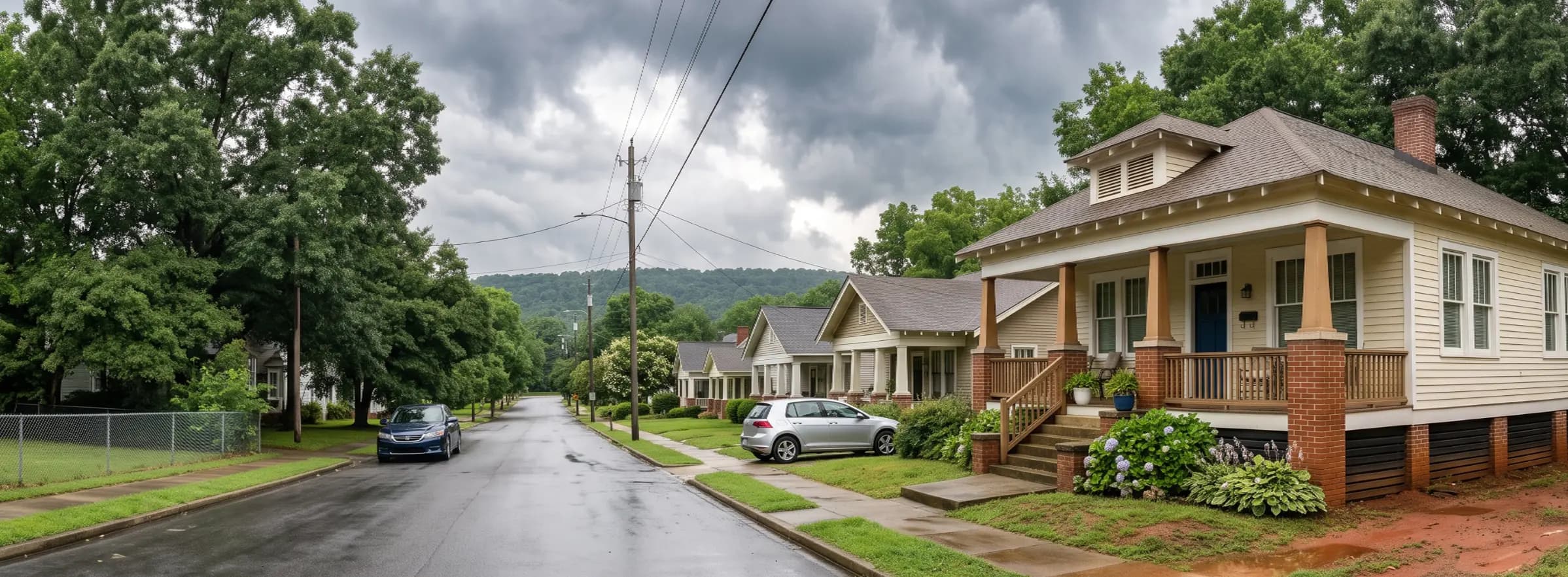

Standing water in a crawl space or a musty smell after a summer storm does not mean a home is beyond saving, but it does mean the clock is running. Mold remediation in Birmingham means physically removing mold-contaminated material and fixing the moisture source that fed it, following the ANSI/IICRC S520 standard that governs professional remediation nationwide, since the Alabama Department of Public Health sets no state-specific mold licensing standard of its own. Jefferson County homeowners need real cost figures, an honest read of why Birmingham homes flood and saturate the way they do, and a way to vet a contractor in a state that licenses none of them.
Village Creek's flood record, not the red clay soil underneath it, is what sets Birmingham's mold risk apart from other Southeast cities. Both play a role in a given home's exposure, but knowing your elevation relative to the nearest creek matters as much as knowing your foundation type.
Key insights
- Typical cost. Most Birmingham mold jobs run $1,400 to $5,800, with crawl space encapsulation after flood exposure pushing toward $12,000.
- No state license. Alabama has no mold remediation license or state standard, so verification depends on IICRC AMRT training and Certified Firm status rather than a license number.
- Village Creek leads. Repetitive urban flooding along Village Creek, not the red clay soil common across the Southeast, is what makes Birmingham's risk profile distinct.
- Flood pattern, not storm pattern. Village Creek has flooded Ensley and Pratt City more than 20 times in 20 years, independent of hurricane landfall.
- Renters have limited leverage. Alabama's landlord-tenant law gives landlords 14 days to repair after written notice, and tenants cannot withhold rent in the meantime.
- Clearance testing matters. Because there is no state inspector oversight, an independent post-remediation clearance test is the only reliable confirmation that a Birmingham job actually worked.
Why Birmingham homes are especially prone to mold
Birmingham homes are especially prone to mold because two mechanisms compound each other: repetitive Village Creek flooding in low-lying neighborhoods, and red clay soil that traps moisture against pier-and-beam foundations across nearly every home in Jones Valley. The city sits in that valley, a long trough running between Red Mountain and Shades Mountain, and that topography funnels rainwater toward the valley floor rather than letting it drain outward. Add roughly 56 inches of rain a year and 71 percent average relative humidity, per NWS Birmingham climate data, plus a housing stock where a large share of homes still sit on vented, unencapsulated crawl spaces, and the conditions for sustained moisture are built into the landscape itself.
 Birmingham's red clay retains water long after rainfall stops, often pushing nearby crawl space framing above the 19 percent moisture threshold NIOSH associates with active fungal growth.
The primary driver is Village Creek, along with Valley Creek, Shades Creek, and Five Mile Creek. Since 1970, flooding in Birmingham has triggered more than 17 federally declared disasters, and Village Creek's floodplain alone covers an estimated 53 percent of the city's mapped Special Flood Hazard Area. In the last 20 years, Village Creek has flooded the same Ensley and Pratt City neighborhoods more than 20 times, sometimes multiple times in a single year, a repetition rate driven by undersized culverts, roadbed erosion, and the creek's position at the valley's low point rather than by tropical storm intensity. This pattern is what separates Birmingham from cities where flood risk tracks hurricane landfall: homes in the Village Creek corridor face repeat exposure on a schedule closer to annual than seasonal.
Layered on top of the flood risk is red clay soil, a factor Birmingham shares with much of the Southeast rather than one unique to the city. Much of Jefferson County sits on expansive clay that absorbs water quickly during frequent thunderstorms and then holds it against foundation walls and crawl space framing long after the rain stops. That clay expands when saturated and contracts as it dries, a cycle that stresses pier-and-beam foundations common in the city's pre-1950s neighborhoods and keeps humidity trapped beneath the house even when the surface looks dry. This factor compounds flood risk in low-lying areas and operates on its own timeline everywhere else in Jones Valley, which is why a home does not need to sit near a creek to develop chronic crawl space moisture.
Beyond both mechanisms is Birmingham's cooling season. Air conditioning runs close to eight months a year here, and that continuous cycle creates condensation on ductwork and evaporator coils that adds a third, HVAC-driven moisture source, separate from either the clay or the creek.
Tornado and roof damage as a mold pathway
Birmingham sits in Dixie Alley, a Southeastern tornado corridor distinct from the Great Plains' Tornado Alley, and tornado-damaged roofs create a mold pathway independent of both red clay and Village Creek flooding. The April 27, 2011 Super Outbreak, the most prolific tornado outbreak on record, included an EF4 that tracked directly through Jefferson County, killing 20 people in Birmingham and leaving thousands of homes with compromised roofs across neighborhoods including Pratt City, Pleasant Grove, and Concord. An earlier F5 tornado struck the same west Birmingham corridor on April 8, 1998, meaning some of the same neighborhoods that appear in the Village Creek flood record have also absorbed tornado damage within recent memory.
 A tarp that shifts like this lets rain reach exposed decking well within the 24 to 48 hour window mold needs to establish once wood framing gets wet.
A damaged roof does not need a hole in it to let moisture in. Missing shingles, cracked flashing, or a tarp that shifts in the next storm all allow water into attic insulation and ceiling drywall, and that moisture behaves the same way any other roof leak does: mold can establish within the same 24 to 48 hour window that applies after a Village Creek flood. A blue tarp is a temporary fix, not a repair, and homes with storm-damaged roofs should schedule a moisture assessment before the next rain event rather than waiting for visible ceiling staining to appear.
The first 24 to 48 hours after a Village Creek flood
The first step after a Village Creek flood is confirming it is safe to re-enter the home, since standing water carries Category 3 contamination under IICRC S500 that can seed mold on saturated drywall and framing within 24 to 48 hours. That window is faster than the general water damage timeline that applies to an ordinary leak, which is why flood response cannot wait for a scheduled appointment.
 A tide mark this high on brick means Category 3 floodwater likely reached wall cavities and subfloor framing, not just the exterior surface, which is why IICRC S500 treats this as a full-removal job rather than a surface cleanup.
Confirm it is safe to re-enter
Wait for utility crews or local officials to confirm electrical service is safe before entering a flooded home. Village Creek's combined runoff history means standing water should be treated as contaminated regardless of how it looks.
Cut power to affected circuits
Shut off electricity to flooded rooms at the breaker panel rather than at individual outlets, since floodwater can compromise wiring even where no damage is visible.
Document everything before touching anything
Photograph water lines on walls, damaged flooring, and affected belongings before extraction begins. This documentation supports an NFIP claim later and speeds contractor scoping.
Begin water extraction within hours, not days
Pump out standing water and remove saturated carpet, padding, and drywall below the waterline as soon as it is safe. Category 3 water requires removal of porous materials rather than attempted cleaning.
Run fans and dehumidifiers continuously
Position air movers and a dehumidifier in affected rooms and run them around the clock. The 24 to 48 hour mold establishment window does not pause for scheduling convenience.
Call a remediation contractor and your insurer the same day
Schedule a moisture assessment before visible mold appears, and open an NFIP claim immediately if you carry flood coverage, since the standard policy's proof-of-loss deadline starts running from the date of loss.
For jobs that fall outside an active flood, the standard professional mold remediation process still applies, covering inspection, containment, removal, and post-work verification in sequence.
What mold remediation costs in Birmingham
Mold remediation in Birmingham typically costs $1,400 to $5,800, depending primarily on affected square footage and whether the job involves a crawl space, not on which neighborhood the home sits in. A licensed remediation contractor prices by the square foot of contaminated material, the equipment needed for containment and drying, and whether encapsulation follows the initial cleanup.
 Vapor barrier installation is the line item that pushes a Birmingham crawl space job from the low end of its cost range toward the high end, since red clay soil requires sealing the entire floor rather than treating isolated wet spots.
Labor typically accounts for 40 to 60 percent of a Birmingham quote, with the remainder split between containment materials, HEPA filtration equipment, and disposal fees for contaminated drywall or subfloor. Jobs that require working around finished basement drywall in newer Hoover or Vestavia Hills construction usually price at the higher end of a given scope, since finished walls add demolition and rebuild steps that an open crawl space does not.
| Project scope | Typical cost | What drives the price |
|---|---|---|
| Small patch, under 10 sq ft | $400-$800 | Nonporous surface, single room, no containment needed |
| Moderate infestation, 10-100 sq ft | $1,400-$3,500 | Containment setup, HEPA filtration, one to two rooms |
| Large infestation, 100-500 sq ft | $3,500-$7,500 | Multi-room scope, porous material removal, extended drying |
| Whole crawl space, red clay saturation | $3,500-$9,000 | Vapor barrier, sump correction, mold removal from framing |
| Post-flood crawl space or basement | $6,000-$12,000 | Category 3 water protocols, full encapsulation, clearance testing |
Cost also varies by where the mold is found, since access, containment needs, and material replacement differ by location even at similar square footage. A flooded crawl space, for example, is priced by both its size and its location at once, since size drives the labor and material scope while location adds the below-waterline requirements Category 3 water brings, and a contractor's final mold remediation cost typically reflects whichever factor pushes the total higher.
| Location | Typical cost | Local cost driver |
|---|---|---|
| Bathroom (grout, drywall, ceiling) | $500-$1,800 | Tile removal and re-grouting add labor beyond the mold cleanup itself |
| Crawl space, red clay saturation, no flood | $1,500-$6,000 | Vented crawl spaces need vapor barrier work alongside removal |
| HVAC and ductwork | $600-$4,000 | The long cooling season means condensation returns without duct sealing |
| Finished basement, Hoover or Vestavia Hills | $2,000-$7,000 | Drywall demolition and rebuild add cost an open crawl space avoids |
| Below-waterline area, Village Creek flood | $6,000-$12,000 | Category 3 water protocols require full material replacement |
Per-square-foot pricing in Birmingham generally falls between $9 and $22, slightly below the national $10 to $25 range, reflecting the region's lower labor costs. A standalone inspection runs $300 to $650, and independent clearance testing after the work is complete typically adds $200 to $500. Homes affected by Village Creek flooding should expect a 10 to 20 percent surge premium during active flood response, when contractor demand across Ensley and Pratt City spikes simultaneously.
How long mold remediation takes in Birmingham
A mold job in Birmingham typically takes two to four days from inspection to clearance when it is isolated and away from Village Creek, but the timeline is driven more by which of the city's risk pathways caused the mold than by the size of the affected room. Depending on that pathway, total project length can run anywhere from two days for an isolated bathroom patch to two full weeks for a flood-driven whole-home job, a range wide enough that cause matters far more than square footage when a homeowner is trying to plan around the work.
 Active drying like this typically runs continuously for two to five days before a Birmingham job is ready for clearance testing, which is the step that determines the total timeline more than the demolition itself.
Timelines stretch further when a job depends on outside coordination rather than on the remediation crew's own schedule. A roofer completing tornado repairs before a drying crew can finish an attic, or a Village Creek property waiting on an NFIP adjuster before demolition begins, both add days that have nothing to do with the mold itself, which is why a phase-by-phase checklist helps homeowners track what to expect at each step.
| Scenario | Active work | Total timeline | Why it differs |
|---|---|---|---|
| Isolated crawl space patch, no flood or storm history | 1-2 days | 2-4 days | A standard job on dry ground away from Village Creek |
| Chronic crawl space, red clay saturation | 2-4 days | 4-7 days | Vapor barrier and drainage correction beyond a dry-ground job |
| Village Creek flood, Ensley or Pratt City | 3-5 days | 5-10 days | Category 3 protocols plus NFIP adjuster scheduling before demolition |
| Tornado-damaged roof or attic | 2-4 days | 5-12 days | Timeline tracks the roofer's repair schedule, not the drying crew's |
| Whole-home, multiple rooms | 5-8 days | 10-14 days | Rare outside an active flood or storm event given Birmingham's building stock |
Alabama's mold licensing law and what to check instead
Alabama has no state law governing residential or commercial mold standards, and no license is required to perform mold remediation work that does not involve structural repair. The Alabama Department of Public Health confirms this directly: there is no contractor accreditation or mold remediation certification requirement anywhere in the state. That absence of oversight means the burden of vetting a contractor falls entirely on the homeowner, since there is no license number to check and no state agency that will investigate a botched job.
In place of a license, three items function as the closest available substitute. IICRC AMRT training indicates a technician has completed the industry's standard mold remediation coursework. An active listing on the IICRC Global Locator confirms the company maintains Certified Firm status, which requires ongoing insurance and continuing education. Pollution liability insurance, distinct from general liability, covers the specific risk of a contractor accidentally spreading contamination between rooms or to a neighboring unit. A contractor who cannot produce all three should be treated as a red flag regardless of how the estimate looks on paper.
Verifying those three items takes about ten minutes and does not require taking a contractor's word for any of it.
Ask for the technician's IICRC certificate number
A legitimate AMRT-trained technician can provide this on request. The number itself does not confirm current standing, which is what the next step is for.
Search the IICRC Global Locator for the firm
The locator shows whether the company holds active Certified Firm status, not just an individual technician's past training. A firm that trained one employee years ago but let its firm status lapse will not appear as current.
Request proof of pollution liability insurance
Ask to see the certificate directly rather than accepting a verbal confirmation. General liability alone does not cover contamination spread between rooms or units.
Confirm structural repair licensing separately if it applies
If the job includes rebuilding subfloor or replacing framing, ask for the contractor's Alabama general contractor license number for that portion of the work, since mold certification alone does not cover it.
That fourth check is worth raising early, before signing anything, as part of the broader process of choosing a mold remediation company.
Questions to ask a Birmingham mold contractor
The most important question for a Birmingham mold contractor is whether their firm currently holds active IICRC Certified Firm status, since Alabama's lack of licensing makes that the closest thing to a credential check available. Four more questions round out a complete vetting conversation.
 A credible contractor points to specific findings like this vent before naming a scope of work, rather than quoting a price before ever inspecting the crawl space.
1. Are you IICRC AMRT trained, and can I verify your firm on the IICRC Global Locator?
Credible answer: a specific certification number you can look up on the spot, not just a verbal claim of experience.
2. Do you carry pollution liability insurance in addition to general liability?
Credible answer: they show you the certificate directly rather than a verbal yes, since this is one of the few protections Alabama's lack of licensing leaves in place.
3. Will an independent third party perform clearance testing, or will you test your own work?
Credible answer: yes, an independent party, since nothing in Alabama forces that separation the way licensed assessor-remediator states do.
4. How will you classify the water if this job follows a Village Creek flood?
Credible answer: an immediate reference to Category 3 water protocols under IICRC S500, since anything less signals unfamiliarity with the area's most common large-scale mold source.
5. What is your plan for the moisture source, not just the visible mold?
Credible answer: a specific plan for drainage or crawl space ventilation, not just removal, since on red clay soil the same spot regrows within a season without it.
Where mold hides in Birmingham homes
Mold in a Birmingham home concentrates in crawl space framing, basement walls, bathroom grout, HVAC drain pans, and, after a Village Creek flood, drywall below the waterline. A professional mold inspection is the fastest way to confirm which of these locations applies to a given house.
 Growth concentrated at a baseboard like this points to hydrostatic pressure pushing moisture through the wall from outside, a pattern common in Hoover and Vestavia Hills basements rather than older crawl space homes.
A moisture meter reading is usually the deciding factor between a location that needs active remediation and one that just needs better ventilation. Framing above 19 percent moisture content signals conditions NIOSH identifies as conducive to active fungal growth, while readings below that threshold typically point to a cosmetic surface issue instead.
| Location | Primary cause | DIY or pro |
|---|---|---|
| Crawl space framing | Red clay saturation, vented crawl space humidity | Pro if moisture meter reads above 19 percent |
| Basement walls (newer suburbs) | Hydrostatic pressure from clay expansion | Pro if wall is cracked or actively weeping |
| Bathroom grout and ceiling | Standard humidity, poor ventilation | DIY if under 10 sq ft on tile |
| HVAC drain pan and ductwork | Long cooling season, condensation | Pro if inside ductwork |
| Below-waterline drywall (flood corridor) | Village Creek or tributary flooding | Always pro, Category 3 water |
| Attic sheathing | Roof leaks, inadequate ventilation | Pro if beyond a small isolated spot |
Bathroom grout and a below-waterline flood location can look like the same small patch and still call for entirely different responses, since the cause behind the mold matters more than its size. For a full room-agnostic process covering supply costs and step-by-step cleaning, the DIY mold removal process explains what qualifies as a small enough job to handle without a contractor.
Mold species common in Birmingham
Cladosporium, Aspergillus and Penicillium, Stachybotrys chartarum, and Chaetomium are the four species most often confirmed in Birmingham homes, per CDC mold classifications, tied respectively to year-round humidity, HVAC condensation, sustained Village Creek saturation, and post-flood cellulose decay.
 Aspergillus and Penicillium concentrate on HVAC vents like this because Birmingham's near eight-month cooling season keeps condensation forming on ductwork longer than in most Southeast markets.
Species identification changes the remediation approach more than it changes the cleaning products used. A Stachybotrys finding triggers stricter containment and do-not-disturb protocols under IICRC S520, while a Cladosporium finding on tile or grout often allows a more routine cleanup.
| Species | Common location | Notes |
|---|---|---|
| Cladosporium | Crawl spaces, HVAC vents | Year-round baseline species regardless of flood exposure |
| Aspergillus and Penicillium | Older homes, HVAC systems | Common in homes with long-term humidity rather than a single event |
| Stachybotrys chartarum | Village Creek flood corridor, sustained saturation | Requires prolonged moisture, concentrated in repeat-flood neighborhoods |
| Chaetomium | Post-flood drywall and subfloor | Cellulose-decomposing, elevated after flood events |
Stachybotrys and Chaetomium concentrations run higher in Ensley and Pratt City specifically because those neighborhoods experience the sustained saturation both species require, a pattern distinct from the more evenly distributed Cladosporium and Aspergillus growth found across drier, higher-elevation parts of the city. Stachybotrys carries its own containment protocol and cost premium, detailed separately on black mold removal since the process differs enough from the other three species to warrant its own treatment.
Insurance coverage for Birmingham homeowners
A standard Alabama HO-3 policy covers mold only when it traces to a sudden, named peril such as a burst pipe or a covered appliance failure, not to gradual leaks, chronic humidity, or flooding. Most HO-3 policies cap mold-specific payouts at $5,000 to $10,000 regardless of the underlying cause, which rarely covers a full crawl space remediation and encapsulation job.
Village Creek flood damage sits outside homeowners insurance entirely. Flood losses, including any resulting mold, fall under a separate NFIP flood policy, and homes in the Village Creek floodplain that carry flood insurance should file that claim immediately given the standard 60-day proof-of-loss deadline. Homes without flood coverage in a repeat-flood corridor face the full remediation cost out of pocket, which is part of why FEMA's buyout program in Ensley and Pratt City proved more cost-effective than repeated claims over multiple decades. Endorsements, the claims dispute process, and the complete national coverage framework are detailed on does homeowners insurance cover mold rather than repeated here.
Buying or selling a Birmingham home with a mold history
Alabama follows a caveat emptor standard for residential real estate, meaning sellers carry limited mandatory disclosure duties for conditions like mold unless concealment rises to the level of fraud. That standard puts more weight on independent inspection than in states with mandatory mold disclosure forms. A buyer touring a home in Ensley, Pratt City, or any other creek-adjacent neighborhood should ask directly about flood history and request documentation rather than relying on silence as evidence of a clean record.
 A clearance certificate and moisture readings from any past remediation carry more weight than a seller's disclosure form, since Alabama's caveat emptor standard leaves buyers to verify a mold history themselves.
For homes with a documented past remediation, a clearance certificate and moisture readings from the original job serve as useful proof the work crossed the point when professional remediation is required and was handled correctly, particularly given that Alabama has no state inspector to verify it independently. Sellers who can produce that documentation typically face fewer objections during the buyer's own inspection period.
Mold and renters in Birmingham
Alabama's Uniform Residential Landlord and Tenant Act, codified at Code of Alabama Section 35-9A-204, requires landlords to comply with building and housing codes materially affecting health and safety and to maintain rental units in habitable condition. While the statute does not name mold specifically, courts have interpreted these habitability requirements to cover mold problems that affect tenant health. A landlord has 14 days after written notice to make repairs, and Alabama law does not permit tenants to withhold rent in the meantime, which limits practical leverage compared to states with rent-escrow options.
A tenant dealing with mold should submit written notice describing the problem, keep copies of all correspondence, and document the mold with photographs and moisture readings if possible. If a landlord takes no action within the 14-day window, the tenant's remaining options are lease termination or a legal claim under the habitability statute. State-by-state tenant escalation options beyond Alabama's specific timeline are laid out at mold in your rental.
Neighborhood mold risk in Birmingham
Mold risk in Birmingham splits between Village Creek flood exposure and red clay soil saturation, and seven areas illustrate the range: historic pier-and-beam districts, the Village Creek floodway, and newer suburbs built on finished basements instead of crawl spaces. No single label like historic, suburban, or working-class predicts which risk a given block carries, since two neighborhoods built in the same decade can end up on opposite sides of the flood line depending on which side of a ridge they sit on.
 A street's elevation relative to the nearest creek predicts its flood exposure more reliably than its distance in miles, which is why homes a few blocks apart can carry very different risk profiles.
Elevation relative to the nearest creek matters more than distance measured in miles. A home a few blocks from Village Creek but sitting on higher ground can fall entirely outside the mapped floodway, while a lower home on the same street floods repeatedly. The same logic holds away from the creek entirely: two homes on red clay a block apart can see very different crawl space moisture depending on grading differences invisible from the street, which is why foundation type and drainage matter more than which side of town a home sits on.
| Neighborhood | Primary risk factor | Homeowner notes |
|---|---|---|
| Forest Park / Highland Park | Red clay, pier-and-beam foundations | Pre-1930s housing stock, open vented crawl spaces are common |
| Crestwood | Red clay, mid-century vented crawl space | Homes from the 1950s and 1960s show similar crawl space patterns to older districts |
| Bluff Park | Ridge-top drainage, older foundations | Elevation reduces flood exposure but not clay saturation |
| Ensley | Village Creek floodplain | Repeat flood history, mill-village housing stock from the early 1900s |
| Pratt City | Village Creek floodplain | Among the most frequently flooded areas in the city over the past 20 years |
| Avondale | Historic mill village, tributary proximity | Older industrial-era housing near a Village Creek tributary |
| Vestavia Hills / Hoover | Hillside drainage from Shades Mountain, finished basements | Newer construction shifts risk from crawl spaces to basement hydrostatic pressure |
Preventing mold in a Birmingham home
Inspecting the crawl space vapor barrier, correcting foundation grading, and keeping HVAC condensate lines clear prevent most Birmingham mold calls, with Village Creek flood monitoring added for creek-adjacent homes. None of these require a full-time contractor relationship, and most homeowners can complete the first three on their own with a flashlight and an afternoon, which makes prevention meaningfully cheaper than even a small remediation job.
 Running a dehumidifier continuously in an unencapsulated crawl space keeps humidity below the 60 percent threshold mold needs to establish, without requiring a full vapor barrier retrofit.
None of these actions replace a working moisture barrier. Even a strict HVAC maintenance schedule cannot offset water actively entering a crawl space or basement from outside, which is why grading and vapor barrier checks matter most on red clay lots. Homes near Village Creek face a different calculation entirely, since no amount of routine maintenance changes what happens when floodwater reaches the crawl space directly, which is why monitoring and fast extraction matter more there than any preventive schedule.
| Action | Frequency | Why it works |
|---|---|---|
| Inspect crawl space vapor barrier | Twice yearly | Confirms red clay moisture is not bypassing the barrier |
| Clean HVAC condensate drain line | Every 3 months during cooling season | Prevents the algae clogs that back up condensate into ductwork |
| Grade soil away from foundation | Annually, after clay settling | Reduces water pooling against pier-and-beam foundations |
| Monitor Village Creek flood alerts | Ongoing, flood season | Allows early extraction before floodwater reaches interior framing |
| Run a crawl space dehumidifier | Continuously in unencapsulated crawl spaces | Keeps humidity below the 60 percent threshold mold needs to establish |
Homes on higher ground away from Village Creek should prioritize the first three actions, all of which trace back to the humidity thresholds mold needs to establish in the first place. Homes inside the floodway should treat flood monitoring as a standing habit rather than a reactive step, since early extraction is what keeps a job in the crawl-space price range instead of the post-flood one.
Frequently asked questions
How much does mold remediation cost in Birmingham?
Most Birmingham jobs run $1,400 to $5,800, with a typical project landing near $3,200. Small bathroom or closet patches under 10 square feet can cost as little as $400 to $800, while whole-crawl-space jobs after a Village Creek flood or a slab leak commonly reach $6,000 to $12,000 once encapsulation is included.
Does Alabama require a license for mold remediation contractors?
No. Alabama has no state law governing mold remediation and no mold-specific contractor license, and the Alabama Department of Public Health confirms it sets no residential mold standards. A general contractor license is only required if the job involves structural repair, so verification has to rely on IICRC AMRT training, an active Certified Firm listing, and proof of pollution liability insurance instead of a license number.
How long does mold remediation take in Birmingham?
A single-room job typically takes two to four days from inspection to clearance. Crawl space jobs tied to red clay saturation or a Village Creek flood usually run five to ten days once drying time, encapsulation, and independent clearance testing are factored in.
Why does Village Creek flood so often?
Aging drainage infrastructure, not storm severity, is the main cause. The city's ongoing culvert and buyout projects have reduced losses in some stretches, but Ensley and Pratt City homeowners should still check FEMA flood zone maps before buying or renovating, since the creek's floodplain has not changed enough to remove those neighborhoods from repeat-flood status.
Are renters in Birmingham protected if their apartment has mold?
Yes, indirectly. Alabama's Uniform Residential Landlord and Tenant Act requires landlords to keep rental units in a habitable condition and gives them 14 days after written notice to make repairs. Alabama does not allow rent withholding, so a tenant's main leverage is written notice, documentation, and, if the landlord does not act, lease termination or legal action.
Do I have to disclose past mold when selling my Birmingham home?
Alabama follows a caveat emptor standard, meaning sellers have limited mandatory disclosure duties for conditions like mold unless the concealment amounts to fraud. Buyers should not rely on silence as a sign of a clean history and should request an independent inspection rather than trusting a disclosure form alone.
Is the mold in my crawl space dangerous?
It depends on the species and the extent of growth, but any visible crawl space mold means moisture is reaching wood framing and insulation, which risks structural decay in addition to health effects. A moisture reading above 19 percent on exposed framing is the threshold most Birmingham inspectors use to recommend professional assessment rather than a DIY wipe-down.
Can I clean small patches of mold myself?
Yes, for isolated patches under 10 square feet on nonporous surfaces like tile or sealed concrete, consistent with EPA's threshold for DIY-appropriate cleanup. Birmingham's red clay soil and near-constant crawl space humidity mean small patches recur quickly if the moisture source is not fixed first, so DIY cleaning without addressing drainage or grading usually buys only a few months before the mold returns.
How much does crawl space encapsulation cost in Birmingham?
Full encapsulation with a vapor barrier, sealed vents, and a dedicated dehumidifier typically runs $3,500 to $12,000 depending on square footage and access. Homes on Birmingham's red clay with standing water history, common in the Ensley and Pratt City floodway, tend to land at the higher end because of added drainage work.
Does homeowners insurance cover mold in Birmingham?
Only when the mold traces to a sudden, covered peril like a burst pipe, not to gradual leaks, chronic humidity, or flooding. Village Creek flood damage specifically falls under NFIP flood coverage rather than a standard Alabama HO-3 policy, and most HO-3 policies cap mold-related payouts at $5,000 to $10,000 regardless of cause.
What certifications should a Birmingham mold contractor have?
Look for IICRC AMRT training, an active IICRC Certified Firm listing you can verify through the IICRC Global Locator, and proof of pollution liability insurance. Because Alabama issues no license, these three items are the closest available substitute for a license check.
- CDC: Basic Facts About Mold
- EPA: Mold Cleanup in Your Home
- IICRC S500 Standard for Professional Water Damage Restoration
- IICRC S520 Standard for Professional Mold Remediation
- NIOSH: Dampness and Mold in Buildings
- NWS Birmingham: Historical Overview of Flooding
- FEMA: Loss Avoidance Study, Birmingham AL Acquisitions
- Alabama Department of Public Health: Indoor Air Quality
Sam Hickerson is the founder of RestoreAdvisor and writes consumer guides on mold remediation, water damage restoration, inspection, testing, and home recovery. His work focuses on helping homeowners understand costs, risks, and when to call a professional. He draws on guidance from the EPA, CDC, IICRC, and other authoritative sources to make complex home issues easier to navigate.