
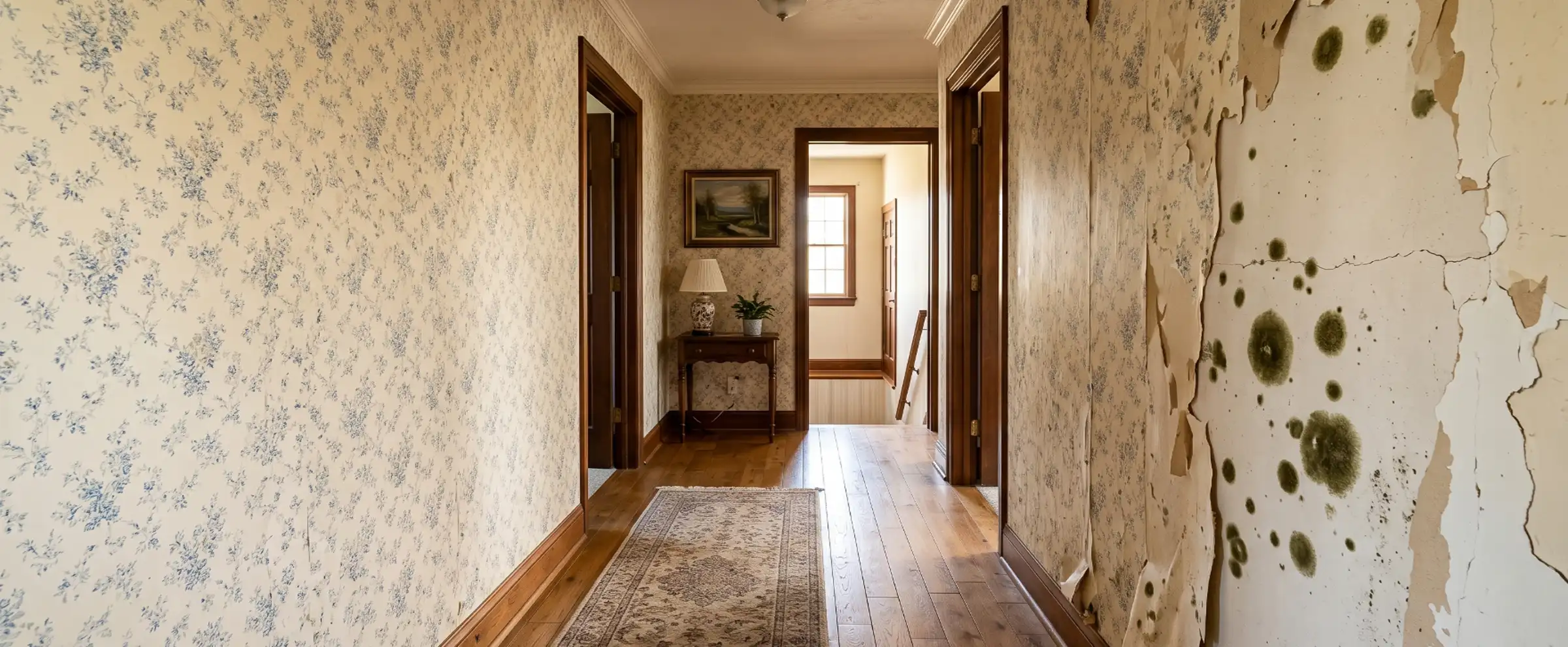

Chaetomium mold grows quietly behind water-damaged drywall and under saturated wallpaper, often dismissed as ordinary musty discoloration until a lab report returns its name. It is not the same as Stachybotrys but belongs in the same category of concern: a toxin-producing, cellulose-digesting fungus that only establishes after sustained water intrusion.
Chaetomium is classified under ANSI/IICRC S520 as a water-damage indicator organism, meaning its presence in a home is not a humidity problem; it is evidence of a serious and typically prolonged moisture event that has already begun decomposing the building materials it colonizes.
Key insights
- Sustained moisture required. Chaetomium needs water activity above 0.90 and does not grow from ordinary humidity alone. Its presence signals significant water damage.
- Cellulose is its food source. Drywall paper facing, wallpaper, wood, and ceiling tiles are primary growth substrates. Concrete and tile rarely support Chaetomium colonies.
- Third most common indoor mold. Chaetomium globosum is one of the most frequently isolated species in water-damaged buildings, appearing in the ERMI Group 1 water-damage indicator panel alongside Stachybotrys chartarum.
- Named mycotoxins with serious effects. Chaetomium produces chaetoglobosins, sterigmatocystin (a confirmed carcinogen), and chaetochromin. These are not the same compounds as Stachybotrys mycotoxins but carry comparable health concern.
- DIY scope is very limited. The EPA 10-square-foot threshold applies. Any growth on porous materials including drywall or wood framing requires professional remediation per ANSI/IICRC S520.
- Often co-occurs with Stachybotrys. Both species require similar conditions, so both are commonly found together in the same water-damaged building materials.
What Chaetomium mold is
Chaetomium is a genus of cellulose-digesting fungi that grows on water-damaged building materials and produces mycotoxins harmful to human health, classified by ANSI/IICRC S520 as a water-damage indicator organism requiring professional remediation. It comprises more than 95 recognized indoor-relevant species, was first described by botanist Gustav Kunze in 1817, and is consistently identified as the third most common mold genus in water-damaged buildings worldwide.
 Material this soft isn't just colonized, it's actively being digested; Chaetomium's cellulolytic enzymes break down the drywall paper itself, which is why affected sections almost always need replacement rather than cleaning.
Unlike molds that simply colonize a surface, Chaetomium actively decomposes it. Its cellulolytic enzymes break down the drywall paper facing, wallpaper, ceiling tiles, cardboard, and wood it grows on, meaning affected materials frequently cannot be cleaned and must be replaced. The signs of mold it leaves, including soft discolored drywall, dark staining at seams, and persistent musty odor, are often the first indicators homeowners notice before a species is confirmed.
The most common indoor species is Chaetomium globosum, which produces two principal mycotoxins, chaetoglobosins A and C, when growing on building materials. Research published in the International Journal of Molecular Sciences (Fogle et al., 2008) found that C. globosum grows across a wide pH range (4.3 to 9.4) with optimal chaetoglobosin production at neutral pH, conditions that correspond closely to water-damaged drywall.
What Chaetomium mold looks like
Chaetomium mold starts as a white or light gray cottony, woolly growth and darkens to olive green, then dark brown or near-black as the colony matures, with a distinctly fuzzy or hairy surface texture that sets it apart from the slimy appearance of Stachybotrys chartarum. The color change occurs as the mold produces perithecia, which are flask-shaped spore-bearing structures visible as dark dots under magnification.
 The dark dots visible across this colony are perithecia, spore-bearing structures that only form as the mold matures, which is part of why color alone can't confirm a species this easily confused with Stachybotrys.
A strong musty odor often accompanies Chaetomium growth, frequently described as a wet, earthy smell similar to rotting wood or damp soil. This odor comes from volatile organic compounds (MVOCs) produced during active cellulose decomposition and can be detectable before visible growth is apparent.
| Feature | Early stage | Mature stage | Notes |
|---|---|---|---|
| Color | White to gray | Olive green, brown, near-black | Color alone cannot confirm species |
| Texture | Cottony, woolly | Fuzzy, hairy | Never slimy (distinguishes from Stachybotrys) |
| Growth pattern | Small circular tufts | Expanding colonies with dark centers | Perithecia visible as dark dots under magnification |
| Odor | Mild musty | Strong earthy, rotting wood | MVOC production intensifies with colony age |
| Spore appearance | N/A | Dark brown, football-shaped | Do not disperse readily unless disturbed |
Because Chaetomium spores are dark-walled and football-shaped, they can be misidentified visually as Stachybotrys or Alternaria. Species confirmation requires mold testing through surface swab, tape lift, or air sampling sent to a certified mycology lab.
Where Chaetomium mold grows in homes
Chaetomium grows wherever two conditions align: sustained moisture and a cellulose-based substrate. It requires water activity above 0.90, which means it does not establish colonies from ordinary household humidity or minor condensation. The presence of Chaetomium in a home is, by definition, evidence of significant and typically prolonged water intrusion.
 Joists this colonized typically took days to weeks of sustained saturation to reach this stage, since Chaetomium needs water activity above 0.90, well beyond what ordinary basement dampness provides.
Most species grow optimally between 77°F and 95°F (25°C and 35°C), meaning year-round indoor temperatures fall comfortably within their growth range in most U.S. climates. The table below shows the most common locations where Chaetomium is found after a water event, what typically causes it in each location, and whether the scope is likely DIY or professional.
Chaetomium can establish a visible colony within days to weeks of sustained saturation, which is why slow hidden leaks behind walls or under flooring produce the largest infestations because the moisture goes unaddressed longest.
| Location | Primary moisture cause | What to look for | Scope |
|---|---|---|---|
| Drywall and wallpaper | Plumbing leak, roof leak, flooding | Discoloration, soft or crumbling surface, dark staining at seams | Professional |
| Ceiling tiles | Roof leak, condensation from HVAC above | Circular brown stains, fuzzy growth on tile surface | Professional if tiles are saturated |
| Wood framing and subflooring | Flooding, persistent plumbing leaks | Dark woolly growth on framing, soft wood, musty odor in wall cavity | Professional |
| Basement walls and floor | Foundation moisture, flooding | Growth along wall-floor joint, on stored cardboard or wood | DIY only if under 10 sq ft on non-porous surface |
| Crawl space | Ground moisture, flooding, inadequate vapor barrier | Growth on floor joists and OSB, along ground-level framing | Professional |
| HVAC components | Condensate drain clogs, dirty drain pans | Growth on duct liner, inside air handler | Professional |
| Behind baseboards | Slow pipe leak, flooding | Musty odor, soft drywall behind baseboard, visible growth when removed | Professional if drywall involved |
Chaetomium is commonly found alongside mold from water damage events because it and Stachybotrys require the same conditions: sustained saturation of cellulose-based building materials. A mold test returning positive for one of these species should prompt testing for the other.
Health risks of Chaetomium mold
Chaetomium poses health risks through two mechanisms: IgE-mediated allergic sensitization and direct mycotoxin exposure. For healthy adults, exposure typically triggers respiratory and allergic symptoms. For immunocompromised individuals, it can cause serious and potentially fatal fungal infections.
 C. globosum specifically is one of the species most commonly isolated in the homes of asthmatic patients, which makes symptoms like these worth treating as a signal to test rather than just a seasonal flare.
The mycotoxin profile of Chaetomium is among the most complex of any indoor mold genus. Confirmed mycotoxins produced by multiple Chaetomium species include chaetoglobosins A through K, sterigmatocystin and O-methylsterigmatocystin (structurally related precursors of aflatoxin B1), chaetochromin (a documented teratogen), chaetocin, chetomin, and cochliodinols. Sterigmatocystin has been classified as a potent carcinogen. Chaetoglobosins A and C act by binding to actin, inhibiting cell division, locomotion, and cell surface projection formation, effects documented as lethal to mammalian cells in laboratory studies published in the International Journal of Molecular Sciences.
| Population group | Common symptoms | Serious conditions | Risk level |
|---|---|---|---|
| Healthy adults | Cough, nasal congestion, eye irritation, headache, fatigue | Hypersensitivity pneumonitis with prolonged exposure | Moderate |
| Individuals with asthma | Worsened asthma control, increased attack frequency | Allergic bronchopulmonary mycosis | High |
| Mold-sensitized individuals | Rhinitis, hives, skin rash, itchy eyes | Severe allergic reactions | High |
| Children | Respiratory symptoms, fatigue, cognitive symptoms reported | Asthma development with sustained exposure | High |
| Elderly | Respiratory symptoms, fatigue | Pulmonary mycosis | High |
| Weakened immune system individuals | Sinusitis, respiratory distress, skin and nail infections | Pulmonary mycosis, brain abscess, fatal cerebral infections | Very high |
Chaetomium globosum specifically has been documented to cause pulmonary mycosis, severe brain abscesses, and fatal cerebral infections in immunocompromised individuals, and is one of the species most commonly isolated in the homes of asthmatic patients, with invasive pulmonary infections documented in clinical literature.
Neurological effects including persistent headaches, fatigue, and cognitive impairment have been associated with prolonged exposure. Skin and nail fungal infections are a documented consequence of direct contact. Anyone whose respiratory symptoms, fatigue, or cognitive difficulties improve when away from home should discuss mold exposure symptoms with a physician and arrange a mold inspection.
Individuals with mold-triggered asthma face elevated risk from this genus specifically: C. globosum is one of the species most commonly isolated in asthmatic patients' homes, and invasive pulmonary infections have been documented in the clinical literature.
Chaetomium vs. Stachybotrys: the other black mold
Chaetomium and Stachybotrys chartarum are both water-damage indicator molds that grow on cellulose-based building materials, produce serious mycotoxins, and require professional remediation under ANSI/IICRC S520, but they are distinct genera with different toxin profiles and one key visual difference: Chaetomium has a fuzzy, woolly texture while Stachybotrys is slimy. The two are frequently confused on visual inspection and often co-occur in the same water-damaged structure.
 Fuzzy and woolly texture like this points toward Chaetomium over the slimy wet look of Stachybotrys, but the two frequently co-occur in the same water-damaged material, so a visual call alone isn't enough.
One practical difference that matters for testing: Stachybotrys spores are encased in slime and disperse poorly through air, while Chaetomium spores also stay near the source unless physically disturbed. Both are more accurately detected by surface sampling than air sampling in contained, moist growth scenarios.
| Feature | Chaetomium | Stachybotrys chartarum |
|---|---|---|
| Appearance | Woolly, fuzzy; white turning olive-brown to near-black | Slimy, wet texture; dark greenish-black |
| Growth pattern | Circular colonies with hairy surface | Dense, wet-looking colonies |
| Spore dispersal | Spores stay near source unless physically disturbed | Spores encased in slime, low air dispersal unless dried |
| Primary mycotoxins | Chaetoglobosins, sterigmatocystin, chaetochromin | Trichothecenes (satratoxin H, roridin E) |
| Moisture requirement | Water activity above 0.90, sustained saturation | Water activity above 0.94, near-constant moisture |
| Can be confirmed by | Lab testing: surface swab, tape lift, or air sampling | Lab testing: surface swab, tape lift, or air sampling |
| Remediation standard | ANSI/IICRC S520 | ANSI/IICRC S520 (same standard applies) |
The critical shared fact: neither Chaetomium nor Stachybotrys can be reliably identified by visual inspection alone. Both require professional laboratory testing to confirm. Confirmed black mold removal protocols differ from standard remediation and carry a cost premium of 15%–25%.
How to test for Chaetomium mold
Testing for Chaetomium requires laboratory analysis, since it cannot be distinguished from Stachybotrys or Alternaria by appearance alone. The three methods used are surface sampling by tape lift or swab, air sampling for airborne spore counts, and ERMI DNA testing of collected dust; surface sampling is the most reliable for Chaetomium specifically because its spores stay close to the growth source unless disturbed.
 A swab taken directly from the colony like this is more reliable than air sampling here, since Chaetomium spores stay close to the growth source unless the material is dried out or physically disturbed.
Air sampling captures airborne spores and returns a spore count per cubic meter of air, compared against an outdoor baseline. Air sampling is most useful when a source has been disturbed or when occupant symptoms are present but no visible growth has been located. The detection limit for Chaetomium spores through air sampling is typically less useful when growth is contained and moist, since Chaetomium spores do not disperse readily unless dried out or disturbed.
Surface sampling by tape lift or swab is more reliable when visible growth is present. Samples are sent to an accredited mycology laboratory for microscopic analysis. Surface samples can confirm genus and often species, which matters for understanding the mycotoxin profile present.
ERMI (Environmental Relative Moldiness Index) testing uses DNA analysis of collected dust to identify and quantify mold species. Chaetomium globosum is included in the ERMI Group 1 water-damage indicator panel. An elevated ERMI score with a positive Chaetomium signal is a strong indicator of past or present sustained water damage in the home. The EPA notes that ERMI has been peer-reviewed for research purposes but has not been validated for non-research use.
A professional mold inspection is recommended in these situations:
- Any visible mold growth of uncertain species in a water-damaged home
- Persistent musty odor without visible growth
- Occupant health symptoms correlated with time spent in the home
- Following any major water event including flooding, roof leak, or burst pipe
- Before purchasing a home with any history of water intrusion
DIY vs. professional Chaetomium removal
The EPA's 10-square-foot threshold governs whether DIY removal is appropriate for any mold species. For Chaetomium specifically, the practical scope of DIY is even narrower than that threshold suggests, because Chaetomium almost exclusively grows on porous building materials including drywall, wood, insulation, and wallpaper, where surface cleaning is not an adequate remediation strategy per ANSI/IICRC S520.
 A patch on drywall like this one falls outside DIY scope regardless of size, since hyphae penetrate the porous paper facing in a way surface cleaning simply can't reach.
The conditions below determine whether a Chaetomium situation is within DIY scope or requires a licensed professional. When in doubt, the presence of this genus on any porous material should be treated as a professional job.
| Condition | DIY appropriate? | Reason |
|---|---|---|
| Under 10 sq ft on non-porous surface (tile grout, painted concrete) and moisture source confirmed fixed | Yes, with PPE | Surface cleaning can reach hyphae on non-porous materials |
| Under 10 sq ft on drywall, wood, or wallpaper | No | Hyphae penetrate porous materials; surface cleaning leaves active growth |
| Any growth exceeding 10 sq ft | No | EPA threshold requires professional remediation |
| Growth in wall cavities, behind drywall, or in structural framing | No | Hidden extent unknown; improper removal spreads spores |
| Co-occurring with Stachybotrys | No | Combined mycotoxin load and extent requires professional protocols |
| Any occupant is immunocompromised, has asthma, or is pregnant | No | Elevated health risk makes professional containment mandatory |
| Source of moisture has not yet been identified or fixed | No | Mold will recur regardless of cleaning |
For the rare cases where small-scale DIY removal is appropriate (under 10 square feet on a confirmed non-porous surface with the moisture source already fixed), the required process covers containment with 6-mil polyethylene sheeting, PPE including an N95 respirator and nitrile gloves, surface cleaning with a detergent followed by an EPA-registered antimicrobial, HEPA vacuuming, and drying verification below 16% moisture content. The complete DIY mold removal supply kit, PPE costs, and surface-by-surface comparison table go deeper on what each step requires.
When professional remediation is needed, the process follows ANSI/IICRC S520. A certified remediator will assess the full extent of growth, establish negative air pressure containment, remove contaminated porous materials, apply antimicrobial treatment to remaining structural elements, and conduct drying verification to confirmed moisture content below 16%. Clearance testing by a separate, independent assessor confirms the space meets post-remediation standards before any reconstruction begins.
For professional work, look for contractors holding the IICRC Applied Microbial Remediation Technician (AMRT) credential. A professional mold remediation job follows a seven-phase process: inspection, containment, air filtration, removal, cleaning, drying verification, and post-remediation clearance testing.
Chaetomium mold removal cost
Chaetomium mold removal costs $500 to $15,000 or more for most residential jobs, with the wide range driven by infestation size, which materials are affected, and whether structural framing or subflooring must be replaced. Because Chaetomium's cellulolytic enzymes actively decompose the materials it grows on, remediation jobs frequently require material replacement on top of the standard removal cost.
Per-square-foot rates typically run $10–$25 for accessible single-room jobs, but jump significantly when Chaetomium has penetrated wall cavities, structural framing, or subfloor assemblies, scenarios that require demolition in addition to mold removal.
| Scope | Typical cost | What it includes |
|---|---|---|
| Small patch (under 25 sq ft) on drywall or wallpaper | $500–$1,500 | Containment, removal of affected drywall, framing treatment, drying |
| Moderate contamination (25–100 sq ft), single room | $1,500–$4,000 | Full containment, material removal, HEPA air scrubbing, antimicrobial treatment, clearance testing |
| Large contamination (100–300 sq ft) or multiple surfaces | $4,000–$8,000 | Multi-area containment, extensive material removal, drying equipment, clearance |
| Whole-room or structural framing involvement | $6,000–$15,000 | Structural wood treatment or replacement, subfloor removal if needed, full IICRC S520 protocol |
| HVAC system involvement | $2,000–$10,000+ | Duct cleaning or replacement, air handler cleaning, separate NADCA-qualified contractor |
| Clearance testing (independent assessor) | $300–$600 | Post-remediation air and surface sampling sent to accredited lab |
Clearance testing by an independent assessor ($300–$600) should be treated as a required line item, not an optional add-on; it is the only way to confirm the job is complete before reconstruction seals walls back up.
Jobs involving structural framing or subfloor replacement push totals higher; the full mold remediation cost ranges by scope, mold type, and location reflect that variability.
Whether a situation qualifies for DIY or requires a licensed contractor depends on the size, substrate, and occupant health factors defined in when mold remediation is required.
How to prevent Chaetomium mold
Preventing Chaetomium requires eliminating the sustained moisture it needs to establish, specifically keeping building materials below 19% moisture content and indoor relative humidity between 30% and 50% RH per EPA guidance. Because Chaetomium requires water activity above 0.90 to grow, it cannot establish from ambient humidity alone, and active leaks, flooding, or chronic water intrusion must be identified and repaired.
 A slow leak like this one can saturate drywall and framing for months before discovery, exactly the sustained moisture condition Chaetomium needs and a quick visual check rarely catches in time.
The most critical intervention window is the first 24–48 hours after any water event. Chaetomium cannot establish without sustained saturation, so rapid drying of affected materials to below 19% moisture content, confirmed with a moisture meter, eliminates the conditions it requires before a colony can form.
| Prevention action | Frequency | Why it prevents Chaetomium specifically |
|---|---|---|
| Inspect plumbing under sinks, behind appliances, and at water heater connections | Every 6 months | Slow leaks saturate drywall and framing for months before discovery, the prime Chaetomium growth condition |
| Inspect roof, flashing, and gutters for damage | Every 6 months (after major storms) | Roof leaks deliver sustained moisture directly to attic sheathing and ceiling drywall |
| Address any water intrusion within 24–48 hours | After any water event | Chaetomium cannot establish without sustained saturation; rapid drying eliminates its window |
| Use a moisture meter to verify drying after any water event | After leak repair or flooding | Confirms building materials are below the 19% moisture content threshold before closing walls |
| Run exhaust fans during and 20 minutes after showers | Every use | Reduces surface moisture on drywall and grout where condensation accumulates |
| Maintain crawl space vapor barrier and dehumidification | Annually inspect, continuous dehumidification | Crawl spaces provide persistent ground moisture that supports Chaetomium on floor joists |
| Ensure HVAC condensate drains are clear | Every 3 months | Clogged drains overflow into air handlers and ductwork, creating saturated cellulose conditions |
| Keep indoor humidity between 30% and 50% RH | Continuous monitoring with hygrometer | Reduces general moisture load even though humidity alone is insufficient for Chaetomium growth |
Keeping indoor humidity and mold levels in check with hygrometers, dehumidifiers sized to the space, and seasonal adjustments addresses the ambient moisture load that worsens leak-driven saturation.
A complete room-by-room mold prevention schedule covers every major moisture source with frequency and rationale for each action.
Frequently asked questions
Is Chaetomium mold dangerous?
Yes. Chaetomium produces mycotoxins including chaetoglobosins and sterigmatocystin, a confirmed carcinogen. For immunocompromised individuals, it can cause serious pulmonary infections and, in rare cases, fatal brain abscesses. For healthy adults, it causes allergic and respiratory symptoms comparable to other toxic mold genera.
What does Chaetomium mold look like?
Chaetomium starts as white or gray cottony fuzz and progressively darkens to olive green, brown, or near-black as it matures. It grows in circular patterns with a distinctly hairy or woolly surface texture. A musty, earthy odor resembling rotting wood commonly accompanies active Chaetomium colonies.
How do I know if I have Chaetomium or Stachybotrys?
Visual inspection cannot reliably tell them apart. Chaetomium has a fuzzy, woolly texture while Stachybotrys is slimy and wet-looking, but both are dark-colored and often co-occur. The only reliable way to differentiate them is laboratory testing: a surface swab or tape lift sent to a certified mycology lab. Do not assume one species over the other based on appearance.
Can I remove Chaetomium myself?
Only for patches under 10 square feet on non-porous surfaces where the moisture source has already been fixed. Any growth on drywall, wood, wallpaper, or other porous materials requires professional remediation under ANSI/IICRC S520 because surface cleaning cannot reach the hyphae embedded in porous substrates.
What are the symptoms of Chaetomium mold exposure?
Common symptoms include coughing, wheezing, nasal congestion, itchy or watery eyes, skin rash, headaches, and fatigue. Immunocompromised individuals may experience fungal sinusitis, pulmonary infections, or nail infections. Neurological symptoms and cognitive impairment have been associated with prolonged high-level exposure.
How much does Chaetomium removal cost?
Professional removal ranges from $500 for small patches to $15,000 or more for large or structurally involved contamination. Because Chaetomium digests the building materials it grows on, remediated drywall and framing frequently require replacement, which adds cost beyond the mold removal itself.
Does Chaetomium only grow after a major water event?
Yes. Chaetomium requires water activity above 0.90 and will not establish from ordinary humidity or minor surface condensation. Its presence in a home is reliable evidence of significant and sustained moisture: a serious plumbing leak, flooding, a roof leak, or chronic water intrusion, not just a humid bathroom.
- ANSI/IICRC S520: Standard for Professional Mold Remediation
- CDC: Basic Facts About Mold
- EPA: Mold Cleanup in Your Home
- NIOSH: Dampness and Mold in Buildings
- NIH/PMC: Chaetomium and Chaetomium-like Species from European Indoor Environments
- NIH/PubMed: Mycotoxin production by Chaetomium spp. and related fungi
- NIH/PMC: Growth and Mycotoxin Production by Chaetomium globosum
- NIEHS: Mold
Sam Hickerson is the founder of RestoreAdvisor and writes consumer guides on mold remediation, water damage restoration, inspection, testing, and home recovery. His work focuses on helping homeowners understand costs, risks, and when to call a professional. He draws on guidance from the EPA, CDC, IICRC, and other authoritative sources to make complex home issues easier to navigate.