
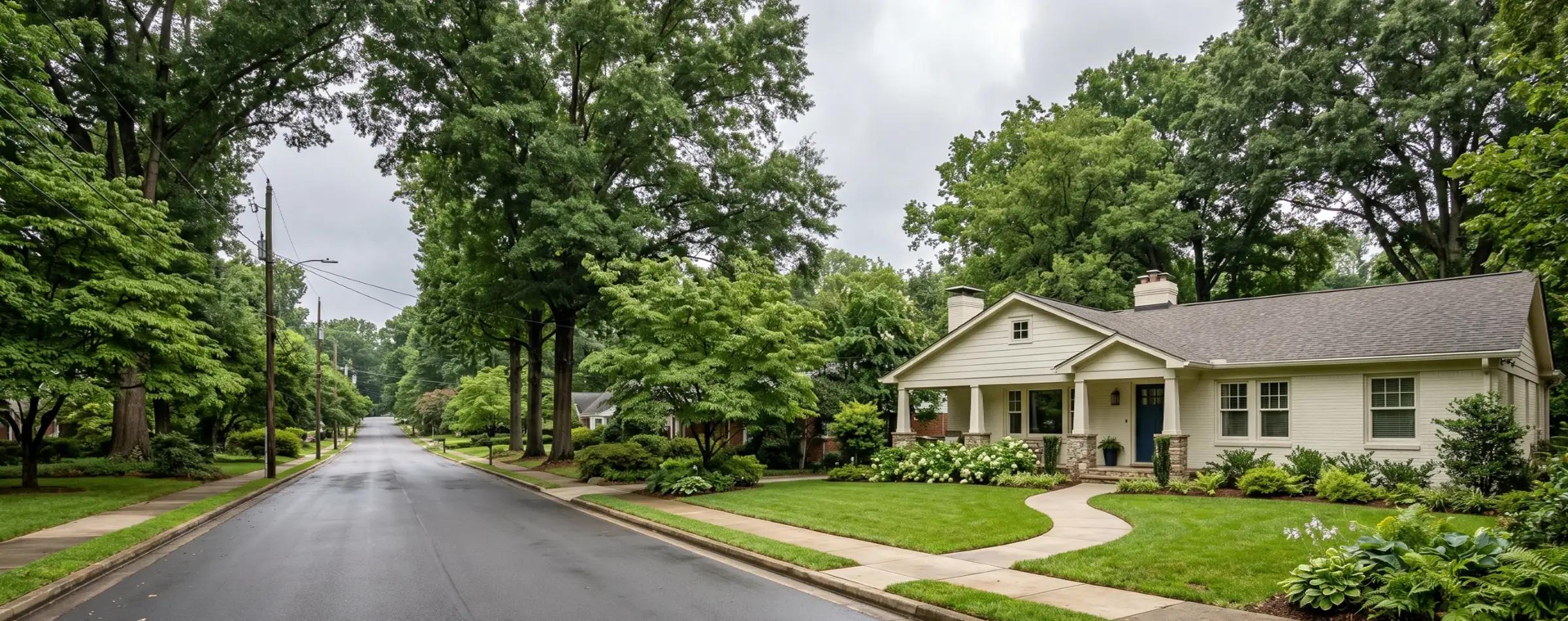

If you have a crawl space in Charlotte, you already have the conditions for mold. The city's humid subtropical climate pushes summer dew points above 70°F for months at a time, and when that warm air enters a vented crawl space it condenses on cooler joists and subflooring the way a cold drink sweats on a hot porch. For the many Charlotte-area homes that sit on pier-and-beam foundations, that cycle repeats from April through October. Most Charlotte mold jobs begin under the floor, and almost everything else comes second.
Mold remediation in Charlotte is the containment, removal, and treatment of mold-contaminated materials under the ANSI/IICRC S520 standard, and North Carolina licenses no mold contractors, so the NC Licensing Board for General Contractors covers only construction projects costing $40,000 or more. Anyone can sell the service without a credential, which leaves vetting entirely to the homeowner.
Key insights
- Closed crawl spaces are a code option. North Carolina's residential code recognizes a closed, conditioned crawl space under Section R409 as an alternative to the vented design in Section R408, and converting a vented crawl space generally requires a permit.
- Dew points do the damage. When 90°F outdoor air carrying a 72°F dew point meets structural wood at 70°F, condensation forms on joists, subflooring, and ductwork. That cycle runs daily from April through October in every vented crawl space in the metro.
- Helene left a flood layer. More than 12 inches of rain fell on Mecklenburg County in September 2024. About 170 Catawba River floodplain homes were damaged, 46 beyond repair, and 4 were swept completely off their foundations, so any home in that corridor with unresolved water intrusion is at risk of active mold today.
- Typical cost. Charlotte jobs usually cost $1,300–$5,300, with crawl space work at $1,800–$8,800. Crawl space jobs are the dominant project type here, and labor demand peaks from April through October.
- Sellers carry liability. NC G.S. 47E lets a seller answer No Representation on the disclosure form, but concealing known mold, or hiding remediation work, can still support a fraud or misrepresentation claim.
- No license to rely on. North Carolina has no dedicated mold remediation license, so IICRC AMRT and Certified Firm status are the only verifiable credential benchmarks, and independent verification is the homeowner's primary protection before signing anything.
What Charlotte crawl space jobs cost
Most Charlotte mold remediation jobs cost $1,300–$5,300, and the mid-range is about $2,100, with the price driven mainly by how much of the crawl space or living area is affected. Because Charlotte homes so often sit over crawl spaces, that space is where prices climb fastest, with crawl space jobs costing $1,800–$8,800 once tight access, wood treatment, and moisture correction are added to the mold removal itself.
 A crawl space door this small means every bag of removed insulation is dragged out by hand, which is why access under 24 inches adds labor hours to the bid.
Bureau of Labor Statistics data put Charlotte-metro construction and extraction wages at about 88 percent of the U.S. average in May 2025. Crawl space access under 24 inches, structural wood treatment, and heavy demand from April through October shape the mold remediation cost of a Charlotte job far more than the hourly rate does.
| Project size | Estimates | Example |
|---|---|---|
| Under 10 sq ft | $400–$1,300 | Tile grout, caulk, and painted drywall in a bathroom |
| 10–100 sq ft | $700–$3,500 | Single room where drywall comes out, or a partial crawl space |
| 100–300 sq ft | $2,200–$7,900 | Attic sheathing and insulation, or a full crawl space |
| 300–1,000 sq ft | $5,300–$17,500 | Multi-room job with HVAC involvement and containment |
| Over 1,000 sq ft | $13,000–$26,500 | Whole-home flood response with demolition and restoration |
Pricing is about $9–$22 per square foot for standard affected surfaces, so a lump-sum bid divided by the affected area shows whether it is in range. Where the mold sits matters as much as how much there is, because access, containment, and structural wood change the scope, and a bid that quotes one flat price for a crawl space and a bathroom is hiding something.
| Location | Estimates | Why it shows up here |
|---|---|---|
| Bathroom | $400–$1,800 | Surface mold is common and a porous tile backer escalates the work |
| Attic | $900–$4,400 | Blocked soffit vents and thin ridge ventilation in older homes |
| Lower level | $1,300–$6,100 | Less common than crawl spaces, with flood risk near creek corridors |
| Interior walls | $1,800–$7,000 | Moisture from plumbing, roof leaks, or flood water |
| Crawl space | $1,800–$8,800 | Pier-and-beam homes and dew-point condensation |
| HVAC system | $2,600–$8,800 | Condensate drain clogs during humid months |
After a major storm like Helene, demand for remediation crews in Mecklenburg County can outrun local supply for months, and any surge sits on top of normal pricing. If a major weather event has recently hit the area, collect quotes quickly and compare at least three bids, written so that containment, removal, drying, and clearance appear as separate lines.
A standalone inspection before work begins costs $300–$700 and is billed separately from remediation. Lab testing adds $300–$900, and clearance testing costs $200–$500, with lab turnaround of 24 to 72 hours. Keep clearance as its own line item and out of the remediation quote if you want an independent result. Reconstruction after removal, such as replacing drywall, insulation, or flooring, costs $400–$8,800 and is a separate phase, usually handled by a general contractor.
After a Charlotte leak or storm flood
Start drying within 48 hours of any water intrusion, because the CDC puts the start of mold growth at 24 to 48 hours after a moisture event and every wet day widens the area that must be removed. Charlotte sees two kinds of intrusion: the Catawba River corridor flooding that Helene brought, and short summer convective storms, fed by Gulf and Atlantic moisture across the Piedmont, that overwhelm older roof drainage.
 A brown ring like this signals roof or flashing intrusion, and the attic above it creates mold risk within 48 to 72 hours if it is not dried promptly.
Hurricane Helene delivered more than 12 inches of rain to Mecklenburg County in September 2024, and the river corridor took the worst of it. Mecklenburg County Storm Water Services confirmed about 170 damaged homes in the Catawba River floodplain, 46 beyond repair, with four houses on Upper Riverhaven Drive swept completely off their foundations.
Mark the high-water line
Note how far water or damp staining reached on walls and photograph it before cleanup. Any home along the Catawba River, Little Sugar Creek, Irwin Creek, or McAlpine Creek that took on water in fall 2024 and was not professionally dried within 48 hours deserves an evaluation for active mold even when no growth is visible.
Dry everything within two days
Remove soaked carpet, padding, and insulation, then run fans and a dehumidifier around the clock. Wet material left in place longer is the usual reason a small job grows into mold after water damage that reaches framing.
Check the ceilings after a downpour
Short Piedmont storms can drop 2–4 inches within hours. Brown rings or discoloration on ceilings, particularly in attic-adjacent rooms of pre-1980 homes, point to roof or flashing intrusion that creates attic mold risk within 48 to 72 hours if it is not dried promptly.
Watch lower-level apartments
Basement-level apartments in South End, Villa Heights, and Elizabeth, along with homes that have inadequate roof drainage in older pre-1970s stock, see repeated short flooding that never looks dramatic but keeps materials damp past the point where mold begins.
When water is active or has spread through a large area, an emergency mold removal response handles extraction and drying together, which is faster than coordinating separate trades. Summer storms here can drop 2–4 inches within hours, so a crew that arrives with extraction pumps and drying equipment on the same truck saves a day that wet framing may not have.
Why Charlotte crawl spaces sweat
Charlotte's main mold driver is the daily exchange of humid air through open foundation vents in the area's many pier-and-beam homes, and flooding is secondary. When 90°F air with a 72°F dew point meets structural wood at 70°F, condensation forms at once on joists, subflooring, insulation, and any ductwork below the living space. The moisture feeds Cladosporium, Penicillium, and Aspergillus colonies that can establish within 48 hours of sustained wetness, according to the CDC.
 Streets like this one sit over vented crawl spaces built before summer dew points were a design concern; closing the vents and conditioning the space is the code-recognized alternative.
North Carolina's residential code lets a builder or owner choose a closed crawl space under Section R409 instead of the vented design in Section R408, and converting an existing vented space generally requires a permit. In Charlotte's climate the open vents of the older design let humid air in unchecked on every warm day, so knowing the early signs comes before any encapsulation project.
A second effect pulls the problem upstairs. Up to 40% of first-floor air in a crawl space home can come from below, carrying spores and musty air through gaps in the subfloor. The stack effect is the mechanism, and the pattern shows up as a persistent smell that stays strong on the ground floor and fades on upper levels, or as allergy symptoms that track with humidity and worsen in summer. The EPA states that controlling moisture is the only dependable long-term mold control, and in a Charlotte crawl space that means encapsulation, not surface treatment. When the floor-level odor pattern is present, the crawl space is the starting point for any inspection.
Hiring with no North Carolina license
North Carolina has no dedicated mold remediation license, so anyone can call themselves a mold contractor and many do. Construction projects costing $40,000 or more fall under a general contractor license, but mold work itself carries no required credential, which makes the standards behind professional mold remediation the baseline for judging any bid.
 A lookup like this at the IICRC Global Locator is effectively the only verification available in North Carolina, since the state has no dedicated mold remediation license to check instead.
IICRC AMRT certification is the credential that replaces what a license would verify. The Applied Microbial Remediation Technician designation requires passing a proctored exam, documented field experience, and adherence to ANSI/IICRC S520, and the IICRC separately certifies firms as Active Certified Firms, which requires carrying appropriate insurance and maintaining certified staff. These two listings are the verifiable benchmarks worth confirming before signing anything. The AMRT, MRS, WRT, and NORMI equivalents each carry their own training and examination requirements, so ask which one a contractor means. Two questions are especially revealing in a market with no license: what standard governs the work, and what happens to the moisture source. A contractor who cannot answer both directly is a red flag.
Book an inspector who will not do the repair
Hire a mold inspector who does not also perform remediation, since a company cannot objectively assess a problem it is paid to fix. Look for an inspector holding ACAC CIEC or CMC credentials, and ask for the written assessment before any contractor quotes.
Look up the firm and the lead technician
Use the IICRC Global Locator at iicrc.org/iicrcgloballocator to confirm the remediation company holds Active Certified Firm status and that the lead technician holds the Applied Microbial Remediation Technician credential. If the firm does not appear or shows lapsed status, stop, because firm status and technician status are separate entries.
Request insurance proof and call the insurer
Ask for certificates of general liability, workers' compensation, and pollution liability insurance. Verify them directly with the insurer, not only from a document the contractor provides.
Read the written scope for S520 and containment
The scope must cite ANSI/IICRC S520 as the governing standard, name the contamination condition (1, 2, or 3), identify affected materials and square footage, specify containment and negative air procedures, and include post-remediation verification by a separate inspector.
Hold the final payment for clearance results
After remediation, have your original inspector or a third-party assessor conduct post-remediation verification. Do not accept a visual inspection alone as clearance.
| Ask this | Credible answer |
|---|---|
| What standard governs your work? | It names ANSI/IICRC S520 and the contamination condition level, not "industry standards" |
| What happens to the moisture source? | A named fix for drainage, vapor drive, or the leak, since removal alone means the problem returns |
| Is your firm an Active Certified Firm? | A yes with a firm name you can search, plus a separate AMRT number for the lead technician |
| Do you carry pollution liability? | A certificate handed over on the call, with a policy you can verify with the insurer |
| Who does the clearance testing? | A separate assessor, since the remediator cannot clear its own work |
| Is the scope in writing? | A written scope listing affected areas, containment, and clearance, and no start date before it is signed |
| Can you guarantee all the mold will be gone? | No guarantee of that kind, only a promise to fix the moisture source and pass independent clearance testing |
Once two written bids answer every one of those questions, the remaining differences are price and warranty terms, and the standards for how to choose a mold remediation company apply to each. Ask for the warranty in writing, including what it covers on regrowth and whether it depends on keeping a dehumidifier running in the crawl space.
What a crawl space cleanup involves
A Charlotte crawl space cleanup follows a fixed sequence under S520: moisture assessment, containment at the access point, HEPA air scrubbing under negative pressure, insulation removal, treatment of structural wood, antimicrobial application, drying below 16% wood moisture content, and independent clearance testing. Surface jobs follow the same logic in a shorter form, since every phase of the mold remediation process exists to find the source, contain the spread, and prove the space is clean.
 Access this tight is standard for Charlotte crawl space work, which is why a crew in a Tyvek suit and respirator needs a HEPA scrubber running before any wood is touched.
The assessor enters with a moisture meter and flashlight, documents affected joists and subfloor, photographs growth, and samples the air or surfaces when species matter. The remediator then seals the access point, runs a HEPA scrubber to hold negative pressure, and pulls mold-contaminated insulation, which almost always needs replacing rather than cleaning. Joists and the underside of the subfloor are treated by hand scrubbing or wire brushing, dry ice blasting for heavier colonies, or soda blasting where surface removal is warranted. The crew applies antimicrobial treatment, vacuums with HEPA equipment, and dries the space before clearance sampling is booked. Encapsulation is a separate follow-on project that prevents recurrence.
| Job type | Active work | Drying | Lab | Total |
|---|---|---|---|---|
| Bathroom or small surface | 1–2 days | 1–2 days | 1–3 days for lab | 3–7 days |
| Single room with drywall | 2–3 days | 2–4 days | 1–3 days for lab | 1–2 weeks |
| Crawl space | 2–4 days | 3–7 days | 1–3 days for lab | 1–3 weeks |
| Attic | 2–4 days | 3–5 days | 1–3 days for lab | 1–2 weeks |
| Multi-room or post-flood | 5–10+ days | 7–14 days | 1–3 days for lab | 3–6 weeks |
Clearance must come from an independent party before the space returns to service, and the lab turnaround is part of the schedule, not an afterthought. Reconstruction, meaning replaced drywall, insulation, or flooring, is a separate phase and a separate contract, typically handled by a general contractor instead of the remediator.
Spotting mold from the floor up
The earliest signs of mold in Charlotte follow the stack effect: the problem starts below and shows itself above. Floor-level odor, warped first-floor hardwood, and ground-floor humidity that runs higher than upstairs all point to the crawl space before anything visible appears, and most owners find mold during a sale inspection, a renovation, or a spring HVAC startup. The EPA lists a musty odor and visible staining as the two most actionable early indicators.
 Edges rising above center like this mark the earliest stage of moisture absorption from below; springy or soft spots mean the subfloor itself has already lost structural integrity.
A smell that is strongest at floor level
The stack effect pulls crawl space air upward through gaps in the subfloor, HVAC registers, and plumbing penetrations. A persistent earthy or musty smell that is stronger near the floor than at head height, and that worsens when humidity rises from May through September, is among the most consistent signs of mold below the house.
Hardwood that cups or bounces
Wood flooring absorbs moisture from below when crawl space humidity stays above 60% RH. Cupping, where board edges rise above the center, is the earliest stage, and soft or springy spots mean the subfloor has absorbed enough moisture to lose structural integrity. The pattern is common in Myers Park, Dilworth, and Plaza Midwood homes with original hardwood over unencapsulated crawl spaces.
A musty blast when the HVAC starts in spring
Ductwork that runs through the crawl space picks up mold spores and musty air over the off-season, and the first spring cycles push that air straight into living spaces. If the smell clears after a few days it was likely surface duct buildup, and if it lingers the air handler or the crawl space itself needs inspection.
Symptoms that ease away from home
When stack effect migration raises spore counts in the living space, occupants often report morning congestion, worse symptoms in summer, and noticeable improvement after a few days elsewhere. This is not diagnostic on its own, but alongside any physical sign of moisture it justifies a professional assessment.
Dark or powdery growth on joists
If you can safely reach the crawl space, look for dark staining, fuzzy growth, or a white powdery film on joists, blocking, or the underside of the subfloor. Active mold tends to be dark green, black, or gray, and older colonies look white or chalky; either one warrants remediation. White mineral deposits on foundation walls are efflorescence, not mold, but they confirm moisture nearby.
Brown rings on first-floor ceilings
Charlotte's summer storms deliver high-intensity, short-duration rain that can overwhelm older roof drainage. Discoloration after a storm, especially in attic-adjacent rooms of pre-1980 homes, signals intrusion that creates attic mold risk within 48 to 72 hours if not dried promptly.
Patches under 10 square feet on hard surfaces such as tile grout, painted concrete, and glass are reasonable for DIY mold removal by the EPA's 10 square foot rule. Crawl space mold sits outside that rule, because access limits, the near-universal involvement of structural wood, and the need to address vapor drive from the soil make jobs there unsuitable for a homeowner regardless of patch size. If the mold is below your floor, call a professional, and treat any patch that returns within a few weeks of cleaning as a sign the moisture source is still active.
Mold insurance after Helene
Charlotte's most common mold cause, slow crawl space moisture building up over months or years, is also the one standard HO-3 policies reliably exclude. Gradual leaks, condensation, and ground vapor migrating through pier-and-beam foundations are not sudden covered perils, while a burst pipe is, and the distinction matters because many Charlotte owners file mold claims for the wrong cause and are denied. Most HO-3 policies carry a mold sublimit of $5,000–$10,000, which handles small jobs but falls short of a post-flood or multi-room crawl space project.
Flood-driven mold from events like Helene needs a separate NFIP policy, and NFIP policies carry a 30-day waiting period, so coverage bought after a storm watch does nothing for that event. Check the sublimit, the cause exclusions, and the filing deadline now, because they decide what mold insurance coverage pays after the next storm.
Documentation decides many of these claims. Dated photographs of the crawl space before cleanup, the plumber's or roofer's repair invoice, and the assessor's written scope show an adjuster whether the cause was a sudden event or years of vapor, and a crawl space that was cleaned and sealed before anyone photographed it leaves the carrier free to assume the slower cause.
Molds behind Charlotte crawl spaces
Cladosporium dominates Charlotte homes, found in most crawl space and bathroom inspections across Mecklenburg County, with Penicillium and Aspergillus in water-damaged materials and Stachybotrys chartarum after floods that saturated drywall. Lab results from mold testing show which is present before work starts, and that sets the containment level.
 A culture this dense reflects how comfortably Cladosporium colonizes Charlotte crawl spaces, since it thrives at the 50 to 90°F range the city sees for nine or ten months of the year.
Cladosporium colonizes Charlotte crawl space joists, subflooring, and bathroom grout year-round, and it thrives in the 50–90°F range the city sees for nine or ten months of the year. Penicillium and Aspergillus are the second most common category, and a lab report often lists them on one line; they appear in homes with HVAC condensate leaks, repeatedly wet crawl space insulation, and bathroom ceiling damage. Both genera include species capable of producing mycotoxins, with health effects ranging from allergic sensitization to aspergillosis.
Post-flood species shift significantly. After Helene's 2024 flooding in Mecklenburg County, Stachybotrys chartarum and Chaetomium globosum became realistic findings in homes where drywall and wood stayed saturated for weeks. Both species need roughly 7–10 days of sustained moisture to establish, which fits what some Catawba River corridor homes experienced. A confirmed Stachybotrys finding calls for the full ANSI/IICRC S520 containment used in black mold removal, so species identification before work begins is a required step on post-flood jobs.
Alternaria is common in Charlotte bathrooms and kitchens, particularly around window frames and shower areas, and spikes seasonally as outdoor spore counts rise from June through October. For households with asthma or known mold allergies, elevated Alternaria indoors justifies prompt remediation regardless of visible growth size, confirmed through air sampling and not by sight alone.
Charlotte homes by era and creek
Pre-1970s homes carry the highest crawl space mold risk in Charlotte because they combine vented crawl spaces and no vapor barriers with aged plumbing and insulation practices that trap moisture against structural wood. Pre-war construction in Myers Park and Dilworth relies on old-growth joists that resist rot better than modern lumber, but they sit over crawl spaces never designed for today's humidity. Post-war bungalows in NoDa and Belmont added fiberglass batts to crawl space floors in the 1960s and 1970s, which hold moisture against wood and speed colonization, and the 1990s growth of Ballantyne and Steele Creek brought OSB subflooring, which is more moisture-sensitive than plywood and shows mold sooner when crawl space humidity climbs.
| Era | Build | Weak point | Neighborhoods |
|---|---|---|---|
| Before 1950 | Brick, old-growth joists, vented crawl space | No vapor barrier and aged plumbing | Myers Park, Dilworth, Belmont, NoDa |
| 1950s–1970s | Wood frame, batts added to crawl space floor | Insulation holds moisture against joists | Plaza Midwood, Eastover, Commonwealth |
| 1970s–1990s | Vinyl siding, OSB, larger floor plans | OSB subfloor sensitivity and ducts in crawl spaces | University City, Matthews, South Charlotte |
| 1990s–2010s | Suburban growth, engineered lumber, tighter shells | Good above-grade envelope with standard crawl space venting | Ballantyne, Steele Creek, Huntersville |
| 2010s–present | Slab-on-grade and closed crawl space code builds | New code lowers risk, but pre-code homes still predominate | South End infill, Concord, Mooresville |
The clay-heavy Piedmont soil under Mecklenburg County adds a foundation-level pathway of its own. Unlike sandy coastal soil that drains quickly, it holds water and transmits it laterally, pushing moisture against foundation walls and upward through vapor. Homes beside Little Sugar Creek in Dilworth, McAlpine Creek in south Charlotte, and Irwin Creek in west Charlotte sit where the water table climbs during storms, which raises hydrostatic pressure on crawl space foundations even with no visible flooding. Which era a home falls into shapes what a contractor should look for and where remediation is most likely needed. Inspectors assessing older homes should meter joist moisture instead of relying on surface growth, since old-growth wood can hold deep mold without discoloration.
 Yards beside a creek can stay dry while the water table rises under the foundation, so a crawl space can take on moisture even when nothing visibly floods.
Risk also changes from one part of Mecklenburg County to the next, because creek corridors, the Catawba River, and the age of the housing stock each add their own moisture path. An address near Little Sugar Creek and one near Mountain Island Lake call for different first questions from an assessor.
| Area | Risk factor | Notes for homeowners |
|---|---|---|
| Myers Park, Eastover | Pre-war brick on vented crawl spaces | Old-growth joists resist rot, but the crawl spaces predate vapor control, and a mature tree canopy slows drying around foundations |
| Dilworth, Elizabeth | Little Sugar Creek water table, bungalow crawl spaces | Storms raise groundwater against foundations even with no flooding, and lower-level apartments see repeated short flooding |
| Plaza Midwood, NoDa, Belmont | 1930s–1960s bungalows with batts on the crawl space floor | Original hardwood over unencapsulated crawl spaces cups first, and the batts hold moisture against the joists |
| South End, Villa Heights | Lower-level units and infill beside older stock | Short floods that never look dramatic keep materials damp past the point where mold starts |
| West Charlotte | Irwin Creek corridor and older stock | Hydrostatic pressure on crawl space foundations rises with the creek during storms |
| South Charlotte, Matthews | McAlpine Creek watershed and 1970s–1990s OSB subfloors | OSB shows mold sooner than plywood when crawl space humidity climbs, so check joists and subfloor together |
| Mountain Island Lake, Riverhaven | Catawba River floodplain and Helene damage | Homes that took water in September 2024 and were not dried within 48 hours deserve an assessment even with no visible growth |
| Ballantyne, Steele Creek, Huntersville | 1990s–2010s suburban builds with tighter shells | Good above-grade envelopes, but standard vented crawl spaces and undersized HVAC leave moisture in the house |
Buying or selling under G.S. 47E
North Carolina's Residential Property Disclosure Act, G.S. 47E, has sellers of one-to-four unit homes complete the Residential Property and Owners' Association Disclosure Statement, which allows a No Representation answer on many items. That option does not protect a seller who knows about mold, because a seller who remediated and hid the work, or who saw obvious signs and said nothing, can face a fraud or misrepresentation claim.
 Fresh paint and mulch can sit above an untouched foundation, and white salt staining at the base of the brick shows moisture that cosmetic work does not fix.
The practical buyer risk in this market is crawl space mold in homes that changed hands fast, especially along the Catawba River corridor after Helene. Homes bought for investment renovation and resold within 12 months of the storm may carry disclosure gaps, either because the seller genuinely did not inspect or because the remediation was incomplete. The disclosure form creates a paper record, but it does not substitute for an independent inspection before closing.
For buyers, ask for the paper trail
Request prior mold inspection reports, remediation invoices, and clearance testing documentation from the seller. Where none exist for a flooded home or an older unencapsulated crawl space, commission an independent inspection before waiving the due diligence period. Myers Park, Dilworth, Plaza Midwood, and the Mountain Island Lake area carry elevated inspection priority for this reason.
For sellers, fix it first and keep the report
If you are aware of past or present mold, remediate before listing and keep the remediation scope, the contractor's credentials, and the post-clearance air sampling report. Charlotte buyers and agents increasingly request this documentation as a condition of offer, particularly on older homes with crawl spaces. A documented, cleared crawl space is easier to defend against a buyer's inspector than a verbal assurance, and an encapsulation warranty that transfers to the new owner adds value to the listing.
A completed job is easiest to defend when the file shows it crossed the point when mold remediation is required and was cleared by an independent assessor. Keep the assessor's protocol, the clearance lab report, and the contractor's insurance certificate together, since a buyer's agent will ask for all three.
Renting in Mecklenburg with mold
Mold disputes are common in Charlotte's older crawl space rental stock, and North Carolina has no mold-specific tenant statute. Under North Carolina General Statute 42-42, the landlord's duty to keep premises fit and habitable is the legal basis a tenant relies on, and it fits best when the mold comes from structural moisture the tenant did not cause.
The practical framework for renters: document the mold with dated photographs, notify the landlord in writing (email creates a timestamp), and keep a copy of everything. North Carolina sets no specific deadline for a landlord's response, and a reasonable-time standard applies that is shorter for conditions affecting health. If the landlord does not respond within a reasonable period, tenants may contact Mecklenburg County Code Enforcement or Charlotte-Mecklenburg Housing Code Inspection. Withholding rent carries procedural risk, so consult an attorney or legal aid before pursuing it. If a landlord still refuses, a tenant's options come down to code enforcement or an attorney, and the dated photographs and written notice gathered at the start are the evidence either one will ask for first.
Charlotte prevention starts at the vents
The most effective prevention steps for Charlotte homes are crawl space encapsulation with mechanical dehumidification, monthly condensate drain clearing from April through October, roof checks after storms, and indoor humidity held between 45% and 55% year-round. Each one targets a specific moisture path behind the majority of mold cases in Mecklenburg County.
 A sealed edge like this one only works if it's paired with closed foundation vents and mechanical dehumidification; a liner alone doesn't stop the daily condensation cycle Charlotte's dew points create.
Close the crawl space before mold starts
For homes with vented crawl spaces, which is most of pre-2025 Charlotte, encapsulation with a sealed 20-mil vapor barrier, closed foundation vents, and a commercial-grade dehumidifier is the single highest-return prevention investment. North Carolina dew points exceed 65°F from April through October, so on every day outdoor air enters the crawl space during those months, condensation risk is active. Encapsulation is quoted as its own project, separate from remediation. Any home that experienced Helene flooding or sustained water intrusion should have active mold addressed before sealing, since closing moisture in accelerates colonization.
Clear the condensate drain every month in season
Charlotte's seven-to-nine-month cooling season means the air handler runs almost continuously from April through October, and the drain line from the handler to the pan to the exterior discharge point clogs with algae and debris in humid weather. A blocked line overflows into the cabinet and pan, creating the sustained moisture that feeds Cladosporium and Aspergillus inside ductwork. Clear it monthly with a wet-dry vacuum and a cup of diluted bleach. Ductwork in the crawl space is a second pathway, because condensation on uninsulated ducts contributes directly to joist and subfloor mold.
Walk the roof line after hard storms
Charlotte's Piedmont location puts it in a thunderstorm corridor where 2–4 inch rainfall events are common in summer. Missing or lifted shingles create moisture pathways into attic insulation and sheathing that homeowners rarely see until mold has established. Inspect flashings around chimneys, skylights, and HVAC units after any storm with sustained winds above 40 mph, and include attic access in a mold inspection as part of annual maintenance on pre-1990s homes.
Hold indoor humidity at 45–55%
In a crawl space home, indoor humidity is directly tied to what happens below the floor, and Charlotte summers push it well above 60% in houses without adequate cooling or humidity control. Set the thermostat fan to auto so moisture on the cooling coil drains away instead of being blown back into the house between cycles. If post-summer readings in living areas stay above 60%, consider a whole-home dehumidifier integrated with the HVAC system, and use portable units of 30–50 pints per day in below-grade spaces, garages, and rooms the central system does not dehumidify.
Frequently asked questions
How much does mold remediation cost in Charlotte, NC?
Most Charlotte homeowners pay $1,300–$5,300, and the mid-range is about $2,100. Crawl space work costs $1,800–$8,800, and jobs over 1,000 square feet cost $13,000–$26,500. These are estimates based on national pricing adjusted for Charlotte labor costs.
Does North Carolina require mold remediation contractors to be licensed?
No. North Carolina has no state mold remediation license. Construction projects costing $40,000 or more need a general contractor license under NC G.S. Chapter 87, but the mold work itself is unlicensed, so IICRC AMRT certification and Active Certified Firm status are the main credentials to check.
What is the biggest mold risk in Charlotte homes?
Crawl spaces. Many Charlotte-area homes sit on pier-and-beam foundations with vented crawl spaces, and summer dew points above 70°F make moisture condense on joists and subflooring whenever outdoor air gets in. The cycle runs from April through October unless the space is encapsulated and dehumidified.
Did Hurricane Helene cause mold problems in Charlotte?
Yes. Helene brought more than 12 inches of rain to Mecklenburg County in September 2024, and about 170 homes in the Catawba River floodplain were damaged, 46 beyond repair. Homes that took on water and were not professionally dried within 48 hours can have active mold today.
Do I need to disclose mold when selling a Charlotte home?
Yes, if you know about it. North Carolina General Statute 47E has sellers complete the Residential Property and Owners' Association Disclosure Statement, which allows a No Representation answer, but a seller who conceals known mold can still face a fraud or misrepresentation claim. Keeping the remediation scope and clearance report on file protects you.
How do I verify a Charlotte mold contractor's credentials?
Search the IICRC Global Locator for Active Certified Firm status and the technician's AMRT credential. Ask for certificates of general liability, workers' compensation, and pollution liability insurance, and require a written scope citing ANSI/IICRC S520 with independent clearance testing.
What mold species are most common in Charlotte?
Cladosporium leads year-round, mostly in crawl spaces and bathrooms, with Penicillium and Aspergillus in water-damaged materials. After Helene, contractors reported more Stachybotrys and Chaetomium in homes where drywall stayed saturated.
How long does mold remediation take in Charlotte?
Small surface jobs take 1–2 days. Crawl space jobs take 2–4 days of active work plus 3–7 days of drying before clearance, and multi-room or post-flood jobs run 5–10 days or more. Lab results add 1–3 days, and a mid-size project with reconstruction can take 2–6 weeks.
Can I stay home during mold remediation in Charlotte?
Yes, for a contained job under 10 square feet in one bathroom, but crawl space, HVAC, or multi-room work calls for leaving, especially with children, older adults, or anyone with a respiratory condition. The contractor's containment and negative air setup decides how safe staying is.
What does a mold inspection cost in Charlotte?
The inspection cost for a standard residential inspection is about $300–$700, and lab testing adds $300–$900. Clearance testing after the work adds $200–$500 as a separate line, and an inspection bundled with testing costs $400–$1,300.
Will homeowners insurance cover mold in Charlotte?
Only when the mold follows a sudden covered event such as a burst pipe. Slow crawl space moisture, condensation, and ground water are excluded, most HO-3 policies cap mold at $5,000–$10,000, and flood mold from storms like Helene needs a separate NFIP policy.
- EPA: Mold Cleanup in Your Home
- CDC: Basic Facts About Mold
- IICRC S520 Standard for Professional Mold Remediation
- Mecklenburg County Storm Water Services: Hurricane Helene Recovery
- NC G.S. 47E: Residential Property Disclosure Act
- NC G.S. Chapter 87: Contractors
- IICRC Global Locator
- BLS: Occupational Employment and Wages in Charlotte-Concord-Gastonia, NC-SC, May 2025
Sam Hickerson is the founder of RestoreAdvisor and writes consumer guides on mold remediation, water damage restoration, inspection, testing, and home recovery. His work focuses on helping homeowners understand costs, risks, and when to call a professional. He draws on guidance from the EPA, CDC, IICRC, and other authoritative sources to make complex home issues easier to navigate.