
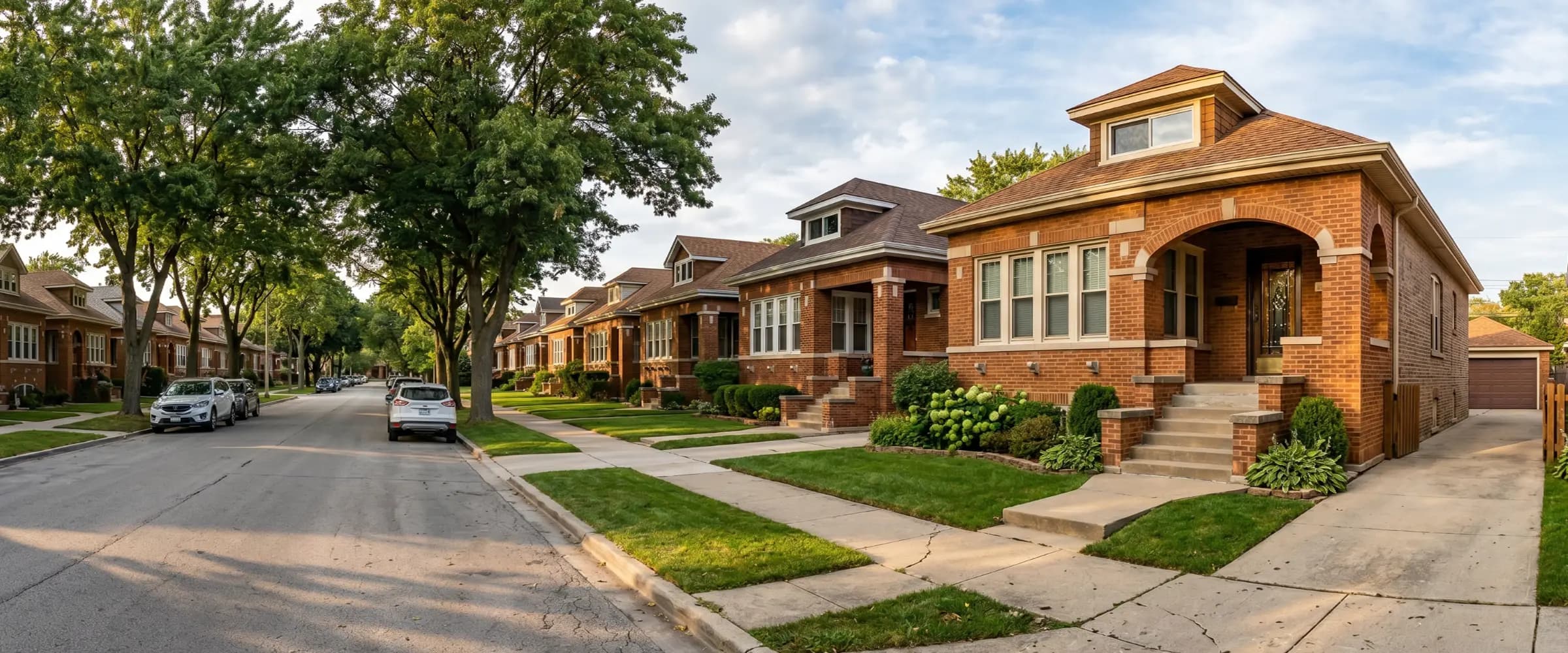

Chicago mold remediation follows a different calculus than most American cities. The Windy City's mold story isn't driven by hurricane flooding or coastal humidity; it's driven by three structural conditions that have existed for a century: a combined sewer system that backs up into basements during summer storms, a housing inventory dominated by flat-roofed bungalows and two-flats that pool rather than shed water, and masonry construction that stays damp long after a moisture event ends. When those conditions combine with Chicago's freeze-thaw winters, which burst pipes in balloon-frame walls that have never been properly insulated, the result is some of the highest basement mold rates of any major Midwest city.
Mold remediation is the process of containing, removing, and treating mold-contaminated materials to return a structure to a condition with normal fungal ecology, following the ANSI/IICRC S520 standard. In Illinois, this work is now regulated under the Mold Remediation Registration Act (SB 1087, 410 ILCS 105), administered by the Illinois Department of Public Health (IDPH). As of January 1, 2025, any contractor performing mold remediation for compensation must be registered with the IDPH and hold third-party certification from IICRC, NORMI, or ACAC.
Key insights
- Illinois requires contractor registration. The Mold Remediation Registration Act (SB 1087), effective January 1, 2025, requires all mold remediation contractors to register with the Illinois Department of Public Health and hold IICRC, NORMI, or ACAC certification. Penalties reach $5,000 per violation.
- Chicago's combined sewer system is the city's primary mold driver. The TARP project has reduced overflow events, but basement sewer backup during heavy rainfall still affects thousands of Cook County homes annually, and Category 3 contaminated water requires full professional remediation regardless of patch size.
- Flat roofs create a distinct leak pathway. The bungalow and two-flat roofline that defines Chicago's residential neighborhoods pools water at seams and parapets, producing slow leaks into top-floor ceilings and attic decking that often go undetected for months.
- Local remediation costs run $1,600–$8,000 for most residential jobs. Small basement surface jobs start around $800–$1,200. Post-sewer-backup jobs requiring Category 3 protocols run $3,000–$12,000+.
- Illinois does not require a separate mold assessor license. Illinois uses a single registration for remediators, meaning one contractor can assess and remediate the same job. Clearance testing should always be performed by an independent assessor to eliminate conflicts of interest.
- A sewer backup endorsement is the most important coverage gap to close. Standard HO-3 policies exclude sewer backup damage entirely. Without an endorsement, a basement mold job from a backed-up floor drain is an out-of-pocket expense.
Why Chicago homes face elevated mold risk
Chicago's mold problem is structural, not seasonal. Three conditions make Cook County homes significantly more vulnerable than the national baseline, and understanding them helps homeowners identify which risk actually applies to their specific property.
 Category 3 sewage-contaminated water from a combined sewer backup requires full professional remediation under ANSI/IICRC S520, including containment, PPE, and complete removal of all porous materials that contacted the water.
The combined sewer system
Chicago operates one of the largest combined sewer systems in the country, which handles both stormwater and sanitary sewage in a single pipe network. During heavy rainfall events, the system can exceed capacity, pushing Category 3 sewage-contaminated water backward through private sewer laterals into basements through floor drains, utility sinks, and toilets. The Metropolitan Water Reclamation District's $3.8 billion Tunnel and Reservoir Plan (TARP) has reduced overflow events significantly since the 1970s, but backup flooding during intense summer storms still affects thousands of homes. Mold from sewer backup is classified as a Category 3 water event under ANSI/IICRC S520, which requires professional remediation, full containment, PPE, and contaminated material disposal regardless of how small the affected area appears. CDC guidance on mold cleanup confirms that any mold growth should be fully removed and that moisture sources must be corrected before remediation begins. A sewer backup in a finished basement typically results in complete drywall removal to the floor joists and subfloor replacement across the entire flooded zone.
Flat and low-slope roofs
The defining roofline of Chicago's residential neighborhoods, from brick bungalows in Beverly to two-flats in Logan Square, is flat or barely sloped. These roofs rely on internal drains and parapet gutters that clog with debris, pond water at seams and membrane joints, and fail slowly rather than all at once. A flat roof that pools water for weeks after a rainstorm typically produces leaks into the top-floor ceiling and attic decking that the homeowner attributes to condensation rather than a structural failure. By the time water stains appear on the ceiling, Stachybotrys and Chaetomium have often been growing on the wet wood decking above for months. Identifying early warning signs, including musty odors in a top-floor room or ceiling staining that reappears after drying, is critical in these buildings.
Aging housing stock and balloon-frame construction
A substantial portion of Chicago's residential building stock dates to before 1940, with the bungalow belt constructed largely between 1910 and 1940. These homes used balloon-frame construction, where continuous wall studs from foundation to roofline create vertical channels between floors. A single plumbing leak or roof penetration can travel inside the wall cavity from top to bottom before appearing as visible mold on a surface. Brick exterior walls absorb and retain moisture for extended periods, and older mortar that has not been tuckpointed allows water infiltration directly through the wall. Freeze-thaw cycling throughout a Chicago winter cracks this mortar repeatedly, creating new entry points each spring.
Chicago's polar vortex pipe-burst legacy
Chicago's January 2019 and February 2021 polar vortex events caused widespread pipe failure inside pre-1960 balloon-frame homes, where copper supply lines run through uninsulated exterior wall cavities rather than interior chases. When those cavities dropped below freezing (reaching -23°F at O'Hare in January 2019 according to the National Weather Service Chicago office), supply lines burst inside the wall, releasing water that flowed down the continuous cavity before appearing at a floor drain or ceiling stain. Homeowners who repaired the pipe and cleaned visible water without opening the wall cavity are living with enclosed mold that was never remediated.
 Wall cavity mold of this extent is invisible from the surface and undetectable without opening the wall. Stachybotrys growth at this density indicates the framing stayed continuously wet for weeks or longer before the drywall was removed.
What this means for buyers of post-2019 homes
Any pre-1960 bungalow or two-flat in Jefferson Park, Norwood Park, Portage Park, Clearing, or Bridgeport that changed hands after 2019 warrants specific inquiry. Ask the seller directly whether any pipe bursts occurred during either polar vortex event and request documentation of professional drying. If documentation does not exist, a targeted moisture meter scan of the exterior wall cavities by a licensed mold remediation contractor before closing is not optional on these properties. Stachybotrys and Chaetomium enclosed in a dried-out wall cavity can remain dormant through multiple dry seasons and become active again when indoor humidity rises in summer.
What this means for current owners
If your home sustained a freeze-related pipe burst during either event and the repair involved patching the drywall without opening the wall to the framing, schedule a professional mold inspection that includes moisture meter readings at the base of the affected exterior walls. A moisture reading above 19% on wood framing indicates active risk; knowing what signs of mold to look for on adjacent surfaces helps you decide how urgently to act. A reading above 28% indicates structural wood rot has likely begun alongside any mold colonization.
Neighborhood mold risk in Chicago
The highest mold remediation volume in Chicago concentrates in three zones: the pre-1920 sewer-backup corridor running through Bridgeport, Pilsen, and the Near West Side; the bungalow belt (Beverly, Portage Park, Norwood Park) where flat roof failures are the dominant pathway; and the lakefront neighborhoods (Rogers Park, Edgewater) where Lake Michigan humidity drives chronic HVAC condensate and masonry moisture. Proximity to the Chicago River, Des Plaines River, and combined sewer infrastructure adds risk across all three zones during heavy rainfall events.
 The white mineral deposits along the base of the wall are efflorescence, a sign of water migrating through the masonry. In pre-1960 Chicago bungalows, this pattern typically indicates deteriorated mortar joints that are actively wicking groundwater into the wall.
More than half of Cook County's single-family homes and two-flats were built before 1960, according to U.S. Census Bureau estimates, making Chicago's residential stock one of the oldest of any major American city. The table below maps seven areas by primary risk factor, housing type, and the specific conditions homeowners should investigate in each part of the city.
| Neighborhood / area | Primary mold risk | Housing type | Homeowner notes |
|---|---|---|---|
| Bridgeport / Pilsen | Combined sewer backup, clay sewer lateral failure, masonry moisture wicking | Greystones, worker cottages, two-flats | Sewer lateral condition is critical; older clay tile lines fail without visible warning. Check for tide marks at basement floor level before buying. |
| Bungalow belt (Beverly, Portage Park, Norwood Park) | Flat roof leaks, unfinished basement walls, original plumbing | Chicago bungalows, brick two-flats | Most common mold scenario: flat roof leak into attic decking and top-floor ceiling over 12–24 months. Roof inspection annually is non-negotiable. |
| Logan Square / Humboldt Park | Gut rehab moisture enclosure, sewer backup | Two-flats and three-flats | Post-rehab mold from construction moisture enclosed before drying is complete. Look for musty odors in closets on exterior walls. |
| Jefferson Park / Edison Park | Freeze-thaw pipe failure, HVAC condensate, basement tile | Ranch homes, brick bungalows | Northwest Side freeze events in 2019 and 2021 burst pipes inside wall cavities. Check for staining behind finished basement drywall. |
| Rogers Park / Edgewater | Lakefront condensation, HVAC condensate, masonry moisture wicking | Brick courtyard apartments, vintage greystones | High ambient humidity from Lake Michigan proximity. HVAC condensate and brick moisture wicking are the leading drivers. |
| South Loop / West Loop | HVAC oversizing (short cycling), construction moisture enclosure, condo common elements | High-rise and mid-rise condos | Short-cycling HVAC systems fail to dehumidify adequately. Common element pipe failures can spread mold across multiple units. |
| Oak Park / Berwyn (inner suburbs) | Balloon-frame cavity mold, sewer backup, flat roof leaks | Late Victorian and Craftsman bungalows | Same sewer and flat-roof dynamics as Chicago proper. Cook County suburban sewer systems have similar overflow history. |
What mold remediation costs in Chicago
Most Chicago residential mold remediation jobs fall between $1,600 and $8,000, placing the city slightly above the national mid-range average of $1,500–$6,000. The premium reflects higher labor rates in Cook County, the additional cost of Category 3 protocols for sewer backup jobs, and the complexity of working inside finished basements with limited access.
 Moisture meter readings above 19% on drywall or framing trigger professional remediation scope under ANSI/IICRC S520; readings above 28% indicate structural wood rot has begun alongside mold colonization.
The single largest cost variable is whether the moisture source was a clean water event (burst pipe, roof leak) or a contaminated water event (sewer backup). Category 3 sewage-involved mold requires specialized PPE, different disposal procedures, and broader material removal even when visible growth appears limited. Contractors who underbid Category 3 jobs by skipping protocol requirements put homeowners at legal and health risk.
| Project scope | Typical cost range | Chicago-specific drivers | Per sq ft |
|---|---|---|---|
| Small surface job (under 25 sq ft, basement wall or bathroom) | $800–$1,800 | Minor flat roof drip or condensation | $12–$25 |
| Mid-range single room (drywall removal, HEPA air scrubbing, clearance test) | $2,000–$4,500 | Finished basement after minor pipe leak | $15–$25 |
| Category 3 sewer backup (basement, contaminated water protocols) | $3,500–$12,000 | Combined sewer overflow, floor drain backup | $20–$35+ |
| Multi-room or attic flat roof damage | $4,500–$10,000 | Flat roof failure, extended moisture, multiple rooms affected | $18–$30 |
| HVAC system involvement | $3,000–$8,000+ | Evaporator coil or ductwork contamination | Varies by system |
| Whole-home or structural framing | $10,000–$30,000+ | Undetected balloon-frame cavity mold, multi-story spread | $20–$40 |
Clearance testing by an independent assessor adds $300–$700 to any project. This is not optional on any job larger than a surface-level patch; it is your documentation that the work was completed to the ANSI/IICRC S520 standard and your proof for insurance carriers and future buyers. A standalone mold inspection to assess scope before remediation begins typically costs $300–$600 in the Chicago metro.
Cost also varies significantly by where in the home the mold is located. Finished basement jobs are the highest-volume category in Chicago and typically cost more than comparable above-grade work due to limited access, the need for temporary dehumidification during drying, and the frequency of Category 3 protocols when sewer backup is involved.
| Location in home | Typical Chicago cost | Primary cost driver |
|---|---|---|
| Basement walls, unfinished | $800–$2,500 | Surface treatment, HEPA; no drywall removal |
| Basement, finished (drywall removal) | $2,500–$8,000+ | Full material removal, Category 3 if sewer involved |
| Bathroom (shower, ceiling, grout) | $500–$2,000 | Tile removal, caulk replacement, ventilation correction |
| Attic / flat roof decking | $2,000–$7,000 | Accessibility, soda blasting or abrasive treatment of sheathing |
| HVAC system and ductwork | $2,000–$8,000+ | Component cleaning or replacement, NADCA protocols |
| Wall cavity (balloon-frame, freeze event) | $3,000–$10,000+ | Wall opening, framing treatment, extended drying, rebuild |
| Kitchen (under sink, cabinet interiors) | $600–$3,000 | Cabinet removal, leak repair coordination |
Most Chicago remediation projects take 1–3 days of active work for surface-level jobs and 3–7 days for finished basement or multi-room jobs, plus 24–72 hours for clearance test results to return from the lab. The two factors that extend Chicago timelines beyond those of other markets are plumber coordination (required before remediation begins when sewer backup or a freeze pipe caused the moisture) and the drying phase in humid Chicago summers, which can run longer than the national average when ambient outdoor humidity is high. Chicago jobs that involve slab plumbing or sewer lateral repair before remediation can add several days to the overall schedule.
How to spot mold in a Chicago home
The five most reliable mold indicators in Chicago homes are: tide marks on concrete block basement walls (sewer backup history), top-floor ceiling staining that reappears after drying (flat roof leak), a musty odor concentrated in one exterior wall corner (balloon-frame cavity mold), a musty smell when the HVAC first starts up in spring (evaporator coil contamination), and soft or discolored drywall at the base of an exterior wall (freeze pipe burst inside the wall cavity). Each signal maps to a specific moisture source and determines whether standard remediation or Category 3 contaminated-water protocols apply.
 A ceiling stain that reappears after drying or painting indicates an active leak source above rather than a one-time event. In a Chicago bungalow, a top-floor stain like this typically means the flat roof membrane or drain is failing.
Tide marks on concrete block basement walls
A horizontal line of white mineral deposits (efflorescence) at a consistent height on the basement wall is the clearest indicator of prior sewer backup flooding. The deposit marks the high-water line of sewage-contaminated water. If the line sits at floor drain level or above, Category 3 mold protocols apply to that basement regardless of how recently the flooding occurred or whether any mold is currently visible on the surface.
Ceiling staining on the top floor that reappears after drying
A water stain on a top-floor ceiling that keeps coming back after painting or drying indicates a flat roof leak, not condensation. By the time the stain is visible inside, Stachybotrys and Chaetomium have typically been growing on the wet wood decking above for weeks. The scope is almost always larger than the ceiling stain suggests and requires a moisture meter assessment of the decking before any remediation quote can be accurate.
Musty odor concentrated in one exterior wall corner
A persistent musty smell that localizes to a specific corner of a room, particularly on an exterior wall, is the signature of mold inside a balloon-frame wall cavity. In Chicago bungalows and two-flats, this pattern follows either a failed mortar joint that allowed water to enter through the brick exterior, or a freeze pipe burst that released water inside the wall. The odor travels up the continuous wall cavity and concentrates at the ceiling corner. Opening the wall is the only way to assess scope.
HVAC startup odor in spring
A musty or earthy smell that occurs when the air conditioning or forced-air heat first starts up in spring, then fades after 15–30 minutes of operation, indicates mold on the evaporator coil, in the drain pan, or on the supply ductwork. The spores are being distributed through the home with every heating and cooling cycle. This is particularly common in Chicago courtyard buildings and two-flats where older equipment has been in continuous operation for more than a decade.
Floor-level discoloration or soft spots at the base of exterior walls
Staining, paint separation, or soft drywall at the very base of an exterior wall in a finished basement is a freeze-event signal in pre-1960 Chicago homes. Supply lines that run through the exterior wall cavity in balloon-frame construction freeze at the lowest point of the cavity and burst there. The water flows down inside the wall and pools at the base before it appears on the surface, and the mold that follows is inside the wall, not on it.
A professional mold inspection using a moisture meter and thermal imaging can confirm which scenario applies and map the full scope of affected material before remediation begins.
Common mold species in Chicago homes
The four mold species most commonly found in Chicago homes are Cladosporium (year-round, low-moisture surfaces), Aspergillus and Penicillium grouped as Asp/Pen (water-damaged insulation and HVAC systems), Stachybotrys chartarum (sustained wetness from flat roof leaks or sewer backup), and Alternaria (seasonal, bathrooms and HVAC returns). Which species appears depends on which of Chicago's primary moisture drivers caused the growth, and the species present in a lab report is often the clearest indicator of whether Category 3 protocols, standard remediation, or surface cleaning apply.
 Stachybotrys chartarum requires continuous wetness to establish. Its presence along the lower wall at this density indicates sustained moisture exposure over weeks or longer, the pattern typical of a sewer backup or slow foundation leak in a Chicago basement.
Cladosporium
Cladosporium is the most prevalent species in Chicago year-round, appearing as olive-green to black spots on drywall, windowsills, bathroom grout, and basement masonry. It grows at lower moisture levels than most other species and is frequently the first mold to establish itself on walls with chronic condensation. While Cladosporium is a common allergen, it is classified as a lower health risk than Stachybotrys and typically does not require containment-level protocols on small areas of non-porous surfaces.
Aspergillus and Penicillium
Aspergillus and Penicillium (grouped in air sampling reports as Asp/Pen because they are visually indistinguishable under typical testing) appear frequently in water-damaged insulation, HVAC systems, and the paper facing of drywall in Chicago basements. Health risks from Aspergillus species vary considerably by strain, with certain strains producing mycotoxins including ochratoxin A and aflatoxin. Both genera are fast-growing and can colonize fiberglass batt insulation within 48 hours of a water event.
Stachybotrys chartarum
Stachybotrys chartarum (black mold) grows on cellulose-rich materials, primarily drywall paper and wood framing, that have stayed wet continuously for an extended period. In Chicago, Stachybotrys most commonly appears after an undetected flat roof leak, a slowly failed sewer lateral, or a pipe burst inside a balloon-frame wall cavity. It is rarely the first species to colonize; its presence on a surface typically indicates the material has been wet for weeks or longer. Professional clearance testing is always required after black mold removal.
Chaetomium
Chaetomium is increasingly common in Chicago's older housing stock, particularly in post-flood drywall that was dried in place rather than removed. Like Stachybotrys, it produces mycotoxins and is classified in the ERMI Group 1 (water damage indicator species). Its presence in an air sample or surface swab is a reliable signal of previous or ongoing sustained moisture in the building.
Alternaria
Alternaria appears seasonally in Chicago homes, peaking in late summer when outdoor spore counts are high. Inside, it concentrates in bathrooms, around window seals, and in HVAC return plenums where condensation is a regular condition. For occupants who are already experiencing respiratory symptoms, understanding the health risks by mold type helps determine how urgently to act.
Illinois mold contractor registration law
As of January 1, 2025, Illinois requires every contractor performing mold remediation for compensation to register with the Illinois Department of Public Health (IDPH) and hold third-party certification from IICRC, NORMI, or ACAC under the Mold Remediation Registration Act (410 ILCS 105, amended by SB 1087). Before this law took effect, Illinois had no credential requirement for mold remediation work, meaning any individual could offer these services without training or licensure.
 Illinois law requires contractors to display their unique IDPH registration number on all proposals and contracts. Verify the number matches the IDPH database entry before signing any remediation agreement.
Illinois enacted SB 1087 in August 2024 with unanimous bipartisan support in both chambers, closing a decades-long consumer protection gap and giving homeowners a verifiable standard to hold contractors to before any work begins.
Under 410 ILCS 105, every contractor performing mold remediation for compensation in Illinois must:
Be registered with the IDPH
Registration requires submitting proof of third-party certification, evidence of financial responsibility (insurance), and a non-refundable $200 application fee. The registration is valid for two years and must be renewed with continued proof of certification and insurance.
Hold recognized third-party certification
Accepted certifying bodies under SB 1087 are the IICRC, NORMI, and ACAC, or another nationally recognized non-profit organization approved by the IDPH. The IICRC's Applied Microbial Remediation Technician (AMRT) is the most common qualifying credential for remediation work.
Display a unique IDPH registration number
The registration number must appear on all business materials, including proposals, contracts, and invoices. If a contractor cannot produce this number on request, they are not legally authorized to perform remediation work in Illinois. Verify any contractor at the IDPH mold remediation registration database before signing.
Penalties for non-compliance
Penalties reach $5,000 per violation. If an unregistered contractor performs remediation on your property and the work is deficient, you have limited recourse because the contractor was operating outside the law.
Illinois's single-registration model means one contractor can assess and remediate the same job, which is why independent clearance testing by a third party is an important consumer protection step regardless of what the law requires. The IICRC AMRT, MRS, and NORMI CMR are the credentials to confirm before signing any remediation contract.
How to hire a mold remediation contractor in Chicago
Illinois's new registration law eliminates the worst actors from the market, but registration alone does not tell you whether a contractor will do the work correctly. Use this checklist to evaluate any contractor before signing.
 IICRC AMRT certification must be held by the technician performing the work, not just the company owner. Verify active credential status independently at the IICRC Global Locator before work begins.
1. Confirm IDPH registration status
Ask for the contractor's IDPH registration number and verify it in the IDPH's online database at idph.illinois.gov. A number displayed on a proposal is meaningless if it doesn't match the database entry for that company name and address.
2. Verify IICRC AMRT credential independently
Go to the IICRC Global Locator and search by the company name or technician name. The technician performing the work should hold an active AMRT, not just the company owner. A certificate on a wall doesn't tell you who will be in your home.
3. Require a written scope of work before signing
The scope must identify specific rooms, materials, containment method, moisture source fix, and the clearance testing plan. A verbal estimate is not a scope of work.
4. Ask who performs clearance testing
It must be an independent industrial hygienist or certified inspector, not the remediation crew.
5. Confirm pollution liability insurance
Standard general liability policies exclude mold as a pollution event; without pollution liability coverage you could be responsible if cross-contamination occurs.
6. Ask about the sewer backup protocol specifically
If your job involves water from a floor drain or toilet overflow, ask directly whether the contractor is following Category 3 (contaminated water) protocols under ANSI/IICRC S520. A yes or no answer tells you a great deal about their training level.
7. Confirm asbestos awareness for pre-1980 homes
Chicago's pre-1950 housing stock has a high rate of asbestos-containing materials: pipe insulation on boiler systems, black mastic adhesive under vinyl floor tiles, plaster containing asbestos aggregate, and certain drywall joint compounds used in pre-1980 renovations. When a mold remediation job requires opening walls, removing flooring, or disturbing pipe insulation in a bungalow or greystone, the contractor must confirm whether asbestos is present before disturbing those materials. Disturbing asbestos without a licensed abatement contractor is an IDPH violation. Ask any contractor working on a pre-1980 Chicago home whether they will test for asbestos before disturbing suspect materials, and whether they carry IDPH asbestos contractor licensure or will subcontract that work to a firm that does.
| Chicago scenario | DIY appropriate? | Reason |
|---|---|---|
| Surface mold under 10 sq ft on painted concrete block or tile (no sewer involvement) | Yes, with proper PPE | EPA threshold; non-porous surface, contained area |
| Sewer backup of any size reaching any finished material | No | Category 3 contaminated water; professional protocol required under ANSI/IICRC S520 regardless of visible area |
| Flat roof leak, drywall staining on top-floor ceiling | No | Hidden mold in decking above is highly likely; scope cannot be determined without moisture meter inspection |
| Condensation mold on window sills or basement wall surface, under 10 sq ft | Yes, with proper PPE | Non-porous or painted surface; moisture source addressable by homeowner |
| Pipe burst inside a wall cavity (freeze event) | No | Wall must be opened to dry framing; hidden mold scope cannot be assessed from surface |
| Bathroom grout or caulk mold, visually contained | Yes, with proper PPE | Non-porous substrate; standard cleaning protocol applies |
| Mold discovered behind finished basement drywall during renovation | No | Scope expansion likely; containment and HEPA required to prevent cross-contamination |
Before signing anything, review the questions to ask a mold remediation company, which covers 20+ questions with good answer and red flag framing for each.
Bid comparison, insurance claim navigation, and the full contractor shortlisting process are at /mold-remediation/how-to-choose/.
Chicago homeowners insurance and mold
Illinois HO-3 homeowners insurance policies follow the same covered-peril doctrine that applies nationally: mold is covered only when it results directly from a sudden and accidental covered peril, such as a burst pipe or a roof leak from a hailstorm. Mold from gradual moisture, chronic high humidity, or repeated flooding is excluded under virtually every standard policy.
The sewer backup gap is Chicago's most important coverage issue
A sewer backup, which is the most common cause of basement mold in Chicago, is not covered under a standard HO-3 policy. It is not covered under FEMA's National Flood Insurance Program (NFIP) either, which covers rising surface water from flooding, not sewage entering through drains. Sewer backup coverage requires a separate endorsement added to your homeowners policy, typically priced at $50–$150 per year for $10,000–$25,000 of coverage. Given that a Category 3 sewer backup mold job in a finished Chicago basement routinely costs $5,000–$12,000, this endorsement is one of the most cost-effective protections available.
Standard mold sublimits apply
Even when mold is covered under a homeowners claim, Illinois policies typically cap mold remediation at $5,000–$10,000 per occurrence. On a large job, this sublimit can leave a substantial balance uncovered. The ISO endorsement HO 04 26 (Fungi, Wet or Dry Rot, or Bacteria) raises coverage limits to $25,000–$100,000 and costs $200–$500 per year. It is available from most carriers and is worth requesting explicitly, not just assuming your policy includes it. The cause-by-cause coverage table, endorsement details, and claims filing process are in homeowners insurance and mold.
Buying and selling a Chicago home with mold
Buying or selling a Chicago home where mold has been present requires understanding two distinct risks: sellers have limited statutory disclosure obligations under Illinois law, and buyers have no guaranteed right to mold test results before closing. Illinois does not have a mold-specific disclosure statute, which shifts the burden of discovery almost entirely onto the buyer.
 Illinois has no statutory mold disclosure requirement, placing the burden of discovery on the buyer. A pre-purchase inspection with moisture meter readings on basement walls and exterior wall bases is essential for any pre-1960 Chicago bungalow or two-flat.
Illinois does not have a statutory mold disclosure requirement
Illinois sellers are governed by the Illinois Residential Real Property Disclosure Act (765 ILCS 77), which requires disclosure of known material defects but does not specifically name mold or water intrusion. Sellers must disclose if they have knowledge of basement flooding or water intrusion, but a seller who replaced drywall after a sewer backup without professional remediation and without disclosing it is not violating the letter of the law if they claim ignorance of the mold that grew inside the wall.
Buyer due diligence in Chicago must be more aggressive than the inspection report
A standard home inspection identifies visible conditions only. For any pre-1960 Chicago bungalow, greystone, or two-flat, request that your inspector use a moisture meter on basement walls and at the base of exterior walls on every floor, check the flat roof condition and interior drain clearance, look for tide marks on concrete block basement walls (white mineral deposits at a consistent height indicate prior flooding), and probe the attic decking for soft spots that indicate past or current leaks.
If you are selling a Chicago home with a remediation history
Document the work thoroughly. A clearance report from an independent assessor, combined with contractor invoices and before-and-after photographs, is significantly more reassuring to a buyer than a verbal representation that the problem was fixed. Buyers who discover mold after closing in a situation where the seller had knowledge can pursue legal claims under the Act's material defect framework, even without a specific mold statute.
Post-flood investment properties carry elevated undisclosed mold risk
Chicago's neighborhood flood history, particularly in the Bridgeport, Pilsen, and near Southwest Side corridors, means that investment properties acquired after significant moisture events and quickly rehabbed may have mold enclosed behind new drywall. When evaluating these properties, look for inconsistencies: new drywall in an otherwise unrehabbed basement, fresh paint over masonry with no other renovation visible, or a property sold unusually quickly after a significant storm event.
Tenant rights and mold in Chicago rentals
Chicago renters have some of the strongest mold protections available to residential tenants, primarily because the Chicago Residential Landlord and Tenant Ordinance (RLTO, Chicago Municipal Code 5-12) establishes habitability duties that courts have consistently interpreted to include mold remediation when the moisture source is a landlord's responsibility.
Under the RLTO, landlords are required to maintain rental units in a condition that meets minimum health and safety standards. Mold resulting from a leaking roof, failed plumbing, inadequate building ventilation, or a sewer backup that the landlord failed to address constitutes a habitability violation. Tenants whose landlords fail to act after written notice can pursue several remedies: withholding rent into an escrow account after specific notice requirements are met, exercising repair-and-deduct rights for qualifying repairs, or terminating the lease and pursuing damages.
The Illinois Residential Tenants' Right to Repair Act (765 ILCS 742) provides additional repair-and-deduct rights statewide, and a complaint to the Chicago Department of Housing is an escalation option when landlords remain unresponsive after written demand. Chicago renters who need to understand how Illinois compares to other states, or how to document and escalate a habitability claim, will find the escalation steps and state-by-state comparison in tenant mold rights.
Mold prevention for Chicago homeowners
Chicago homeowners can prevent most mold by targeting the city's three structural moisture drivers: inspect and clear flat roof drains every spring and fall to stop the leak pathway that produces Stachybotrys in attic decking, install a backwater valve on the main sewer line to block the sewer backup pathway that triggers Category 3 remediation, and run a basement dehumidifier from May through September to keep indoor humidity below 50% RH during Chicago's high-humidity season. Masonry tuckpointing every 10–15 years and post-storm attic checks address the remaining two pathways.
 A backwater valve installed on the main sewer line is the only reliable protection against combined sewer overflow entering through basement floor drains. A sump pump alone does not prevent sewer backup.
Flat roof inspection every spring and fall
Schedule a flat roof inspection in April (after winter freeze-thaw damage is visible) and again in October (before freeze season begins). Clear interior roof drains of debris after every significant wind event. A ponded flat roof is not normal; standing water on a flat roof 48 hours after rain is a warning sign of drain failure or membrane slope inadequacy.
Sewer backup valve installation
A backwater valve (also called an overhead sewer conversion) installed on the main sewer line prevents sewage from pushing back into the basement through floor drains during a combined sewer overflow event. The City of Chicago's Department of Water Management offers a Private Drain Repair program that subsidizes some sewer lateral repair costs. A backwater valve is a permanent fix for the city's most common mold cause; a sump pump alone does not prevent sewer backup.
Maintain basement humidity below 50% RH from May through September
Chicago's summers regularly push outdoor humidity above 70%, which drives indoor basement humidity toward 60%–70% without active dehumidification. A dedicated basement dehumidifier sized to the square footage of the space, combined with a continuous drain line to a utility sink, is the most reliable way to keep indoor humidity below the 50% threshold where mold risk rises sharply. Set the humidistat target at 45%–50%.
Tuckpoint masonry every 10–15 years
Brick mortar in Chicago's climate erodes through freeze-thaw cycling. Failed mortar joints allow water to wick directly through the exterior wall into the wall cavity, producing moisture conditions that are nearly impossible to detect until mold is established. Tuckpointing is less expensive than mold remediation by a significant margin.
Attic inspection after every significant storm
In flat-roofed construction, the attic space is often minimal (a crawl space rather than a full attic), but checking for wet insulation or soft decking after heavy rain should be a seasonal habit. When mold remediation is eventually required, catching it at the attic decking level is far less expensive than waiting until it has spread to the ceiling joists below.
Frequently Asked Questions
Does Illinois require mold remediation contractors to be licensed?
Yes. The Illinois Mold Remediation Registration Act (SB 1087, 410 ILCS 105), effective January 1, 2025, requires all contractors performing mold remediation for compensation to register with the Illinois Department of Public Health (IDPH) and hold third-party certification from IICRC, NORMI, or ACAC. Contractors receive a unique IDPH registration number that must appear on all business materials. Penalties for operating without registration reach $5,000 per violation.
How much does mold remediation cost in Chicago?
Most Chicago mold remediation projects run between $1,600 and $8,000 for residential jobs. Small basement surface jobs start around $800–$1,200. Category 3 sewer backup jobs, which require contaminated water protocols under ANSI/IICRC S520, run $3,500–$12,000 depending on the extent of finished material involved. Clearance testing by an independent assessor adds $300–$700 and should be budgeted as a standard part of any project.
What makes Chicago homes especially prone to mold?
Chicago homes face elevated mold risk because of three structural conditions: the city's combined sewer system backs up sewage-contaminated water into basements during heavy summer storms, the flat or low-slope roofs on bungalows and two-flats pool water and produce slow hidden leaks, and the pre-1950 balloon-frame and masonry construction retains moisture for extended periods after a water event. A fourth factor compounds all three: Chicago's extreme freeze-thaw winters burst pipes inside wall cavities, producing hidden moisture that often isn't discovered until mold is well established.
How do I verify a mold contractor's registration in Illinois?
Verify any contractor at the Illinois Department of Public Health's online registration database before signing. Ask the contractor for their IDPH registration number and confirm it matches the database entry for that company name and address. The registration number must appear on the contractor's proposals and contracts. Additionally, verify the AMRT credential of the technician performing the work at the IICRC Global Locator (iicrc.org/iicrcgloballocator), which lists active certification holders by name and company.
Does homeowners insurance cover mold in Chicago?
Standard Illinois HO-3 policies cover mold only when it results from a sudden and accidental covered peril, such as a burst pipe. Sewer backup, which is the most common mold cause in Chicago, requires a separate endorsement and is excluded under standard policies and under FEMA flood insurance. Most policies also cap mold remediation coverage at $5,000–$10,000, which is below the cost of a mid-range job. The ISO HO 04 26 endorsement raises that limit to $25,000–$100,000.
Can I do my own mold removal in a Chicago basement?
Yes, for contained surface mold under 10 square feet on non-porous surfaces per EPA guidance. However, most Chicago basement mold extends behind finished drywall and into framing, exceeding DIY scope. Any mold that followed a sewer backup requires professional Category 3 remediation regardless of visible patch size because the contaminated water reached porous materials. For scenarios that do qualify, the DIY mold removal process covers appropriate scope, PPE requirements, and safety equipment.
What mold species are most common in Chicago homes?
Cladosporium is the most common year-round species, appearing on drywall, window frames, and masonry. Aspergillus and Penicillium (Asp/Pen) appear frequently in water-damaged insulation and HVAC systems. Stachybotrys chartarum is found after sustained moisture from undetected flat roof leaks or sewer backup events. Alternaria peaks seasonally in late summer in bathrooms and around window seals.
Should I get a mold inspection before buying a Chicago bungalow?
Yes. Request that the inspector use a moisture meter on basement walls and the base of exterior walls, check the flat roof drainage condition, and look for tide marks at basement floor level that indicate prior sewer backup flooding. Illinois has no statutory mold disclosure requirement, so the burden of discovery is on the buyer. A professional mold inspection before closing on a pre-1960 Chicago home is one of the most cost-effective investments available.
Do Chicago renters have mold rights?
Yes. The Chicago Residential Landlord and Tenant Ordinance (RLTO) requires landlords to maintain units in a habitable condition. Mold resulting from a landlord's failure to maintain the building's roof, plumbing, or envelope is a habitability violation. Tenants can pursue rent withholding, repair-and-deduct, or lease termination with damages after proper written notice procedures are followed. The Chicago Department of Housing handles habitability complaints.
What is the Illinois TARP and does it affect my basement mold risk?
TARP is the Metropolitan Water Reclamation District's Tunnel and Reservoir Plan, a $3.8 billion combined sewer overflow control system. While TARP has significantly reduced the frequency of sewer backup flooding since the 1970s, overflow events during intense summer storms still affect thousands of Cook County homes each year, particularly those with deteriorated private sewer laterals. A backwater valve is the most effective protection against sewer backup flooding in Chicago homes.
How long does mold remediation take in a Chicago home?
Small surface jobs take 1–2 days. Mid-range finished basement jobs involving drywall removal and HEPA air scrubbing take 3–5 active days plus 24–72 hours for clearance test results. Large jobs, including HVAC contamination or multi-room structural damage, run 1–2 weeks. Coordinating a plumber to address the sewer lateral or burst pipe before remediation begins can add several days to the overall schedule.
What questions should I ask a Chicago mold contractor before signing?
Ask for their IDPH registration number, the name of the AMRT-certified technician performing the work, whether they carry pollution liability insurance (not just general liability), how they classify the water event (Category 1, 2, or 3) and why, who performs the clearance test and whether it is independent from their company, and what happens if the job fails clearance. A contractor who cannot answer these questions clearly is not ready to do the work. The complete questions list at /mold-remediation/questions-to-ask/ covers 20+ questions with good and red flag answer framing.
Sam Hickerson is the founder of RestoreAdvisor and writes consumer guides on mold remediation, water damage restoration, inspection, testing, and home recovery. His work focuses on helping homeowners understand costs, risks, and when to call a professional. He draws on guidance from the EPA, CDC, IICRC, and other authoritative sources to make complex home issues easier to navigate.