
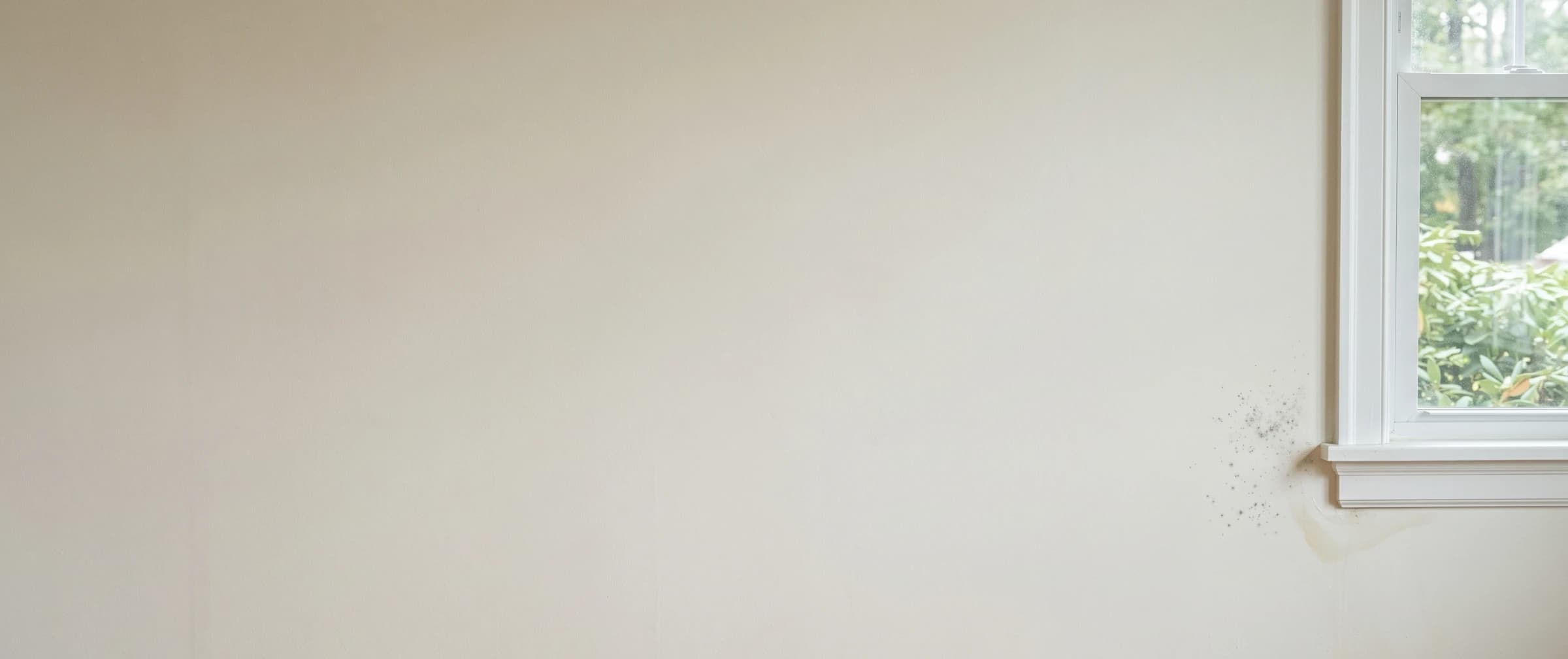

You found mold. Maybe you fixed a leak, or the humidity finally dropped, and the patch looks a little smaller than it did last week. It is tempting to wonder whether it will just clear up on its own if you give it time. The answer, backed by the EPA, CDC, and IICRC S520, the governing standard for professional mold remediation, is no. Mold does not go away on its own. It goes dormant, and dormant is not the same as gone.
Mold dormancy is the biological state in which a colony stops active growth and spore production when moisture drops below the threshold required for its survival, but the spores, hyphae, and any mycotoxins remain viable in place, per IICRC S520 and EPA guidance. This article explains exactly what happens to mold when moisture is removed, why fixing the water source alone is not enough, and what you actually need to do to eliminate the problem before it restarts.
Key insights
- Dormant is not dead. Mold spores stop growing without moisture but remain viable for months to years and reactivate as soon as conditions change.
- Fixing moisture stops growth but does not remove mold. The existing colony stays embedded in porous materials even after the leak is repaired or humidity drops.
- Dry mold spreads more easily. Dried spores are lighter than active ones and become airborne more readily, carrying the colony to new surfaces throughout the home.
- Porous materials cannot be cleaned: they must be replaced. Drywall, insulation, and carpet hold hyphae below the surface where cleaning products cannot reach.
- The 24–48 hour rule cuts both ways. Mold can establish a new colony within 24–48 hours of moisture returning to a dormant-spore-contaminated surface.
- The EPA threshold for DIY scope is 10 square feet. Patches larger than that, or any mold inside walls or HVAC systems, require a professional.
No, mold does not go away on its own
Mold does not self-resolve, die off, or disappear without physical removal, regardless of whether the moisture source has been eliminated. Mold is a fungus, and like all fungi it requires moisture to grow, feed, and reproduce. Per the EPA's mold guidance, mold growth requires a moisture source, oxygen, and an organic material to feed on. Remove one of those factors and active growth stops. But stopping growth is not the same as eliminating the mold.
 Surface mold represents only a fraction of the colony. Per IICRC S520, hyphae typically extend into the substrate well beyond what is visible without removing the material.
Mold colonies consist of two components: the visible surface growth and the root-like structures called hyphae that extend into the material beneath it. When you see a dark patch on a ceiling or wall, the hyphae have already penetrated the substrate. Surface appearance tells you only a fraction of the story.
There is no natural mechanism by which mold decomposes itself, fades, or disappears without physical removal. Left alone without intervention, a colony that has dried out is simply waiting. It has not resolved. The signs of mold you see are evidence of a problem that will continue or return, not one that is trending toward resolution on its own.
What dormant mold actually means
Dormancy is the biological state mold enters when moisture drops below the threshold needed for active growth. The EPA identifies 60% relative humidity as the general threshold above which mold can grow; below that level, active colonies slow or stop. Below roughly 50% RH, most species go fully dormant.
 A lighter, dried appearance signals dormancy, not resolution. The EPA notes mold growth resumes once relative humidity climbs back above 60 percent.
In dormancy, the colony stops producing new spores and stops digesting the substrate. From the outside, it may look lighter, smaller, or less vivid. These appearances lead many homeowners to conclude the problem is improving. It is not. What has changed is the colony's activity level, not its presence or viability.
Mold spores are among the most resilient biological structures in nature. Research cited by NIOSH confirms that spores can remain viable through extreme temperature variation, extended dry periods, and UV exposure that would destroy most microorganisms. Some species produce spores capable of remaining dormant for decades. When moisture returns from a new leak, a seasonal humidity increase, or even ambient humidity levels climbing above 60%, germination can begin within 24–48 hours.
Why fixing the moisture source is not enough on its own
Fixing the moisture source stops new growth but does not remove the mold already present. Repairing the leak or reducing indoor humidity is an essential first step, and skipping it guarantees recurrence. But it is only the first step in a two-part process. Knowing when professional remediation is required helps determine whether the second step is a DIY job or one that needs a contractor.
 Repairing the leak stops new growth but does not remove the existing colony. The CDC notes mold cleanup requires fixing the water problem and removing the mold, not one without the other.
Fixing moisture does three things: it stops the existing colony from expanding, it prevents new colonies from forming in the same location, and it removes the primary condition that makes professional remediation viable long-term. Without fixing moisture first, any remediation work is temporary.
The CDC: Basic Facts About Mold is explicit on this point: mold cleanup requires both fixing the water problem and cleaning up the mold. Skipping either step produces a temporary result at best.
What happens on porous vs. nonporous surfaces
The surface type determines whether cleaning is possible or whether material replacement is required. On nonporous surfaces, mold can be physically removed. On porous materials, the hyphae penetrate the substrate and cleaning products cannot reach them, which is why the same patch keeps returning after surface treatment.
 Nonporous materials like tile and glass can be fully cleaned because mold sits only on the surface. IICRC S520 classifies porous materials with visible growth as Condition 3, typically requiring removal rather than cleaning.
Nonporous surfaces such as glass, ceramic tile, metal, and sealed concrete do not allow hyphae to penetrate. On these surfaces, the colony sits on top of the substrate and can be physically removed with appropriate cleaning agents and technique. Once cleaned and dried correctly, a nonporous surface does not retain viable mold.
Porous and semi-porous surfaces tell a different story. Mold on drywall, wood framing, insulation, and carpet allows hyphae to grow into the material itself. The surface growth you see represents only the visible portion of a colony that extends below the surface. Cleaning the top layer with bleach or other products does not reach the hyphae inside the material. IICRC S520 is explicit that porous materials with mold contamination at Condition 3 (visible mold growth) typically cannot be adequately cleaned and must be removed and replaced.
Is dormant mold still dangerous?
Yes. The assumption that dry or dormant mold is harmless is incorrect and one of the most common misconceptions that leads homeowners to delay action.
Dormant mold colonies pose two categories of risk. First, physical disturbance of a dormant colony (walking past it, running a vacuum nearby, or even air movement from an HVAC system) can dislodge spores and send them airborne. Dry spores are lighter than active ones and remain suspended in air longer, increasing the likelihood of inhalation. Second, dormant mold still carries mycotoxins on the spore surfaces. Mycotoxin content does not disappear when the colony becomes inactive.
The health risks from mold are most acute for people with asthma, mold allergies, compromised immune systems, and young children whose respiratory systems are still developing. For these groups, dormant mold in the home carries the same categories of risk as active mold. It simply produces fewer new spores per day. The underlying hazard remains.
For healthy adults, repeated low-level exposure to airborne spores from a dormant colony can still produce cumulative sensitization over time, meaning a person who did not initially react to mold may develop an allergy or respiratory response after months of ongoing exposure. Controlling indoor humidity and fixing moisture sources promptly are the core of any mold prevention strategy.
What to do instead of waiting
The correct response to discovered mold, regardless of whether it appears active or dormant, is removal. The sequence recommended by the EPA and IICRC S520 is: fix the moisture source first, then remove the mold.
 The EPA recommends detergent and water as the first-line cleaner for mold on nonporous surfaces, not bleach.
For patches under 10 square feet on cleanable surfaces, DIY mold removal is within scope for most homeowners using appropriate PPE and cleaning protocols. The EPA's first-line recommendation is detergent and water on nonporous surfaces, not bleach. Bleach fails on porous materials because the water component feeds surface mold even as the chlorine kills what it contacts on top.
For porous materials with visible mold growth (drywall, wood, insulation, carpet), cleaning is not adequate. The affected material needs to be removed and replaced, the structural framing behind it cleaned and dried to below 16% moisture content per IICRC S520 standards, and the area allowed to dry before reconstruction begins.
After any removal work, mold testing using air sampling can confirm that spore levels have returned to normal background levels. This step is especially important after larger jobs or in homes with vulnerable occupants.
Even after correct removal, recurrence is possible if the moisture source was not fully eliminated or if spores survived in a porous substrate below the cleaning depth. Addressing the root moisture source and verifying dryness with a moisture meter are the two actions most predictive of whether mold stays gone.
When to call a professional
Call a professional when the affected area exceeds 10 square feet, when mold is inside walls or HVAC systems, when the same spot keeps returning after cleaning, or when a high-risk person lives in the home. Each of these conditions moves the job beyond what consumer products and DIY technique can reliably resolve.
 A professional inspection identifies whether the moisture source has been fully resolved, the most common reason mold returns after cleaning.
The affected area exceeds 10 square feet
Above that threshold, proper containment, negative air pressure, and HEPA filtration are needed to prevent spore spread during removal. A professional team performing mold remediation sets up containment barriers and runs HEPA air scrubbers to prevent cross-contamination of unaffected areas.
Mold is inside walls, under floors, or in the HVAC system
Hidden mold growth requires moisture mapping tools, including thermal imaging and calibrated moisture meters, to locate and scope correctly. Work inside wall cavities or ductwork introduces significant spore spread risk if not handled with proper containment.
The same spot keeps returning after cleaning
Recurrence after cleaning is almost always a sign that the moisture source has not been fully eliminated, that hyphae survived below the cleaning depth, or both. A mold inspection can confirm which one is happening and locate moisture pathways that visual inspection misses.
A high-risk person lives in the home
Children, older adults, people with asthma or mold allergies, and anyone with a compromised immune system face more serious consequences from mold exposure. For households with these members, professional scope is appropriate at smaller patch sizes than the general 10-square-foot rule.
You cannot identify or eliminate the moisture source
Mold without a diagnosed and fixed moisture source will return regardless of how thoroughly the visible growth is removed. If the origin of the moisture is not clear, a professional inspection is the most reliable way to find it, and understanding why mold can come back after seemingly successful removal helps set realistic expectations.
The mold remediation cost for professional work ranges from $500–$1,500 for small contained jobs to $3,500 and above for larger infestations or multi-room scope. Getting a written scope of work and clearance testing after completion are the two most important quality controls when hiring.
The EPA contamination level classifications and the full decision framework for when professional remediation is required go deeper into scope thresholds, covering Condition 1, 2, and 3 classifications that determine whether cleaning or material removal is the appropriate response.
After the work is done, the right prevention habits keep the problem from recurring. Keeping indoor humidity below 50% year-round, fixing leaks within 24–48 hours, and running exhaust fans during activities that generate steam are the foundation of any mold prevention strategy.
Frequently asked questions
Does mold go away on its own?
No. Mold does not go away on its own. Active growth stops when moisture drops below the threshold required for the species present, and the colony enters dormancy. But the spores, hyphae, and any mycotoxins remain in place. As soon as moisture returns from a new leak, seasonal humidity, or condensation, the colony reactivates within 24–48 hours. Physical removal is the only way to eliminate it.
Does mold die when it dries out?
No. Drying stops active mold growth but does not kill the colony or its spores. Mold enters a dormant state when it loses its moisture source. Research cited by NIOSH confirms that fungal spores can remain viable through extended dry periods, and some species can survive dormancy for years or longer. Dormant spores remain reactive and will resume growth when moisture returns.
Will mold go away if you fix the moisture?
No. Fixing the moisture source is the essential first step, but it does not remove existing mold. The hyphae embedded in porous building materials stay in place, and dormant spores on and inside surfaces remain viable. You need to fix the moisture and physically remove the mold. Skipping the removal step means the same colony reactivates the next time conditions change.
Can mold dry up and disappear?
Mold can dry out and appear to shrink or lose color, but it does not disappear. The colony goes dormant, and dry spores actually become more hazardous in one respect: they are lighter than active spores and spread more easily through the air when disturbed. Apparent visual improvement is not evidence the problem has resolved.
Is dormant mold dangerous?
Yes. Dormant mold still carries health risk, and for one reason it can be more hazardous than active mold: dry spores are lighter and become airborne more easily when disturbed, spreading the colony to new surfaces throughout the home. Mycotoxins also remain on spore surfaces regardless of whether the colony is active or dormant.
What happens if mold is left untreated?
Untreated mold continues to degrade the substrate it has colonized. Wood framing can lose structural integrity over months to years as hyphae break down cellulose. Drywall paper deteriorates. Insulation loses performance. Beyond structural damage, ongoing spore exposure increases the cumulative health burden on occupants, particularly those with respiratory sensitivities.
Can I just paint over mold?
No. The EPA explicitly states that painting over mold is not an acceptable remediation step. Paint does not kill dormant or active mold beneath it. The colony continues breaking down the substrate underneath, and the paint will typically blister, peel, or discolor within months. The mold then reappears at the surface with a larger and deeper footprint than before.
Sam Hickerson is the founder of RestoreAdvisor and writes consumer guides on mold remediation, water damage restoration, inspection, testing, and home recovery. His work focuses on helping homeowners understand costs, risks, and when to call a professional. He draws on guidance from the EPA, CDC, IICRC, and other authoritative sources to make complex home issues easier to navigate.