
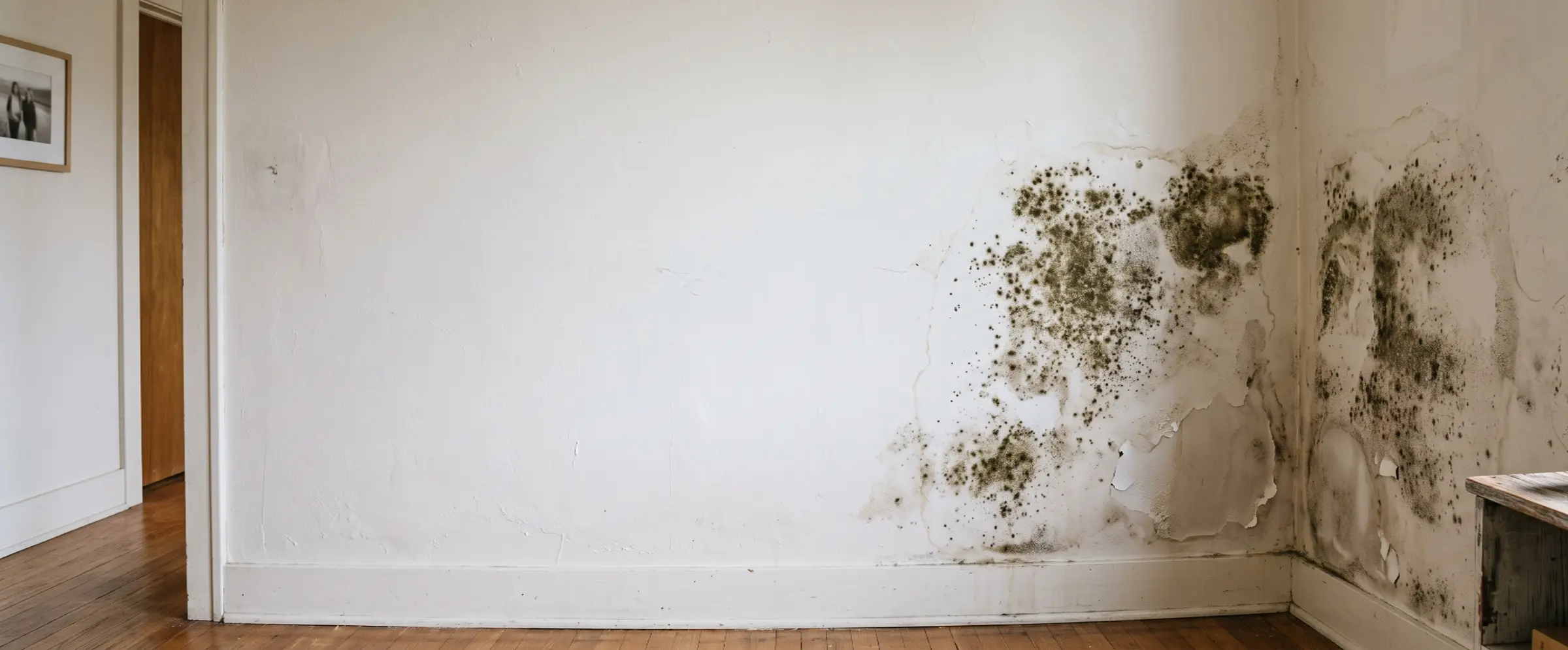

Finding mold in one corner of a room raises an obvious next question: is it already somewhere else. Mold spreads by releasing microscopic spores into the air, not by creeping across a surface the way a water stain does, and those spores can land and take hold anywhere they find moisture and an organic surface to feed on. The EPA and the IICRC S520 standard for professional mold remediation both treat spore dispersal, not surface-level crawling, as the mechanism behind mold moving through a building.
That distinction matters for how urgently you act. A single patch of mold on a shower tile behaves differently from mold growing near an air handler that has been running for a week, since one has almost no path to the rest of the house and the other has a direct one.
Key insights
- Spore-driven, not surface-driven. Mold spreads primarily through airborne spores rather than physical growth across a surface.
- Germination starts fast. Spores can begin colonizing a wet surface within 24 to 48 hours of contact.
- Visible growth takes about a week. A new colony typically becomes visible within 3 to 12 days if moisture persists.
- HVAC systems are the fastest room-to-room vector. A running air handler can distribute spores to every room the ductwork serves.
- Disturbing mold accelerates spread. Dry-brushing, vacuuming without a HEPA filter, or scraping a colony releases a burst of spores into the air.
- Fixing moisture stops it. Spores are everywhere in ordinary indoor air; they only become a growing colony where standing moisture lets them.
Does a small mold spot mean it is already spreading
Yes, even a spot that looks contained can already be spreading, since mold reproduces by releasing spores into the air rather than by the visible colony itself expanding outward. A mold colony is the visible fruiting body of the fungus; the individual organism reproduces by pushing spores into circulating air, and each spore is capable of starting an entirely new colony wherever it lands on a damp surface.
 A spot this size can still fall within the EPA's 10 square foot DIY threshold, but the spores it has already released aren't limited to what's visible here.
This is why a mold problem that looks contained to one tile or one section of drywall can already have a foothold elsewhere. The colony itself doesn't need to touch a new area for the fungus to establish there, which is why catching signs of mold early in adjoining rooms matters as much as treating the original spot.
How mold spreads through spores
Mold reproduces through spores, tiny particles between 2 and 10 microns that are light enough to stay suspended in air for hours. Every established colony continuously releases spores as part of normal reproduction, independent of whether anyone disturbs it.
 Each colony continuously releases spores as part of normal reproduction, and CDC guidance notes background spore levels are present in ordinary indoor air even without an active problem.
Once airborne, a spore needs three conditions to germinate into a new colony: moisture, a food source such as drywall paper, wood, dust, or fabric, and a temperature generally between 68°F and 86°F. Indoor air always contains some background level of mold spores, per CDC: Basic Facts About Mold, which is why the presence of a few spores isn't itself a health concern. The concern starts when spores land somewhere wet enough to let them grow.
Because spores travel on air currents, they follow the same paths air already moves through a home: doorways, stairwells, gaps around pipes, and especially forced-air systems. A colony growing near an intake vent has a far easier path to the rest of the house than one growing in a sealed closet with the door shut.
Left uncorrected, a moisture problem that seeded one colony will typically seed others nearby over time, which is part of why professional mold remediation focuses on fixing the source of moisture, not just cleaning the mold that's currently visible.
How fast mold spreads
Mold spreads on a predictable timeline once a spore lands on a wet surface, and the clock starts within a day or two of moisture exposure. Spores can begin germinating and sending out hyphae, the thread-like structures that root into a surface, within 24 to 48 hours of sustained dampness, a pattern NIOSH's guidance on dampness and mold in buildings ties directly to how long a surface stays wet.
 A colony this sparse is roughly 3 to 12 days old; the timeline resets each time the surface fully dries, which is why intermittent dampness slows growth more than steady moisture speeds it up.
That progression only holds if the surface stays wet. A basement corner that never fully dries will grow a colony noticeably faster than a windowsill that dries out between rain events, since each dry spell interrupts hyphae before they can root in for good. The type of moisture matters too: a one-time spill that gets wiped up and dried within hours rarely gives spores enough time to establish, while a slow, ongoing source like a pinhole leak keeps the same spot wet day after day until the source itself gets fixed.
| Time after exposure | What's happening |
|---|---|
| 24–48 hours | Spores germinate and hyphae begin rooting into the wet surface |
| 3–12 days | A colony becomes visible as fuzzy or discolored spotting |
| 1–2 weeks | The colony matures and begins releasing large numbers of new spores |
| 2–4 weeks (if moisture continues) | Growth expands outward and can cross into adjoining materials |
A colony doesn't expand in a fixed shape or at a constant rate. It grows outward from wherever the food source and moisture are richest, spreading fastest along the wettest edge and slowing or stopping wherever the surface dries out, which is why mold typically looks like an irregular blotch rather than a neat circle.
The same 24 to 48 hour window governs mold after water damage, which covers what happens when a flood or leak doesn't get fully dried in time.
Does mold spread through walls
Yes, mold can spread through a wall cavity, both by growing into the material itself and by moving laterally to reach the far side. The paper facing on drywall and the wood framing behind it are both cellulose-based food sources of the kind EPA guidance identifies as ideal material for mold growth, so a colony that starts on the visible face of a wall can send hyphae through the paper and into the gypsum core.
From there, moisture wicking through the cavity can carry spores and hyphae toward insulation, adjacent studs, or the drywall on the opposite side of the wall, particularly in shared walls between rooms or units. A wall that stays wet on one side rarely stays dry on the other for long, and how far mold on drywall has penetrated the paper and gypsum core is what decides whether a spot gets wiped clean or cut out and replaced.
Wall cavity spread is also one of the more common ways mold goes undetected for weeks, since the visible signs on one side of a wall can lag well behind what's happening inside it.
Does touching mold make it spread faster
Yes, touching, scraping, dry-brushing, or vacuuming mold without a HEPA filter disturbs the colony and releases a concentrated burst of spores into the air. Those spores are then free to land on nearby surfaces, and physical contact can also transfer fragments of the colony directly onto hands, tools, or cleaning rags.
 The IICRC S520 standard calls for wet cleaning over dry methods specifically because dry-brushing, sanding, and unfiltered vacuuming aerosolize spores instead of removing them.
This is why cleaning a mold patch the wrong way sometimes makes the problem look worse a week later in a nearby spot. Scrubbing dry, using a household vacuum without HEPA filtration, or sanding a moldy surface all agitate the colony far more than gentle wet cleaning does. For patches under 10 square feet on cleanable, nonporous surfaces, DIY mold removal walks through the wet-cleaning sequence and the PPE recommendations OSHA's guidance on mold cleanup calls for to limit spore release during the work itself.
Larger or more established colonies need containment, not just careful technique, which is one of the reasons the IICRC S520 standard calls for sealed work areas and negative air pressure on remediation jobs above a certain size.
How mold spreads from room to room
Mold moves between rooms mainly through moving air, whether that air is driven by an HVAC system, natural drafts, or people and pets carrying spores on clothing, shoes, or fur, the same airborne pathways CDC guidance points to as the primary way spores travel through a building. Each pathway gives spores a way past the walls and doors that would otherwise contain them.
 An HVAC system pulls return air from one room and pushes it through every other room the ductwork serves, which is why running the system near an active colony spreads spores faster than an open door alone.
Some pathways move far more spores than others. An HVAC system pulls air from every connected room several times an hour, while a closed door with no shared ductwork can keep two rooms nearly isolated from each other even during an active mold problem. These pathways also stack: someone walking through a room near an active colony can carry spores on their shoes to the next room they sit down in, which is why a mold problem sometimes turns up in a room with no obvious moisture source of its own.
| Pathway | How it moves mold | How to limit it |
|---|---|---|
| HVAC ductwork | Return air pulls spores from one room and supply vents push them into every other room the system serves | Turn off the system to the affected room; don't run it until the source is addressed |
| Open doors and drafts | Natural air currents and foot traffic carry loose spores through doorways and hallways | Close the door and cover any gaps during cleanup |
| People and pets | Spores settle on clothing, shoes, and fur and get carried to new rooms | Change clothes and wipe down pets after contact with a moldy area |
| Shared plumbing or wall cavities | Moisture wicks through a shared structure, carrying hyphae toward the next room | Address the moisture source, not just the visible patch |
An HVAC system is the fastest of these pathways because it actively moves large volumes of air through the entire structure on a schedule, rather than relying on incidental drafts. If mold has already reached the coils, drain pan, or duct liner, clearing it typically means cleaning or replacing those components rather than just swapping the air filter, the scope of work mold in HVAC remediation actually involves.
Signs mold has spread beyond what you can see
The clearest sign mold has spread is a musty smell in a room where nothing is visibly growing, since odor often precedes visible spotting by days or weeks, a pattern EPA guidance attributes to the microbial volatile organic compounds mold releases before a colony becomes visible. A handful of other patterns point to the same conclusion.
 EPA guidance attributes the musty smell that shows up before visible spotting to microbial volatile organic compounds mold releases as it grows, which is why odor often reaches a room before staining does.
Musty odor with no visible source
A smell that's strongest in a specific room, even without staining, usually means growth is happening somewhere out of sight, such as behind a wall or under flooring.
Odor coming from HVAC vents
If the smell is strongest near a supply register, the system itself is likely distributing spores from a source near the coils or ductwork.
Staining on the far side of a shared wall
Discoloration appearing on the opposite side of a wall from the original mold patch is a strong indicator of cavity spread.
Symptoms that track room by room
Household members who feel worse in one part of the house and better elsewhere are describing a real pattern worth investigating, not just coincidence.
Confirming whether growth has actually spread, as opposed to just smelled that way, is what mold testing is for, particularly air sampling that can catch elevated spore counts in a room with no visible colony at all.
How to stop mold from spreading
The fastest way to stop mold from spreading is to fix the moisture source feeding it, since new spores will keep colonizing the same conditions no matter how many times the visible patch gets cleaned. Containment and correct cleaning technique handle the rest.
 Sealing the room before cleaning follows the same containment logic in the IICRC S520 standard, which prevents spores disturbed during cleanup from settling in adjoining spaces.
1. Fix the moisture source first
Repair the leak, condensation point, or humidity problem before cleaning. Cleaning without addressing the cause buys a few weeks at most.
2. Contain the area
Close doors, shut off HVAC service to that room, and cover any large opening with plastic sheeting if the affected area is bigger than a small patch.
3. Clean nonporous surfaces wet, not dry
Wipe or scrub with detergent and water rather than dry-brushing, sanding, or vacuuming without a HEPA filter, all of which release spores instead of removing them.
4. Discard contaminated porous material
Drywall, carpet, or insulation that has stayed wet and moldy for more than 48 hours generally can't be cleaned back to a safe condition and needs to be bagged and removed.
5. Monitor nearby surfaces for two weeks
Check the other side of shared walls, adjoining rooms, and HVAC vents for new spotting or odor after cleanup, since a moisture problem that fed one colony can seed another nearby.
Long-term prevention comes down to keeping indoor humidity below 60%, the threshold the EPA cites as the point past which surface moisture supports mold growth, with room-by-room targets and dehumidifier sizing scaled to that number.
When spreading mold needs a professional
Mold that covers more than about 10 square feet, has reached HVAC ductwork, or keeps reappearing after cleaning generally needs a professional rather than continued DIY effort. That threshold comes from EPA guidance and is echoed in the IICRC S520 standard's contamination classifications, which scale the required containment and PPE to the size and location of the affected area.
A few other signals point the same direction: mold spreading across multiple rooms, growth inside wall cavities that requires opening the wall to reach, or a household member with asthma or a compromised immune system living in the home. In those situations, negative-air machines and sealed containment keep spores from spreading further during the work itself, something a spray bottle and a sponge can't do.
Professional mold remediation cost typically runs $1,500 to $6,000 depending on how far the colony has spread and how many rooms or materials are involved.
Frequently asked questions
Does mold spread to other rooms?
Yes, mold spreads to other rooms when spores travel through the air, through HVAC ducts, or on people and pets and land on a damp surface in a new location. It does not need to touch the original colony to take hold elsewhere.
How fast does mold spread in a house?
Mold spreads fast once moisture is present. Spores can begin germinating within 24 to 48 hours of contacting a wet surface, and a visible colony can form within 3 to 12 days if the moisture source is not fixed. That's different from mold that looks dried out between wet periods: a colony that appears dead can still hold viable, dormant spores capable of resuming growth the moment moisture returns.
Can mold spread through the air conditioner?
Yes, an HVAC system can spread mold spores through every room the ductwork serves. Running the system while mold is present near the coils, drain pan, or ducts pushes spores through the supply registers into the rest of the home.
Does touching mold spread the spores?
Yes, touching, scrubbing dry, or vacuuming mold without a HEPA filter disturbs the colony and releases spores into the air, where they can settle on nearby surfaces and start new growth.
Does mold spread through walls?
Yes, mold can grow through the paper facing on drywall and along wood framing inside a wall cavity, and it can spread laterally to the other side of the wall if moisture and cellulose are present there too.
Can you stop mold from spreading once it starts?
Yes, fixing the moisture source, containing the affected area, and cleaning or removing contaminated material stops further spread. The moisture source has to be corrected or new spores will keep finding somewhere to grow.
Does mold spread faster in summer?
Yes, mold grows fastest between 68°F and 86°F, a range many homes hit during summer, and higher indoor humidity in warmer months gives spores more damp surfaces to colonize.
Will opening a window near mold spread it further?
It can. Moving air, whether from a window, a fan, or foot traffic through the room, carries loose spores to new surfaces. Contained, still air limits how far a colony's spores travel before they're cleaned up.
Does bleach stop mold from spreading?
No, bleach only kills mold on nonporous surfaces like tile and glass. It doesn't reach spores that have already taken hold in porous material like drywall or wood, so bleaching a porous surface won't stop the spread; detergent and water or an EPA-registered antimicrobial work better on those materials.
Does cold weather slow mold's spread?
Yes, growth slows below about 40°F, but cold doesn't kill mold spores. They go dormant and can resume spreading as soon as the surface warms and moisture returns.
How far can mold spread from the original spot?
There's no fixed distance. Spread follows moisture, not proximity, so a colony can stay confined to a few inches in a consistently dry area or expand across an entire room and beyond the EPA's 10 square foot threshold if the dampness continues, the same size cutoff used to decide when mold remediation is required.
Does mold spread to clothing or furniture in the room?
Yes, mold can spread to clothing, curtains, or upholstered furniture if spores settle on the material and it stays damp, though items in a normally dry room aren't automatically contaminated just from being nearby. Machine-washing removable fabric and vacuuming upholstery with a HEPA filter usually resolves light surface contact; heavily soiled or musty-smelling porous items are often more practical to replace.
Sam Hickerson is the founder of RestoreAdvisor and writes consumer guides on mold remediation, water damage restoration, inspection, testing, and home recovery. His work focuses on helping homeowners understand costs, risks, and when to call a professional. He draws on guidance from the EPA, CDC, IICRC, and other authoritative sources to make complex home issues easier to navigate.