
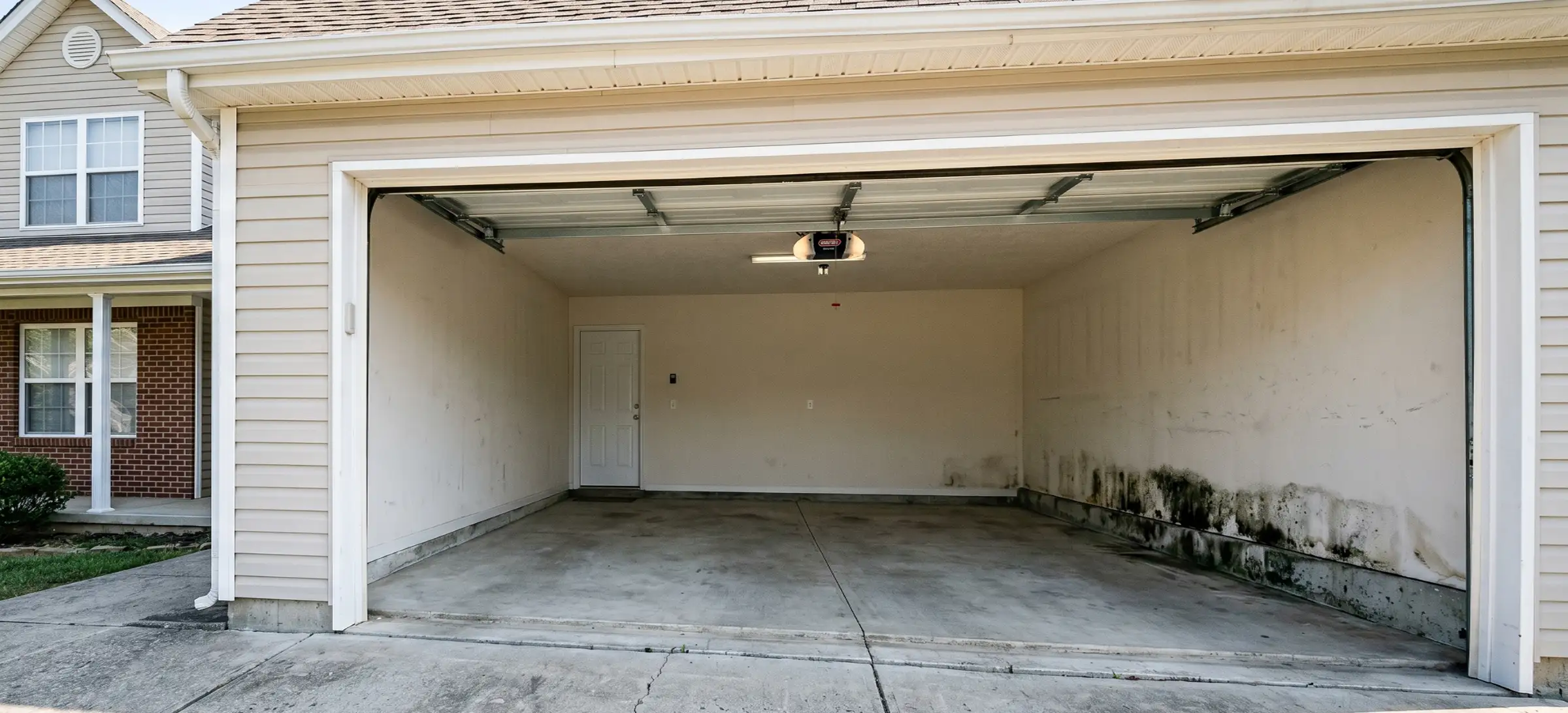

Garages are among the most overlooked mold locations in a home, and in an attached garage that oversight carries real consequences. Per the ANSI/IICRC S520 Standard for Professional Mold Remediation, mold growth requires only moisture, a food source, and temperatures between roughly 40°F and 100°F, conditions that garages supply regularly without any active leak present.
What makes garages different is the combination of poor ventilation, concrete floors that hold moisture, and direct physical connections to the living space, particularly in attached garages where mold has a clear path into your home's air supply. When mold remediation is needed, garage jobs range from a simple concrete scrub to full drywall removal depending on how far growth has spread.
Key insights
- Mold begins growing within 24–48 hours of a moisture event, according to EPA guidance, making fast action after any garage leak critical.
- Attached garages share air with your home through gaps around plumbing, electrical penetrations, and the connecting door, allowing spores to migrate into living areas.
- Concrete alone does not feed mold, but dust, organic debris, and cardboard stored on concrete floors provide the food source mold needs to colonize the surface.
- The EPA recommends professional remediation for any mold patch exceeding 10 square feet, which in a garage can be reached quickly given how much uninterrupted wall and floor space is available.
- Drywall in garages is a high-risk material because its paper facing is an excellent mold food source and it absorbs moisture quickly when humidity or a leak is present.
- Clearance testing after professional remediation confirms spore levels have returned to normal before the garage is used again, per IICRC S520 protocol.
Why garages are prone to mold
Garages create nearly ideal mold conditions because of how they are built and used. Unlike the rest of a home, most garages have limited mechanical ventilation, concrete slab floors that draw in ground moisture, and walls that cycle between wide temperature extremes. These factors combine to create persistent condensation.
 A single car dripping from its undercarriage on a cold day can add gallons of moisture here, moisture that evaporates slowly in an unconditioned space and raises humidity for hours.
Vehicles driven in during rain or snow track significant water onto the floor. A single car dripping from its undercarriage can deposit gallons of moisture in a cold session. Because garages are not conditioned spaces, that moisture evaporates slowly and raises the local relative humidity. The CDC: Basic Facts About Mold notes that mold will grow wherever moisture is present and a food source exists, and garages routinely supply both.
Four structural factors drive most garage mold problems:
- Poor ventilation. Most residential garages rely on passive ventilation through a single wall vent or under the garage door. When doors are closed in humid weather, air stagnates and moisture accumulates.
- Concrete moisture migration. Concrete is porous. Ground moisture wicks upward through slab floors and foundation walls by capillary action, keeping surfaces perpetually damp unless a vapor barrier or sealant is in place.
- Stored organic materials. Cardboard boxes, paper, wood shelving, and fabric items are all food sources for mold. These materials absorb ambient humidity and create localized high-moisture zones that accelerate growth.
- Temperature differentials. In heated garages, cold garage doors and exterior walls create surfaces where warm interior air condenses, providing the sustained moisture mold needs.
Where mold hides in a garage
Garage mold most commonly develops along the base of walls where concrete meets drywall, on the ceiling near roof penetrations, on stored organic materials like cardboard, and inside wall cavities where humidity concentrates unseen. It tends to grow where moisture is highest and airflow is lowest, which is why corners, floor-to-wall joints, and areas behind stored items are the first places to check.
 Cardboard sitting directly on concrete like this absorbs ambient humidity and creates its own localized moisture zone, feeding growth even away from any active leak.
The material behind the mold matters as much as the location. Concrete and sealed surfaces can usually be cleaned if the area is small and the moisture source is resolved. Drywall and wood framing cannot be effectively cleaned once mold penetrates the surface; those materials need to be removed. The table below maps each location to its primary cause, what to look for, and whether DIY cleaning is appropriate.
| Location | Primary cause | What to look for | DIY or pro |
|---|---|---|---|
| Concrete floor | Ground moisture, tracked-in water | Black or gray discoloration, white mineral deposits, musty odor | DIY if surface only |
| Lower drywall sections | Moisture wicking from slab, condensation | Dark staining, soft or crumbling drywall, paint bubbling | Pro: drywall absorbs spores |
| Ceiling | Roof leak, condensation from HVAC | Water stains, circular growth patterns, sagging drywall | Pro if area exceeds 10 sq ft |
| Wood framing and studs | Chronic humidity, water intrusion behind wall | Visible only when drywall is removed, or detected by moisture meter | Pro: structural material |
| Garage door tracks and panels | Condensation, poor insulation | Fuzzy white or gray growth, rust streaks near track | DIY if limited to surface |
| Stored items and shelving | Cardboard and fabric absorbing ambient humidity | Fuzzy growth, musty smell from boxes or equipment | Discard affected porous items |
| Wall-to-floor joint | Ground moisture, inadequate caulking | Consistent dark line along base of walls | DIY if caulk line only, pro if drywall involved |
A note on concrete discoloration. True mold growth on concrete appears as fuzzy or powdery colored growth, often gray, black, or green. White chalky deposits are usually efflorescence, mineral salts left behind as water evaporates through the slab, not mold. You can distinguish them with a drop of water: efflorescence dissolves or softens; mold does not. A detailed look at what signs of mold appear on different materials, including concrete, drywall, and wood, helps distinguish true growth from mineral deposits.
Common mold types found in garages
The most common mold species found in garages are Cladosporium, Penicillium, Aspergillus, and Alternaria, all of which are allergenic and grow on concrete, drywall, wood, and stored organic materials. Stachybotrys chartarum, the toxigenic species associated with chronic moisture damage, is less common but does appear in attached garages with long-standing leaks.
 Color alone can't sort these into allergenic versus toxigenic categories, since several species overlap in appearance depending on the substrate and moisture level.
Species identification matters because the cleaning method, PPE level, and decision to DIY or call a professional all depend on what is growing. Color alone is not a reliable indicator, since multiple species can appear black or green depending on the substrate and moisture level.
| Species | Appearance | Preferred surface | Health category | DIY appropriate |
|---|---|---|---|---|
| Cladosporium | Olive-green to black, powdery | Concrete, wood, stored items | Allergenic | Yes, small patches |
| Penicillium | Blue-green, velvety | Cardboard, insulation, drywall | Allergenic/ opportunistic | Yes, small patches |
| Aspergillus | White, yellow, or green; granular | Concrete, stored organic materials | Allergenic/ opportunistic | Yes, small patches |
| Alternaria | Dark brown to black, woolly | Drywall, wood | Allergenic | Yes, small patches |
| Stachybotrys chartarum | Greenish-black, slimy texture | Drywall, wood with sustained moisture | Toxigenic | No: call a pro |
Stachybotrys chartarum, commonly called black mold, requires sustained moisture for extended periods, typically weeks, to establish. It is less common in garages than in basements or crawl spaces, but it does appear in attached garages where chronic leaks or flooding has gone unaddressed. If growth is slimy rather than fuzzy and dark greenish-black, do not disturb it. Confirmed black mold removal requires professional containment, negative air pressure, and independent clearance testing before the space is safe to use.
Color alone is not a reliable identifier because multiple species can appear black or dark green depending on the substrate and moisture level. When the species is uncertain, mold testing by a qualified laboratory confirms the identification and informs the remediation scope.
Attached garages: a direct path into your home
An attached garage shares at least one wall with the living space, and often shares an HVAC system, plumbing, and electrical conduit. Each of these creates pathways for mold spores to travel indoors. This distinction matters significantly for how urgently garage mold should be addressed.
 Growth this close to the connecting door matters more than the same patch would in a detached structure, since opening that door draws garage air into the house in most homes.
Spores move from the garage into the home through four primary routes:
- Gaps around penetrations. Electrical conduit, plumbing pipes, and gas lines passing through the shared wall create gaps that are rarely fully sealed. Spores travel through these openings continuously.
- The connecting door. Opening the door between the garage and living space creates an air pressure differential. In most homes, this draws air from the garage into the house rather than the reverse.
- Shared HVAC equipment. If your air handler, furnace, or water heater is located in the garage and serves the living space, mold spores that enter the return air stream are distributed throughout the home. When HVAC mold is present this is the fastest whole-home contamination pathway.
- Transferred on surfaces. Clothing, shoes, boxes, and tools moved from a moldy garage into the house carry spores on their surfaces.
For these reasons, mold in an attached garage warrants the same urgency as mold inside the living space. Detached garages carry lower immediate risk to occupant health but still require prompt attention to prevent structural damage from worsening.
If household members are experiencing unexplained respiratory symptoms, allergy flares, or fatigue that improves when away from home, garage mold is worth investigating. The population-specific risks by health condition and age group are detailed in is mold dangerous.
DIY garage mold removal
For mold patches under 10 square feet on non-porous or sealed surfaces, DIY removal is within scope for most homeowners, following EPA cleanup guidance. This typically applies to surface growth on sealed concrete floors, painted drywall with no soft spots, or garage door tracks.
 This scope only applies if the moisture source is already fixed and the surface is sealed concrete or intact painted drywall, not raw drywall or wood framing.
Before starting, confirm the moisture source is identified and fixed. If it is not, cleaning is temporary regardless of how well it is done.
What you need:
- N95 respirator at minimum (P100 half-face respirator for heavy growth)
- Nitrile gloves and safety goggles
- Disposable coveralls or clothes you can bag and wash immediately
- Stiff-bristle brush
- HEPA vacuum
- Spray bottle and cleaning solution
- Heavy-duty plastic bags for disposal
Cleaning products for garage surfaces:
| Product | Best for | Dilution | Limitation |
|---|---|---|---|
| Dish detergent and water | Sealed concrete, painted surfaces | Several drops per quart | Does not kill spores; follow with vinegar or H2O2 |
| White vinegar (undiluted) | Non-porous surfaces, concrete | Undiluted | Odor dissipates in hours; does not bleach |
| Hydrogen peroxide (3%) | Concrete, sealed surfaces | Undiluted | May lighten some surfaces |
| Bleach solution (1 cup per gallon) | Non-porous surfaces only | 1:10 ratio | Ineffective on porous materials per IICRC S520; generates fumes |
| Commercial antifungal cleaner | All non-porous surfaces | Per label | Varies by product |
Do not use bleach on raw concrete, wood, or drywall. The IICRC S520 standard, the industry protocol for professional mold remediation, explicitly identifies bleach as ineffective for porous materials because the water carrier can penetrate and feed further growth while the chlorine stays at the surface. For porous surfaces, the material typically needs to be removed rather than cleaned.
Removal steps:
1. Fix the moisture source
Identify and repair the leak, condensation point, or ventilation problem before touching the mold. Cleaning without addressing the cause leads to regrowth within weeks.
2. Gather PPE and supplies
Wear an N95 respirator (or P100 for heavy growth), nitrile gloves, goggles, and disposable coveralls. Have your spray bottle, stiff brush, HEPA vacuum, and cleaning solution ready before you start.
3. Seal off the area
Close the door to the house and turn off any shared HVAC equipment. Open the garage door and any windows to ventilate, then tape plastic sheeting over the door connecting to your home.
4. Mist the mold before scrubbing
Lightly spray the moldy surface with water before scrubbing to suppress airborne spores. Never dry-scrub mold.
5. Apply cleaning solution and scrub
Apply your chosen cleaning solution to the surface and scrub with a stiff brush. Let the solution dwell for 10 minutes before wiping.
6. HEPA vacuum and bag debris
Vacuum the cleaned area and surrounding surfaces with a HEPA vacuum. Seal all disposable materials, including the brush and rags, in heavy-duty plastic bags before removing from the garage.
7. Dry the area completely
Run a dehumidifier and keep ventilation going until the area reaches below 50% relative humidity. Moisture meters should read below 16% on wood surfaces before the job is complete, per the IICRC S520 standard.
8. Verify and monitor
Inspect the area after 72 hours. If mold has returned or a musty odor persists, the moisture source was not fully resolved or growth extends deeper than the surface. Call a professional for assessment.
The DIY mold removal process covers containment setup, cleaning product dilutions, and safe disposal of contaminated materials in full detail.
When to call a professional
Professional remediation is required when the affected area exceeds 10 square feet, when mold has penetrated porous materials like drywall or wood framing, or when any of the conditions below apply. Each makes DIY removal inadequate or unsafe.
 A reading from a meter like this is what confirms whether framing behind the drywall needs treatment too, not just the visible surface growth.
- Mold is on or behind drywall. Once mold has penetrated drywall's paper facing, surface cleaning cannot remove it. The drywall must be cut out and replaced, which requires containment to prevent spore spread.
- Mold is on wood framing or structural lumber. Wood studs and floor joists hold moisture at levels that allow deep penetration. Surface cleaning leaves viable spores. Professional treatment using mechanical abrasion, antimicrobial application, and moisture correction is required.
- You suspect Stachybotrys chartarum. Slimy, dark greenish-black growth on drywall or wood that has been wet for weeks should be treated as Stachybotrys until testing confirms otherwise.
- Growth is recurring. If mold returns within weeks of cleaning, either the moisture source was not resolved or growth extends deeper than the surface treatment reached.
- The garage is attached and HVAC equipment is present. The potential for whole-home contamination through shared ductwork escalates the stakes significantly.
- You or household members have respiratory conditions or immune compromise. When remediation is required covers the health-based decision criteria in full.
Professional remediation follows the IICRC S520 standard: containment with negative air pressure, air filtration using HEPA scrubbers, removal of affected materials, antimicrobial treatment, drying to measured moisture targets, and independent clearance testing before the space is returned to use.
Before remediation begins, a mold inspection by a qualified inspector establishes the full scope of affected materials using moisture meters and sometimes thermal imaging.
Garage mold removal costs
Professional garage mold removal typically costs $500–$4,000, depending on the size of the affected area, the materials involved, and whether structural removal is required. Surface cleaning of concrete sits at the low end; jobs involving drywall demo, wood framing treatment, or HVAC equipment run significantly higher.
 Framing contamination this extensive behind an ordinary looking wall is exactly what pushes a job from the low end of the cost range into the multi-thousand dollar range.
The table below breaks down typical ranges by scenario. These figures are garage-specific and do not include clearance testing, which runs $200–$600 as a separate line item.
| Scenario | Affected area | Typical cost | What drives the price |
|---|---|---|---|
| Surface mold on concrete floor or walls | Under 50 sq ft | $500–$1,200 | Cleaning, HEPA vacuuming, containment |
| Drywall removal and replacement | 50–100 sq ft | $1,200–$2,500 | Demolition, disposal, new drywall, finishing |
| Wood framing treatment | 1–3 wall bays | $1,500–$3,500 | Mechanical abrasion, antimicrobial, drying |
| Multi-surface (floor, walls, ceiling) | 100–200 sq ft | $2,000–$4,500 | Larger containment zone, extended drying |
| Attached garage with HVAC involvement | Varies | $3,000–$10,000+ | HVAC component cleaning or replacement adds significantly |
| Whole-garage severe infestation | Full garage | $4,000–$15,000 | Full demo of affected materials, structural treatment |
These figures are garage-specific. National cost data by mold type, project size, and per-square-foot rates is available in mold remediation cost.
Additional cost factors specific to garages:
- If HVAC equipment shares the garage space, expect duct cleaning or component replacement costs on top of structural remediation.
- Attached garages where mold has spread to the shared wall between garage and living space may require work on both sides, roughly doubling the drywall cost.
- Concrete floor sealing ($1–$3 per square foot) after remediation reduces recurrence risk and is often quoted as an add-on.
Does homeowners insurance cover garage mold?
Whether homeowners insurance covers garage mold depends entirely on what caused the moisture. Most standard HO-3 policies follow a covered-peril doctrine: mold is covered only when it results from a sudden, accidental covered event.
The cause determination is where most claims run into trouble. Insurers will inspect the moisture source and look for evidence of how long the problem existed. A leak that has been seeping for months before mold became visible is typically classified as gradual rather than sudden, which falls outside coverage regardless of how the homeowner describes it.
| Cause | Typically covered | Notes |
|---|---|---|
| Burst pipe in garage | Yes | Document immediately; report within 48–72 hours |
| Roof leak causing rapid water intrusion | Sometimes | Coverage depends on storm vs. wear-and-tear determination |
| Gradual plumbing leak | No | Insurer treats as maintenance failure |
| Chronic condensation or humidity | No | Excluded as a maintenance issue in virtually all policies |
| Vehicle damage causing water intrusion | Sometimes | May fall under auto policy rather than homeowners |
| Flooding | No (standard policy) | Requires separate NFIP or private flood policy |
Standard policies also impose mold sublimits, commonly $5,000–$10,000, even when the underlying cause is covered. Because garage remediation involving drywall and framing can exceed these limits, documenting the damage and cause thoroughly before filing is essential. Filing a claim, disputing a denial, and understanding mold sublimits are covered in depth under homeowners insurance.
If water damage is the origin of your garage mold, understanding the pathway from water damage to mold claim is important. Mold after water damage covers the documentation steps, Category 1/2/3 water classifications, and the insurance claim sequence from initial event to remediation approval.
How to prevent mold in your garage
Prevention is primarily a moisture management problem. Every other factor (temperature, organic materials, surface type) is secondary to keeping relative humidity below 50% and eliminating standing water quickly.
 A reading at 47% like this one sits comfortably below the 60% threshold where the EPA says growth becomes likely on most surfaces.
The EPA identifies 60% relative humidity as the threshold above which mold growth becomes likely on most surfaces, and recommends keeping indoor humidity between 30% and 50% year-round.
The actions below address the most common failure points in garages.
| Prevention action | Frequency | Why it works |
|---|---|---|
| Inspect and repair roof, gutters, and fascia for leaks | Annually (after winter) | Roof leaks are the leading source of ceiling and upper-wall mold in garages |
| Check and replace garage door weather stripping and bottom seal | Annually | Worn seals allow rain and groundwater to enter at floor level |
| Seal concrete floor with penetrating sealer or epoxy coating | Every 3–5 years | Blocks capillary moisture migration from ground through slab |
| Install a dehumidifier set to 50% RH or below | Continuous in humid months | Removes ambient moisture before it reaches mold-growth threshold |
| Add ventilation (exhaust fan or ridge vent) | Install once; inspect annually | Breaks stagnant air that allows humidity to concentrate |
| Store items on metal shelving, not cardboard boxes on the floor | Ongoing | Eliminates food sources and removes items from the highest-moisture zone |
| Dry wet vehicles before closing the garage door | After every rain or snow event | A single dripping car can add gallons of moisture to a closed garage |
| Seal all penetrations through the shared wall (attached garages) | Inspect annually | Blocks the pathway spores use to move into living areas and reduces moisture transfer |
| Check dryer and exhaust fan vents terminate outside, not into the garage | During any renovation or new appliance install | Exhausts venting indoors dramatically increase humidity load |
Dehumidifier sizing: A standard two-car garage (approximately 400–600 square feet) requires a 30–50 pint dehumidifier for effective moisture control during humid months. In climates where humidity regularly exceeds 70%, a 70-pint unit is more appropriate. Look for ENERGY STAR-rated units with a built-in humidistat so they cycle automatically.
Ventilation options: Passive gable vents are the minimum standard for detached garages. For attached garages or any space with chronic humidity problems, an exhaust fan rated at a minimum of 50–80 CFM vented to the exterior provides active moisture removal. Confirm that any existing exhaust fan actually terminates outside the structure and not into the attic or wall cavity, a common installation error that turns one moisture problem into two.
Frequently asked questions
Can garage mold spread into my house?
Yes, particularly in attached garages. Spores migrate through gaps in the shared wall, around penetrations, and through the connecting door whenever it opens. If HVAC equipment is located in the garage, spores can enter the air handler and be distributed through every room the system serves. Addressing garage mold promptly is the most effective way to protect indoor air quality.
What does mold in a garage look like?
Garage mold typically appears as dark spots or fuzzy patches in colors ranging from white and gray to green and black. On concrete, it may look like dark staining or powdery growth. On drywall, look for bubbling or peeling paint, soft wall sections, and discoloration along the base. On stored items, fuzzy growth and a musty smell are the primary indicators.
How long does it take for mold to grow in a garage after a leak?
Mold begins growing within 24–48 hours of a moisture event under the right conditions, according to EPA guidance. This is why stopping a leak and beginning drying within the first day is so important. Growth that has been present for more than 48–72 hours before drying begins typically requires professional assessment to determine how far it has penetrated.
Is it safe to park in a garage with mold?
For most healthy adults, yes. Parking briefly in a garage with mold is unlikely to cause immediate harm. However, spending extended time in a moldy garage (for storage, hobbies, or workspace activities) increases cumulative spore exposure. For anyone with asthma, allergies, or immune compromise, even limited exposure can trigger symptoms. Remediate before using the space regularly.
Can I paint over mold in my garage?
No. Painting over mold does not kill it. The growth continues behind the paint film, and the paint typically peels within weeks as the mold continues to degrade the surface underneath. Any mold must be removed rather than covered before repainting. Applying mold-resistant primer after remediation is appropriate, but it does not substitute for removal.
What is the white stuff on my garage concrete floor?
White chalky deposits on concrete are most commonly efflorescence, mineral salts carried to the surface as water moves through the slab and evaporates. This is not mold, but it does indicate active moisture migration through the concrete, which creates conditions for mold to grow on items placed on or near the floor. Apply a concrete sealer to reduce moisture movement. If the white deposit is fuzzy rather than powdery and has a musty smell, it may be a white mold species such as Penicillium or Aspergillus.
Sam Hickerson is the founder of RestoreAdvisor and writes consumer guides on mold remediation, water damage restoration, inspection, testing, and home recovery. His work focuses on helping homeowners understand costs, risks, and when to call a professional. He draws on guidance from the EPA, CDC, IICRC, and other authoritative sources to make complex home issues easier to navigate.