
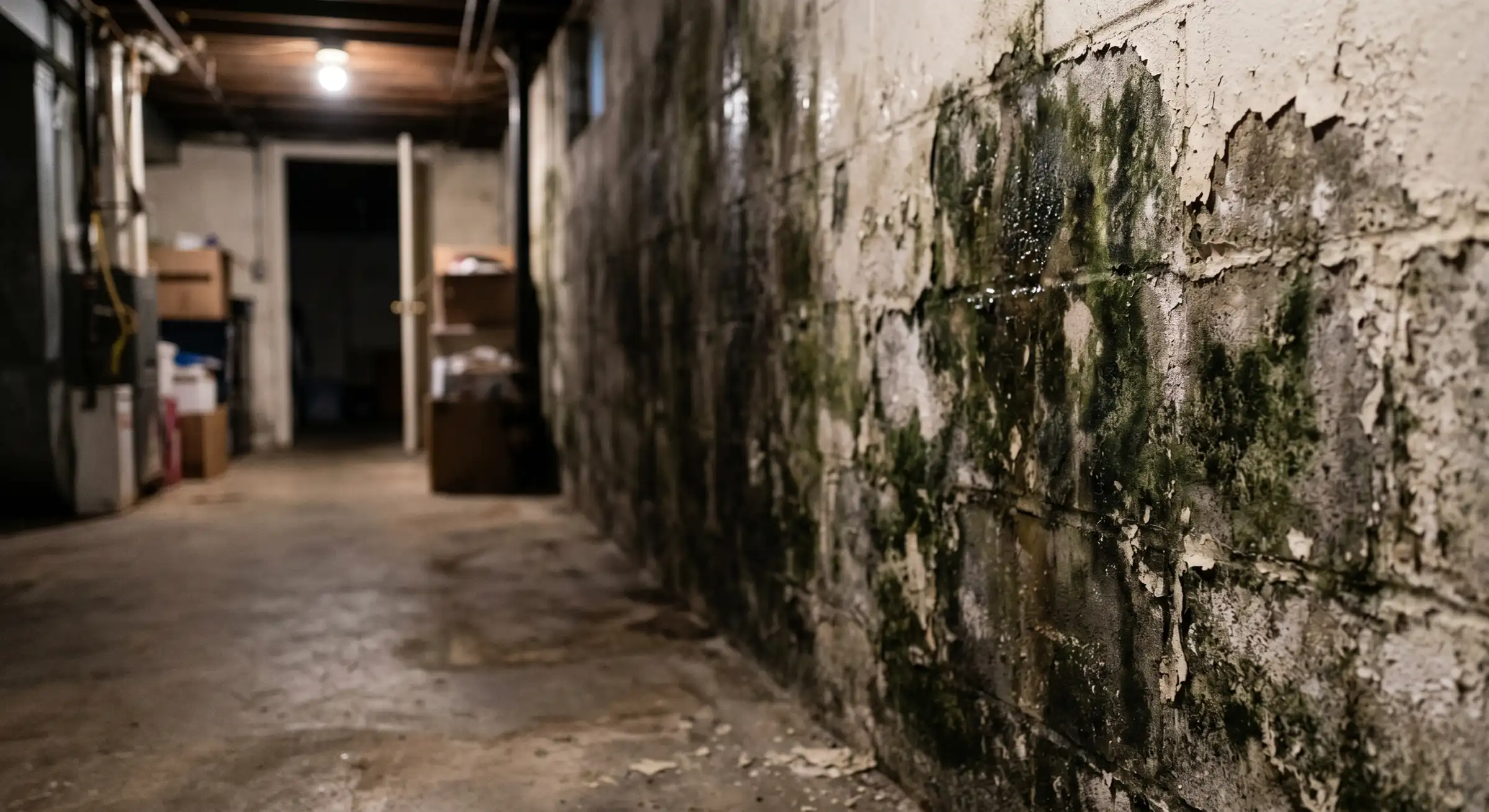

Green mold is not a single organism. It is a broad term for dozens of fungal species whose spore colonies appear green, with the three most common residential genera being Aspergillus, Penicillium, and Cladosporium. Per ANSI/IICRC S520, these are classified as Category 2 or higher hazards when growth exceeds 10 square feet or involves porous building materials, requiring the same professional containment and clearance standards as other remediated mold.
Finding green mold on a wall, in a basement, or on wood after a leak is understandably alarming. The species matters: some green mold is a nuisance allergen, others produce mycotoxins that require professional containment.
Key insights
- Green mold is not one organism. It is most often Aspergillus, Penicillium, or Cladosporium. Color alone cannot confirm the species or its toxicity level.
- The EPA recommends professional removal for any mold-affected area larger than 10 square feet, regardless of species or color.
- Aspergillus and Penicillium can produce mycotoxins under certain conditions, making them potentially more hazardous than their commonplace appearance suggests.
- Cladosporium is the world's most widespread outdoor mold genus and a frequent indoor allergen, but it rarely produces mycotoxins.
- Green mold can begin colonizing wet surfaces within 24-48 hours of water exposure, per EPA guidance. Addressing moisture within 24 hours is the single most effective prevention measure.
- Lab testing is the only reliable way to confirm species and toxicity. Visual color, texture, and location are useful starting points but are not definitive.
What green mold looks like and how to identify it
Green mold appears as fuzzy, velvety, or powdery patches in shades ranging from pale mint to dark olive green, and identifying it correctly requires looking beyond color alone. Color shifts with the mold's age, its food source, humidity level, and light exposure. A colony of Aspergillus can appear bright blue-green on one wall and dark olive on another in the same room.
 Texture narrows the field faster than color does: raised and cushioned points toward Aspergillus or Penicillium, flat and powdery points toward Cladosporium.
Texture is a more reliable starting signal. Fuzzy or velvety colonies with a raised, cushioned appearance point toward Aspergillus or Penicillium. A flat, dry, powdery surface with irregular spreading suggests Cladosporium. None of these cues are definitive. Only professional mold testing through an accredited laboratory can confirm the species and assess actual risk.
Green mold vs. mold that only looks green
Stachybotrys chartarum, the species commonly called black mold, occasionally appears greenish-black rather than true black, particularly in early-stage growth or when partially dried. Trichoderma, a separate fast-growing genus, frequently presents as bright green and is sometimes found in crawl spaces and HVAC systems. Neither belongs to the three primary green mold genera.
If the growth is slimy rather than powdery or velvety, and is located in an area with chronic, sustained moisture rather than a single leak event, professional black mold removal protocols should be considered before assuming it is a lower-risk green mold species.
Green mold vs. efflorescence and algae
Efflorescence is a white or grayish mineral deposit that forms when water moves through concrete or masonry, carrying dissolved salts to the surface. It is not mold, does not penetrate the substrate, and poses no health risk. A damp-cloth wipe test helps distinguish the two: efflorescence powders off and does not return within a week. Mold regrows.
Algae produces a green biofilm on exterior surfaces and in high-humidity interior spaces. It tends to be more evenly colored, slicker to the touch, and confined to surfaces with some light exposure. Unlike green mold, algae does not penetrate porous building materials. Knowing the signs of mold versus these look-alikes avoids unnecessary remediation or, more dangerously, misidentifying active mold as something benign.
Green mold species: what each one means for your home
The most common green mold species found in homes are Cladosporium, Aspergillus, and Penicillium, each differing in toxicity, preferred surfaces, and whether DIY removal is appropriate. Trichoderma is included below because it is frequently misidentified as one of the primary three.
 Basements favor Aspergillus and Cladosporium specifically, since the sustained moisture from foundation seepage or pipe condensation gives both genera the environment they need.
Identifying the specific type of green mold in your home helps determine the appropriate removal approach and potential health risks. The following comparison breaks down the key characteristics and concerns associated with the three most common green mold species found in residential properties.
| Species | Appearance | Preferred surfaces | Health category | DIY appropriate? |
|---|---|---|---|---|
| Cladosporium | Olive-green to dark greenish-black; dry, velvety, irregular clusters | Window sills, bathroom walls, wood, carpet, HVAC fans | Allergen; rarely produces mycotoxins | Yes, under 10 sq ft on non-porous surfaces |
| Aspergillus | Blue-green to greenish-yellow; powdery or granular; circular colonies | Basements, crawl spaces, water-damaged insulation, HVAC | Allergen and potential mycotoxin producer; aspergillosis risk | No, on porous materials. Yes on hard tile or glass under 10 sq ft |
| Penicillium | Bright blue-green to teal; powdery surface texture; fast-spreading | Water-damaged wallpaper, drywall, carpet, behind walls | Allergen and mycotoxin producer (ochratoxin A, patulin) | No on porous surfaces. Limited yes on non-porous under 10 sq ft |
| Trichoderma | Bright green; cottony or dense clusters; fast growth rate | Crawl spaces, structural lumber, HVAC, compost-adjacent soil | Mild allergen; opportunistic pathogen in weakened immune system | No; confirm species by testing before attempting removal |
Cladosporium
Cladosporium is olive-green to dark greenish-black, with a dry, velvety texture and a tendency to form irregular spreading clusters. It is one of the most common mold genera in both outdoor and indoor environments globally. Indoors, it colonizes window sills, bathroom walls, wooden surfaces, carpeting, and HVAC fan components. The CDC: Basic Facts About Mold and NIEHS both classify Cladosporium as a primary allergen. Most species do not produce mycotoxins, but spore inhalation triggers respiratory symptoms and allergic reactions in sensitive individuals. C. herbarum is the most commonly identified allergenic species.
Aspergillus
Aspergillus includes more than 185 known species. The green-presenting varieties, particularly Aspergillus fumigatus and Aspergillus flavus, are among the most medically significant indoor molds. Aspergillus commonly colonizes basements and crawl spaces with sustained moisture, water-damaged insulation, and HVAC systems with condensate buildup. Certain strains produce aflatoxins and other mycotoxins. Aspergillus fumigatus can cause aspergillosis, a serious lung infection, in immunocompromised individuals. The NIEHS identifies Aspergillus as a high-priority species for professional remediation due to its mycotoxin-producing potential.
Penicillium
Penicillium appears as a bright blue-green to teal colony with a powdery surface texture. It is frequently found on water-damaged wallpaper, carpets, and behind walls where a slow, undetected leak has created sustained moisture. Certain Penicillium species produce mycotoxins including ochratoxin A and patulin, both of which are documented health hazards at sustained exposure levels. The CDC notes Penicillium as a significant indoor allergen and a cause of sinus infections and lung inflammation. Its fast growth rate on porous materials means it can colonize drywall and insulation deeply within days of a moisture event.
Trichoderma
Trichoderma is a bright green, fast-growing genus found primarily in soil, compost, and untreated wood. Indoors, it appears in crawl spaces, on structural lumber, and occasionally in HVAC systems where organic debris accumulates. It is less frequently encountered than the three primary genera but should be confirmed through testing rather than assumed benign, particularly in households with immunocompromised members.
Is green mold dangerous?
Green mold poses real health risks, and the severity depends on the species, the exposed person's health status, and the duration of exposure. Not all green mold produces mycotoxins, but each of the three most common genera carries documented health effects that justify prompt action rather than monitoring.
 Anyone in this risk category, asthma, immune suppression, age extremes, faces a meaningfully higher stake from Aspergillus and Penicillium than a healthy adult with the same exposure would.
Green mold's health risks vary significantly depending on the duration and intensity of exposure, as well as individual sensitivity levels. Understanding the range of symptoms associated with different exposure scenarios can help you determine the urgency of remediation.
Symptoms by exposure level
Short-term, low-level exposure in otherwise healthy adults typically produces mild symptoms: nasal congestion, throat irritation, and eye watering. Prolonged or heavy exposure causes more serious effects, including chronic respiratory infections, persistent cough, fatigue, and headaches. In vulnerable individuals, Aspergillus exposure can progress to aspergillosis, a fungal lung infection, while sustained exposure to Cladosporium or Penicillium spores can trigger hypersensitivity pneumonitis, a form of lung inflammation. NIOSH's Dampness and Mold in Buildings report documents the dose-response relationship between indoor mold exposure and lower respiratory symptoms across all major genera. The health effects of mold guide on this site covers these conditions at clinical depth, including symptom tables by population and mold category.
High-risk populations
Children, elderly adults, people with asthma, individuals on immunosuppressive medications, and those with chronic lung disease face disproportionate risk from Aspergillus and Penicillium exposure. The CDC and NIEHS specifically identify these groups as requiring greater caution around all indoor mold, including common green varieties. If anyone in the household falls into these categories, professional assessment is warranted regardless of the health effects of mold visible at the surface.
Where green mold grows in homes
Green mold most commonly grows in basements, bathrooms, on walls, in HVAC systems, and on wood framing after water intrusion. All three primary genera require the same three conditions to establish: moisture, an organic food source, and time. Per the EPA's mold cleanup guidance, colonization can begin within 24–48 hours of water intrusion on eligible surfaces. The table below maps the most common residential growth locations to their typical cause, most likely species, and removal approach.
 Shower steam alone can push localized humidity above 80% within minutes, well past the 60% threshold where Cladosporium and Penicillium begin active spore production.
Bathrooms are prime locations for green mold development due to constant exposure to moisture and humidity. Window frames, grout lines, and tile surfaces in these spaces create ideal conditions for mold colonization when water vapor condenses on cooler surfaces.
| Location | Primary moisture cause | Species typically found | Professional required? |
|---|---|---|---|
| Walls (interior surface) | Plumbing leak, condensation, high humidity | Cladosporium, Penicillium | Almost always; drywall is porous |
| Basement walls and framing | Foundation seepage, flooding, condensation | Aspergillus, Cladosporium | Yes if over 10 sq ft or on wood framing |
| Bathroom (grout, caulk, ceiling) | Steam, inadequate exhaust ventilation | Cladosporium, Penicillium | DIY for small tile/grout; pro for ceiling drywall |
| Wood framing and subflooring | Roof leak, plumbing failure, crawl space moisture | Aspergillus, Trichoderma | Yes; porous material penetration |
| HVAC and ductwork | Condensate buildup, dirty drain pans, high humidity | Cladosporium, Aspergillus | Yes; spore dispersal risk throughout home |
| After flooding or water damage | Water intrusion soaking porous materials | Penicillium, Aspergillus | Yes; multiple materials affected |
Green mold on walls
Green mold on walls almost always signals a moisture problem within or behind the wall surface, not just on it. Cladosporium and Penicillium are the most frequent wall species. Surface growth visible on painted drywall often represents a fraction of the actual colony, which extends into the paper face, gypsum core, or cavity insulation behind the visible patch. Penicillium penetrates rapidly into porous wall materials after even a slow, minor leak sustained over weeks.
Addressing mold on drywall requires a clean-versus-replace assessment before any removal attempt. Surface cleaning on porous materials rarely eliminates the full colony and leaves mycotoxin-producing roots intact.
Green mold in the basement
Basements create near-ideal conditions for Aspergillus and Cladosporium: cooler temperatures, organic food sources in wood framing and stored cardboard or fabric, and chronic humidity from foundation seepage or pipe condensation. Basement mold concentrations near floor joists, rim joists, and sump areas are common after flooding or persistent dampness. Aspergillus, with its higher mycotoxin potential, is more frequently encountered in basements than in above-grade spaces because of the sustained moisture environment.
Green mold in the bathroom
Bathroom mold is most often Cladosporium or Penicillium, growing on grout, caulk, ceiling drywall, and behind tile where steam and condensation accumulate without adequate exhaust. Bathroom mold that returns within weeks of cleaning almost always indicates inadequate ventilation combined with a persistent moisture pathway, such as a leaking supply line behind the wall. Shower steam raises localized relative humidity above 80% within minutes, well above the 60% threshold at which most green mold genera begin active spore production.
Green mold on wood
Green mold on structural or finish wood is particularly significant because the underlying wood may be weakened even when the visible surface colony appears small. Aspergillus and Trichoderma are frequent colonizers of raw or untreated lumber in crawl spaces and attics. Treating mold on wood requires species-appropriate methods, and colonized porous wood typically cannot be cleaned by surface methods alone. The moisture content of the wood matters: IICRC S520 cites 19% moisture content as the threshold above which active mold growth is likely, and 28% as the point at which structural rot begins.
Green mold after water damage
Flooding, burst pipes, and roof leaks create concentrated growth conditions that favor rapid Penicillium and Aspergillus colonization. Mold after water damage grows fastest in the first 48-72 hours and often remains hidden inside wall cavities, under flooring, and in insulation long after surfaces appear dry. Sustained saturation selects for faster-penetrating species over Cladosporium, which means post-flood green mold carries a higher probability of involving mycotoxin producers than typical ambient household mold.
How to remove green mold
Green mold removal follows the same foundational framework as all mold remediation: fix the moisture source first, then address the colony. Removing visible mold without eliminating the underlying moisture cause guarantees recurrence, usually within weeks.
 This kit only applies to non-porous or semi-porous surfaces under 10 square feet; drywall and untreated wood need professional removal regardless of how the visible patch looks.
Before attempting any mold removal yourself, it's crucial to gather the right protective equipment and cleaning supplies. However, understanding when DIY methods are appropriate—and when to call a professional—can save you time, money, and potential health risks.
DIY removal: scope and limits
The EPA and ANSI/IICRC S520 both establish 10 square feet as the threshold below which homeowners without preexisting respiratory conditions or immune compromise may attempt removal on non-porous or semi-porous surfaces. Above that threshold, or on porous materials such as drywall, insulation, or untreated wood, professional remediation is required regardless of species.
The complete step-by-step DIY mold removal process, PPE requirements, and itemized supply kit are covered separately. The surface eligibility question is the most important judgment to make before starting: non-porous, semi-porous, or porous determines the entire approach.
For green mold specifically, the following cleaning product guidance applies:
| Product | Dilution | Dwell time | Best for | Limitation |
|---|---|---|---|---|
| Sodium hypochlorite (bleach) | 1:10 with water | 10-15 minutes | Tile, tub surrounds, glass, non-porous hard surfaces | Does not penetrate porous surfaces; leaves colony intact on drywall or wood |
| White vinegar | Undiluted | 1 hour | Semi-porous surfaces, grout, caulk | Less effective against heavy colonies; multiple applications required |
| Hydrogen peroxide (3%) | Ready to use | 10-15 minutes | Non-porous and semi-porous surfaces | May discolor some materials; confirm on an inconspicuous area first |
| Quaternary ammonium (commercial biocide) | Per label | Per label | Non-porous hard surfaces; post-cleaning treatment | Requires PPE and ventilation; not for use in food prep areas without rinsing |
When to call a professional
Professional mold remediation is required when any of the following apply:
- The affected area exceeds 10 square feet
- Mold is growing on or behind drywall, insulation, or structural wood
- The growth is confirmed or suspected Aspergillus or Penicillium on any porous material
- Anyone in the household is immunocompromised, has asthma, or is under age 6 or over age 65
- Mold returns within weeks of cleaning, indicating an unresolved moisture source
- The moisture source has not been identified and repaired before cleaning begins
- The mold grew following a water damage event that soaked porous materials for more than 24 hours
The when remediation is required guide covers the EPA and IICRC contamination level classifications in full, including the L1/L2/L3 decision framework that contractors use to scope jobs.
Green mold removal cost
Professional green mold removal costs vary by the size of the affected area, the species confirmed through testing, and whether structural materials require replacement.
 Containment like this becomes standard once growth crosses into porous wall material, since surface-visible mold on drywall usually represents only a fraction of the actual colony.
The cost of green mold removal varies significantly based on the extent of contamination and location within your home. Professional remediation typically requires specialized equipment and containment procedures to prevent spore spread.
| Scenario | Area affected | Typical cost | Notes |
|---|---|---|---|
| Small surface job (tile, grout, glass) | Under 10 sq ft | $300–$800 | Often DIY-appropriate on non-porous surfaces |
| Moderate wall or ceiling growth | 10–50 sq ft | $800–$2,500 | Likely involves drywall removal and replacement |
| Large area or hidden growth behind walls | 50–150 sq ft | $2,500–$5,000 | Requires containment, HEPA air scrubbing, clearance testing |
| Basement or crawl space infestation | 150+ sq ft or structural wood | $3,000–$10,000+ | Species testing, encapsulation, and structural treatment may be needed |
| Post-water-damage remediation | Varies by saturation | $1,500–$8,000+ | Depends on how many porous materials were soaked and for how long |
Full national cost tables, cost-per-square-foot pricing mechanics, and a breakdown of what drives contractor pricing are covered in the mold remediation cost guide.
How to prevent green mold
Green mold prevention is fundamentally a moisture management problem. All three primary genera require sustained relative humidity above 60%–70% or direct water contact to begin active colonization. Maintaining indoor humidity between 30%–50% RH using calibrated hygrometers and appropriately sized dehumidifiers eliminates the primary growth condition for all three.
 A reading in this range sits below the colonization threshold for all three primary green mold genera, which is why humidity control alone prevents most cases before they start.
Controlling moisture levels is your first line of defense against green mold taking hold in your home. A quality dehumidifier can maintain ideal humidity levels and create an environment where mold simply can't thrive.
| Action | Frequency | Why it works |
|---|---|---|
| Fix all leaks within 24 hours | Immediately upon discovery | Mold colonizes wet surfaces within 24–48 hours per EPA guidance |
| Maintain indoor humidity at 30%–50% RH | Ongoing monitoring | Below the colonization threshold for Aspergillus, Penicillium, and Cladosporium |
| Run bathroom exhaust fans during and 20 minutes after showers | Every use | Reduces localized humidity spikes above 80% RH |
| Inspect basement rim joists and sump area | Monthly | Earliest detection point for Aspergillus and Cladosporium colonization |
| Clean HVAC drip trays and replace filters every 60–90 days | Quarterly | Condensate pans are a primary growth site for Cladosporium and Aspergillus |
| Seal foundation cracks and clean gutters | Annually | Prevents soil moisture from entering basement or crawl space |
| Use mold-resistant drywall in kitchens, baths, and basements | At renovation | Reduces porous food source for Penicillium |
| Inspect attic ventilation and roof flashing | Annually | Addresses two primary moisture pathways for green mold on structural wood |
Comprehensive mold prevention strategies by room, humidity management tool recommendations, and mold-resistant material specifications are covered in full in the prevention guide.
Frequently asked questions
Is green mold dangerous?
Green mold can be dangerous, depending on the species. Aspergillus and Penicillium both include species that produce mycotoxins and cause respiratory infections, particularly in high-risk individuals. Cladosporium is primarily an allergen and rarely produces mycotoxins. No green mold should be dismissed as harmless without lab testing to confirm the species and strain.
What causes green mold on walls?
Green mold on walls is caused by sustained moisture from a plumbing leak, roof intrusion, condensation, or elevated indoor humidity above 60%–70% RH. Cladosporium and Penicillium are the most common wall species. Surface-visible wall mold almost always extends deeper into the drywall or insulation than the visible patch suggests.
Can I remove green mold myself?
You can remove green mold yourself if the affected area is under 10 square feet, located on a non-porous or semi-porous surface, and no household members have compromised immunity or asthma. Growth on drywall, wood framing, or insulation requires professional remediation regardless of the visible size of the colony.
What kills green mold?
On non-porous surfaces, diluted sodium hypochlorite (1:10 bleach to water), 3% hydrogen peroxide, or undiluted white vinegar effectively kills surface green mold. Bleach does not penetrate porous materials and should not be used on drywall or wood. Commercial quaternary ammonium biocides are the most effective option for non-porous surfaces when a stronger residual barrier is needed.
How do I know if the green mold in my house is toxic?
Visual inspection cannot determine toxicity. Species confirmation requires lab analysis of a swab or tape-lift sample by an accredited laboratory. Aspergillus and Penicillium are the primary green mold genera with mycotoxin-producing potential, but not all strains produce mycotoxins under all conditions. Professional mold testing is the only reliable method for accurate toxicity assessment.
How fast does green mold spread?
Green mold can begin colonizing wet surfaces within 24–48 hours of water exposure, per EPA guidance. Active spore production disperses the colony to adjacent surfaces within days under humid conditions. Penicillium is among the fastest-growing indoor mold genera on porous materials such as drywall and carpet.
Does green mold go away on its own?
No. Green mold does not go away on its own. Without removing the moisture source and physically eliminating the colony, it continues to grow and spread. Painting over mold traps spores temporarily but does not kill the colony, and regrowth through the paint surface is common within months.
Sam Hickerson is the founder of RestoreAdvisor and writes consumer guides on mold remediation, water damage restoration, inspection, testing, and home recovery. His work focuses on helping homeowners understand costs, risks, and when to call a professional. He draws on guidance from the EPA, CDC, IICRC, and other authoritative sources to make complex home issues easier to navigate.