
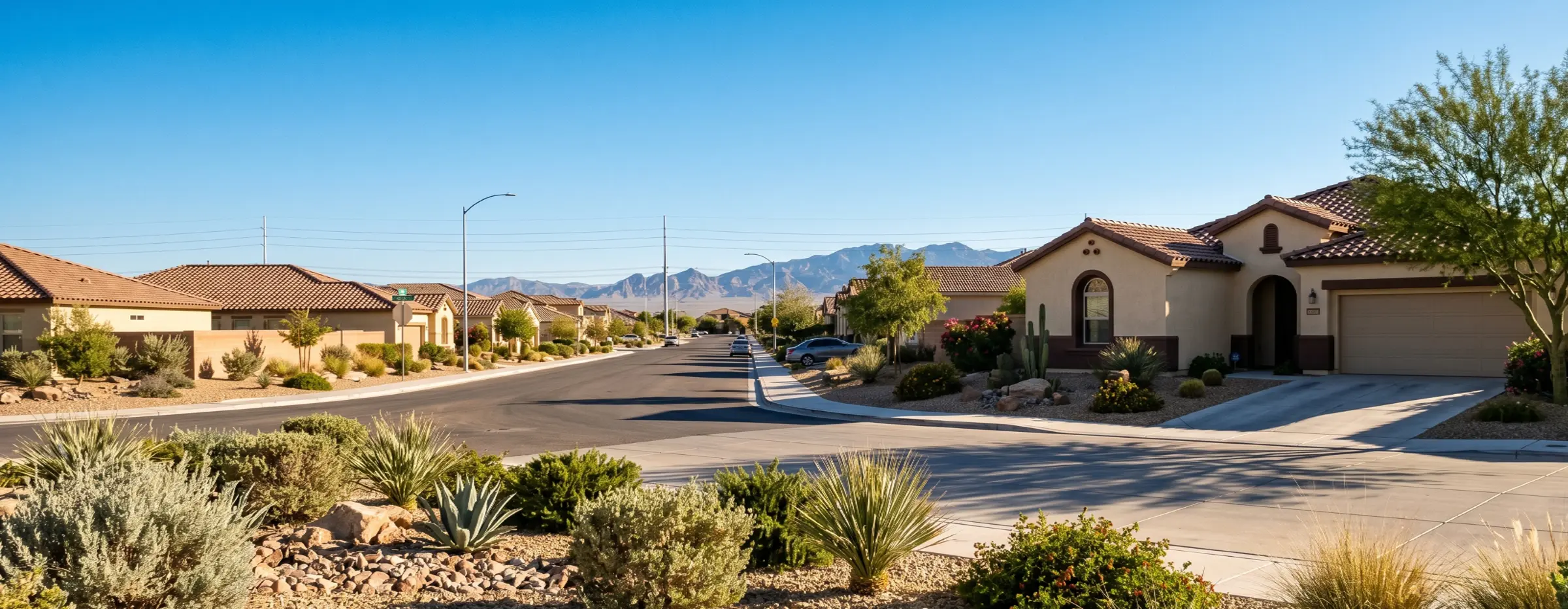

Clark County's municipal water is among the hardest in the nation, which the Las Vegas Valley Water District reports at roughly 278 parts per million, or 16 grains per gallon. That one fact shapes most local mold. It shortens the life of copper supply lines running through slab foundations, scales up HVAC condensate drains until they overflow into wall cavities, and corrodes tank water heaters from the inside faster than in softer-water markets. Moisture in a Las Vegas house comes from its plumbing and cooling systems, and the dry air outside hides the damage until it is well established.
Mold remediation in Las Vegas is the containment, removal, and verification of mold-contaminated material under the ANSI/IICRC S520 standard, and Nevada has no standalone mold license, so the Nevada State Contractors Board (NSCB) regulates only the structural repair work that comes with it. With no state license to lean on, the quality gap between contractors here comes down to the certifications and insurance you verify yourself.
Key insights
- Indoor water, not outdoor air. Slab leaks, HVAC condensate overflow, swamp coolers, and monsoon intrusion cause most Las Vegas mold, and desert heat shortens the window to respond.
- Floor-level mold means a plumber first. In a slab home, baseboard staining is a slab leak signal until a pressure test says otherwise, and cleaning it first brings it back within weeks.
- Hard water makes the pipes the weak point. Copper lines under slabs pinhole early and condensate lines scale shut, so water bills and HVAC startup odors are the first warnings.
- Nevada licenses the repairs, not the mold work. The NSCB licenses drywall, framing, and flooring contractors under NRS 624, so verify IICRC AMRT and Certified Firm status for the mold itself.
- Seller disclosure has teeth. A seller who conveys without disclosing a known defect can owe the buyer treble the repair cost under NRS 113.150.
- Typical cost. Most Las Vegas jobs cost $1,600–$6,200, and slab leak aftermath usually sits in the interior wall range of $2,100–$8,300.
Las Vegas costs by moisture source
Most Las Vegas mold remediation jobs cost $1,600–$6,200, with a mid-range of about $2,500, and the biggest swings come from the moisture source, because slab leaks and HVAC jobs need a second trade before the mold crew starts. A plumber's leak repair or a condensate line flush is billed separately from the mold work, so a bid that lumps the two together is harder to compare against one that itemizes them.
 Las Vegas remediation bids should itemize moisture source correction separately from mold removal; per IICRC S520, any crew that begins work before a slab leak is repaired or a condensate drain is cleared is not following the standard.
Las Vegas-valley construction and extraction pay was about 4 percent above the U.S. average in May 2025, according to the Bureau of Labor Statistics. The mold remediation cost of a valley job also reflects what hard water does to slab plumbing and condensate lines, since a bid usually carries a plumber's leak repair or a drain line flush as a separate trade before the mold crew starts.
| Project scope | Estimates | What drives it here |
|---|---|---|
| Under 10 sq ft | $500–$1,600 | Single wall, closet, or under-sink surface containment |
| 10–100 sq ft | $800–$4,100 | One or two rooms with drywall removal and HEPA work |
| 100–300 sq ft | $2,600–$9,300 | Slab leak aftermath with flooring and subfloor removal |
| 300–1,000 sq ft | $6,200–$20,500 | Multi-room growth with phased containment |
| Over 1,000 sq ft | $15,500–$31,000 | Whole-home work with structural replacement |
Costs are about $10–$26 per square foot, and slab leak and whole-home jobs sit at the top of that band. Slab leak and HVAC jobs carry the highest premiums in the valley because each needs a separate trade to correct the moisture source before remediation billing begins. The room matters as much as the size.
| Location | Estimates | What drives it here |
|---|---|---|
| Bathroom | $500–$2,100 | Exhaust fan failure and leaking shower valves |
| Attic | $1,000–$5,200 | Flat roof ponding and evaporative cooler leaks |
| Garage and slab perimeter | $1,600–$7,200 | Monsoon intrusion under garage doors and through weep holes |
| Interior walls | $2,100–$8,300 | Slab leaks wicking up into lower wall cavities |
| HVAC and ducts | $3,100–$10,500 | Scaled condensate lines and contaminated ductwork |
Lab testing adds $300–$1,000, clearance testing by an independent assessor adds $200–$600, and reconstruction after removal can add $500–$10,500. A standalone inspection with moisture metering and thermal imaging costs $300–$800, and the inspection cost is separate from the remediation scope, so it is worth ordering first when the source of the water is unknown.
Storm-season quotes run higher
Remediators report higher prices and longer waits during and just after the July through September monsoon, when demand spikes across the county. A job that can safely wait until October may price better, though a wet wall should never wait on the calendar.
The plumber comes before the mold crew
IICRC S520 puts moisture source correction ahead of any claim that remediation is complete. On a slab leak, the owner hires a licensed plumber to find and repair the line first, and that repair is billed separately and adds one to three days before the mold crew can begin.
Scale in the drain line is the most common culprit
Remediators serving the valley consistently point to mineral buildup in HVAC condensate lines as the single most common cause of overflow into wall cavities. Flushing the line each April, before the nine-to-eleven-month cooling season starts, is the highest-return prevention step in the county.
First steps when a slab or cooler leaks
Find which system is leaking before anyone prices mold, because the repair order differs: a plumber for a slab, a drain-line flush for an HVAC overflow, a roofer or cooler technician for a rooftop unit. A suspected burst line or active monsoon intrusion belongs with emergency mold removal.
 Floor-level mold at the baseboard-to-wall joint in a slab-foundation home typically indicates a plumbing leak that has been active for weeks; by the time it is visible, mold is usually already established in the wall cavity above.
Las Vegas mold looks different from mold in humid cities, because dry outdoor air dries surface finishes quickly while hidden cavities hold moisture for weeks. The usual early signals show up on a water bill, in a smell when the air conditioner starts, or along a baseboard, and each can be checked in a few minutes without any equipment.
Compare the water bill to last year
A rise of 20%–40% with no change in use is a strong sign of a slab plumbing leak, and it is a reason to book a pressure test before calling a mold inspector.
Sniff the first cooling cycle of spring
A musty or earthy smell when the air conditioner or cooler first starts means growth in the air handler, coil, or ductwork. The odor fades as the system runs because the spore load dilutes, and the fading does not mean the mold is gone.
Check six inches above the floor
In a slab home, moisture rises from below, so the first signs sit at the lowest point: paint separation, dark staining on the baseboard, soft or buckled flooring, and discoloration along the wall-to-floor joint. They often appear far from the actual leak because water follows the path of least resistance through the slab.
Look for a brown stain under the roof unit
A ceiling stain below or beside a rooftop evaporative cooler points to a drain pan overflow or a failed water line. A stain that dries and returns each season, while the cooler runs, confirms an active leak and likely mold in the cavity above.
Press the drywall within two days of a monsoon
Soft or spongy drywall beside a door, window, or foundation edge is saturated and will not dry from the surface. Indoor humidity that stays above 60% for a day without a dehumidifier means mold risk is active, and the CDC names that level as the point where common indoor species can colonize.
Symptoms that ease when you are away, such as nasal congestion, irritation, or a persistent cough, are signs of mold that deserve attention before anything is visible, since many valley owners blame desert dust or dry air and let hidden growth sit for months. A doctor's visit can rule out allergies but does not locate the moisture, so checking the water bill, the cooling system, and the baseboards is the faster way to find the source.
Size is not the only test for a homeowner. Under 10 square feet on tile, glass, or sealed concrete fits the EPA's DIY threshold with an N95 respirator, gloves, and a proper cleaner, while porous drywall, insulation, and framing need professional removal at any size because spores reach below the surface.
 Tile and grout are non-porous surfaces where DIY cleaning is appropriate for patches under 10 square feet; mold at the wall-to-floor joint or on drywall behind tile requires professional assessment.
Floor-level mold in a slab home overrides the size rule entirely, because it nearly always sits downstream of a source that has been active longer than the patch suggests. Three more cases always call for a professional, which are mold you can smell but cannot find, mold at or beside an air handler, duct, or return, and mold that comes back within 90 days of a cleaning. Small, dry, surface-level patches are the only ones suited to DIY mold removal.
Hard water, slabs, and monsoon moisture
Las Vegas mold has five common sources, and hard water makes three of them worse: slab plumbing, HVAC condensate lines, and tank water heaters. Monsoon flooding and swamp coolers make up the other two, and each hides moisture inside a closed cavity. The valley's water is among the hardest in the country, according to the Las Vegas Valley Water District.
 Hard water mineral scale in Clark County condensate drain lines is the leading cause of evaporator coil overflow into wall cavities; IICRC S520 requires the moisture source to be corrected before any remediation begins.
Condensate lines that scale shut
Central air runs nine to eleven months a year, so evaporator coils sit below dew point almost continuously. Mineral deposits clog the drain pan and line, and the overflow soaks wall cavities and subfloor before any stain shows. A musty odor from the supply vents often appears before any visible growth.
Copper under the slab
Most valley homes sit on slab-on-grade foundations with copper or polybutylene supply lines in or under the concrete. Hard water speeds copper corrosion and pinhole leaks. Unlike a basement leak that pools where you can see it, a slab leak migrates up through the concrete into flooring and lower wall cavities, creating sustained wetness in a closed space, and a water bill spike with no obvious source is often the first hint.
Swamp coolers on the roof
Older homes and many rentals still use evaporative coolers, which cool by pulling air through wet pads and add roughly 3–7 pints of moisture an hour to indoor air. Three parts fail: drain pans that clog and hold standing water, pads that grow colonies and push spores into the airstream, and distribution lines that crack or corrode and drip onto the roof deck. Because the units sit on the roof, a leak runs down through the deck, ceiling, and interior wall before any sign appears inside, and one failing pan through a single monsoon season can grow hidden mold in the ceiling framing below.
Monsoon runoff against the foundation
Caliche hardpan soil cannot absorb quick rain, so water pushes against foundations, under garage doors, and through window weep holes into any low point. Dry outdoor air then dries exterior surfaces fast while interior cavities hold moisture for weeks.
Water heaters failing early
Hard water corrodes tank heaters from the inside, cutting their service life to 8–10 years against 12–15 in softer-water markets. A slow leak behind a heater in a closet or garage can soak the wall and flooring for months before staining shows. Washing machine hoses and dishwasher drain lines are secondary sources in slab homes, where a slow drip has nowhere to go but the subfloor, and an unexplained musty smell in a laundry room or garage is worth a moisture meter before anyone assumes the cause.
The August 2022 monsoon showed how much one season can add. The National Weather Service in Las Vegas called it the wettest monsoon season in 10 years, and the flash flooding that month reached the Strip and seeped into casinos and parking garages. Homes that took in water that season and were not professionally dried within 48 hours can still turn up mold in wall cavities during renovations and inspections.
Heat compresses the timeline after any of these events. The same 24-to-48-hour germination window the EPA describes applies, but spore production can start faster in materials soaked at 110°F than in a mild climate, and the same response sequence for mold after water damage applies to slab leaks and monsoon intrusion alike.
Nevada licenses contractors, not mold
Nevada has no mold assessor or remediator license, so any contractor can quote a mold job, while repair work such as drywall, framing, and flooring requires an NSCB license under NRS 624. That creates an open market where credentialed professionals and uncredentialed operators bid on the same jobs, and IICRC certifications carry the same weight here as anywhere else.
 Before signing any remediation contract in Nevada, confirm IICRC AMRT certification and Active Certified Firm status at the IICRC Global Locator, and verify any NSCB license number at nvcontractorsboard.com if the scope includes drywall removal or structural repairs.
Verify three things before signing. First, the lead technician's IICRC AMRT certification and the company's Certified Firm status, both confirmable in the IICRC Global Locator. Second, an active NSCB license for any scope with drywall, flooring, or framing, which you can look up at nvcontractorsboard.com. Third, a certificate of insurance listing general liability, workers' compensation, and pollution liability. Pollution liability is the critical one, because standard general liability commonly excludes microbial contamination and leaves the mold work itself uncovered.
A contractor who can recite credential numbers on the spot is showing a quality signal, and hesitation or a redirect to general experience is a red flag in an unregulated market. A written quote that lists the credential numbers next to the company name lets you verify them at your own pace and keeps the claim on record if the work falls short.
 In Nevada's unregulated mold market, verify IICRC AMRT certification and Active Certified Firm status before a crew arrives; a contractor who cannot provide a credential number on request is not operating under IICRC S520 protocols.
Which IICRC credentials can you show me today?
A credible answer gives a credential number and points you to the locator. A vague reference to industry training with no number is a warning, and so is a crew that cannot say whether its firm status is active.
Does your bid fix the moisture source first?
S520 requires the source to be corrected, so a crew should say a slab leak needs a plumber first and a condensate line needs clearing first. Treating the mold now and leaving the source for later is outside the standard.
Who runs the clearance test?
An independent third party, not the remediation company, collects the air and surface samples, and a crew that tests its own work or never mentions clearance is a red flag.
How do you contain the work zone?
Expect 6-mil poly sheeting, negative air machines, and HEPA filtration. Closing the door and opening a window is not containment.
Which Nevada contractor license covers the repairs?
A current NSCB number you can look up. Saying no license is needed is true for the mold removal itself and false for structural repair, so a crew that claims it covers both is half right at best.
What does your pollution liability certificate list?
A certificate of insurance with pollution liability on it. Relying on general liability to cover everything leaves the mold work itself uninsured.
The most predictable path to recurrence here is treating visible mold while the moisture source stays open. Any contractor who proposes mold treatment before a slab leak is repaired or a condensate drain is cleared is working outside the standard, however good the price sounds. A bid that does not name the moisture source in writing leaves no way to hold the crew to that sequence.
Nevada does not require the company that scopes the job to be a different company from the one that removes the mold. The principle still protects you, because a company that both scopes and removes has a financial interest in a larger scope. On jobs above roughly $5,000, an independent ACAC-certified assessor can scope the work before bids are collected.
How a Las Vegas job runs
Professional remediation in the valley follows the sequence in ANSI/IICRC S520, which runs from moisture source correction through containment, removal, treatment, and drying to independent clearance testing, with documentation at each phase before the next begins. The remediation process varies in depth by moisture source, and the valley's two most common sources reshape the order.
A slab leak job needs a licensed plumber to finish the repair and let the slab begin drying before the mold crew can set up containment, which adds one to three days of plumbing work to the schedule. An HVAC condensate job needs the drain line cleared and the system inspected first, or the source reloads the affected materials within weeks of the crew leaving. After removal and drying to the S520 target of 16% moisture content in wood, an independent inspector collects air and surface samples for clearance, and the lab typically returns results within 1–3 business days.
| Job type | Active work | Total with clearance | Valley factor |
|---|---|---|---|
| Patch under 10 sq ft | 1 day | 2–4 days | Rarely extended |
| Single room | 1–2 days | 3–5 days | HVAC shutdown if the room is adjacent |
| HVAC-involved | 2–4 days | 4–7 days | Duct cleaning or replacement adds time |
| Slab leak | 3–5 days | 6–10 days | Plumber finishes before the mold crew starts |
| Multi-room or whole home | 5–10 days | 7–14 days | Phased containment, and occupants likely displaced |
Who pays for Las Vegas mold
Insurance pays for mold only when the moisture came from a sudden covered peril such as a burst pipe, appliance failure, or storm damage, and the cause of the water decides coverage, not the presence of mold. Most Nevada policies cap mold at a sublimit that can fall well below a slab leak job in the $2,100–$8,300 interior wall range once reconstruction is included.
Gradual HVAC condensate overflow, chronic slab leak mold, swamp cooler damage, and monsoon flooding are the typical exclusions, and flood damage needs a separate NFIP or private flood policy that does not separately reimburse mold. Coverage depends on the cause, the endorsements on the policy, and how flood coverage interacts with it, so confirm what mold insurance coverage your policy carries.
An insurer may call overflow neglect
Slow condensate overflow can be argued as deferred maintenance, and a slab leak that seeped for weeks falls under the gradual-seepage exclusion, so photograph and date everything the day you find it.
After a monsoon, document before cleanup
Photograph affected areas with timestamps, keep damaged materials for the adjuster, and report within 24 hours, because a late report gives the insurer grounds to argue gradual damage.
Valley areas ranked by pipe age
Mold risk in the valley is highest in pre-1980 housing in North Las Vegas, Downtown, and East Las Vegas, where copper and galvanized plumbing is at or past service life in hard water. Risk follows construction era, foundation type, and distance from monsoon flow paths more than zip code.
 Pre-1980 homes in North Las Vegas and Downtown carry the highest mold risk in the valley due to aging copper and galvanized supply lines; Clark County's hard water accelerates corrosion beyond typical service life projections.
Construction era is the strongest single predictor of slab plumbing risk. The 1988-to-2008 boom produced the largest stock of slab homes whose copper lines are now 20–38 years old, close to or past service life in hard water, and post-2010 homes use PEX supply lines that resist corrosion but not monsoon flooding or skipped HVAC maintenance.
| Area | Risk factor | Construction notes | Homeowner alert |
|---|---|---|---|
| North Las Vegas, Carey and Civic Center | Aging slab plumbing from pre-1970s infrastructure | Pre-1960s copper prone to pinholes, some galvanized still present | Watch the water bill monthly, and check for a slab leak before booking a mold inspection |
| Downtown and Arts District | Aging plumbing and flat roof failures | Mixed 1940s–1970s stock with tar-and-gravel flat roofs that pond | Inspect flat roofs before monsoon season and meter the walls on any purchase |
| East Las Vegas, Paradise area | Monsoon pathways and rental maintenance gaps | Dense 1960s–1980s housing with high rental turnover and uneven maintenance records | Inspect any ground-floor or below-grade space after a storm |
| Spring Valley and Enterprise | HVAC condensation in growth-era slabs | 1990s–2000s construction with heavy cooling demand and scaled drain lines | Flush the condensate line each April or May, before peak cooling |
| Summerlin | HVAC condensation and isolated slab leaks | Master-planned 1990s–2010s homes, better maintained but not immune | First-generation homes before 2000 carry slab leak risk, and HVAC upkeep is the main prevention step |
| Henderson and Green Valley | Swamp cooler legacy and HVAC transition | Mixed 1980s–2000s stock, some still on evaporative cooling | Moving to refrigerated air removes the largest ongoing indoor moisture source |
| Strip corridor condos | Cross-unit plumbing failures and dense rental stock | High-rise and mid-rise construction | A shared stack failure can mold the next unit with no visible intrusion |
Pre-1980 homes in North Las Vegas and Downtown add risk from galvanized or early copper lines and original ductwork, which is why homes in these areas often need professional mold remediation when a slab leak or monsoon event goes undried. Ask about plumbing age and storm history before buying.
Molds by moisture source in the valley
Cladosporium is the most common species in valley homes year round, with Aspergillus and Penicillium following any water event and Alternaria following the monsoon, because species here track indoor moisture sources and not outdoor humidity. That is why the species named in a lab report points back to a specific system in the house, whether it is a clogged condensate line, a pinholed slab line, or a door that lets monsoon water in.
 Mold at a sliding door corner in a slab-foundation home typically indicates monsoon water intrusion or a failed door seal rather than ambient humidity; the growth pattern spreading upward from the floor-wall joint confirms moisture is entering from below or through the frame.
Cladosporium follows the cooling season
Scaled condensate lines raise humidity inside air handlers and on coil surfaces until it establishes with no visible moisture event. It turns up on HVAC parts, around window seals with condensation, and under sinks where slow drips go unnoticed, and it needs less water than any other common indoor species, which is why it thrives in a market where moisture problems hide.
Aspergillus and Penicillium ride the ductwork
Air sampling cannot separate the two genera, so labs report a single Asp/Pen result. Both establish fast on wet drywall and insulation and then move into ducts, where they produce viable spores the air system sends to every room. In homes where HVAC runs ten months or more, one condensate overflow that reaches the air handler can seed a colony that circulates for months before growth shows elsewhere. Aspergillus fumigatus, within this group, is a particular concern for people with weakened immune systems.
Stachybotrys follows the longest-hidden leak
It needs sustained, continuous wetness, the kind a copper line leaking for eight to twelve weeks into a closed wall creates, or a monsoon intrusion left undried. Its dark greenish-black, slimy surface and strong musty odor set it apart on sight, though only a lab confirms it.
Alternaria follows the monsoon calendar
It enters during storms through opened windows, door gaps, and any envelope breach, and it peaks in August and September. It is among the leading triggers of mold-related asthma attacks in sensitized people, which matters where owners blame desert dust for symptoms and delay looking by weeks.
A positive Stachybotrys result calls for the stricter containment described under black mold removal. A symptom pattern tied to specific rooms or vents is worth a sample even before anything is visible, and the sample should come from the suspect room and from outdoors as a comparison, since a lab result means little without one.
Renters and condo owners in Las Vegas
Renters in Nevada rely on the habitability standard in NRS 118A.290, which requires landlords to keep units free of conditions that materially affect health, and mold from deferred maintenance or plumbing failure falls inside it. Nevada has no mold statute with set remediation deadlines, so a complaint about mold in your rental depends on being put in writing and escalated to Clark County Code Enforcement if the landlord does not act. Depending on the facts, renters have options such as rent withholding, repair and deduct, or constructive eviction.
 Nevada tenants have habitability rights under NRS 118A.290, but the state has no standalone mold statute with defined timelines; mold from landlord-deferred maintenance or plumbing failures should be documented in writing and reported to Clark County Code Enforcement if the landlord does not act.
Las Vegas has one of the highest concentrations of HOA-governed and condominium communities in the country, from the master-planned neighborhoods of Summerlin and Henderson to Strip-corridor high-rises. Liability is harder to sort out than in a single-family home because the water often starts in a different unit or in common-area plumbing.
Associations are governed by NRS Chapter 116, and under NRS 116.3107 the association has the duty to maintain, repair, and replace common elements such as shared plumbing stacks, the roof, and the exterior envelope unless the declaration provides otherwise, while each owner maintains their own unit. When a stack failure or roof leak molds a unit, who pays turns on whether the source was a common element or a unit component, and that is often disputed.
Start by documenting the source with photographs and a written report from a licensed plumber or inspector before any work begins, because the source decides liability. Ask the association in writing to inspect and repair the common element, and keep a copy of the request. If the association refuses and mold is affecting your unit, you may have grounds to pursue the remediation cost against it, and an independent moisture assessment report helps establish causation before you negotiate. For unit-to-unit leaks, such as a washing machine overflow upstairs, the same statute makes whoever is responsible for the damage liable for its prompt repair, so the owner whose appliance failed and that owner's insurance are the main recovery target.
Buying or selling with mold history
Nevada is a strict disclosure state. Under NRS 113.130, sellers must give buyers a completed disclosure form at least 10 days before conveyance, and mold counts as a material defect because it adversely affects value or use. A buyer who never receives the form can rescind the purchase before conveyance without penalty under NRS 113.150, the first remedy that statute provides.
 Nevada's seller disclosure law requires known mold to be listed on the SRPD form at least 10 days before closing; buyers should not rely on disclosure alone and should request a pre-purchase mold inspection with moisture metering on any home with a history of water damage or prior repairs near plumbing or HVAC.
Sellers answer for what they know
Known mold goes on the form, and a seller who conveys without disclosing a defect the seller knew of owes the buyer treble the repair cost plus court costs and attorney's fees under NRS 113.150. The buyer's action must be brought within one year after discovering the defect or two years after conveyance, whichever is later.
Courts only require actual knowledge
A seller cannot disclose what they genuinely do not know, and the Nevada Supreme Court said so in Nelson v. Heer, a 2007 case where the seller had repaired earlier water damage and was unaware of elevated mold. That gives some sellers a reason to skip a pre-listing inspection, so buyers should not rely on disclosure alone for a home with water damage, insurance claims, or plumbing and HVAC repairs.
Flips after a monsoon can hide damage
Investor activity picks up in the weeks after big storms, and quick cosmetic work can cover intrusion behind new flooring and paint. For homes that changed hands within 8–16 weeks of a major monsoon, ask for moisture remediation records and order moisture readings before closing.
A post-remediation file protects resale
Keep four documents: the written scope naming the source and the correction method, the independent clearance report with lab results, before-and-after photos, and the contractor's certificate of completion. The clearance report is the proof that mold was present, remediated, and cleared, which satisfies the disclosure duty at resale, supports a future claim if mold recurs, and establishes causation in an HOA dispute. Keep them with your property records, not only in email.
Order a CLUE report to see prior insurance claims on the property, and add a pre-purchase mold inspection with moisture metering and thermal imaging for homes in older plumbing areas or those sold soon after a storm. A CLUE report lists earlier water and plumbing claims by date and amount, so a history of repeated water losses is a reason to ask for the repair records before closing.
An April-to-October mold calendar
Keep indoor humidity between 40% and 50% year round and flush the HVAC condensate line every April, because those two habits address the valley's two most common pathways, scaled drains and slow slab leaks. The calendar follows the climate: HVAC work in April, drainage in June, and a post-monsoon check in October before the house is sealed for winter.
 Evaporative cooler pads, drain pans, and water distribution lines should be inspected annually before the cooling season begins; a clogged drain pan running through a single monsoon season can produce hidden mold in the ceiling framing below without any visible interior staining.
| Action | Frequency | Why it matters here |
|---|---|---|
| Flush the condensate drain | Each April, monthly after clogs | Hard water scale blocks the line and overflow feeds wall cavity mold |
| Test slab plumbing with a moisture meter or pressure test | Each spring | Pre-2000 copper in Henderson, Summerlin, and North Las Vegas is past typical service life in hard water |
| Clear drainage paths | Each June | Hardpan soil sends blocked water against the structure |
| Inspect or replace the swamp cooler | Before cooling season | Pads, sumps, and lines leak, and units over 10 years old are candidates for refrigerated air |
| Watch indoor humidity | Year round | Monsoon season and running coolers can push humidity past 60% |
| Change HVAC filters | Every 60–90 days | Restricted airflow chills the coil and raises condensate |
After any monsoon event with visible water near the foundation, garage, or ground-floor windows, measure indoor humidity within 24 hours, meter any concrete, drywall, or wood within three feet of the water path, and run a dehumidifier in the affected space. Book a professional assessment if wood reads above 16% or concrete above 1%, because waiting beyond 48 hours sharply raises the odds of colonization in the wall cavities.
Growth over 10 square feet, any in an HVAC system, or growth that returns after cleaning moves the problem past prevention and into when mold remediation is required territory. At that point the calendar stops helping, and the next step is an assessment that finds the moisture source before anyone prices removal.
Frequently asked questions
Does Las Vegas have a dry enough climate to prevent mold?
No. Las Vegas homes develop mold from indoor moisture sources including HVAC condensation, slab plumbing leaks, swamp cooler humidity, and monsoon flooding. Summer heat accelerates growth once moisture is present, which shortens the window for a homeowner to respond.
How much does mold remediation cost in Las Vegas?
Most Las Vegas jobs cost $1,600–$6,200, and the mid-range is about $2,500. Jobs under 10 square feet cost $500–$1,600, interior wall work costs $2,100–$8,300, HVAC systems cost $3,100–$10,500, and jobs over 1,000 square feet cost $15,500–$31,000. These are estimates based on national pricing adjusted for Las Vegas labor costs.
Does Nevada require mold remediation contractors to be licensed?
No. Nevada has no standalone mold remediation license. A contractor doing structural repairs as part of the job needs a Nevada State Contractors Board license under NRS 624, but mold assessment and removal are unregulated at the state level, so IICRC AMRT certification and Certified Firm status are the main quality benchmarks. Verify credential numbers and pollution liability insurance before signing, which is the heart of how to choose a mold remediation company.
How do I verify a Las Vegas mold contractor's credentials?
Check the IICRC Global Locator for AMRT certification and Certified Firm status. Verify any contractor license with the Nevada State Contractors Board, and request a certificate of insurance showing general liability, workers' compensation, and pollution liability coverage.
Do I have to disclose mold when selling a home in Las Vegas?
Yes. Under NRS 113.130, sellers must provide the disclosure form at least 10 days before conveyance, and mold counts as a material defect. A seller who conveys without disclosing a defect the seller knew of can owe treble the repair cost plus court costs and attorney's fees under NRS 113.150, so disclosing mold in writing protects the seller.
What causes mold in Las Vegas homes?
Four sources lead: HVAC condensation from a long cooling season, slab plumbing leaks that migrate through concrete without pooling, swamp cooler moisture added to indoor air, and monsoon flash flooding from July through September.
Which Las Vegas neighborhoods have the highest mold risk?
North Las Vegas, Downtown, and East Las Vegas carry the highest risk because of aging plumbing in pre-1980 housing. Summerlin and Henderson see lower rates but still get HVAC condensation and monsoon events, and Spring Valley and Enterprise sit in the middle.
What mold species are most common in Las Vegas?
Cladosporium is the most common year-round species, Aspergillus and Penicillium establish quickly after water events and circulate through ductwork, Stachybotrys appears after sustained moisture from slab leaks or flooding, and Alternaria spikes in monsoon season. A lab result from mold testing confirms which one a sample holds.
Should I stay home during mold remediation in Las Vegas?
For most small contained jobs, yes. For HVAC-involved jobs, multi-room contamination, demolition, or households with asthma, allergies, or weakened immunity, no, and temporary relocation until clearance testing is complete is the recommended approach.
Does homeowners insurance cover mold remediation in Las Vegas?
Only when the cause is a sudden covered peril such as a burst pipe, and then up to a mold sublimit set in the policy, because gradual condensate overflow, slab leaks, and monsoon flooding are generally excluded. NFIP flood insurance does not separately reimburse mold remediation.
How long does mold remediation take in Las Vegas?
Small contained jobs take 1–3 days, one-to-two-room jobs take 3–5 days, and HVAC-involved or whole-home jobs take 5–10 days or longer, especially when slab leak repair must come first. Clearance testing adds 1–3 business days for lab turnaround.
What should I ask a Las Vegas mold contractor before signing?
Ask for the IICRC AMRT credential number and Certified Firm verification, confirm pollution liability insurance, ask how moisture source correction is documented, and confirm that clearance testing will be done by an independent third party. A contractor who cannot answer these specifically is not following S520.
- IICRC S520 Standard for Professional Mold Remediation
- EPA: Mold Cleanup in Your Home
- CDC: Basic Facts About Mold
- Nelson v. Heer (Nevada Supreme Court, 2007)
- IICRC Global Locator
- NRS 113.130 and 113.150: Nevada Seller Disclosure
- NRS 116.3107: Upkeep of Common-Interest Community
- Las Vegas Valley Water District: Water Quality
- NWS Las Vegas via KTNV: Wettest monsoon season in 10 years
- BLS: Occupational Employment and Wages in Las Vegas, May 2025
Sam Hickerson is the founder of RestoreAdvisor and writes consumer guides on mold remediation, water damage restoration, inspection, testing, and home recovery. His work focuses on helping homeowners understand costs, risks, and when to call a professional. He draws on guidance from the EPA, CDC, IICRC, and other authoritative sources to make complex home issues easier to navigate.