
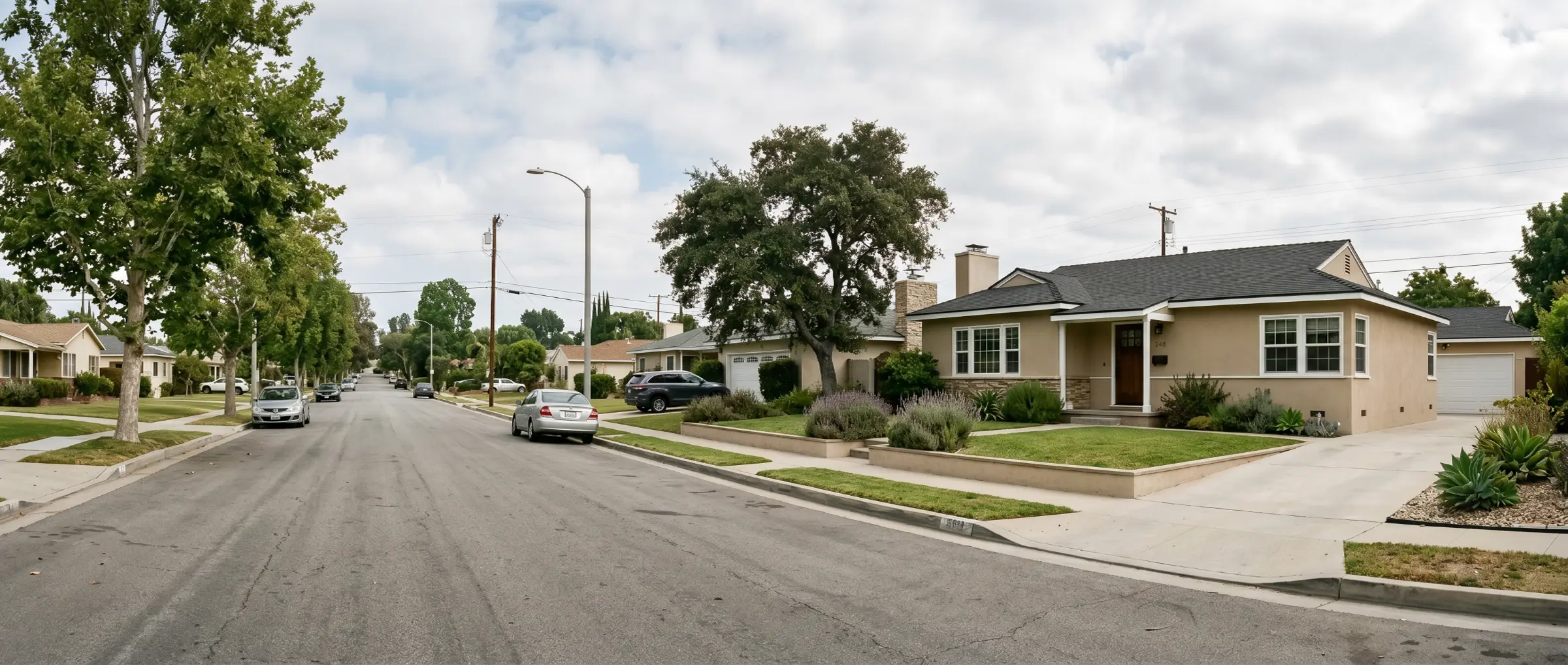

Mold in Los Angeles seldom turns up where the water starts. A corroding copper pipe sealed inside a concrete slab, coastal fog condensing inside a stucco wall, a sprinkler head soaking a foundation plate through the dry season, and a hairline earthquake crack that admits the first storm of winter all work out of sight. By the time a Los Angeles homeowner sees a patch of growth, the source has usually been active for months, the damp area is larger than the stain, and the job has moved past anything a spray bottle can fix.
Mold remediation in Los Angeles is the assessment, containment, removal, treatment, and verification of fungal contamination under the ANSI/IICRC S520 standard, and California licenses no mold remediators, so the Contractors State License Board (CSLB) covers only the structural work that comes with it while IICRC credentials do the screening for the mold work itself. The California Department of Public Health (CDPH) points to national certification bodies, including the IICRC, as the professional benchmark.
Key insights
- No mold license exists. California licenses structural contractors through the CSLB but offers no mold-specific license, so IICRC AMRT certification and pollution liability insurance are the practical screens for the mold work itself.
- Five local moisture routes. Aging slab plumbing, coastal fog, winter storms on flat roofs, hillside irrigation against stucco, and earthquake cracks account for most Los Angeles mold, and each works out of sight.
- Slab leaks usually come first. Copper or galvanized lines routed through the slab in homes built from 1950 to 1990 can leak for months and soak bottom-plate framing long before any stain appears.
- Disclosure is mandatory. Civil Code Section 1102.6 requires sellers to list known mold on the Transfer Disclosure Statement, and the Toxic Mold Protection Act requires landlords to disclose known mold to tenants.
- 2025 fires left wet walls. Firefighting water soaked buildings near the Palisades and Eaton burn zones, and homes that were never professionally dried can hold concealed mold behind walls and under floors.
- Typical cost. Most Los Angeles jobs cost $1,800–$7,100, with a mid-range near $2,800. Slab-leak coordination, HVAC involvement, and multi-room contamination push a project well above the typical range.
Hidden moisture behind LA stucco
Los Angeles averages only about 15 inches of rain a year, yet mold work continues in every month, because the moisture sources that matter here sit inside the building rather than outside it. Six of them account for nearly every job, and each one runs independently of the weather, which is why so many owners are caught off guard.
 A plumber locating a pinhole leak in a corroded copper supply line beneath a jackhammered Los Angeles slab, the most common hidden mold source in homes built before 1990.
Corroding copper beneath the slab
Most homes built from 1950 to 1990 carry copper or galvanized supply and waste lines routed directly through the concrete. As those pipes age, pinhole leaks open from mineral corrosion, and the water travels into the sand base, climbs through micro-cracks in the slab, and soaks bottom-plate framing and subfloor for months. The first signal is often a warm spot on a tile floor or a jump in the water bill, and by the time moisture reaches a baseboard, mold after water damage has typically taken hold behind the drywall.
Fog condensing inside coastal stucco
Within roughly 5–10 miles of the Pacific, the marine layer holds morning relative humidity at 80%–90% for days at a time, even in the dry season. Venice, Santa Monica, Culver City, and Playa del Rey see it most. Moisture-laden air meets cooler wall surfaces at window and door flashing, condenses inside the assembly, and stays there. California's permissible mold exposure limits were never formally set, even though the Toxic Mold Protection Act of 2001 directed the state to set them, so coastal owners have no regulatory number to point to.
Winter storms on flat and low-slope roofs
Most of the city's rainfall arrives in a handful of intense atmospheric river storms. Flat roofs, low-slope membranes, and parapet walls are built with little drainage capacity, and a single 4-inch storm can overwhelm a marginal scupper or roof drain. Water then enters wall cavities through stucco cracks, failed flashing, and parapet joints and stays out of view until signs of mold appear on an interior ceiling.
Sprinklers aimed at hillside stucco
Lawns and planting beds in hillside and coastal neighborhoods get watered heavily on weekly schedules all dry season. Overspray that hits the wall, or runoff that drains back toward the foundation, soaks the bottom plate and wall framing slowly and steadily, which is the pace that lets mold settle deep inside an assembly. Stucco makes it worse because it absorbs and holds water while the exterior face looks dry.
Earthquake cracks that admit rain
Even a minor quake that leaves no structural damage can crack stucco at window and door openings, pull roof flashing away from its base, and stress slab plumbing at joints and elbows. Los Angeles feels dozens of earthquakes a year, and each one is a possible new entry point that may not show until staining appears months later. After any felt quake, stucco penetrations, parapet flashing, and roof membrane edges deserve a look, especially in homes built before 1980.
Firefighting water in the 2025 burn areas
The January 2025 Palisades Fire burned 23,448 acres, and the Eaton Fire destroyed structures across Altadena and Pasadena. Homes next to the burn zones that survived were saturated by suppression water, and mold can start on wet building materials within 24–48 hours. Many of those buildings were not professionally dried before residents returned, so surviving homes in Pacific Palisades, Brentwood, and Altadena need an assessment for concealed growth when no drying records exist.
Cost by scope in Los Angeles
Most Los Angeles mold remediation jobs cost $1,800–$7,100, with a mid-range of about $2,800, and the price rises once a slab leak, an HVAC system, or several rooms are involved. January through March storm weeks fill contractor calendars, and post-fire demand has stretched them further in the burn-adjacent neighborhoods.
Construction and extraction workers in the Los Angeles-Long Beach-Anaheim metro earned about 118 percent of the U.S. average pay in May 2025, according to the Bureau of Labor Statistics. A Los Angeles mold remediation cost also reflects the plumber who must repair a slab leak first, parking and elevator limits at condominium jobs, and containment on hillside lots where crews carry equipment up steep stairs.
 A jackhammered slab trench in a Los Angeles living room exposing a corroded copper pipe. Slab-leak jobs often land in the interior wall range of $2,400–$9,400, before the separate plumbing repair.
Square footage sets the base price, and access sets how far the final bid drifts from it. Hillside crawl spaces, condominium units reached by elevator, and slab-on-grade homes where the water source sits under the floor all add time and equipment that flat-rate quotes tend to undercount, so the access conditions belong in the written scope.
| Project size | Estimates | Case | Los Angeles notes |
|---|---|---|---|
| Under 10 sq ft | $600–$1,800 | Bathroom grout, one ceiling spot | No material replacement |
| 10–100 sq ft | $900–$4,700 | Single room, porous materials | Drywall and insulation come out |
| 100–300 sq ft | $2,900–$10,500 | Several rooms, slab-leak spread | Wall cavities often wetter than they look |
| 300–1,000 sq ft | $7,100–$23,500 | Hillside crawl space, roof-leak attic | Access and containment add labor |
| Over 1,000 sq ft | $17,500–$35,500 | Whole home, HVAC spread, post-fire moisture | Multi-assembly scope |
Pricing runs about $12–$29 per square foot, so dividing a lump-sum bid by the affected area shows whether it is in range. Where the growth sits changes the figure as much as how much of it there is, because an attic with a flat roof deck to remove, a crawl space reached down a steep hillside, and a bathroom in a condominium each carry different access costs.
| Location | Estimates | Cost driver |
|---|---|---|
| Bathroom | $600–$2,400 | Ventilation gaps, plus condo access premiums |
| Attic | $1,200–$5,900 | Flat roofs that need deck removal |
| Interior walls | $2,400–$9,400 | Slab-leak wicking and stucco reentry work |
| Crawl space | $2,400–$12,000 | Steep hillside access adds 20%–30% |
| HVAC and ducts | $3,500–$12,000 | Ten to eleven months of operation concentrates condensate |
Lab testing adds $400–$1,200, clearance testing by an independent hygienist adds $200–$700, and most insurance carriers require the clearance report. Reconstruction after removal can add $600–$12,000, and a standalone inspection runs $400–$900 in the Los Angeles area, so the inspection cost sits outside the remediation bid. Slab-leak jobs need a licensed plumber to stop the source before any removal starts, and most remediation firms will not begin until the plumber confirms the repair and soil drying is under way. Budget the plumbing separately, because fixing the moisture source comes before any cleanup.
First steps once mold shows
Start by working out where the water is coming from, because in a Los Angeles house the visible mold and the moisture source are often far apart. Mold on a baseboard can trace to a leak under the slab, mold on a ceiling can trace to a cracked parapet six feet away and eight feet up, and mold inside a wall can trace to a sprinkler head fifteen feet from the house. Cleaning the visible patch without finding the source brings it back within weeks, and the EPA lists fixing the moisture source as the first step of any cleanup.
Floor-level mold: call a plumber first
Staining at the baseboard of a slab home, a warm tile spot, or an unexplained rise of 20%–40% in the monthly water bill points to a supply-line leak. A plumber's pressure test or acoustic leak detection should come before any mold quote.
Ceiling stains after a storm: get the roof checked
Brown staining that appears within 48–72 hours of a winter storm points to the roof, parapet, or stucco, and a roofer should find the entry point before anyone opens the ceiling.
Wet walls after the fires: book moisture mapping
Walls and floors that took suppression water in January 2025 should be mapped for moisture by a professional, because growth can sit behind finished surfaces long after the home looks dry.
Active water that is still spreading, from a burst line or a fresh roof failure, calls for emergency mold removal, where extraction and drying run together before growth can establish. Photograph every affected surface with the date visible, shut off the water if a supply line is the source, and keep wet materials in place until an inspector has seen them.
Staying home is reasonable for a bathroom surface job when the rest of the house stays out of the work zone. Three situations almost always call for moving out. Slab-leak jobs involve a week or more of structural drying before remediation even starts, post-fire jobs in Pacific Palisades, Altadena, or Brentwood may involve suppression water in several assemblies at once, and any job that touches the HVAC system sends spores through every room while work is underway. In all three the real scope is larger than the visible surface, and living in the house raises both exposure and the chance of spreading growth to clean areas.
A job turns professional once the damp area passes about 10 square feet, once porous materials such as drywall or insulation are involved, or once the HVAC system is touched. Knowing where that line falls before calling anyone helps you judge whether the quote you receive is proportionate.
California licenses no mold work
California issues no standalone mold remediation license, which changes how a homeowner screens contractors. Where a state license screens for competence, the buyer here has to run the checks personally, and an unqualified operator can work freely in the gap, because anyone can advertise mold removal and no state agency reviews mold training, equipment, or insurance before the first job.
The Contractors State License Board (CSLB) requires an appropriate classification, typically a Class B General Building license or a relevant specialty license, for structural work done as part of remediation. Surface-level removal with no demolition does not legally require a CSLB license, though insurers almost always want one. The California Department of Public Health points to national bodies, including the IICRC and NORMI, for mold-specific credentials.
Three checks, run independently, replace the state license. The first is an active CSLB license at cslb.ca.gov, the second is IICRC AMRT or Certified Firm status through the IICRC Global Locator, and the third is a certificate of insurance that lists pollution liability as its own coverage line. Contracts should cite the IICRC S520 standard or CDPH guidelines. California also has no statutory requirement for post-remediation clearance testing, so independent third-party verification happens only when the homeowner demands it in the contract.
Vetting a Los Angeles contractor
Vet a Los Angeles contractor in three stages: confirm credentials before requesting bids, compare answers while reviewing them, and read the scope before signing. No state license sets a floor here and demand surges after storms and fires, so choosing a firm for professional mold remediation depends on those checks.
 Verifying a contractor's CSLB license and IICRC credentials before they arrive is the primary protection for LA homeowners in a state with no standalone mold remediation license.
Before you request bids
Pull the contractor's record through the CSLB license search and confirm the license is active, in good standing, and in a classification that fits the scope. Then look the company up in the IICRC Global Locator for AMRT-certified technicians or Certified Firm status. A firm that cannot give you a license number on the spot has answered the first question.
While you compare bids
Six questions separate prepared contractors from the rest, and the credible answers matter more than the totals.
| Ask the company | Credible answer |
|---|---|
| Which CSLB license number covers this job? | Gives the number immediately, and it checks out at cslb.ca.gov |
| Does any technician hold IICRC AMRT certification? | Names a certified technician or points to Certified Firm status |
| Does your insurance include pollution liability? | Yes, with a certificate that shows it as a separate line |
| Who runs the clearance testing? | A separate hygienist or environmental firm, never the remediation company |
| Will the scope cite IICRC S520 or CDPH guidelines? | Yes, and the contractor can explain what that means in practice |
| Have you handled slab-leak mold before? | Describes plumber coordination and says work waits until the source is repaired |
Before you sign
Read the scope line by line. It should name containment methods, removal criteria, and the clearance protocol, because a contract that says only "mold removal" leaves every decision to the contractor. Free "mold testing" bundled into a remediation bid is a conflict of interest, since assessment and remediation are separated in good practice. Post-fire surge pricing with a vague scope, a verbal claim that the mold is gone after a visual check, and any bid that omits independent clearance are each reasons to walk. Comparing at least two written bids against the steps in how to choose a mold remediation company makes those gaps visible.
How a job runs, start to clearance
A Los Angeles job moves from assessment to containment, removal, drying, and clearance, and a slab leak or post-fire scope adds waiting time before any of it starts. Assessment comes first because the moisture reading decides whether the plumber, the roofer, or the remediation crew goes in first, and no phase starts until the one before it is documented.
The crew builds containment with plastic sheeting and negative air, removes affected drywall and insulation, treats the framing, and dries the structure before clearance samples are taken. A single-room surface job takes 1–3 days. A multi-room project runs 3–7 days of active work plus 1–3 days for clearance testing and lab results. Slab-leak jobs wait on the plumber, which adds 5–10 days before remediation can begin. Drying is the phase homeowners most often rush, and a job is not finished until moisture readings return to normal ranges for the materials involved. Each phase follows the standard sequence, and because California does not require clearance testing, the contract should name who performs it and what result closes the job.
Signs of mold and DIY limits
Mold in a Los Angeles house hides at floor level or inside walls far more often than it grows on an open surface. Slab leaks, fog condensation, and storm intrusion all deliver water behind finished surfaces, so the early evidence is indirect. Five signs show up most often, and each one connects to a single moisture route, which makes the sign itself a clue to who should be called first.
 A moisture meter reading of 24.8% at a baseboard in a Los Angeles home, above the IICRC S520 warning threshold of 19% and approaching the 28% structural damage level.
A water bill that climbs without a reason
A pinhole leak in a copper line under the slab can run for months without surfacing, and a 20%–40% rise in monthly water use with no change in habits justifies a plumber's pressure test before a mold inspection. Warm spots on tile, buckled hardwood or laminate near bathroom fixtures, and soft baseboards usually travel with it.
White chalky crust at slab level
White crystalline efflorescence where the baseboard meets the slab means water is moving up through the concrete toward the framing. In a Los Angeles slab home that almost always means a plumbing leak rather than a drainage problem.
Hollow or soft stucco near windows
Stucco that sounds hollow or yields to pressure around window and door frames has trapped moisture inside the assembly. Dark green or gray staining on the lowest 12–24 inches of an exterior wall, below a planting bed or lawn edge, is the outside face of the same problem, and it is usually mistaken for dirt.
Ceiling stains after atmospheric river storms
Brown staining that shows up within 48–72 hours of a storm needs an assessment promptly, since it marks a roof, parapet, or flashing failure feeding the cavity above.
A musty smell when the air conditioning starts
A musty odor at spring startup means growth in the air handler or ductwork, which sends spores through every room each time the system runs. Symptoms that ease when you leave the house are worth acting on early, because mold exposure symptoms often appear weeks before anything is visible.
A walk around the exterior after any felt earthquake takes under 30 minutes. New hairline cracks at stucco window and door corners are moisture entries that did not exist before the quake, and finding them before the next storm keeps them from becoming interior mold, while a dated photograph of each crack gives an insurer or a plumber a baseline if staining appears later.
DIY cleanup suits surface growth on non-porous materials under 10 square feet, once the moisture source is fixed and nobody in the household has asthma, allergies, or a weakened immune system. The EPA threshold applies in Los Angeles as it does everywhere, but the source problem makes the decision harder, and the steps for DIY mold removal spell out the supplies and containment a legitimate small job still needs.
 Professional mold remediation requires HEPA air scrubbing and containment barriers, equipment and protocols that define the threshold between a legitimate DIY job and work that requires a licensed contractor.
| Scenario | DIY appropriate? | Reason |
|---|---|---|
| Bathroom grout or caulk, under 10 sq ft, no wall cavity involved | Yes, with protective gear | Surface growth on a non-porous material, with ventilation as the source |
| Ceiling spot after a storm, roof now repaired | Possibly, if under 10 sq ft and the drywall is firm | Confirm the drywall has not delaminated before treating the surface |
| Baseboard discoloration in a slab home | No | A slab leak is the likely source and needs a plumber first |
| Any mold in a home near the 2025 fire zone | No | Suppression water soaks several assemblies, and the scope is rarely visible |
| HVAC or ductwork involvement | No | Contaminated air distribution calls for NADCA-standard cleaning |
| Mold after earthquake-cracked stucco | No | The source may be ongoing, and the scope grows once the wall is opened |
| A household member with respiratory illness | No | Disturbing mold warrants professional containment |
Where HO-3 mold coverage stops
California HO-3 policies cover mold only when a covered peril caused it, and the practical coverage in Los Angeles is narrower than the policy wording suggests. Knowing the gaps before filing prevents the common mistakes that void a claim, and the main ones are the cause of the water, the policy sublimit, and the paperwork the carrier wants.
Coverage applies when mold follows a sudden and accidental water event, such as a pipe burst or an appliance failure. The exclusions that catch Los Angeles owners most often are gradual slab leaks, which insurers treat as maintenance failures, fog condensation damage, flood-related mold from atmospheric river storms, which needs separate NFIP or private flood coverage, and, in some policies, firefighting water when the fire was not on the insured property.
Most California policies cap mold coverage at a sublimit set in the policy, and a slab-leak-driven multi-room project usually exceeds it. The carrier decides which water event started the damage, so the dates in the plumber's report and the photographs matter as much as the dollar limit, and a claim filed without them tends to be treated as gradual damage.
Insurers also care about paperwork. Most carriers want a licensed contractor on the job, a written scope, and an independent clearance report before they close a mold claim, so the documentation habits described for hiring double as claim protection. Photographs with visible dates, moisture readings, and the plumber's findings tie the mold to a specific event instead of a long-running condition.
A slab leak adds its own complication, because most policies pay for the water damage from a sudden slab leak and not for the pipe repair, and mold from an undetected gradual leak is usually excluded as neglect. If you find mold tied to a slab leak, record the discovery date and get a plumber's report showing the leak was not known earlier before you call the insurer. NFIP flood claims and the claims process also shape how much mold insurance coverage pays in practice.
Molds common in Los Angeles
Three groups turn up most often in Los Angeles homes: Cladosporium, which dominates coastal and HVAC settings through the year; Aspergillus and Penicillium, which establish in water-damaged materials from slab leaks and storm intrusion; and Stachybotrys chartarum, which appears after sustained wetness. The moisture source, more than the outdoor climate, decides which one a home has.
 Air sampling cassettes sent to an accredited lab identify the specific mold species present in a Los Angeles home, the result determines whether Cladosporium surface cleaning, Asp/Pen containment protocols, or Stachybotrys full remediation is required.
Cladosporium is present across all neighborhoods. It grows on painted surfaces, window sills, and HVAC components in the low-level humidity that marine air and condensation create. It is a common allergen but lower risk for healthy adults, and mold testing by air sampling is often what separates a routine Cladosporium result from a more serious Asp/Pen or Stachybotrys finding. Fog keeps coastal neighborhoods above the 55% relative humidity that sustains it, even in dry months.
Aspergillus and Penicillium appear on an air sampling report as a single Asp/Pen result and favor wet drywall and insulation in slab-leak homes. They grow quickly on cellulose once moisture content passes 19%, and some Aspergillus strains produce mycotoxins with documented health effects, so people with respiratory conditions should stay out of confirmed Asp/Pen areas until remediation ends.
Stachybotrys chartarum, often called black mold, needs 72 hours or more of continuous moisture and a cellulose surface. Slab leaks that run for months meet that condition easily, as do roof intrusions after repeated storms and the suppression-soaked walls of the 2025 fire areas. A confirmed result calls for the stricter protocols in black mold removal and independent clearance afterward.
Where Los Angeles mold concentrates
Risk in Los Angeles clusters into three zones: coastal communities from Venice to Malibu where fog humidity never lifts, hillside neighborhoods from the Hollywood Hills to Silver Lake where drainage and groundwater are structural problems, and inland mid-century districts such as Hancock Park and Mid-Wilshire where original slab plumbing carries persistent leak risk. Pacific Palisades and Altadena carry the added burden of 2025 suppression moisture.
 Los Angeles mold risk concentrates in three zones: flat mid-century neighborhoods with aging slab plumbing, hillside properties with drainage and groundwater problems, and coastal communities under year-round marine layer humidity.
Risk varies inside each zone, since a 1960s slab home in Hancock Park faces different odds than a 1990s renovated bungalow on the same block. The useful question is which driver applies to your construction era and foundation, and the neighborhoods that follow are a starting point for matching a street to a likely cause.
| Area | Risk factor | Construction era | Homeowner notes |
|---|---|---|---|
| Venice, Santa Monica, Culver City | Year-round fog humidity | 1920s–1960s bungalows; 1990s–2000s infill condos | Morning humidity can reach 85%–90% in summer, window flashing fails most often, and HVAC runs all year |
| Hollywood Hills, Laurel Canyon | Hillside drainage and groundwater | 1950s–1970s mid-century builds on custom foundations | Steep lots push groundwater toward foundations, crawl spaces are often unsealed, and an annual post-storm inspection pays off |
| Silver Lake, Echo Park, Los Feliz | Pre-1950 wood frame on hillsides | Pre-1940 craftsman and Spanish Colonial | Original galvanized or early copper plumbing, and canyon microclimates hold moisture longer than flat districts |
| Hancock Park, Mid-Wilshire, Koreatown | Slab plumbing from the 1950s–1970s | 1940s–1970s postwar homes on original copper slab lines | An unexplained water bill is the main clue, and these districts generate many slab-leak mold calls |
| San Fernando Valley | Flat roofs and atmospheric river exposure | 1950s–1980s tract homes | Clogged scuppers let storm water into parapet walls, and summer heat speeds growth |
| Palisades, Brentwood | Post-fire suppression moisture | 1950s–1980s ranch and contemporary homes | Verify drying records before buying or moving in |
| Long Beach, Compton, South LA | Aging multi-unit stock | 1920s–1960s apartments and fourplexes | Decades of deferred plumbing work, and SB 655 makes visible mold a code-enforceable condition |
Los Angeles renters and landlords
Los Angeles renters are entitled to a unit free of mold that affects health under California Civil Code Section 1941.1. They may repair and deduct after written notice under Section 1942, and they can ask the Los Angeles Housing Department (LAHD) to compel a landlord under Health and Safety Code Section 17920.3.
 Los Angeles's dingbat apartment stock, built primarily between 1955 and 1975, concentrates mold risk through aging plumbing, minimal ventilation, and shared wall assemblies where one unit's leak becomes a neighbor's mold problem. California SB 655 makes visible mold in these buildings a code-enforceable substandard housing condition.
The dingbat apartment stock built from 1955 to 1975 concentrates the problem through aging plumbing, minimal ventilation, and shared wall assemblies where one unit's leak becomes the neighbor's mold. When mold appears in a rental, a mold inspection by an independent hygienist gives both sides the documentation to settle scope and liability.
Section 1941.1 defines a habitable dwelling as one free of dampness and visible mold that threatens health. Mold that meets that standard is a legal defect the landlord must correct, and Section 1942 lets a tenant repair and deduct the cost from rent once the landlord has had written notice and a reasonable time to act.
SB 655, effective January 1, 2016, added visible mold to the list of substandard housing conditions under Section 17920.3, so code enforcement can act without a tenant filing suit. A complaint to LAHD triggers an official inspection and a remediation order. The same law added Civil Code Section 1941.7, which says a landlord is not obligated to repair a mold-related defect until the landlord has notice of it, so dated written notice starts the clock.
The Toxic Mold Protection Act of 2001 requires written disclosure before a lease is signed when the landlord knows or has reasonable cause to believe mold is present at a level that threatens health. Leasing a unit with known mold and no written disclosure creates civil liability, and a tenant who never received the disclosure can cite that failure in a complaint to LAHD or in court.
A tenant facing a landlord who will not act should photograph the mold with dates, send written notice by certified mail, and contact LAHD code enforcement or the Los Angeles City Attorney's office. If formal notice still fails, tenant mold rights include repair-and-deduct, rent withholding, and constructive eviction.
Condos and HOAs across Los Angeles
Condominium owners in Los Angeles share walls, risers, and roofs with neighbors, so a leak in one unit often becomes mold in another. Under California Civil Code Section 4775, the association repairs, replaces, and maintains the common area and each owner maintains their own separate interest unless the declaration says otherwise, which makes the source of the water the first question in any dispute. Time matters in a condominium because moisture that travels between units can reach a neighbor's wall within days, so the first call should go to the building manager the same day the water is found.
Photograph the damage, get a plumber's or inspector's written finding on where the water started, and send the association a written request to inspect and repair the common element before work begins. A shared riser, a roof membrane, or an exterior wall belongs to the association in most declarations, while a failed washing machine hose or water heater inside the unit belongs to the owner, and the master policy and the owner's HO-6 policy each respond differently, so read both for the mold sublimit before assuming either one pays.
Buying or selling after mold
Los Angeles sellers must disclose known mold on the California Transfer Disclosure Statement under Civil Code Section 1102.6, and no minimum patch size exempts a small spot. Leaving known mold off the form creates civil liability whether or not the growth was visible at the time of sale.
 California Civil Code Section 1102.6 requires sellers to disclose known mold on the Transfer Disclosure Statement with no minimum size threshold, a legal obligation that applies to every residential sale in Los Angeles regardless of remediation history.
What the Toxic Mold Protection Act left open
Health and Safety Code Sections 26100–26156 direct CDPH to set permissible exposure limits and remediation guidelines, and as of 2026 no limits have been formally adopted under the Toxic Mold Protection Act. Sellers can reduce lingering disclosure risk by remediating to CDPH guidelines and documenting the result with a clearance report from an independent industrial hygienist.
What buyers near the burn zones should request
Buyers considering homes next to the Palisades or Eaton fire areas, including Pacific Palisades, Brentwood, Altadena, and Pasadena, should ask for records of professional drying and mold clearance before closing. Short-ownership flips may come with limited knowledge of prior conditions.
Pre-purchase work for slab-era houses
For any pre-1990 home with original slab plumbing, an independent inspection that includes moisture mapping and a slab moisture assessment before closing is plain risk management. Anyone who proceeds without records should budget for a remediation scope and screen contractors before engaging one. Anyone on the selling side should confirm what the Transfer Disclosure Statement asks about mold before listing.
An LA mold prevention routine
Five upkeep tasks cover most mold prevention in Los Angeles, and each targets a local moisture route instead of the generic humidity advice written for rainier climates. The tasks follow the calendar, with roof and drain work before the November rains, humidity checks through the foggy months, and a plumber's visit that can happen in any season.
 Clearing gutters and downspouts each November before the first atmospheric river storm is the single most effective pre-rain-season mold prevention action for Los Angeles homeowners with pitched or low-slope roofs.
Have a plumber assess slab lines every one to two years
Any home built from 1950 to 1990 should get a licensed plumber's check of supply-line condition, using acoustic leak detection or tracer gas to find pinholes before they reach the bottom plate. A sustained rise of 10%–15% in water use over a steady baseline is a dependable early warning.
Inspect flat and low-slope roofs each November
Clear scuppers and roof drains before the rain season, then check parapet flashing and stucco openings at windows and doors. After each major storm, look for bulging or soft stucco below window frames, and treat brown ceiling staining within 72 hours as a sign of a leaking roof rather than condensation.
Hold indoor humidity at 45%–55% near the coast
Place a hygrometer at mid-wall height in the main living area in Venice, Santa Monica, and other fog-affected neighborhoods. During long marine layer spells, run the HVAC on fan mode to circulate air, and clean condensate drain lines every six months, since near-continuous operation clogs pans and secondary lines that can overflow into ceilings within hours.
Keep sprinklers off stucco
Aim heads away from walls and runoff paths away from the foundation, and move planting beds within 3 feet of the house to drip irrigation. Reset timers each spring and fall, because summer schedules over-water once evaporation slows.
Walk the exterior after any felt earthquake
Check stucco at window and door penetrations for hairline cracks, look at flashing edges at parapets and chimneys for separation, and listen for any change in water pressure that could mean a stressed slab pipe. The walk takes under 30 minutes.
Homes in Pacific Palisades, Brentwood, Altadena, or a neighboring area that received suppression water in January 2025 deserve one more step. Without moisture mapping on file, commission one, because even a home that looks undamaged can hold elevated moisture in wall cavities and crawl spaces. Moisture mapping records also give an insurer, a buyer, or a remediation crew a baseline, so a copy belongs with the property file.
Timing matters as much as the tasks. January through March is peak discovery season, when storms expose envelope failures that stayed hidden in the dry months, and contractor schedules are longest. November is the best month for preventive inspections and roof work. A second demand spike runs from July through September as summer heat speeds growth from winter moisture, so non-urgent jobs book most easily from April through June and in October.
Frequently asked questions
How much does mold remediation cost in Los Angeles?
Most Los Angeles jobs cost $1,800–$7,100, and the mid-range is about $2,800. Jobs under 10 square feet cost $600–$1,800, interior wall work costs $2,400–$9,400, crawl spaces cost $2,400–$12,000, and jobs over 1,000 square feet cost $17,500–$35,500. These are estimates based on national pricing adjusted for Los Angeles-area labor costs, and clearance testing adds $200–$700.
Does California require a mold remediation license?
No. California has no standalone mold remediation license. Contractors doing structural work need an active CSLB license in the right classification, and IICRC AMRT certification is the market-standard credential for the mold work itself. Most insurance carriers ask for both when you file a claim.
What causes mold in Los Angeles homes?
Five drivers account for most Los Angeles mold: corroding slab plumbing in homes built from 1950 to 1990, coastal fog that holds humidity high in western neighborhoods, winter storms that overwhelm flat roofs and stucco flashing, hillside irrigation that soaks stucco walls through the dry season, and earthquake cracks in stucco and slab pipes. Firefighting water added a sixth cause near the 2025 Palisades and Eaton burn zones.
Does homeowners insurance cover mold in Los Angeles?
Only when the mold follows a sudden and accidental covered event, such as a burst pipe. Gradual slab leaks, fog condensation, and flood-related mold are typically excluded. Most California policies cap mold coverage at a sublimit set in the policy, so check the sublimit and ask when mold remediation is required before deciding whether a claim is worth filing.
Do I need to disclose mold when selling a home in Los Angeles?
Yes. California Civil Code Section 1102.6 requires sellers to disclose known mold on the Transfer Disclosure Statement. Leaving known mold off the form creates legal liability, and remediation documented to CDPH guidelines with an independent clearance report lowers the ongoing disclosure burden.
Can I stay in my home during mold remediation in Los Angeles?
Sometimes. A single bathroom surface job usually lets you stay in the rest of the house. Three Los Angeles situations almost always call for moving out: slab-leak jobs, which need a week or more of structural drying before remediation starts; post-fire jobs in Pacific Palisades, Altadena, or Brentwood, where firefighting water may have soaked several assemblies at once; and any job that involves the HVAC system, because spores travel through every room while work is underway.
How do I verify a mold contractor's credentials in Los Angeles?
Search cslb.ca.gov to confirm the CSLB license is active and in good standing, then search the IICRC Global Locator at iicrc.org/iicrcgloballocator for AMRT certification or Certified Firm status. Ask for insurance certificates showing general liability, workers compensation, and pollution liability. All three checks matter because no mold-specific license exists.
Which Los Angeles neighborhoods have the highest mold risk?
Coastal areas such as Venice, Santa Monica, and Malibu deal with fog humidity all year. Hillside areas such as the Hollywood Hills, Silver Lake, and Echo Park have drainage and groundwater problems. Mid-century areas such as Hancock Park, Mid-Wilshire, and Los Feliz carry slab-leak risk, and Pacific Palisades, Altadena, and Brentwood carry concealed moisture from 2025 firefighting.
How did the 2025 Los Angeles fires affect mold risk?
Firefighting water soaked surviving buildings next to the Palisades and Eaton burn zones, and mold can start on wet building materials within 24–48 hours. Homes that were not professionally dried may hold mold inside wall cavities and under flooring, so owners and buyers should ask for moisture mapping records before assuming the structure is clear.
How long does mold remediation take in Los Angeles?
A single-room surface job takes 1–3 days. Multi-room projects run 3–7 days of active work plus 1–3 days for clearance testing and lab results. Slab-leak jobs wait for a plumber to repair the line first, which adds 5–10 days to the schedule, and each phase follows the remediation process.
- IICRC S520 Standard for Professional Mold Remediation
- EPA: Mold Cleanup in Your Home
- CDC: Basic Facts About Mold
- California Toxic Mold Protection Act (HSC 26100-26156)
- CSLB License Search
- California Civil Code 4775: Common area maintenance
- California CDPH: Mold FAQs
- BLS: Occupational Employment and Wages in Los Angeles-Long Beach-Anaheim, May 2025
Sam Hickerson is the founder of RestoreAdvisor and writes consumer guides on mold remediation, water damage restoration, inspection, testing, and home recovery. His work focuses on helping homeowners understand costs, risks, and when to call a professional. He draws on guidance from the EPA, CDC, IICRC, and other authoritative sources to make complex home issues easier to navigate.