
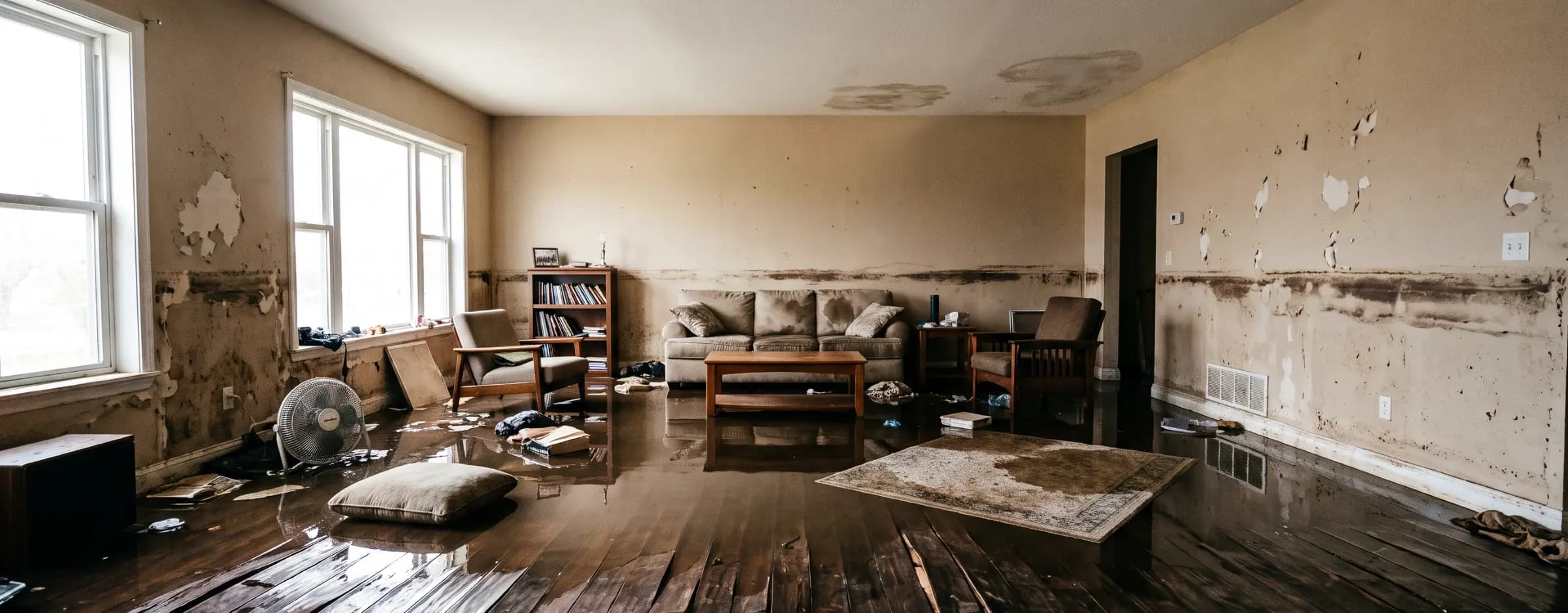

Water is still sitting in parts of the house, or it just finished draining, and drywall, flooring, and belongings have been wet for hours or longer. Flood-related mold is one of the most predictable consequences of a flood, and also one of the most preventable if the response starts within the first two days. Getting the sequence right now, safety first, water out, materials dried or removed, keeps a flood from turning into a full gut renovation.
Mold after flooding is fungal growth that develops on building materials and contents following contact with flood water: water that enters a home from an external source such as a storm, a river overflow, or overland runoff, rather than an internal plumbing failure. The Institute of Inspection, Cleaning and Restoration Certification classifies this water under IICRC S500 as Category 3, the most contaminated tier, because flood water typically carries sediment, sewage, or chemical runoff picked up on its path into the home.
Key insights
- Mold can begin within 24 to 48 hours of flood water contact, faster than most other causes of water damage because flood water deposits organic matter and nutrients directly onto surfaces.
- Flood water is almost always Category 3. Under the ANSI/IICRC S500 standard, water from storms, rivers, and rising groundwater is treated as grossly contaminated regardless of how clean it looks.
- Standard homeowners insurance excludes flood damage entirely. Only a National Flood Insurance Program policy or a private flood policy responds to flood-caused mold, and both come with specific conditions.
- Porous materials wet for more than 48 hours, including drywall, carpet padding, and insulation, usually can't be cleaned and need to be removed.
- Testing for mold after a flood isn't recommended by the CDC or EPA. If a surface touched flood water and wasn't dried within two days, the safest move is to treat it as contaminated.
- Re-entry safety comes before mold cleanup. Structural damage, electrical hazards, and gas leaks from flooding can be life threatening and have to be ruled out first.
What to do in the first 24 to 48 hours
The first 24 to 48 hours call for confirming it's safe to enter, shutting off power and any active water source, documenting the damage, extracting standing water, removing soaked porous materials, and starting mechanical drying, in that order. Drying only starts working once the earlier steps are done, and flood-related mold stays contained to fewer materials the faster this sequence happens.
 Respiratory and eye protection are non-negotiable for this step given flood water's Category 3 classification under ANSI/IICRC S500, and a disposable coverall is worth adding if you have one on hand. The dark streaking above the waterline shows contamination has already established, which is why extraction alone won't resolve it.
1. Confirm it's safe to enter
Wait for an official all-clear from local authorities if one has been issued for your area, and check for structural damage, downed power lines, and gas leaks before going past the doorway. Standing flood water can be electrified by downed lines or submerged outlets, so never wade through it, and leave immediately without investigating if you smell gas or hear a hissing sound. Situations involving active water, downed lines, or unknown structural damage fall under emergency mold removal rather than this standard timeline.
2. Shut off the power and stop the water source
Turn off electricity to affected circuits at the breaker if it's safe to reach without stepping into water. Stop any water intrusion you're able to control, whether that means closing a valve, sandbagging an entry point, or simply waiting for outside floodwater to recede.
3. Photograph everything before you touch it
Document water lines, damaged materials, and every affected room before moving or discarding anything. This record matters for both the insurance claim and the eventual contractor's scope of work, and it's far easier to capture before cleanup starts than to reconstruct afterward.
4. Remove standing water
Pump or extract standing water using a sump pump or a wet/dry vacuum as soon as it's safe to do so. Every hour standing water sits in the house eats into the 24 to 48 hour window before materials are considered contaminated.
5. Pull out soaked porous materials
Remove carpet, padding, and any porous items that have already been wet for more than 48 hours and won't dry in time. Waiting on this step is one of the most common reasons a contained flood turns into a larger mold problem.
6. Start mechanical drying
Open windows if outdoor humidity allows, and run fans and dehumidifiers continuously until moisture readings on the remaining materials return to normal. Visual dryness isn't reliable on its own, since a surface can look dry while the material underneath is still saturated.
7. Leave the HVAC system off
Don't run the HVAC system if it was submerged or if flood water reached the ductwork or drain pan. Running it before a professional inspects and cleans it can push contamination through every room the system serves instead of drying the home.
How fast mold grows after a flood
Mold can begin growing within 24 to 48 hours of flood water contact, and visible colonies can appear within three to twelve days if materials stay wet, according to EPA recommendations for mold cleanup after disasters. Flood water speeds up this timeline because it deposits organic matter, spores, and nutrients directly onto surfaces rather than leaving them simply damp.
The 48-hour window is the same threshold used for water damage generally, but flooded homes rarely hit it. Displacement, road closures, and the sheer volume of water involved often keep people out of the house for days rather than hours, which is one reason flood-related mold cases tend to be larger and more widespread than mold that follows a single roof leak or an isolated indoor spill.
Why flood water is treated differently than a pipe leak
Flood water gets treated as contaminated from the start because of where it has been, not how it looks. A burst pipe typically releases clean, sanitary water, which the IICRC S500 standard classifies as Category 1 unless it sits untreated long enough to deteriorate. Flood water, by contrast, has already traveled across streets, yards, sewers, or riverbeds before it ever reaches the house.
That path is why the S500 standard classifies flooding from storm surge, rising rivers, and overland runoff as Category 3, sometimes called black water, regardless of clarity or odor. Category 3 water can carry pathogens, heavy metals, pesticide residue, and sewage, and the practical consequence is that porous materials in contact with it, drywall, carpet, insulation, and paper-faced products, are generally removed rather than cleaned. Restoration crews typically cut affected drywall out to about 12 inches above the visible waterline rather than stopping right at the line, since water wicks upward into the material faster than it's visible from the surface. This is also why flood cleanup calls for PPE, including waterproof gloves, an N95 respirator, and eye protection, even before any mold has become visible.
Where mold hides after a flood
Mold after a flood hides inside wall cavities, under flooring, in insulation, and inside the HVAC system, the enclosed, low-lying spaces flood water reaches first and dries last. The visible growth on a baseboard or a piece of furniture is often the smallest part of the problem.
 Contamination like this typically extends well beyond what's visible from outside the wall, which is why moisture meters and thermal imaging are used to map the actual extent before demolition begins. Under ANSI/IICRC S520, affected framing and insulation are removed rather than treated in place once colonization reaches this stage.
Moisture meters and thermal imaging typically find contamination in these locations before it shows up on a painted surface, which is why a professional inspection often turns up more affected area than a homeowner's walkthrough does. Material matters as much as location: cellulose-based products like drywall paper facing, particleboard, and paper-backed insulation support growth far faster than concrete or tile sitting in the same wet spot.
| Location | Why it's high risk | What to look for | DIY or pro |
|---|---|---|---|
| Subfloor and flooring | Water pools and is absorbed from below, where it's least visible | Cupping, buckling, or a musty smell coming up through the floor | Pro |
| Drywall, lower 2 feet | Paper facing wicks moisture and feeds mold quickly | Discoloration, soft spots, bubbling paint | Pro if soaked |
| Insulation and wall cavities | Traps moisture behind an intact surface for weeks | Persistent odor with no visible source, higher moisture meter reading behind the wall | Pro |
| HVAC system | Spreads spores through every room it serves | Musty smell from vents, visible growth in ductwork or the drain pan | Pro |
| Basement or crawl space | Lowest point in the home, slowest to dry | Standing water, efflorescence, condensation on pipes | Pro |
| Furniture and upholstery | Cushioning and padding stay wet long after the surface looks dry | Odor, discoloration, sagging fabric | Usually discard |
| Cabinets and baseboards | Particleboard and MDF swell and hold moisture | Swelling, delamination, peeling laminate | Pro if structural |
Cladosporium and Aspergillus/Penicillium tend to appear first on flood-affected materials because they colonize quickly, while black mold, Stachybotrys chartarum, shows up more often in homes where materials stayed saturated for a week or longer without intervention.
What to save and what to throw away
Porous items that stayed wet for more than 48 hours and can't be fully dried and disinfected should be thrown away, while nonporous items can usually be cleaned and kept, following FEMA and EPA guidance issued after major flood events. The distinction comes down to whether a material can trap contamination below the surface, not whether it looks clean once it dries.
 Every item in this pile is porous with an internal cavity or layered construction, mattress foam, upholstery padding, carpet backing, which is why none of them can be fully disinfected once flood water has soaked through. Solid, nonporous items like glass and metal rarely end up in a pile like this, since they can usually be cleaned and kept.
A quick way to sort items: if detergent and water can reach every surface of the object and it has no internal cavity, it can likely be cleaned. Anything with foam, fabric, or layered construction usually can't be disinfected all the way through once flood water has soaked in, which is why furniture and mattresses typically can't be saved even when they look intact once dry.
| Item | Material type | Keep or discard | Why |
|---|---|---|---|
| Drywall that was soaked | Porous | Discard | Absorbs contaminants along with water and can't be fully disinfected |
| Carpet and carpet padding | Porous | Discard | Padding holds moisture indefinitely, even when the carpet surface dries |
| Mattresses and upholstered furniture | Porous | Discard | Foam and fabric layers can't be disinfected all the way through |
| Solid wood furniture | Semi-porous | Clean if not warped | Can sometimes be salvaged if dried and cleaned quickly |
| Books and paper documents | Porous | Freeze or discard | Freezing halts mold growth until items can be dried or digitized |
| Wooden cutting boards and utensils | Porous | Discard | Cannot be safely sanitized once contaminated |
| Metal, glass, and hard plastic | Nonporous | Clean and keep | Detergent and hot water fully removes contamination |
| Washable clothing and linens | Porous, washable | Wash in hot water | Machine washing resolves contamination that hand cleaning can't |
| Food that contacted flood water | N/A | Discard | Risk applies regardless of packaging, except unopened, undamaged cans |
Freezing paper documents and photos in a sealed bag stops mold from spreading further until there's time to dry or digitize them properly. Cleaning steps for the items worth saving follow the same process used for DIY mold removal generally: detergent and water, full drying, and a final wipe-down rather than disinfectant alone.
Health risks from flood-related mold
Flood-related mold carries the same core health risks as any other mold, allergic reactions, respiratory irritation, and in some cases more serious illness in vulnerable people, but flood water adds bacterial and chemical exposure on top of it. According to CDC: Basic Facts About Mold, people with asthma, allergies, or weakened immune systems are more likely to experience symptoms from mold exposure and should avoid doing the cleanup themselves.
Symptoms commonly linked to flood-affected homes include coughing, wheezing, eye and throat irritation, and skin rashes, and these can come from the mold itself, from bacteria in the flood water, or from both. Anyone with a chronic respiratory condition, a young child, or an immunocompromised household member should stay out of the affected area during active cleanup regardless of who performs it. Health effects range from allergic reactions in an otherwise healthy adult to more serious conditions in someone with asthma or a compromised immune system, detailed by population and species in health risks and symptoms.
DIY cleanup vs professional flood remediation
Small, contained flood damage on a hard, cleanable surface is a reasonable DIY project, but most flooding events exceed that scope quickly. The EPA's 10 square foot threshold is the standard starting point: below that, and on nonporous materials, a homeowner with proper PPE can usually clean the area with detergent and water.
 A reading of 31 percent is well past the 28 percent threshold IICRC S500 associates with structural damage, confirming saturation deep enough at that spot to require material removal rather than surface treatment. Established growth spreading across a wall like this is past DIY scope regardless of the exact square footage, which is why a P100 respirator and full coveralls replace the N95 and gloves adequate for lighter Category 3 water contact.
Flooding tends to push past that threshold fast, since water rarely stays confined to one small area once it's inside a house. Calling in professional mold remediation becomes the right move when affected material exceeds 10 square feet, when the HVAC system was submerged, when the water came from a river, storm surge, or any source that may carry sewage, when structural materials like subfloor or framing were saturated, when mold has already been growing for more than 48 hours or has spread beyond a single room, or when anyone in the household has asthma, allergies, or a compromised immune system.
If you decide to hire out the job, how to choose a mold remediation company covers what credentials and documentation to ask for before signing anything, which matters more after a flood than after an isolated leak because demand for contractors spikes and not every crew responding to a disaster area is properly credentialed.
Does flood insurance cover mold
Standard homeowners insurance does not cover flood damage or mold that results from it, because flood is a specifically excluded peril on nearly every HO-3 policy. Coverage for flood-caused loss, including flood-related mold, only comes through a National Flood Insurance Program policy or a private flood insurance policy, and either has to be purchased separately from a homeowners policy.
 Photographing water lines and mold damage before cleanup starts is the documentation insurers expect when reviewing a claim for prompt mitigation under an NFIP policy. Even documentation-only visits call for basic PPE in a Category 3 space, since photographing doesn't require touching contaminated material but still means standing in it.
Even with an NFIP policy in place, mold coverage has conditions attached. The NFIP claims handbook lists treatment for mold and mildew, along with pumping out floodwater and structural drying, as expenses the program can pay when mitigation happens promptly.
The same policy excludes mold, mildew, or moisture damage that resulted from the policyholder's failure to act with reasonable speed after the water receded, and it generally won't pay for mold testing itself. NFIP building coverage also caps at $250,000 for a residential structure and doesn't cover additional living expenses if the home becomes temporarily uninhabitable, so a severe flood can still leave a real gap between what the policy pays and what remediation costs.
Renters face a different question entirely, since a landlord's policy typically covers the structure and not the tenant's belongings; renters' mold rights addresses who's responsible for cleanup and repairs when a rental floods.
If you're filing an NFIP claim as a homeowner, you generally have 60 days from the date of loss to submit a sworn proof of loss unless your insurer grants a written extension, a separate and earlier deadline than most homeowners policies use.
Disputing a denied claim, and the coverage rules for causes beyond flooding, work differently depending on whether the source was a flood, a leak, or long-term humidity, a distinction homeowners insurance mold coverage addresses in full.
Does FEMA help pay for flood mold cleanup
FEMA can help pay for flood mold cleanup through Individual Assistance grants, a program separate from the National Flood Insurance Program that doesn't require a flood insurance policy to qualify. It's typically available only after the President declares a major disaster for the affected area, and it's meant to supplement insurance rather than replace it.
Individual Assistance can cover home repairs and cleanup costs that insurance doesn't reach, including mold remediation, up to a combined maximum of $44,800 for housing assistance and $44,800 for other needs assistance per household for disasters declared in federal fiscal year 2026, a figure FEMA adjusts annually under the Stafford Act. Applicants generally need to have already filed a claim with any insurance they carry and to register through disasterassistance.gov within the deadline FEMA sets for that specific disaster. Homeowners without flood insurance in a declared disaster area are usually the ones who end up relying on this program most, since NFIP coverage only applies to a policy that was already in place before the flood, not one purchased afterward.
Cost of mold remediation after a flood
Flood-related mold remediation typically costs between $500 and $75,000 or more, and the driving factor is scope: how many rooms were affected, whether the HVAC system needs decontamination, and whether structural materials have to be removed and rebuilt rather than just dried and cleaned. Because flood water is Category 3 by default, jobs tend to land toward the higher end of general mold remediation cost ranges even when the affected footprint looks modest.
 Labor for cutting out and bagging contaminated material like this, not the antimicrobial treatment applied afterward, is usually the largest line item on a flood remediation invoice. Category 3 water rules out cleaning drywall in place, which is why demolition scope, not square footage alone, drives most of the cost variation between similar-sized jobs.
Labor for extraction and demolition usually accounts for more of the total than the antimicrobial treatment itself, since Category 3 water calls for removing porous materials rather than cleaning them in place. A finished basement or contamination spread across multiple floors also adds disposal fees a single-room job wouldn't carry, which is part of why two homes with similar square footage can land at opposite ends of that range.
| Scope | Cost range | What drives the price |
|---|---|---|
| Single room, limited flooding | $500–$3,000 | Small area, partial drywall and flooring removal |
| Multiple rooms or a flooded basement | $3,000–$12,000 | Larger removal footprint, longer drying time |
| Whole floor with extensive contamination | $12,000–$30,000 | HVAC decontamination, multiple material types removed |
| Whole-home flood with demolition | $30,000–$75,000+ | Structural drying, subfloor and framing replacement, full reconstruction |
| Category 3 sewage-contaminated water | Add 15%–25% | Biohazard PPE, additional disinfection protocols |
These ranges reflect remediation and material removal only, not the separate costs of reconstruction, replacing personal belongings, or temporary housing, which typically run through a different part of the same insurance claim.
How to prevent mold from returning
Preventing flood-related mold from coming back depends on getting the affected area fully dry and confirming it before anything gets rebuilt, closed up, or repainted. Rebuilding over a wall cavity that still reads wet on a moisture meter is one of the most common reasons mold reappears after any water damage, not just flooding.
 A sump pump addresses the moisture source directly, which matters more for preventing recurrence than any surface treatment applied during the original remediation. The hygrometer on the workbench reading normal humidity confirms the space has actually dried through before new drywall goes up, not just on the surface.
Two separate risks drive most recurrence: framing or subfloor that reads dry to the eye but not to a moisture meter, and a moisture source that was addressed once but never actually fixed for good. The only way to confirm the first risk is actually resolved rather than assumed is clearance testing after remediation, done before either risk gets sealed behind new drywall.
| Action | Frequency | Why it matters |
|---|---|---|
| Confirm framing and subfloor moisture with a meter | Before closing up any wall or floor | Rebuilding over damp material is the leading cause of flood mold recurrence |
| Run dehumidifiers to bring moisture back to baseline | Continuously until readings normalize | A surface can look dry while the material underneath is still saturated |
| Get independent clearance testing | Before reconstruction begins | Confirms remediation actually worked instead of relying on a visual check |
| Fix the moisture source permanently | Once, immediately after remediation | A home that flooded once is statistically more likely to flood again without a fix |
| Install a sump pump or backwater valve | Once, for repeat-risk basements | Directly addresses the most common cause of recurring flood damage |
| Monitor humidity with a hygrometer | Ongoing for the first few months | Catches a slow-developing moisture problem before mold re-establishes |
| Photograph and document the finished repair | Once, at completion | Useful for insurance, resale disclosure, or a future claim |
Frequently asked questions
How long does mold remediation take after a flood?
Most flood-related jobs take one to two weeks from the start of active work to reconstruction-ready, though the drying phase alone can run three to seven days depending on how saturated materials became before drying started. Larger jobs involving structural drying, demolition, and clearance testing can run longer.
Can flood-damaged drywall be saved?
Rarely, once it has been soaked by flood water. Drywall is porous and absorbs contaminants along with moisture, and the lower portion in contact with flood water typically has to be cut out and replaced rather than dried in place.
Do I need to get my home tested for mold after a flood?
No, testing generally isn't necessary. The CDC and EPA both note that if a surface touched flood water and wasn't fully dried within 48 hours, the safest assumption is that mold is present, and the response is the same regardless of species or spore count.
Can I use bleach to clean flood-damaged surfaces?
Only on nonporous surfaces like tile, glass, and sealed countertops. Bleach doesn't reach mold growing inside porous materials like drywall or wood, so using it on a flood-contaminated wall without removing the affected material first masks the smell rather than solving the problem.
How much flood water does it take before mold becomes a risk?
There's no minimum amount. Even a small amount of flood water that saturates a porous material and isn't dried within 48 hours can support mold growth, regardless of how much total water entered the home.
Can I stay in my home while cleaning up flood mold?
It depends on the extent of the contamination and whether the HVAC system, multiple rooms, or a large area were affected. Small, contained flooding may allow you to remain in unaffected parts of the home, while whole-floor or sewage-contaminated flooding usually calls for temporary relocation during active work.
Is it normal to smell mold before you can see it after a flood?
Yes, a musty odor often shows up before any visible growth. Flood water reaches inside walls and under flooring before mold becomes visible on a painted surface, so a persistent musty smell with no obvious source is a reason to check those hidden locations rather than wait for something you can see.
Do I need a permit to remove flood-damaged drywall?
Usually not for straightforward removal and replacement of like-for-like materials, but check with your local building department if the repair touches structural framing, electrical, or plumbing. Homes in a flood zone may also face separate rules once damage crosses a certain threshold.
Sam Hickerson is the founder of RestoreAdvisor and writes consumer guides on mold remediation, water damage restoration, inspection, testing, and home recovery. His work focuses on helping homeowners understand costs, risks, and when to call a professional. He draws on guidance from the EPA, CDC, IICRC, and other authoritative sources to make complex home issues easier to navigate.