
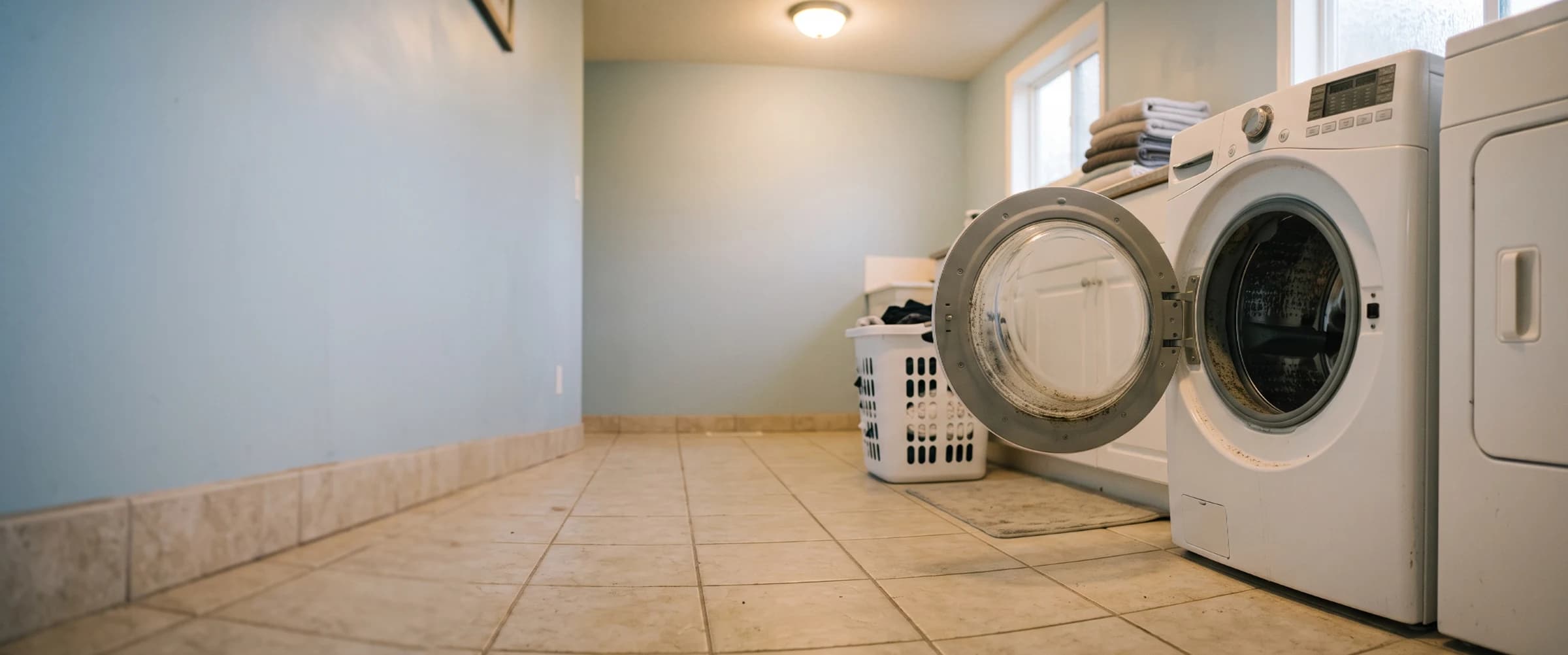

Finding mold in your washing machine, or catching that musty smell your clothes carry even after a full wash cycle, usually means the machine itself has become the source of the problem rather than the solution. Mold in a washing machine is fungal growth, most often Cladosporium, Fusarium, or Exophiala species, that colonizes the rubber door gasket, detergent drawer, and drum interior when detergent residue and trapped moisture create a steady food source, according to peer-reviewed sampling of household washing machines published through the National Institutes of Health. It's a common problem, not a sign you've done anything wrong, and in nearly every case it's fixable with a thorough cleaning and a few changes to how the machine dries out between loads.
The fix almost always comes down to a hot cleaning cycle, a scrub of the gasket and drain filter, and a change in how the machine dries out between loads, whether the cause is a design quirk in a front-load washer, an overuse of fabric softener, or a drain filter nobody's touched in years.
Key insights
- Fungi were found in the majority of machines tested. A peer-reviewed sampling study of household washing machines identified mold and yeast species in most units tested, concentrated in the detergent drawer and rubber door seal.
- Front-load washers trap more moisture than top-load washers. The folds of a front-load door gasket hold standing water after every cycle, which is why mold complaints are heavily concentrated in that washer style.
- The most common species is Cladosporium. Sampling of residential washing machines found Cladosporium as the most frequently isolated black mold genus, followed by Ochroconis, with Aspergillus, Fusarium, and Exophiala also common.
- Manufacturers have acknowledged the problem. Whirlpool, Sears, and LG settled class-action lawsuits in 2016 covering millions of front-load washers built between 2001 and 2010 after consumers reported chronic mold and odor.
- Mold can reestablish within 24 to 48 hours. If moisture is left standing in the gasket or drawer after cleaning, spores that survive the cleaning cycle can begin regrowing within one to two days.
- Cleaning failure and cleaning frequency are the two most common causes. Overusing detergent, skipping the monthly cleaning cycle, and leaving the door closed between loads account for most recurring cases.
How to clean mold out of a washing machine
Cleaning mold out of a washing machine means running a hot bleach or vinegar cycle through the empty machine while separately hand-scrubbing the gasket, detergent drawer, and drain filter, since a normal wash cycle alone never reaches any of those three spots. The full process works the same way for front-load and top-load machines, with the gasket step applying only to front-loaders, and it follows the same DIY mold removal principles used on small, cleanable jobs anywhere else in the home.
 A bleach solution needs several minutes of contact time within the gasket folds to reach mold that plain wiping leaves behind. Once rubber develops visible pitting, replacement is usually more effective than continued scrubbing.
1. Empty and inspect the machine
Remove all laundry and empty the detergent, bleach, and fabric softener dispensers so nothing gets bleached or damaged once cleaning starts.
2. Clean the door gasket
Pull back the folds of the rubber gasket and scrub visible mold with a cloth or soft brush dipped in a bleach solution, working into every crevice where water pools. This step doesn't apply to standard top-load washers without a door seal.
3. Remove and soak the detergent drawer
Take out the detergent and fabric softener tray, soak it in hot soapy water for 10 to 15 minutes, then scrub with a brush and rinse thoroughly before setting it aside to air dry.
4. Clean the drain filter
Locate the small access door at the bottom-front of the machine, place a shallow pan underneath to catch residual water, and pull out the drain filter to clear trapped lint, hair, and detergent buildup before rinsing it and setting it back in place.
5. Run a hot cleaning cycle
Set the washer to its hottest water setting and longest cycle, add bleach or a washing machine cleaning tablet directly to the empty drum, and let it run through completely to reach the drain pump and internal hoses.
6. Wipe down the drum and door
After the cycle finishes, wipe the drum interior and inside of the door with a clean, dry cloth to remove residual moisture before it has a chance to support new growth.
7. Air-dry with the door open
Leave the door and detergent drawer open until the machine is completely dry. Trapped humidity, not a missed spot of cleaning, is what allows mold to reestablish within a day or two.
If mold is heavy enough that scrubbing doesn't fully remove staining from the gasket, a replacement gasket is usually more effective than repeated deep cleaning, since degraded rubber develops surface pitting that holds spores no amount of scrubbing can reach.
Best products for cleaning washing machine mold
Chlorine bleach is the best overall choice for actually killing established mold in a washing machine, since it works faster and reaches deeper into a contaminated gasket than any other household product, but a lot of cleaning experts recommend alternating it with a vinegar cycle for regular maintenance rather than using bleach every time, since repeated bleach cycles wear on rubber gaskets and vinegar keeps the machine fresh in between without that risk.
 Bleach and vinegar should never be combined in the same cycle, since the mixture releases chlorine gas. Alternating between them on separate cleaning days avoids that risk entirely.
Bleach
The strongest option, and the right call for a badly contaminated gasket or drum that vinegar and peroxide haven't touched. It kills mold on contact and disinfects the drain pump during a full hot cycle, but frequent use degrades rubber gasket material over time, it has a harsh smell, and it must never be combined with vinegar, ammonia, or hydrogen peroxide in the same cycle since that combination produces toxic fumes.
White vinegar
The gentler, lower-risk choice for routine maintenance and light buildup. It's acidic enough to kill many surface mold and mildew species, doesn't degrade rubber the way bleach can, and is safe to use every month without worrying about fumes or residue. Its limitation is straightforward: it's noticeably weaker than bleach against heavy or embedded contamination, so it's a maintenance product more than a rescue product.
Hydrogen peroxide
A middle option worth reaching for on gasket spots where you don't want bleach anywhere near nearby fabric or trim. It breaks down mold cell walls without leaving a strong chemical odor behind, but like vinegar it's weaker than bleach on established biofilm and works best as a spot treatment rather than a whole-machine solution.
Baking soda and vinegar combined
A two-step approach that's especially good when odor, not just visible mold, is the main complaint. Baking soda lifts residue from the drum first, and the vinegar that follows disinfects what's left behind. The tradeoff is time: running both takes longer than a single bleach cycle, and it isn't strong enough for heavy gasket contamination on its own.
Commercial washer cleaner tablets
Convenient for monthly maintenance since they're formulated specifically to break down detergent film and biofilm, but they're not designed to replace hand-scrubbing an already moldy gasket or drawer, only to keep a clean machine clean.
| Product | Mixture | Best for | How it works | Limitation |
|---|---|---|---|---|
| Chlorine bleach | 1 cup bleach per hot cycle, or 1:4 dilution for spot cleaning | Heavy gasket and drum contamination | Oxidizes and kills mold on contact, and disinfects the drain pump during a full cycle | Can degrade rubber gaskets over time with frequent use; never mix with vinegar or ammonia |
| White vinegar | 1 cup added to detergent tray on a hot cycle | Light buildup and routine maintenance | Acidic enough to kill many surface mold and mildew species | Less effective than bleach on heavy or embedded contamination |
| Hydrogen peroxide | 2 cups water, ½ cup peroxide for spot cleaning | Gasket spots without bleaching risk to nearby fabric | Breaks down mold cell walls without leaving a strong chemical odor | Weaker than bleach on established biofilm |
| Baking soda and vinegar | 1 cup baking soda in drum, then 4 cups vinegar added mid-cycle | Combined odor removal and light cleaning | Baking soda lifts residue while vinegar disinfects | Two-step process takes longer than a single bleach cycle |
| Commercial washer cleaner tablets | One tablet per manufacturer's monthly cleaning cycle | Routine monthly maintenance | Formulated specifically to break down detergent film and biofilm | Doesn't replace manual gasket and drawer scrubbing for existing mold |
On the nonporous metal and rubber surfaces inside a washer, bleach kills mold effectively, which is different from how it performs on porous household surfaces like drywall or wood, where it often fails to reach growth below the surface.
Why does mold grow in a washing machine?
A washing machine grows mold when warm, damp conditions inside the drum and gasket combine with an organic food source, usually detergent and fabric softener residue, that never fully rinses away, matching the conditions the EPA identifies as necessary for mold growth in any part of a home. Modern high-efficiency, or HE, washing machines make this more likely. These machines use much less water than older models, and many skip the agitator entirely, relying on tumbling and spraying instead of a full soak, so they need a low-sudsing detergent formulated specifically for that smaller water volume.
The problem compounds with fabric softener specifically. Softener is designed to coat fibers with a waxy film, and some of that film ends up coating the inside of the drum and gasket instead, where it holds moisture against the rubber and plastic surfaces long after the cycle ends. A closed washer door traps that humidity inside rather than letting it evaporate, which is often the single biggest factor separating a machine that develops a persistent mold smell from one that doesn't.
Detergent choice matters too. Regular detergent produces far more suds than an HE machine's smaller water volume can rinse away, and those extra suds don't rinse out completely, adding another layer of residue for fungi to feed on. This is also why a musty smell often shows up gradually rather than all at once: it takes repeated cycles of buildup before there's enough residue and standing moisture to support visible growth.
Where mold hides in a washing machine
Mold in a washing machine hides most often in the rubber door gasket, the detergent and fabric softener drawer, the drum interior, the drain pump and hose, the lint filter, and the bleach dispenser cup, six locations where water and residue linger longest between loads and where the usual signs of mold are easiest to miss. The rubber door gasket on front-load washers is the most common site, since it never fully drains between cycles. The detergent and fabric softener drawer is the second most common, because leftover product and standing water sit there between washes with no airflow to dry it out.
 The cavity behind the drawer rarely gets touched during routine cleaning, so residue and standing water can build into visible mold there even when the drawer itself looks clean.
The drum interior itself can develop a thin film along the back wall and around the agitator, particularly in machines that see frequent fabric softener use. Less visible but just as important are the drain pump and hose, where lint, hair, and detergent residue collect and can develop mold that circulates a musty smell through the whole cycle without ever appearing on a surface you can see. The lint or debris filter, found on many front-load models, traps organic material directly and needs regular emptying for the same reason, and a persistent musty smell that won't go away even after cleaning often traces back to this filter or the drain hose rather than a spot you can see. Top-load washers with a separate bleach dispenser cup can develop the same residue buildup in that small reservoir.
A greenish-black film on the gasket is usually a species like Cladosporium rather than the toxic black mold associated with water-damaged homes, since Stachybotrys and similar species need sustained saturation of a porous building material to establish, conditions a washing machine's rubber and plastic parts don't provide.
Is it mold, or just mineral buildup and soap scum?
Not everything found inside a washing machine is mold. Mineral buildup from hard water leaves a chalky, white to gray crust that flakes or scrapes off dry, while soap scum from detergent and fabric softener residue forms a greasy, waxy film that feels slick rather than fuzzy. Mold, by contrast, is usually black, green, or pink, has a fuzzy or slimy texture, spreads or darkens over days rather than staying static, and carries a musty odor that neither mineral deposits nor soap residue produce.
A simple field test settles most cases. Mineral buildup and soap scum wipe or scrape away with a dry cloth or a fingernail, while mold smears, stains the cloth, or leaves color behind even after wiping. The same texture and color distinctions used to identify mold versus mildew elsewhere in a home apply here too, and if the growth is fuzzy, colored, and expanding rather than a static crust, treating it as mold and moving on to cleaning it is the right call.
Front-load washers vs. top-load washers: which grows more mold?
Front-load washers grow mold far more often than top-load washers because of a structural difference in how each design drains water. A front-load washer's rubber door gasket folds inward in an accordion shape that traps a ring of standing water after every cycle, and that trapped water combined with detergent residue is the single biggest reason mold complaints concentrate so heavily in front-load models.
 A top-load washer has no door gasket to trap standing water, but the detergent and bleach dispenser cups can still build up the same residue-driven mold as a front-loader.
Top-load washers, whether traditional agitator models or newer HE top-loaders, drain more completely because water and residue settle straight to the bottom of a flat basin rather than pooling in a folded seal. That doesn't make top-loaders immune. The detergent drawer, bleach dispenser cup, and fabric softener reservoir on a top-load machine can still develop the same residue-driven mold as a front-loader, just without the gasket problem driving most of it. If you're choosing between the two with mold as a deciding factor, a top-load washer carries meaningfully lower risk, though neither style eliminates the need for regular cleaning.
Is mold in a washing machine dangerous?
For most healthy people, mold in a washing machine is a nuisance rather than a health hazard. The species most commonly found in household washing machines, including Cladosporium, Fusarium, and Exophiala, are documented allergens per CDC: Basic Facts About Mold, capable of triggering sneezing, mild respiratory irritation, or skin sensitivity in exposed individuals, but they rarely cause serious illness in someone with a healthy immune system.
The exception is people who are immunocompromised, undergoing chemotherapy, or living with a chronic respiratory condition such as asthma or COPD. Peer-reviewed sampling of residential washing machines has specifically flagged some of the fungal species recovered, including certain Fusarium and Exophiala strains, as opportunistic pathogens capable of causing infection in people whose immune defenses are already weakened, even though the same species pose little risk to a healthy adult handling laundry.
For someone managing asthma or a known mold allergy, the practical concern isn't usually infection but exacerbation of existing symptoms from repeated low-level spore exposure every time the machine runs. If you notice new or worsening respiratory symptoms that track with doing laundry, that pattern is worth mentioning to a doctor rather than assuming it's unrelated.
Is it safe to keep using a moldy washing machine?
Yes, for most households it's safe to keep doing laundry while you deal with the mold, as long as you clean the machine promptly rather than letting the problem sit indefinitely. Whether mold is dangerous enough to warrant extra precaution depends mostly on who's in the household. A few precautions are worth following in the meantime. Wash items belonging to anyone who is immunocompromised, an infant, or managing a chronic respiratory condition separately and clean the machine before running those loads. Pull laundry out as soon as the cycle ends rather than leaving it to sit in a damp drum, and skip fabric softener until the machine has been cleaned, since it adds exactly the residue that feeds the problem. Continuing to use a moldy machine indefinitely without ever cleaning it is what turns a minor gasket issue into the kind of buildup that eventually needs a repair technician or a replacement part.
Why does washing machine mold keep coming back?
Washing machine mold keeps coming back most often because the moisture source, not the mold itself, was never actually addressed. A cleaning cycle removes visible growth and much of the surface biofilm, but if the door stays closed and the gasket folds stay wet between loads, the conditions that produced the mold are still in place and regrowth can begin within 24 to 48 hours.
 This residual moisture sits against the gasket for days between loads if the door gets closed too soon, which is why mold returns even after a thorough cleaning if the habit doesn't change.
Detergent habits are the second most common cause. Using more detergent than recommended leaves extra residue behind every single cycle no matter how well the machine is cleaned in between. Fabric softener use compounds this further, since its residue coats surfaces and holds moisture even after a thorough cleaning.
In some cases the cause isn't a habit at all but a design issue with the machine. This became public enough that Whirlpool, Sears, and LG settled class-action lawsuits in 2016 covering millions of front-load washers manufactured between 2001 and 2010, after tens of thousands of consumers reported chronic mold and odor problems despite following recommended cleaning routines. Newer machines address this with improved venting and self-cleaning cycles, but if a well-maintained older front-loader keeps developing mold no matter what you do, a design limitation is likely the reason mold keeps returning rather than a cleaning gap.
Mold in the dryer
Mold in a dryer is less common than in a washer but develops the same way, through trapped moisture rather than heat exposure, since dryers rarely stay warm long enough between loads to prevent it. The most likely spots are the door gasket seal, the lint trap housing beneath the removable filter, and the exhaust vent line if it has a kink or blockage that traps humid air instead of venting it outside. A musty smell from a dryer that persists after cleaning the lint trap usually points to the vent line rather than the drum itself, and a vent that hasn't been cleaned in over a year is worth inspecting for both mold risk and fire safety.
Mold in the laundry room beyond the machine
A laundry room can develop mold independently of the washing machine itself when ambient humidity in the room stays elevated from vented dryer exhaust, poor ventilation, or a location without a window or exhaust fan. Signs to check outside the appliances include musty odor near the floor or baseboards, visible spotting on drywall behind or beside the washer, and condensation on cold water supply lines. The humidity level that causes mold growth follows the same thresholds in a laundry room as anywhere else in the home, and a hygrometer reading consistently above 60 percent relative humidity in that space signals a ventilation problem worth addressing separately from the appliance itself.
How to keep mold from coming back
Keeping mold out of a washing machine for good means leaving the door open between loads, using only the recommended amount of detergent, and running a monthly hot cleaning cycle, the three habits that remove the moisture and residue mold needs to return. Three more habits, switching away from fabric softener, removing wet laundry promptly, and wiping the gasket weekly, close the remaining gaps and match the same mold prevention principles that apply throughout the rest of the home.
 Leaving the door open after every load is the single habit that does the most to stop mold from returning, since it lets residual moisture in the gasket fully evaporate.
Leave the door open after every load
An open door lets residual moisture in the drum and gasket evaporate instead of staying trapped, which is the single most effective prevention step for front-load washers.
Use only the recommended amount of detergent
Excess detergent leaves residue that doesn't fully rinse out and becomes a food source for mold over time.
Switch away from liquid fabric softener
Softener residue coats the drum and gasket with a film that holds moisture; dryer sheets accomplish the same softening without leaving buildup inside the washer.
Remove wet laundry promptly
Damp clothes left in the drum after a cycle raise humidity inside the machine and give mold extra time to establish before the next load starts.
Run a monthly hot cleaning cycle
A monthly empty cycle with bleach, vinegar, or a commercial washer cleaner removes the residue buildup that a normal wash cycle doesn't fully rinse away.
Wipe the gasket and drawer weekly
A quick wipe with a dry cloth after wash day removes the standing moisture that would otherwise sit for days before the next load.
When do you need a professional?
Most washing machine mold is a DIY-appropriate cleaning job, not a case for professional mold remediation. Call an appliance repair technician rather than continuing to clean if mold returns within days of a thorough cleaning despite an open door and proper detergent use, since that pattern points to a failed door seal, a clogged drain trap, or standing water inside the machine that cleaning alone can't reach.
A different kind of professional becomes relevant if mold has spread from the appliance onto the surrounding wall, flooring, or cabinetry, particularly if a supply line or drain hose has been leaking unnoticed behind the machine. At that point the problem is no longer confined to the washer and falls under the same decision framework used for any household mold, following the same containment and clearance standards set by the IICRC S520 standard used for professional mold remediation across the industry. Growth larger than about 10 square feet on a porous building material is generally the threshold worth acting on.
How much does it cost to fix a moldy washing machine?
Fixing a moldy washing machine costs nothing beyond household supplies in most cases, since the problem is almost always solvable with bleach, vinegar, or a commercial cleaning tablet and an hour of scrubbing. Cost only climbs when the mold points to a mechanical failure rather than a cleaning gap, such as a degraded door gasket or a drain system holding standing water no cleaning cycle can reach, the same threshold that determines when mold remediation is required anywhere else in the home.
A repair technician's diagnostic visit costs more than a DIY cleaning but far less than replacing the whole machine, and knowing which fix actually applies to your situation keeps you from paying for a full replacement when a $150 gasket swap would have solved it.
| Fix needed | Typical cost | What's included |
|---|---|---|
| DIY cleaning | $0–$25 | Bleach, vinegar, or a few commercial cleaning tablets already on hand or bought locally |
| Commercial washer cleaner (ongoing) | $10–$25 per box | Monthly maintenance tablets for routine prevention |
| Appliance repair service call | $75–$150 | Diagnostic visit plus labor to inspect the drain system and seals |
| Door gasket replacement | $150–$400 | Parts and labor for a degraded or unrepairable front-load gasket |
| Drain pump or hose replacement | $150–$350 | Parts and labor if trapped water in the drain system is the underlying cause |
| Washing machine replacement | $500–$1,500+ | A new unit when repeated professional cleaning and repair haven't resolved chronic regrowth |
These figures cover appliance-specific fixes only. If mold has spread beyond the machine into flooring, drywall, or cabinetry, mold remediation cost follows a different and typically higher pricing structure than an appliance repair.
Frequently asked questions
Is mold in a washing machine dangerous?
Yes, in some cases, but for most healthy people it's a nuisance rather than a hazard. The fungi that colonize washing machines are generally low-risk for a healthy adult and cause at most mild allergy symptoms. People with asthma, chronic lung disease, or a weakened immune system face a higher risk and should treat visible or smelled mold as a reason to clean the machine immediately.
Can I get sick from mold in my washing machine?
It's uncommon, but not impossible. Research on household washing machines has identified fungi capable of causing opportunistic infections in people with compromised immune systems, though healthy individuals typically experience nothing worse than an allergic reaction or mild irritation.
Does vinegar kill mold in a washing machine?
Partially. White vinegar is acidic enough to kill many surface mold and mildew organisms and works well on light buildup in the detergent drawer and gasket, but it doesn't reach mold embedded in rubber gaskets or hidden in the drain pump the way a hot bleach cycle does.
How often should I clean my washing machine to prevent mold?
Once a month at minimum. A monthly hot-water cleaning cycle, combined with wiping the gasket and drawer after every load, is the interval that keeps fungal buildup from re-establishing.
Why does my front-load washer smell like mold specifically?
Its door gasket traps residual water after every cycle in a way top-load washers don't, and that standing moisture combined with detergent residue is what creates the smell.
Can mold in a washing machine spread to my clothes?
Yes. If the drum, gasket, or detergent drawer is contaminated, spores and biofilm residue can transfer onto laundry during the wash cycle, which is usually what produces a musty smell in clean clothes even after they've dried.
Should I replace my washing machine if the mold keeps coming back?
Only if a full cleaning and gasket replacement doesn't resolve it. Persistent regrowth after proper cleaning usually points to a design issue trapping water behind the gasket or drain system rather than a cleaning failure, and at that point repair or replacement is more cost-effective than repeated deep cleans.
Is black mold in a washing machine the same as toxic black mold in a house?
No. The black growth found on washer gaskets is almost always Cladosporium or a similar dark mold species that thrives on detergent residue, not Stachybotrys chartarum, which requires sustained water saturation of a porous building material and doesn't grow on rubber or plastic appliance parts.
Sam Hickerson is the founder of RestoreAdvisor and writes consumer guides on mold remediation, water damage restoration, inspection, testing, and home recovery. His work focuses on helping homeowners understand costs, risks, and when to call a professional. He draws on guidance from the EPA, CDC, IICRC, and other authoritative sources to make complex home issues easier to navigate.