
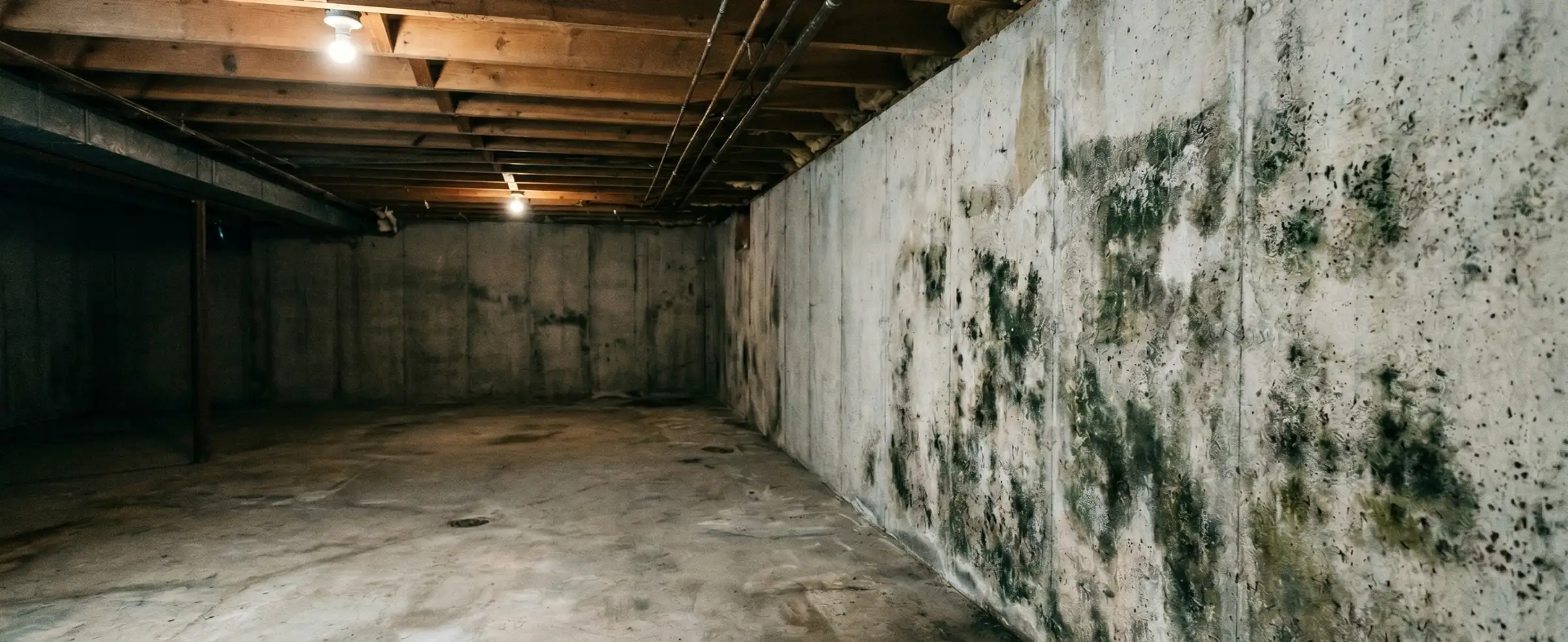

You found mold on your concrete floor or wall. Mold on concrete is a fungal growth that colonizes organic debris and biofilm on the surface of porous concrete, sustained by moisture absorption through the concrete matrix, as defined under ANSI/IICRC S520, the industry standard for professional mold remediation. The good news is that concrete is one of the more cleanable surfaces mold grows on; it cannot penetrate the way it does into wood or drywall. Most recurring concrete mold problems come down to one mistake: cleaning the surface without fixing the water source first.
Key insights
- Mold does not feed on concrete. It grows on organic debris, dust, and biofilm that accumulate on and within the pores of the concrete surface.
- Efflorescence is often mistaken for white mold. Spray the area with water; efflorescence dissolves or darkens, mold does not.
- Fixing the moisture source is step one. Cleaning mold from concrete without addressing the water pathway guarantees regrowth within weeks.
- The EPA's 10 sq ft threshold applies to concrete. Surface areas larger than 10 square feet should be evaluated and handled by a licensed mold professional.
- Bleach kills surface mold but does not penetrate. On unsealed, porous concrete, surface cleaning must be followed by a penetrating sealer to reduce future water absorption.
- Penetrating sealers outperform coatings for mold prevention. Silane/siloxane sealers reduce water entry into the concrete matrix; acrylic coatings can trap vapor and create worse conditions beneath the surface.
Mold vs. efflorescence: how to tell them apart
Mold and efflorescence are both common on concrete and are frequently confused with each other, but they require completely different responses. Efflorescence is a mineral salt deposit left behind when water migrates through concrete, evaporates at the surface, and deposits dissolved salts. It poses no health risk and indicates a moisture pathway, not a biological problem.
 A spray of water settles the question fast: the salts on the left will dissolve or darken, while the growth on the right stays put and often releases a musty odor when disturbed.
To tell them apart, spray the area with water. Efflorescence is water-soluble: it will darken, dissolve, or temporarily disappear when wet. Mold does not dissolve. If the discoloration stays put, has a fuzzy, spotted, or slimy texture, or produces a musty or earthy odor when disturbed, it is mold. A second test: apply a drop of household bleach. Mold-based discoloration will lighten within a minute; efflorescence will not change color.
The presence of efflorescence is an important warning sign. It means water is actively moving through your concrete. That moisture pathway will support mold growth on any organic debris present on the surface, so even if what you see today is efflorescence, the underlying moisture problem creates conditions for mold. The signs of mold in a basement often involve both: efflorescence on the wall plus mold on adjacent stored items or framing.
Why concrete is vulnerable to mold
Concrete is vulnerable to mold because it is porous, absorbs moisture through capillary action, and accumulates the organic debris that mold feeds on. Unlike wood or drywall, concrete does not serve as a direct food source, but its pore structure holds water long enough to sustain mold colonies on any organic material present on the surface. Even when the surface looks dry, the interior can retain enough moisture to keep those conditions active.
 Concrete this age has usually carbonated enough to drop its surface pH from the roughly 12 to 13 range fresh concrete starts at, which is what makes older basement walls more hospitable to growth than new ones.
Four structural factors make concrete particularly prone to mold:
Porosity. Poured concrete and concrete block both have pore structures that absorb water and humidity. Unsealed concrete can absorb up to 10% of its weight in water. Even "sealed" concrete loses sealer effectiveness over time as the coating wears or the sealer degrades.
pH drop over time. Fresh concrete has a high alkaline pH (around 12–13) that is inhospitable to mold. As concrete ages, a process called carbonation reduces the surface pH, making it progressively more hospitable to biological growth. Most residential basement concrete older than 10–15 years has carbonated sufficiently to support mold.
Organic debris accumulation. Concrete does not provide a food source for mold directly, but dust, dirt, wood debris, paper, insulation particles, and other organics that collect on or within the pores of concrete do. This is why mold on concrete often appears first along floor-wall joints, in cracks, and in corners where debris accumulates.
Below-grade location. Concrete below grade is in near-constant contact with soil moisture. Ground water migrates inward through the foundation wall and slab through hydrostatic pressure, regardless of surface conditions. The humidity and moisture levels that trigger mold growth above 60% RH are routinely exceeded in unventilated basement spaces.
Where mold grows on concrete by location
Mold grows on concrete in basements, crawl spaces, garages, patios, and foundation walls, with each location driven by a distinct moisture source: hydrostatic pressure below grade, condensation in enclosed spaces, poor drainage on exterior slabs, and vehicle moisture in garages. The root cause determines whether surface cleaning is sufficient or whether a structural moisture correction is required.
 Growth concentrated at this joint rather than spread evenly across the slab usually points to debris accumulation at the seam, not a moisture problem with the concrete itself.
The table below maps each concrete surface type to its most common moisture pathway, what growth typically looks like, and whether the job is appropriate for DIY or requires a professional.
| Location | Primary moisture source | What mold looks like here | DIY or pro |
|---|---|---|---|
| Basement walls (poured) | Groundwater seepage, condensation | Black or gray spots near floor, white growth mid-wall | Pro if more than 10 sq ft |
| Basement walls (block) | Capillary seepage through mortar joints | Spotty growth along mortar lines, efflorescence nearby | Pro if recurring or extensive |
| Basement floor | Hydrostatic pressure, vapor transmission | Fuzzy patches in corners, under rugs or stored items | DIY if small; pro if recurring |
| Crawl space floor/walls | Ground moisture, high RH, condensation | Green or white growth, often extensive | Pro (confined space, large area) |
| Garage slab | Vehicle moisture, humidity, poor drainage | Spotted growth near drains, walls, or door threshold | DIY if isolated surface patches |
| Patio/outdoor slab | Rain, poor drainage, shade, leaf debris | Green algae-like mold, black spotting in low areas | DIY for most cases |
| Foundation exterior | Soil moisture, surface runoff | White, green, or black coating on exposed foundation | DIY or landscaping correction |
Block foundation walls allow more water infiltration per linear foot than poured concrete because moisture migrates through mortar joints rather than the face of the wall, making them harder to seal from the interior. Persistent mold on basement concrete walls with active seepage typically requires an interior drainage system rather than surface cleaning alone.
Mold on crawl space concrete floors is among the hardest to address with DIY methods. OSHA classifies crawl spaces as confined spaces, and the large surface areas typically involved nearly always exceed the 10 sq ft EPA threshold. Crawl space mold almost always requires encapsulation rather than surface cleaning because the moisture source is ground vapor migrating through the slab, not a correctable surface condition.
Mold species found on concrete
The most common mold species found on concrete are Cladosporium, Aspergillus, Penicillium, and Alternaria. Stachybotrys chartarum can appear on concrete only when cellulose-based material such as drywall backing or wood debris is present on or adjacent to the surface. The five species below account for the vast majority of growth found on residential concrete and determine whether DIY cleaning is appropriate.
| Species | Appearance on concrete | Common location | Health category | DIY appropriate |
|---|---|---|---|---|
| Cladosporium | Olive-green to black, powdery or flat | Basement walls, outdoor slabs | Allergenic | Yes, under 10 sq ft |
| Aspergillus | Yellow-green, gray, or black; flat with white edges | Basement floors, garage slab | Allergenic to pathogenic | Yes, under 10 sq ft |
| Penicillium | Blue-green, velvety texture | Damp basement walls, near insulation | Allergenic | Yes, under 10 sq ft |
| Alternaria | Dark brown to black, velvety | Outdoor concrete, near drains | Allergenic | Yes, under 10 sq ft |
| Stachybotrys chartarum | Greenish-black, slimy when wet, dry and powdery when disturbed | Only where cellulose material is present on or adjacent to concrete | Toxigenic | No; call a professional |
An important note on Stachybotrys (often called black mold): this species cannot colonize concrete directly because it requires cellulose as a food source. It grows on concrete only when there is paper-faced drywall, wood debris, cardboard boxes, or similar material on or directly adjacent to the concrete surface. If you see large areas of black slimy mold on a concrete wall, it is almost always growing on the paper backing of adjacent drywall or on organic debris, not on the concrete itself.
Visual identification alone cannot confirm mold species. Only mold testing with laboratory analysis can do that. For practical purposes, the cleaning process for Cladosporium, Aspergillus, and Penicillium is the same; the key variable is whether the affected area is small enough for DIY work.
How to remove mold from concrete yourself
DIY removal is appropriate when the affected area is under 10 square feet, the moisture source can be corrected, no household members have compromised immune systems or respiratory conditions, and there is no evidence of mold inside adjacent wall cavities. The EPA's mold cleanup guidance defines these as the limits of safe self-remediation.
 This scope only holds under 10 square feet; a patch this size on a wall with active groundwater seepage behind it will just return regardless of how thoroughly it's scrubbed.
Step 1. Fix the moisture source. Identify whether mold is coming from a plumbing leak, groundwater seepage, condensation, or drainage failure. Correct this before any cleaning begins.
Step 2. Put on PPE. Wear an N95 respirator or better, nitrile gloves, safety goggles, and long sleeves. Open windows and run a fan exhausting air outdoors. Do not use a standard vacuum, as it will spread spores. A HEPA vacuum is acceptable for debris removal only.
Step 3. Clear and dry the surface. Remove stored items from the area. HEPA vacuum to remove loose debris. Allow concrete to dry as long as possible before applying cleaning solution.
Step 4. Apply the appropriate cleaning solution. Apply the appropriate cleaning solution. Select the product below based on your concrete location and the severity of growth:
| Product | Dilution | Dwell time | Best for | Limitation |
|---|---|---|---|---|
| Bleach solution | 1 part bleach : 3 parts water | 10–15 min | Outdoor concrete, garage slab, non-porous surfaces | Does not penetrate porous concrete; do not mix with ammonia or vinegar |
| Trisodium phosphate (TSP) | 1/2 cup per gallon water | 15 min | Basement walls, block foundations | Requires thorough rinsing; avoid drains in some jurisdictions |
| Hydrogen peroxide (3%) | Full strength or 1:1 with water | 10 min | Basement floors, areas where bleach fumes are a concern | Slower acting; may require repeated application |
| Distilled white vinegar | Full strength | 30–60 min | Mild surface mold, odor treatment | Least effective on heavy growth; does not disinfect as broadly as bleach |
| Commercial OSHA-registered biocide | Per label | Per label | Professional-grade treatment for heavy growth | Read label for surface compatibility |
For heavy mold on outdoor concrete, a pressure washer at 1,200–2,000 PSI following the cleaning solution application removes growth efficiently. Do not pressure wash interior basement or crawl space concrete, as this distributes contaminated water and increases interior moisture.
Step 5. Scrub and rinse. Use a stiff-bristled brush on the treated area. Rinse thoroughly with clean water and allow to dry completely, at least 24–48 hours. Do not seal while still damp.
Step 6. Verify dryness and seal. Confirm the concrete is dry before sealing. Apply a penetrating silane/siloxane sealer per the sealing section below.
The full DIY mold removal process, including complete PPE supply costs and a surface-by-surface comparison beyond concrete, covers the broader scope of self-remediation work.
When to call a professional
Call a professional for concrete mold when the affected area exceeds 10 square feet, when growth recurs after repeated cleaning, or when the moisture source is active foundation seepage rather than a surface condition. The EPA's 10 sq ft threshold is the standard decision point, codified in IICRC S520 as the boundary between DIY-appropriate work and work requiring a trained remediation contractor. Several concrete-specific conditions also warrant professional involvement regardless of visible area:
 Coverage at this scale often means the visible concrete surface represents only a fraction of the actual moisture problem, especially where the wall meets finished framing nearby.
Recurring mold on the same surface after repeated DIY cleaning almost always means an active moisture source that DIY cleaning cannot fix, typically groundwater intrusion requiring interior drainage, a sump pump, or exterior waterproofing. Professional mold remediation contractors who work on foundations can assess and address this.
Mold on concrete adjacent to finished walls is a red flag. The visible concrete surface may show only a fraction of the actual growth. Mold behind drywall or within wall cavities requires containment, removal of affected materials, and clearance testing, none of which are appropriate DIY tasks.
Stachybotrys growth requires professional-level containment; IICRC S520 classifies it as Condition 3, the highest contamination level. It is identifiable by black, slimy growth on wet surfaces that turns powdery when dry.
When household members have asthma, chronic respiratory conditions, or compromised immune systems, any mold disturbance without proper containment carries meaningful health risk. The EPA's 10 sq ft rule is the starting point, but mold remediation requirements also factor in contamination level, occupant health, and whether the moisture source can realistically be corrected.
Concrete mold removal cost
Concrete mold removal costs range from $300 for a small outdoor patch to $4,500 or more for extensive basement wall and floor coverage, with most residential jobs falling between $500 and $2,500 depending on location, surface area, and whether foundation waterproofing is part of the scope.
The cost figures below represent surface cleaning and sealing of concrete without major reconstruction. Projects that involve removing adjacent drywall, replacing insulation, or installing interior drainage systems will cost substantially more.
| Scenario | Typical cost | What drives cost | Notes |
|---|---|---|---|
| Small basement floor patch (under 25 sq ft) | $500–$1,000 | Surface cleaning, containment, clearance testing | Often DIY-eligible at this size |
| Basement wall coverage (25–100 sq ft) | $1,000–$2,500 | Containment, cleaning, sealing, clearance testing | Add $500–$1,500 if drywall removal needed |
| Extensive basement floor and wall (100–300 sq ft) | $2,000–$4,500 | Full room containment, professional cleaning, clearance | Frequent in older, unfinished basements |
| Crawl space concrete floor | $1,500–$4,000 | Confined-space access, large area, encapsulation | Encapsulation adds $3,000–$8,000 to total |
| Garage slab (full coverage) | $800–$2,500 | Containment, power washing, sealing | Often lower cost due to easier access and ventilation |
| Outdoor patio/driveway | $300–$1,200 | Pressure washing, biocide, sealing | Most can be DIY; professional for extensive growth |
These ranges do not include the cost of fixing the underlying moisture source, which is a separate contractor scope. Foundation waterproofing, drain tile installation, or exterior grading corrections can add $3,000–$15,000 depending on the extent. The mold remediation cost breakdown covers how project size, mold type, and location affect overall pricing.
If mold removal follows water damage from a sudden event such as a pipe burst or flooding, your homeowners insurance may cover the remediation. Review your policy for mold sublimits and document everything before cleaning. Additional context on the mold after water damage pathway covers what qualifies for coverage.
Sealing concrete to prevent mold
A penetrating silane/siloxane sealer is the most effective product for preventing mold recurrence on concrete: it bonds inside the concrete matrix to repel water without trapping vapor, making it suitable for both interior and exterior surfaces including below-grade walls. Surface-coating sealers such as acrylics and epoxies can trap moisture vapor beneath the film and accelerate mold conditions if the concrete still has active moisture transmission.
 A penetrating sealer like this one bonds inside the concrete matrix rather than forming a surface film, which is why it tolerates below-grade vapor emission that would cause an acrylic coating to trap moisture and peel.
Not all sealers work the same way on below-grade concrete. The table below compares the five main product categories by how they work, where they perform best, and where they fall short, so you can match the right product to your specific surface.
| Sealer type | How it works | Best for | Mold prevention | Limitation |
|---|---|---|---|---|
| Penetrating silane/siloxane | Bonds inside the concrete matrix; repels water without closing pores | Basement walls, crawl space walls, exterior concrete | Excellent | No visible change to surface; requires reapplication every 5–10 years |
| Penetrating silicate | Reacts with free lime in concrete to form calcium silicate; hardens surface | Older, porous concrete; basement floors | Good | Does not seal against liquid water under hydrostatic pressure |
| Acrylic coating | Forms a surface film that blocks liquid water | Garage floors, outdoor patios | Moderate | Traps vapor if concrete is still transmitting moisture; peels over time |
| Epoxy coating | Thick surface film; very durable | Garage floors where vapor emission is low | Moderate | Will delaminate if applied over vapor-emitting concrete; requires moisture testing first |
| Crystalline waterproofing | Reactive product that grows crystals in capillary tracts | Foundation walls with active seepage | Excellent for seepage | More expensive; requires surface preparation |
Before applying any sealer to a basement slab, confirm vapor emission levels with a calcium chloride test or an ASTM F2170 in-situ relative humidity probe. Epoxy and acrylic coatings require vapor emission below 3 lbs per 1,000 sq ft per 24 hours; penetrating silane/siloxane and crystalline products tolerate higher emission rates and are the correct default for below-grade concrete.
How to prevent mold on concrete
Preventing mold on concrete comes down to controlling what the concrete surface is exposed to: moisture absorption, organic debris, and vapor transmission. The actions below are specific to the concrete surface itself. For the full room-level prevention schedule covering dehumidifier sizing, grading, gutters, sump pump maintenance, and vapor barriers by location, the basement mold guide covers those in detail.
 A reading at 45% like this one keeps the surrounding air below the threshold where condensation would form on the cool concrete surface, the main mechanism that reactivates mold on an otherwise clean wall.
The three concrete-specific variables you can control are how much water the surface absorbs, how much organic debris accumulates on it, and how quickly moisture is removed from the air around it.
| Action | Frequency | Why it works |
|---|---|---|
| Seal concrete with penetrating silane/siloxane sealer | Every 5–10 years | Reduces water absorption into the concrete matrix; makes the surface harder to colonize |
| Clean organic debris from concrete surfaces | Monthly | Removes the food source mold needs; mold cannot colonize bare, clean concrete alone |
| Keep indoor RH below 50% | Continuous | Prevents condensation on cool concrete; eliminates the moisture mold needs to activate |
| Fix plumbing leaks immediately | On discovery | Eliminates a direct, controllable moisture source before mold can establish |
| Test concrete moisture before sealing | Before each sealer application | Applying sealer over vapor-emitting concrete traps moisture and accelerates mold beneath the coating |
If mold on your concrete has been recurring despite cleaning, a professional mold inspection is the most efficient next step. Inspectors use moisture meters and thermal imaging to identify water pathways not visible at the surface, allowing targeted correction rather than repeated surface treatment.
Frequently asked questions
Can mold actually grow on concrete?
Yes. Mold does not feed on concrete itself, but it grows readily on the organic debris, dust, and biofilm that accumulate on concrete surfaces. Because concrete is porous, it absorbs and holds moisture, keeping those organic deposits wet long enough for mold to colonize. Concrete that is sealed, clean, and dry is resistant to mold; aged, unsealed, damp concrete in low-light conditions is highly susceptible.
How do I tell mold from efflorescence on concrete?
Spray the area with water. Efflorescence is mineral salt deposits that dissolve or darken when wet. Mold does not dissolve and may release an earthy odor when disturbed. Efflorescence is typically white and powdery with a crystalline look; mold is fuzzy, slimy, spotted, or flat and can be white, black, green, or gray.
Is bleach effective for killing mold on concrete?
Bleach kills surface mold on concrete effectively when applied at a dilution of one part bleach to three parts water with a 10-minute dwell time, per EPA guidance. It does not penetrate deeply into unsealed porous concrete. It also does not fix the moisture source, so mold will return without that correction.
What causes mold on basement concrete walls?
The most common causes are groundwater seeping through the foundation via hydrostatic pressure, condensation forming when warm humid air contacts cool concrete, and plumbing leaks nearby. Concrete walls below grade are in near-constant contact with soil moisture, which migrates inward through capillary action, especially in walls without interior drainage or waterproofing.
Should I seal concrete after removing mold?
Yes, after the surface is clean, completely dry, and the moisture source is corrected. A penetrating silane/siloxane sealer reduces water absorption into the concrete matrix. Surface coatings like acrylics can trap vapor if applied to concrete that still has active moisture transmission.
When does mold on concrete require a professional?
Call a professional when the affected area exceeds 10 square feet, when mold is inside wall cavities behind the concrete, when Stachybotrys is suspected (black, slimy growth), when outbreaks recur after cleaning, or when household members have respiratory illness or compromised immune systems.
How much does it cost to remove mold from concrete?
Concrete mold removal costs range from $500 to $4,000 for most residential jobs, depending on the area affected, location, and whether waterproofing correction is included. Crawl space jobs with encapsulation can exceed this range significantly.
Can I paint over mold on concrete?
No. Paint does not kill mold and traps moisture underneath the coating, which accelerates mold growth behind the surface. Remove the mold, correct the moisture source, dry the concrete, and then apply a mold-resistant sealer or paint if desired.
Sam Hickerson is the founder of RestoreAdvisor and writes consumer guides on mold remediation, water damage restoration, inspection, testing, and home recovery. His work focuses on helping homeowners understand costs, risks, and when to call a professional. He draws on guidance from the EPA, CDC, IICRC, and other authoritative sources to make complex home issues easier to navigate.