

Mold prevention is the practice of eliminating or controlling the moisture conditions that allow mold spores to germinate and colonize indoor surfaces, per the EPA's foundational guidance that indoor mold growth can and should be prevented by controlling moisture. If your home stays dry, mold spores that enter through windows, doors, and HVAC vents cannot take hold. If moisture accumulates unchecked, mold will grow on almost any organic surface, often invisibly, within 24–48 hours.
If you already see growth, signs of mold covers identification across surfaces and locations.
Key insights
- Moisture is the only variable. Mold spores are everywhere indoors and outdoors and cannot be eliminated. Only moisture control determines whether spores grow.
- The EPA-recommended humidity range is 30%–50% relative humidity. Mold spores begin germinating when indoor humidity stays consistently above 60%.
- The 24–48 hour rule. Per IICRC S520 and EPA guidance, wet materials dried within 24–48 hours of a water event will not develop mold colonization.
- Exhaust fans must vent to the exterior. Fans that exhaust into an attic or wall cavity move moisture from one problem area to another and are a leading cause of attic mold.
- Mold-resistant drywall works by eliminating paper. Standard drywall has a paper facing that mold uses as a food source. Fiberglass-faced gypsum board removes that substrate.
- Painting over mold does not stop it. The CDC and EPA both state that mold must be removed before repainting. Paint-only treatment allows growth to continue beneath the surface.
Why moisture is the only variable you control
Mold requires four conditions to grow: moisture, a food source (wood, paper, drywall, dust, fabric), oxygen, and temperatures between roughly 40°F and 100°F. The first three are present in virtually every home, and temperature cannot be managed to mold-suppressing levels without making the home uninhabitable. Moisture is the one lever homeowners can actually control, which is why every other strategy on this page is ultimately a moisture strategy.
Understanding whether mold is dangerous gives context for why prevention matters beyond aesthetics: sustained dampness is associated with respiratory illness, allergic sensitization, and asthma exacerbation, particularly in children and immunocompromised individuals.
Humidity control: the foundation of mold prevention
Controlling indoor relative humidity is the most reliable mold prevention measure because it addresses the root condition rather than individual symptoms like a single leak or one damp corner.
The EPA and CDC both recommend maintaining indoor relative humidity below 60%, with an ideal target of 30%–50%. At relative humidity above 60%, mold spores begin germinating on organic surfaces. At above 80%, growth accelerates rapidly.
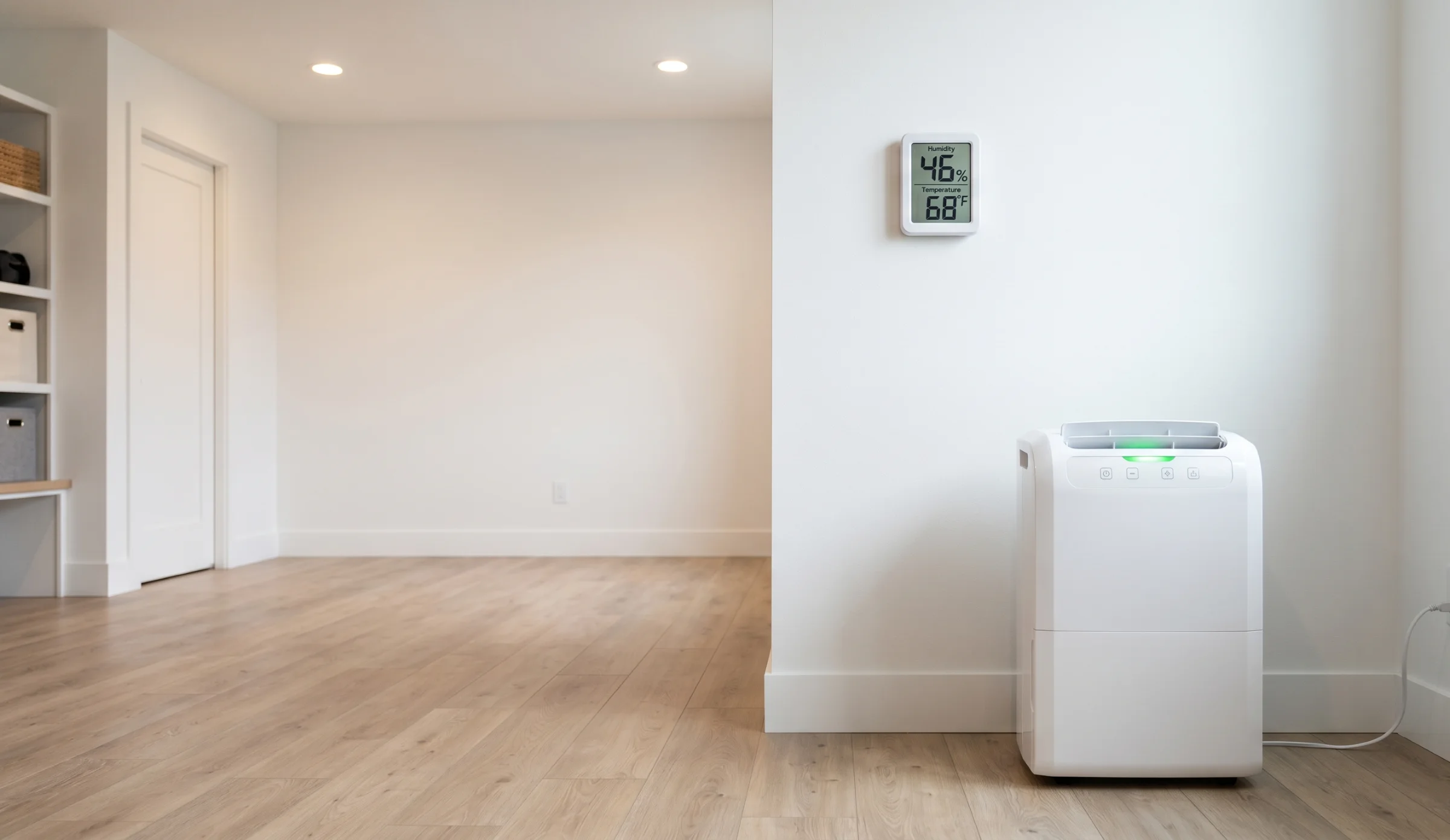
 A reading in the 30 to 50 percent range like this one is the target the EPA sets; above 60 percent is where mold spores begin germinating on organic surfaces.
How to measure humidity. A hygrometer (also called a humidity meter) reads indoor relative humidity in real time. Basic models cost $15–$30 at hardware stores. Place one in each moisture-prone zone: each bathroom, the basement, the laundry room, and any room with condensation on windows. Digital combo units that display both temperature and humidity are most practical.
Tools for lowering humidity:
| Tool | Best application | Effective range | Notes |
|---|---|---|---|
| Central air conditioning | Whole-home cooling season | Removes humidity as byproduct of cooling | Oversized systems short-cycle and leave residual humidity |
| Portable dehumidifier | Basement, crawl space, laundry room | 500–2,500 sq ft depending on unit | Choose models with built-in humidistat and auto-drain |
| Whole-home dehumidifier | Entire home in humid climates | Full home | Installed in HVAC return; most effective in hot/humid regions |
| Exhaust fans | Bathrooms, kitchen | Single-room spike reduction | Must vent to exterior, not attic |
Dehumidifier sizing. For a 1,000 sq ft basement with moderate dampness, a 30–50 pint unit is typically sufficient; a very damp space of the same size needs 50–70 pints. Choose models with a built-in humidistat so the unit cycles automatically rather than running continuously.
A poorly maintained HVAC system with mold can also distribute spores throughout the house regardless of how well other humidity controls are managed.
Ventilation: exhausting moisture before it settles
Ventilation prevents moisture from accumulating in the air of kitchens, bathrooms, and other rooms where water vapor is generated in bursts. Without exhaust ventilation, humid air stays trapped until it condenses on cooler surfaces like walls, ceilings, and window frames.
Bathroom fans. The Home Ventilating Institute (HVI) recommends a minimum of 1 CFM per square foot of bathroom area. A 60 sq ft bathroom needs at minimum a 60 CFM fan. For bathrooms with a shower and no window, sizing up to 80–110 CFM is better practice. Run the fan during every shower and for 20–30 minutes afterward. Fans must exhaust to the exterior through the roof or an exterior wall, never into the attic. Fans ducted into attic spaces are one of the primary causes of attic mold.
 A fan sized for this room needs at least 1 CFM per square foot per HVI standards; ducting it into the attic instead of outside just relocates the moisture problem.
Kitchen exhaust. The HVI recommends range hood fans rated at a minimum of 100 CFM for standard gas or electric ranges. Run the hood fan while cooking and for several minutes after. Keep it clean; grease-clogged filters reduce airflow significantly.
Whole-home ventilation. In tightly sealed modern homes, opening windows is often insufficient for managing moisture. Energy recovery ventilators (ERVs) and heat recovery ventilators (HRVs) exchange stale, humid indoor air for fresh outdoor air while recovering most of the energy cost. These are particularly valuable in cold-climate homes where windows are closed for months at a time.
Common ventilation mistakes:
- Running bathroom fans that exhaust into the attic or a wall cavity rather than outdoors
- Using range hoods that recirculate air through a charcoal filter rather than exhaust it out
- Never running exhaust fans because they are loud or inconvenient, resulting in chronic high humidity
- Opening windows in humid summer weather, which pulls more moisture in than it exhausts
When chronic ventilation failure has allowed mold to establish, when mold remediation is required covers where the prevention threshold ends and professional removal begins.
Leak and water management: cutting off mold at the source
Active leaks and chronic moisture intrusion are the most common triggers for serious mold problems. A slow drip under a sink or a hairline crack in the foundation can sustain the moisture level needed for mold growth for months before visible signs appear.
Plumbing leaks. Inspect under every sink, around the toilet base, at the water heater, and behind the washing machine every six months. Look for staining, mineral deposits, soft flooring, or peeling cabinet interiors. Fix dripping faucets and supply line connections promptly. Mold after water damage documents how quickly colonization follows even minor leaks.
Roof leaks. Inspect the attic after heavy rain for wet insulation, water stains on the decking or rafters, or daylight showing through the roof. Have the roof inspected by a contractor every 3–5 years, and after any major storm.
Foundation and grading. The ground around your foundation should slope away from the house at approximately 5% grade (6 inches of drop over 10 feet) on all sides. Flat or inward-sloping soil channels rainwater toward the foundation and eventually into the basement or crawl space. Extend downspouts at least 4–6 feet from the foundation and clean gutters at least twice yearly to prevent overflow from saturating the soil against the foundation. This is one of the most cost-effective basement mold prevention measures available.
 An extension carrying water 4 to 6 feet out like this does more for basement mold prevention than almost any other five dollar fix available.
Windows and door frames. Condensation on interior window glass indicates high indoor humidity. Water that drips to the sill and soaks into the frame or drywall below creates a persistent mold niche. Reapply exterior caulk around window and door frames every few years and replace cracked glazing compound.
Condensation on pipes. Cold water pipes in warm, humid spaces develop condensation that drips and wets surrounding framing or insulation. Insulate cold water pipes in basements, crawl spaces, and any uninsulated wall cavity to bring the pipe surface temperature above the dew point.
Room-by-room mold prevention
Prevention priorities differ by location because each room generates moisture differently and dries at a different rate. A bathroom produces a humidity spike within minutes of a shower starting, while a basement stays elevated for months at a time from ground moisture alone, so the same humidity target and cleaning schedule that keeps one room mold-free can leave the other exposed.
| Location | Top prevention actions | Key frequency | Why it matters |
|---|---|---|---|
| Bathroom | Run exhaust fan 20–30 min after shower; squeegee walls; re-caulk grout annually | Daily / annually | Highest per-sq-ft humidity load in the home |
| Kitchen | Run range hood fan while cooking; wipe up spills immediately; check under-sink plumbing | Daily / quarterly | High humidity from cooking plus frequent small leaks |
| Basement | Maintain dehumidifier at 50% RH; grade foundation soil away from house; inspect sump pump | Year-round / seasonally | Below-grade location collects moisture from soil and air |
| Crawl space | Install 6-mil poly vapor barrier; seal foundation vents in humid climates; dehumidify | Install once; inspect annually | Ground moisture migrates directly into wood framing |
| Attic | Confirm bath/dryer exhausts vent to exterior; maintain ridge and soffit ventilation | Inspect annually | Exhaust fan misrouting and inadequate ventilation cause most attic mold |
| HVAC system | Change filters every 1–3 months; clean condensate drain pan annually | Monthly / annually | A mold-contaminated HVAC system distributes spores throughout the home |
| Laundry room | Verify dryer vents to exterior; don't leave wet laundry in machine; run exhaust fan | Per use | Dryer steam and wet clothing are concentrated moisture sources |
| Bedroom / living areas | Monitor humidity with hygrometer; fix window condensation; avoid carpet in basement bedrooms | Monthly check | Low-humidity areas can develop problems from hidden leaks or poor insulation |
Crawl space mold warrants its own prevention approach given the combination of ground moisture, limited airflow, and direct wood framing exposure.
After a water event: the 24–48 hour window
Drying materials within 24–48 hours of any water event is the most time-critical mold prevention action a homeowner can take. Per the IICRC S520 standard and EPA guidance, mold colonization on wet organic materials typically begins within 24–48 hours at normal indoor temperatures.
 Carpet padding this saturated almost always needs replacement rather than drying, since it rarely returns to safe moisture content within the 24 to 48 hour window that prevents colonization.
Immediate steps after a spill, leak, or minor flood:
- Stop the water source if possible (shut off supply valve, apply temporary patch to roof).
- Remove standing water with a wet/dry vacuum or mop immediately.
- Pull back any soaked carpet or rugs and dry both the carpet and the subfloor separately. Carpet padding almost always requires removal and replacement.
- Place fans to maximize airflow across wet surfaces. A standard box fan moves about 1,000–2,500 CFM; position it to exhaust humid air out a window or doorway rather than circulating it.
- Run a dehumidifier in the affected space.
- Use a moisture meter (available at hardware stores for $20–$60) to confirm the structural materials are returning to baseline. Wood framing is considered dry when moisture content reads below 19%.
- If walls or subfloor materials remain wet after 24–48 hours despite active drying, the affected material may need to be opened or removed.
For significant water intrusion, involving a professional water mitigation contractor within the first few hours gives the best chance of staying inside the drying window.
Mold-resistant materials for renovations and repairs
Choosing the right materials during renovations dramatically reduces long-term mold risk, particularly in bathrooms, basements, and kitchens where moisture exposure is regular.
Drywall. Standard drywall uses a paper facing that mold colonizes readily when wet. Mold-resistant drywall (fiberglass-faced gypsum board) eliminates the paper layer, removing the primary food source. Products include USG Sheetrock Mold Tough and National Gypsum Gold Bond. These are appropriate for any high-moisture area. Note that water-resistant "green board" drywall still has a paper facing and offers less protection than fiberglass-faced board.
 Fiberglass-faced board like this removes the paper layer mold feeds on; green board still has that paper facing and offers meaningfully less protection despite the similar name.
Paint. Mold-inhibiting paint additives or factory-formulated mold-resistant paints contain antimicrobial compounds that slow surface colonization. The CDC recommends adding mold inhibitors to paints used in kitchens and bathrooms. These products slow mold regrowth on painted surfaces but are not a substitute for moisture control and cannot be used to paint over existing mold.
Caulk and grout sealers. Mold-resistant caulk contains fungicidal additives that resist the pink, black, and gray mold that commonly colonizes grout joints and caulk lines around tubs, showers, and sinks. Re-caulk shower and tub surrounds every 1–3 years, as cracked caulk allows water intrusion behind tile.
Insulation. Fiberglass batt insulation and mineral wool (rock wool) are both naturally mold-resistant because they are made from inorganic materials that mold cannot use as a food source. Cellulose insulation (recycled paper) is significantly more vulnerable to mold when wet and should not be used in spaces with a history of moisture problems. Closed-cell spray foam creates an air and vapor barrier that eliminates condensation in wall cavities and is the most mold-resistant option for basement rim joists and crawl space walls.
Flooring. Carpet holds moisture and provides an ideal substrate for mold. The CDC recommends against using carpet in bathrooms, basements, or any below-grade space. Ceramic tile, porcelain tile, sealed concrete, and luxury vinyl plank are all moisture-resistant alternatives. If carpet is used in a basement, ensure it sits over a vapor barrier, not directly on concrete.
Subflooring. Tongue-and-groove OSB and standard plywood both mold readily when wet. Pressure-treated plywood and products like Huber AdvanTech (a moisture-resistant engineered wood) offer better performance in areas prone to water exposure.
Inspection and monitoring: catching problems early
Regular inspections catch the conditions that lead to mold before visible growth appears. Early detection is far less costly than remediation: the average mold remediation cost runs $1,500–$6,000 nationally, while addressing a moisture source early typically costs a fraction of that.
Once growth is confirmed, mold remediation covers what the removal process involves, the scope of professional work, and how to choose a contractor.
Monthly checks:
- Read hygrometers in high-risk areas and confirm readings are within 30%–50%
- Look under bathroom and kitchen sinks for evidence of drips or soft cabinet interiors
- Check HVAC condensate drain pan for standing water or discoloration
Quarterly checks:
- Inspect washing machine supply hoses and drain connection for leaks
- Check water heater for corrosion or drips at the fittings
- Run a visual check around window frames and door frames for condensation staining
- Inspect the sump pump pit and test the float if applicable
Annual checks:
- Inspect the attic after the first heavy rain of the season for wet insulation or stained decking
- Walk the basement and crawl space perimeter looking for efflorescence, staining, or soft wood
- Check gutters and downspout extensions and clear any debris
- Have a professional inspect the roof every 3–5 years
 An annual walk-through like this catches efflorescence and soft wood while the fix is still cheap, well before it becomes a $1,500 to $6,000 remediation project.
When to call a professional. If you find staining, a persistent musty odor, or conditions you cannot attribute to an obvious source, a mold inspection by a credentialed professional (IICRC AMRT or ACAC CIEC certified) can determine whether mold is present behind surfaces and identify the moisture source. If visible mold covers more than 10 square feet, professional remediation is recommended over a DIY approach.
Prevention cost: what the tools and upgrades actually cost
Prevention is substantially less expensive than remediation, which averages $1,500–$6,000 nationally. A hygrometer or an upgraded exhaust fan runs a fraction of that cost and, installed before a moisture problem takes hold, can eliminate the need for professional remediation entirely.
| Tool or upgrade | Typical cost | Frequency | Payoff vs. remediation |
|---|---|---|---|
| Digital hygrometer | $15–$30 per unit | One-time | Identifies humidity problems before mold appears |
| Portable dehumidifier (basement) | $150–$350 | Every 5–10 years | Prevents $1,500–$6,000 remediation projects |
| Whole-home dehumidifier (installed) | $1,200–$2,800 | Every 8–15 years | Most effective in hot/humid climates |
| Bathroom exhaust fan upgrade | $150–$400 installed | Every 10–15 years | Prevents chronic bathroom humidity |
| Gutter cleaning | $100–$250 per service | 1–2 times per year | Prevents foundation water intrusion |
| Downspout extensions | $5–$20 per extension | One-time | Directs water away from foundation |
| Foundation regrading | $500–$3,000 | One-time | Addresses chronic basement seepage |
| Mold-resistant drywall (per room) | $0.50–$1.00/sq ft premium over standard | One-time at renovation | Reduces long-term risk in bathrooms and basements |
| Crawl space vapor barrier (installed) | $1,200–$4,000 | Every 15–25 years | Prevents crawl space and subfloor mold |
| Moisture meter | $20–$60 | One-time | Confirms drying after water events |
The most cost-effective combination for most homes is a hygrometer in each high-humidity area, a dehumidifier in the basement or crawl space if relative humidity exceeds 60% regularly, and prompt repair of any leak within 24 hours of discovery. For patches under 10 square feet on non-porous surfaces, DIY mold removal is within scope for most homeowners and avoids the cost of professional remediation entirely.
Frequently asked questions
What is the most effective way to prevent mold in your home?
Moisture control is the single most effective mold prevention strategy, specifically keeping indoor relative humidity at 30%–50% using a combination of exhaust ventilation, dehumidification, and prompt leak repair. No cleaning product, paint, or air purifier prevents mold if a chronic moisture source is not resolved first.
What humidity level prevents mold growth?
Mold growth is suppressed when indoor relative humidity stays below 60%. The EPA and CDC both recommend a target of 30%–50% as the ideal range. A basic hygrometer ($15–$30) lets you monitor levels in real time. Note that humidity fluctuates throughout the day, so checking periodically gives a more accurate picture than a single reading.
How long does it take for mold to grow after a water leak?
Mold can begin growing within 24–48 hours of a water event on wet organic materials at normal indoor temperatures. This timeline is cited by both the IICRC S520 standard and EPA guidance and applies to drywall, wood framing, carpet, and insulation. Drying materials below 19% moisture content within that window prevents colonization.
Do dehumidifiers prevent mold?
Yes, dehumidifiers are one of the most reliable tools for mold prevention in moisture-prone spaces. Choose a unit sized to the square footage of the space and set the built-in humidistat to maintain 50% relative humidity or below. Models with continuous drain hoses eliminate the need to empty a reservoir manually, which matters in very damp spaces where the reservoir fills quickly.
Does mold-resistant drywall actually work?
Mold-resistant drywall significantly outperforms standard paper-faced drywall in wet conditions because it removes the paper layer that mold uses as a food source. It will not prevent mold growth if water pools against it or if there is a persistent leak behind it; moisture control must accompany the material choice.
Can I paint over mold to stop it from spreading?
No. The CDC and EPA both state that painting over mold does not stop growth. Mold continues to grow beneath the paint and will eventually break through. Mold must be fully removed before repainting. Mold-inhibiting paint additives are useful as a preventive measure on clean surfaces only.
Does air conditioning prevent mold?
Air conditioning removes moisture as a byproduct of cooling and helps suppress mold growth during humid months. However, an oversized AC unit short-cycles before removing adequate humidity, leaving the air cool but still damp. If your home feels clammy despite running AC, have a technician verify the system is correctly sized for the square footage.
How do I prevent mold in a bathroom with no window?
Install an exhaust fan rated at minimum 1 CFM per square foot of bathroom floor area (HVI standard). Run it during and for 20–30 minutes after every shower. Squeegee shower walls after use, leave the shower door or curtain open to allow airflow, and clean grout and caulk lines regularly with a mold-killing product.
Sam Hickerson is the founder of RestoreAdvisor and writes consumer guides on mold remediation, water damage restoration, inspection, testing, and home recovery. His work focuses on helping homeowners understand costs, risks, and when to call a professional. He draws on guidance from the EPA, CDC, IICRC, and other authoritative sources to make complex home issues easier to navigate.