
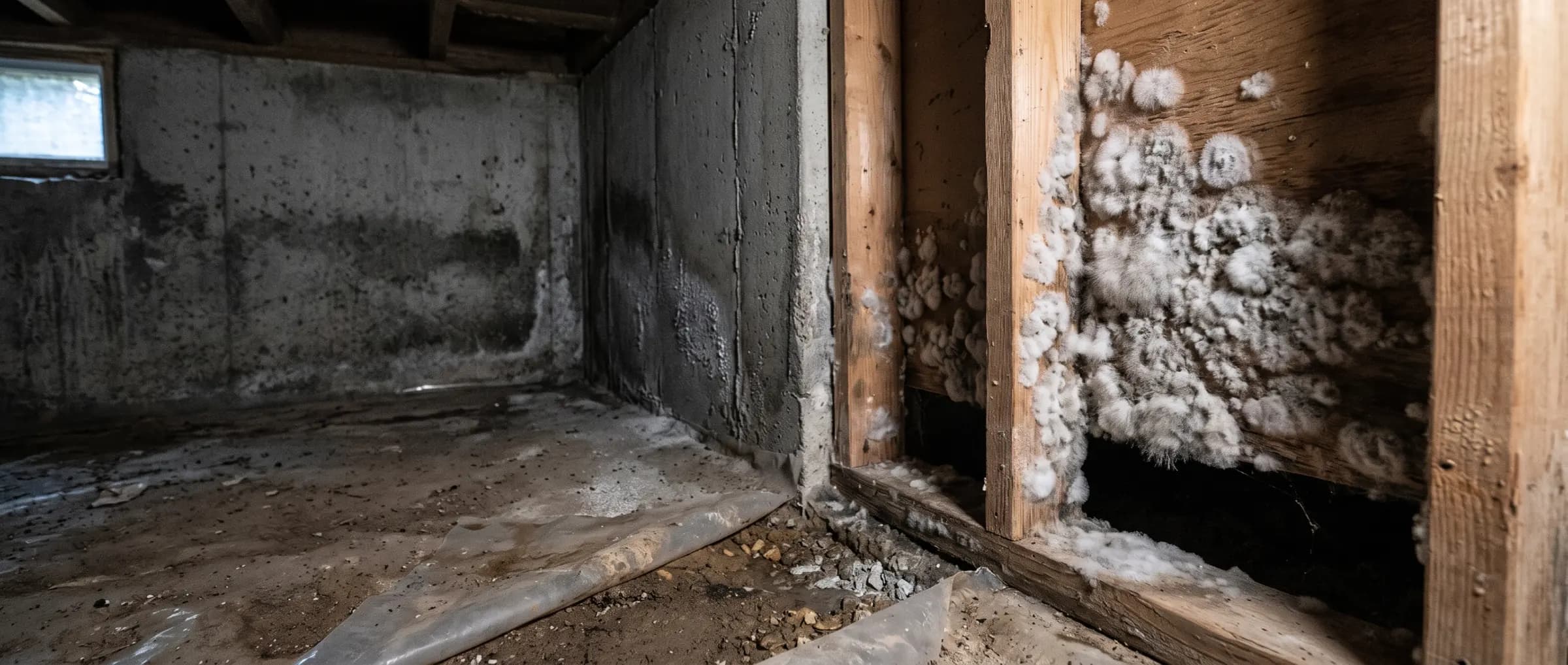

Finding a fast-growing white or gray patch behind a houseplant, near an HVAC vent, or in a damp closet is unsettling, especially once a quick search turns up the word mucormycosis. For most healthy households, mucor mold is a cleanup problem rather than a medical emergency. Understanding how to identify it, who actually faces infection risk, and when a small patch crosses the line from DIY mold removal to professional help makes the decision straightforward.
Mucor is a genus of fast-growing fungi in the order Mucorales, identified by its tall, cotton-like colonies and rapid spread compared to most other household mold, according to CDC classification and ANSI/IICRC S520 standards. It is one of the molds capable of causing mucormycosis, a rare infection that almost exclusively affects people with significantly weakened immune systems.
Key insights
- Fast grower. Mucor can produce a visible colony within 24 to 48 hours of sustained moisture, faster than slower genera like Aspergillus or Penicillium.
- Color changes with age. Fresh mucor is white or pale yellow and fluffy. It darkens to gray, beige, or brown as it matures and sporulates.
- Mucormycosis is rare. The infection mainly affects people with diabetes, cancer, organ transplants, or other conditions that suppress the immune system.
- Common indoor locations include HVAC components, overwatered plant soil, water-damaged carpet, and condensation-prone surfaces near vents and windows.
- The EPA's 10-square-foot rule still applies. Small, nonporous patches are usually DIY-appropriate; larger or porous contamination calls for a professional.
- Lab confirmation matters. Mucor cannot be reliably distinguished from other white or gray molds by eye alone.
What is mucor mold
Mucor is a genus of roughly 40 fast-growing fungal species found in soil, decaying organic matter, and damp indoor surfaces, with colonies that start white or pale yellow and darken to gray as spores form. Under a microscope, mucor's hyphae branch at wide angles and lack the root-like rhizoids found in its close relative Rhizopus, which is one reason lab analysis rather than a visual check is needed to confirm species. It's also one of the more common molds found on stored food, particularly bread and soft fruit, which is why it's sometimes called bread mold outside the context of home remediation.
 Mucor's tall thread-like hyphae topped with black sporangia distinguish it from flatter household molds like Aspergillus and Penicillium; the same cottony structure appears on damp wood, drywall, and stored food indoors.
Visually, mucor stands apart from flatter household mold because it grows upward in a cottony, almost fur-like mass that can reach noticeable height within days. A mold testing air or surface sample is the only reliable way to confirm mucor rather than a similar-looking species, since color and texture alone leave room for misidentification.
| Growth stage | Color | Texture | Typical timeline |
|---|---|---|---|
| Early | White to pale yellow | Fluffy, cotton-like | 24–48 hours after moisture exposure |
| Mature | Gray to beige | Dense, slightly fuzzy | 3–7 days |
| Sporulating | Dark gray to brown | Powdery surface, tall growth | 1–2 weeks |
Mucor vs white mold
A color description rather than a species name, white mold can refer to several different genera, and mucor is one of the more common ones found indoors. Aspergillus, Penicillium, and Trichoderma can all appear white in early growth stages before darkening, which means a homeowner cannot tell mucor apart from these look-alikes without testing.
What separates mucor from most of its white-colored counterparts is speed and shape. Where Aspergillus and Penicillium tend to form flatter, more compact colonies, mucor grows tall and cottony and can visibly expand across a surface within a day or two of finding consistent moisture.
Rhizopus is the closest visual match and the genus most often confused with mucor, since both start white and grow quickly. The two are typically grouped together in casual references to mucormycosis-causing molds, even though only a lab can confirm which one is actually present on a given surface. Either way, pinning down the species matters less for a homeowner than knowing when professional remediation is required in the first place.
| Species | Initial color | Growth pattern | Health concern |
|---|---|---|---|
| Mucor | White to pale yellow, darkening to gray | Tall, fast, cottony | Allergic reaction; mucormycosis in high-risk people |
| Aspergillus | White to yellow-green | Flat, powdery | Allergic reaction; aspergillosis in high-risk people |
| Penicillium | White to blue-green | Velvety, compact | Allergic reaction; rare infection in immunocompromised people |
| Trichoderma | White, becoming green | Wooly patches | Allergic reaction; wood decay |
| Rhizopus | White, becoming gray-black | Fast, with root-like rhizoids | Most common cause of mucormycosis |
Where mucor mold grows in your home
Mucor needs sustained moisture and organic material, which is why it shows up most often around HVAC components, overwatered houseplants, and surfaces that stay damp for days rather than hours. Unlike condensation-only molds that need just a humid surface, mucor also feeds readily on dust, soil, and decaying plant matter, which broadens the list of places it can establish itself.
 Mold on HVAC registers forms where condensation meets accumulated dust; per IICRC S520, vent contamination requires professional assessment since disturbing it without containment spreads spores through the entire duct system.
Indoor air ducts and the surfaces around them are a frequent source, since condensation inside an HVAC system combines moisture with accumulated dust. Stored seeds, pet food, and houseplant soil that stays consistently moist are another common starting point, along with water-damaged carpet and any surface that has gone through a slow leak without proper drying.
Below-grade rooms add a second layer of risk: a finished or unfinished basement often combines higher ambient humidity with reduced airflow, the exact conditions mucor needs to establish quickly. A space that already runs damp for other reasons gives mucor a head start compared to a well-ventilated room with the same moisture event.
| Location | Why mucor grows there | DIY or pro |
|---|---|---|
| HVAC vents and ducts | Condensation plus dust accumulation | Pro |
| Houseplant soil | Overwatering and decaying organic matter | DIY if isolated to soil |
| Carpet and padding | Water damage that wasn't fully dried | Depends on size and source |
| Bathroom and kitchen surfaces | Recurring humidity and food residue | DIY if under 10 sq ft |
| Window sills | Condensation from temperature differences | DIY if nonporous |
| Stored food and seeds | Residual moisture before storage | Discard affected items |
Is mucor mold dangerous
For most healthy people, mucor mold causes the same allergic and respiratory symptoms as other common household mold: sneezing, congestion, itchy eyes, and a sore throat from spore exposure. The bigger concern is reserved for people with significantly weakened immune systems, where certain Mucor species can cause a serious infection.
Mucor mold belongs to the order Mucorales, the group of fungi responsible for mucormycosis, a rare but potentially life-threatening infection in people whose immune defenses are already compromised, per the CDC. Outside of that population, exposure to mucor in a home is treated the same as exposure to any other allergenic mold: an irritation and allergy issue, not an infection risk.
Mucormycosis: who's actually at risk
People with poorly controlled diabetes, blood cancers, recent organ or stem cell transplants, long-term steroid use, or severe burns and wounds carry meaningfully elevated risk for mucormycosis, according to CDC clinical guidance. Healthy people with normal immune function almost never develop the infection, even with regular exposure to mucor spores, which are present in soil and air nearly everywhere.
 Poorly controlled diabetes is the leading risk factor for mucormycosis; the CDC recommends that immunocompromised patients seek professional mold removal rather than attempting cleanup themselves.
For households with a high-risk member, a professional mold inspection and removal are worth the cost even for a small colony, since the goal is eliminating spore exposure entirely rather than just visible growth. The infection requires both exposure to a Mucorales fungus and an underlying condition that prevents the immune system from clearing it before it takes hold.
The infection itself develops when fungal spores enter the body through the sinuses, lungs, skin, or digestive tract and the body's weakened defenses fail to clear them before they invade surrounding tissue and blood vessels. The CDC names five clinical types based on where the infection takes hold: rhinocerebral mucormycosis affecting the sinuses, eyes, and brain; pulmonary mucormycosis in the lungs; cutaneous mucormycosis through a wound or burn; gastrointestinal mucormycosis from ingestion; and disseminated mucormycosis, where infection spreads through the bloodstream to multiple organs.
| Risk factor | Why it matters |
|---|---|
| Uncontrolled diabetes | Impairs the immune cells that normally clear fungal spores |
| Blood cancers or chemotherapy | Suppresses white blood cell production |
| Organ or stem cell transplant | Anti-rejection drugs suppress immune response |
| Long-term steroid use | Reduces the body's ability to fight fungal infection |
| Severe burns or open wounds | Provides a direct entry point for the fungus |
How to remove mucor mold
Removing mucor mold means scrubbing the colony off a nonporous surface with detergent or hydrogen peroxide, or cutting out and replacing the material if it's porous, per EPA cleanup recommendations and the surface-cleaning thresholds set in IICRC S520. A patch under 10 square feet on tile, glass, or sealed countertop is generally DIY-appropriate, while larger or porous areas call for a professional.
 The EPA recommends an N95 respirator, gloves, and eye protection for any DIY mold cleanup; patches larger than 10 square feet or on porous materials require a certified professional per IICRC S520.
The right product depends on the surface. Detergent and hydrogen peroxide work on most nonporous materials without the fumes or surface damage bleach can cause, and bleach itself should be reserved for hard, nonporous surfaces since it cannot reach mold growing inside porous material.
| Product | Dilution | Dwell time | Best for | Limitation |
|---|---|---|---|---|
| Dish detergent | 1 tsp per cup of warm water | 5–10 minutes | Tile, glass, sealed countertop | Limited disinfecting power |
| Hydrogen peroxide | 3% solution, undiluted | 10 minutes | Nonporous surfaces, grout | Can lighten colored grout or fabric |
| White vinegar | Undiluted, 5% acetic acid | 1 hour | Nonporous surfaces, mild cases | Strong odor during application |
| Bleach | 1 cup per gallon of water | 10 minutes | Hard, nonporous surfaces only | Ineffective on porous materials; do not use on wood or drywall |
1. Confirm the patch is small and nonporous
Measure the affected area. If it is under 10 square feet and on tile, glass, metal, or sealed countertop, DIY cleanup is appropriate per EPA guidance.
2. Suit up before you touch it
Put on an N95 respirator, gloves, and goggles. Open a window if one is nearby and close the door to the room.
3. Mix a detergent or hydrogen peroxide solution
Combine dish detergent with warm water, or use 3% hydrogen peroxide straight from the bottle. Avoid bleach on porous materials.
4. Scrub the colony off the surface
Work in small sections, scrubbing until the visible growth is gone rather than just discolored.
5. Dry the surface completely
Use a fan or dehumidifier to bring the surface to fully dry within 24 to 48 hours so spores cannot reestablish.
6. Bag and dispose of cleanup materials
Seal sponges, rags, and gloves in a plastic bag before throwing them away to avoid spreading spores through the house.
Mucor on carpet, drywall, or other porous material rarely cleans up completely with surface scrubbing, since the growth penetrates the material rather than sitting on top of it. The same applies anytime mucor turns up inside HVAC ductwork, since disturbing it without proper containment during mold remediation risks spreading spores through the entire duct system.
The affected area is larger than 10 square feet
A patch this size has typically had time to establish a colony with deeper spore penetration, even on materials that look cleanable.
The mold is growing on drywall, carpet, insulation, or another porous material
Scrubbing the surface leaves spores embedded below, which is why these materials are usually cut out and replaced rather than cleaned.
Mucor is inside HVAC ductwork or the air handler
Cleaning inside ductwork without proper containment and negative air pressure can push spores throughout the home instead of removing them.
Anyone in the household has diabetes, cancer, a transplant, or another condition that weakens immunity
Professional removal with verified clearance testing reduces exposure risk for someone who cannot safely fight off a fungal infection.
The mold keeps returning after cleaning
Recurrence after a proper cleaning attempt usually means the underlying moisture source was never fixed.
You cannot identify or fix the moisture source causing the growth
Removal without correcting the moisture problem only delays regrowth, often within days given how fast mucor spreads.
What removal typically costs
Mucor mold removal generally runs $300 to $6,000, with the price driven by how much material has to be cut out, whether HVAC components are involved, and the size of the affected area rather than the species itself. A small surface job on tile or sealed countertop sits at the low end, while jobs involving carpet replacement, drywall removal, or duct cleaning push toward the higher end of the remediation cost range.
 IICRC S520 sets 16% moisture content as the clearance threshold after remediation; a reading above this level means the material is still too wet and mold can reestablish.
Labor typically accounts for the largest share of the bill, since containment setup, HEPA filtration, and disposal of contaminated material take more time than the actual cleaning step. Jobs that require coordinating a separate plumber or HVAC technician to fix the underlying moisture source before remediation begins tend to land toward the higher end of their scenario's range.
| Scenario | Typical cost |
|---|---|
| Small surface patch (under 10 sq ft, nonporous) | $300–$800 |
| Carpet or padding replacement | $800–$2,500 |
| Drywall removal and replacement | $1,200–$3,500 |
| HVAC duct cleaning and treatment | $1,500–$5,500 |
| Multi-room or whole-house job | $4,000–$8,000+ |
Most homeowners insurance policies treat mold removal the same regardless of species, covering it when the underlying cause, such as a sudden pipe burst, is a covered peril and excluding it when the moisture is from a slow, unaddressed leak. Checking the policy's mold sublimit before assuming full coverage is worthwhile, since most policies cap mold-specific payouts well below the cost of a larger job.
How to prevent mucor mold from coming back
Preventing mucor comes down to controlling moisture and organic debris, since the fungus needs both to establish a colony in the first place. Keeping indoor relative humidity below 60% addresses the moisture half of that equation across the whole house, not just the specific spot where mold was found.
 A clogged HVAC condensate drain creates standing water that combines with dust accumulation to feed mold growth; quarterly drain line inspections are one of the most effective prevention steps for mucor specifically.
Houseplants, stored food, and HVAC condensate drains deserve particular attention because they combine moisture with the organic material mucor feeds on most readily. A consistent maintenance routine in these areas does more to prevent recurrence than any one-time cleaning effort.
Because mucor establishes itself faster than most household mold, the prevention window after any water event is shorter than usual. Drying a wet area within a day, rather than waiting two or three, makes the biggest difference on top of the routine mold prevention habits that matter across every mold type, not just this one.
| Prevention action | Frequency | Why it works |
|---|---|---|
| Keep indoor humidity below 60% | Continuous, monitor with hygrometer | Removes the moisture mucor needs to establish |
| Check HVAC condensate drain lines for clogs | Quarterly | Prevents standing water and dust buildup near vents |
| Avoid overwatering houseplants | Ongoing | Reduces consistently damp soil, a common mucor source |
| Dry water-damaged carpet within 24–48 hours | As needed after any leak or spill | Matches mucor's fast colonization window |
| Store food and seeds in airtight, dry containers | Ongoing | Eliminates a moisture and organic-matter source |
| Inspect window sills for condensation | Monthly during heating season | Catches early moisture before mold establishes |
| Schedule an inspection after any water event | Within a week of the event | Confirms drying was complete before mold has time to grow |
If a patch shows up repeatedly in the same spot despite cleaning, that's usually a sign the moisture source itself was never addressed rather than a sign the signs of mold were missed the first time. Tracking down and fixing that source is what actually stops mucor from returning.
Frequently asked questions
Can mucor mold be black or dark colored?
Yes, mature colonies darken from white to gray, beige, or brown as they sporulate, though true black coloring is unusual. A black patch is more likely Stachybotrys or Aspergillus niger, which is another reason lab testing matters more than color alone.
Does mucor mold have a smell?
Yes, established colonies produce a musty odor from the compounds they release as they grow, and the smell can show up before the colony is visible enough to spot by eye.
Can mucor mold grow on food?
Yes, mucor is a common contaminant of bread, fruit, and other stored food, which is one reason it's sometimes called bread mold. Discard contaminated food rather than cutting around the visible growth.
Will an air purifier remove mucor mold?
No, not on its own. An air purifier can capture airborne spores but won't remove an existing colony or fix the moisture feeding it, so it works alongside removal and moisture control rather than replacing them.
Is mucor the same as mucormycosis?
No. Mucor is the mold genus. Mucormycosis is the infection that some Mucorales fungi, including certain Mucor species, can cause in people with weakened immune systems. Most people exposed to mucor never develop the infection.
How fast does mucor mold grow?
Faster than most household mold species. Mucor can establish visible colonies within 24 to 48 hours of sustained moisture exposure and spreads across a surface more quickly than slower-growing genera like Aspergillus or Penicillium.
Can mucor mold spread from one room to another?
Yes, especially through HVAC systems, which can carry spores from a contaminated duct or vent into rooms with no other moisture problem. Fixing the source and having ductwork professionally cleaned, rather than treating each room separately, is what stops the spread.
Sam Hickerson is the founder of RestoreAdvisor and writes consumer guides on mold remediation, water damage restoration, inspection, testing, and home recovery. His work focuses on helping homeowners understand costs, risks, and when to call a professional. He draws on guidance from the EPA, CDC, IICRC, and other authoritative sources to make complex home issues easier to navigate.