
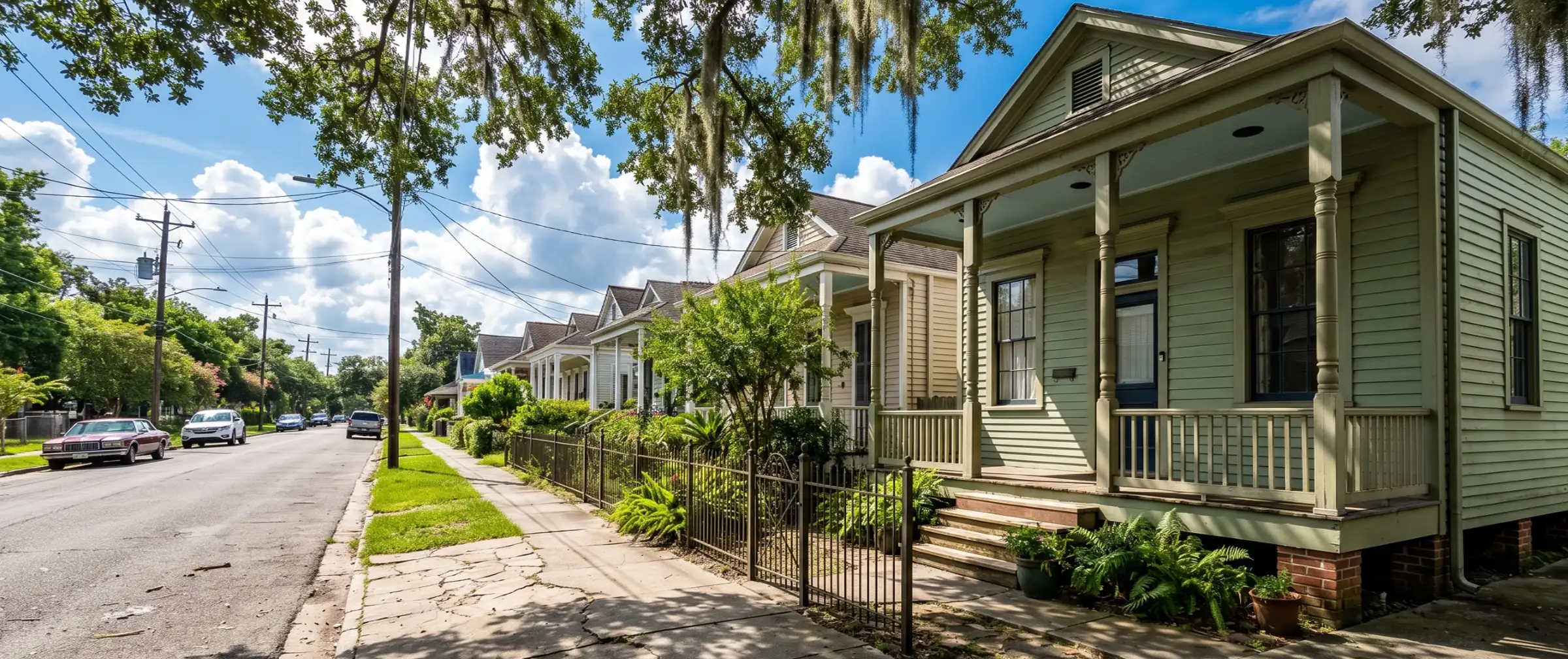

New Orleans sits below sea level, bordered by Lake Pontchartrain and the Mississippi River, in a subtropical climate that averages 63 inches of annual rainfall and 76% relative humidity year-round. When you add two decades of hurricane flooding to that baseline (Katrina in 2005, Ida in 2021) the result is a housing stock with mold risk unlike any other American city. For New Orleans homeowners, mold is not an occasional problem. It is a year-round structural reality that requires a contractor who understands both local conditions and Louisiana's specific licensing requirements.
Mold remediation in New Orleans is the professional process of identifying, containing, removing, and treating mold-contaminated building materials, governed by Louisiana Revised Statutes §37:2156 and administered by the Louisiana State Licensing Board for Contractors (LSLBC), and conducted per the ANSI/IICRC S520 Standard for Professional Mold Remediation.
Key insights
- 63 inches of annual rainfall. New Orleans and Miami receive more annual precipitation than any other major U.S. cities, per NOAA data from the NWS New Orleans/Baton Rouge office. Both average over 60 inches per year, creating year-round mold pressure that never fully lets up between storm seasons.
- 80% of the city flooded in 2005. When the levees failed after Hurricane Katrina, floodwaters inundated 134,000 housing units (70% of all occupied units in New Orleans). Floodwaters stayed for up to 43 days in lower-lying areas, generating what the CDC documented as the most severe urban mold event in U.S. history.
- Louisiana's $7,500 license threshold. Any mold remediation job with labor and materials exceeding $7,500 requires an LSLBC Mold Remediation license. Act 422, effective August 1, 2025, raised net worth requirements for licensees and strengthened enforcement.
- The Healthy Homes Ordinance. New Orleans' 2022 city ordinance, fully phased in by January 2025, explicitly prohibits mold in rental units and has levied over $420,000 in fines in its first enforcement phases.
- Average 90% morning humidity. New Orleans averages 90% morning relative humidity year-round, well above the EPA's 60% threshold above which mold grows readily, meaning HVAC systems must run 10–11 months annually just to keep indoor conditions in an acceptable range.
- Delayed-onset mold is the hidden risk. Homes flooded in 2005 that were not fully gutted and dried often developed secondary mold growth years later as residual moisture migrated through wall cavities and subflooring. Buyers of pre-2010 homes in flood zones should treat Katrina-era damage as an unresolved risk until an independent inspection confirms otherwise.
What mold remediation costs in New Orleans
New Orleans mold remediation costs run 10–20% above national averages, driven by year-round humidity that extends drying timelines, a labor market shaped by two decades of post-storm demand, and Louisiana's licensing requirements that set a quality floor for larger jobs. The national average for remediation sits at $1,500–$6,000; in New Orleans, mid-range projects typically land at $1,500–$6,500, with post-flood or multi-room jobs frequently exceeding $10,000.
 A reading past 19% like this one confirms active mold risk under IICRC S520, well before bubbling paint alone would have told a homeowner the wall behind it was still wet.
The per-square-foot rate in New Orleans runs $10–$25 for standard remediation. Jobs involving structural wood replacement, HVAC cleaning, or Stachybotrys chartarum protocols push toward the upper range or beyond. Clearance testing is a separate cost of $300–$700 for air sampling and lab analysis; it should always be performed by a firm different from the one that did the mold remediation cost work.
| Project scope | Typical cost | Local cost drivers | Notes |
|---|---|---|---|
| Small patch (under 10 sq ft) | $500–$1,500 | Containment setup, HEPA vacuuming, antimicrobial treatment | Below LSLBC license threshold |
| Single room (bathroom, bedroom) | $1,500–$3,500 | Drywall or tile removal, extended drying in high humidity | Most common residential job type |
| Multi-room or post-storm | $4,000–$10,000 | Structural wood treatment, HVAC inspection, clearance testing | Often triggers LSLBC license requirement |
| Whole-home or flood remediation | $10,000–$30,000+ | Full gut and rebuild, soda blasting, foundation drying | Post-Katrina/Ida legacy repairs included |
| HVAC system mold | $1,500–$6,000 | Coil cleaning, duct treatment, condensate drain correction | Common due to 10–11 month A/C season |
| Clearance testing (standalone) | $300–$700 | Air sampling, lab analysis, written report | Required for IICRC S520 compliance |
| Standalone inspection | $250–$500 | Moisture metering, visual assessment, scope documentation | Use a separate firm from your remediator |
Post-storm surge pricing is a real factor in New Orleans. After major named storms, contractor demand spikes and wait times stretch to 2–4 weeks. Documented surge premiums of 15–25% above normal rates are common in the months following a significant hurricane. If your home sustained wind or water damage, the mold after water damage timeline matters. The 48-hour window for effective drying to prevent mold growth is often missed in mass-casualty storm events, and the remediation scope expands accordingly.
Location within the home also shapes cost significantly in New Orleans, where construction type varies by neighborhood and era. A bathroom in a 1920s shotgun house presents different access and material challenges than the same square footage in a 1980s slab-construction home in Gentilly.
| Location in home | Typical cost | New Orleans-specific context |
|---|---|---|
| Bathroom | $500–$2,500 | High humidity from minimal ventilation in older shotgun houses; window A/C units create condensation on walls |
| Crawl space / under-floor | $1,500–$5,000 | Raised pier-and-beam construction common pre-1960s; ground moisture wicks up from below-grade soil |
| Attic | $1,500–$6,000 | Hurricane wind damage exposes sheathing to rain; roof penetrations common in aging housing stock |
| Basement | Rare | True basements are uncommon; raised slab and pier construction dominate |
| HVAC ducts and air handler | $1,500–$6,000 | Near-continuous operation creates sustained condensation risk on coils and drain pans |
| Whole wall cavity (post-storm) | $3,000–$10,000+ | Katrina and Ida homes with unresolved flood damage may have mold behind intact finishes |
Why New Orleans mold risk is different
New Orleans carries a higher baseline mold risk than any other major American city, driven by 63 inches of annual rainfall, 76% average year-round humidity, a geography that sits largely below sea level, and a hurricane history that has flooded the majority of the city's housing stock within the past two decades. No other urban market combines all four of those factors simultaneously.
 Water at this depth stayed in some lower-lying areas for up to 43 days after the 2005 levee failures, the kind of sustained saturation that produces the city's most severe mold cases even now.
When Hurricane Katrina made landfall on August 29, 2005, the levee failures inundated approximately 80% of the city. The CDC and a separate MMWR report documented that floodwaters remained in lower-lying areas for up to 43 days. Environmental researchers estimated that more than 100,000 homes sustained significant mold damage, and a 2006 peer-reviewed study published in Environmental Health Perspectives measured indoor mold spore concentrations as high as 645,000 spores per cubic meter inside New Orleans homes (more than twelve times the threshold considered very high).
Hurricane Ida's Category 4 landfall on August 29, 2021, exactly 16 years after Katrina, produced a second wave of mold claims across southeast Louisiana. The Louisiana Department of Health issued guidance stating that almost all properties damaged by Ida and subject to rainwater would develop mold growth. A 2024 NIH-published study interviewing 238 residents and 68 remediation workers in the New Orleans area found that despite improved knowledge of safety practices since Katrina, adherence to recommended cleanup protocols had not kept pace. Hidden mold from Ida-related repairs is likely still present in a meaningful portion of affected homes.
HVAC systems are the non-storm driver that operates year-round. With A/C running 10–11 months annually, condensate drain failures and evaporator coil contamination are the leading source of hidden mold in homes that have never flooded. Any interruption in drainage (a clogged drain pan, a refrigerant leak, or a power outage) can seed mold growth within 48 hours in New Orleans' ambient conditions. The signs of mold in these situations often don't appear until weeks later, after growth has spread behind walls.
Construction era and mold vulnerability
Pre-1920 homes in the French Quarter and Tremé carry the highest inherent mold risk due to heart pine framing with no vapor barriers and plaster walls that hold moisture behind historic finishes. Homes from the 1920–1950 shotgun era follow closely, with pier-and-beam foundations that allow ground moisture to migrate upward and minimal insulation that offers no moisture buffering. Every construction era in New Orleans has a specific vulnerability tied to the materials and methods of its time.
 Framing this old was built with no vapor barrier at all, which is why pre-1920 homes in the French Quarter and Tremé carry more inherent risk than their current condition would suggest.
The era a home was built in often matters more than its current condition. Renovation and cosmetic updates do not change what is inside the walls, and post-storm repairs done without full gutting can leave moisture-compromised framing behind new finishes.
| Construction era | Typical neighborhoods | Primary mold vulnerability | Key risk factor |
|---|---|---|---|
| Pre-1920 | French Quarter, Tremé, Bywater, Marigny | Heart pine and cypress framing with no vapor barriers; plaster walls hold moisture behind finishes | Organic material behind historic finishes traps post-storm moisture for months |
| 1920–1950 | Mid-City, Carrollton, Broadmoor, Irish Channel | Shotgun and double-shotgun houses with minimal insulation; pier-and-beam allows ground moisture to migrate upward | Raised construction lets water pool beneath floor joists after flooding; inadequate under-floor ventilation |
| 1950–1980 | Lakeview, Gentilly, New Orleans East | Early fiberglass insulation traps moisture; original central A/C ductwork prone to condensation in attics | HVAC ducts in unconditioned attic spaces; no modern vapor barriers in wall assemblies |
| 1980–2000 | Algiers, Kenner metro, Jefferson Parish | Improved framing but lightweight engineered wood (OSB) adopted; less flood-resistant than solid lumber | OSB swells and delaminates when wet, accelerating mold colonization after even minor flooding |
| Post-2005 (post-Katrina) | Lower Ninth Ward, Gentilly, Lakeview rebuild | "Road Home" rebuild era; varies widely in quality; some gut-and-replace work was incomplete | Incomplete flood remediation before reconstruction; homes with residual moisture behind new finishes |
The city's shotgun houses, narrow one-story structures built on long skinny lots, predominantly between the 1880s and 1950s. They represent a particular category of risk. Many have high ceilings of 12–15 feet that force cooling systems to run constantly, little or no wall insulation, and original windows that leak air and moisture. In neighborhoods like the Irish Channel, Tremé, and Bywater, shotgun houses often sit close together with limited airflow between structures, creating microclimates where exterior walls stay damp for days after rain. The Louisiana Department of Health recommended after both Katrina and Ida that homeowners remove and replace any drywall that had been in contact with floodwater, a standard that was not universally followed in the pressure to return quickly after each storm. The EPA mold cleanup guidance aligns with the same principle: porous materials that absorbed floodwater should not be cleaned in place.
Louisiana mold remediation licensing law
Louisiana requires a Mold Remediation license from the LSLBC for any project where the total value of labor and materials exceeds $7,500. This is a single license requirement, unlike Florida's two-license system requiring separate assessor and remediator credentials. In Louisiana, the same company may legally assess and remediate, though best practice under IICRC S520 calls for clearance testing to be performed by a separate, independent party.
 A proposal reviewed like this should include an LSLBC license number the homeowner can verify directly, since Louisiana's single-license system makes that check the primary safeguard before signing.
To obtain an LSLBC Mold Remediation license, the contractor's qualifying party must complete 24 hours of board-approved training covering mold biology, health effects, assessment methods, containment procedures, remediation protocols, safety practices, and Louisiana's Unfair Trade Practices and Consumer Protection Law. The contractor must maintain general liability insurance and workers' compensation coverage.
Act 422 (effective August 1, 2025) formally elevated mold remediation to a full contractor classification in Louisiana, increased the net worth threshold for licensees from $10,000 to $25,000, eliminated the bond option for satisfying net worth (only an irrevocable letter of credit is now accepted as an alternative), and strengthened enforcement penalties for unlicensed work. Performing mold remediation without a license in Louisiana can result in misdemeanor charges, fines of up to $500 per day, or up to three months in prison.
No separate license is required for mold assessment or inspection in Louisiana. The licensing framework only covers remediation work. However, inspectors should still hold IICRC or ACAC credentials; the absence of a state assessment license does not mean any untrained person can conduct an inspection. AMRT, MRS, and Certified Firm status are the mold remediation certifications worth verifying before signing any contract.
How to verify an LSLBC Mold Remediation license:
1. Go to the LSLBC Contractor Search at lslbc.louisiana.gov. Select "Search by Type of Contractor" and choose "Mold Remediation" from the dropdown.
2. Search by company name or license number. Confirm the license status shows as active, not expired or suspended.
3. Confirm the qualifying party. The licensed individual must be employed by or affiliated with the contracting company. A license held under a different business entity does not transfer.
4. Check insurance documentation. Ask the contractor for a certificate of liability insurance naming you as an additional insured. Minimum general liability coverage for LSLBC mold licensees is $100,000.
How to verify and hire a contractor
Verifying a New Orleans mold contractor starts with confirming an active LSLBC Mold Remediation license at lslbc.louisiana.gov, then checking that the qualifying party holds an IICRC AMRT credential, and finally reviewing a written scope of work before signing anything. In this market, the license check is non-negotiable. After Katrina and Ida, unlicensed operators and out-of-state contractors flooded the area offering low bids on jobs they were not equipped to complete correctly.
 A conversation at a pier-and-beam property like this one is exactly where asking about specific New Orleans experience separates a credentialed contractor from an out-of-state operator working an unfamiliar foundation type.
Price is not the right filter here. Low bids in this market often mean no written protocol and no valid clearance testing, leaving homeowners with mold that returns within months and documentation that would not hold up to an insurance adjuster or future buyer. The seven questions below separate credentialed contractors from operators who should not be on your shortlist.
| Question to ask | What a credible answer sounds like | Red flag |
|---|---|---|
| Is your company licensed with the LSLBC for mold remediation? | Provides license number immediately; confirms qualifying party name | Says "we're licensed" without a number, or claims the job is under $7,500 when scope clearly isn't |
| Does your qualifying party hold an IICRC AMRT certification? | Names the AMRT credential holder and offers to provide IICRC Global Locator confirmation | Confuses IICRC with "certified" generically; mentions training certificates without named credentials |
| Will the scope of work be provided in writing before you start? | Yes, with a remediation protocol describing containment method, removal scope, antimicrobial treatment, and drying targets | Offers verbal scope only; provides a quote without a written protocol |
| Who will perform clearance testing? | A separate licensed industrial hygienist or independent testing firm (not the same company doing the remediation) | Offers to perform their own clearance testing, or says clearance testing isn't necessary |
| What is your containment method for this job? | Describes 6-mil polyethylene sheeting, negative air machine with HEPA filtration, and pressure differential confirmation | Says they'll "seal off the area" without describing equipment or methods |
| Do you have workers' compensation insurance covering this job? | Yes, provides certificate on request | Declines to provide certificate or says workers are independent contractors |
| Have you worked on post-Katrina or post-Ida remediation in New Orleans? | Describes specific experience with historic construction, shotgun houses, or pier-and-beam foundations | Claims general experience without any New Orleans or Gulf Coast specifics |
Professional mold remediation in New Orleans should follow the full ANSI/IICRC S520 process: moisture source correction before any mold work begins, containment setup with negative air pressure, HEPA filtration and air scrubbing during removal, physical removal of porous contaminated materials, antimicrobial treatment of structural surfaces, controlled drying to below 16% wood moisture content, and independent clearance testing before containment is removed. Skipping any of these steps, particularly moisture source correction and independent clearance, is the primary reason mold returns after remediation in this climate. The EPA draws the professional threshold at 10 square feet of visible growth. Anything above that, or involving HVAC systems or post-flood structural materials, requires a licensed contractor regardless of how contained it appears.
What mold inspectors find in New Orleans homes
The most common mold species in New Orleans homes are Cladosporium and Aspergillus/Penicillium year-round, with Stachybotrys chartarum and Chaetomium globosum appearing in elevated rates in any structure that sustained significant flooding during Katrina or Ida. A 2006 Environmental Health Perspectives study confirmed Cladosporium and Aspergillus/Penicillium as the dominant airborne genera in post-Katrina New Orleans homes.
 Growth concentrated this low on the wall, with paint already separating from the baseboard, often points to ground moisture wicking upward rather than a leak from above.
Cladosporium is the dominant year-round species in New Orleans, found on virtually every damp surface from bathroom tile grout to HVAC supply registers. It thrives in the 60–80°F temperature range with relative humidity above 55%, conditions that describe most New Orleans interiors for the majority of the year. Cladosporium is an allergenic species that triggers respiratory irritation and worsens mold and asthma symptoms, a serious concern in Louisiana, which has some of the highest asthma rates in the nation.
Aspergillus and Penicillium are the second most common species complex, and the 2006 Environmental Health Perspectives study of New Orleans homes after Katrina identified them alongside Cladosporium as the most prevalent airborne genera, with Aspergillus predominating indoors. The two genera get reported together as a single Asp/Pen result on most lab sheets, since separating them requires culturing rather than a visual read. Several Aspergillus species produce mycotoxins. A. niger is the black-appearing species often misidentified as Stachybotrys; A. fumigatus poses the highest health risk to immunocompromised residents.
Stachybotrys chartarum requires sustained water saturation in drywall, wood, or paper materials that stayed wet for days or weeks, which describes conditions in New Orleans homes after both Katrina and Ida. Post-flood Stachybotrys is not a baseline species but appears consistently in houses with unresolved flood damage. It produces trichothecene mycotoxins and requires containment and removal protocols more intensive than standard mold cleanup. Confirmed black mold removal jobs typically run 15–25% above standard remediation rates.
Chaetomium globosum appeared in elevated rates following post-Katrina remediation studies in New Orleans and is associated with cellulose-rich materials (drywall paper, wood framing, and cardboard) that remained wet. It is frequently co-detected with Stachybotrys in post-flood sampling, and its cellulose-decomposing enzymes pose a structural threat to wood framing in addition to health risks.
Alternaria is primarily an outdoor species that infiltrates during storm events when windows and doors are breached, and persists in organic debris that accumulates in crawl spaces, attic insulation, and A/C drain pans. It is a leading asthma trigger and peaks seasonally during hurricane season (June–October) when outdoor spore counts are highest.
For interpretation of air sampling results, a mold testing professional can explain how spore counts compare to outdoor baseline levels. That comparison is the standard for determining whether indoor contamination is elevated beyond what the climate naturally produces.
Buying or selling a home in New Orleans after Katrina and Ida
Buyers in New Orleans should commission an independent mold inspection before closing on any pre-2010 home in a flood-affected neighborhood, and sellers are required by Louisiana law to disclose known mold on the property disclosure form. The state's disclosure framework is knowledge-based, not inspection-based, which means buyer due diligence matters more here than in most markets.
 New drywall that doesn't match the height of water stains still visible next door is one of the clearest signs a post-storm renovation like this one skipped a full gut-and-dry before closing the walls back up.
Louisiana's property disclosure form requires sellers to disclose whether the property contains mold or mildew for all residential sales. A seller who renovated after Katrina without fully addressing mold, or who has never had the home inspected, can legally answer "unknown" on the form. In a city where 70% of occupied homes sustained flood damage in 2005, "unknown" is a common answer that should not reassure buyers.
Post-storm flipping activity is a recognized risk in New Orleans' lower-lying neighborhoods. Homes flooded during Katrina or Ida that were cosmetically renovated but not fully gutted and dried carry concealed mold risk that may not be visible during a standard walkthrough. Common indicators include: fresh paint over low portions of walls, new drywall not matching the original height of water stains visible in adjacent spaces, replacement flooring that sits higher than surrounding rooms (indicating subflooring was not replaced), and musty odor that is strongest in closets or behind appliances.
What buyers should do before closing:
Commission an independent mold inspection from a professional holding ACAC or IICRC credentials. A qualified mold inspection uses moisture meters, thermal imaging where warranted, and air sampling to identify contamination that a visual walkthrough misses. Request all moisture meter readings in writing, not just a verbal report.
Pull the flood zone map for the specific property at FEMA's Flood Map Service Center and determine whether the structure sits in an AE, VE, or X zone. Flood zone placement affects both insurance cost and the likelihood of future inundation events.
Ask for documentation of any post-storm remediation. Sellers in New Orleans who completed professional remediation after Katrina or Ida should have clearance testing reports, a written scope of work, and a final inspection record. Absence of any of that paperwork on a home that flooded is a significant red flag, not a clean bill of health.
Request disclosure of the insurance history via a CLUE report. A property with multiple mold or water damage claims signals recurring moisture problems. A property with no claims in a flood zone may indicate prior owners were uninsured, which tells you nothing about what happened to the structure.
Louisiana homeowners should review their specific mold insurance coverage limits before a claim arises, particularly the mold sublimit and whether the policy covers flood-triggered mold through an endorsement or NFIP policy.
Insurance coverage in New Orleans
Standard Louisiana homeowners policies follow HO-3 form language and cover mold only when caused by a sudden, covered peril such as a burst pipe or appliance leak that is promptly reported and repaired. Mold resulting from flooding, chronic humidity, a slow roof leak, or deferred maintenance is typically excluded. Most Louisiana policies cap mold-specific coverage at $5,000–$10,000 regardless of actual remediation cost.
 Reviewing both policies side by side like this is what catches the gap most homeowners find out about too late: wind damage from a storm like Ida is typically covered, but the storm surge that floods the interior falls under flood insurance alone.
NFIP flood insurance covers mold damage that directly and exclusively results from floodwater intrusion, provided cleanup begins within a reasonable time after the flood event. Mold that developed because a homeowner delayed cleanup or failed to mitigate is generally excluded. The NFIP's 30-day waiting period for new policies is a critical limitation in New Orleans. Purchasing coverage only when a storm is approaching provides no protection for that event.
Storm surge is not wind. Many New Orleans homeowners learned after Katrina that standard homeowners policies covered wind damage but excluded storm surge, which is classified as flooding and covered only by separate flood insurance. After Ida, a similar pattern emerged: roof damage from wind was generally covered, while interior damage from storm surge was not. Reviewing your policy's specific storm surge and mold sublimit language before hurricane season is more useful than discovering the limitation during a claim.
Renter protections under the Healthy Homes Ordinance are a separate dimension of the New Orleans insurance question. Landlords found in violation of the ordinance's mold standards face city fines and can face civil liability to tenants. Renters who identify mold in their unit can file a complaint through 311 or nola311.org, triggering an inspection.
Neighborhood mold risk breakdown
Mold risk in New Orleans is not uniform across the city. It concentrates in neighborhoods that flooded deepest during Katrina and Ida, where older housing stock was rebuilt quickly under post-storm pressure without always completing full gut-and-dry remediation first.
 A rebuild pace this fast under the Road Home program often prioritized occupancy over full structural drying, which is why residual moisture can still be migrating through walls nearly two decades later.
The Road Home program rebuilt tens of thousands of homes between 2006 and 2009, often on accelerated timelines that prioritized occupancy over full structural drying. Nearly two decades later, that residual moisture continues to migrate through wall cavities and subflooring in homes that show no outward sign of a problem. The seven neighborhoods below reflect the highest-risk corridors, ranked by flood depth, construction era, and foundation type.
| Neighborhood | Primary risk factor | Flood history | Homeowner notes |
|---|---|---|---|
| Lower Ninth Ward | Deep Katrina flooding; highest proportion of homes that flooded above roof line in 2005; significant Ida wind damage in 2021 | Up to 20+ feet of floodwater in 2005; Ida roof damage widespread | Many post-Katrina rebuilds completed quickly; request clearance testing documentation before purchase; assume incomplete remediation without proof |
| Lakeview | Levee breach flooding in 2005; near-total inundation; significant rebuilt housing stock | 5–10 feet of standing water for weeks after 2005 levee failure | Rebuilt post-2005 construction may have concealed Chaetomium and Stachybotrys behind renovated finishes; age of any renovation matters |
| Broadmoor | Low-lying bowl geography that floods from multiple directions; Katrina and Ida both impacted this neighborhood | 4–8 feet in Katrina; repeated street flooding in heavy rain events | Pier-and-beam homes common; inspect crawl space and under-floor framing carefully; HVAC units in attics face humidity stress year-round |
| Gentilly | Katrina flooding from London Avenue Canal levee breach; Ida wind damage; significant rebuilt housing stock | 5–8 feet in Katrina; Ida wind damage 2021 | Slab construction common post-rebuild; watch for moisture wicking through concrete slabs; inspect HVAC condensate drains carefully |
| Mid-City | Moderate Katrina flooding; significant shotgun and bungalow housing stock from early 20th century; Carrollton Avenue area saw Ida flooding | 2–6 feet in Katrina; Ida-related localized flooding | Shotgun houses with high ceilings and poor insulation; inspect under-floor space and attic sheathing; window A/C units create wall condensation |
| New Orleans East | Predominantly post-1960s construction; heavy Katrina flooding; 2021 Ida damage; significant Vietnamese-American and working-class homeowner community | Some areas saw 8–12 feet of Katrina flooding | Large number of owner-occupied homes that may not have received full professional remediation; ranch-style construction with slab foundations |
| Tremé | Historic district; pre-1920 construction dominant; Creole cottages and shotgun houses with plaster walls and cypress framing | Less severe Katrina flooding than eastern neighborhoods but significant interior moisture | Oldest housing stock in the city; historic materials trap moisture differently than modern construction; plaster walls should be moisture-metered before any renovation |
Mold prevention in New Orleans
Prevention in New Orleans is not about eliminating humidity, which is not achievable in a subtropical coastal city. It is about managing moisture systematically so that the baseline conditions never tip into active mold growth.
 A line flushed monthly like this one matters more here than almost anywhere else in the country, since 10 to 11 months of continuous A/C operation gives organic buildup far more time to clog drainage.
Maintain HVAC drainage year-round. The condensate drain line is the single highest-risk mold pathway in a New Orleans home. With A/C running 10–11 months per year, the drain pan and condensate line accumulate organic material that clogs drainage and allows standing water to sit against the air handler. Flush the condensate line with diluted bleach or white vinegar monthly during the cooling season and inspect the drain pan at every filter change. Confirmed HVAC mold typically costs $1,500–$6,000 to remediate and requires both an IICRC AMRT and NADCA-credentialed contractor.
Inspect the roof after every named storm. New Orleans' hurricane season runs June through November, and even tropical storms produce wind speeds capable of lifting flashing, cracking ridge vents, or displacing ridge cap shingles. A roof leak that goes undetected through a winter allows moisture to saturate attic insulation and sheathing over months. Have a licensed roofer inspect the full envelope (flashing, penetrations, ridge, and gutters) after any storm with sustained winds above 50 mph.
Measure, don't guess, indoor humidity. Place a digital hygrometer in each area of the home you're most concerned about: typically the master bedroom, the attic, and the crawl space or under-floor space. Target 45%–55% relative humidity indoors. Above 60% year-round puts every surface in the house in a permanent growth window. In New Orleans summers, keeping humidity and mold growth below that threshold requires an appropriately sized HVAC system and a working dehumidifier in any space not adequately conditioned.
Address under-floor moisture in pier-and-beam homes. Raised construction common in pre-1960s New Orleans allows air circulation but also allows ground moisture to migrate upward through the floor system. Install a continuous vapor barrier of at least 6-mil polyethylene on the ground surface beneath the home, seal any penetrations, and ensure cross-ventilation between piers is not blocked by landscaping, HVAC equipment, or stored materials.
Follow the 48-hour rule after any water intrusion. The CDC: Basic Facts About Mold and the Louisiana Department of Health both state that mold begins growing within 24–48 hours of moisture exposure in warm, humid conditions. After any water entry (from a roof leak, a plumbing failure, or a storm surge event) begin drying immediately. If standing water is present, power needs to be safely restored to run dehumidifiers and fans. Do not wait for insurance adjuster approval before beginning drying; document with photos first, then act.
Frequently asked questions
How much does mold remediation cost in New Orleans?
New Orleans mold remediation typically costs $1,500–$6,500 for mid-range projects. Small patches under 10 square feet run $500–$1,500. Large-scale post-flood or multi-room jobs regularly exceed $10,000–$20,000. At $10–$25 per square foot, New Orleans pricing runs 10–20% above national averages, driven by year-round humidity that extends drying time and a licensed contractor market shaped by two decades of post-storm demand.
Do mold remediation contractors in Louisiana need a license?
Yes. Louisiana Revised Statutes §37:2156 requires an LSLBC Mold Remediation license for any project where labor and materials exceed $7,500. Verify any contractor's license at lslbc.louisiana.gov before signing. Act 422, effective August 1, 2025, increased financial requirements for licensees and strengthened enforcement penalties.
What is the $7,500 threshold in Louisiana mold law?
The $7,500 threshold is the dollar amount, combining labor and materials, at which a mold remediation contractor must hold an LSLBC Mold Remediation license. Projects below that amount are exempt from the license requirement, though property owner exemptions apply when owners remediate their own homes. Louisiana's single-license model differs from Florida, which requires separate assessment and remediation licenses.
Is mold common in New Orleans homes?
Yes. New Orleans averages 63 inches of annual rainfall and 76% year-round humidity, with 90% morning humidity in summer, per NOAA. The city's below-sea-level geography, subtropical climate, and hurricane history create mold pressure unlike any other major American market. Louisiana consistently ranks among the top two states for mold-affected housing nationally.
Do sellers in Louisiana have to disclose mold?
Yes. The Louisiana Real Estate Commission's required property disclosure form asks sellers to disclose known mold or mildew. However, the form is knowledge-based, not inspection-based, and sellers who have not tested or inspected can answer "unknown." Buyers in New Orleans should commission an independent inspection rather than rely solely on the disclosure form, particularly for homes built before 2010 in flood-affected neighborhoods.
What mold species are most common in New Orleans?
Cladosporium and Aspergillus/Penicillium dominate year-round, per the 2006 Environmental Health Perspectives study of post-Katrina New Orleans homes. Post-flooding events elevate Stachybotrys chartarum and Chaetomium globosum in structures where drywall or wood stayed wet for more than 48 hours. Alternaria peaks seasonally during hurricane season in outdoor air and enters homes through storm-damaged envelopes.
How long does mold remediation take in New Orleans?
A single-room job runs 1–3 days of active work plus 1–2 days for drying verification and clearance testing. Multi-room or post-flood jobs take 5–10 days. Clearance lab results add 24–72 hours. Power outages after hurricanes can delay dehumidification and significantly extend drying timelines.
Will homeowners insurance cover mold in New Orleans?
Standard Louisiana homeowners policies cover mold only from sudden, covered perils like burst pipes. Mold from flooding, chronic humidity, or slow leaks is typically excluded. Most policies cap mold coverage at $5,000–$10,000. NFIP flood insurance covers mold directly caused by flooding if cleanup begins promptly. Storm surge, the primary flood mechanism in New Orleans, requires flood insurance, not a standard homeowners policy.
What is the New Orleans Healthy Homes Ordinance?
The Healthy Homes Ordinance, phased in through January 2025, requires rental property owners in New Orleans to register with the city and meet minimum rental standards that explicitly prohibit mold in the interior of the unit. Tenants can report violations through 311 or nola311.org. The city has levied over $420,000 in fines during early enforcement phases.
Can I do my own mold remediation in New Orleans?
Yes, if you own the property. Louisiana exempts residential property owners from the $7,500 license requirement when remediating their own home. The EPA's 10-square-foot guideline applies: patches under 10 square feet can be handled with proper PPE, including an N-95 respirator, gloves, and eye protection. Anything larger, involving HVAC systems, or in a post-flood home with potential Stachybotrys warrants a licensed professional rather than DIY mold removal.
How do I verify a mold contractor's Louisiana license?
Go to lslbc.louisiana.gov and use the Contractor Search. Select "Mold Remediation" from the license type dropdown. Search by company name or license number. Confirm the license shows as active, the qualifying party is current, and you receive a certificate of liability insurance naming you as an additional insured. Verify your assessor's ACAC or IICRC credentials separately, since no state license is required for mold assessment in Louisiana.
What should I do if I find mold after a storm in New Orleans?
Document everything with photographs before touching anything; your insurance claim may depend on it. Then begin drying immediately: open windows if outdoor humidity is lower than indoor, run dehumidifiers and fans, and remove wet materials within 48 hours. Contact your insurance carrier and an independent mold inspector before allowing a remediation contractor to begin work. Avoid contractors who approach you unsolicited after a storm, a common practice in New Orleans following major events that often involves inflated scoping and unlicensed work.
- LSLBC: Mold Remediation License
- LSLBC Contractor Search
- CDC: Mold After Hurricanes Katrina and Rita
- NIH/PubMed: Airborne Mold in New Orleans After Flooding
- NIH/PubMed: Mold Remediation Practices After Hurricane Ida
- EPA: Mold Cleanup in Your Home
- IICRC S520 Standard for Professional Mold Remediation
- Louisiana Department of Health: Mold After Hurricane Ida
- NOAA NWS New Orleans/Baton Rouge
- The Data Center: Katrina Facts for Impact
Sam Hickerson is the founder of RestoreAdvisor and writes consumer guides on mold remediation, water damage restoration, inspection, testing, and home recovery. His work focuses on helping homeowners understand costs, risks, and when to call a professional. He draws on guidance from the EPA, CDC, IICRC, and other authoritative sources to make complex home issues easier to navigate.