
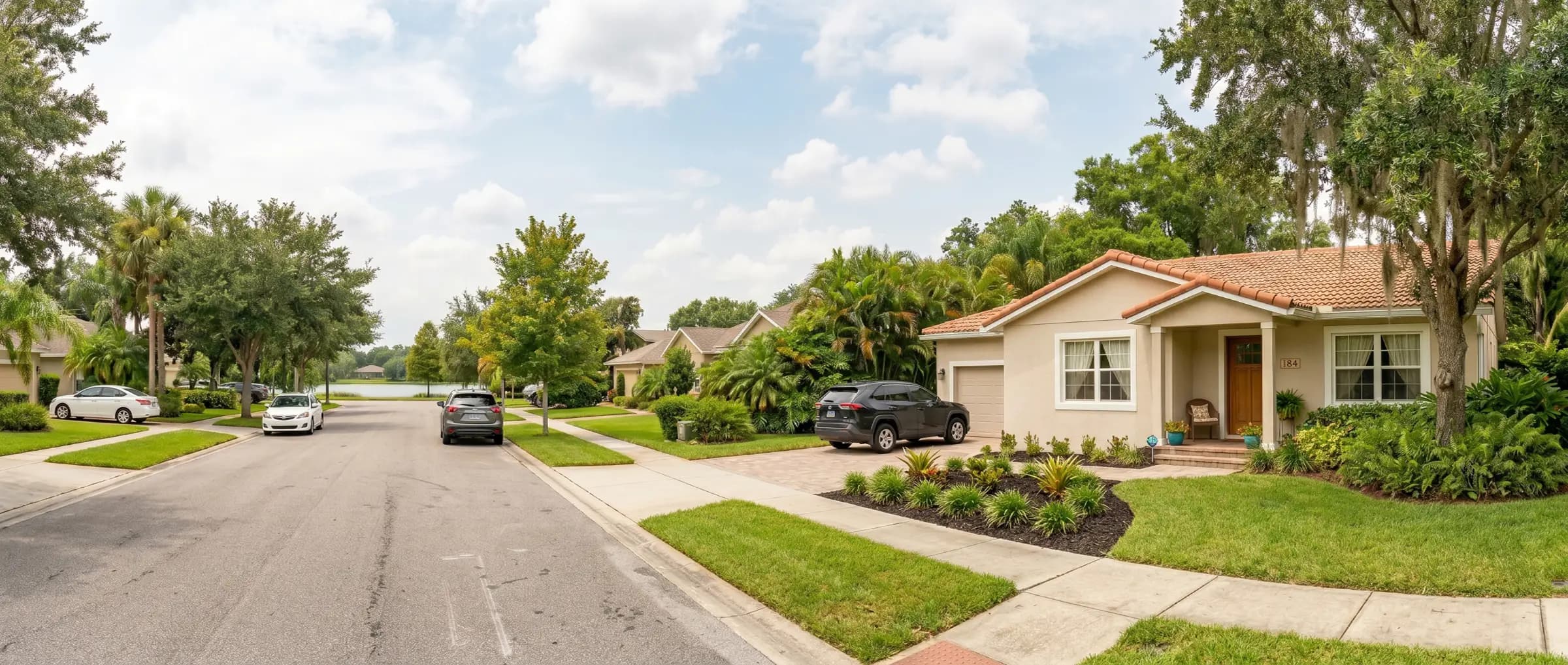

Orlando homeowners deal with mold under different conditions than the coastal Florida cities that usually dominate this conversation. There's no storm surge here, no tidal flooding, no salt air working through stucco. What Orlando has instead is water everywhere at ground level: hundreds of lakes that keep ambient humidity elevated independent of the weather, roughly 50 inches of annual rainfall concentrated into intense summer downpours, and an HVAC system that runs nearly year-round fighting a losing battle against both.
Mold remediation is the licensed, standards-based process of identifying, containing, removing, and verifying the elimination of fungal growth in a structure, governed in Florida by the ANSI/IICRC S520 standard and regulated under DBPR Chapter 468. In Orlando, any job affecting more than 10 square feet legally requires a Florida-licensed Mold Remediator, and the work must be verified by a separately licensed Mold Assessor before it's considered complete. This guide covers what that work costs in Orange County, what the law requires of the contractor you hire, and the neighborhood-specific risk factors that determine how urgently you should act.
Key insights
- Typical local cost. Mold remediation in Orlando runs $1,500–$6,500 for most jobs, with national per-square-foot pricing of $10–$25 holding for the metro.
- Two-license rule. Florida requires separate DBPR-licensed companies for assessment (MRSA) and remediation (MRSR) on any job over 10 square feet.
- No off-season. Orlando's year-round humidity and near-continuous A/C use mean mold risk doesn't drop in winter the way it does in drier climates.
- Storm legacy still active. Homes in low-lying drainage corridors that weren't fully extracted and dried after 2024's inland flooding are still presenting hidden mold to assessors today.
- Lake proximity raises baseline risk. Homes near Orlando's many lakes run higher ambient humidity than the metro average, independent of any storm or leak.
- Clearance testing must be independent. The company that tests your air after remediation can't be the same company that did the remediation work.
Why Orlando grows mold differently than coastal Florida
Orlando's mold risk comes from standing humidity and inland rainfall rather than from the coastal threats that shape places like Miami or Tampa. The city sits about 82 feet above sea level on flat, poorly draining terrain dotted with hundreds of lakes, which keeps relative humidity averaging 74% year-round and pushing past 90% on summer mornings, per NOAA data for the region. That baseline humidity, combined with roughly 50 inches of annual rainfall concentrated into intense afternoon thunderstorms from June through September, means indoor air conditioning works harder and longer here than in almost any other major U.S. metro to keep pace.
 Standing water that lingers past the 24-48 hour mark, the threshold IICRC S520 identifies for mold to begin establishing in affected structures, is the clearest sign a home near a drainage corridor needs prompt extraction and drying.
Orlando's average humidity runs close to the 80%-plus morning readings typical of Florida's coastal cities, and its annual rainfall is comparable too, so the meaningful difference isn't how humid the air gets, it's what's driving the moisture and what threatens a structure on top of it. Coastal Florida markets add storm surge, tidal flooding, and salt air corrosion to their humidity baseline. Orlando adds hundreds of lakes and inland flash flooding instead, which means the risk is just as real but the threats a homeowner needs to plan around are different.
That near-continuous A/C season is itself a mold risk factor. Orange County homes typically run cooling systems 9 to 11 months a year, and every hour of operation produces condensate that has to drain correctly to avoid feeding mold growth at the HVAC line. Add in clay-heavy soil pockets in parts of Metro West and Dr. Phillips that hold moisture against slab foundations longer than the sandy soil common elsewhere in the metro, and you get a city where mold risk stays elevated through every season rather than concentrating around a single storm window.
Inland flooding is the other half of the picture. Unlike Gulf and Atlantic coast cities, Orlando faces no storm surge, but heavy rain events can still overwhelm the Little Wekiva River and other drainage corridors. Hurricane Milton brought up to 15 inches of rain to the Orlando area in October 2024, and the Florida Division of Emergency Management confirmed rising water along the Little Wekiva River through the worst of the storm. Homes in that corridor and similar low-lying drainage areas that weren't dried within the 24–48 hour window mold needs to establish are still surfacing hidden growth more than a year later.
| Risk factor | Why it matters in Orlando | What it means for homeowners |
|---|---|---|
| Lake-driven humidity | Hundreds of lakes add ambient moisture independent of rainfall | Indoor RH runs higher near lakes than the metro average |
| Year-round A/C condensate | 9–11 month cooling season produces constant condensate | HVAC drain lines need regular inspection, not just seasonal checks |
| Inland flash flooding | Little Wekiva and other corridors overflow during heavy rain | Drainage-adjacent homes need rapid response after any major storm |
| Clay soil pockets | Metro West and Dr. Phillips hold slab moisture longer than sandy soil elsewhere | Slab-level mold warrants assessment even from small visible patches |
| Mixed construction era | 1920s bungalows through 2020s new builds across the metro | Older homes often have outdated vapor barriers and aging HVAC |
How Orlando's construction eras affect mold risk
The era a home was built in is often a better predictor of where mold will appear in Orlando than its location relative to a lake or flood corridor, since building practice changed more across the metro's century of growth than the housing stock itself did from neighborhood to neighborhood.
| Era | Primary vulnerability |
|---|---|
| Pre-1950s | Wood-frame construction with absent or degraded vapor barriers; original single-pane windows that condense readily in summer humidity; pier-and-beam sections vulnerable to ground moisture given Orlando's high water table |
| 1950s–1970s | Concrete block walls without exterior moisture barriers; slab edges that wick ground moisture into wall bottom plates; original ductwork routed through unconditioned attic space |
| 1980s–1990s | Paper-faced drywall throughout, including bathrooms; undersized attic ventilation relative to Florida's humidity load; HVAC systems now well past their original design life |
| Post-2000 | Tighter building envelopes that trap indoor moisture when HVAC systems are undersized or short-cycle; stucco-over-frame construction that can hide moisture intrusion behind the cladding for weeks before any interior sign appears |
Mold risk by Orlando neighborhood
College Park, Audubon Park, and Dr. Phillips carry the highest baseline mold risk in Orlando due to older housing stock and lake proximity, while newer master-planned communities like Lake Nona and Baldwin Park carry comparatively lower risk despite sitting in similarly humid conditions. Risk in Orlando tracks proximity to the metro's many lakes and construction era more reliably than it tracks distance from any single landmark, and exposure to the inland drainage corridors that flood during heavy rain matters more than coastal proximity, since Orlando has none. The seven areas below cover the clearest examples of each risk pattern across Orange County.
 Older homes under mature tree canopy retain moisture longer at the roofline and foundation, while newer construction near retention ponds faces less canopy shading but sits closer to standing water that can stay elevated after heavy rain.
The pattern that cuts across all seven areas is that age and lake proximity matter more than which side of town a home sits on. A 1950s home two blocks from a lake in east Orlando carries a similar risk profile to a 1950s home near a lake in the western suburbs, while a 2020s build in a newer master-planned community tends to run lower risk almost anywhere in the metro because of updated vapor barriers and HVAC systems.
| Neighborhood | Primary risk factor | Homeowner notes |
|---|---|---|
| College Park | Older lake-front housing stock | 1920s–1960s homes with aging vapor barriers near Lake Adair and Lake Concord |
| Audubon Park | Mid-century construction near small lakes | 1950s–60s ranch homes; check HVAC condensate lines given the home age |
| Dr. Phillips | Clay soil pockets, 1980s–90s construction | Slab moisture migration; check foundation-level mold even from small visible patches |
| Metro West | Clay-heavy soil, Hurricane Milton flood exposure | Storm-related secondary mold still surfacing in some homes |
| Little Wekiva corridor | Inland flash flood risk | Highest local exposure to the 2024 Milton flooding event |
| Baldwin Park | Newer construction, former Navy base site | Lower baseline risk from newer building codes, but lake-adjacent lots still run humid |
| Lake Nona | New construction, high-humidity lake cluster | Newer HVAC systems reduce risk, but airport-area storm exposure remains |
Mold risk in Orlando's vacation rental homes
Vacation rental homes in Orlando carry a higher mold risk than owner-occupied homes in the same neighborhoods because of extended vacancy between bookings, thermostats set high to cut cooling costs while empty, and no one present day-to-day to catch a slow leak before it becomes a remediation job. Orlando and the surrounding Kissimmee corridor make up one of the largest short-term rental markets in the United States, with tens of thousands of active vacation home listings concentrated around the theme park corridor in Davenport, Kissimmee, Championsgate, and parts of west Orange County.
 A thermostat left in the mid-80s between bookings stops active dehumidification, letting indoor humidity climb into the range where mold can establish well before the next guest checks in.
Vacancy is the core risk, not the climate
A vacation home sitting empty for one to two weeks between bookings with the thermostat set to 78–80°F to save on electricity loses the active dehumidification that running an HVAC system at a normal setpoint provides. Indoor humidity can climb into the mold-favorable range well before the next guest arrives, especially during the wet season when outdoor humidity is already elevated.
A slow leak can run for an entire booking gap
In an owner-occupied home, a dripping supply line or a failing water heater usually gets noticed within a day or two. In a vacation rental between stays, that same leak can run undetected for the full length of the vacancy window, which in Orlando's market frequently runs one to two weeks even during peak season.
HOA and resort-community rules complicate who responds
Many Orlando-area vacation homes sit inside HOA-governed resort communities with their own maintenance and pest-and-mold reporting requirements separate from the county's. Property managers and owners should confirm in writing who is responsible for moisture issues traced to shared irrigation, drainage, or pool-deck runoff versus issues confined to a unit's interior, including common trouble spots like a bathroom or kitchen.
Guest health complaints move faster than typical disputes
A guest who experiences respiratory symptoms during a short stay is far more likely to leave a public review or file a platform complaint than a long-term tenant is to escalate the same issue, which means a vacation rental's mold problem becomes a reputational and revenue problem before it becomes a structural one. Addressing a musty odor or visible spotting before the next guest checks in is rarely optional in this market.
A property manager or owner who suspects mold in a vacation rental should treat the same MRSA/MRSR licensing rules that apply to any Florida home, but the timeline matters more here: a remediation job needs to be scheduled and cleared between bookings, which can mean coordinating a rush mold inspection rather than waiting for the next open week on a contractor's calendar.
What mold remediation costs in Orlando
Mold remediation in Orange County typically costs $1,500 to $6,500, tracking close to the national average because Orlando has no major cost-inflating factor like storm-surge demand spikes or extreme regional labor shortages. A small bathroom or closet job on a cleanable surface under 10 square feet can come in under $1,000, while a whole-room job involving drywall removal, structural drying, and clearance testing after major water intrusion can run $15,000–$25,000 or more.
 Plastic sheeting sealed around doors and windows combined with a negative air machine venting outside are core IICRC S520 containment requirements, preventing spores from spreading to the rest of the home during active work.
Pricing in Orlando tracks the national curve more closely than Florida's coastal markets because the metro doesn't carry the same storm-surge demand spikes or condo-access complexity that push those markets above the national average. Jobs that qualify as DIY mold removal under the EPA's 10-square-foot threshold sit at the bottom of that range; everything larger is where scope drives the price, since how much material has to come out and how long drying equipment needs to run matter more than square footage alone.
| Project scope | Typical cost | What drives the price |
|---|---|---|
| Small patch, under 10 sq ft | $500–$1,500 | DIY-eligible scope; pro pricing covers labor minimum |
| Single room, 10–100 sq ft | $1,500–$4,500 | Containment setup, material removal, drying equipment |
| Multi-room, 100–300 sq ft | $4,500–$10,000 | Larger containment, longer drying time, more material replacement |
| Whole-home, 300+ sq ft | $10,000–$25,000+ | Full reconstruction, HVAC involvement, extended clearance testing |
| Post-storm flood job | $8,000–$25,000+ | Category 3 water contamination, structural drying, possible mold in subfloor |
Room location changes the math too. A bathroom job tends toward the lower end because the affected area is usually small and the surfaces are often nonporous tile and grout that respond well to cleaning. Attic and crawl space jobs run higher because of access difficulty and the likelihood that insulation or structural wood needs replacing. A garage or HVAC-involved job can fall anywhere in between depending on whether ductwork needs full replacement or just cleaning.
| Location | Typical cost range | Local cost driver |
|---|---|---|
| Bathroom | $500–$2,000 | Small footprint, mostly nonporous surfaces |
| Kitchen | $500–$3,000 | Under-sink leaks, refrigerator water line failures |
| Attic | $1,500–$6,000 | Roof leak access, insulation replacement |
| Crawl space or slab edge | $1,500–$8,000 | Clay soil moisture migration in Metro West and Dr. Phillips |
| HVAC system | $600–$10,000+ | Duct length, coil access, condensate line repair |
Per square foot, Orange County contractors generally charge in the $10–$25 per square foot range, consistent with national norms, with the high end reserved for jobs requiring deep demolition or specialized containment.
Florida mold licensing: what the DBPR requires
Florida requires two separate state licenses for any mold job over 10 square feet: a Mold Remediator (MRSR) license for the company that does the physical cleanup, and a Mold Assessor (MRSA) license for the company that inspects the property and verifies the work afterward. Florida is one of only two states with this statutory two-license system, and Orlando contractors operate under the same Chapter 468 framework as the rest of the state.
 A written scope of work naming the license number, contamination level, and remediation protocol is what DBPR Chapter 468 requires before any work begins, not a verbal quote.
A remediator who can't produce an MRSR number, or an assessor who can't produce an MRSA number, isn't operating legally in Florida regardless of how the company markets itself. A standalone mold inspection is a separate cost from remediation under this same two-license structure.
| License type | Issued by | Scope |
|---|---|---|
| Mold Assessor (MRSA) | DBPR, Florida Chapter 468 | Inspection, written remediation protocol, post-job clearance testing |
| Mold Remediator (MRSR) | DBPR, Florida Chapter 468 | Physical removal and treatment work under the assessor's written protocol |
The 12-month assessor-remediator separation rule and the written remediation protocol requirement work the same way statewide, since Florida's licensing statute doesn't vary by city. The statutory citations behind these requirements are covered in Florida mold licensing law.
Questions to ask an Orlando mold contractor
The most important question to ask an Orlando mold contractor is whether the assessor and remediator are two separately licensed companies, since Florida law makes that the single biggest legal and quality marker on any quote. What changes from market to market is the urgency context and what a red flag actually signals locally.
 Florida law requires the company performing remediation to provide a written scope of work before any physical removal begins, not a verbal estimate.
In a market with no single dominant storm-surge corridor, the biggest variable isn't whether a contractor knows the law, it's whether they'll actually follow the parts of it that cost them money, like turning down a job to test their own work or skipping HVAC inspection on a job near supply registers.
How to verify a contractor's Florida license before hiring
Verifying a license takes less than five minutes on the Florida DBPR's lookup tool and is the only reliable way to confirm a contractor is legally authorized to work in your home.
- Go to myfloridalicense.com and search under Mold-Related Services. Enter the contractor's name or license number directly.
- Confirm the license type matches the work. An MRSA license covers assessment and clearance only; an MRSR license covers physical remediation only.
- Confirm the assessor and remediator are different individuals. Search both names separately, since Florida law prohibits the same person from holding both roles on one project.
- Check for complaints or disciplinary actions. An active suspension or a pattern of complaints is disqualifying regardless of anything the contractor tells you.
| Question | Credible answer | Red flag |
|---|---|---|
| Are you MRSR licensed, and can I see the number? | Provides the number immediately and it verifies on DBPR's site | Hesitation, or a license that doesn't match the company name |
| Will a different company handle clearance testing? | Yes, names a separate MRSA-licensed assessor | Offers to "test their own work" |
| What's the written remediation protocol? | Provides a scope document before work begins | No written protocol, verbal estimate only |
| How do you handle HVAC if ducts are involved? | Describes coil and duct inspection, names containment steps | Skips HVAC assessment entirely on a job near supply registers |
| What's included in the clearance criteria? | References post-remediation verification per IICRC S520 | Vague reference to "looks clean" without lab sampling |
A separate concern in this market: after Hurricane Milton, several out-of-state and unlicensed crews moved into Central Florida to chase storm-damage work. Confirming DBPR licensing and checking for an IICRC AMRT certification before signing is the single most effective filter against that activity. Comparing bids and warranty terms matters just as much as the license check before signing anything.
Does insurance cover it in Orlando
Florida HO-3 homeowners policies typically cap mold coverage at a $10,000 sublimit, and that coverage only applies when the mold results from a sudden, covered peril like a burst pipe rather than from gradual humidity or a slow leak. Given that a single whole-home job in Orlando can run $25,000 or more, that sublimit often falls well short of actual remediation costs after a significant water event.
The HO 04 26 endorsement raises that limit to $25,000–$100,000 for an additional $200–$500 a year, which is worth pricing out for any homeowner near a lake or flood corridor. Mold connected to flooding rather than a plumbing failure generally isn't covered by a standard homeowners policy at all and instead falls under NFIP flood insurance, which carries its own 30-day waiting period and separate documentation requirements. Homes affected by Milton's Little Wekiva River flooding that lacked flood coverage at the time of the storm are the clearest local example of this coverage gap.
Orlando homes still showing Milton mold
Homes in the Little Wekiva River corridor and similar low-lying drainage areas that flooded during Hurricane Milton in October 2024 are still presenting hidden mold to licensed assessors well over a year after the storm. This isn't a closed chapter. It's an active due diligence problem for anyone buying, selling, or renovating in an affected corridor, since the standard 24-48 hour drying window for mold establishment has long since passed in any home that wasn't fully extracted and dried at the time.
 Mold concealed behind baseboards and trim often goes undetected for months after a flood, since visible damage at the surface can dry and look resolved while moisture continues working through the wall cavity behind it.
Pull the flood history before assuming a home is clear
Cross-reference the Orange County Property Appraiser's records with FEMA flood map data and any publicly available Milton inundation mapping. A home resold since the storm may show no flooding on a standard disclosure form if the current seller didn't personally experience the event, since Florida's disclosure duty covers only the seller's ownership period, and the same gap can affect whether insurance coverage applies if mold surfaces after closing.
Ask for documentation, not just a clean-looking repair
Request the written remediation protocol, post-clearance air sampling results from a licensed MRSA assessor, and contractor invoices showing individual DBPR license numbers for any property with known Milton exposure. A seller who can't produce that paperwork after a documented flood event isn't necessarily hiding something, but there's no proof the work was done to the IICRC S520 standard either.
Order an independent assessment on any property in the flood corridor
A standard home inspection isn't a licensed mold assessment under Florida law and won't reliably detect hidden growth inside wall cavities or under flooring. On any home near the Little Wekiva corridor or another drainage area affected by Milton, a separate MRSA-licensed inspection is worth the cost before closing, and the same vetting steps you'd use to choose a mold remediation company apply equally to picking the assessor.
Know what delayed Milton mold looks like
Homes that were dried quickly or only cosmetically repaired after the storm often show no visible mold for months. Warning signs that surface later include a musty odor concentrated in one room, baseboards that feel soft or show faint discoloration at the original flood line, paint that's lifted slightly at the wall-floor junction, or allergy symptoms that improve when you spend time away from the property.
Buying or selling a home with mold history
Florida's seller disclosure obligations apply in Orlando the same way they do statewide: a seller who knows about a current or past mold problem, whether Aspergillus or another species, has a duty to disclose it under Florida case law, and standard disclosure forms used in most Central Florida transactions ask directly about prior water damage and remediation history. For a buyer evaluating a home in a flood-corridor or older lake-front neighborhood, a documented remediation history with a clearance certificate is a stronger signal than the absence of any mentioned history at all, since it shows the problem was identified and resolved under the IICRC S520 standard rather than simply painted over.
 A documented remediation history with a clearance certificate gives a buyer more confidence than no disclosed history at all, since it shows a past problem was resolved to the IICRC S520 standard rather than simply hidden.
For homes specifically affected by Hurricane Milton's flooding, the documentation and assessment steps worth taking are covered above. The same risk applies to renters in an affected rental property, who have separate legal protections, including a landlord's habitability duty under Florida law, that don't apply the same way to homeowners.
Orlando also has an unusually high concentration of HOA-governed master-planned communities compared to older Florida cities, including Lake Nona, Baldwin Park, and Horizon West. In these communities, the HOA typically owns and maintains shared drainage systems, retention ponds, and common-area landscaping, but the home's interior, including any mold inside the walls or HVAC system, remains the owner's responsibility. Before buying into one of these communities, ask whether the HOA has any record of neighborhood-wide drainage issues, since a retention pond that doesn't drain properly after heavy rain can keep groundwater elevated under nearby slabs long after the storm has passed.
Mold species common in Orlando homes
The mold species most commonly found in Orlando homes are Cladosporium, Aspergillus, Penicillium, Alternaria, and, in flood-affected properties, Stachybotrys chartarum and Chaetomium, broadly the same species mix found across Central Florida rather than anything unique to the metro. Cladosporium shows up most consistently on HVAC coils, window sills, and bathroom surfaces, a function of how little moisture it actually needs to take hold compared to the other species on this list. Aspergillus and Penicillium turn up most often in water-damaged drywall and insulation, particularly around HVAC condensate failures, and lab reports frequently list them together as Asp/Pen since a visual inspection alone won't tell the two apart.
Alternaria tends to spike seasonally with outdoor spore counts during the summer thunderstorm months, when wind-driven rain pushes outdoor spore concentrations higher across the whole metro. What distinguishes Orlando from a typical year is the species shift in homes affected by Hurricane Milton's flooding. In properties along the Little Wekiva corridor and other drainage areas that weren't extracted and dried within the standard window, post-flood sampling has shown elevated Stachybotrys chartarum and Chaetomium rates, consistent with the pattern documented after other major Florida flood events. Both species require the kind of sustained saturation that inland flash flooding delivers, and their presence in a sample is a strong indicator that moisture was active for weeks rather than days. Visual identification can't reliably distinguish any of these species; confirming which one is present requires mold testing by a licensed assessor.
Preventing mold in an Orlando home
Preventing mold in Orlando comes down to controlling indoor humidity and responding fast after rain, since the city's year-round moisture load means there's no off-season where the risk naturally drops. The five actions below address Orlando's specific combination of near-continuous HVAC operation, inland flood exposure, and clay-soil drainage issues, rather than generic mold-prevention advice that would apply equally anywhere.
 Soil or mulch that sits level with or above the stucco's base, rather than sloping down and away from it, lets water pool against the foundation long enough to wick moisture through to interior slab edges.
Service HVAC condensate lines twice a year
Given the 9–11 month cooling season typical in Orange County, a clogged condensate line can produce standing water inside a closet or attic air handler closet well before anyone notices a leak. Schedule a check each spring and again mid-summer.
Target 45%–55% indoor humidity
A simple hygrometer placed away from supply vents gives an accurate reading. Above 60% relative humidity for sustained periods is the threshold where mold growth accelerates, per EPA guidance, and Orlando's outdoor humidity makes it easy to drift past that mark without noticing, often well before a visible patch grows large enough to meet the threshold for when mold remediation is required.
Inspect after any named storm, not just direct hits
Milton demonstrated that inland Orlando can flood from rainfall alone without a direct hurricane strike. Check attic, baseboard, and slab-edge areas within 48 hours of any heavy regional rain event, particularly if your home sits near the Little Wekiva corridor or another low-lying drainage area.
Check foundation grading on clay-soil lots
Homes in Dr. Phillips, Metro West, and similar clay-heavy pockets should have grading that slopes water away from the slab. Standing water against a foundation for more than a day is enough to begin wicking moisture through to interior slab edges, the same way a clogged HVAC condensate line lets water sit against a closet floor.
Replace HVAC filters on a strict schedule
A clogged filter forces the system to run longer to reach set temperature, which increases condensate production and humidity cycling throughout the home. Monthly replacement during peak summer months is worth the minor added cost.
If you've already spotted signs of mold, the next step is confirming the scope before deciding whether it's a DIY job or one that needs a professional.
Frequently asked questions
How much does mold remediation cost in Orlando?
Most Orlando jobs run $1,500–$6,500, with small bathroom or closet patches starting around $500 and whole-house jobs after major flooding reaching $20,000 or more. Per square foot, Orange County contractors generally charge $10–$25, in line with national averages, though post-storm demand can push pricing toward the upper end for several months after a named storm.
Does Florida require a license for mold remediation?
Yes. Florida requires a Mold Remediator license (MRSR) issued by the DBPR for any remediation job over 10 square feet, and a separate Mold Assessor license (MRSA) for the inspector who tests and clears the work. The same company cannot legally hold both roles on a single job.
Is Orlando a high-risk city for mold?
Yes, though for different reasons than Florida's coastal cities. Orlando sits inland with no tidal flooding or storm surge exposure, but its hundreds of lakes, roughly 50 inches of annual rainfall, and near-continuous air conditioning season combine to keep indoor humidity in the mold-favorable range for most of the year.
Did Hurricane Milton cause lasting mold problems in Orlando?
Yes, in specific corridors. Milton dropped up to 15 inches of rain on the Orlando area in October 2024 and pushed the Little Wekiva River out of its banks, and homes in affected drainage corridors that weren't fully dried within 48 hours are still surfacing hidden mold well over a year later.
Can I claim mold remediation on my Florida homeowners insurance?
Sometimes, depending on the cause. A standard Florida policy only pays out when the mold traces back to a sudden, covered event like a burst pipe, and even then the payout is usually capped well below what a significant job costs. Chronic humidity, a slow roof leak, or flooding fall outside that coverage unless you've added a specific endorsement or separate flood policy.
How do I verify a mold remediation contractor's Florida license?
Search the contractor's name or license number directly on the DBPR's online lookup tool at myfloridalicense.com. A valid result shows the license type (MRSR or MRSA), current status, and any disciplinary history. Anyone who can't produce a license number on request should not be hired.
What Orlando neighborhoods have the highest mold risk?
Lake-adjacent and flood-corridor neighborhoods carry the highest baseline risk, including areas near the Little Wekiva River, College Park's older lake-front homes, and parts of Metro West and Dr. Phillips with heavier clay soil. Pre-1980s construction throughout the metro also carries elevated risk from outdated vapor barriers and aging HVAC systems.
How long does mold remediation take in Orlando?
A single bathroom or closet job typically takes 1–3 days. Whole-room or post-storm jobs involving drywall removal and structural drying usually run 5–10 days, and clearance testing after a large job adds another 1–3 days before the space is cleared for reconstruction.
Do I need a separate mold inspector if I already hired a remediation company?
Yes, for the verification step. Florida law requires the assessor who performs clearance testing to be a different company than the one that did the remediation work, which prevents a conflict of interest in confirming the job was done correctly.
What's the difference between mold remediation and mold removal?
Remediation is the complete, standards-based process: containment, removal, drying, and clearance testing under ANSI/IICRC S520. Removal is sometimes used informally to describe just the physical cleanup step, but a job that skips containment or clearance testing isn't full remediation even if the visible mold is gone.
Does the age of my Orlando home affect mold risk?
Yes. Pre-1950s wood-frame homes often have absent or degraded vapor barriers and original single-pane windows that condense readily. Mid-century concrete block homes from the 1950s-70s have slab edges prone to ground moisture wicking. Homes from the 1980s-90s used paper-faced drywall throughout and often have undersized attic ventilation. Newer construction has tighter envelopes that trap humidity when HVAC systems are undersized.
How do I know if a home was affected by Hurricane Milton's flooding?
Check the Orange County Property Appraiser's records and FEMA flood maps against publicly available Milton inundation data, particularly for properties near the Little Wekiva River corridor. A standard seller disclosure only covers the current owner's tenure, so a home resold since the storm may show no flooding on paper even if it was affected.
Can mold testing tell me which species I'm dealing with?
Not from looking at it. Visual identification alone can't reliably distinguish mold species, since several common types look nearly identical to the naked eye. Confirming species requires air or surface sampling by a licensed MRSA assessor, sent to a certified lab for analysis, which typically returns results within 24 to 72 hours.
Why is mold a bigger risk in Orlando vacation rentals than in regular homes?
Extended vacancy between bookings is the main reason. Thermostats are often set higher to save on cooling costs while the home sits empty, which lets indoor humidity climb, and a slow leak can run undetected for the full length of a one to two week booking gap instead of being caught within a day or two the way it would be in an owner-occupied home.
Sam Hickerson is the founder of RestoreAdvisor and writes consumer guides on mold remediation, water damage restoration, inspection, testing, and home recovery. His work focuses on helping homeowners understand costs, risks, and when to call a professional. He draws on guidance from the EPA, CDC, IICRC, and other authoritative sources to make complex home issues easier to navigate.