
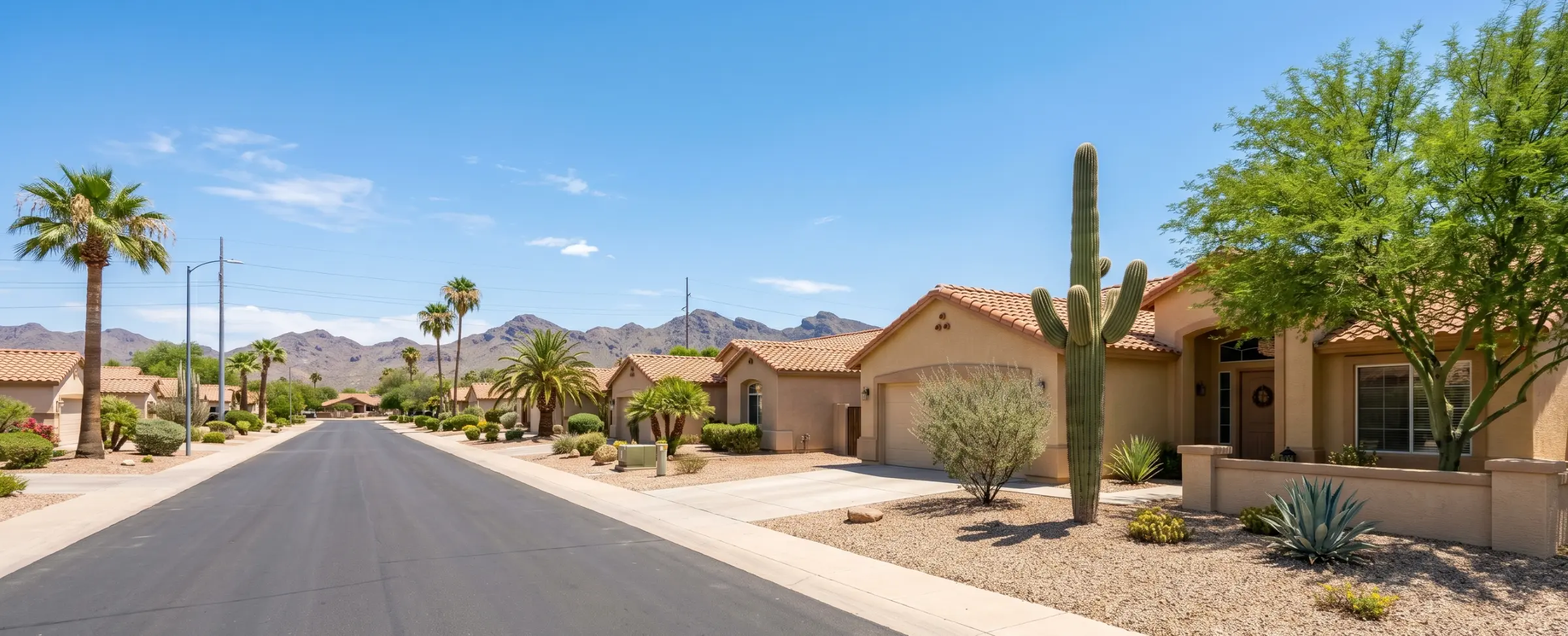

Phoenix looks like the last place to find a mold problem, with about 8 inches of rain a year and relative humidity that sits between 10% and 30% for most of the year. The desert does not protect a house, because mold grows on moisture inside the building whatever the outdoor forecast says. Phoenix homes make that moisture in desert-specific ways: evaporative coolers, leaks in the slab, a long air conditioning season, and monsoon storms that lift indoor humidity from 15% to 70% in a matter of hours. Most owners start looking into mold remediation weeks after a storm, a slow slab leak, or a cooler drain that backed up into an interior wall.
Mold remediation in Phoenix is the identification, containment, removal, and cleaning of mold contamination under the ANSI/IICRC S520 standard, and because Arizona has no state mold license, the Arizona Registrar of Contractors (ROC) licenses the repair work around it for any job of $1,000 or more. A homeowner therefore has two things to verify: the contractor's license, and the mold-specific training that the license does not test.
Key insights
- Arizona has no mold license. Any contractor doing repair, reconstruction, or restoration work of $1,000 or more in labor and materials must hold an active Arizona ROC license, which can be checked at roc.az.gov.
- The monsoon is the outdoor trigger. The National Weather Service dates it June 15 to September 30, and a single storm can push indoor humidity above the 60% line where growth accelerates within 24–48 hours.
- Evaporative coolers add a local risk. Swamp coolers hold water at the air intake and drain pan, and a clogged pan or failed line can soak the wall behind the unit with no sign inside the home.
- Slabs hide leaks. Most Phoenix homes sit on concrete slabs with no crawl space, so a plumbing leak moves up into flooring, baseboards, and walls for months before anyone sees water.
- Most jobs cost $1,400–$5,600. Same-day and next-day jobs after a monsoon storm commonly carry a 15%–25% surge premium from July through September.
- Sellers must disclose mold. The Arizona Association of Realtors' Seller Property Disclosure Statement covers known mold and prior water damage, and an as-is sale does not waive that duty.
First moves after a monsoon or leak
After a monsoon intrusion or a leak, anything that got wet needs to dry within 48 hours, and the source has to be found before any cleaning starts. Active flooding calls for emergency mold removal at once, and in a slab house a plumber often comes before a mold company.
Check the water bill first
A bill that jumps 20%–40% with no change in use points to a slab leak that shows no water on the surface. Have a plumber pressure test the lines before calling a mold inspector, since a leak can saturate the concrete and climb into flooring and baseboards for weeks.
Photograph and dry inside 48 hours
After storm intrusion or a cooler overflow, photograph the damage and start fans and dehumidifiers at once. Roof intrusion that keeps ceiling drywall saturated for more than two days almost always produces active growth, so brown ceiling stains after a summer storm call for an assessment within 48–72 hours.
Leave floor-level mold alone
Do not scrub staining at a baseboard or under flooring until someone has metered the cavity. Cleaning the surface over a wet slab spreads spores and hides how far the moisture has gone.
Shut down a failing cooler or drain
An evaporative cooler with a failed drain, or a condensate line that is backing up, pushes moisture further into the wall every hour it runs. Turn it off until it is repaired.
Slab leaks, monsoon intrusion, and cooler overflow all follow the same arc as mold after water damage: wet materials, a quiet week or two, and then visible growth in a spot that looked fine at first. That delay is why a house can seem fine after a storm and show staining at the baseboards two weeks later, and why the early photos and moisture readings matter.
What Phoenix mold jobs cost
Most Phoenix mold jobs cost $1,400–$5,600, and the mid-range is about $2,200. A small patch lands near the bottom of that range, and jobs that open the slab-leak aftermath, attic plywood, or an HVAC system land near the top. Access matters as much as area, since a small attic patch under a summer roof costs more to reach and treat than a larger patch in a bathroom.
 An estimate reviewed here in October typically lands at standard rates; the same job quoted during July through September often carries a 15 to 25% post-monsoon surge premium instead.
Construction and extraction workers in the Phoenix area earn about 94 percent of the U.S. average, according to the Bureau of Labor Statistics' May 2025 data. Labor minimums, material removal, and HEPA containment then decide where a particular mold remediation cost lands, and the minimum charge matters most on small jobs where the affected area is limited.
Post-monsoon demand across the metro drives surge pricing, typically from July through September. Emergency jobs with same-day or next-day scheduling can add 15%–25% above standard pricing, and a job that is not urgent usually returns to standard rates when scheduled in October or November. Getting an inspection done early in the season, before storms arrive, lets a homeowner line up a contractor without paying for urgency.
| Project scope | Estimates | Price drivers |
|---|---|---|
| Small patch, under 10 sq ft | $500–$1,400 | Labor minimum charge |
| Single room, 10–100 sq ft | $700–$3,700 | Material removal and drying |
| Multi-surface, 100–300 sq ft | $2,300–$8,400 | Drywall replacement and HEPA containment |
| Attic or large area, 300–1,000 sq ft | $5,600–$18,500 | Accessibility, plywood treatment, and structural drying |
| Whole home, 1,000+ sq ft | $14,000–$28,000 | Slab-leak aftermath, structural drying, and rebuild |
Pricing comes to $9–$23 per square foot, so dividing a lump-sum bid by the affected area shows whether it is in range. Structural materials, attic plywood, and HVAC systems fall outside the per-square-foot model and are quoted as project scopes.
Cost by location in the home
| Location | Estimates | Price drivers |
|---|---|---|
| Bathroom shower or ceiling | $500–$1,900 | Tile removal and ventilation correction |
| Kitchen sink cabinet or wall | $700–$3,700 | Cabinet removal and coordination with the leak repair |
| Attic plywood and insulation | $900–$4,700 | Accessibility and abrasive or soda blasting removal |
| HVAC system and ductwork | $2,800–$9,400 | Component-level cleaning or replacement |
| Behind walls after a slab leak | $1,900–$7,500 | Slab repair coordination and full cavity drying |
| Evaporative cooler and adjacent wall | $700–$3,700 | Cooler removal, pad replacement, and wall treatment |
Costs outside the remediation invoice
Clearance testing comes from a separate inspector after the work and is usually left out of remediation quotes, so confirm it separately before agreeing to a bid. A standalone mold inspection cost before remediation begins runs $300–$700 for most Phoenix homes. Budget for both invoices together, since a low remediation quote may leave the testing for the homeowner to arrange.
| Item | Estimates | When it applies |
|---|---|---|
| Standalone inspection | $300–$700 | Before the bid, to meter the slab and find the source |
| Lab testing | $300–$900 | When species or spore counts matter to the scope |
| Clearance testing | $200–$600 | After remediation, by a firm other than the remediator |
| Inspection with testing | $400–$1,400 | When one visit covers both the scope and the samples |
| Rebuilding | $500–$9,400 | Drywall, flooring, and finishes after clearance |
Why a desert city still grows mold
Phoenix gets mold despite its dry climate because the moisture comes from the house itself. Evaporative coolers, slab plumbing, HVAC condensate, and monsoon storms supply it all year, and the CDC's mold basics put the growth threshold at sustained humidity above 60%, with colonies able to start on wet materials in 24–48 hours.
 A unit like this pulls outdoor air through water-saturated pads by design; a clogged drain pan or degraded pad can push that same moisture directly into the wall cavity below without any interior warning sign.
The National Weather Service defines the monsoon as June 15 to September 30. Moisture streams in from the Gulf of California and the Gulf of Mexico, and single-cell thunderstorms can drop an inch of rain in under an hour. Outdoor humidity can pass 70% during those storms, and indoor humidity follows within hours when windows or doors are open or the envelope is loose.
Phoenix has a far higher concentration of evaporative coolers than most large American cities, and they are a mold pathway that humid markets do not have. The unit pulls outdoor air across water-saturated pads, and when a drain pan clogs, pads degrade, or a line fails, the excess goes into the intake plenum and the wall or attic around it. A cooler that ran through a monsoon with a clogged drain can grow heavy mold behind the unit with nothing visible indoors.
Most Phoenix homes also sit on a concrete slab. Plumbing runs through it, so even a slow leak can climb through the concrete, soak flooring adhesive, and wet the subfloor or baseboards for months before it shows. The cooling season runs about 9–10 months, which means the air conditioner makes condensate almost continuously.
A clogged condensate line backs water into the air handler and drain pan and can wick into nearby drywall or insulation, and HVAC mold is often mistaken for dusty air when it is active contamination. With a cooling season of 9 to 10 months, a line that clogs in April can run wet through the whole summer before anyone traces the smell.
What the Arizona ROC license covers
Arizona has no dedicated mold remediation license, but any contractor doing repair, reconstruction, or restoration work of $1,000 or more in labor and materials must hold a current license from the Arizona Registrar of Contractors under Arizona Revised Statutes Title 32, Chapter 10. The license is the legal baseline for repair work, and the rest of the vetting has to cover what it leaves out.
 An ROC license check here confirms legal authorization to do repair work, but it says nothing about mold competency specifically, which is why IICRC certification matters more in Arizona than in states with a dedicated mold license.
The license covers the reconstruction side of a job, such as replacing drywall, treating framing, and restoring surfaces, and it confirms the contractor carries the required bonding. The physical removal and cleaning of mold carries no license of its own. A contractor can hold a current ROC license and know nothing about containment, HEPA filtration, or post-remediation clearance, so training credentials and insurance carry more weight here than they do where the state tests for mold competency.
An unlicensed contractor doing repair work over $1,000 is committing a crime under Arizona law, and hiring one leaves you without recourse through the ROC complaint process if the work fails. Checking the license before signing takes a few minutes at roc.az.gov and is the cheapest protection a homeowner has in a state with no mold license.
Hiring in a state with no mold license
Hiring in Phoenix means checking the ROC license for legal authority and then checking everything the license does not cover. The two checks answer different questions, and a company can pass the first and fail the second. Work through both checks before comparing prices, because a low bid from a company that fails either one costs more once the job has to be redone.
Run the ROC lookup first
Search the company by name or license number on the ROC site and confirm the license is active, not suspended, revoked, or expired.
Ask for pollution liability by name
Confirm the company carries contractor's pollution liability insurance in addition to general liability. General liability does not cover biological hazard work, and many Arizona companies carry only that.
Check the technicians, not the owner
Confirm the people doing the work hold IICRC AMRT certification, which can be verified at iicrc.org, and ask for named individuals and certification numbers.
Separate the tester from the cleaner
Assessment and clearance testing should come from a different company than the remediator. The inspector who writes your scope should not profit from the cleanup.
Put five questions to every company before signing:
| Question | Credible answer |
|---|---|
| What is your ROC license number, and can I verify it? | Gives the number immediately and welcomes verification at roc.az.gov. A claim that ROC does not apply to mold work is wrong. |
| Do your technicians hold IICRC AMRT certification? | Names specific certified individuals and offers certification numbers. "We follow IICRC standards" with no names is not an answer. |
| Do you carry contractor's pollution liability insurance? | Yes, with a certificate on request. General liability only means they are not fully insured for mold work. |
| Will a separate company do assessment and clearance? | Yes. A company that insists on testing its own work has a conflict of interest. |
| What is your containment protocol, and how do you verify negative air? | Describes polyethylene sheeting, HEPA-filtered negative air machines, and a manometer check. "We seal the area" is not enough. |
Contractors who dodge these questions or answer vaguely should be dropped before any contract is signed, the same way you would when you choose a mold remediation company anywhere with weaker state oversight. Written answers to all five, collected from at least three companies, make the bids easy to compare.
How a Phoenix remediation job runs
Professional remediation follows the ANSI/IICRC S520 sequence in Phoenix as elsewhere, and the desert adds two scheduling problems: slab leak coordination and summer attic heat. Each of the four stages has a named owner, and the plumber's repair sits ahead of all of them, so the calendar depends on trades that the remediation company does not control.
 Containment set up like this for an attic job in summer only gets a handful of working hours before midday heat, since interior attic temperatures here can exceed 150°F well before noon.
Meter the slab, drain, and cooler
A licensed inspector confirms the extent of contamination and identifies the moisture source. In Phoenix this step almost always involves a moisture meter reading at slab level, an inspection of the HVAC condensate drain, and, if an evaporative cooler is present, an inspection of the cooler unit and the adjacent wall cavity. The assessment and the remediation must be performed by separate companies.
Fix the source before anyone starts
Remediation cannot begin until the moisture source is fixed. In Phoenix this often means a licensed plumber repairs a slab leak before the remediation crew arrives. Slab repairs can take 1–5 days, and that timeline is entirely separate from the remediation timeline.
Seal the work zone and clean
The crew sets up a sealed work zone with negative air pressure using HEPA-filtered machines. In summer attic jobs, crews work early morning shifts only, as interior attic temperatures can exceed 150°F by midday, which cuts effective working hours to four or five a day.
Dry below 16% and clear
The work zone must dry to a wood moisture content below 16% before clearance testing can proceed. In Phoenix's low ambient humidity this typically happens within 24–48 hours. Clearance testing is conducted by the separate inspector using air sampling cassettes sent to an accredited lab, with results in 24–72 hours.
A passing clearance report with lab results attached ends the mold remediation process and is the document needed before reconstruction begins, before an insurance claim can close, and before a future buyer can confirm the home was properly remediated. Keeping it with the contractor invoices gives the next owner proof that the work met the standard.
How long Phoenix jobs take
Most jobs run 3–7 days from crew arrival to clearance results, not counting the time to fix the moisture source. Drying is usually the shortest stage in Phoenix's dry air, and lab turnaround and trade scheduling account for most of the rest. A realistic total for a mid-range single-room job in a non-emergency period is 7–14 days from discovery to the clearance report.
| Job type | Crew time | Typical delay |
|---|---|---|
| Small surface job | 1–2 days | Lab results take 24–72 hours |
| Single room | 3–5 days with drying and clearance | A plumber adds 1–5 days when the slab is leaking |
| Attic or multi-room | 5–10 days | Early-morning-only attic shifts in summer |
| Post-monsoon emergency | 14–21 days from discovery to report | Contractor backlog adds 1–2 weeks |
Any contractor who gives a standard timeline for an attic job without mentioning the early-morning schedule has either not done many Phoenix attics or is telling you what you want to hear. Four or five working hours a day is the reason an attic job runs longer than a ground-level job of the same size.
Floor-level signs and the DIY line
Mold in Phoenix homes most often shows at floor level rather than on the walls: buckled flooring, discolored baseboards, and staining around toilet bases are the first visible signs in slab homes. A musty odor that gets stronger when the HVAC or the cooler starts up points to contamination inside the system itself.
 Staining at floor level like this, not on the walls above it, is the pattern to watch in slab-foundation homes, since plumbing runs through the concrete itself rather than a visible crawl space.
Other signals worth acting on include a musty smell at spring startup, soft flooring near toilet bases or under vanities, white or grayish staining on baseboards at slab level (efflorescence that often comes before mold), and dark staining on the wall beside an evaporative cooler. The early signs of mold are also physical: symptoms that worsen indoors and ease when the occupant leaves are worth acting on before any growth is visible.
Small patches under 10 square feet on non-porous or semi-porous surfaces are generally within DIY scope under EPA guidance, as long as the moisture source is confirmed fixed. Bathroom tile, grout, and a shower surround are the usual candidates, because the surface is hard and the cavity behind it is rarely involved.
 This scope only holds above slab level; the same patch size at a baseboard in a Phoenix home often represents just the visible edge of a much larger colony growing inside the wall cavity.
The slab changes the calculation for anything near the floor. A small patch at a baseboard or under a vanity can be the visible edge of a much larger colony in the cavity above a saturated slab, and the slab itself can hold moisture and mold that a surface wipe never reaches. Cleaning the surface without a meter reading and a professional look at the cavity is a common reason mold returns within weeks of a DIY attempt.
| Situation | DIY appropriate? | Why |
|---|---|---|
| Mold on bathroom tile or grout, under 10 sq ft | Yes, if the source is fixed | Non-porous surface, EPA threshold met, no hidden cavity |
| Mold on painted drywall above slab level, under 10 sq ft | Possibly, with a meter reading | Check cavity moisture first, and call a pro if the meter reads above 16% |
| Any mold at baseboard or floor level in a slab home | No | Slab leak moisture extends further into cavities than the surface shows |
| Mold on or near an evaporative cooler wall | No | Cooler moisture usually penetrates the wall cavity |
| Mold inside HVAC registers or the air handler | No | Needs a system-level assessment, and DIY cleaning spreads spores through the ducts |
| Any mold when someone has asthma, allergies, or an immune condition | No | The risk of disturbing it outweighs the savings |
DIY holds up only when three conditions line up: a hard surface, a fixed source, and no vulnerable household member. Missing any one of them moves the job to a professional, and floor-level cases in slab homes fail the second condition most often because the real source is under the concrete.
Where the answer is yes, DIY mold removal on non-porous surfaces calls for an N95 respirator, gloves, and a cleaner matched to the surface. Run the air conditioner, bag the used wipes before leaving the room, and stop at once if the stain turns out to continue into the wall behind it.
Cooler and monsoon coverage gaps
Arizona homeowners policies follow the standard HO-3 pattern, so mold insurance coverage attaches when the mold comes from a covered peril such as a sudden, accidental water event and is excluded when it comes from gradual leaks, maintenance failures, or flooding. Evaporative coolers and monsoon flooding generate the most disputes.
Cooler neglect counts as maintenance
Most standard policies treat cooler maintenance as the homeowner's job. If a drain pan fails gradually or pads deteriorate and mold grows in the adjacent wall, insurers usually call it a maintenance failure and exclude it. A sudden failure of a cooler water line may count as an accidental discharge, but the wording varies by insurer and needs a close read.
Monsoon flooding needs its own policy
Standard policies exclude flood, so mold from ground-level storm water entering the home is not covered under the base policy and needs NFIP or private flood coverage. Wind-driven rain through storm-damaged roofing or windows is typically covered as storm damage, though the line between wind-driven rain and surface flooding is often disputed after monsoon events.
Sublimits stop short of the job
Most Arizona policies cap mold coverage at $5,000 to $10,000, which is below the cost of a moderate remediation. Endorsements that raise the cap to $25,000 or more are available from most carriers for $200–$500 a year and are worth pricing given the monsoon risk.
When filing a claim tied to a water event, document the damage with photos and video, ask for the insurer's own mold inspector instead of accepting only the remediation company's assessment, and confirm in writing whether the estimate includes clearance testing. Keep every receipt for drying, testing, and temporary housing, and ask for the adjuster's scope in writing so any gap from the assessor's protocol can be raised before repairs begin.
Mold species that follow the monsoon
Four species account for most Phoenix homes: Cladosporium, Aspergillus, Penicillium, and Alternaria. Cladosporium dominates year-round, Alternaria climbs during the monsoon, and Stachybotrys chartarum shows up after sustained moisture such as an unresolved slab leak. The first three are present in most homes at low levels, so the species list matters less than where the moisture started and how long it stayed.
 Colonization this heavy on the paper backing typically means the moisture behind this wall was active for weeks or months, not the day or two a quick surface check would suggest.
The mix an inspector finds depends on where the moisture started and how long it stayed. A slab leak that persisted for months produces a different species picture than attic intrusion that dried within a week. Lab results from an outdoor comparison sample show whether indoor counts are elevated or simply track the monsoon spore load outside.
Cladosporium is the most common species year-round, turning up on window frames, bathroom grout, and inside HVAC systems. It tolerates lower humidity than most molds, which is why it persists through the dry months. It is a moderate allergen, with the strongest effects in people who already have respiratory conditions, and its small, numerous spores mean air samples from Phoenix homes often show elevated counts even without visible growth.
Aspergillus and Penicillium appear together in most Phoenix air sampling reports, since light microscopy cannot tell them apart. Both are common in HVAC systems, stored organic materials, and attics. Aspergillus fumigatus is the species of clinical concern for immunocompromised people, and during the monsoon outdoor counts of both genera rise sharply and spores enter through cooler intakes and open windows. Confirming what is present takes lab-based mold testing with an outdoor comparison sample.
Alternaria is strongly seasonal here, peaking from June through September when outdoor spore counts rise. It is one of the leading triggers for mold-related asthma attacks, and it grows on dust, window seals, and anywhere outdoor air enters the building. NIOSH research on dampness and mold in buildings documents its link to asthma and sensitization.
Stachybotrys chartarum needs sustained high moisture, so it turns up after slab leaks that went undetected for weeks or months, after monsoon intrusion that was not dried within 48 hours, or in homes with cooler moisture damage that built up over several seasons. Where it is present, black mold removal calls for stricter containment, do-not-disturb procedures, and post-clearance requirements beyond the standard S520 scope.
Where mold hides by home era
Mold in Phoenix homes collects in four places tied to the year of construction: below slab-level baseboards and flooring in homes built after 1980, inside wall cavities next to evaporative coolers in mid-century homes, in attic plywood and insulation after roof intrusion in any era, and inside air handlers wherever a condensate drain has clogged.
 Deposits and staining like this at a slab penetration often mean the leak has been active for months, since there's no crawl space here to make the moisture visible any sooner.
Knowing the era narrows the likely source before an inspector arrives. Pre-1960s homes in Central Phoenix carry aging galvanized plumbing risk, while 1980s–2000s slab construction in Ahwatukee carries below-grade plumbing leaks and HVAC condensate risk. Newer homes shift the risk again, toward tight envelopes and oversized cooling equipment.
| Era | Typical areas | Main vulnerability | What to watch for |
|---|---|---|---|
| Pre-1960s | Central Phoenix, Encanto, Coronado | Aging galvanized plumbing, no vapor barriers, and untreated wood framing | Pinhole pipe leaks, wall staining, and attic mold from poor ventilation |
| 1960s–1980s | Maryvale, Alhambra, Deer Valley, North Mountain | Early evaporative cooler installations, single-pane windows, and thin insulation | Cooler drain overflow into walls, window frame condensation, and attic moisture |
| 1980s–2000s | Ahwatukee, North Phoenix, Desert View | Slab-on-grade construction at scale and first-generation HVAC condensate systems | Slab plumbing leaks, drain pan failures, and flooring delamination |
| 2000s–2015 | Laveen, Estrella, Desert Ridge, North Gateway | Tight envelopes with weak mechanical ventilation and spray foam that traps moisture | Bathroom and kitchen vapor buildup, and oversized-HVAC condensate problems |
| Post-2015 | South Mountain, new Laveen, West Phoenix | Energy-efficient construction with reduced air exchange | High indoor humidity during the monsoon and too little exhaust ventilation |
Phoenix neighborhoods by moisture driver
Seven parts of the metro stand out for mold, each with a driver rooted in construction era: aging plumbing in pre-1970s Central Phoenix, cooler systems in mid-century Maryvale and Alhambra, slab leaks in 1980s–2000s Ahwatukee, and condensate failures in tightly sealed newer builds in Laveen and Desert Ridge.
| Neighborhood | Era and type | Primary mold driver | Homeowner notes |
|---|---|---|---|
| Central Phoenix and Encanto | Pre-1960s craftsman and bungalow stock | Aging galvanized or iron plumbing with pinhole leaks and no original vapor barriers | A whole-home re-pipe often comes before remediation, so check baseboards and under-sink floors |
| Maryvale and Alhambra | 1960s–1970s tract homes with many evaporative coolers | Cooler drain pan overflow and single-pane window condensation | Inspect cooler units and the walls behind them at the start of the season, and expect window frame mold |
| Arcadia and Biltmore | 1950s–1980s luxury remodels | Remodel-era plumbing, steam showers in updated bathrooms, and complex HVAC layouts | Steam shower waterproofing failures are a frequent source, and high-end HVAC needs dedicated condensate monitoring |
| Ahwatukee Foothills | 1980s–2000s slab construction | Slab leaks pushing moisture up through flooring and sealed attics that trap humidity | Multi-level homes with sealed attics show elevated humidity after monsoon storms, so check attic humidity afterward |
| Laveen and Estrella | 2000s–2015 tight construction | Moisture buildup in tightly sealed framing and oversized-HVAC condensate | Poor mechanical ventilation often shows as mold in closets and interior walls |
| North Phoenix and Desert Ridge | 1990s–2010s slab homes with large footprints | Clogged condensate drains on oversized systems and flood irrigation near foundations | Flood irrigation can push moisture toward slab edges, so inspect the foundation perimeter |
| Downtown, Eastlake, and South Phoenix | Mixed eras and dense infill | Aging plumbing, flat or low-slope roof drainage, and post-storm roof intrusion | Flat roofs are especially vulnerable to monsoon intrusion, so check roof drainage after each storm |
Renters and Arizona's five-day notice
Arizona's residential landlord and tenant law requires a landlord to keep a rental fit and habitable and to keep ventilating and cooling systems in good working order under A.R.S. 33-1324. The statute does not name mold or set a mold-specific repair deadline, so a tenant relies on the general duty.
When a breach affects health and safety, a tenant can give the landlord written notice that names the problem and states a termination date at least five days out. If the landlord does not fix the breach within five days, the lease ends on the date in the notice, as A.R.S. 33-1361 provides, and a landlord who fixes it in time keeps the tenancy.
A dated written notice with photographs does the most work in any dispute, since it fixes the date the landlord learned of the problem and starts the five-day clock. A tenant should not repair or remove mold in a rental without the landlord's agreement, because doing so can complicate both the notice and the landlord's response.
Buying after monsoon season
Arizona sellers must disclose known mold and prior water damage on the Seller Property Disclosure Statement under ARS 32-2156, and an as-is sale does not remove that obligation. Buyers who skip an independent mold inspection risk inheriting moisture problems that developed during the monsoon before the home was listed.
 A home entering the market in October may hide storm intrusion from July or August that simply hasn't developed into visible growth yet, which is why a fall purchase here carries its own timing risk.
An as-is clause limits repairs, not honesty
Sellers must disclose known material defects, including mold, prior water damage, and plumbing leaks, whether or not the sale is as-is. Courts have held that an as-is clause limits a seller's duty to make repairs and not the duty to disclose what they know. Concealing known mold can support fraud or negligent misrepresentation claims, and Arizona's limitations period for fraud is three years from discovery.
Pull the claims history and meter the slab
Buyers of older Phoenix homes should request a CLUE report, which shows five years of insurance claims and can reveal water events a seller never mentioned. During the inspection, ask for a moisture meter and thermal imaging in bathrooms, the laundry room, and the slab perimeter near plumbing penetrations, and for the cooler, its drain line, and the adjacent wall if the home has one.
Mind the fall timing
A home bought shortly after the monsoon carries extra risk, since July or August intrusion may not show as visible mold by the time it is listed in October. A pre-purchase mold inspection by an independent assessor and not the general home inspector is a reasonable step for any Phoenix purchase, and more so in older neighborhoods or in a home with an evaporative cooler.
Prevention on the monsoon calendar
Phoenix prevention centers on four conditions that differ from humid-climate cities: the monsoon window, evaporative cooler upkeep, slab moisture, and a condensate line that works longer each year than most of the country's. The actions follow the Phoenix calendar, from condensate checks in April to humidity watching through the monsoon.
 Sealing a frame like this in May or June closes off one of the more common storm-intrusion points in older Phoenix homes, where even a small gap can let in significant moisture during wind-driven monsoon rain.
| Action | Frequency | Why it matters | Target |
|---|---|---|---|
| Clear the HVAC condensate line | Monthly, April through November | A 9–10 month cooling season means near-continuous condensate, and clogs form faster than in shorter seasons | Flush the pan and line with a wet/dry vac and confirm water reaches the exterior |
| Service the evaporative cooler | April and July | Pad degradation and drain pan clogs are the main cooler mold pathways, and monsoon humidity speeds pad wear | Replace pads yearly, confirm the drain flows, and check the adjacent wall |
| Check roof penetrations after storms | After each significant storm | Monsoon cells are intense and localized, and flashing and skylight seals are common entry points | Inspect the attic within 48 hours of any measurable rain |
| Watch indoor humidity | Daily, June 15 through September 30 | Indoor humidity can go from 15% to 70% within hours, and the 60% line starts growth in 24–48 hours | Use a hygrometer and run the AC or a dehumidifier to stay below 55% |
| Inspect slab-area plumbing | Annually, October or November | Slab leaks have no crawl space to show them, and slow leaks soak flooring for months | Look for buckled flooring, stained baseboards, and high meter readings near toilets and sinks |
| Seal window and door frames | May or June | Failed seals in older homes let wind-driven rain in through even a small gap | Re-caulk cracked or separated frames before the monsoon |
Any intrusion where materials did not dry within 48 hours calls for a professional look, and the scope, material type, and contamination level decide when remediation is required and when monitoring and drying are enough. If materials stayed saturated longer than 48 hours, air and surface sampling before remediation helps confirm the species and the extent.
Frequently asked questions
Does Phoenix's dry climate mean my home is safe from mold?
No. Phoenix's low annual rainfall of around 8 inches masks a serious seasonal risk. Monsoon storms from June 15 to September 30 can push indoor relative humidity from 10% to 70% or higher within hours. Evaporative coolers, slab foundation moisture migration, HVAC condensate, and plumbing leaks create the localized moisture mold needs regardless of what the outdoor forecast reads.
How much does mold remediation cost in Phoenix?
Most Phoenix jobs cost $1,400–$5,600, and the mid-range is about $2,200. Small patches under 10 square feet cost $500–$1,400, a multi-surface job of 100–300 square feet costs $2,300–$8,400, and whole-home jobs reach $14,000–$28,000, which works out to $9–$23 per square foot. Post-monsoon emergency jobs often carry a 15%–25% surge premium from July through September.
Does Arizona require a mold remediation license?
No. Arizona does not have a dedicated mold remediation license. However, any contractor performing repairs or restoration work totaling $1,000 or more in labor and materials must hold a current Arizona ROC license. Always verify a company's ROC number at roc.az.gov before hiring.
How do I verify an Arizona contractor's ROC license?
Visit roc.az.gov, search by company name or license number, and confirm the license is active and not suspended or revoked. Also confirm the company carries general liability, workers' compensation, and contractor's pollution liability insurance, which is the only policy type that specifically covers mold remediation work.
What are the most common causes of mold in Phoenix homes?
The leading causes are HVAC condensate drain clogs, evaporative cooler leaks and overflow, plumbing slab leaks under concrete foundations, monsoon storm intrusion through roof penetrations or failed window seals, and post-water-damage moisture that was not dried within 48 hours.
What does the Arizona ROC license cover, and what doesn't it cover for mold work?
The ROC license confirms a contractor is legally authorized to perform construction and repair work in Arizona and carry the required bonding. It does not verify any mold-specific training, testing, or competency. A contractor can hold a current ROC license and have no training in containment protocols, HEPA filtration, or post-remediation clearance, which is why IICRC AMRT certification matters so much in Arizona. Always verify both: ROC at roc.az.gov for legal authorization, and IICRC at iicrc.org for mold-specific training.
What mold species are most common in Phoenix homes?
Cladosporium and Aspergillus/Penicillium are the most common year-round species. During and after monsoon season, Alternaria increases significantly because outdoor spore counts rise. Stachybotrys chartarum appears in homes with sustained moisture from slab leaks or unresolved water damage.
Does homeowners insurance cover mold remediation in Phoenix?
It depends on the cause. Mold from a sudden accidental event like a burst pipe is typically covered subject to your policy's mold sublimit, usually $5,000 to $10,000. Mold from gradual leaks or evaporative cooler neglect is almost always excluded as a maintenance failure, and mold from monsoon flooding is excluded under the base policy and requires separate NFIP or private flood coverage.
Do Phoenix sellers have to disclose mold?
Yes. Under ARS 32-2156 and through the Arizona SPDS, sellers must disclose known material defects including mold and prior water damage. An as-is designation does not remove this obligation. Concealing known mold can result in fraud or misrepresentation claims under Arizona law.
Can I remove mold myself in a Phoenix home?
Sometimes. Small surface patches under 10 square feet on non-porous surfaces may be within DIY scope if the moisture source is confirmed resolved. Any mold found at or near floor level in a slab-foundation home warrants professional assessment before cleaning, because slab leak moisture routinely produces larger hidden colonies behind the surface than the visible patch suggests.
Is evaporative cooler mold a common problem in Phoenix?
Yes. Phoenix's widespread use of evaporative coolers creates a mold risk specific to this market. Cooler pads hold moisture at the air intake, and a clogged drain pan or failed water line can push moisture into adjacent wall cavities or ductwork. Inspect pads and drain lines at the start of each cooling season and after monsoon storms.
How long does mold remediation take in Phoenix?
Small surface jobs take 1–2 days. Single-room infestations typically take 3–5 days including drying and clearance testing, and attic or multi-room jobs take 5–10 days. During monsoon season, contractor backlogs can push scheduling out 1–2 weeks, and slab leak jobs add 1–5 days because a plumber must finish repairs before remediation begins.
What does mold smell like in a Phoenix home?
Mold produces a musty, earthy odor similar to damp soil or old paper. In Phoenix homes it is most noticeable near the evaporative cooler intake wall, at HVAC supply registers when the system first starts up in spring, and under bathroom vanities with slow plumbing leaks. A smell that worsens when the HVAC runs is a strong sign of contamination inside the air handler or ductwork.
Can a Phoenix renter make the landlord fix mold?
Yes, through the general duty to keep a rental fit and habitable. Arizona's statute does not name mold or set a mold-specific deadline, but a written notice describing a health and safety breach gives the landlord five days to fix it before the tenant can end the lease. Keep dated photographs and a copy of the notice.
- IICRC S520 Standard for Professional Mold Remediation
- EPA: Mold Cleanup in Your Home
- CDC: Basic Facts About Mold
- NIOSH: Dampness and Mold in Buildings
- Arizona Registrar of Contractors (ROC) License Search
- NWS Phoenix: Local Climate
- ASU: Basics of the Arizona Monsoon
- Arizona Revised Statutes 33-1361: Noncompliance With Rental Agreement
- Arizona Revised Statutes 33-1324: Landlord to Maintain Premises
- BLS: Occupational Employment and Wages in Phoenix-Mesa-Chandler, May 2025
Sam Hickerson is the founder of RestoreAdvisor and writes consumer guides on mold remediation, water damage restoration, inspection, testing, and home recovery. His work focuses on helping homeowners understand costs, risks, and when to call a professional. He draws on guidance from the EPA, CDC, IICRC, and other authoritative sources to make complex home issues easier to navigate.