
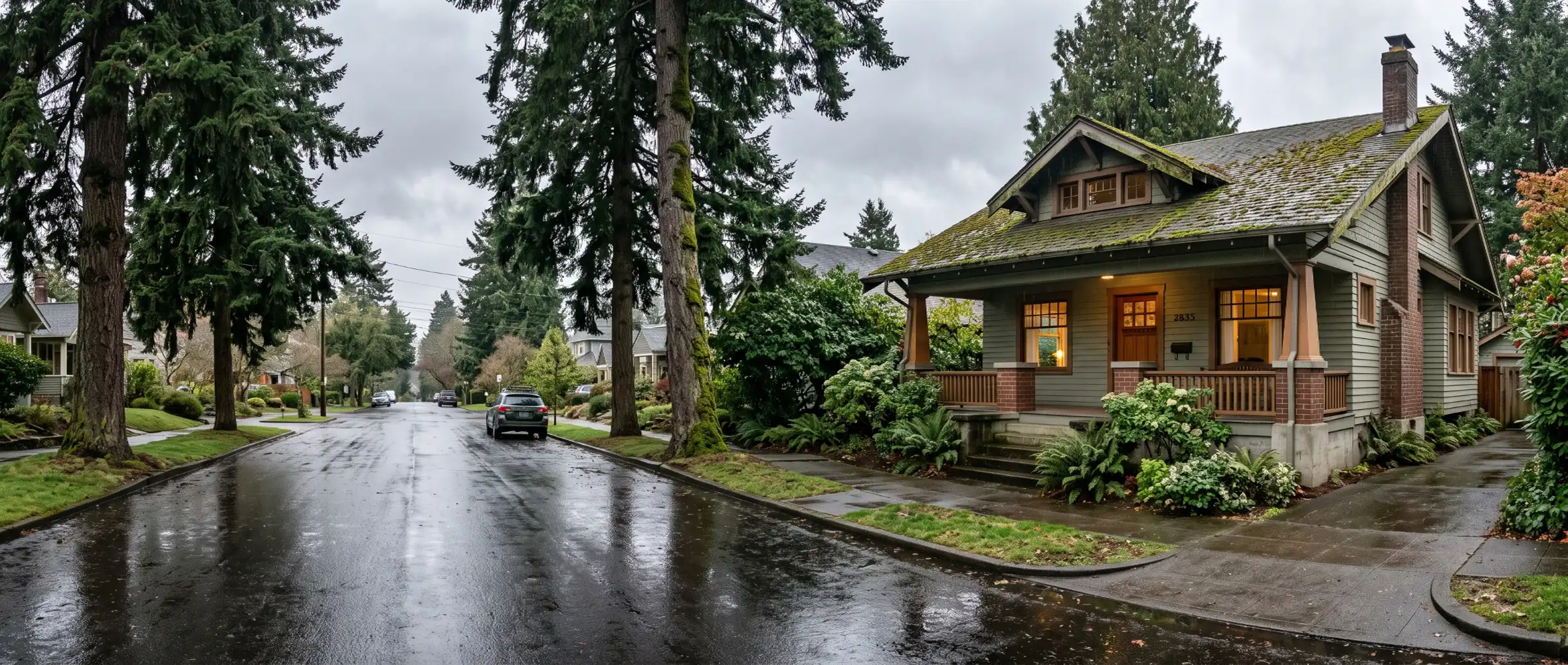

Finding mold in a Portland home rarely means something went badly wrong. It usually means the house is doing exactly what houses in this climate do after enough wet months in a row, and that distinction matters for how worried you should actually be and what happens next. A patch in a crawl space or behind a bathroom fan is common enough here that it's rarely a sign of neglect, but it does need to be dealt with correctly, since the same dampness that grew it will bring it back if the underlying moisture never gets fixed.
Mold remediation is the process of identifying the moisture source, removing contaminated material, and treating the area following the ANSI/IICRC S520 standard, with contractor oversight in Oregon falling under the Construction Contractors Board rather than a dedicated mold license. This covers what it costs in Portland, how to hire someone given that licensing structure, what your insurance and legal options look like, and which neighborhoods and housing types carry the most risk.
Key insights
- Oregon has no mold license. Contractors performing repair work need a CCB Restoration Services (RSC) endorsement instead.
- Typical cost runs $500 to $6,000. Per-square-foot pricing falls between $10 and $25 for most jobs.
- Crawl spaces drive most calls. Portland's bungalow-era housing stock sits on vented crawl spaces that trap ground moisture year-round.
- Landlords must fix structural mold causes. ORS 90.320 requires Oregon rentals to stay weatherproofed and free of mold-promoting conditions.
- Mold is excluded from the $300 rent-deduction statute. ORS 90.368 names mold specifically as ineligible for that remedy.
- Sellers must disclose known mold. Oregon's Seller's Property Disclosure Statement under ORS 105.464 covers material defects, including mold in a crawl space or wall cavity.
Why Portland homes are prone to mold
Portland's mold risk comes from sustained dampness rather than dramatic storms. The city gets between 36 and 44 inches of rain a year spread across roughly 150 days of measurable precipitation, concentrated heavily from November through March. December alone averages around 4.5 inches across 18 to 20 rainy days, and relative humidity holds in the low 80s through the winter months. That long, low-intensity wet season, not flash flooding, is what keeps moisture levels elevated in crawl spaces, attics, and exterior walls for months at a stretch.
 Efflorescence on a crawl space foundation wall indicates moisture has been wicking through the concrete consistently over many wet seasons. Portland's clay-heavy soil holds water against the foundation longer than sandier soils, keeping this cycle active even between rain events.
The housing stock makes that climate more consequential than it would be elsewhere. Portland has one of the older housing profiles of any major West Coast city, with entire east-side neighborhoods built out in the bungalow boom that followed the 1905 Lewis and Clark Exposition. Homes from that era and through the 1950s commonly sit on unfinished basements or vented crawl spaces with concrete foundation walls that develop hairline cracks over a century of settling. Ground moisture wicks through those cracks and through bare crawl space soil, and without a vapor barrier or mechanical ventilation, that moisture has nowhere to go.
Portland's clay-heavy soil compounds the problem. Clay drains slowly compared to sandier soils, so water sits against foundation walls and under crawl space vapor barriers longer after a storm passes. The city's combined sewer system, which once routed stormwater and sewage through the same pipes in older neighborhoods, used to overflow into the Willamette during heavy rain; the Big Pipe Project, completed in 2011 at a cost of $1.4 billion, cut those overflows by 94%, though homes near the system's remaining outfalls and low-lying older neighborhoods can still see backups during the heaviest storms. The February 1996 Willamette flood, which crested roughly 10 feet above flood stage and put Johnson Creek and Fanno Creek well outside their banks, is the clearest example of what happens when that baseline saturation gets a sustained heavy-rain event layered on top; homes in those drainage corridors that took on water then are still the ones most likely to show legacy moisture issues today.
Roofs add a third pathway, and it works differently than most homeowners assume. Moss buildup from constant shade and moisture lifts shingles and traps water against roof decking, but the bigger driver in vented attics is a phenomenon called attic rain: warm, moisture-laden air from the living space rises into the attic, and on cold, clear nights, radiational cooling drops the underside of the roof sheathing below the dew point, so the moisture condenses directly onto the wood. Adding more ridge or soffit ventilation, the standard advice for attic mold almost everywhere else, can actually make this worse in Portland's marine climate, since outdoor air here is itself a moisture source rather than a drying agent. The more reliable fix is sealing the gaps between the living space and the attic, the can lights, plumbing stacks, and bathroom fan ducts that let humid indoor air reach the attic in the first place, with ventilation playing a supporting role rather than the primary one.
- Annual rainfall: 36–44 inches, concentrated November through March (NOAA NWS Portland)
- Rainy days per year: roughly 150
- Winter relative humidity: averages in the low 80s, December through February
- Dominant housing era: 1905–1950s bungalows on crawl spaces or unfinished basements
How to spot mold in a Portland home
The clearest sign of mold tied to Portland's climate is a musty smell that tracks the calendar rather than a single event: it shows up with the first heavy rain in October and doesn't fully clear until the dry stretch in July or August. A leak-driven stain, by contrast, usually appears once and then holds steady in size and shape, while a chronic-moisture stain darkens through the winter and lightens as the house dries out over summer.
Where that smell or staining shows up narrows down the likely cause considerably, since each part of a Portland home has its own dominant failure mode.
| Location | What to look for | What it usually means |
|---|---|---|
| Crawl space | Musty odor strongest near the floor, visible moisture on a vapor barrier or bare soil | Ground moisture and clay soil drainage, not a recent leak |
| Basement | Staining or efflorescence on concrete walls, a damp smell that's worse after a multi-day rain stretch | Hydrostatic pressure pushing groundwater through foundation walls |
| Attic | Dark staining on the underside of roof sheathing, compressed or damp insulation near the ridge | Attic rain condensation, especially in homes with can lights or unsealed bathroom fan ducts |
| Roof and gutters | Moss buildup, lifted or curling shingles, gutters that overflow during heavy rain | A maintenance issue now, an interior moisture problem later if left alone |
| Bathroom ceiling or walls | Peeling paint or soft drywall near the exhaust fan | An underpowered or rarely used exhaust fan failing to clear shower humidity |
| Window sills and frames | Black speckling on wood, condensation that returns daily in winter | Single-pane or older double-pane condensation, a smaller-scale version of the attic rain mechanism |
A stain or odor that fits one of these patterns doesn't automatically mean a contractor is needed. A signs of mold checklist covering the full range of visual and odor indicators is worth a look first, since a small surface patch on a nonporous material is often manageable without professional help.
Mold species common in Portland
The most common species found in Portland homes is Cladosporium, which appears year-round in crawl spaces and on window sills because it tolerates cooler temperatures better than most other common indoor mold. That cold tolerance lines up with Portland's own pattern of sustained, moderate-temperature dampness rather than a single hot, acute moisture event, which is why the species shows up consistently across all twelve months instead of clustering around one season.
 The scattered colony pattern across the full sheathing surface is consistent with Cladosporium, Portland's most common indoor species, which thrives in the cool sustained moisture of a vented attic rather than requiring a single flood or leak event.
Visual color and texture aren't reliable enough to confirm species on their own, which is why a lab sample matters once a contractor is already on site for removal. Each location in a Portland home tends to produce a different moisture profile, and that profile is what determines which species actually take hold there. HVAC systems and poorly ventilated attic insulation tend to favor Aspergillus and Penicillium, which lab reports usually identify only by genus rather than exact species, while Alternaria concentrates on window frames and in bathrooms, tracking closely with condensation rather than structural leaks.
| Species | Common location | Notes | Health category |
|---|---|---|---|
| Cladosporium | Crawl spaces, window sills | Cold-tolerant; active even in cooler months | Allergenic |
| Aspergillus and Penicillium | HVAC systems, attic insulation | Often grouped together since lab reports usually identify only the genus | Allergenic; some species toxigenic |
| Alternaria | Window frames, bathrooms | Tracks closely with condensation rather than structural leaks | Allergenic |
| Stachybotrys chartarum | Crawl spaces, basements | Requires sustained moisture; fits Portland's long wet season | Higher concern; requires full containment |
The species behind most black mold removal calls requires that kind of extended exposure rather than a single flood event, which is part of why crawl spaces and basements account for a disproportionate share of Stachybotrys findings in Portland compared to storm-driven markets.
Mold remediation cost in Portland
Most Portland mold remediation projects cost between $500 and $6,000, depending on the size of the affected area and whether structural materials need to be cut out and replaced. Small, contained jobs in a bathroom or a single crawl space access point land at the low end; multi-room jobs or those involving attic sheathing, subflooring, or wall cavity framing push toward the higher end. Most contractors price by the square foot, with per-square-foot rates generally running $10 to $25, though demolition-heavy jobs with structural wood replacement can run well past $15,000.
 Crawl space clearance in Portland's pre-1950s bungalow stock can run as little as 18 to 24 inches, forcing crews to work lying down rather than crouching. That access difficulty, not mold severity, is what pushes most Portland jobs toward the top of the cost range.
The exact figure on a quote depends less on the mold itself than on what the contractor has to cut into to reach it. A bathroom job that stays on tile and grout costs far less than one where the crew has to open a wall to chase a leak back to its source, and a crawl space job where the existing vapor barrier is salvageable costs less than one where it has to be torn out and replaced entirely.
| Affected area | Typical cost | What drives the price |
|---|---|---|
| Under 10 sq ft, nonporous surface | $300–$800 | Often DIY-eligible per EPA guidance; professional cost reflects a minimum service call |
| Bathroom or single crawl space access point | $500–$2,000 | Confined space, limited demolition, single moisture source |
| Whole crawl space or finished basement | $2,000–$8,000 | Vapor barrier work, insulation removal, larger square footage |
| Attic with roof leak history | $1,500–$6,000 | Sheathing replacement, ventilation correction, moss-related roof repair |
| Multi-room or structural mold | $6,000–$15,000+ | Drywall and framing removal, HVAC involvement, extended containment |
Cost by location in the home follows a similar pattern to the rest of the country, with Portland's older housing stock pushing crawl space and basement jobs slightly higher because of vapor barrier and insulation work that newer slab-foundation homes in other markets don't need. HVAC jobs carry their own cost logic, since duct cleaning and component replacement for Aspergillus contamination are priced per system rather than by square footage.
| Location | Typical cost | Why |
|---|---|---|
| Bathroom | $500–$2,500 | Confined containment, ceiling or grout-line growth |
| Crawl space | $1,500–$6,000 | Vapor barrier installation, ground moisture treatment, low clearance labor premium |
| Basement | $1,500–$7,000 | Concrete wall treatment, finished basement material removal |
| Attic | $1,500–$6,000 | Sheathing access, insulation removal, moss-related roof tie-in |
| HVAC system | $600–$5,000+ | Duct cleaning or component replacement, NADCA standards apply |
Inspection and testing run separately from remediation. An inspection cost typically runs $300 to $450, and post-remediation clearance testing, which confirms the work succeeded, adds another $200 to $600. Cost varies further with contractor demand and access, so a written, itemized quote after an in-person inspection is the only reliable way to budget a specific job. Demand tends to climb each year once the first sustained heavy rain hits in October, as crawl space and attic problems that built up over the dry summer finally surface, so scheduling earlier in the year often means shorter wait times for an inspection.
How to hire a mold remediation contractor in Portland
Oregon has no dedicated state mold remediation license, which means the Oregon Construction Contractors Board's bond and insurance requirements, not a mold-specific credential, are what actually back up a contractor's work. The CCB issues two endorsements that cover this kind of job: Restoration Services (RSC), built specifically for fire, water, mold, and disaster damage, and the broader Residential General Contractor (RGC) endorsement that some larger remediation firms hold instead because it lets them take on structural repair work in the same visit. Neither endorsement requires mold-specific training to obtain, so the license confirms financial accountability rather than technical competence on its own.
 A scope of work naming the affected square footage and stating whether clearance testing is billed separately is what makes a bid comparable against a second quote, since Oregon's CCB licensing structure leaves that level of detail up to the contractor rather than a state requirement.
Most Portland remediation companies hold the RSC endorsement, since it's the one built for this exact category of work, while companies that regularly handle jobs involving joist replacement or framing repair often carry both. Knowing which one a contractor holds before they arrive helps set expectations for what they can legally take on without bringing in a second company.
| Endorsement | What it covers | What it doesn't confirm |
|---|---|---|
| Restoration Services (RSC) | Fire, water, mold, and disaster damage on residential and small commercial structures | IICRC training, mold-specific technique, containment protocol knowledge |
| Residential General Contractor (RGC) | Broader scope including structural repair, useful if the job involves joist or framing replacement | Same gap; a wider scope license doesn't add mold-specific vetting |
Because that gap exists on both endorsements, the actual verification work falls on the homeowner. Pulling a contractor's record at the CCB's lookup tool by name or license number shows three things worth checking independently: whether the license itself is active, whether the bond is current, and whether the liability insurance has lapsed, since a license can display as active while the coverage behind it has expired.
Asking whether the lead technician holds IICRC AMRT certification confirms training on S520 containment and clearance procedures specifically, something the CCB endorsement alone doesn't test for. A contractor without that certification isn't automatically a bad choice, but it shifts more of the verification burden onto the license and bond check above.
A scope of work that names the affected square footage and states whether clearance testing is a separate line item, rather than a single bundled number, is what makes a bid comparable against a second quote and against the final invoice once work wraps up. A bid that comes in well below two others without that level of detail is usually skipping the moisture-source repair or the post-removal containment cleanup, not reflecting a genuinely lower remediation cost for the same scope of work.
| Question to ask | What a credible answer looks like |
|---|---|
| What's your CCB license number? | Given immediately, verifiable at oregon.gov/ccb |
| Which endorsement do you hold, RSC or RGC? | Names the specific endorsement and explains why it fits this job |
| Have you identified the moisture source? | A specific answer naming the source, not a generic reference to "the mold" |
| Is clearance testing included or billed separately? | Either is fine, as long as it's stated before work starts |
| Does the lead technician hold IICRC AMRT certification? | A direct yes with a name you can check, not a vague reference to training |
| Who performs the clearance test? | An independent inspector, not the same crew that did the removal |
A contractor who answers all six clearly and without hesitation has likely done enough mold remediation work to know what a homeowner needs to hear before signing anything.
What the remediation work actually involves
A Portland mold job follows the same underlying sequence regardless of which contractor performs it, since the steps come from the IICRC S520 standard rather than any one company's process, and a technician's IICRC AMRT certification is what confirms they were actually trained on it. The crew seals off the work area with plastic sheeting and runs a HEPA air scrubber under negative pressure so spores can't spread to the rest of the house while material is disturbed.
 Containment under negative pressure keeps spores from spreading to the rest of the house while contaminated drywall and framing are removed, the same sequence IICRC S520 calls for regardless of which contractor performs the work.
Anything too porous to clean, typically insulation, drywall, or framing that's absorbed moisture for an extended period, gets bagged and removed once the containment is sealed and running. Surfaces that can be salvaged instead are HEPA vacuumed and treated with an EPA-registered antimicrobial, which is generally faster and less disruptive than a full tear-out when the material hasn't been saturated long enough to lose its structural integrity. Any crawl space vapor barrier or drainage correction goes in only after this cleaning step is complete, since sealing moisture-damaged material behind a new barrier before it's actually clean just traps the problem rather than solving it.
| Job type | Active work | Drying time | Clearance lab | Total |
|---|---|---|---|---|
| Bathroom or small surface | 1–2 days | 1–2 days | 1–3 days | 3–7 days |
| Crawl space remediation | 2–4 days | 3–5 days | 1–3 days | 1–2 weeks |
| Crawl space with new vapor barrier | 3–5 days | 5–7 days | 1–3 days | 2–3 weeks |
| Attic with roof leak history | 2–4 days | 3–5 days | 1–3 days | 1–2 weeks |
| Multi-room or structural mold | 5–10+ days | 7–14 days | 1–3 days | 3–6 weeks |
The job isn't finished until an independent inspector, not the company that did the removal, confirms it through clearance testing. A job that fails on the first pass usually means the moisture source wasn't fully addressed before the barrier or drywall went back up, not that the removal itself was incomplete.
Does insurance cover it?
Mostly not, given how Portland's mold typically forms. Homeowners insurance is built around a sudden-versus-gradual distinction: a burst pipe or an appliance failure can trigger coverage for the resulting mold, but Portland's defining risk pattern is the opposite of sudden. Moisture that builds in a crawl space over a wet winter or seeps through a clay-soil foundation over years falls on the excluded side of that line, capped or denied regardless of how the eventual damage adds up.
Moss-related roof damage runs into the same problem from a different angle. Most Oregon carriers treat moss buildup as a maintenance issue rather than a covered peril, so mold tracing back to a moss-damaged roof gets denied the way a slow plumbing leak would: the homeowner had the opportunity to catch it before it became expensive. That puts regular roof cleaning closer to an insurance decision than a cosmetic one.
On the rare occasions a policy does respond, the payout rarely covers the full job. Carriers that pay out for a covered cause still attach a sublimit that often runs well under what a crawl space or basement remediation actually costs, and the full homeowners insurance coverage picture gets more complicated once overflowing creeks or storm drain backups push the claim into flood territory, where standard coverage doesn't apply and a separate NFIP or private flood policy becomes the only path. NFIP itself covers mold sparingly, mainly when a home was inaccessible after the flood rather than as a general remediation benefit.
Documentation determines most contested claims regardless of the cause. Photograph the source event, not just the mold, and note both the discovery date and the date remediation started, since an adjuster's call on "sudden" versus "gradual" usually comes down to whether that timeline exists on paper.
Buying or selling a Portland home with mold
Oregon law requires sellers to disclose known material defects through the Seller's Property Disclosure Statement under ORS 105.464, and mold in a crawl space, basement, or wall cavity qualifies as exactly that kind of defect. The specifics of seller disclosure obligations vary significantly by state, but Oregon's mechanics are straightforward: the statement asks sellers to answer based on actual knowledge, with "yes," "no," or "unknown" as the standard options, and the form's final catch-all question asks whether any other material defect affects the property and only accepts a yes or no answer. A seller who knows about mold and marks "unknown" anyway, particularly when the mold is visibly obvious or has an associated musty smell, risks a buyer later arguing the seller must have known.
 Oregon's disclosure statute runs on the seller's actual knowledge rather than a duty to investigate, so a buyer's own pre-purchase inspection remains a stronger safeguard than the disclosure form alone, particularly in century-old construction.
An as-is sale doesn't remove this duty. Oregon courts treat the disclosure obligation as separate from the sale terms, so an as-is clause limits a seller's liability for defects they genuinely didn't know about but doesn't protect against a claim based on knowingly withholding known mold. Buyers, for their part, carry a parallel duty under the statute to pay diligent attention to defects they could discover through reasonable inspection, which is the legal basis for why a pre-purchase inspection matters even when a seller's disclosure looks clean.
For buyers specifically touring older Portland homes, the mold inspection process should include a crawl space and basement check regardless of what the disclosure states, since vapor barrier gaps and foundation cracks in century-old construction are easy for a seller to genuinely not know about. A documented clearance report from a prior remediation, if one exists, is worth requesting directly rather than relying on the disclosure form's summary.
Mold rights for Portland renters
Oregon's habitability statute, ORS 90.320, requires landlords to keep rental units weatherproofed and free from conditions that promote mold growth, including a functioning roof, sound exterior walls, and working plumbing. If mold traces to a structural issue like a roof leak, a plumbing failure, or inadequate ventilation, the landlord is responsible for the repair, not the tenant. The full tenant rights picture, including escalation options beyond what's covered here, applies the same habitability principle across states; Oregon's version layers in ORS 90.275 and 90.305, which require landlords to inform tenants of known conditions affecting health or safety, on top of the baseline weatherproofing duty.
 Buildings like this one predate modern vapor barrier and ventilation standards, which is part of why ORS 90.320 places the weatherproofing duty on the landlord rather than the tenant when a structural issue is the actual cause.
One detail trips up a lot of tenants trying to self-help: ORS 90.368 lets tenants deduct up to $300 from rent for minor habitability repairs after written notice, but the statute explicitly excludes mold, radon, asbestos, and lead-based paint from that remedy. A tenant who buys a dehumidifier and tries to deduct the cost the way they might for a broken faucet is not protected by that statute. The correct path for unresolved rental mold is written notice under ORS 90.360 and 90.365, which generally requires landlords to respond to health and safety issues within about seven days, followed by the standard remedies, including rent withholding in limited circumstances, if the landlord doesn't act.
Document the mold and the suspected cause in writing
Include the location, a description, and any visible cause like a window condensation pattern or a known leak. Verbal notice is generally not sufficient to preserve legal remedies in Oregon.
Give the landlord a reasonable window to respond
Seven days is the practical standard for health and safety issues under ORS 90.365. Keep a copy of the notice and the date it was delivered.
Escalate to code enforcement if the landlord doesn't act
Portland's Bureau of Development Services can inspect for code violations tied to habitability. A documented violation gives a tenant additional leverage beyond the civil remedies in ORS Chapter 90.
Neighborhood risk across Portland
Mold risk in Portland varies by neighborhood mainly because of three local factors: proximity to a creek or drainage corridor prone to surface flooding, how old the housing stock is, and how exposed a roofline is to moss buildup. No single factor predicts risk on its own, since a newer home near a flood-prone creek can carry different exposure than an older home on a hillside with no flooding history at all.
| Area | Primary risk factor | Notes |
|---|---|---|
| Lents, Powellhurst-Gilbert | Johnson Creek surface flooding | Creek has flooded the area more than 40 times in the past 75 years; the city's ongoing floodplain restoration work targets this corridor specifically |
| Sellwood, St. Johns | Combined sewer overflow, legacy risk | Both sit near former overflow outfalls; the city's Big Pipe Project cut Willamette overflows by 94% after completion in 2011, though the heaviest storms can still strain older pipes nearby |
| Buckman, Hosford-Abernethy, Richmond | Crawl space and basement age | Dense concentration of pre-1930s bungalows with original crawl space foundations |
| Irvington, Laurelhurst | Roof and gutter maintenance | Larger, older homes with complex rooflines prone to moss buildup and ice-dam-adjacent moisture |
| Cedar Hills, West Slope | Slope drainage | Hillside lots where grading directs runoff toward foundations rather than away |
| Council Crest, Arlington Heights, Portland Heights | Glacial loess soil on steep slopes | Early 20th-century West Hills homes sit on windblown silt that holds moisture differently than the city's clay base, adding foundation movement risk on top of age |
| Hazelwood, Centennial | Mixed-era HVAC condensate | Newer construction with central air; condensate drain clogs are the dominant non-rain-related cause |
These factors aren't exclusive to any one area; flood corridor proximity and crawl space age both extend well beyond the neighborhoods named here.
Preventing mold in a Portland home
The five most effective ways to prevent mold in a Portland home are clearing roof moss annually, checking the crawl space vapor barrier once a year, running bathroom exhaust fans during and after every shower, cleaning gutters twice a year, and maintaining steady crawl space and attic ventilation.
 Clearing moss before the fall rains start is one of the few prevention steps that addresses a cause specific to Portland's climate, since moss buildup lifts shingles and traps moisture against the decking underneath.
Roof moss removal earns the top spot on this list because it's the one action that interrupts the attic rain cycle covered earlier rather than just managing humidity after the fact. A roof cleared before October, when the first sustained heavy rain typically arrives, gives shingles a full dry season to shed water properly instead of trapping it against decking that's already compromised by a season of moss growth. The remaining four actions work together to keep humidity controlled once the roof itself is no longer contributing moisture it shouldn't be.
| Action | Frequency | Why it works |
|---|---|---|
| Inspect and clear roof moss | Annually, before fall rains | Moss buildup lifts shingles and traps moisture against decking |
| Check crawl space vapor barrier | Annually | Gaps let ground moisture rise into the floor structure year-round |
| Run bathroom exhaust fans during and after showers | Every use | Clears condensation before it settles on cooler surfaces |
| Clean gutters and downspouts | Twice yearly, fall and spring | Portland's tree canopy clogs gutters faster than most cities |
| Maintain crawl space and attic ventilation | Ongoing | Static, unventilated air holds humidity against wood framing |
A hygrometer placed in a crawl space or basement is a low-cost way to catch rising humidity before it becomes visible mold, since humidity and mold growth are directly linked at the mechanism level. These five actions work best as part of a broader mold prevention routine rather than one-time fixes, and the EPA's general guidance targets indoor relative humidity below 60%, with most remediation professionals recommending 30% to 50% as the practical range for preventing growth in vulnerable spaces. Anyone uncertain whether a given patch crosses the line into needing a professional should weigh it against the EPA's 10-square-foot threshold and the other signs that call for more than a DIY cleanup.
Frequently asked questions
Does Oregon require a mold remediation license?
No. Oregon has no dedicated state mold remediation license. Contractors who perform repair or reconstruction work as part of remediation need an Oregon Construction Contractors Board endorsement, most often the Restoration Services (RSC) endorsement, which covers fire, water, mold, and disaster damage on residential and small commercial structures.
How much does mold remediation cost in Portland?
Most Portland mold remediation jobs run $500 to $6,000, with small bathroom or crawl space patches at the low end and multi-room or structural jobs running higher. Per-square-foot pricing typically falls between $10 and $25, and projects involving demolition or structural wood replacement can exceed $15,000.
Is my landlord required to fix mold in my Portland rental?
Yes, if the mold stems from a building defect. Under ORS 90.320, Oregon landlords must keep rental units weatherproofed and free of conditions that promote mold growth. If a leak, ventilation failure, or structural issue is causing the mold, the landlord must repair it within a reasonable time after written notice.
Do I have to disclose mold when selling a house in Portland?
Yes. Oregon's Seller's Property Disclosure Statement, required under ORS 105.464, asks sellers to disclose known material defects, and mold in a crawl space, basement, or wall cavity qualifies. Sellers answer based on actual knowledge, but a buyer who finds undisclosed, obviously visible mold can pursue a claim.
Can I deduct mold cleanup costs from my rent in Portland?
No, not under the minor repair statute. ORS 90.368 allows tenants to deduct up to $300 for minor habitability repairs, but the statute specifically excludes mold from that deduction right. Tenants dealing with rental mold need to use written notice and the standard habitability remedies under ORS 90.360 and 90.365 instead.
What causes mold in Portland crawl spaces?
Bare or poorly vented crawl spaces under older Portland bungalows trap ground moisture year-round, and Portland's clay-heavy soil holds water against the foundation longer than sandier soils. Combined with roughly 150 days of measurable precipitation a year, this keeps crawl space humidity elevated even outside the rainy season.
Does homeowners insurance cover mold remediation in Portland?
Sometimes, and only up to a sublimit. A standard Oregon HO-3 policy covers mold remediation when it follows a sudden, covered event like a burst pipe, typically capped at $5,000 to $10,000. Mold from gradual leaks, chronic humidity, or the rainy season generally is not covered.
What is attic rain in Portland homes?
Attic rain is condensation that forms on the underside of roof sheathing when warm, moisture-laden indoor air reaches an unsealed attic and meets cold sheathing on a clear night. It's common in Portland's vented attics and gets worse, not better, if the only fix attempted is adding more ventilation, since outdoor air here is itself a moisture source.
What is the most common mold species in Portland?
Cladosporium is the most common species found in Portland homes, appearing year-round in crawl spaces and on window sills because it tolerates cooler temperatures better than most other indoor mold. Aspergillus, Penicillium, and Alternaria are also common, with Stachybotrys chartarum appearing mainly after sustained moisture in crawl spaces or basements.
How do I verify a Portland mold contractor's credentials?
Search the contractor's name or license number at the Oregon CCB's lookup tool to confirm the license, bond, and liability insurance are all active. Then ask whether the lead technician holds IICRC AMRT certification, which confirms training on S520 containment and clearance procedures that the CCB endorsement alone doesn't test for.
Can I remove mold myself in a Portland home?
Yes, for patches under 10 square feet on a nonporous surface like tile or glass, following EPA guidance on detergent-and-water cleaning that's also the basis for DIY mold removal on small jobs. Mold in a crawl space, behind drywall, or on porous materials like wood and insulation generally needs professional remediation, since DIY cleaning on those surfaces rarely reaches the moisture trapped underneath.
How long does mold remediation take in Portland?
A small bathroom or surface job typically takes 3 to 7 days from inspection through clearance testing. A crawl space job involving a new vapor barrier runs longer, often 2 to 3 weeks once drying time and lab turnaround are included.
Sam Hickerson is the founder of RestoreAdvisor and writes consumer guides on mold remediation, water damage restoration, inspection, testing, and home recovery. His work focuses on helping homeowners understand costs, risks, and when to call a professional. He draws on guidance from the EPA, CDC, IICRC, and other authoritative sources to make complex home issues easier to navigate.