
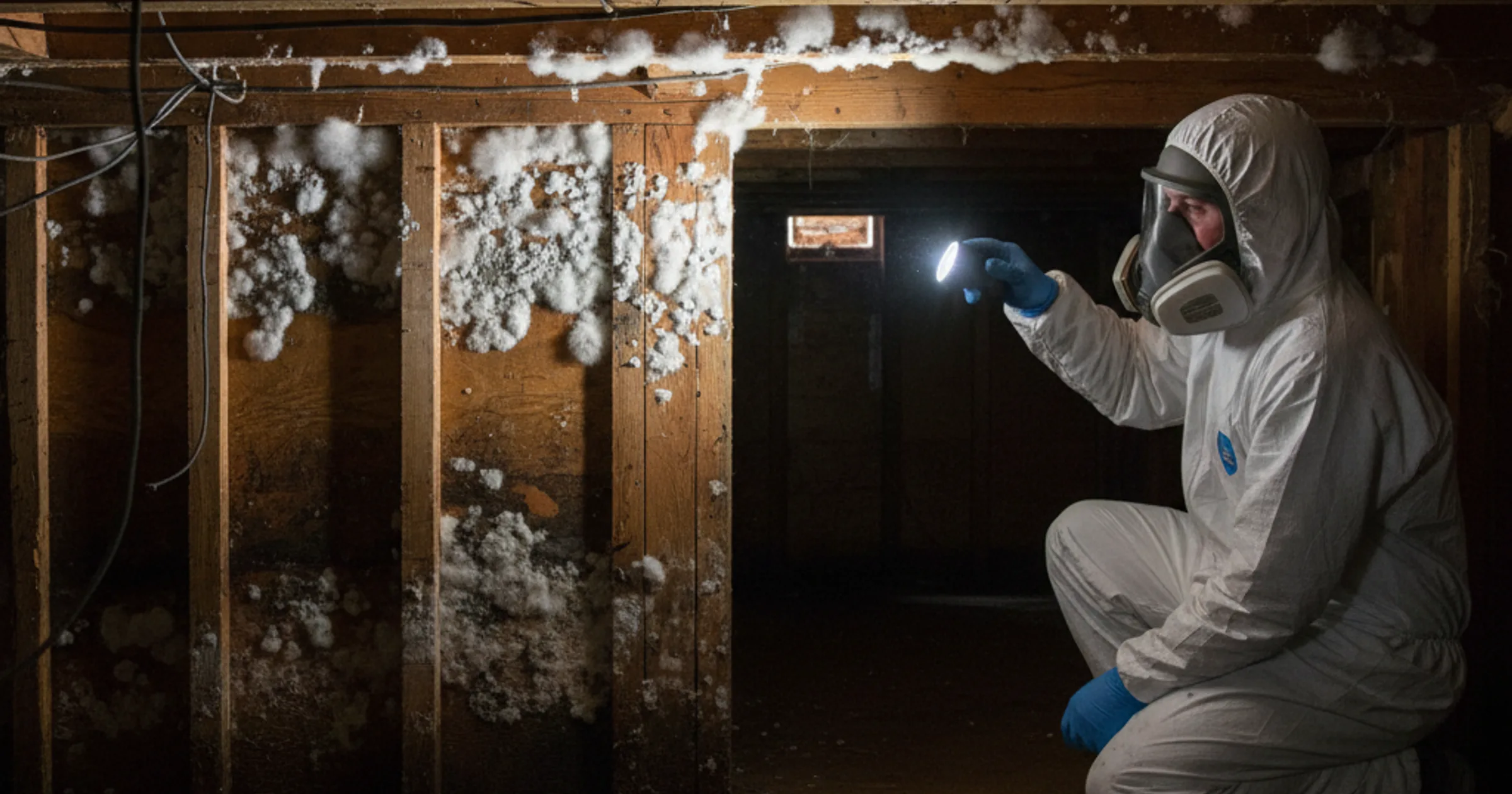

You found something white and fuzzy on a wood beam or concrete wall, and you are not sure what it is. That uncertainty is worth resolving quickly, because white mold and its common look-alikes require completely different responses. White mold is a term for several fungal species, most commonly Aspergillus, Penicillium, and Cladosporium, that colonize organic materials such as wood and drywall in damp conditions and are subject to remediation standards set by the ANSI/IICRC S520 Standard for Professional Mold Remediation. This page will help you confirm what you are looking at, understand the health and structural stakes, and decide whether to handle it yourself or call a mold remediation professional.
Key insights
- White mold cannot be identified by color alone. Visual inspection cannot confirm species or toxicity. Professional air or surface sampling is required to know which fungus you have.
- Color does not equal safety. The EPA states all mold should be removed regardless of type or color. Certain Aspergillus and Penicillium strains produce mycotoxins comparable to darker mold species.
- Efflorescence is the most common look-alike. The water test (misting the substance) is the fastest way to tell them apart: efflorescence dissolves, white mold does not.
- The EPA threshold is 10 square feet. Areas smaller than this on non-porous surfaces can typically be handled by a capable homeowner. Structural wood framing warrants professional remediation regardless of size.
- Mold grows within 24–48 hours of moisture. A leak or flood that goes unaddressed over a weekend is enough time for visible white mold to establish on wood framing.
- Fixing the moisture source is not optional. Surface cleaning without correcting the underlying moisture problem will result in regrowth, often within days.
What white mold is
White mold is not a single fungal species but a visual category covering several molds during their white or off-white growth phase. According to the ANSI/IICRC S520, the most common species behind indoor white mold are Aspergillus, Penicillium, Cladosporium, Trichoderma, and Mucor, all of which require the same three conditions: a moisture source, an organic food source such as wood or drywall, and temperatures in the range that most homes maintain.
Some of these species will shift color to green, gray, or black as they mature and produce spores, which is why white mold is often a temporary description rather than a permanent identifier. Mold growing in a light-colored room may remain white throughout its lifecycle, while the same species on a darker surface may appear gray from the start.
 The hyphae shown penetrating below the surface here are why wiping away visible growth alone rarely resolves an infestation on porous wood.
White mold's distinctive structure allows it to penetrate deep into porous materials, making it more invasive than surface-level growth. Understanding which species is present matters because health risks of mold vary considerably across species, from mild allergenicity in Cladosporium to mycotoxin production and invasive infection risk in certain Aspergillus strains.
White mold vs. efflorescence and mildew
White mold, efflorescence, and mildew are distinguished by texture, surface type, and a simple water test: misting the suspect substance dissolves efflorescence but leaves mold intact. Knowing which one you have matters because the treatment for each is completely different.
 A mist of water settles which side of this comparison you're looking at in seconds: the mineral deposit dissolves, the living mold doesn't.
Efflorescence is a mineral salt deposit, not a living organism. It forms on concrete, brick, and masonry when water migrates through the material and carries dissolved salts to the surface. As the water evaporates, the salts are left behind as a white, powdery, or crystalline crust. Efflorescence is harmless to human health and does not require remediation, though it signals a moisture intrusion issue worth investigating. It has no odor and is found only on masonry surfaces, not on wood or drywall.
Mildew is a surface fungus that grows flat and powdery and does not penetrate materials. It is typically found on bathroom tile, grout, and fabric. Unlike white mold, mildew does not destroy the substrate it grows on and is easier to clean. The practical distinction is texture: mildew stays flat and powdery; white mold grows in three dimensions and can appear fuzzy, cottony, or web-like. Identifying which you have matters because treatment, health risk, and remediation scope differ significantly between mold vs. mildew.
| Feature | White mold | Efflorescence | Mildew |
|---|---|---|---|
| Organism type | Living fungus | Mineral salt deposit | Living fungus |
| Texture | Fuzzy, cottony, or web-like | Powdery, crystalline | Flat, powdery |
| Surfaces | Wood, drywall, fabric | Concrete, brick, masonry | Tile, grout, fabric |
| Odor | Musty | None | Musty (mild) |
| Dissolves in water | No | Yes | No |
| Health risk | Yes | No | Low |
| Penetrates materials | Yes | No | No |
| Requires remediation | Yes | No (fix moisture source) | Usually DIY |
Where white mold grows in homes
White mold is most common in spaces that combine wood or organic materials with persistent humidity and limited airflow. Basements, crawl spaces, and attics account for the majority of residential white mold cases because all three provide structural wood framing, dark conditions, and irregular air circulation. It also appears inside wall cavities after plumbing leaks, where mold after water damage can develop within 24 to 48 hours before the moisture source is even identified, and on stored cardboard, fabric, and wood furniture left in damp spaces.
 Framing and insulation together like this create the combination white mold favors most: an organic food source paired with humidity that has nowhere to escape.
White mold thrives in areas where moisture accumulates and ventilation is limited. The three locations below account for the overwhelming majority of residential cases.
Basement
White mold in basements most often appears on wood floor joists, the back of drywall, and concrete block walls. The basement mold conditions that drive white mold growth are condensation from cold walls meeting warm interior air, water seepage through foundation walls, and plumbing leaks. Efflorescence on concrete walls is frequently mistaken for white mold here; the water test described above resolves the confusion.
Crawl space
Crawl spaces are the highest-risk location for white mold in most homes. Ground moisture vapor migrates upward into the space, saturating wood floor joists and subfloor framing. Combined with limited ventilation, this creates sustained humidity above the 60% relative humidity threshold at which mold establishes reliably. White mold on crawl space floor joists often looks like light dust or natural weathering and is easy to overlook during casual inspection.
Attic
Attic white mold grows primarily on roof sheathing and rafters. Inadequate ventilation, exhaust fans venting into the attic rather than outside, and air leaks from the living space below are the main causes. The distinctive pattern of attic mold is white or gray growth on the underside of roof decking, often with nail head staining as condensation collects at the metal.
White mold species and appearance
The five most common white mold species found indoors are Aspergillus, Penicillium, Cladosporium, Trichoderma, and Mucor. Each produces white or off-white growth in early stages but differs in texture, preferred surface, health risk, and whether DIY removal is appropriate.
 Texture this three dimensional rules out mildew immediately, though it still can't tell you which of five common species you're looking at without a lab sample.
Because none of these species can be reliably distinguished from one another by appearance alone, professional mold testing through air sampling or surface swabbing is the only way to confirm species and guide the appropriate remediation protocol. The table below covers the key differences across the five most common residential species.
| Species | Appearance | Common locations | Health category | Protocol |
|---|---|---|---|---|
| Aspergillus | White to gray, powdery, may develop green or yellow areas | Basements, attics, drywall, stored food | Allergenic; some strains produce mycotoxins | Pro for large areas or weakened immune system residents |
| Penicillium | White to blue-green, velvety or powdery | Water-damaged materials, insulation, wood | Allergenic; some strains produce mycotoxins | Pro for large areas |
| Cladosporium | White to olive-gray, suede-like | Wood framing, fabric, HVAC surfaces | Allergenic | DIY under 10 sq ft on cleanable surfaces |
| Trichoderma | White, cottony clumps | Wet wood, paper, insulation | Allergenic; produces volatile compounds | Pro recommended |
| Mucor | White to gray, fast-spreading, fluffy | Stored food, soil, very wet wood | Allergenic; rare systemic risk in weakened immune system | Pro recommended |
Health risks of white mold
White mold poses real health risks, though the severity depends on the species, exposure duration, and the health status of the people in the home. The EPA states that molds produce allergens, irritants, and in some cases toxic substances, and that sensitive individuals can react to even small amounts. The CDC: Basic Facts About Mold reinforces that all mold found indoors should be removed, regardless of species or color.
 Symptoms that ease away from home and return once back inside are one of the more reliable patterns pointing to mold exposure, even when nothing is visible yet.
The primary health effects associated with white mold exposure include:
- Respiratory irritation: Coughing, wheezing, shortness of breath, and nasal congestion are the most commonly reported symptoms. These are driven by inhaled spores and mold volatile organic compounds (mVOCs).
- Allergic reactions: Sneezing, watery eyes, skin irritation, and worsened asthma. Aspergillus and Penicillium are among the most potent indoor allergens.
- Mycotoxin effects: Certain Aspergillus and Penicillium strains produce mycotoxins that cause more significant effects with prolonged exposure, including fatigue, headaches, and immune suppression.
- Opportunistic infections: In individuals with compromised immune systems, Aspergillus species can cause invasive aspergillosis, a serious pulmonary infection. The NIH notes Aspergillus as a leading cause of infectious death in immunocompromised patients.
High-risk populations include children, the elderly, pregnant individuals, people with asthma or chronic lung disease, and anyone undergoing chemotherapy or taking immunosuppressants. Households with these members should consult a professional rather than attempting DIY removal, since health consequences of exposure scale significantly with immune status and age.
A note on symptoms that track with home occupancy: if respiratory or allergy-like symptoms consistently improve when away from home and worsen upon returning, mold exposure is a plausible cause even without visible growth. This pattern is one of the most reliable signs of mold in a home and warrants a professional inspection even when no growth is visible.
DIY removal vs. professional remediation
The EPA's 10 sq ft threshold determines DIY eligibility for white mold removal. Areas under 10 square feet on non-porous or semi-porous surfaces that a capable homeowner can access safely fall within DIY scope. Structural wood framing, HVAC systems, and areas behind walls or under flooring require professional remediation regardless of size.
 Containment like this becomes mandatory once the IICRC S520 Condition 2 or 3 classification applies, regardless of how small the visible white mold patch looks.
Call a professional when:
- The affected area exceeds 10 square feet
- White mold is on structural wood framing (floor joists, rafters, wall framing)
- Anyone in the household has asthma, allergies, a compromised immune system, or is pregnant
- The moisture source cannot be identified or fixed independently
- Mold is inside HVAC ductwork or the air handler
- Visible growth is accompanied by a strong musty odor throughout the home
- Regrowth occurs after cleaning
Beyond size, the IICRC S520 Condition 1/2/3 classification framework determines whether a job is DIY-eligible or requires professional scope. Conditions involving hidden growth, structural materials, or systemic contamination all qualify as professional regardless of visible square footage. When mold remediation is required by these criteria, containment, negative air pressure, and clearance testing are mandatory steps.
How to remove white mold
Remove white mold by fixing the moisture source first, then cleaning with vinegar, hydrogen peroxide, or borax solution (not bleach on porous surfaces), using an N95 respirator and nitrile gloves, and drying the area completely within 24 to 48 hours. Skipping the moisture fix or reordering the steps is the most common reason white mold returns after cleaning.
 No bleach in this kit is deliberate; on unfinished wood it can't reach the hyphae below the surface and its water content can actually add to the moisture problem.
1. Fix the moisture source first Identify and repair any leak, condensation problem, or humidity issue before touching the mold. For persistent high humidity, a dehumidifier targeting 30%–50% relative humidity is necessary.
2. Set up containment and ventilation Close HVAC vents in the work area. Use a box fan exhausting outward through a window to prevent spreading spores.
3. Put on PPE At minimum: N95 respirator, nitrile gloves, and safety glasses. A disposable coverall is recommended as the affected area approaches 10 square feet. Full PPE costs and supply kit options are covered in the DIY mold removal process for any surface type.
4. Mist and scrub Lightly mist the mold to reduce airborne spore release before disturbing it. Apply cleaner (see product guidance below), let it dwell for 10 minutes, and scrub with a stiff brush.
5. HEPA vacuum After scrubbing, HEPA vacuum the work area to capture remaining spores.
6. Dry completely Dry the area within 24–48 hours. For wood, verify moisture content is below 16% with a moisture meter before any repairs or painting.
Cleaning products by surface:
| Product | Dilution | Dwell time | Best for | Limitation |
|---|---|---|---|---|
| Distilled white vinegar | Undiluted | 10 minutes | Unfinished wood, porous surfaces | Odor; may not fully kill deep roots |
| Hydrogen peroxide (3%) | Undiluted | 10 minutes | Wood, drywall, fabric | Do not mix with bleach |
| Bleach solution | 1 cup per gallon water | 10 minutes | Non-porous surfaces (tile, glass) | Does not penetrate wood; damages fibers |
| Commercial antifungal (EPA-registered) | Per label | Per label | All surfaces | Cost; requires proper ventilation |
Do not use bleach on unfinished wood. The IICRC S520 and EPA both caution that bleach cannot penetrate porous wood surfaces to reach mold hyphae, and the water component of bleach can actually increase moisture in the wood. The mold on wood treatment framework covers sanding, encapsulant application, and surface-specific cleaning by wood type in detail.
For structural wood in attics, basements, and crawl spaces where the affected area is large, professionals use mechanical abrasion (wire brushing), soda blasting, or dry ice blasting to remove mold from the wood surface, followed by antimicrobial treatment and clearance testing. These methods are more effective on porous structural lumber than any chemical-only approach.
White mold removal cost
White mold removal costs $500–$1,500 for small residential jobs under 100 square feet, and $1,500–$6,000 or more for larger infestations on structural wood framing. Cost is driven by the affected surface area, the type of material, and the location in the home.
 The jump between the second and third tiers here usually comes down to one thing: whether soda blasting equipment is needed for structural framing or not.
White mold remediation cost varies significantly depending on whether the job is surface-only cleaning or requires soda blasting, material removal, and structural drying. Per-square-foot rates for surface work run $10–$25. Jobs requiring soda blasting on structural framing add equipment and labor costs that push totals toward the upper end of the ranges below.
| Scenario | Typical affected area | Typical cost | Notes |
|---|---|---|---|
| Small surface area (drywall, trim) | Under 10 sq ft | $300–$700 | May be DIY-eligible |
| Moderate infestation (one room) | 10–100 sq ft | $500–$1,500 | Professional recommended |
| Crawl space or basement framing | 100–300 sq ft | $1,500–$4,000 | Soda blasting or mechanical abrasion often required |
| Whole-attic sheathing | 300+ sq ft | $2,500–$6,000+ | Specialty equipment, clearance testing included |
| White mold plus insulation removal | Variable | Add $500–$2,000 | Contaminated insulation must be bagged and removed |
Post-remediation clearance testing adds $200–$500 but is strongly recommended to confirm the job is complete. The mold remediation cost data shows structural framing jobs in attics and crawl spaces trending toward the upper end of the national range due to access difficulty and soda blasting equipment costs.
Preventing white mold
White mold prevention is moisture control applied consistently. The EPA guidance is clear: mold cannot establish without sustained moisture, so eliminating the moisture source eliminates the risk. After any suspected moisture event, a mold inspection can confirm whether white mold has established before it becomes visible to the eye.
 Pairing the dehumidifier with a moisture meter like this catches drift back toward the 60% threshold before it's visible as new growth on nearby framing.
The table below organizes prevention actions by target location so each action maps to the moisture pathway it addresses.
| Action | Target | Frequency | Why it works |
|---|---|---|---|
| Maintain indoor humidity at 30%–50% RH | Whole home | Ongoing (monitor with hygrometer) | Mold cannot establish reliably below 60% RH |
| Run exhaust fans during and after bathing/cooking | Bathrooms, kitchen | Every use (run 30 min after) | Removes moisture before it settles on surfaces |
| Inspect plumbing under sinks and around appliances | Kitchens, bathrooms, laundry | Monthly | Slow leaks create chronic moisture without visible pooling |
| Check and clear gutters and downspouts | Exterior | Twice yearly | Blocked gutters push water against foundation |
| Seal crawl space with vapor barrier | Crawl space | One-time installation | Blocks ground moisture vapor from entering structural wood |
| Install and maintain crawl space or basement dehumidifier | Crawl space, basement | Check monthly; replace filter per manufacturer | Keeps RH below mold threshold in naturally humid spaces |
| Ventilate attic correctly (IRC R806 requirements) | Attic | Inspect annually | Prevents condensation on roof sheathing from interior moisture |
| Dry any water intrusion within 24–48 hours | Any affected area | Immediately after event | IICRC S520 and EPA both cite this window as the prevention threshold |
A mold prevention schedule with humidity targets, exhaust fan sizing, dehumidifier selection, and inspection routines by location is the most reliable way to stay ahead of white mold before it establishes.
If you have already found white mold and want to confirm no other areas are affected, a professional mold inspector using air sampling can locate hidden moisture damage before it becomes a larger remediation project.
Frequently asked questions
Is white mold dangerous?
Yes, white mold is dangerous and should be removed regardless of species. Aspergillus and Penicillium, two of the most common white mold species, produce allergens and in some strains mycotoxins. They cause respiratory irritation, allergic reactions, and worsened asthma, especially in children, the elderly, and people with compromised immune systems. The EPA and CDC both state that all mold should be removed regardless of color or species.
What is the difference between white mold and efflorescence?
Efflorescence is a harmless mineral salt deposit that forms on concrete and masonry when moisture migrates through the surface. White mold is a living fungus that grows on organic materials such as wood, drywall, and fabric. The fastest field test: mist the substance with water. Efflorescence dissolves; white mold does not. Efflorescence has no odor; white mold typically smells musty.
What does white mold look like on wood?
White mold on wood typically appears as fuzzy, cottony, or web-like growth ranging from bright white to off-white. In early stages it may look powdery or dusty. On darker wood it stands out clearly; on light-colored or painted surfaces it can be easy to miss. It may cover a small patch or spread across large sections of framing when moisture has been present for an extended period.
Can I remove white mold myself?
Yes, if the affected area is under 10 square feet on a non-porous or semi-porous surface, you have no health conditions that increase mold sensitivity, and you can fix the moisture source. For structural wood framing or any area over 10 square feet, professional remediation following IICRC S520 is the safer option.
What kills white mold on wood?
Undiluted distilled white vinegar or 3% hydrogen peroxide, applied and allowed to dwell for 10 minutes before scrubbing with a stiff brush, is effective on surface mold on unfinished wood under 10 square feet. Bleach is not recommended for wood because it cannot penetrate porous surfaces to reach mold hyphae. For structural framing with deep penetration, mechanical abrasion or soda blasting by a professional is more effective than any chemical approach.
Why does white mold keep coming back?
White mold returns when the moisture source has not been corrected. Cleaning visible growth without fixing the leak, condensation problem, or humidity issue leaves conditions intact for regrowth. Mold can also regrow from hyphae that penetrate below the surface of porous materials and survive surface cleaning.
Is white mold the same as mildew?
No. Mildew grows flat and powdery on surfaces and does not penetrate materials. White mold grows in three dimensions, penetrates porous surfaces like wood and drywall, and causes structural damage over time. If the growth is fuzzy, cottony, or web-like rather than flat and powdery, it is mold rather than mildew.
Sam Hickerson is the founder of RestoreAdvisor and writes consumer guides on mold remediation, water damage restoration, inspection, testing, and home recovery. His work focuses on helping homeowners understand costs, risks, and when to call a professional. He draws on guidance from the EPA, CDC, IICRC, and other authoritative sources to make complex home issues easier to navigate.