
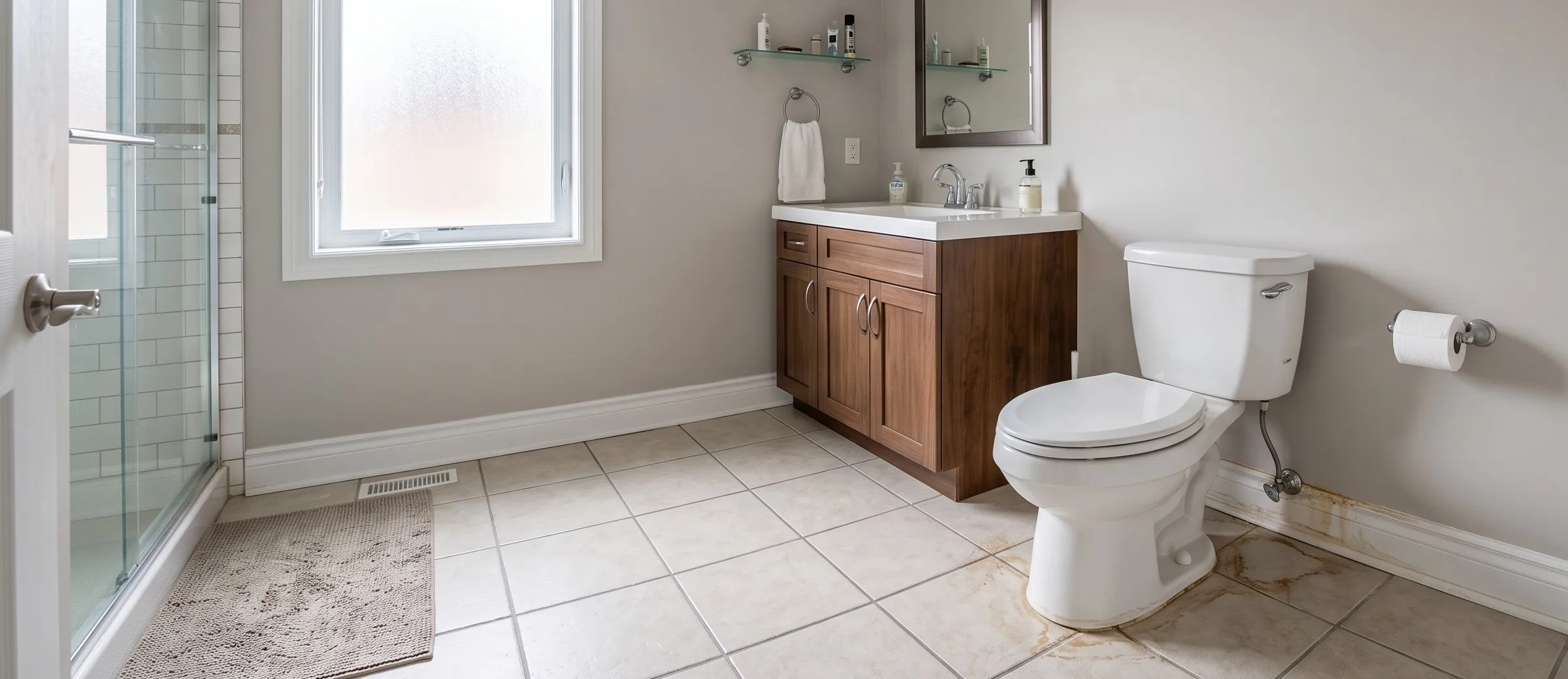

Bathroom water damage is water intrusion from a plumbing fixture, supply line, or failed seal that has moved beyond the tub, sink, or toilet and into flooring, drywall, or the subfloor, classified under IICRC S500 by the water's source and contamination level. It's one of the most common water damage calls a restoration company gets, precisely because a bathroom concentrates more plumbing connections and more daily water use into a smaller footprint than any other room in the house.
If you've found a wet spot near the toilet, a soft patch of flooring by the tub, or a stain on the ceiling below your bathroom, you're dealing with something specific and usually fixable rather than a mystery. Start with what to do in the first hour, then identify which fixture is responsible, and check what restoration typically costs and whether insurance covers it, so you can stop the damage from spreading and decide who to call next.
Key insights
- Bathrooms account for a disproportionate share of home water damage claims because more fixtures, more water volume, and more daily use are concentrated in a small footprint than in any other room.
- The source determines the category. A supply line or overflow of clean water is Category 1 under IICRC S500, while a toilet overflow that contains waste is Category 3, a distinction that changes both the cleanup protocol and the cost.
- A slow leak can run for months behind tile or under a vanity before it's visible, since these locations drain away from sight instead of pooling on the floor where you'd notice it.
- Restoration typically costs $150 to $8,000, depending on whether the leak was caught immediately or has already reached the subfloor, wall cavity, or the ceiling below.
- Mold risk begins within 24 to 48 hours of sustained moisture, per the EPA, which is why documenting and drying a bathroom leak quickly matters more than in a room that dries on its own.
- An upstairs bathroom leak shows up on the ceiling below more often than as visible damage in the bathroom itself, because water finds the path of least resistance through the subfloor before it's noticeable at the surface.
What to do right now
Responding to a bathroom leak means shutting off the water at its source, cutting power to any outlet the water reached, removing standing water, and documenting the damage before calling a plumber and, if needed, a restoration company. Doing these in order limits how far the water spreads while you wait for help to arrive.
 Turning the valve clockwise fully seals the supply line within a quarter turn on most angle stops, faster than walking to the home's main shutoff.
Shut off the water at the source
Most toilets, sinks, and some tubs have their own angle stop valve, usually a small oval or round handle on the supply line. Turn it clockwise until it stops. If the leak is coming from a spot you can't isolate, such as a pipe inside a wall, shut off the home's main valve instead.
Cut power if water reached an outlet
Bathroom GFCI outlets sit close to sinks and tubs by code, which puts them within reach of standing water more often than outlets in other rooms. If water has pooled near an outlet, a plugged-in hair dryer, or a space heater, cut power at the breaker panel rather than approaching the outlet directly. Standing water near live electrical components is a shock hazard regardless of the source, per OSHA.
Remove standing water and start airflow
Towels work for a small amount of water; a wet/dry vacuum is faster for anything more than a puddle. Run the bathroom exhaust fan and prop the door open once the water is up, since trapped humid air slows drying even after the visible water is gone.
Photograph everything before you clean
Photograph the pooled water, the fixture you suspect caused it, and any staining on the floor or walls before you start mopping up or moving anything. If you end up filing a claim, this documentation is what establishes the timeline.
Call for help based on scope
A plumber addresses the fixture itself. If the water reached the subfloor, spread to an adjoining room, or is dripping through the ceiling below, bring in a certified water damage restoration company as well. A toilet overflow that's still actively running or water that reached an outlet moves this from a routine leak into emergency territory, where waiting on the plumber before starting extraction only gives the water more time to spread.
What not to do
A few common reactions to a bathroom leak make the damage worse rather than better, mainly ones that hide the problem instead of stopping it. Most of these mistakes share the same consequence: moisture that isn't caught and dried within 24 to 48 hours crosses the threshold where mold becomes likely.
 Painting over a stain traps whatever moisture remains underneath instead of removing it, which is why the CDC recommends confirming a surface is fully dry before resealing it.
Don't run the shower or tub again until you know the source
If you're not sure whether the leak is coming from the tub, shower pan, or a supply line, using that fixture again adds more water to an area that's already wet and can push moisture further behind the tile before anyone has assessed the damage.
Don't paint or caulk over a stain to hide it
Sealing a stain without confirming the area is dry traps whatever moisture is already there, which is one of the most common reasons bathroom mold shows up weeks after a leak that seemed minor. The CDC: Basic Facts About Mold covers who's most at risk if that happens, a relevant check if anyone in the household has asthma or a compromised immune system.
Don't ignore a toilet that rocks or wobbles
A toilet that shifts when you sit down usually means the wax ring seal has already failed and waste water is leaking with every flush, not just occasionally. Continued use makes the subfloor damage worse.
Don't wait on your insurer before mitigating
Most policies require you to take reasonable steps to prevent further damage regardless of when the adjuster arrives. Extracting water and starting to dry the area protects both the home and the claim.
Where the leak is coming from
Bathroom water damage most often originates at the toilet base, under the vanity or sink, at the tub or shower surround, or as a stain on the ceiling of the room below an upstairs bathroom. Each location points to a different fixture and carries a different level of urgency.
 Staining concentrated at the toilet base and traveling along a grout line usually points to a failed wax ring, not a supply line, since a supply line leak sprays outward rather than seeping downward.
Location matters as much as the amount of water you see. A small amount concentrated at the toilet base carries a different risk profile than the same amount spread along a shower wall, since a still-running toilet overflow can call for emergency water damage restoration response while a slow shower-wall leak typically doesn't.
| Location | Likely source | Key signal | Urgency |
|---|---|---|---|
| Around the toilet base | Wax ring failure or supply line drip | Toilet rocks, floor feels soft nearby | High, contains waste |
| Under the vanity or sink | Supply line, P-trap, or drain leak | Musty smell, warped cabinet floor | Moderate |
| Tub or shower surround | Failed caulk, grout, or pan liner | Loose or hollow tile, stains beyond the shower | Moderate to high |
| Behind the toilet or tub on an exterior wall | Condensation, not a leak | Damp in cold weather only, no fixture nearby is wet | Low, monitor |
| Ceiling of the room below | Any upstairs bathroom source | Stain or sag directly under the tub, shower, or toilet | High |
A leak that only appears during or right after a shower almost always traces back to the tub or shower enclosure itself, since that's the only fixture producing that much water on that schedule. A leak that's present regardless of whether anyone has showered, especially one near the toilet or under the vanity, points to a supply line or drain that's dripping continuously rather than only during use.
One common false positive is worth ruling out before you assume a leak: a toilet tank sweating in humid weather can drip condensation down the outside of the bowl and pool at the base, mimicking a wax ring failure exactly. Wipe the tank dry, wait an hour in similar humidity, and check again; if the tank stays dry and the puddle doesn't return, condensation was the cause rather than a failed seal.
Common causes of bathroom water damage
Bathroom water damage most often traces back to one of six failure points: caulk or grout, the toilet wax ring, a supply line, the shower pan, a drain connection, or an overflow. Each one carries a different water classification and a different repair path, and the classification determines how the restoration company scopes and prices the job.
 Once caulk pulls away from the seam like this, water travels behind the tile with every shower rather than draining as intended, which is why a re-caulk job on a schedule costs far less than the drywall repair that follows a delay.
Age and location narrow this list quickly. A leak near the toilet or shower points toward wax ring, caulk, or pan failure, while a sudden pool with no obvious trigger nearby is more likely a cracked supply line.
| Cause | How it fails | Category | Warning sign |
|---|---|---|---|
| Failed caulk or grout | Seals shrink and crack, letting water behind tile | Category 1 | Loose tiles, staining beyond the shower |
| Toilet wax ring failure | Wax seal between the toilet and drain flange breaks down | Category 3 | Toilet rocks, odor at the base |
| Supply line failure | Braided or plastic line at the toilet, sink, or tub cracks or disconnects | Category 1 | Sudden pooling, visible spray |
| Shower pan or liner failure | Waterproof membrane beneath the shower floor cracks or was installed incorrectly | Category 1 | Ceiling stain below, no visible shower leak |
| Drain leak | P-trap or tailpiece connection loosens under a sink or tub | Category 1 to 2 | Slow drip inside the cabinet |
| Overflow | Toilet, tub, or sink overflows from a clog or left-running fixture | Category 1 to 3 | Water at the floor, source depends on the fixture |
The category range on overflow deserves its own explanation, since it's the one cause on this list that isn't fixed. A tub or sink that overflowed with clean water is Category 1, while a toilet that overflowed because of a clog downstream in the drain line carries the same contamination risk as a sewage backup and should be treated as Category 3 regardless of how the water looks, since the classification is based on contamination level, not visible appearance.
Age matters too: a shower pan failure is more common in bathrooms 15 to 20 years old, when the original waterproof membrane has had time to crack, while a supply line failure behaves like any other burst pipe, a sudden Category 1 event that can happen at any age if the line itself is degraded plastic rather than braided stainless.
Tiled showers vs. one-piece fiberglass or acrylic units
A one-piece fiberglass or acrylic shower or tub insert fails differently than a tiled surround, since there's no grout holding back water across most of the surface. Water problems on these units nearly always start at a seam rather than spreading gradually the way tile grout failure does.
| Unit type | Where it fails | Typical warning sign |
|---|---|---|
| Tiled shower | Grout lines and caulk joints across the surface | Loose tile, staining that spreads gradually beyond one spot |
| Fiberglass or acrylic insert | Wall-to-floor seam, drain gasket, or a stress crack in the shell | A single consistent wet spot at one seam or crack, not spread across the surface |
A cracked fiberglass or acrylic pan is also more likely to need full unit replacement than a patch, since gelcoat and seam repairs rarely hold up long-term under daily water exposure the way a re-grouted tile section does.
Where the water travels
Bathroom water doesn't stay in the bathroom, since gravity and the room's plumbing penetrations give it a direct path down and outward. Water that isn't extracted quickly moves through subfloor seams, around the toilet flange, and along wall cavities into the spaces immediately below and beside the bathroom, which is why the IICRC S500 class system scores an upstairs bathroom leak separately from the ceiling below it.
 A stain this size on the ceiling usually means water has been traveling through the subfloor above for longer than the ring's edge suggests, since drywall only discolors once it has already absorbed as much moisture as it can hold.
A ground-floor bathroom on a slab typically confines a leak to the room itself and possibly an adjoining wall, since there's no floor below for water to travel through. An upstairs bathroom is a different situation entirely, and one worth walking through on its own.
Upstairs bathrooms vs. ground-floor bathrooms
An upstairs bathroom leak is more likely to be discovered as a ceiling stain in the room below than as visible damage in the bathroom itself. Water travels along the underside of the subfloor before it saturates enough drywall to show as a stain, which means by the time you see a mark on the ceiling downstairs, the leak has usually been active longer than the size of that stain suggests.
| Bathroom location | Where damage shows first | What it means for the job |
|---|---|---|
| Ground floor, slab foundation | The bathroom itself, along the base of walls | Contained to one room in most cases |
| Upper floor, over a finished room | Ceiling of the room below | Two rooms affected, ceiling drywall likely needs replacement |
| Upper floor, over an unfinished space | Visible from below in the attic or basement joists | Easier to catch early since the underside is exposed |
The water damage classes system measures how much of the material in each affected room absorbed water, which in practice means the bathroom and the ceiling below it often finish drying on two different schedules even though a single leak caused both.
Signs of bathroom water damage
Bathroom water damage shows up as staining, warping, softness, or smell in locations you touch or see every day, which is both an advantage and a trap. One diagnostic worth doing immediately: tap suspect tile with a knuckle, since a hollow sound rather than a solid one confirms the adhesive underneath has already failed.
 Paint bubbles and lifts once trapped water builds enough pressure behind the surface, a sign the moisture has already been sitting in the wall for days rather than hours.
Not every sign carries the same urgency. A musty smell alone often means poor ventilation rather than a leak, while that same smell paired with soft flooring or a rising water bill is a much stronger signal that water has already reached a porous material.
| Sign | Where to check | What it usually means |
|---|---|---|
| Musty odor that doesn't clear after venting | Anywhere in the room, strongest near the source | Moisture has been present long enough for microbial growth to start |
| Soft or spongy flooring | Around the toilet base and tub edges | Subfloor has absorbed water and is losing structural integrity |
| Discolored or bubbling paint | Walls adjacent to the tub or shower | Water is trapped behind the surface |
| Loose or hollow-sounding tile | Shower and tub surround | Adhesive has failed from sustained moisture behind the tile |
| Rising water bill with no explanation | Not visible in the bathroom at all | A continuous drip is running somewhere in the supply line |
| Stain or sag on a ceiling below | The room directly under an upstairs bathroom | Water has traveled through the subfloor before showing upstairs |
A stain-age check is worth doing before you assume the worst. Press a finger against the discolored area; if it's dry and firm, the leak that caused it may already be resolved, while a spot that's soft or cool to the touch signals active moisture. A leak this contained sometimes shares a source with a problem elsewhere in the home, so it's worth checking the fuller list of signs of water damage if you're also seeing signals outside the bathroom itself.
DIY vs. professional
A DIY response is appropriate when the water is confined to a hard, non-porous surface, the amount is small, and you can confirm the area is fully dry within a day. Professional help becomes the right call once water has reached porous materials like drywall, subfloor, or cabinetry, or once you can't confirm the space behind the wall or under the floor is actually dry.
 A 28.4 percent reading on drywall confirms active moisture, since a visually dry wall can still test wet for days after the surface looks fine.
The moisture-confirmation step is where homeowners most often get this wrong. A surface that looks dry to the eye can still read wet on a moisture meter for days afterward, which is why a professional verifies with a meter rather than a visual check before calling a space fully dry.
| Factor | DIY-appropriate | Call a professional |
|---|---|---|
| Water source | Confirmed and stopped | Unknown or still active |
| Materials affected | Tile, tub surface, non-porous surfaces | Drywall, subfloor, cabinetry |
| Moisture confirmation | Dry within 24 hours, verified by touch | Can't confirm dryness behind a wall or under flooring |
| Area size | A few square feet | Spread beyond the immediate fixture, or into another room |
If you land on the professional side of that table, the same DIY water damage cleanup criteria apply here as they do in any other room, since a bathroom follows the same category and class rules once the water source is identified.
Who to call
Vetting the restoration side of the job matters as much as picking a plumber, since a company that doesn't dry a wall cavity properly can leave a mold problem behind even after the visible leak is fixed. The same water damage restoration checklist that applies to any other cause of water intrusion in the home works for a bathroom leak, since the drying and documentation steps don't change based on which room the water came from.
Call both the plumber and the restoration company at the same time rather than waiting for one to finish first, especially once water has reached drywall or the subfloor, since every hour the space stays wet adds to the drying timeline. When comparing restoration companies, ask whether the technician holds an IICRC Water Damage Restoration Technician (WRT) certification and whether they'll provide written moisture readings before closing the wall back up, not just a verbal confirmation that it's dry.
Cost of bathroom water damage restoration
Bathroom water damage restoration typically costs $150 to $8,000, with the total driven almost entirely by how quickly the water was caught and whether it reached the subfloor or the ceiling below. A leak stopped and dried the same day sits at the low end; one that soaked a wall cavity or spread to another room sits toward the high end.
 A written estimate should separate the plumber's fixture repair from the restoration company's drying and repair work as two distinct line items, not one blended total.
Labor makes up a larger share of a bathroom job than materials, since the room's small footprint limits how much flooring or drywall there is to replace even in a severe case. That's part of why a comparable amount of damage typically costs less in a bathroom than in a larger room like a basement or living room.
| Scenario | Typical cost | What drives it |
|---|---|---|
| Caught immediately, surface water only | $150–$600 | Extraction and drying, no materials removed |
| Localized damage, vanity or small drywall section | $500–$2,500 | Cabinet or baseboard replacement, spot drywall repair |
| Subfloor or wall cavity affected | $2,500–$8,000 | Tile or flooring removal, subfloor drying or replacement |
| Reached the floor or ceiling below | $5,000–$20,000 | Two-room repair, drywall and possibly flooring in both spaces |
| Extensive loss, structural repair needed | $10,000–$30,000+ | Subfloor replacement, plumbing access, full retiling |
These figures track the same water damage restoration cost data used across the vertical, since a bathroom's small footprint often keeps the total lower than a comparable leak in a larger room, even when the underlying category and class are the same.
A per-square-foot sanity check on a contractor's quote uses the same rates found in the water damage restoration cost per square foot figures used across the rest of the vertical: $3 to $7.50 per square foot for mitigation and $20 to $37 per square foot for repair.
Fixing the source vs. restoring the damage
The figures above cover water damage restoration only, not the plumbing repair that stopped the leak, and the two are billed separately by two different companies in most cases.
| Fixture repair | Typical cost | Who does it |
|---|---|---|
| Reset toilet wax ring | $150–$300 | Plumber |
| Re-caulk or reseal tub/shower | $200–$500 | Plumber or handyman |
| Replace a supply line | $100–$300 | Plumber |
| Replace a shower pan or liner | $1,500–$4,000 | Plumber or contractor |
A homeowner comparing a written estimate against these ranges should expect to see both numbers on separate line items, one for the plumber's fix and one for the restoration company's drying and repair work, rather than a single blended total.
Insurance coverage for bathroom water damage
Homeowners insurance typically covers bathroom water damage when the cause is sudden and accidental, such as a supply line that failed without warning, but not when the damage built up gradually from a leak you could have caught sooner. A wax ring or shower pan that failed slowly over months, with staining that was visible before you addressed it, is the scenario insurers are most likely to push back on.
 Photos taken before any cleanup began carry more weight with an adjuster than a description alone, since they establish the timeline the sudden versus gradual determination depends on.
Whether homeowners insurance covers water damage in a bathroom follows the same claim mechanics as any other room: the same documentation checklist, deductible mechanics, and appraisal process for a denied or underpaid claim all apply.
Per NAIC guidance, insurers generally weigh the entry point, how long the source went undetected, and evidence of ongoing maintenance when making that sudden-versus-gradual determination.
A home warranty covers different ground than insurance and is worth checking separately: it typically pays for a worn-out wax ring, supply line, or shower valve, gradual mechanical failures that a standard homeowners policy excludes, though it won't cover the resulting water damage to flooring or drywall the way insurance does.
Renter and condo liability
Renters in a bathroom leak scenario should notify the landlord immediately, since most leases put the plumbing itself under the landlord's responsibility while personal belongings damaged by the leak fall to the renter's own policy if they carry one. Condo owners face a more layered version of the same question: a leak that travels to the unit below can trigger claims against the master policy, the downstairs owner's HO-6 policy, and potentially the originating owner's own policy, depending on whether the association's governing documents treat the plumbing as a common element.
Document the leak the same way an owner would, with photos and a written notice, since verbal reports are harder to prove later if a dispute comes up over who's responsible. Checking the declaration page before a leak happens, rather than during one, is the easiest way to know in advance which policy is supposed to respond first.
Prevention
Preventing bathroom water damage comes down to five recurring maintenance habits, most on a fixed schedule: re-caulk every 1 to 3 years, test the toilet for rocking twice a year, and check supply lines annually. None of these require a professional, and each one targets a different failure point, from caulk and grout to supply lines and toilet seals.
 Applying a fresh bead every 1 to 3 years, before the old caulk visibly cracks, costs a fraction of the drywall repair that follows once water gets behind a failed seal.
Re-caulk the tub and shower every 1 to 3 years
Silicone caulk degrades and pulls away from tile long before it looks obviously cracked. Replacing it on a schedule, rather than waiting for visible failure, keeps water from ever reaching the substrate behind the tile.
Test the toilet for rocking twice a year
Sit and shift your weight. Any movement means the wax ring seal is compromised and should be reset before it leaks with every flush rather than after.
Check supply lines annually
Look at the connections under the sink, at the toilet, and at the tub or shower valve if it's accessible. Replace any braided line showing rust, kinking, or bulging rather than waiting for it to fail.
Run the exhaust fan during and after every shower
Moisture control isn't only a mold issue. Keeping humidity down also slows the rate at which any small, undetected leak saturates surrounding materials.
Watch the water bill for unexplained increases
A jump with no obvious cause is one of the earliest signals of a supply line or toilet leak that hasn't yet produced a visible puddle.
These habits are one piece of a larger system: the same water damage prevention principles apply across every fixture and season in the home, not just the bathroom.
Frequently asked questions
Can I shower while my bathroom has water damage?
It depends on the source. If the leak is coming from the tub or shower itself, using it again adds more water to an already wet area and can push moisture further behind the tile. If the damage came from the toilet or sink and the shower is unaffected, you can typically keep using it while the rest of the room dries out.
How long can a bathroom leak go undetected?
Weeks to months for a slow leak behind tile, under a vanity, or beneath a shower pan, since these areas are hidden from view and drain slowly instead of pooling on the visible floor. A supply line or toilet overflow is different; those show up within minutes because the volume of water is immediate rather than gradual.
Is a wet bath mat or rug a sign of a leak?
Sometimes. A bath mat that's damp right after a shower is normal. One that's still wet hours later, or that's wet along one edge closest to the toilet or vanity rather than the shower, points to a slow leak rather than splash water.
Does homeowners insurance cover a cracked shower pan?
Rarely, on its own. A cracked pan is typically treated as a maintenance and product-failure issue, not sudden and accidental damage, so most insurers exclude the pan replacement itself. The water damage the crack caused to surrounding flooring or the ceiling below may still be covered if it happened suddenly rather than over months.
Should I remove the toilet myself to check for a leak?
You can, if you're comfortable shutting off the supply valve and resetting a wax ring afterward, since this is one of the more DIY-accessible plumbing jobs. If the subfloor underneath feels soft or the toilet has been rocking for a while before you noticed the leak, stop and call a plumber, since the subfloor itself may need repair before the toilet can be reset safely.
What's the difference between bathroom water damage and bathroom mold?
Water damage is the physical intrusion itself, the wet drywall, warped flooring, or soaked subfloor caused by a leak. Mold is a possible consequence of that moisture if it isn't dried within 24 to 48 hours. A bathroom can have water damage with no mold yet, or mold with the original leak already fixed. If mold has already appeared, bathroom mold removal is a different process entirely, covering species identification, removal steps, and prevention specific to fungal growth rather than the original leak.
Will filing a claim for a bathroom leak raise my insurance rates?
It can, especially if it's a second water-related claim within a few years, since insurers track claim frequency more closely than claim size for this peril. A single sudden and accidental claim, like a supply line failure, is less likely to trigger a nonrenewal than a repeat claim tied to the same unresolved source.
How much does it cost to fix water damage behind bathroom tile?
$1,000 to $4,000 for a typical shower wall section, once you include tile removal, substrate replacement, and retiling. The range moves higher if the leak also reached the subfloor or an adjoining room, and it moves lower if the water damage restoration company can dry the cavity through a small access cut instead of removing the whole wall.
Can a small bathroom leak cause damage in the room below?
Yes, if the bathroom is on an upper floor. Water that pools faster than the subfloor can absorb it finds the path of least resistance downward through seams, nail holes, and plumbing penetrations, and it often shows up as a ceiling stain in the room below before it's visible anywhere in the bathroom itself.
Sam Hickerson is the founder of RestoreAdvisor and writes consumer guides on mold remediation, water damage restoration, inspection, testing, and home recovery. His work focuses on helping homeowners understand costs, risks, and when to call a professional. He draws on guidance from the EPA, CDC, IICRC, and other authoritative sources to make complex home issues easier to navigate.