
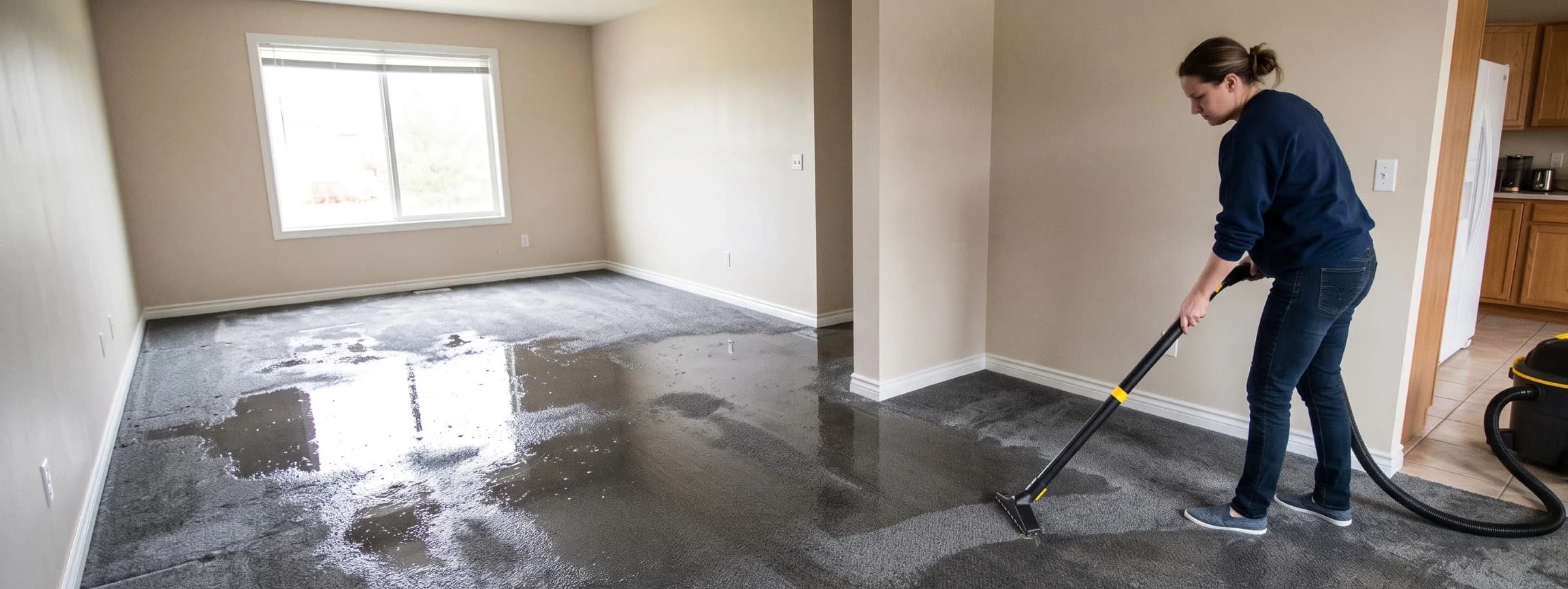

Wet carpet is a race against a fairly short clock. Carpet fibers themselves dry quickly, but the pad underneath holds water like a sponge, and once that pad has been saturated for more than a day or two, saving the carpet becomes far less likely. Under ANSI/IICRC S500, carpet and its underlying pad are classified as porous or semi-porous materials, which is why professional drying protocols treat them as a two-layer problem rather than a single surface to dry. Whether that carpet can be saved comes down mostly to the water source and how fast it gets dried, and both determine everything downstream, including replacement cost and what insurance will pay.
Key insights
- Speed decides the outcome. Carpet wetted by clean water and dried within 24 to 48 hours has a real chance of being saved; beyond that window, odor and microbial growth become likely.
- The pad is usually the deciding factor. Foam and fiber padding absorb water far more aggressively than carpet fibers, and in most cases the pad needs replacing even when the carpet itself is salvageable.
- Water source changes everything. Clean water from a supply line is a different job than gray or black water from a sewer backup or flood, which almost always requires full removal regardless of drying time.
- Carpet type affects the odds. Synthetic fibers such as nylon, polyester, and olefin tolerate a soak better than natural fibers like wool, which retain moisture longer and are more prone to backing damage.
- Fans alone rarely finish the job. Air movement without dehumidification mostly redistributes moisture in the room rather than removing it from the carpet and pad.
- Replacement costs scale with square footage and subfloor involvement. A single-room pad swap is a modest cost; subfloor drying or repair is what pushes a job into thousands of dollars.
Is water damaged carpet worth saving?
Water damaged carpet can usually be saved if it was soaked by clean water and fully dried within 24 to 48 hours. Beyond that window, or with any contaminated water source, replacement is the safer and often the cheaper option once odor, staining, and health risk are factored in.
 The darker core against the lighter edge shows the water is still wicking outward through the pad, meaning the affected area extends past what's visible on the surface.
The carpet fibers themselves are the easiest part of this system to dry. The pad underneath is the real test: it sits in constant contact with the subfloor, holds moisture longer than the fibers above it, and is far more difficult to dry in place without lifting it entirely. A carpet that looks and feels dry on top can still have a soaked pad underneath, which is why checking beneath the surface matters more than judging by touch alone.
The 24 to 48 hour window isn't a rough guess. It comes from EPA guidance on flood cleanup and indoor air quality, which identifies that timeframe as the point at which microbial growth becomes likely on wet porous materials, carpet and pad included.
Carpet is generally worth trying to save if:
- The water source was clean, such as a supply line or an appliance overflow
- The carpet was wet for less than 24 to 48 hours before drying began
- The affected area is contained rather than spread across multiple rooms
- The carpet is synthetic (nylon, polyester, or olefin) rather than a natural fiber
- No musty odor has developed yet, one of the earliest signs of water damage worth checking for beyond the carpet itself
- The carpet is younger than roughly 5 to 7 years old, since older carpet nearing the end of its typical service life often isn't worth the drying effort even when it technically could be saved
Replacement is the better call if:
- The water source was gray or black water: sewage, floodwater, or a backed-up drain
- The carpet has been wet for more than 48 hours
- A musty odor is already present
- The pad is visibly saturated, discolored, or beginning to break down
- The carpet is wool, sisal, or another natural-fiber material
- The carpet is already older or near the end of its expected lifespan, since drying effort isn't worth it for material that's close to replacement regardless
What to do right now
The immediate response to wet carpet is to stop the water source, extract standing water, and check the pad for saturation, all within the first few hours, the same first-hour priorities that apply to any water damage restoration job. Acting quickly has more influence on the outcome than any product or technique used afterward.
 Staining that reaches the subfloor itself, not just the pad, is usually the clearest sign the water sat for hours rather than minutes.
Stop the water source
Shut off the supply valve, appliance, or main line responsible for the leak. If water is entering from outside during a storm, focus on containment and keeping people away from any electrical hazard rather than a shutoff.
Move belongings off the wet carpet
Lift furniture legs onto foil or wood blocks and clear rugs, boxes, and anything absorbent from the room. Furniture left sitting on wet carpet blocks airflow underneath it and can leave rust or dye stains that set permanently.
Extract standing water
A wet/dry shop vacuum pulls up far more water than towels or a household vacuum, and every gallon removed before it soaks into the pad is water that doesn't have to be dried out later. Move slowly and overlap passes rather than rushing across the surface once.
Fold the carpet back to check the pad
Go near the wet spot and fold the carpet back from its nearest edge so you can see the padding underneath. A cool, damp feel or visible discoloration means the water traveled further than the surface suggested. If the spot is too far from any edge to fold back, cut a small flap directly over it with a utility knife instead.
Start airflow and call for help
Position fans to move air across the wet area, and run a dehumidifier if one is available. Then call a plumber if the source needs a repair, and a restoration company if the affected area is larger than a small spot, since emergency water damage restoration response typically arrives within an hour for an active leak.
What not to do
A few common instincts, like reaching for a household vacuum or waiting for a stain to disappear on its own, actually make carpet water damage worse rather than better.
Don't run a household vacuum on standing water
A standard vacuum isn't built to handle liquid and can short out or shock the user. Use a wet/dry shop vacuum instead.
Don't wait for the carpet to look dry before checking underneath
Face fibers dry faster than the pad below them, so a carpet that feels dry to the touch can still have a saturated pad holding moisture against the subfloor.
Don't seal the room and walk away
Closing doors and windows to "let it dry on its own" traps humidity in the space and slows drying rather than speeding it up. Open the room to airflow, or bring in fans, instead.
Don't skip documentation before starting cleanup
Photograph the affected area, the source of the water, and any visible damage before you start extracting or moving anything, since this record matters if you end up filing an insurance claim. This kind of pre-cleanup documentation is the first step in the broader water damage restoration checklist, which also walks through extraction, drying, and the final walkthrough before a job is considered closed.
Signs your carpet has water damage
The clearest signs that carpet has taken on water are a spongy or squishy feel underfoot, a musty odor, dark or discolored patches, and a cool, damp feel when the surface is touched. Several of these signs show up before the carpet ever looks visibly wet.
 A section that looks dry to the eye can still feel cool and damp underneath, since surface fibers dry faster than the pad holding moisture below them.
Dampness often shows up at seams and edges before it reaches the center of a room, since water travels along the path of least resistance beneath the backing and tends to pool where two pieces meet or along a wall. Checking those transition points first, rather than the middle of the room, catches a slow leak earlier than waiting for an obviously soaked patch to appear.
| Sign | What it typically means |
|---|---|
| Squishy or spongy feel underfoot | Water has saturated the pad, even if the surface looks dry |
| Musty or earthy odor | Microbial growth has likely started in the pad or backing |
| Dark or discolored patches | Dye or contaminants have migrated with the water, or mold is beginning to establish |
| Cool, damp feel when touched | Moisture is still present, even without visible staining |
| Rippling or a loose feel near seams | The backing has separated from repeated wet-dry cycles or prolonged saturation |
| Rising water bill with no clear cause | A slow leak may be feeding moisture into the carpet from below or behind a wall |
Is it clean or contaminated water?
The classification of the water that soaked your carpet, not just how long it sat there, determines whether drying is even an appropriate response. Under IICRC S500, water is grouped into three categories, and carpet reacts very differently depending on which one applies.
Category 1 water comes from a clean source such as a supply line, a water heater, or an appliance overflow using fresh water, and carpet wetted by Category 1 water is generally a strong drying candidate if addressed quickly. Category 2 water, sometimes called gray water, carries some contamination, such as dishwasher discharge or an overflowing washing machine, and requires more caution and typically professional cleaning rather than a DIY approach. Category 3 water, or black water, includes sewage backups and floodwater, and carpet exposed to it should be treated as a replacement job regardless of how quickly it's addressed, since the health risk from bacteria and pathogens outweighs any savings from trying to dry and reuse the material. This same water damage categories classification carries through the rest of a restoration job beyond carpet, and a technician assessing a wet carpet will usually ask about the source before recommending drying versus removal.
Common causes of carpet water damage
The most common causes of carpet water damage are burst or leaking supply pipes, washing machine or dishwasher hose failures, roof leaks, flooding, sewage backups, HVAC condensate line failures, and ordinary spills. Knowing which one applies helps predict both the water's starting category and how far it likely traveled beneath the surface.
 A door threshold rarely stops water for long, since the gap underneath lets it wick straight into the carpet fibers on the other side.
Burst or leaking supply pipe
A burst pipe behind a wall or under a slab often floods a room before anyone notices, since pressurized water pushes volume out quickly. This is typically clean, Category 1 water if the source is caught and stopped within the first day.
Washing machine or dishwasher hose failure
A cracked or disconnected supply hose can run for hours before anyone hears or sees it, especially in a laundry room with carpet nearby or on a floor above a finished living space.
Roof leak reaching a room below
Water traveling down through a ceiling cavity often reaches carpet gradually, which means the carpet can stay wet for days before staining ever becomes visible on the ceiling above it.
Flooding or heavy storm runoff
Water from flooding is classified as Category 3 by default regardless of how it entered the home, and that automatic classification is often the deciding factor in whether flood-soaked carpet gets dried or replaced.
Sewage or drain backup
Water backing up through a floor drain or toilet carries contamination that makes carpet removal the standard response regardless of how quickly it's addressed.
HVAC condensate line failure
A clogged or disconnected condensate drain line can drip steadily for weeks before the resulting stain or odor is ever traced back to the HVAC system rather than a plumbing source.
Spills, pet accidents, or an overfilled planter
These minor, everyday sources are the most common cause of carpet water damage and also the easiest to prevent lasting harm from. An isolated spill rarely reaches the pad if it's blotted up within an hour or two.
Why carpet padding needs replacing
Carpet padding needs replacing after water damage in most cases because foam and fiber pad absorb and hold moisture far more aggressively than the carpet fibers sitting on top of it. Even when the visible carpet dries successfully, a pad that stayed wet long enough tends to develop odor, lose its cushioning structure, or become a hidden moisture reservoir against the subfloor.
 The saturated section sits noticeably flatter and more compressed than the dry pad around it, which is why a soaked pad rarely bounces back to its original cushioning once it dries.
Rebond foam pad, the most common type under residential wall-to-wall carpet, works like a sponge: it fills with water quickly and releases it slowly, which means it can still be damp days after the carpet above feels completely dry. Fiber pad behaves similarly and can also begin to break down structurally once saturated. The rare exception is a pad specifically rated as a moisture barrier or waterproof underlayment, which is more commonly installed in basements and below-grade rooms precisely because standard pad performs so poorly there.
A pad that has been wet for more than a day or so is rarely worth trying to save, since the material cost of new pad is modest compared to the labor of pulling up carpet, drying pad in place, and reinstalling it, with no guarantee the pad dries evenly or fully. Leaving a saturated pad in place also raises the odds of the musty odor and health symptoms the CDC associates with prolonged dampness, since a pad trapped against a subfloor is exactly the kind of hidden, humid environment mold favors. Most restoration companies will recommend pad replacement as a standard line item any time carpet has been wet enough to require extraction, even if the carpet itself is being kept.
Does carpet type matter?
Carpet fiber type changes both how well the material tolerates water and how quickly it can dry, which is why the same soaking event can produce very different outcomes in two different rooms of the same house. That gap is often wide enough to decide whether the carpet gets saved or replaced, independent of how fast anyone responded to the water itself.
 The synthetic swatch on the left stays light because its fibers don't absorb water, while the wool swatch on the right shows browning as natural dyes and tannins migrate to the surface, a discoloration that rarely fades even after professional cleaning.
The difference comes down to whether the fiber itself absorbs water or just sheds it. Synthetic fibers are largely non-absorbent, so the water sitting in a nylon or polyester carpet is mostly trapped between fibers rather than inside them, which is why it releases relatively quickly once air movement and dehumidification start. Natural fibers like wool draw water into the fiber structure itself, which is slower to release and part of why wool carpet is more prone to shrinkage and browning, a yellow-brown discoloration caused by natural dyes and tannins migrating to the surface as the fiber dries.
| Carpet type | Water tolerance | Drying difficulty | Salvage likelihood |
|---|---|---|---|
| Nylon | High | Moderate | Good, if dried within 48 hours |
| Polyester | Moderate to high | Moderate | Good for clean water, shorter soak times |
| Olefin/ polypropylene | High | Easier, resists moisture absorption | Good |
| Wool | Low | Slow, prone to shrinkage and browning | Poor, replacement often recommended |
| Berber/loop pile | Moderate | Slower due to tight weave trapping moisture | Fair |
| Carpet tile | Varies by backing | Easier to lift individual tiles | Good, since affected tiles can be swapped individually |
Synthetic fibers such as nylon, polyester, and olefin dominate residential wall-to-wall carpet in the United States, and all three tolerate a soaking better than natural fibers because they don't absorb water into the fiber itself the way wool does. A wool carpet that dries slowly enough to show browning rarely recovers its original color even after professional cleaning, which is why insurance adjusters and restoration companies generally treat visible browning as a replacement signal rather than something worth attempting to reverse. Berber and other tight loop-pile weaves dry more slowly than cut-pile styles because the dense weave traps moisture against the backing longer.
Carpet tile is worth calling out separately since it behaves differently from wall-to-wall installation: individual tiles in the affected area can often be lifted, dried separately or replaced outright, and reinstalled without touching the rest of the floor. That localized approach usually makes carpet tile both faster and cheaper to restore than a continuous roll of carpet, where the whole run is treated as one connected piece.
Where the water travels beneath carpet
Water rarely stops at the carpet and pad. It typically continues into the tack strips, the subfloor, and sometimes the baseboards and drywall at the room's perimeter, and each of those materials has its own drying timeline separate from the carpet above them.
 Water rarely stays contained to a single layer, since it moves both downward into the subfloor and sideways through the tack strip into the wall assembly at the same time.
Tack strips, the thin wood strips with angled nails that hold carpet edges in place along the perimeter of a room, can absorb enough water to swell or begin rusting the nails, which weakens their grip on the carpet. A plywood or OSB subfloor beneath wet pad can swell, delaminate, or develop a moldy odor if it stays wet, while a concrete slab subfloor won't be structurally damaged by water but can wick moisture back up into new carpet and pad if it isn't confirmed dry before reinstallation. How long any of these layers take to dry depends heavily on the water damage classes system, since a Class 1 loss with minimal absorption dries far faster than a Class 3 or 4 loss where water has saturated multiple layers of flooring material.
Baseboards sitting in standing water for more than a few hours can wick moisture up into the drywall behind them. This is one reason a technician checking a wet carpet will often also check the wall a few inches above the floor rather than treating the carpet as an isolated problem.
DIY drying vs. calling a professional
Whether wet carpet is a reasonable DIY drying job or one that needs a restoration company comes down to the water source, the size of the affected area, and how quickly you were able to respond. Getting any one of those three factors wrong is usually what turns a manageable weekend job into a bigger repair later.
 An air mover and dehumidifier only go to work once standing water is already extracted, since running them on top of pooled water just spreads the moisture around the room.
Most restoration companies will do a phone assessment at no cost before dispatching a technician, which is worth using even for a borderline case. Describing the source, the square footage affected, and how long the carpet has been wet is usually enough for a company to tell you over the phone whether the job is within a reasonable DIY range or needs professional equipment.
| Factor | DIY-appropriate | Call a professional |
|---|---|---|
| Water source | Clean water (Category 1) | Gray or black water (Category 2 or 3) |
| Area affected | Small, contained spot | Full room or multiple rooms |
| Response time | Within a few hours | Water sat for a day or more before discovery |
| Pad condition | Dry or only lightly damp | Visibly saturated or discolored |
| Equipment on hand | Shop vac, fans, a rented dehumidifier | None, or the area is too large for home equipment |
A small spill or a quickly caught supply-line drip on a contained patch of clean-water-soaked carpet is well within DIY territory: extract with a shop vac, fold the carpet back at its nearest edge to check the pad, run fans and a dehumidifier, and confirm dryness with a moisture meter before putting furniture back. The same DIY water damage cleanup tools and drying technique apply to walls, flooring, and any other material in the room if the water reached beyond the carpet itself.
A soaked room, any water that sat overnight or longer, or any source beyond clean water is a different situation. Commercial-grade air movers and low-grain-refrigerant dehumidifiers pull far more moisture out of pad and subfloor than consumer equipment can in the same time frame, and a professional company can confirm dryness with the same moisture-meter thresholds a technician uses on any other water damage job: readings under roughly 15% in the pad and subfloor before reinstallation. Drying times vary by material and how much water was involved, and carpet typically dries faster than hardwood or drywall in the same room in any how long water damage restoration takes comparison across materials.
Who to call
The right call depends on what's actually failing. A plumber addresses the source if it's a fixture, supply line, or appliance connection, while a restoration company handles extraction, drying, and any pad or subfloor replacement. For anything beyond a small DIY-eligible spot, both calls typically happen the same day rather than one after the other, since delaying the drying call while waiting on the plumbing repair only extends how long the carpet sits wet.
Ask any restoration company whether the technician arriving is IICRC certified and whether the company carries Water Damage Restoration Technician (WRT) credentialing, since this confirms familiarity with the drying protocols and moisture thresholds specific to carpet and pad systems. Most companies follow the same what to expect during water damage restoration sequence regardless of material, from the first-visit assessment through daily monitoring to a final moisture-meter check before the job closes.
Cost to restore water damaged carpet
Water damaged carpet restoration typically costs $300 to $4,500 depending on whether the carpet can be dried in place, whether the pad needs replacing, and whether the subfloor was affected. Full multi-room replacement with subfloor drying or repair can run considerably higher.
 Disposal of contaminated carpet is billed as its own line item on most estimates, since hauling and dump fees apply regardless of how small the room was.
Labor makes up the majority of a professional bill in most of these scenarios, not materials, since extraction equipment, drying monitoring visits, and disposal of contaminated carpet all add hours regardless of room size. That's part of why a small, quickly caught leak and a multi-day soak in the same size room can land in very different price ranges even when the material cost of new carpet and pad would be identical.
| Scenario | Typical cost | What drives the cost |
|---|---|---|
| DIY extraction and drying, small spot | $0–$150 | Wet/dry vac rental, fan or dehumidifier rental |
| Professional extraction and drying, carpet saved | $300–$800 | Equipment, labor, one to two rooms |
| Extraction, drying, and pad replacement, one room | $500–$1,500 | New pad material, extended drying time, labor |
| Carpet and pad replacement, one room | $1,000–$4,000 | Material grade, square footage, installation labor |
| Multi-room replacement with subfloor drying or repair | $3,000–$15,000+ | Subfloor material, additional labor, larger square footage |
Carpet grade is the single biggest variable in a replacement scenario: builder-grade carpet and pad run toward the low end of the range per square foot, while higher-pile or higher-density carpet costs meaningfully more in material alone. Subfloor involvement is what typically pushes a job from a modest single-room cost into a much larger one, since drying or replacing plywood or OSB adds both time and a second trade to the job. National water damage restoration cost figures run higher than carpet-only numbers once hardwood, drywall, and structural repairs are factored in, while carpet's own per-square-foot rate sits toward the lower end of that range compared to hardwood or tile.
Does insurance cover carpet damage?
Water damaged carpet is typically covered under a standard HO-3 homeowners policy when the water source was sudden and accidental, such as a burst pipe or a failed appliance connection. Damage from flooding, an uninsured sewer backup, or a leak left unaddressed for weeks is generally excluded under the same policy.
 Photos taken before any cleanup starts are what an adjuster relies on to confirm the loss matches a sudden, accidental cause rather than gradual wear.
One detail specific to carpet claims is depreciation. Because carpet is treated as a wearing item with a defined useful life, an actual cash value settlement will typically factor in the carpet's age before the loss, and a five-year-old carpet won't be reimbursed at the same rate as new material regardless of what a replacement quote costs today. A replacement cost value policy avoids this reduction but usually requires the repair or replacement to actually be completed before the withheld depreciation is paid out.
Flood-specific damage, including groundwater or overland flooding, falls entirely outside what standard homeowners insurance covers and requires a separate NFIP flood policy, a distinction worth confirming with an insurer before assuming a claim will be paid. This exclusion catches a lot of homeowners off guard, since floodwater and a covered sudden pipe failure can leave carpet looking identical once the water is already inside the house.
Document the source, the affected area, and the carpet's approximate age with photographs before starting any cleanup, and contact your insurer early in the process rather than after the carpet has already been removed or replaced. Waiting until after the work is done to loop in the adjuster is the most common reason a claim gets disputed on documentation grounds.
A second detail worth knowing before a claim is filed: if only part of a room's carpet is damaged, an adjuster sometimes has to approve replacing the entire room rather than patching the affected section, since matching an existing carpet's exact dye lot is often impossible once the original run is no longer in production. This isn't guaranteed on every claim, but it's worth raising with the adjuster directly if a partial repair is proposed for a carpet that isn't brand new.
Removing carpet odor after drying
Getting rid of carpet odor after water damage means confirming the carpet and pad are fully dry first, then treating the fibers with an enzymatic cleaner or diluted hydrogen peroxide before finishing with baking soda to absorb any remaining smell. A musty smell that lingers after carpet has fully dried usually means moisture is still present somewhere in the pad or backing, not that the smell itself needs a stronger cleaner.
 Baking soda absorbs odor sitting on the fiber surface, but it does nothing for a smell coming from deeper in the pad, which is why it works best as a final step rather than the whole treatment.
Odor removal only works once drying is actually complete, and every treatment step assumes that's already been confirmed with a moisture meter reading, not just a visual check.
Confirm the pad and backing are fully dry first
No odor treatment produces a lasting result on carpet that still holds moisture, since the smell will simply regenerate as the remaining dampness continues feeding microbial growth.
Vacuum thoroughly before applying anything
Removing loose soil and debris first keeps any cleaning solution from binding with dirt rather than reaching the fibers and backing where the odor originates.
Treat with an enzymatic cleaner or diluted hydrogen peroxide
An enzymatic carpet cleaner breaks down the organic residue causing the smell rather than just masking it, and 3% hydrogen peroxide from a standard pharmacy bottle works as a lower-cost alternative on most synthetic carpet.
Apply baking soda for a lingering, lighter odor
Baking soda absorbs residual odor from the fiber surface once the deeper treatment has had time to work. Let it sit for a few hours before vacuuming it back up.
Call a professional if odor persists after a few days
Odor that doesn't clear within a few days of confirmed dryness usually means the pad has retained enough moisture or organic residue that surface treatment alone can't reach it, at which point pad replacement is typically the more reliable fix than repeated cleaning attempts.
Carpet on stairs and area rugs
Stair carpet and area rugs each behave differently from flat wall-to-wall installation when they get wet, and both deserve a separate note since neither fits the standard extraction-and-dry process cleanly.
Stair carpet is stretched over pad on each individual tread and secured more densely than a flat room installation, which makes lifting a section to check the pad underneath considerably harder. A restoration company will typically treat each affected step as its own small extraction and drying job rather than one continuous area, and full replacement is more common on stairs than on flat floors simply because partial drying in place is so much more difficult to execute cleanly.
Area rugs have an advantage flat carpet doesn't: they can usually be moved outside to dry, which speeds the process and lets sunlight help suppress any early microbial growth on a rug wetted by clean water. A rug soaked by contaminated water, or one made from a natural fiber like wool or jute, is a different calculation, and professional rug cleaning that includes full submersion washing is often a better outcome than attempting to dry a natural-fiber rug in place.
Preventing water damage to carpet
Preventing water damage to carpet mainly comes down to catching leaks early, protecting padding in high-risk rooms, and keeping appliance connections in good repair. Most carpet water damage traces back to a preventable source rather than an unavoidable event, so those habits meaningfully lower the odds of ever facing this problem.
 Braided stainless resists the cracking and bulging that eventually splits standard rubber hoses, which is why a five to seven year replacement schedule is cheap insurance against a sudden failure.
Check appliance hoses and connections annually
Washing machine and dishwasher supply hoses are among the most common sources of carpet-adjacent water damage, and rubber hoses in particular degrade over years of pressure exposure. Replacing them with braided stainless steel every five to seven years is cheap insurance against a sudden failure.
Use a moisture-resistant pad in basements and below-grade rooms
Standard rebond foam pad performs poorly in rooms with elevated ground moisture. A pad rated as a moisture barrier resists water penetration significantly better and is worth the modest upcharge in any below-grade installation.
Address spills and small leaks within hours, not days
A small amount of water caught and dried quickly rarely causes lasting damage. The same amount left to sit for a few days can soak deep enough into the pad to require full replacement.
Keep an eye on water bills and visible plumbing
Checking exposed supply lines and shutoff valves for corrosion or dampness every few months catches a slow leak before it ever reaches the carpet. A quick glance at the water meter periodically catches the ones you can't see at all, and these same habits are the core of water damage prevention for plumbing, appliances, and drainage across the rest of the house, not just the rooms with carpet.
Avoid wall-to-wall carpet in the highest-risk rooms
Basements and rooms built on a concrete slab carry structurally higher moisture exposure than the rest of the house. Hard flooring with area rugs, which can be lifted and dried far more easily than fixed wall-to-wall carpet, is a safer long-term choice in these spaces, worth considering in any basement renovation given how often basement water damage traces back to flooring that was never designed to handle moisture underfoot.
Frequently asked questions
Can water damaged carpet be saved?
Yes, if the water was clean and the carpet is dried within 24 to 48 hours. Carpet soaked by contaminated water, or left wet longer than 48 hours, usually needs to be replaced rather than dried and reused.
How long does it take for carpet to dry after water damage?
Carpet itself can dry in 1 to 2 days with commercial air movers and a dehumidifier running. The pad underneath and the subfloor beneath that often take longer, and a moisture meter reading is the only reliable way to confirm both layers are dry.
Should I pull up wet carpet myself?
Yes, for a small contained spot from a clean source: folding the carpet back from the nearest wall edge to check the pad is reasonable to do yourself. For a soaked room, standing water, or any contaminated source, extraction and lifting is safer left to a restoration company with the right equipment and PPE.
Does carpet padding always need to be replaced after water damage?
In most cases, yes. Padding absorbs and holds water far more than the carpet fibers above it, and foam or fiber pad rarely dries fully enough to prevent odor or mold growth once it has been soaked.
How do I know if water reached the subfloor under my carpet?
A cool, damp, or dark-stained subfloor when you lift the carpet and pad means moisture has traveled through, and a moisture meter reading confirms it. Plywood and OSB subfloors that stay wet can swell, delaminate, or develop mold within the same 24 to 48 hour window as the carpet above them.
Is wet carpet covered by homeowners insurance?
Usually, if the water source was sudden and accidental, such as a burst pipe or an appliance failure. Carpet damage from flooding, sewer backup without an endorsement, or a leak that was left unaddressed for weeks is typically excluded under a standard HO-3 policy, per NAIC's consumer guidance on home insurance.
Can I just run fans and let wet carpet dry on its own?
Fans alone are rarely enough for anything beyond a small, contained spill. Without a dehumidifier pulling moisture out of the air, fans mostly move damp air around the room rather than removing it, which slows drying and raises the odds that the pad stays wet long enough to develop odor or mold.
How much does it cost to replace water damaged carpet?
Carpet and pad replacement for a single room typically runs $1,000 to $4,000, depending on carpet grade and square footage. Adding subfloor drying or repair pushes multi-room jobs into the $3,000 to $15,000 range, and checking the water damage restoration cost per square foot for your specific square footage helps confirm whether a quote is reasonable.
What's the difference between wet carpet and moldy carpet?
Wet carpet is a water damage problem: the fibers, pad, and subfloor are saturated but no fungal growth has started yet, and quick extraction and drying can often save the material. Moldy carpet means that window has already passed: cleaning up mold on carpet is a remediation and replacement decision, not a drying one.
Can carpet on stairs be dried the same way as wall-to-wall carpet?
Not exactly. Stair carpet is stretched over padding on each individual tread and typically stapled or tacked more densely than a flat room installation, which makes lifting a section to check the pad more difficult and often means a restoration company treats each step as its own small extraction job rather than one continuous area.
Sam Hickerson is the founder of RestoreAdvisor and writes consumer guides on mold remediation, water damage restoration, inspection, testing, and home recovery. His work focuses on helping homeowners understand costs, risks, and when to call a professional. He draws on guidance from the EPA, CDC, IICRC, and other authoritative sources to make complex home issues easier to navigate.