
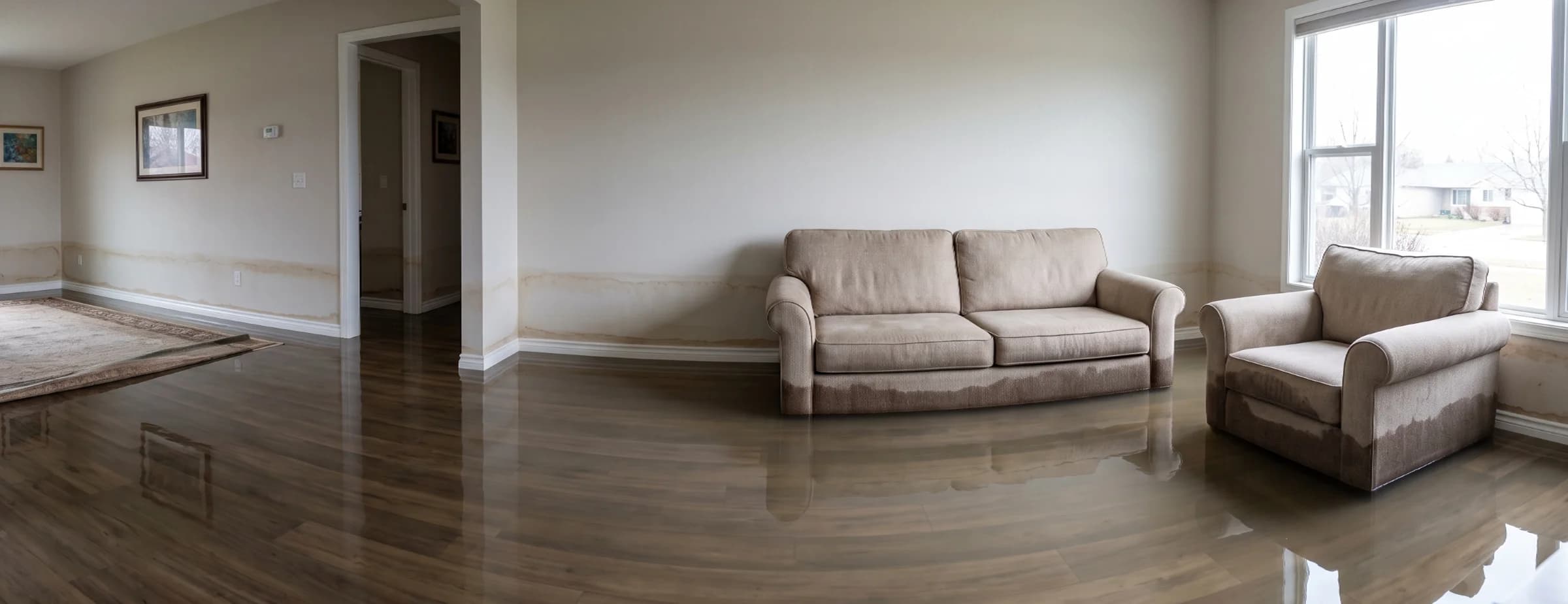

Water standing in the house, or a flood that just receded, puts you in a stressful spot, and the instinct is to do everything at once. That instinct works against you: acting out of order costs more than acting a step slower in the right order does. Flooding is also one of the most misunderstood causes of water damage on the insurance side, since the coverage that pays for a burst pipe usually doesn't apply here at all.
Water damage from flooding is structural and material damage caused by water entering a home from an external source, such as a storm, a river or lake overflow, or overland runoff, rather than from an internal plumbing failure. Under IICRC S500, the Institute of Inspection, Cleaning and Restoration Certification's standard for professional water damage restoration, flood water is classified as Category 3, the most contaminated tier, because it typically carries sediment, bacteria, and chemical runoff picked up on its way into the home. The insurance gap is the part that catches most homeowners off guard: the coverage that responds to a burst pipe almost never responds to a flood, and knowing that before making any calls changes what happens next.
Key insights
- Flood water is Category 3 under IICRC S500, the most contaminated tier, regardless of how clear it looks, because of where it traveled before reaching the house.
- Standard homeowners insurance never covers flood damage. Only a National Flood Insurance Program policy or a private flood policy responds, and either has to be purchased separately.
- New NFIP policies carry a 30-day waiting period in most cases, so flood insurance bought after a storm is already forecast typically won't apply to that storm.
- NFIP building coverage caps at $250,000 for a single-family home, with contents coverage capped at $100,000, figures that can leave a real gap on a severe loss.
- Restoration cost typically runs $1,500 to $35,000, and a whole-home flood with structural repairs can exceed $75,000.
- Porous materials submerged for more than 24 to 48 hours are generally removed rather than cleaned, since Category 3 water contaminates them below the surface.
What to do right now if your home is flooding
The first priority during active flooding is getting people and pets away from rising water, cutting power if it's safe to reach the breaker, and documenting the damage before anything is touched or moved. Every step after that, extraction, drying, and cleanup, depends on getting this sequence right first, since acting out of order can turn a manageable loss into a dangerous one.
 OSHA's flood safety guidance calls for reaching the breaker only along a dry path, since stepping into standing water to shut off power creates the shock hazard it's meant to prevent.
1. Get people and pets to higher ground
Move everyone away from rising water before doing anything else in the house. Floodwater can hide dropped electrical lines, sharp debris, and unstable footing even in a familiar room, and a few inches of moving water can knock an adult off balance.
2. Cut power at the breaker if it's safe to reach
Shut off electricity to affected circuits without stepping into standing water to reach the panel, following the shock-hazard precautions in OSHA's flood response guidance. If the panel itself is already wet or the only path to it crosses standing water, leave it off-limits and call the utility company instead.
3. Photograph the damage before moving anything
Document water lines, affected rooms, and damaged belongings before extraction or cleanup starts. This record matters for both the insurance claim and the eventual restoration company's scope of work, and it's far easier to capture before anything gets moved than to reconstruct afterward.
4. Call your insurer and a restoration company
Report the loss to your insurer and get a restoration crew scheduled as soon as it's safe to do so. The restoration process that follows starts with inspection and category classification, the same step every water damage job begins with regardless of cause. Confirming a company holds current water damage restoration certifications, an IICRC Certified Firm status and a WRT-certified technician on the crew, is a fast way to screen out an unqualified outfit before committing to one.
5. Leave standing water and demolition to professionals once it's past a contained area
A small, clean spill on a hard surface is a reasonable DIY water damage cleanup project, but flooding rarely stays that contained. Once water has spread across a room or soaked into carpet, drywall, or subfloor, Category 3 handling calls for professional extraction and PPE most homeowners don't have on hand, and a fuller restoration checklist covers the sequence from here through documentation and prevention.
What not to do during a flood
Wading through standing water without checking for hazards, running a submerged HVAC system, and waiting on an adjuster before starting extraction are the most common mistakes that turn a contained flood into a larger loss. Each one either creates a new hazard or lets standing water sit longer than it needs to, and avoiding them costs nothing.
 A submerged or partially submerged outlet can energize the surrounding water with no visible warning, which is why the safer move is confirming power is off to the area before anyone walks through it.
Wading through standing water without checking for electrical hazards first
Standing water can be energized by a submerged outlet or a downed line well outside the house, and there's no way to tell by looking. Confirm power is off to the area, or wait for a professional, before walking through it.
Using a household vacuum on standing water
A shop vacuum built for wet extraction is a different tool entirely from a household vacuum, and using the wrong one risks an electrical short or a ruined machine that does nothing to remove the water. Wet/dry extraction equipment or a sump pump is the right tool for this step.
Running the HVAC system if it was submerged or reached by floodwater
Running the system before a professional inspects and cleans it can push contaminated air and spores through every room the ductwork serves. Leave it off until an inspection confirms it's safe to operate.
Waiting on an insurance adjuster before starting mitigation
Photographing the damage first is enough documentation to begin extraction and drying immediately. Delaying mitigation to wait for an adjuster visit lets standing water sit longer and pushes more materials past the point where they can be saved.
Reentering before local authorities have issued an all-clear
Floodwater can mask structural damage, downed lines, and gas leaks that aren't visible from outside. Situations involving active water, an unclear all-clear, or unknown structural damage call for the response sequence in emergency water damage restoration rather than a standard timeline.
Who to call and in what order
The right sequence after a flood is typically your insurer first, then a restoration company, and the utility company if power, gas, or water service was affected. Calling in that order gets the claim opened while a crew is still being scheduled, rather than losing a day to sequencing them the other way.
 Reporting the loss starts the claim regardless of whether a standard policy or a National Flood Insurance Program policy ends up paying, since both use the same initial documentation window.
Your insurer needs to know about the loss regardless of whether a standard policy or a flood policy ultimately pays, since the claim process and documentation requirements start the same way any water damage restoration claim does. If the flood affected a shared structure, a condo, a duplex, or a multi-unit building, notify the property manager or HOA as well, since responsibility for common areas versus individual units typically splits differently than it would in a single-family home.
From there, choosing a water damage restoration company that responds quickly matters more after a flood than after an isolated leak, since demand for crews spikes across an entire area at once and not every company responding to a disaster zone is properly credentialed. If the flood was part of a widespread regional event, check whether the county or city has opened a local emergency management line or a debris pickup schedule, since disposal rules for flood-contaminated materials sometimes differ from routine trash collection and a missed pickup window can mean paying for a private haul-away instead.
Is it safe to go back inside
Reentry after a flood is only safe once local authorities have issued an all-clear for the area and the home itself has been checked for structural damage, downed power lines, and gas leaks. A flood is different from an isolated leak in exactly this respect: the hazard often extends beyond the house itself, and the decision to reenter isn't purely a homeowner's call the way it would be after a burst pipe.
 A ceiling that has visibly dropped under saturated drywall can fail without further warning, which is why a controlled assessment from a distance comes before any decision to enter the room below it.
Before crossing the doorway, check for visible foundation cracks, a sagging or bulging ceiling, and warped door frames that suggest the structure shifted while saturated. Never enter if you smell gas, hear a hissing sound, or see a downed line anywhere near the property, and leave immediately if any of those signs appear after you're already inside. Water that's still moving, whether it's still rising or draining out, adds a further risk of unstable footing and hidden debris that a homeowner walking through for the first time won't see coming.
Even after an all-clear, staying in the home during active extraction and drying isn't always realistic. Category 3 contamination, a lost bathroom or bedroom, or a household member with asthma or another vulnerable condition are all reasons a restoration crew might recommend temporary relocation, and what to expect during water damage restoration explains how that call typically gets made on site.
Is the water safe to drink after a flood
Flood-affected drinking water should be treated as unsafe until a health department or water provider confirms otherwise, whether the home is on a private well or connected to a municipal system. That rule holds regardless of how the water looks, smells, or tastes, since contamination from flooding is often invisible.
A well that was submerged or sits in a flood-affected area needs professional disinfection and a lab test before it's safe again, a process that generally takes seven to ten days after treatment before sampling can confirm the water is clear, according to CDC guidance on disinfecting wells after an emergency. A municipal system under a boil-water advisory calls for the same caution: bring water to a rolling boil for one full minute before drinking, cooking, or brushing teeth, and switch to bottled water if the advisory doesn't specify that boiling is sufficient. Boiling kills bacteria but doesn't remove chemical contamination, so water that smells like fuel or chemicals needs a call to the local health department rather than a pot on the stove.
When is it safe to turn utilities back on
Power, gas, and water service are safe to restore only after a professional confirms wiring, gas lines, and any submerged equipment weren't damaged, not simply once the floodwater has receded. Turning utilities back on too early is one of the more common causes of a second, preventable incident layered on top of the flood itself.
Electrical panels, outlets, and any wiring that was underwater need inspection by a licensed electrician before power is restored, since water damages insulation and connections in ways that aren't visible from outside the panel. Gas appliances and lines that were submerged, or that a household member shut off during the event, need a professional check for leaks and pilot-light safety before use, and a propane tank that shifted or tipped during flooding needs inspection before it's reconnected. Water heaters, well pumps, and any electrical equipment in a flooded basement or crawl space fall under the same rule: if it was underwater, a professional clears it before it gets power again.
Why flood water damage is treated differently
Flood water is classified as Category 3 under IICRC S500, the most contaminated tier the standard defines, regardless of how clear or odorless it looks. That classification is what separates flooding from most other causes of water damage and drives most of the PPE, containment, and material-removal decisions on the job.
 IICRC S500 assigns flood water to Category 3 based on its point of entry into the home, not its visual clarity, which is why testing rather than appearance drives the classification.
A burst pipe releases clean, sanitary water in most cases, which IICRC S500 classifies as Category 1 unless it sits untreated long enough to deteriorate, and a roof leak usually falls into that same starting category. Flood water, by contrast, has already crossed streets, yards, sewers, or riverbeds before it ever reaches the house, and that path is why it starts at Category 3 instead.
Category 3 water, sometimes called black water, can carry pathogens, heavy metals, pesticide residue, and sewage. The practical consequence is that porous materials in contact with it, drywall, carpet, insulation, and paper-faced products, are generally removed rather than cleaned. The four-tier water damage classes system works alongside category to describe drying difficulty, not contamination level, so a flood can be severe on one scale without changing its water damage category 3 status on the other.
Restoration crews typically cut affected drywall out to about 12 inches above the visible waterline rather than stopping right at the line, since water wicks upward into the material faster than it's visible from the surface. This is also why flood cleanup calls for waterproof gloves, an N95 or higher-rated respirator, and eye protection even before any visible contamination shows up, a PPE standard the EPA outlines specifically for flood cleanup and indoor air quality.
What causes flooding
Flooding happens when water from an external source overwhelms the ground's or a structure's ability to drain it away, and the source can be a storm, a body of water, a drainage failure, or prolonged ground saturation. Each cause behaves a little differently in terms of speed, warning time, and contamination level.
 Water entering at a door threshold or foundation line is the defining trait IICRC S500 uses to route a loss into Category 3, regardless of which specific weather event pushed it there.
Warning time matters as much as the source itself, since a homeowner with two days' notice before a river crests can protect belongings and shut off utilities in advance, while flash flooding or a levee failure can leave almost none. Regardless of the cause, IICRC S500 treats water from any of these sources as Category 3 once it enters a home, so the classification stays the same even though the risk profile and lead time don't.
| Cause | How it happens | Water classification |
|---|---|---|
| Storm surge or coastal flooding | A hurricane or major coastal storm pushes seawater inland past the shoreline | Category 3, saltwater plus debris |
| River or lake overflow | Sustained rain or snowmelt exceeds a channel's capacity and spills over its banks | Category 3 |
| Flash flooding | Intense, short-duration rainfall overwhelms drainage faster than it can carry water away | Category 3 |
| Urban storm drain backup | Municipal storm systems exceed capacity during heavy rain and back up into streets and yards | Category 3 |
| Dam or levee failure | A structural failure releases impounded water rapidly and without much warning | Category 3 |
| Groundwater seepage | Prolonged ground saturation forces water through a foundation wall or slab | Category 2 to 3, depending on the source |
Flash flooding deserves particular attention because it offers the least warning of any cause of flooding. The National Weather Service issues a Flood Watch when conditions are favorable for flooding and a Flood Warning when flooding is imminent or already occurring, and knowing the difference matters for how much time there is to act before water reaches the house.
Where flood water causes the most damage
Flood water causes the most damage in basements, crawl spaces, and ground-floor rooms, since these are the lowest points water reaches first and the slowest areas to dry afterward. A home's foundation and framing sit closest to that damage path, which is why a flood that never rises above the baseboards can still compromise structural materials most homeowners wouldn't think to check.
 Laminate and engineered flooring absorb water through the seams first, which is why cupping and buckling often show up before any staining is visible on the surface above.
Basements and crawl spaces flood first because they're the lowest point on the property, and standing water there can persist for days after the rest of the house has drained, especially without a working sump pump. Ground-floor drywall, flooring, and cabinetry absorb water on contact, and materials like particleboard cabinetry and laminate flooring swell and delaminate faster than solid wood or tile. Electrical panels and HVAC equipment mounted low on a wall or in a basement utility closet are especially vulnerable, since floodwater reaching either one turns a water problem into an electrical or air-quality problem as well.
Flooding also leaves behind mud, silt, and debris in a way a burst pipe or roof leak never does, since the water carried it in from outside. That sediment works into flooring seams, HVAC returns, and wall cavities as the water recedes, and it needs to be cleared out as part of extraction rather than left for the drying phase to handle on its own.
Beyond the structure itself, signs of water damage that show up days or weeks after a flood, a lingering musty smell, a slow-forming ceiling stain from wicking moisture, or a floor that stays spongy underfoot, usually trace back to one of these low, enclosed areas that didn't fully dry the first time around. Contents on or near the floor take the same hit as the structure around them. Furniture, rugs, and anything stored in boxes on a basement floor are usually a total loss once submerged, while photographing each item before it's discarded gives both an NFIP contents claim and a homeowners contents claim the documentation they need. Paper documents and undamaged electronics have a narrow window where freezing or careful drying can still save them, but anything that sat in Category 3 water for more than a day or two is safer to replace than to risk keeping.
What flood water damage restoration costs
Flood water damage restoration typically costs $1,500 to $35,000, and a whole-home flood involving structural repairs can push past $75,000. Category 3 handling drives much of that range higher than a comparable clean-water loss, since contaminated materials generally get removed rather than cleaned, and Category 3 jobs commonly add 15% to 25% to the base cost of an otherwise similar-sized loss.
 How long standing water sits before extraction starts is the single biggest driver of the final bill, since every added hour of contact time pushes more material past the point of being salvageable.
How much standing water sat before extraction started is usually the single biggest driver within that range, since every additional hour of contact time pushes more materials past the point where they can be cleaned instead of replaced. Square footage affected, how many floors were involved, and whether the HVAC system needs decontamination all compound on top of that starting point.
| Scope | Cost range | What drives the price |
|---|---|---|
| Small basement flood, quickly extracted | $1,500–$5,000 | Limited standing water, partial material removal |
| Moderate flood, single floor | $5,000–$15,000 | Standing water for hours, drywall and flooring removed |
| Major flood, multiple rooms or floors | $15,000–$35,000 | Larger removal footprint, longer drying, contents pack-out |
| Severe whole-home flood with structural damage | $35,000–$75,000+ | Structural drying, subfloor and framing replacement, full reconstruction |
These figures cover extraction, drying, cleaning, and material removal specific to a flood loss, not full reconstruction or the cost of replacing personal belongings, which typically run through a separate line item on the same insurance claim. For a broader look at how water damage restoration cost breaks down by category, class, and room across all causes, not just flooding, that comparison is useful for judging whether a flood-specific quote is in a reasonable range.
Homeowners comparing a per-square-foot bid against these totals can also check it against water damage restoration cost per square foot to confirm the rate itself, separate from the total dollar figure, looks right for Category 3 work. A quote that comes back as a single flat number with no rate or square footage breakdown is harder to verify against either benchmark, and it's worth asking the contractor to itemize before signing.
Does insurance cover flood water damage
No, standard homeowners insurance does not cover flood damage under any circumstances, because flood is a specifically excluded peril on nearly every HO-3 policy. This is the single biggest difference between flooding and other causes of water damage: a burst pipe or a sudden appliance failure is typically covered under the sudden-and-accidental standard in a standard policy, and a flood simply isn't, no matter how sudden or unavoidable it was.
 Whether a homeowners policy, an NFIP policy, or both end up paying often comes down to exactly how the water entered the home, a detail worth pinning down early in this call.
Coverage for a flood loss comes only through a National Flood Insurance Program policy, managed by FEMA, or a comparable private flood insurance policy, and either has to be purchased separately from a homeowners policy before the flood happens. NFIP building coverage caps at $250,000 for a single-family home, and contents coverage caps at $100,000, limits that can leave a real gap on a severe loss even with a policy in place. New NFIP policies typically carry a 30-day waiting period before coverage takes effect, with a few narrow exceptions such as a policy tied to a mortgage closing, so a flood policy purchased after a storm is already in the forecast usually won't apply to that specific storm.
One distinction trips up a lot of homeowners after a hurricane or major storm: wind-driven rain that enters through a storm-damaged roof or a broken window is typically a homeowners insurance claim, while water that rises from the ground and enters at floor level is a flood claim, even when both happen during the same storm. A homeowners insurance and water damage claim and an NFIP claim can both apply to the same event depending on how the water actually entered the home, and sorting that out correctly often determines which policy, or both, ends up paying.
Building coverage and contents coverage under an NFIP policy are separate line items with their own deductibles, so a homeowner can be fully covered on structural repairs while personal belongings are underinsured, or the reverse. Filing the claim itself also runs on a tighter clock than a standard homeowners claim: NFIP policyholders generally have 60 days from the date of loss to submit a sworn proof of loss, according to the NFIP claims handbook, unless the insurer grants a written extension. If a settlement seems too low for the actual damage, NFIP policies include an appraisal process for disputing the valuation, a separate track from simply asking the adjuster to reconsider, and it's worth requesting in writing rather than letting a lowball number stand.
Does FEMA help pay for flood damage restoration
Yes, FEMA can help pay for flood damage restoration through Individual Assistance grants, a program separate from the National Flood Insurance Program that doesn't require a flood insurance policy to qualify. It's only available after the President declares a major disaster for the affected area, and it's designed to supplement insurance rather than replace it.
The FEMA Individual Assistance program can cover home repairs and cleanup costs that insurance doesn't reach, up to a combined maximum tied to housing assistance and other needs assistance per household, a figure FEMA adjusts annually. Applicants generally need to have already filed a claim with any insurance they carry and register through the federal disaster assistance portal within the deadline set for that specific disaster. Homeowners without flood insurance in a declared disaster area are usually the ones who rely on this program most, since NFIP coverage only applies to a policy that was already in place before the flood, not one purchased afterward.
How to prevent flood damage in the future
The most effective flood prevention combines a working sump pump with a battery backup, grading that moves water away from the foundation, and a flood insurance policy in place well before the next storm season. None of these stop a major regional flood on their own, but together they reduce both the odds of water reaching the house and the financial exposure if it does.
 A battery backup keeps a sump pump running through the exact conditions most likely to cause both a power outage and heavy rain at the same time, the scenario a standard sump pump alone can't handle.
A sump pump with battery backup keeps working through a power outage, which is exactly when heavy rain and pump failure tend to happen together. Foundation grading, backwater valves on sewer lines, and elevating critical utilities like a water heater or electrical panel above expected flood levels address the physical risk, while a standing NFIP or private flood policy addresses the financial one, since the 30-day waiting period means it has to be in place before a storm is forecast to do any good. The broader water damage prevention system, covering plumbing, appliances, and drainage year-round, complements these flood-specific steps rather than replacing them, since a home can face both plumbing-related water damage and flood risk at the same time.
Frequently asked questions
Is flood damage the same as regular water damage?
No, flooding is one specific cause of water damage, not a synonym for it. NFIP defines a flood narrowly, as water covering at least two acres of normally dry land or affecting two or more properties, a technical distinction that can determine whether an insurer treats a loss as a flood claim or a standard water damage claim.
Does homeowners insurance cover flood damage?
No, standard homeowners insurance excludes flood damage entirely. Homes in a FEMA-designated high-risk flood zone with a government-backed mortgage are required to carry flood insurance, while homes outside that zone can still buy it voluntarily, and roughly a quarter of NFIP claims come from outside those high-risk areas.
How much does flood water damage restoration cost?
Most flood restoration jobs run $1,500 to $35,000, and a whole-home flood with structural repairs can exceed $75,000. These figures cover extraction, drying, and material removal only, not mold remediation, which is priced and billed separately once flood-related mold has set in.
How long does it take to dry out a flooded home?
Three to seven days for mechanical drying alone, and one to several weeks total once extraction, demolition, and reconstruction are included. Homes with extensive standing water or multiple affected floors take longer, and drying can't start correctly until standing water is fully extracted.
Can I clean up flood damage myself?
Rarely, beyond the immediate safety and extraction steps. Because flood water is Category 3 by default, the EPA and IICRC recommend professional handling for anything beyond a small, contained area on a hard, nonporous surface, and porous materials that were submerged usually need to be removed rather than cleaned.
Can floodwater ever be Category 1 or 2 instead of Category 3?
Rarely, but yes. Groundwater seepage from prolonged ground saturation is sometimes classified as Category 2 rather than Category 3, depending on the source, while storm surge, river overflow, and flash flooding are treated as Category 3 without exception.
Does FEMA pay for flood damage if I don't have flood insurance?
Sometimes, through FEMA Individual Assistance, but only after the President declares a major disaster for the affected area and generally only to supplement gaps insurance doesn't cover. Individual Assistance grants generally don't have to be repaid, unlike the SBA disaster loans FEMA often refers applicants to for costs beyond the grant maximum.
Should I throw away flooring and drywall after a flood?
Usually yes, if they were submerged for more than 24 to 48 hours. Porous materials like carpet padding, drywall, and insulation absorb contaminants along with the water and generally can't be fully disinfected, so restoration crews remove them rather than attempt to clean them in place.
How soon does mold become a risk after a flood?
Within 24 to 48 hours of materials staying wet, and flooded homes often miss that window because of displacement and access delays. Flood-related mold carries its own health risks and remediation cost beyond that timeline, and mold after flooding goes into both in full.
- IICRC S500: Standard for Professional Water Damage Restoration
- EPA: Flood Cleanup to Protect Indoor Air and Your Health
- CDC: How to Disinfect Wells After an Emergency
- OSHA: Flood Preparedness and Response
- FEMA: National Flood Insurance Program
- FEMA/NFIP Claims Handbook
- National Weather Service: Flood Watches and Warnings
- FEMA: Individual Assistance
Sam Hickerson is the founder of RestoreAdvisor and writes consumer guides on mold remediation, water damage restoration, inspection, testing, and home recovery. His work focuses on helping homeowners understand costs, risks, and when to call a professional. He draws on guidance from the EPA, CDC, IICRC, and other authoritative sources to make complex home issues easier to navigate.