
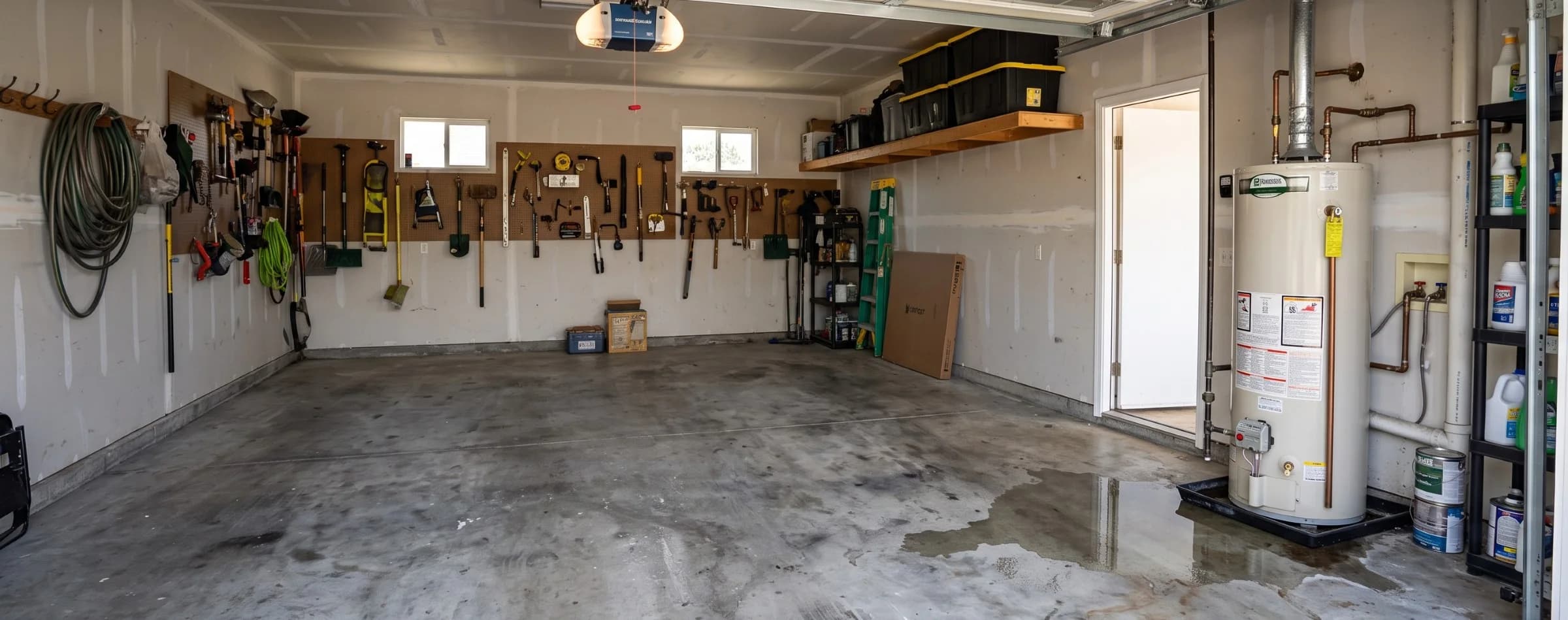

A wet or musty garage floor is one of the easiest problems in a house to put off, right up until it reaches the wall shared with the rest of the home or the vehicle parked over it. The cause is almost always the slab, the door, an appliance, or the roof, and each one points to a different fix, a different cost, and a different specialist to call. Knowing which one you're dealing with first means calling the right person once instead of guessing through two or three.
Garage water damage covers any water intrusion, leak, or standing moisture inside a garage, and it's classified under the same ANSI/IICRC S500 category and class system used throughout water damage restoration: Category 1 clean water, Category 2 gray water, or Category 3 contaminated water, depending on the source. A garage differs from most rooms in one structural way that matters here: its floor sits at or near grade, its main opening is a door built for weather resistance rather than a sealed wall assembly, and stored belongings and a vehicle usually sit directly in the path of anything that gets in.
Key insights
- Garage floors are required to slope toward the door. Under IRC Section R309.1, the parking area of a garage floor must slope to a drain or the main vehicle entry door, which is why puddles that won't drain often signal a settled slab or blocked path rather than normal wear.
- Attached garages share a fire-rated wall with the home. IRC Section R302.6 requires that wall to be finished in gypsum board, so water-damaged drywall on that wall has to be replaced with fire-rated material, not a standard patch.
- Water heaters and washing machines are commonly installed in garages, and appliance failure is one of the most frequent sources of standing water in a garage that never had a roof leak or a storm event.
- Mold begins growing within 24 to 48 hours of a moisture event, and an attached garage gives spores a direct path into the living space through the connecting door and any gaps around plumbing and wiring.
- Detached garages carry lower risk to indoor air quality but the same risk to structure, stored belongings, and a parked vehicle, since the building and everything in it are still exposed to the same moisture.
- Standard homeowners insurance treats a garage like any other room, covering sudden, accidental causes such as a burst pipe while excluding gradual seepage, flooding, and ordinary wear on a door seal.
Why garages are vulnerable
A garage's floor typically sits closer to grade than any room in the living space, and its main entry, the garage door, is built to keep out weather at a basic level rather than to seal against standing water the way an exterior wall assembly does. That combination, plus a floor that's required by code to carry liquids somewhere rather than absorb them, is why garages see water damage patterns other rooms rarely encounter.
 A compressed bulb seal that has hardened with age no longer forms a continuous line against the concrete, and under IRC Section R309.1 the floor's slope carries this water toward the door rather than away from it.
Four structural factors explain most of it. None of them show up on a home inspection report the way a cracked driveway or an aging roof would.
The floor sits at or near grade
Unlike an upstairs bedroom or even most basements with a footing below the frost line, a garage slab is often poured close to the surrounding soil grade, which puts it directly in the path of surface runoff and rising groundwater during heavy rain. A garage slab showing that same hydrostatic pressure and cracking pattern often points to the same underlying cause behind foundation water damage, whether that's expansive soil, poor drainage, or a rising water table, since the two structures frequently sit on the same footing and soil conditions.
The main door isn't a sealed opening
A garage door has weatherstripping along the bottom and sides, not the water-resistive barrier used on an exterior wall, so wind-driven rain, snowmelt, and standing water in the driveway can work past a worn seal. The International Residential Code requires the parking area of the floor to slope toward that door or a drain specifically so liquids move out rather than pool.
It's an unconditioned space
Without heating or cooling, a garage swings through wider temperature ranges than the rest of the house, which drives condensation on cold concrete, pipes, and metal doors even without an active leak anywhere. In climates that see hard freezes, that same swing puts an exposed frozen pipe feeding a hose bib, washing machine, or water heater at real risk, since a garage rarely gets the same freeze protection as conditioned living space.
It concentrates the home's mechanicals
Water heaters, washing machines, and sometimes furnaces or well pressure tanks are commonly installed in a garage specifically because a failure there does less damage to finished space. That means the garage absorbs the first hit when one of those fails, whether that's a burst pipe feeding an exterior hose bib or a water heater tank giving way.
None of this means every garage will eventually leak. It does mean a garage needs the same moisture vigilance as a basement or crawl space, arguably more, given how much a homeowner typically stores or parks inside one.
Common causes of garage water damage
Garage water almost always enters from one of five points: the door and threshold, the slab itself, an appliance, the roof above, or a shared wall with the house. Each source leaves a different pattern, the water's location, timing, and whether it correlates with rain or a specific appliance cycle, and that pattern narrows down the cause before you call anyone.
 White efflorescence forming along both sides of the crack confirms moisture is actively wicking through the slab rather than sitting on top of it, a sign of hydrostatic pressure or groundwater rather than a surface spill.
More than one of these can be active at once, particularly during a major storm when a worn door seal lets rain in at the same moment saturated ground is pushing moisture through the slab. Distinguishing which one is contributing the most volume usually comes down to where the water first appears, at floor level near the door versus mid-floor with no obvious path in from outside.
| Symptom | Likely source | What to check | Category |
|---|---|---|---|
| Water along the bottom of the door, worse during rain | Door seal or threshold | Weatherstripping wear, slope of the apron just outside | 1 |
| Puddle mid-floor or in a low corner with no rain pattern | Slab crack or hydrostatic pressure | Visible cracks, efflorescence, grading around the exterior slab | 1–2 |
| Water pooled around the water heater or washer | Appliance failure | Supply line, tank base, hose connections | 1–2 |
| Staining on the ceiling or upper wall | Roof leak | Attic or roof deck above the garage, flashing | 1 |
| Musty smell with no visible water | Condensation or slow slab seepage | Humidity level, uninsulated walls, vapor migration | N/A |
| Water backing up from a floor drain | Sewage or storm drain backup | Municipal line, floor drain trap | 3 |
Eight causes account for nearly all garage water damage once the symptom has been matched to a source. The list runs from a worn door seal and a compromised slab through a failed appliance, a failed HVAC unit, a frozen supply line, a leaking roof, storm runoff, and a backed-up drain.
| Cause | Mechanism | Category |
|---|---|---|
| Worn door seal or threshold | Wind-driven rain or standing water pushes past aging weatherstripping | 1 |
| Cracked or unsealed slab | Hydrostatic pressure and groundwater migrate through the concrete or a crack | 1–2 |
| Water heater failure | Tank corrosion, a failed T&P valve, or a loose fitting releases water at the base | 1 |
| Washing machine or utility sink leak | Supply line, hose, or drain failure specific to garage-installed laundry | 1–2 |
| Refrigerator or freezer leak | A garage unit's water line, defrost drain, or door gasket fails | 1 |
| HVAC or furnace condensate leak | A clogged condensate line or a cracked drain pan on a garage-installed unit overflows | 1 |
| Frozen supply line or hose bib | Water inside an uninsulated pipe expands and splits the line during a hard freeze | 1 |
| Roof leak or storm runoff | Flashing and shingle failure, or grading and gutters that send surface water at the door | 1–3 |
A worn door seal and a settled or cracked slab account for the largest share of garage water damage that isn't tied to a single dramatic event. Both fail slowly and are easy to overlook until a heavy storm exposes them at once.
Cold-climate garages add a seasonal cause to this list: a supply line feeding an exterior hose bib, a washing machine, or a water heater can freeze and split without any of the usual slow warning signs. A frozen line inside a garage wall or ceiling usually reveals itself as a sudden gush once it thaws rather than a gradual drip, which is why this cause tends to show up as an emergency instead of something caught early.
A failed water heater is one of the more frequent single causes, since garages are a common installation spot specifically because a tank failure there does less damage than one inside finished space. Corrosion, a failed T&P valve, and a loose fitting each leave different warning signs before a water heater leak turns into standing water on the floor.
A blocked municipal line or an undersized floor drain can also push contaminated water back into a garage during heavy rain. That water is treated as Category 3 regardless of how clean the rest of the intrusion looks, since it's carrying whatever the sewer line was carrying.
A furnace or air handler installed in the garage can leak too, usually from a clogged condensate line or a cracked drain pan rather than the refrigerant side of the system. A garage-mounted unit's HVAC condensation leak follows the same slow, easy-to-miss pattern as one hidden in an attic, since the drip pan sits low and out of view behind the unit.
Appliance and mechanical causes like these tend to show up gradually, one drip at a time. A garage owner who catches one early, before staining or rust appears, usually avoids the higher end of the cost range entirely.
Storm runoff and flooding follow the opposite pattern from a slow appliance leak: water arrives fast, in volume, and often carrying contamination from the driveway or street rather than a clean supply line. A garage positioned downhill from a driveway, or with a threshold lower than the surrounding grade, is especially exposed once flooding outpaces what the door seal and slope were designed to handle.
Garage door water leaks
A garage door leaks most often at the bottom seal, the vertical side seals, or the threshold where the door meets the slab, and each spot fails for a different reason. Wind-driven rain typically finds the bottom seal first, since it takes the most standing water and the most foot and vehicle traffic of any part of the door.
 Repeated compression and temperature swings cause a bulb seal's rubber to crack and split like this. Replacing it every one to two years catches the wear before it lets rain or standing water through.
Bottom seals come in two common types. A bulb seal, a rounded rubber gasket that compresses against the floor, seals tighter on an uneven or slightly sloped surface but wears out faster from repeated compression, while a J-seal or bead seal that tucks under the door's bottom edge lasts longer but does a poorer job on a floor that isn't perfectly flat.
Side and top seals fail less often than the bottom seal but cause damage in a different way. Wind-driven rain pushed through a gap on the hinge side or a top corner tends to run down inside the wall cavity rather than pooling visibly on the floor, which is why a side-seal leak is frequently misdiagnosed as a roof or wall leak until someone actually inspects the door track.
For a garage whose slab sits at or below the surrounding grade, weatherstripping alone often isn't enough, since gravity works against the door regardless of how new the seal is. A threshold seal or flood dam, a raised rubber or aluminum strip fastened across the base of the opening, adds a physical barrier that a replacement seal by itself doesn't provide, and it's a common add-on for a garage that keeps flooding at the door even with new weatherstripping installed.
Signs of water damage in a garage
Garage-specific signs of water damage include efflorescence and staining at the base of walls, rust on stored metal tools or shelving, a persistent musty smell, and a garage door that drags or doesn't seal flush anymore. Because a garage floor is usually bare concrete rather than carpet or finished flooring, several of these signs appear on the slab itself before they ever reach a wall.
 Efflorescence marks where moisture has been wicking through the slab, not damage on its own. The matching discoloration climbing the drywall beside it shows the moisture has already reached the wall assembly, not just the concrete.
Most of these signs are easier to catch in a garage than in a finished room, since bare concrete and open stud bays don't hide water the way carpet or painted drywall can elsewhere in the house. The one exception is the wall shared with the house, where finished drywall on the garage side can mask a leak until it's already reached the living-space side.
| Sign | What it usually means |
|---|---|
| White chalky deposits (efflorescence) on the slab or wall base | Mineral salts left behind as moisture wicks through the concrete, not damage on its own but a marker of ongoing moisture |
| Dark staining or discoloration on the floor | Pooled water evaporating repeatedly in the same spot |
| Rust on stored tools, shelving, or the water heater base | Sustained dampness sitting at floor level |
| Door drags or won't seal flush anymore | A wood-core panel or the bottom seal absorbing moisture and swelling |
| Musty odor with no visible standing water | Condensation or a slow slab leak that hasn't pooled yet |
| Peeling paint or bubbling drywall on the shared wall | Moisture behind the wall on the side facing the house |
Staining that shows up high on a wall or on the ceiling of a garage often traces back to a roof leak above rather than anything happening at floor level. A stain's shape adds another clue: a ring that has stopped growing usually means the source was resolved at some point, while a stain that keeps expanding outward points to an active leak still feeding it.
Efflorescence deserves a separate mention because it's frequently mistaken for early water damage when it isn't. The white deposits dissolve or soften under a drop of water, while true staining and discoloration do not, a quick field test that avoids tearing into a wall over mineral salts alone.
A garage wall is diagnosed the same way as any other wall in the house. The moisture meter, thermal imaging, and stain-age tests used to confirm general signs of water damage anywhere else apply exactly the same way here.
If garage water damage goes untreated
Untreated garage water damage escalates on a predictable timeline: mold begins colonizing damp materials within 24 to 48 hours, and by six months or more, surface cleaning is no longer enough and structural repair becomes necessary. Concrete, framing, and stored belongings keep absorbing moisture well past the point where the original leak has stopped, which is why the cost of waiting compounds rather than staying flat.
 Staining climbing this high up the studs signals prolonged exposure, not a recent event, the point past which drying alone stops being enough and the framing itself needs to be assessed for replacement.
How fast this progresses depends on ventilation, climate, and how much material the water reaches along the way, the same variables behind water damage classes, which measure drying difficulty separately from contamination type. A garage that stays sealed up and humid can climb from a Class 1 or 2 job toward a Class 3 or 4 within weeks, while one with airflow and a running fan can stall that same progression before the underlying leak is even fixed.
| Timeframe | What typically happens |
|---|---|
| 24–48 hours | Mold begins colonizing damp cardboard, drywall paper facing, and any wood already in contact with standing water |
| 1–2 weeks | Efflorescence and rust become visible, and a wood-core garage door panel starts to swell and stick |
| 1–3 months | Framing on the shared wall begins to soften, and a slab crack widens further through freeze-thaw cycling in cold climates |
| 6 months or more | Structural repair, framing replacement or slab injection, becomes necessary instead of surface cleaning, and mold has likely migrated past the garage side of the shared wall |
A slow, ignored door-seal leak reaches these same endpoints too, just on a longer timeline than a catastrophic flood would take. Catching the problem in the first day or two matters as much as the size of the leak itself.
What to do right now
The first priority after finding water in a garage is protecting people and a parked vehicle from electrical and contamination risk before anything else. Moving the vehicle, cutting power at the breaker, and stopping the source, in that order, prevents most of the damage that turns a simple leak into a larger claim.
 Closing this valve stops fresh water from continuing to feed the tank, but water already in the tank and lines will keep draining out until that supply empties.
Move the vehicle if water is rising
Back the vehicle out rather than waiting if standing water is climbing toward the floor pan or door sills, since Category 2 or 3 water reaching electrical or fuel system components can cause damage a simple wipe-down won't fix.
Cut power to the garage at the breaker
Standing water near an outlet, the water heater, or a garage door opener is an electrical shock hazard, so cut power at the breaker before wading in to investigate further, consistent with OSHA's flood response guidance on electrical hazards in standing water.
Identify and stop the source if it's accessible
Close the water heater or washing machine's shutoff valve if either is the cause, or clear debris from a floor drain if that's where the backup is coming from.
Photograph the damage before cleaning
Document standing water, staining, and any affected stored items before you start moving or discarding anything, since this record supports an insurance claim regardless of the eventual cause.
Extract standing water and start airflow
Remove pooled water with a wet-dry vacuum or push broom toward the door, then run fans and a dehumidifier to begin drying before mold has the 24 to 48 hour window it needs to establish, per EPA guidance on drying timelines after a water event.
What not to do
Several instinctive reactions to garage water make the damage worse rather than better, particularly running electrical equipment or driving a vehicle before either has been checked. Avoiding these four actions in the first hour protects both safety and any resulting insurance claim.
 Blistering and delamination like this is what trapped moisture looks like months after a coating goes down over a slab that hadn't fully dried.
Don't run the garage door opener through standing water
Water at the base of the door can reach the opener's electrical components and the door track, and operating it before things are dry risks damaging the opener or creating a second shock hazard.
Don't start a vehicle that's taken on water
Have it inspected before starting the engine if water reached the floor pan or higher, since water in the intake or electrical system can cause damage that a quick start makes worse.
Don't assume a dry-looking slab is dry
Concrete can look dry on the surface while still holding elevated moisture underneath, so confirm with a moisture reading rather than a visual check before storing items back on the floor.
Don't wait on insurance before mitigating
Nearly every policy requires the homeowner to take reasonable steps to prevent further damage, and delaying cleanup to wait for an adjuster can itself become grounds for a reduced payout.
Don't epoxy or coat the floor before confirming it's fully dry
A coating applied over concrete that hasn't finished drying traps residual moisture against the slab, and that trapped moisture typically shows up months later as bubbling, peeling, or delamination rather than as a problem you catch right away.
Attached vs. detached garages
An attached garage shares at least one wall, and often a slab, with the living space, so water damage there can migrate into the home through that wall, the connecting door, or shared HVAC equipment, while a detached garage carries the same structural and financial risk without the indoor air quality exposure. Most homeowners already know which type they have, but the distinction still matters once damage is confirmed, since it changes who to call, which code requirements apply, and how the loss splits across the insurance policy.
| Factor | Attached garage | Detached garage |
|---|---|---|
| Structural connection | Shares a wall and often a slab with the house | Freestanding, with no shared structure |
| Fire-rated wall requirement | Required under IRC Section R302.6 | Not applicable |
| Mold and air-quality risk | Spores can migrate through the shared wall and connecting door | Contained to the structure itself |
| Typical insurance coverage | Covered under dwelling coverage (Coverage A) | Often covered under other structures (Coverage B), a set percentage of dwelling coverage |
Under International Residential Code Section R302.6, the wall separating an attached garage from the house must be finished with a minimum of half-inch gypsum board, and five-eighths-inch Type X drywall if there's habitable space above the garage. That requirement affects repair cost directly: water-damaged drywall on that shared wall has to be replaced with the same fire-rated material rather than a lower-grade patch.
Coverage also splits along that same line. An attached garage falls under dwelling coverage, the same policy section as the rest of the house. A detached garage typically falls under other structures coverage, which is commonly set at around 10 percent of dwelling coverage and can carry its own separate deductible depending on the policy.
That shared wall is also where garage mold typically starts if moisture isn't caught quickly, since spores that take hold there have a direct path into the house through gaps around plumbing and wiring and every time the connecting door opens. Anyone in the household with asthma or a compromised immune system faces elevated risk when spores travel this path, a group the CDC identifies as most affected by indoor mold exposure.
Protecting vehicles and belongings
A garage typically holds a parked vehicle, tools, seasonal storage, and often a spare refrigerator or freezer, all sitting exposed on or near the floor where water arrives first. Elevating storage and knowing which vehicle systems water can reach are the two actions that limit loss the most before a leak is even fixed.
 Water at this depth has moved well past a shallow puddle and is close enough to the vehicle's lower body panels to warrant checking the floor pan and undercarriage before the car gets driven anywhere.
Not everything in a garage carries equal risk when water starts rising, and prioritizing what to move first matters. A parked vehicle and anything already on the floor should come before anything on a shelf, since gravity has already done part of the protection work for items stored higher up.
| Item type | Why it's at risk | What to do |
|---|---|---|
| Cardboard boxes on the floor | Wick moisture and become a mold food source within 24 to 48 hours | Move to shelving raised off the slab |
| Parked vehicle | Floor pans, door sills, and undercarriage electronics can take on water in anything beyond a shallow puddle | Move the vehicle if water is rising, and have it inspected before starting it if water reached the floor pan |
| Tools and metal shelving | Surface rust develops quickly at floor level | Store on raised or wall-mounted shelving rather than directly on concrete |
| Spare refrigerator or freezer | Sits directly on the floor and is itself a possible leak source | Check the level and drain pan periodically, and elevate on a low platform in flood-prone garages |
A vehicle sitting in more than a shallow puddle is a different problem than a wet floor by itself. Water above the level of the floor pan can reach wiring harnesses, connectors, and in newer vehicles, low-mounted control modules, and Category 2 or 3 water carries contamination that a simple rinse won't fully address even after the level drops.
A garage that doubles as a laundry room adds its own risk. A washing machine leak or a burst supply hose can release far more water in a single incident than a slow slab leak ever would, which is why the hose connections deserve a look alongside the door seal and slab.
Cardboard absorbs ambient humidity and becomes a food source for mold well before the box itself looks wet, which is why it's worth moving first regardless of what's inside. Metal shelving a few inches off the floor costs little and removes both problems at once.
A spare refrigerator or freezer leak follows the same water-line and defrost-drain failure pattern as one in a kitchen. It's worth checking the drain pan periodically, since a unit like this often sits unused for weeks at a time in a garage, and a slow leak there can go unnoticed far longer than it would inside the house.
DIY vs. professional cleanup
A small, clean-water puddle from a door seal or a brief appliance leak is usually DIY-safe if you can dry it within a day. Anything involving a cracked slab, visible damage on the shared wall, sewage, or water that reached electrical components is a call to a professional.
 A reading this far above 17 percent puts the wood well outside the DIY-safe range, since drying alone won't undo saturation that's already reached this deep into the framing.
The shared wall with the house is the one factor that tips many otherwise DIY-sized garage jobs toward a professional. Fire-rated drywall replacement and antimicrobial treatment on both sides of that wall require access and materials most homeowners aren't set up to handle themselves.
| Factor | DIY-safe | Call a professional |
|---|---|---|
| Water source | Clean supply line or rainwater | Sewage, floodwater, or an unknown source |
| Area affected | Under roughly 25 sq ft, surface only | Spread across the slab or up the shared wall |
| Materials involved | Bare concrete, sealed floor | Drywall, framing, or insulation on the shared wall |
| Moisture reading | Under 15% on any wood component | Above 17% or still rising |
| Timeline | Caught and dried within 24 hours | Standing more than a day, or of unknown duration |
The extraction-then-drying sequence for DIY water damage cleanup is the same in a garage as anywhere else in the house, though bare concrete actually dries faster than carpet or drywall would in the same scenario. That faster drying time is part of why so many garage-sized leaks stay DIY-safe if caught early.
Who to call depends on the cause more than the water itself. A plumber handles the water heater, washing machine, or floor drain; a garage door technician handles a failed seal or a damaged panel; and a restoration company handles extraction, drying, and any drywall or framing work on the shared wall.
If more than one of those applies, call the specialist and a water damage restoration company at the same time rather than one after the other. Sequencing them back to back only stacks two separate response windows instead of running them in parallel.
Cost of garage water damage restoration
Garage water damage restoration typically costs $300 to $10,000, though a simple door-seal fix caught early can run as little as $0 to $300, and an attached garage needing shared-wall repair can exceed $15,000. The specific driver is almost always which materials were affected, not just how much water was involved.
 A written estimate should break out labor and materials separately, since labor, not materials, is what typically drives the difference between a straightforward garage job and one that costs several times more.
An attached garage with damage reaching the shared wall typically costs more to fully close out than a detached garage with the same square footage affected. Fire-rated drywall and the antimicrobial step required on both sides of that wall add labor a detached structure never needs.
| Scenario | Typical cost | What drives it |
|---|---|---|
| Door seal or threshold leak, caught early | $0–$300 | DIY weatherstripping replacement, no structural drying needed |
| Minor slab seepage, dried within a day | $300–$1,500 | Extraction, fans, and a dehumidifier or a short professional visit |
| Water heater or washing machine failure | $500–$5,000 | Appliance repair or replacement plus extraction and drying, billed separately |
| Roof leak or storm-driven flooding | $1,000–$10,000 | Roof repair, extended drying, and possible drywall or insulation replacement |
| Attached garage with shared-wall drywall and framing damage | $2,000–$15,000+ | Fire-rated drywall replacement, framing treatment, and antimicrobial work on both sides of the wall |
A garage cleanup estimate that runs noticeably above what the described scope suggests is worth checking against the water damage restoration cost figures for category, class, and room type nationally. An outlier estimate for a straightforward garage job usually means either a broader scope than described or an inflated quote.
Labor, not materials, drives most of this range, since a plumber's visit and a drywall demolition-and-replace job cost roughly the same in a garage as anywhere else in the house. A full slab crack repair or exterior waterproofing job adds considerably more and typically falls outside a standard restoration invoice entirely.
A rate quoted per square foot deserves the same scrutiny. It should fall within the typical water damage restoration cost per square foot range for the water's category rather than running well above it without a stated reason, such as difficult access or extensive material removal.
Is garage water damage covered?
Standard homeowners insurance covers garage water damage under the same sudden-and-accidental standard used for the rest of the house. A burst pipe or water heater failure is typically covered, while a slow door-seal leak or ordinary wear isn't.
 Photographing the stain's full extent, not just a close-up of the worst section, gives an adjuster the reference points needed to confirm how far the damage actually spread.
Insurers look for evidence of how long the water was present and whether it originated from a covered peril, the two factors that decide most garage claims. A garage's exposed construction, bare studs and a visible slab, often makes that determination faster than in a finished room where the source has to be traced behind drywall first.
| Cause | Covered? | Notes |
|---|---|---|
| Burst pipe or appliance failure in the garage | Yes | Document immediately, same sudden-and-accidental standard as anywhere else in the house |
| Roof leak causing rapid intrusion | Sometimes | Depends on storm versus wear-and-tear determination |
| Worn door seal or gradual slab seepage | No | Treated as a maintenance issue |
| Flooding or storm surge | No (standard policy) | Requires separate flood insurance |
| Vehicle damage from garage flooding | Usually not | Typically falls under the vehicle's own comprehensive auto coverage, not homeowners |
Coverage also depends on which part of the policy the garage falls under. An attached garage is covered under Coverage A, dwelling coverage, the same as the rest of the house. A detached garage is typically covered under Coverage B, other structures, which is usually set at 10 percent of dwelling coverage and can apply its own separate deductible in some policies.
Filing a claim and documenting the loss follow the same process used to determine whether homeowners insurance covers water damage anywhere else in the house. The National Association of Insurance Commissioners publishes consumer guidance on exactly how insurers distinguish sudden damage from gradual wear, worth a read before a call with an adjuster.
How to prevent garage water damage
Preventing garage water damage means managing four things: the door seal, the slab's drainage path, appliance maintenance, and exterior grading. Most garage leaks trace back to one of these going unchecked for months or years rather than to a sudden, unpreventable event.
 A penetrating sealer only works on concrete that has fully dried, since sealing over residual moisture traps it against the slab instead of blocking it from wicking up in the first place.
Replace garage door weatherstripping every 1 to 2 years
Rubber seals along the bottom and sides harden and crack with temperature swings, and a worn seal is one of the most common entry points for wind-driven rain and standing water in the driveway.
Check the exterior grade and driveway slope
Ground or pavement that slopes toward the garage instead of away from it sends runoff directly at the door regardless of how new the weatherstripping is, so regrading or adding a threshold dam addresses the cause rather than the symptom.
Inspect appliance connections annually
Water heater fittings, washing machine hoses, and refrigerator water lines installed in a garage should be checked the same way as any other appliance, since a failed hose is one of the more common single sources of standing water.
Seal the slab if efflorescence or dampness recurs
A penetrating concrete sealer or a fully cured epoxy coating reduces moisture wicking up through the slab from the ground below, addressing chronic dampness that shows up as white mineral deposits or a persistent musty smell. Either one should only go over concrete that has finished drying and shows no active moisture, since coating a still-damp slab traps the problem underneath instead of solving it.
Keep gutters and downspouts clear near the garage roofline
Clogged gutters send water straight down the exterior wall closest to the slab, one of the more overlooked contributors to slab-edge seepage in an otherwise sound garage.
These five habits address what's specific to a garage. The same room-by-room logic extends to water damage prevention everywhere else in the house, with plumbing, appliances, the roof, and drainage each getting their own maintenance schedule rather than one blanket routine.
Frequently asked questions
Is water damage in a garage covered by homeowners insurance?
Usually, if the cause is sudden and accidental, like a burst pipe or a failed water heater. A slow door-seal leak, gradual seepage through the slab, or flooding from a storm typically isn't covered under a standard policy.
What water damage category applies to a garage?
It depends on the source, not the room. A clean water heater or supply line failure is Category 1, and storm runoff or a backed-up floor drain is Category 2 or 3, the same water damage categories used throughout the rest of the house.
Can a sloped garage floor actually stop water from getting in?
Not by itself. The slope required under IRC Section R309.1 moves liquids already on the floor toward the door or a drain, but it does nothing to stop water from entering through a worn door seal or a crack in the slab in the first place.
How much does it cost to fix water damage in a garage?
Costs typically range from under $300 for a simple door-seal leak caught early to $15,000 or more for an attached garage needing shared-wall drywall and framing replacement. The materials affected drive the price more than the amount of water involved.
Is it safe to drive a car that's been sitting in standing water?
Not without an inspection first. Water reaching the floor pan or higher can affect electrical connectors, the fuel system, and onboard computers, and starting the engine before those are checked risks turning a cleanup into a repair bill.
Does a detached garage need the same fire-rated wall as an attached one?
No. The fire-rated wall requirement under IRC Section R302.6 applies specifically to the wall shared between an attached garage and the house. A detached garage has no shared wall and isn't subject to that requirement.
How do I know if water reached the wall shared with my house?
Look for staining, bubbling paint, or a soft spot on the interior side of that wall, inside the house, not just the garage side. Water traveling through a shared wall's framing often shows up on the living-space side before it's obvious from the garage.
Will standing water damage my garage door opener?
It can, if water reaches the motor unit or its wiring. Most openers are mounted on the ceiling out of reach of typical standing water, but a door left partially open during a flood event can let water track up higher than expected.
How long does it take for a garage to dry out?
A bare concrete slab with good airflow can dry in 1 to 3 days. Add wet drywall, insulation, or framing on the shared wall, and drying commonly stretches to a week or more, following the same restoration timelines used for any other room.
Is there a step-by-step checklist I can follow?
Yes. The water damage restoration checklist walks through extraction, drying, and documentation as a printable, ordered sequence that applies to a garage the same way it applies to any other room.
Can pipes freeze in my garage?
Yes, more easily than almost anywhere else in the house, since a garage is unconditioned and can drop well below the temperature of the living space during a hard freeze. A supply line feeding a hose bib, washing machine, or water heater is most at risk, and insulating exposed pipe and keeping the door sealed are the two most effective preventive steps.
Can I epoxy my garage floor after water damage?
Not until the slab has fully dried and testing confirms no residual moisture, since epoxy applied over a damp slab traps that moisture and causes bubbling, peeling, or delamination within months. If the water that reached the floor was Category 2 or 3, clean and disinfect the concrete first, since a coating will seal in contamination along with any moisture.
- IICRC S500
- EPA: Flood Cleanup to Protect Indoor Air and Your Health
- OSHA: Flood Preparedness and Response
- CDC: Basic Facts About Mold
- NAIC: A Consumer's Guide to Home Insurance
- International Residential Code: Garages and Carports, Section R309.1
- International Residential Code: Garage Fire Separation, Section R302.6
Sam Hickerson is the founder of RestoreAdvisor and writes consumer guides on mold remediation, water damage restoration, inspection, testing, and home recovery. His work focuses on helping homeowners understand costs, risks, and when to call a professional. He draws on guidance from the EPA, CDC, IICRC, and other authoritative sources to make complex home issues easier to navigate.