
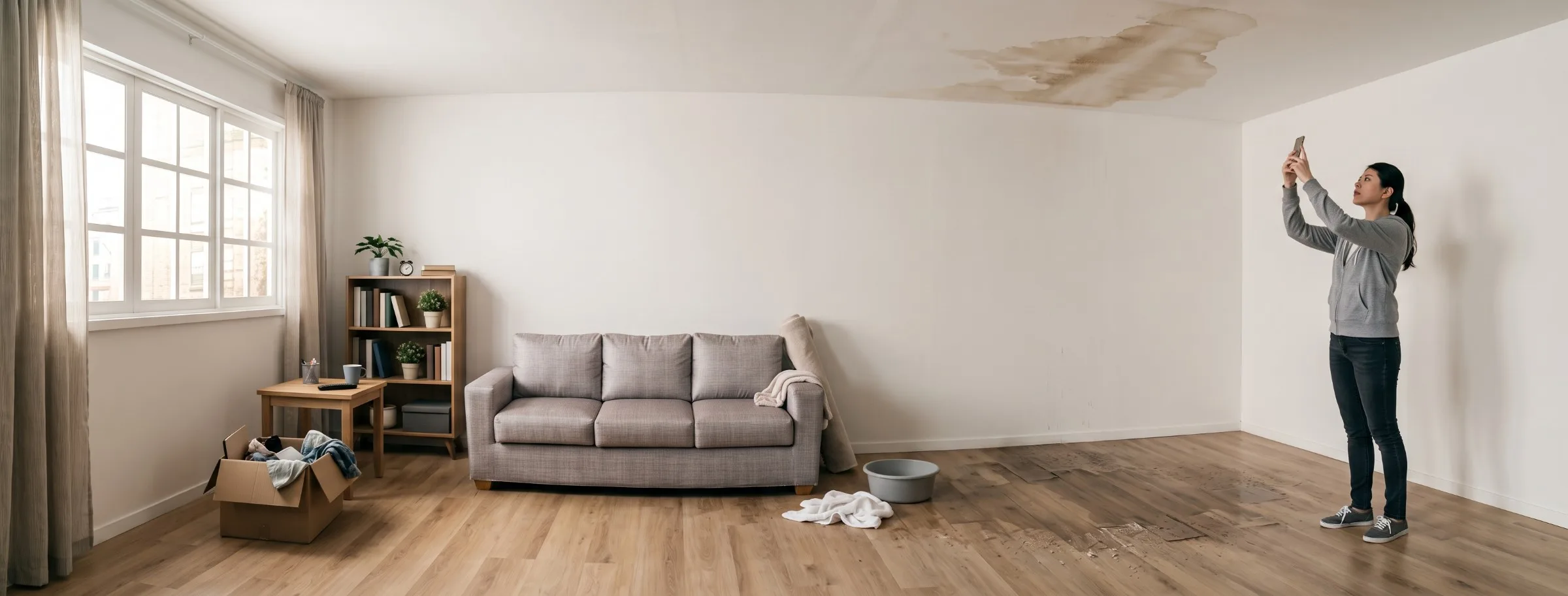

If a pipe burst or an appliance overflowed and soaked your belongings, your renters policy will usually pay to replace them. The exceptions are floods, sewer backups, and leaks that ran for weeks, so the cause of the water decides your claim.
Renters insurance is a named-peril policy, written on the Insurance Services Office HO 00 04 form, that pays for damage to a tenant's belongings from listed events, including accidental discharge or overflow of water from plumbing, heating, air conditioning, fire sprinkler, or appliance systems. Restoration professionals classify that water as clean, gray, or black under ANSI/IICRC S500, the standard behind modern water damage restoration, and the classification affects what can be saved and what must be thrown out.
Your landlord's policy covers the building but not your belongings, so the claim is yours to file. What matters most is how the water started, how quickly you reported it, and whether you can prove what you owned.
Key insights
- Sudden discharge is covered. Renters insurance pays for belongings damaged by sudden and accidental water from a burst pipe, an overflowing appliance, or a leak from the unit above, but it never insures the building itself.
- Floods and backups are excluded by default. Flood damage needs a separate contents-only flood policy, and sewer or drain backup needs a water backup endorsement.
- Slow leaks are excluded. Gradual damage from a drip that ran for weeks is treated as a maintenance failure, not an accident.
- Hotel costs can be covered. Additional living expenses coverage reimburses the amount above your normal costs when covered water damage makes the unit unlivable.
- Liability coverage protects you too. If water from your unit damages a neighbor's belongings or the unit below, personal liability coverage can pay for it.
- Your landlord's insurance will not replace your belongings. About 55 percent of renter households carry renters insurance, which leaves nearly half with no coverage for their own water damage losses.
What renters insurance covers
Renters insurance covers three things after water damage: your personal belongings, your extra living costs if you cannot stay in the unit, and your liability if water from your unit damages someone else's property. It does not cover the building, and it pays only when the water came from a covered source.
 Each pillar pays out only when the water comes from a covered source, and the building itself sits outside all three because the landlord's policy insures the structure.
Because the policy is named-peril, a loss is paid only when it matches a listed peril. Accidental discharge or overflow of water or steam from a plumbing, heating, air conditioning, or fire sprinkler system, or from a household appliance, is one of those perils, along with freezing and sudden damage from electrical current.
Personal property coverage
Pays to repair or replace belongings damaged by a covered water event, including furniture, clothing, electronics, mattresses, and bedding, up to your limit and minus your deductible. The Insurance Information Institute (Triple-I) adds that most policies also cover belongings away from home, usually capped at about 10 percent of your personal property limit.
Additional living expenses coverage
Pays the extra cost of living elsewhere when covered water damage makes the unit unlivable, including hotel bills, a temporary rental, and restaurant meals. It reimburses only the amount above your normal expenses.
Personal liability coverage
Pays when you are legally responsible for water damage to someone else's property, such as an overflowing bathtub that ruins the ceiling and belongings of the neighbor below. Triple-I reports that liability limits generally start around $100,000 and that some experts recommend at least $300,000.
Covered and excluded water damage
Renters insurance covers water damage that is sudden, accidental, and released from a source inside the building, and it excludes water that rises from outside, backs up through drains, or builds up from a slow leak. Coverage depends on how the water started, not on how big the loss is.
 A supply line that splits without warning is a sudden and accidental discharge, the test a renters policy applies, so belongings it damages are covered even though the pipe repair belongs to the landlord.
Most claims fall into one of three groups. Sudden discharge from a burst pipe or an appliance is covered, rising or backing-up water is excluded unless you bought separate coverage, and slow leaks are excluded because they reflect maintenance problems rather than accidents. Wording varies by insurer and state, so the water damage exclusions in your own policy control.
| Water source | Covered? | What to know |
|---|---|---|
| Burst or leaking supply pipe | Yes | Pays for your belongings damaged by the water. The landlord repairs the pipe and the building. |
| Appliance overflow or leak, including washing machines, dishwashers, and water heaters | Yes | Pays for belongings damaged by the discharge. The failed appliance itself is not covered. |
| Leak from the unit above or a shared pipe | Yes | Pays for your belongings when the water began suddenly inside the building. |
| Fire sprinkler discharge | Yes | Accidental discharge from an automatic fire sprinkler system is a listed peril. |
| Frozen pipe that bursts | Yes, with a condition | Most policies expect reasonable effort to keep the unit heated. |
| Rain after wind or hail damages the roof or a window | Usually | Covered when a listed peril such as windstorm or hail creates the opening first. |
| Slow or long term leak | No | Gradual damage, rot, and neglect are excluded. |
| Flood from rising water, storm surge, or a river | No | Requires a separate flood policy. |
| Sewer or drain backup and sump pump failure | No by default | Requires a water backup endorsement. |
| Seepage through the foundation or from groundwater | No | Groundwater seepage is excluded from standard renters coverage. |
A burst pipe is the clearest covered scenario, because the pipe fails without warning and can flood a unit within minutes. The landlord repairs the pipe, walls, and flooring, and your policy replaces the belongings the water ruined, such as a couch, a mattress, and a television, minus your deductible.
Flood and sewer backup
Standard renters insurance does not cover water damage from flooding, so rising water from a storm, an overflowing river, or a flash flood is excluded even when it ruins everything you own. Insurers exclude flood because it damages whole regions at once, so a separate flood policy, either through the National Flood Insurance Program (NFIP) or a private insurer, is the only way to cover belongings against it.
 Floodwater is Category 3 under ANSI/IICRC S500, so soaked upholstery is usually discarded, and a standard renters policy pays for none of it without a separate flood policy.
The exclusion applies to storm surge, river overflow, and surface runoff, and it holds even when the landlord carries a flood policy, because that policy insures only the building. A renter can buy contents-only coverage through the NFIP in any participating community, and, according to FEMA, that policy covers up to $100,000 of belongings in rental units above the lowest elevated floor, excluding subgrade basements.
About 40 percent of NFIP claims come from outside high-risk flood areas, so a low-risk zone does not remove the exposure. NFIP policies carry a 30-day waiting period, so the policy has to be in place before a storm appears in the forecast, and a flood policy pays for belongings only, so a renter with flood insurance still pays for temporary housing after a flood.
Sewer and drain backup
Standard renters insurance also excludes sewer and drain backup, which includes sewage pushing up through a floor drain, shower, or toilet from the main line and water from a failed sump pump. A water backup endorsement adds this coverage for your belongings.
Water backup endorsements commonly carry limits from $5,000 to $25,000, and many carriers price the add-on for renters between roughly $20 and $100 a year. That cost is small next to a sewage backup, a Category 3 loss whose contaminated belongings usually have to be discarded. Many insurers apply a separate deductible to the endorsement, often between $250 and $1,000, and some versions include sump pump overflow while others do not, so confirm the wording before you rely on it.
Slow leaks vs. sudden damage
Renters insurance excludes slow or gradual water damage because the policy covers accidents, not maintenance problems. A leak that dripped under a sink for months, seepage behind a wall, or condensation that rots a cabinet base falls on the exclusion side, even when the first visible damage appears suddenly.
 Layered tide lines, corrosion and peeling baseboard take months to form, which is the evidence an adjuster uses to classify a leak as gradual and therefore excluded.
Adjusters decide whether a loss was sudden by looking at the evidence: the age of stains, rot or rust at the source, mineral deposits, and how long the leak must have run. Dated photos, a plumber's invoice, and your written report to the landlord show when the water started and when it stopped. A tenant who ignored a known drip after reporting it can face a denial for neglect, even when the final failure was sudden.
Frozen pipes carry their own condition. A claim for frozen pipes that burst while you were away often turns on whether you kept the heat on, because policies typically require reasonable effort to maintain heat in the unit.
Neighbor and building leaks
Your renters policy pays for your belongings when water from a neighbor's unit or the building's plumbing damages them, as long as the water was released suddenly and accidentally. It pays based on how the water started, regardless of who was at fault.
The same split applies to a roof leak: the landlord repairs the roof and ceiling, and your policy replaces your belongings when the water arrived suddenly, such as after wind or hail damaged the roof. A leak from worn shingles that dripped for weeks counts as a maintenance failure and usually falls outside coverage.
When your own overflow damages the unit below, your personal liability coverage can pay for the neighbor's belongings and the landlord's repair bill, up to your liability limit. The landlord's insurer may pay for the building first and then seek reimbursement from you, which is why liability limits of at least $100,000 matter.
Landlord insurance vs. renters insurance
A landlord's insurance policy covers the building, not your belongings, your hotel stay, or your liability, so renters insurance fills those gaps. About 55 percent of renter households carry renters insurance, according to Harvard's Joint Center for Housing Studies, which means nearly half have no coverage for their own water damage losses.
 The landlord's property policy pays for the drywall, framing and plumbing being repaired, while the renter's policy responds only to the belongings under the plastic.
A renters policy and a homeowners policy are almost identical except that the renters policy leaves out the building, according to Triple-I, so the same sudden and accidental test applies to both. The landlord insures the structure, and you insure everything you bring into it.
| What was damaged | Landlord's policy | Your renters policy |
|---|---|---|
| Your furniture, clothing, and electronics | Not covered | Covered for listed perils such as accidental water discharge |
| Walls, floors, ceilings, and plumbing | Covered | Not covered |
| Hotel bills and extra meals while the unit is unlivable | Not covered | Covered for a covered loss, above your normal expenses |
| Damage you cause to a neighbor's unit or belongings | Pays for the building and may seek reimbursement from you | Personal liability coverage responds |
| Flood damage to your belongings | Not covered | Not covered without a separate flood policy |
The landlord also controls drying and rebuilding the structure, and a renters policy pays for none of that work. If the landlord is slow to start, put the request in writing and keep dated photos of the wet materials, because wet drywall can lead to mold in a rental within 24–48 hours and delay can turn a covered leak into a disputed one.
What if you have no renters insurance
Without a renters policy, you pay for your own belongings after water damage, even when the water came from the landlord's pipe. The only exceptions are a negligent landlord or a lease and local law that shift the cost to them.
You may have a claim against a landlord who ignored a known leak or failed to make timely repairs of water damage in a rental, and a small claims case can recover the value of ruined belongings in many states. Many leases limit the landlord's liability, so read yours and keep every written repair request, since proof of notice is often what makes a claim recoverable.
After a federally declared disaster, FEMA assistance can help with temporary housing and some personal property needs, and local aid groups sometimes fill the gap. A renters policy bought now will not cover damage that has already started, but it will cover the next loss.
Does renters insurance cover mold?
Renters insurance covers mold only when it results from a covered water event, such as a burst pipe, and most policies exclude or limit it when it comes from humidity, a slow leak, or a flood. Where the water came from determines whether the mold is covered.
 Stain rings around mold show repeated wetting over time, which an insurer treats as a gradual leak and excludes, unlike mold that grows within days of a covered burst pipe.
The EPA advises drying wet materials within 24–48 hours to prevent mold growth, so reporting the loss and starting drying quickly protects both the claim and the unit. Mold that appears after a leak the insurer calls gradual is usually excluded entirely.
Policies that do pay for mold after a covered loss often limit it, and some exclude it, so check the mold terms in your policy summary. Responsibility for removing mold that spreads through the unit depends on state law and your lease, and the rules differ for mold in a rental.
How much renters insurance pays
Renters insurance pays the lesser of your loss and your personal property limit, minus your deductible, and deductibles commonly run $500–$1,000. Triple-I notes that raising a deductible to $1,000 can cut the premium by as much as 25 percent. The valuation method sets how much of each item's value you recover, with actual cash value paying what an item is worth today after depreciation and replacement cost paying the price of a comparable new item. The National Association of Insurance Commissioners uses a five-year-old, $2,000 computer worth about $500 as its example.
| Valuation method | Value used for the claim | Payout after a $500 deductible |
|---|---|---|
| Replacement cost | $8,000 | $7,500 |
| Actual cash value | $4,500 | $4,000 |
Take a burst supply line that soaks a couch, a mattress, a television, and a closet of clothing. Replacing those items new costs $8,000, but they are worth $4,500 after depreciation, so replacement cost coverage pays $7,500 after a $500 deductible and actual cash value pays $4,000. If the unit is unlivable for a week, hotel costs are paid separately under additional living expenses coverage, up to its own limit. Some insurers pay actual cash value first and release the remaining depreciation once you submit receipts for the replacements.
File a claim when the loss clearly exceeds your deductible. With a $500 deductible, an $800 loss pays only $300, so a single soaked rug may not be worth a claim, while a leak that reaches several rooms can run into the thousands of dollars in water damage restoration cost. Report anyway when the damage may be bigger than it looks, since water behind a wall or under flooring can reach belongings you have not found yet.
Sublimits cap certain categories regardless of your overall limit. Triple-I reports that jewelry and other expensive items are generally covered for up to about $1,500, so valuables near a leak-prone area may need a scheduled endorsement.
Hotel and temporary housing costs
Additional living expenses coverage pays the extra cost of living elsewhere when covered water damage makes your rental unit uninhabitable, such as hotel bills, a temporary rental, and restaurant meals. It reimburses the difference between those costs and your normal expenses, so a hotel stay does not replace your rent.
Coverage applies only when the unit is truly unlivable, and many drying jobs allow you to stay, so you may not have a hotel claim at all. Sewage, structural damage, and loss of power or water are the usual reasons an insurer accepts a move out. Keep every receipt, record all relocation expenses as Triple-I advises, and ask the insurer about time and dollar limits before booking a stay longer than a few nights.
How to file a water damage claim
To file a renters water damage claim, stop the water, notify your landlord in writing, document the damage before cleaning, and report the loss to your insurer the same day. Prompt notice and clear evidence of the source are the two things that most often decide the outcome. Late reporting is one of the easiest ways to lose a valid claim, because an insurer can argue the delay let the damage spread or made the cause harder to prove.
 Wide shots of the stain's location plus close-ups with a tape measure for scale give an adjuster the evidence to date and size the loss before anything is cleaned or moved.
1. Stop the water and make the unit safe
Shut off the fixture's valve or the main supply, and tell maintenance immediately if the source is a shared pipe. OSHA warns that standing water near outlets and cords is a shock hazard, so cut power to the affected area at the breaker only if you can reach the panel from a dry surface. For spreading flood water, sewage, or an electrical hazard, treat the situation as emergency water damage restoration and call a restoration company right away.
2. Notify your landlord in writing
Send a text or email with the date, the location of the water, and photos, and ask the property manager to identify the source of the leak in writing. Keep copies, because the source of the water determines which policy pays and whether the landlord owes you a repair deadline.
3. Document the damage before cleaning
Photograph and video every damaged item, the source of the water, and the affected walls and floors before you move anything. Keep damaged items until the adjuster has seen them unless they are contaminated, since Triple-I advises against throwing out damaged belongings before the visit.
4. Protect belongings from further damage
Move undamaged items to a dry room, lift furniture off wet flooring, and run fans or a dehumidifier if the landlord has not started drying. Policies expect reasonable steps to prevent more damage, so keep receipts for fans, tarps, and cleaning supplies.
5. Report the claim to your insurer the same day
Call or file online, get a claim number, and ask how long you have to file, whether the claim exceeds your deductible, and what documents the adjuster needs. These are the same questions Triple-I recommends asking at the first call.
6. Build the inventory and keep every receipt
List each damaged item with its age, purchase price, and replacement cost, and attach receipts or photos of serial numbers. The NAIC offers a free Home Inventory app, and a list built before a loss makes the claim faster.
State law shapes the timeline more than most renters expect. Many states have unfair claims practice rules that require an insurer to acknowledge a claim and respond within set time frames, and deadlines for filing suit after a denial vary by state and policy. Your state department of insurance publishes the specific rules, so look them up on the first day of a claim.
A claim can also affect your premium or renewal, depending on the insurer and your state, because insurers share claim history through reporting databases. Florida's Division of Consumer Services says a single water damage claim cannot be the sole reason for non-renewal unless the insurer shows you failed to take reasonable action to prevent a repeat, and it is worth asking your insurer how it treats a reported loss that ends in no payment before you decide to skip filing.
What to do if your claim is denied
If your renters insurer denies a water damage claim, request the denial in writing, compare the cited reason to your policy language, and appeal with evidence that the damage was sudden and accidental. You can also file a complaint with your state department of insurance if the explanation does not match the policy.
The most common reasons are a gradual leak finding, a named exclusion such as flood or sewer backup, and missing documentation, and renters appeal a denied water damage insurance claim the same way homeowners do. A denial letter should state the reason, and that reason tells you which evidence will matter most in the appeal.
Ask for the adjuster's report, then submit your dated photos, the landlord's written statement about the source, and a plumber's invoice showing the failed part. A plumber's report that names the failed part and the date it failed often settles a dispute over whether the leak was sudden or gradual.
What to check before a leak
Before a leak happens, confirm five things in your renters policy: the valuation method, water backup coverage, flood coverage, your personal property limit, and your liability limit. These decide whether a loss is paid in full or leaves you covering most of it.
 Reviewing valuation, backup and limit terms before a loss is the only time a change helps, because coverage added after water damage starts will not apply to that loss.
Premiums for renters insurance average between $15 and $30 per month, according to the NAIC, so adding a backup endorsement or replacement cost coverage costs little next to a loss. Spending a few minutes with your policy summary before a leak costs nothing and shows which of the five items you already have.
Choose replacement cost valuation
Replacement cost coverage costs about 10 percent more than actual cash value coverage, according to Triple-I. It pays the price of a comparable new item rather than a depreciated value, which can add thousands of dollars to a claim on older belongings.
Add a water backup endorsement
Standard policies exclude sewer and drain backup and sump pump overflow, and the endorsement closes that gap for belongings. Choose a limit based on the value of belongings stored on or below ground level.
Know the claim steps and deadlines
Read the notice requirements in your policy so that filing a water damage insurance claim is a matter of following steps rather than guessing. A policy that requires prompt notice can reduce or deny a payout if the report comes late.
Price a flood policy if your area floods
Buy a contents-only flood policy before storm season, since the waiting period means a policy bought during a storm will not respond. Ground floor and basement units should confirm exactly what the policy covers before relying on it.
Raise limits to match an inventory
Add up what it would cost to replace everything you own, including furniture, clothing, electronics, and bedding, and set the personal property limit near that total. Triple-I recommends a home inventory for this reason, and it also speeds up any claim.
Maintenance habits lower the odds of a claim. Knowing where the shutoff valve is, checking appliance hoses, and placing leak sensors under sinks also give an insurer less reason to call a loss gradual.
Frequently asked questions
Does renters insurance cover rain coming through an open window?
Usually not. Rain that enters through a window or door left open is treated as a maintenance or negligence issue rather than a listed peril, so the resulting water damage is excluded. Rain that enters after wind or hail breaks a window is different because the storm creates the opening, but a slow window or door leak from a failed seal is excluded as gradual damage.
How long do I have to file a renters insurance water damage claim?
Report it right away. Policies require prompt notice, and the deadlines for a sworn proof of loss or for suing an insurer are set by your policy and state law, so ask the claims representative on the first call how long you have. NFIP flood policies set a 60-day deadline for proof of loss.
Does renters insurance cover the appliance that leaked?
No, not the appliance. Renters insurance pays for your belongings damaged by a washing machine leak or a dishwasher overflow, but the failed appliance itself is excluded, and a landlord-owned appliance is the landlord's to repair.
Does my roommate's renters insurance cover my belongings?
Not automatically. Triple-I notes that a domestic partner must be specifically named on a policy to be covered, and roommates who are not named insureds generally need their own policies, so a roommate's belongings are paid only under a policy that lists that person.
Does renters insurance cover a toilet overflow?
Usually yes. A toilet overflow from a clog or a stuck fill valve is a sudden, accidental discharge, so the damage to your belongings is covered under a listed peril. A backup that pushes sewage up from the main line is different, because drain and sewer backup is excluded without an endorsement.
Will a water damage claim raise my renters insurance rate?
Possibly. A claim can affect your premium or renewal, depending on the insurer and your state. Florida's Division of Consumer Services, for example, says a single water damage claim cannot be the sole reason for non-renewal unless the insurer shows you failed to take reasonable action to prevent a repeat.
Does renters insurance cover water damaged electronics?
Yes, if the water source is covered. Phones, laptops, and TVs damaged by a covered leak count as personal property, paid at replacement cost or actual cash value depending on your policy, and an electronic that can be repaired may be paid at the repair cost instead.
Can I buy renters insurance after water damage has already started?
No, not for existing damage. A new policy covers only losses that begin after it takes effect, so buy coverage before the water arrives. If damage has already started, document it and put your repair request to the landlord in writing, because the landlord's duty to repair the unit does not depend on your insurance.
Does renters insurance cover water damage in a condo I rent?
Yes, the same rules apply. Renters insurance covers your belongings in a rented condo exactly as it does in an apartment, while the owner's policy and the association's master policy cover the building. Who pays for repairs depends on who owns the element that failed, which is the question behind most condo water damage disputes.
- IICRC S500
- NAIC: Renters Insurance Basics
- Triple-I: Renters Insurance
- FEMA NFIP: Renters Flood Insurance
- Harvard JCHS: Renters Vulnerable to Climate Disasters Amid Insurance Gaps
- EPA: Flood Cleanup to Protect Indoor Air and Your Health
- OSHA: Flood Preparedness and Response
- Florida Division of Consumer Services: Renters' Insurance Overview
Sam Hickerson is the founder of RestoreAdvisor and writes consumer guides on mold remediation, water damage restoration, inspection, testing, and home recovery. His work focuses on helping homeowners understand costs, risks, and when to call a professional. He draws on guidance from the EPA, CDC, IICRC, and other authoritative sources to make complex home issues easier to navigate.