
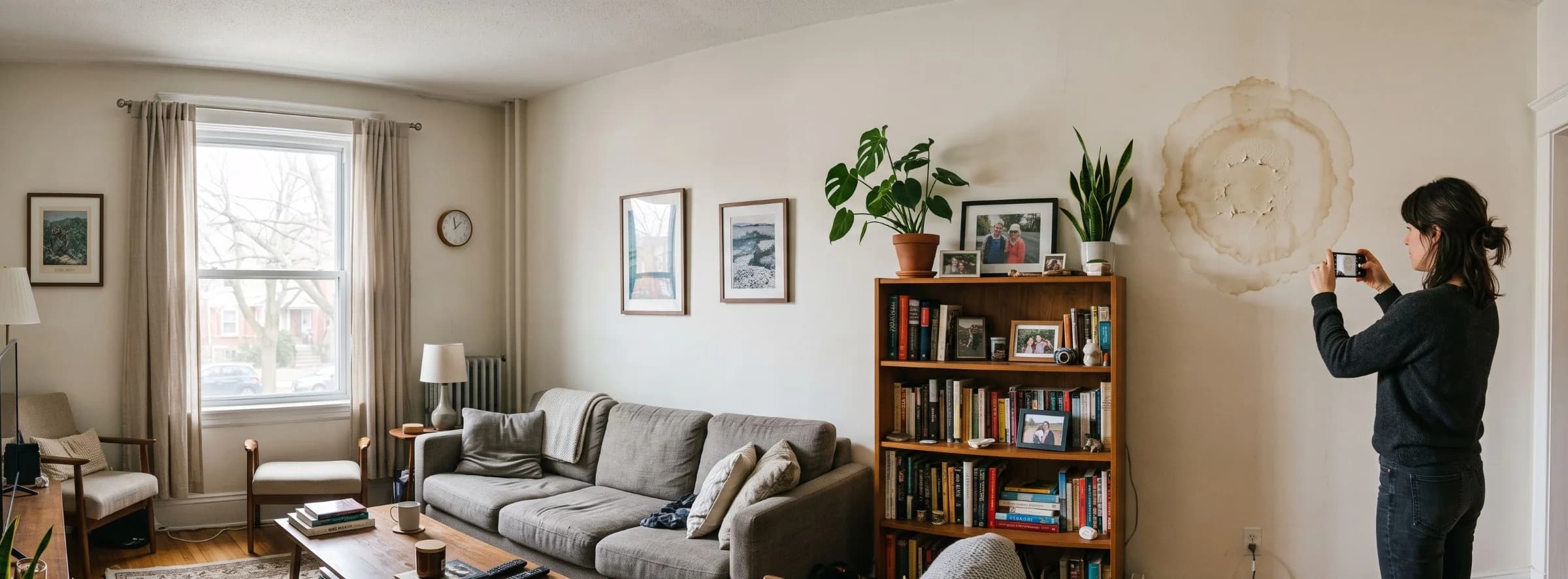

Finding water damage in a rental means dealing with two problems at once: the physical damage itself, and the immediate question of who has to pay for it. That second question causes more landlord-tenant conflict than almost any other maintenance issue, because water damage is expensive, it often traces back to a cause that stays hidden until someone opens a wall, and both sides have a financial incentive to point at the other.
Water damage restoration follows the IICRC S500 standard for classifying and drying out the water itself, while the legal question of who pays is governed by the implied warranty of habitability, a doctrine recognized in every U.S. state that requires landlords to keep a rental unit safe and livable throughout the tenancy. Responsibility for the cost typically comes down to one factor: whether the water came from something the landlord is obligated to maintain, such as plumbing, the roof, or a building-owned appliance, or from something within the tenant's own control, such as an overflowing tub or an unreported leak. You'll find out which side of that line your situation falls on, the exact steps to take in the next hour, how to document and report the damage correctly, and what leverage you have if your landlord doesn't act.
Key insights
- The moisture source decides responsibility. A landlord is responsible when the cause is a building component they maintain, such as plumbing, roofing, or a landlord-owned appliance. A tenant is responsible when their own action, negligence, or delayed reporting caused or worsened the damage.
- The implied warranty of habitability applies in every state. No lease clause can waive it, and it requires landlords to keep essential systems, including plumbing, in working order throughout the tenancy.
- Written notice is the required first step. Before you can pursue rent withholding, repair-and-deduct, or a lease termination, you need documented written notice to your landlord on file.
- Emergency conditions get a faster legal clock. Active flooding, sewage, or a loss of water service typically demand a response within 24 to 48 hours, while routine repairs are usually held to a broader reasonable-time standard.
- Renters insurance covers your belongings, not the building. A standard HO-4 policy can replace damaged personal property from a sudden covered event, but the structure itself is always the landlord's insurance responsibility.
- A landlord generally cannot deduct maintenance failures from your deposit. Security deposit deductions for water damage are only valid when the tenant's own negligence caused the loss.
Who's responsible for water damage
Landlords are legally responsible for water damage that stems from a failure to maintain the building itself, including plumbing, roofing, water heaters, and any appliance the landlord installed. This obligation flows from the implied warranty of habitability, which requires a rental unit to remain fit for occupation throughout the lease term regardless of what the lease itself says.
 IICRC S500 treats a hidden supply line failure like this as a landlord maintenance issue, not tenant negligence, regardless of the building's age.
A burst pipe behind a wall, a failed supply line to a water heater, and a roof that lets rain through during a storm are all examples of causes that sit squarely on the landlord's side of the line, since none of them involve anything the tenant did or failed to do. Normal wear on these systems doesn't shift the repair duty either, even in an older building where some deterioration was inevitable.
In these cases, extraction, drying, and any needed water damage restoration work is the landlord's financial responsibility, and their property insurance is typically what pays for it rather than the tenant's own policy. You shouldn't receive an invoice from the restoration crew directly, since the contract for that work exists between the landlord and the company, not with you.
Even when the source is clearly a landlord-side failure, the paperwork still matters. Ask for a copy of the restoration company's written scope of work and, once the job is complete, a written summary confirming the area was dried and tested. That record protects you if a dispute over the cause comes up later.
A sewage backup from the building's main line falls into the same category and carries added urgency, since contaminated water reaching a living space is treated as a health hazard rather than an ordinary maintenance delay. The clearest test for any of these causes is whether the source is a fixture or system the tenant has no ability to control or repair themselves. A tenant cannot fix a corroded supply line, replace a failing water heater, or patch a roof, so the law places that maintenance duty, and the resulting liability when it fails, on the landlord. If a landlord knew about a leak and did nothing, and the water damage worsened as a result, that delay strengthens the tenant's position considerably.
When you, the tenant, are responsible
A tenant is responsible for water damage costs when their own action, negligence, or failure to report a known issue caused or significantly worsened the damage. This shifts the financial burden even when the underlying fixture, like a supply line or a drain, is technically something the landlord owns.
 Damage like this is treated as tenant negligence, not a building failure, since nothing about the fixture itself caused the overflow.
Common scenarios that shift responsibility to the tenant include:
Leaving a fixture running unattended
A bathtub, sink, or washing machine left running while the tenant is away or asleep, resulting in an overflow, is treated as tenant negligence rather than a building failure.
Failing to report a known leak
If a tenant notices a slow drip or a damp cabinet and doesn't notify the landlord for weeks, the resulting damage from that delay can become the tenant's responsibility even though the pipe itself belongs to the building.
Letting the unit go unheated during freezing weather
A supply line that bursts from frozen pipes because a tenant turned off or set the heat too low during a hard freeze, particularly while away from the unit, is commonly treated as tenant-caused, since most leases require tenants to maintain a minimum indoor temperature for exactly this reason.
Damaging plumbing or an appliance through misuse
Forcing a garbage disposal, overloading a washing machine hose connection, or physically damaging a fixture creates tenant liability for the resulting water intrusion.
Blocking drains or ignoring maintenance requests
If a landlord asked a tenant to stop doing something that was contributing to a plumbing problem and the tenant continued anyway, the tenant assumes responsibility for damage that followed.
Most leases require prompt written notice of any maintenance issue, and that clause does real legal work. A tenant who knew about a problem and sat on it for months has a much weaker position than one who reported it the same day, even if the pipe itself belonged to the landlord all along.
Security deposits come up constantly in these disputes. A landlord generally cannot deduct the cost of a burst pipe, a failed appliance, or any other maintenance-side failure from a security deposit, since deposit deductions are meant to cover damage the tenant caused, not ordinary building failures. If your landlord tries to charge you for water damage you believe was their responsibility, request an itemized written statement and keep your own documentation, since the burden of proving tenant negligence typically falls on the landlord.
That same test, whether the tenant had control over the cause, resolves nearly every common scenario at a glance. A shared plumbing stack serving multiple units is the main exception, since both parties can share liability there.
| Cause | Responsible | Why |
|---|---|---|
| Burst or corroded supply pipe | Landlord | Plumbing is a building system the tenant has no ability to maintain or repair |
| Roof or window leak | Landlord | Building envelope failures fall under the landlord's maintenance duty |
| Failed water heater or landlord-owned appliance | Landlord | The appliance belongs to the building, not the tenant |
| Sewage backup from the main line | Landlord | Contamination from a shared system, treated as an urgent habitability issue |
| Overflow from a neighboring unit | Landlord, for repairs to your unit | Your lease is with your landlord regardless of where the water originated |
| Tenant left a fixture running unattended | Tenant | Direct negligence caused the overflow |
| Tenant failed to report a known leak | Tenant, or shared | Delayed reporting worsens the damage and shifts liability |
| Frozen pipe from the tenant turning off the heat | Tenant | Most leases require a minimum indoor temperature |
| Tenant misuse or damage to a fixture | Tenant | Damage from improper use, not ordinary wear |
Water damage caused by a neighbor
In a multi-unit building, your landlord is still responsible for repairs to your unit even when the water originated somewhere else in the building. A washing machine overflow one floor up, a shared pipe failure, or a leak from a rooftop mechanical unit all reach your apartment as a landlord-side maintenance issue from your perspective, regardless of which specific unit the water started in.
 A landlord is still responsible for repairs to this unit even when the source traces back to a different apartment in the building.
Notify your own landlord in writing as soon as you notice damage, rather than waiting to see whether the two units or their respective renters sort out fault first. Your lease is with your landlord, not with your neighbor, and the repair clock for your unit starts running from your notice regardless of what's happening elsewhere in the building. Behind the scenes, the building owner will typically pursue the responsible party or their renters insurance to recover the cost, but that process shouldn't delay the repair to your own space.
Ground-floor and below-grade units carry a distinct version of this problem, since basement water damage in a below-grade rental unit can come from groundwater or a failed building sump system just as easily as from a neighboring apartment. If your rental sits below street level, document whether the water appears to be rising from the floor rather than dripping from above, since that distinction affects which building system your landlord needs to address.
What to do right now
Shut off the water source if it's safe to reach, then photograph everything before you touch or clean anything. Acting within the first hour limits both the physical damage and any later dispute over what caused it, whether the source turns out to be the landlord's or your own.
 Photos taken before any cleanup or repair work starts are the strongest evidence a tenant has if responsibility for the damage is later disputed.
1. Stop the source if you can do so safely.
Shut off a fixture's supply valve or the unit's main water shutoff if you know its location. Never touch electrical outlets or panels near standing water.
2. Photograph and video everything before cleaning anything.
Wide shots showing the affected area's full extent and close-ups of the source, if visible, both matter. Timestamp your photos or note the date and time separately.
3. Notify your landlord in writing immediately.
A phone call is fine as a first alert, but follow up the same day with an email or text that states what happened, when, and where, so a written record exists.
4. Move belongings out of the affected area and start airflow if it's safe.
Fans and open windows slow further damage while you wait for a response, but standing, contaminated water should be left to a professional rather than handled by hand, in line with the EPA's guidance on flood cleanup and protecting indoor air quality.
5. Call your renters insurance provider if your belongings were affected.
Report the event promptly, since delayed reporting can complicate or void a claim.
If the situation involves active flooding, sewage contamination, or a total loss of water service, treat it as an emergency water damage situation and press your landlord for a same-day response rather than waiting on a standard maintenance timeline. A landlord who doesn't answer the first call is still expected to respond by the end of that day, not the next business day, once an emergency condition is on record.
For a small, clearly tenant-caused spill that you're handling yourself with the landlord's knowledge, the same DIY water damage cleanup safety thresholds that apply to homeowners apply to you as a renter, including when standing water is too extensive or too contaminated to handle without professional equipment. Even a fully DIY-handled spill is worth a quick photo and a one-line note to your landlord, since a pattern of small, undocumented leaks can matter later if a bigger claim needs supporting history.
Document and report water damage
Document water damage by photographing everything before you clean anything up, writing down the timeline, and sending your landlord written notice the same day you discover it. That combination, dated photos, a documented timeline, and written notice on record, is what separates a tenant who gets repairs made and costs assigned correctly from one left disputing a security deposit deduction months later with nothing to point to.
 A dated, written notice with photos attached is what starts the legal clock on a landlord's repair obligation in most states.
Photograph and video the full extent of the damage
Capture wide shots that show the affected area's size and location relative to walls, fixtures, and flooring, along with close-ups of any visible source. These same signs of water damage detection points, staining, warping, soft flooring, a musty smell, apply whether you're a homeowner or a renter trying to establish when a problem started.
Put the timeline in writing
Note the date you first noticed the damage, any prior water issues in the unit, and any maintenance requests you'd already submitted before this event. If you have older emails or texts about a related leak, gather them now rather than searching for them later.
Send formal written notice
State what happened, its approximate location and extent, and a clear request for repair. Email creates a timestamped record on its own; for anything serious, follow up with a letter sent by certified mail with a return receipt so delivery isn't in dispute later.
Set a response expectation
State when you expect to hear back. Courts and housing authorities typically read "reasonable time" as a matter of days for an emergency and a few weeks for a routine repair, so naming a specific window in your notice puts your landlord on record.
Keep documenting after notice is sent
If your landlord doesn't respond, or responds without acting, log every follow-up call, text, and email with its date. A water damage restoration checklist kept from the day damage occurs through the day repairs finish gives you a single, organized record if the dispute escalates.
If water sits too long before drying, mold often follows, and most states treat mold as its own hazard once it appears, with separate notice and disclosure rules distinct from the water event that caused it. A tenant dealing with visible mold, not just the water damage that led to it, should look at mold in a rental, since the reporting deadlines and remedies shift once mold is the primary issue rather than standing water.
How long landlords have to fix it
There is no single nationwide deadline, but active or hazardous water damage generally requires an emergency response within 24 to 48 hours, while non-emergency repairs are held to a broader reasonable-time standard that most courts interpret as roughly two to four weeks. Where your situation falls on that scale depends on severity and your state's specific law.
A handful of states convert that reasonable-time standard into an actual statutory clock rather than leaving it to case-by-case interpretation. Washington's RCW 59.18.070 ties the deadline to what failed: 24 hours for a lost water, heat, or electricity supply, 72 hours for a major plumbing fixture, and 10 days for everything else. Texas Property Code § 92.056(d) sets a rebuttable seven-day presumption, with sewage backup and broken-pipe flooding named as qualifying conditions for that faster remedy. California's Civil Code § 1942 presumes 30 days for most repairs, though that period doesn't apply once habitability itself is at risk. Florida requires a seven-day cure period under Florida Statutes § 83.56 but has no general repair-and-deduct remedy, and New York's Real Property Law § 235-b sets no fixed number at all, leaving the timeline to a housing court's case-by-case determination.
| State | Statute | Repair timeline | Tenant remedies |
|---|---|---|---|
| California | Civil Code §§ 1941–1942 | 30-day presumption for most repairs; no fixed period when habitability itself is at risk | Repair-and-deduct up to one month's rent (twice per 12 months), or vacate and terminate |
| Texas | Property Code § 92.056(d), § 92.0561 | 7-day rebuttable presumption; sewage backup and broken-pipe flooding are named qualifying conditions | Repair-and-deduct up to one month's rent or $500, whichever is greater; lease termination; judicial repair order up to $10,000 in justice court |
| Washington | RCW 59.18.070 | 24 hours for lost water, heat, or electricity or an imminent hazard; 72 hours for a major plumbing fixture; 10 days for other defects | Repair-and-deduct, rent deduction, lease termination |
| Florida | Statutes § 83.56, § 83.51 | 7-day cure period after written notice before rent withholding or termination is available | Rent withholding, lease termination, damages; no general repair-and-deduct remedy |
| New York | Real Property Law § 235-b | No fixed statutory number; reasonable time is a case-by-case housing court determination | Rent abatement, HP action in housing court, warranty of habitability defense in a nonpayment proceeding |
| All other states | Implied warranty of habitability (statutory or common law) | No fixed deadline; courts apply a reasonable-time standard, typically days for emergencies and weeks for routine repairs | Varies by state; consult a local tenant attorney or housing authority |
Severity changes the clock more than almost anything else, even within a single state's framework. A tenant with no working plumbing, active sewage in a living space, or standing water reaching electrical components has a far stronger claim to an immediate response than a tenant reporting a slow, contained drip under a sink. Document the severity clearly in your written notice, since a landlord who receives a vague report has more room to argue their response time was reasonable.
Moving out and hotel costs
A landlord is not automatically required to pay for a hotel just because water damage makes part of a unit temporarily unusable. The standard remedy in most states is a prorated rent reduction for the days the space couldn't be used, not lodging costs, and hotel reimbursement only becomes the landlord's obligation under specific circumstances.
 A prorated rent reduction, not a paid hotel stay, is the standard remedy in most states unless the lease or the landlord's own negligence says otherwise.
Those circumstances typically include the landlord's own negligence causing the uninhabitable condition, such as ignoring a reported leak until it forced a relocation, a lease clause that specifically promises temporary housing or a nightly reimbursement cap, or a local ordinance that goes further than state law. Absent one of those, a tenant who chooses to stay in a hotel during repairs is usually covering that cost themselves, then seeking a rent credit for the days the unit was unusable.
If part of the unit remains usable, you generally have the option to stay while repairs happen, with a rent reduction proportional to the unusable space rather than a full move-out. If no part of the unit is safe or livable, the exceptions above apply, and your renters insurance's additional living expenses coverage may help if your policy includes it and the underlying event was a covered peril.
If your landlord refuses to act
Tenants have several escalation options when a landlord fails to repair water damage after written notice: reporting to local housing or code enforcement, repair-and-deduct where your state allows it, rent withholding into escrow, lease termination through constructive eviction, and small claims court for damages. Which path fits depends on your state's law, the severity of the condition, and how much of the unit is affected.
 A local tenant legal aid organization can confirm which of these remedies applies before a tenant risks the wrong one, since the rules vary significantly by state.
Escalation rarely means picking one option and committing to it outright. Most tenants start with the lowest-friction step, a written demand that names a specific deadline, and only move to a formal complaint, escrow, or court if that deadline passes without action. Acting in that order also builds a stronger paper trail, since each unanswered step becomes evidence that the landlord had multiple chances to fix the problem before you escalated further.
| Option | What it involves | Best used when |
|---|---|---|
| Housing or code enforcement complaint | File a formal complaint requesting an inspection; a written finding of a habitability violation carries real legal weight | The landlord has been unresponsive and you want an official record without going to court |
| Repair-and-deduct | Hire a licensed contractor yourself and deduct the cost from rent, usually capped at one month's rent | Your state allows this remedy and the landlord ignored a written repair deadline |
| Rent withholding into escrow | Stop paying rent directly to the landlord and instead pay into a court-supervised account | Your state requires escrow rather than direct withholding, and the condition is serious |
| Lease termination (constructive eviction) | End the lease without penalty because the unit became uninhabitable and the landlord failed to fix it | The damage is severe, notice and a repair window are both documented, and you're prepared to move out |
| Small claims court | Sue for property damage, temporary housing costs, or a rent refund | You've already moved out or resolved the immediate condition and are seeking financial recovery |
If you decide to pursue repair-and-deduct, or need to call a restoration company yourself because the damage poses an active health risk and your landlord isn't responding, the requirements are similar: document every attempt to reach the landlord first, confirm a documented reasonable repair period has passed, and use only a licensed, insured contractor. The same standards for choosing a water damage restoration company apply whether your landlord is hiring the crew or you are. Treat this as a step alongside a formal complaint rather than a substitute for it, since acting without documented notice first weakens your position to recover the cost.
Rent withholding carries the most risk of these options. If you stop paying without following your state's exact procedure, a landlord can file for eviction and treat the missed payment as a lease violation rather than a protected response to a habitability failure. A local tenant legal aid organization, available for free in most metro areas, can confirm which remedy applies in your state before you act.
Tenants in federally assisted housing have an additional channel: unresolved water intrusion counts as a deficiency under HUD's Healthy Homes program, giving them an extra escalation route through their local public housing authority.
Most states also prohibit landlords from retaliating against a tenant for reporting a habitability issue, whether through a sudden rent increase, a lease non-renewal, or an eviction filed shortly after a complaint. If your landlord's behavior shifts noticeably soon after you report damage or file a housing complaint, keep a record of the timing, since retaliation claims often hinge on how closely the landlord's action followed your protected complaint.
Renters insurance and water damage
Renters insurance covers your personal belongings, not the building itself, and only when the underlying cause qualifies as a covered peril under your policy. A standard HO-4 policy, the category NAIC's consumer guidance on home insurance uses for renters coverage, typically pays to replace furniture, electronics, and clothing damaged by a sudden event like a burst pipe or an appliance failure, but the structural repair, drywall, flooring, and the plumbing itself, is always the landlord's insurance responsibility, not yours.
Renters insurance policies commonly exclude flooding from an outside source, which requires a separate policy through the National Flood Insurance Program, and gradual damage from a leak you knew about and failed to report in time. If your unit floods from an external source like a storm or overflowing waterway, that NFIP policy covers your belongings only, since the building itself is your landlord's policy to insure. Sewer and drain backups are also frequently excluded unless you added a specific endorsement, so check your declarations page rather than assuming the coverage exists.
If your belongings were damaged, report the event to your own insurer promptly and keep the same photo and video documentation you sent your landlord. If the damage was clearly the landlord's fault, your insurer may pursue subrogation against the landlord's policy after paying your claim, which can offset any deductible you paid. The overall process for filing a water damage insurance claim follows the same documentation and timeline principles whether you're a homeowner or a renter, even though a renter's claim is scoped to personal property rather than the structure.
Breaking your lease over water damage
Tenants can end a lease without financial penalty when water damage makes a unit uninhabitable and the landlord fails to remediate it within a reasonable time after written notice. This remedy is called constructive eviction, and it requires more than simply deciding the situation has become intolerable.
 Moving out before written notice and a documented repair window exist is the most common way a legitimate constructive eviction claim falls apart.
A supportable constructive eviction claim generally needs documented written notice to the landlord describing the specific problem, evidence that the landlord failed to respond or act within a reasonable window, and evidence that the condition genuinely rendered the unit uninhabitable rather than merely inconvenient. A housing inspector's report or a professional assessment substantially strengthens a weak claim, since it establishes an independent record rather than relying on the tenant's account alone. Moving out before that documentation exists is the most common way a legitimate claim falls apart, since a tenant who leaves too early can remain liable for the remainder of the lease term.
If you're weighing whether to stay while repairs happen instead of leaving, the same what to expect during water damage restoration considerations that apply to a homeowner, noise, equipment running for days, limited use of part of the unit, apply to you as a tenant deciding whether the disruption is uninhabitable or just inconvenient. A single consultation with a tenant attorney or local legal aid can resolve that question faster than reading through your state's case law, and a certified demand letter sometimes triggers landlord action without requiring you to move out at all.
Preventing water damage as a renter
The most effective water damage prevention available to a renter is reporting problems the same day you notice them and knowing where your unit's shutoff valve is before you ever need it. Neither requires landlord permission or any repair authority you don't have, and both directly limit how much damage a small problem turns into.
 Knowing where a unit's shutoff valve is before a leak happens is one of the few prevention steps a renter can act on without landlord involvement.
Report drips and stains the same day you notice them
A small leak reported immediately is a landlord problem from day one. The same leak left unreported for weeks becomes a shared liability, since most leases require prompt reporting of exactly this kind of issue.
Know where your unit's water shutoff valve is
Ask your landlord or check under sinks and behind toilets when you move in, not during an active leak. Being able to stop the flow yourself in the first minute can be the difference between a contained spill and a claim.
Maintain minimum heat during freezing weather
Most leases require tenants to keep the unit heated to a minimum temperature specifically to prevent frozen and burst pipes. If you're away during a cold snap, don't turn the heat off entirely.
Flag aging appliance supply hoses
If your unit's washing machine, dishwasher, or refrigerator has an original rubber supply hose that looks old or brittle, ask your landlord about replacing it before it fails rather than after.
Use appliances and fixtures as intended
Avoid overloading a washing machine's hose connection, forcing a garbage disposal, or ignoring a toilet that keeps running. Misuse that damages a fixture shifts liability toward you even when the fixture itself belongs to the building.
The same underlying water damage prevention principles that apply to homeowners, catching small problems early and knowing where the controls are, apply just as much to a rental. You can't perform the structural side of it yourself, so prompt reporting is the one lever you actually have.
Frequently asked questions
Is my landlord responsible for water damage in my apartment?
Yes, in most cases, when the water came from something the landlord is obligated to maintain. The implied warranty of habitability, recognized in every U.S. state, requires landlords to keep plumbing, roofing, and building-owned systems in working order. If a burst pipe, roof leak, or failed water heater caused the damage, repair and restoration cost is the landlord's responsibility. If your own actions caused it, or if you didn't report a known leak promptly, you may share or bear the cost instead.
What happens if I caused the water damage myself?
You are typically responsible for repair costs if your own action or inaction caused the damage. Examples include leaving a tub running and flooding the bathroom, failing to report a slow leak you knew about for weeks, or letting supply lines freeze because you turned off the heat while away. Most leases require tenants to report maintenance issues promptly, and failing to do so can shift liability even when the underlying source was a building component.
Can I withhold rent because of water damage?
Yes, in some states, but only after following the correct legal procedure first. Rent withholding without proper notice and a documented repair window can expose you to eviction, since your landlord may treat the missed payment as a lease violation rather than a protected response. Most states that allow withholding require written notice, a reasonable repair period, and in several states the withheld amount must go into a court-supervised escrow account rather than simply being kept back. Consult a local tenant attorney before withholding rent.
How long does my landlord have to fix water damage?
Emergency conditions generally require a response within 24 to 48 hours, while routine repairs are typically held to a broader reasonable-time standard courts interpret as roughly two to four weeks. The exact figure depends on severity and your state's law. A handful of states set fixed statutory deadlines: California's Civil Code presumes 30 days for most repairs, Texas presumes 7 days, and Washington's RCW 59.18.070 sets 24 hours for a lost water supply, 72 hours for a major plumbing fixture, and 10 days for everything else. Check your state and local housing code for the exact standard where you live.
Does renters insurance cover water damage?
Sometimes. A standard HO-4 policy covers your belongings when the cause is a sudden, accidental event like a burst pipe, but it won't touch the building itself, and it typically excludes flooding and unreported leaks unless you've added specific coverage. Flooding from an outside source needs a separate National Flood Insurance Program policy instead. Check your declarations page for the exact exclusions, since they vary by insurer.
What if the water damage came from the unit above mine?
Your landlord is still your point of contact for repairs to your unit, even when the source is a neighboring apartment. In a multi-unit building, the building owner is generally responsible for restoring shared structural components regardless of which unit the water originated in, though the upstairs tenant or their renters insurance may ultimately owe the landlord for the underlying cause. You should still document the damage and notify your own landlord in writing rather than waiting for the two units to sort it out first.
Can I break my lease because of water damage?
Yes, in most states, once the damage makes the unit uninhabitable and your landlord fails to fix it within a reasonable time after written notice. Courts call this remedy constructive eviction, and it only holds up with a documented paper trail behind it; leaving without one is the single biggest reason these claims fail.
What if my landlord's insurance won't cover the damage?
Your landlord's insurance dispute doesn't change their maintenance obligation to you under the implied warranty of habitability. Whether or not their insurer pays, and however long that claim takes to resolve, the landlord is still required to restore the unit to a livable condition within a reasonable time. A coverage dispute between the landlord and their insurer is a separate matter from the landlord's duty to you as a tenant.
Can my landlord charge me for water damage from my security deposit?
Only if the damage was caused by your negligence or a lease violation, not by normal building failures. A landlord generally cannot deduct the cost of a burst pipe, a failed water heater, or any other maintenance issue that fell under their own responsibility. If you dispute a deduction, request an itemized statement in writing and keep your own documentation of the damage's original cause, since the burden of proof for a deposit deduction typically falls on the landlord.
Is water damage in a rental a health hazard?
It can become one if it isn't dried quickly. Standing water and damp building materials create conditions for mold growth within roughly 24 to 48 hours, and the CDC advises that visible mold or a persistent musty odor in a building poses a health risk regardless of species. If your unit already shows signs of mold following a water event, the rules and remedies shift slightly under mold-specific rental law.
Does my landlord have to pay for a hotel if my apartment floods?
Not automatically. Most states only require a prorated rent reduction for the days the unit was unusable, not lodging costs. A landlord typically owes hotel reimbursement only if their own negligence caused the uninhabitable condition, the lease specifically promises temporary housing, or local law requires it. Your own renters insurance may cover a hotel stay under its additional living expenses provision if the underlying water event was a covered peril, regardless of fault.
Can my landlord retaliate against me for reporting water damage?
No, retaliation is illegal in nearly every state once you've reported a habitability issue like water damage. Prohibited retaliation includes a sudden rent increase, a lease non-renewal, or an eviction filed shortly after your complaint. If your landlord's treatment of you changes noticeably soon after you report damage, document the timing, since retaliation claims often depend on how closely the landlord's action followed your protected complaint.
- IICRC S500
- EPA: Flood Cleanup to Protect Indoor Air and Your Health
- HUD: Healthy Homes Program
- NAIC: A Consumer's Guide to Home Insurance
- FEMA: National Flood Insurance Program
- CDC: Basic Facts About Mold
- California Civil Code §§ 1941–1942
- Texas Property Code § 92.056
- Washington RCW 59.18.070
- New York Real Property Law § 235-b
Sam Hickerson is the founder of RestoreAdvisor and writes consumer guides on mold remediation, water damage restoration, inspection, testing, and home recovery. His work focuses on helping homeowners understand costs, risks, and when to call a professional. He draws on guidance from the EPA, CDC, IICRC, and other authoritative sources to make complex home issues easier to navigate.