
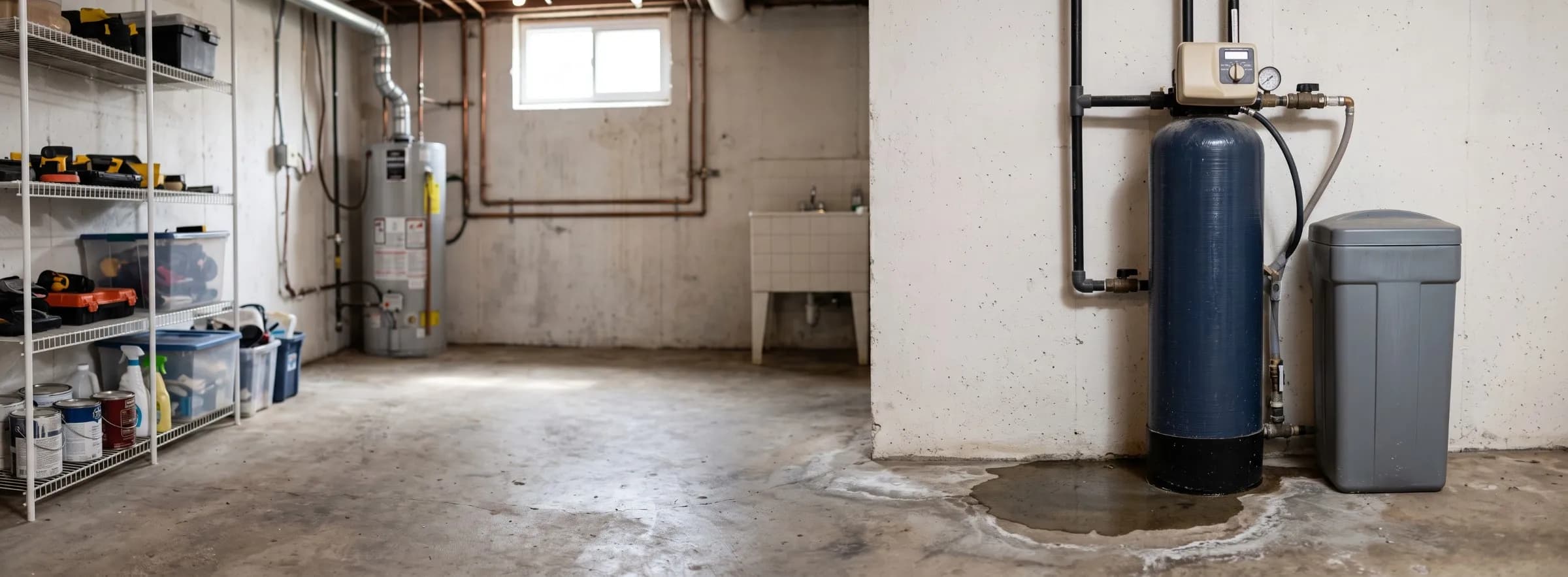

Water pooling under a softener tank or seeping out of a cabinet where a filtration system sits is rarely a sign of a full flood, but it can still soak cabinetry, flooring, and the subfloor beneath it if it goes unaddressed. A water softener or filtration system leak is water escaping from a home's water treatment equipment rather than from a supply or drain pipe itself. It's typically classified as Category 1 clean water under IICRC S500, the standard restoration companies follow for water damage, since it draws from the same supply already running through the house, though a brine tank overflow carries dissolved salt that behaves differently once it hits wood and flooring.
Water softeners, brine tanks, reverse osmosis units, and whole-house filtration systems share the same failure points, the same cabinet or utility-closet installation spots, and largely the same cleanup and insurance questions, which is why a single response applies across all of them. Stopping the water and identifying which part actually failed comes first, and what it typically costs to fix and whether it's likely to be covered by water damage restoration insurance follows from there.
Key insights
- Bypass first, then call. A water softener's bypass valve routes water around the unit and stops the leak at its source without shutting off water to the rest of the house.
- Most leaks are clean water. Softener, filter, and reverse osmosis leaks are typically Category 1 under IICRC S500, since they draw from the same supply already feeding the home.
- Brine overflow is the exception. A salt tank overflow leaves a corrosive residue on flooring and metal that plain water does not.
- The float valve is a common culprit. A stuck brine tank float, not a cracked tank, causes most reported overflow cases.
- Cleanup and equipment repair are billed separately. Water damage cleanup ($150 to $8,000+) and softener or filtration repair ($150 to $2,500) are two different invoices.
- Equipment age matters. Softeners typically last 10 to 15 years, and reverse osmosis membranes and filter housings often fail sooner, closer to the 5 to 10 year mark.
Leak, condensation, or regen cycle?
A water softener discharging water on its own, or a tank sweating with condensation in a humid space, both look like a leak but aren't one. A leak is water reaching the floor from somewhere other than the unit's own drain line or its exterior surface, while normal regeneration water stays inside a dedicated drain line and condensation stays on the tank's exterior rather than pooling from underneath it.
 Water reaching the floor instead of draining through the line points to an actual leak, not a normal regeneration cycle.
During regeneration, the control valve flushes the resin tank and sends brine and rinse water down a dedicated drain line, usually for 10 to 20 minutes every few days, and none of that water is meant to reach the floor. The clearest way to tell a normal cycle from a real leak is where the water ends up: regeneration water runs through its own line to a floor drain, standpipe, or utility sink, so it shouldn't appear anywhere near the unit itself, while water actually pooling under or beside the cabinet is a sign something has failed.
Running a manual regeneration cycle and watching where the water goes settles the question directly. If the timing matches the noise and duration of a normal cycle and every drop ends up in the drain line rather than on the floor, the softener is working as intended, and it's worth checking whether that drain line itself has come loose or clogged before assuming the unit needs repair.
Condensation is the other common false alarm, especially in a garage, unconditioned basement, or any space where humidity swings widely. A cold water line or tank surface can sweat in warm, humid air the same way a glass of ice water does, and that moisture drips and puddles at the base in a way that looks identical to an actual leak. Wiping the tank fully dry and checking back an hour later, with no water source running in between, usually settles which one it is.
What to do right now
The first move is to stop new water from reaching the leak, not to start cleaning up what has already spilled. Work through these steps in order, then move on to identifying exactly which part of the system failed.
 Bypass mode reroutes water around the resin tank without shutting off supply to the rest of the house, unlike closing the main valve.
1. Shut off the water supply or switch to bypass
Locate the shutoff valve on the line feeding the unit and turn it clockwise until it stops. If the softener itself is the confirmed source, its bypass valve routes water around the tank instead, which stops the leak while still supplying water, untreated, to the rest of the house.
2. Cut power to any nearby outlet if water is close to it
Switch off the breaker for a nearby outlet or appliance rather than reaching for a wet plug, the same precaution OSHA's flood response guidance calls for around any standing water near electrical equipment. Many softeners and filtration systems sit within a few feet of an outlet in a basement, garage, or under-cabinet setup.
3. Contain and remove standing water
Towels or a wet vacuum handle most softener and filtration leaks, since the volume involved is usually small compared to a burst pipe. Open the cabinet doors or utility closet fully so air can reach every wet surface, including the back and sides of the unit.
4. Photograph the damage before cleaning further
Photograph the water, the visible source, and any affected cabinetry or flooring before equipment or repairs change what it looked like. This step matters most for an insurance claim, since an adjuster will want to see the damage as it was found, not after it has already been cleaned and dried.
5. Call for help based on what you find
Call the equipment's installer or a water treatment technician if the tank, valve, or membrane failed, a plumber if a supply or drain line failed, and a restoration company if water reached the subfloor or spread past the immediate area. A leak that's spreading fast or reaching multiple rooms is worth treating like any other emergency water damage event rather than waiting to see how far it goes.
What not to do
A few common reactions make a softener or filtration leak worse instead of better, even when they seem like the obvious first move. Reaching for a household vacuum, assuming a wiped-down cabinet is actually dry, and skipping documentation because the leak looks minor are the mistakes that come up most often, and each one either spreads the water further or erases the evidence a claim later depends on.
Don't ignore a small drip because it looks minor
A softener or filter that drips steadily inside a closed cabinet can go unnoticed for days, and by the time it's visible on the floor outside the cabinet, the wood behind it has usually been wet far longer.
Don't assume a dry-looking cabinet floor is actually dry
Particleboard and MDF cabinet bases absorb water and swell before the surface looks visibly wet again, so a spot that feels dry to the touch can still be holding moisture underneath a finish or laminate layer.
Don't skip documentation because the leak seems small
A leak that looks minor today can still be the reason a claim gets denied later if there's no record of when it was found and how it was handled. Following the same documentation habits laid out in the water damage restoration checklist protects a claim even on a small spill.
Softener, filter, or something else?
The system responsible for a leak is identified by where the water actually starts, not by which appliance happens to be nearby. Softeners, brine tanks, reverse osmosis units, and whole-house filters each have a distinct typical leak point, and a kitchen cabinet often holds more than one of these systems within a few feet of a dishwasher or the sink's own supply lines.
 Multiple supply lines sharing one cabinet is why tracing a leak back to its actual source matters more than guessing by which appliance sits closest.
A whole-house filter and a water softener are frequently installed one after another on the same main line, with the filter positioned first to protect the softener's resin bed from sediment. A leak found near the very start of that sequence, before either unit's own housing, usually points to the filter rather than the softener.
| System | Typical leak point | What it looks like |
|---|---|---|
| Water softener (resin tank) | Base of the tank or around the control valve head | Steady drip or puddle directly beneath the tank |
| Brine tank (salt tank) | Top edge of the tank | Overflow spilling over the rim, often with visible salt crust |
| Reverse osmosis unit | Membrane housing, faucet base, or drain line under the sink | Puddle inside the cabinet, or dripping from the RO faucet itself |
| Whole-house filter housing | Housing seam, O-ring, or drain valve | Leak at the canister joint, usually in a basement, garage, or utility closet |
| Connecting supply or drain lines | Anywhere along the tubing or fitting run | Wet spot along a line rather than at the unit itself |
A softener and a nearby refrigerator ice maker line sometimes get confused for one another when both run off a shared supply branch in the same wall or cabinet, so tracing the wet trail back to its actual origin point matters before any repair starts. If two systems sit in the same cabinet, close the shutoff valve to one at a time and watch whether the leak slows, rather than guessing based on which unit looks older.
A traditional salt-based softener with a brine tank is still the most common setup in U.S. homes, but a growing share run a salt-free conditioner instead, a template-assisted crystallization or electronic descaling unit with no brine tank at all. A salt-free system fails at its media housing or its inlet and outlet fittings rather than through a float or an overflow, so a stuck float or a brine tank overflow isn't a relevant cause for that kind of unit, though the same connection and housing failures common to any sealed tank still apply.
Brine tank overflow
A brine tank overflow happens when the safety float inside the salt tank sticks open or the drain line clogs, letting water keep filling the tank past its normal level until it spills over the top edge rather than leaking from a crack. It is the single most common water softener complaint homeowners report, and it is a maintenance fix rather than a repair to the resin tank itself.
 Salt residue left in place keeps drawing moisture from the air and can corrode metal fixtures long after the original overflow stops.
A wet brine tank is also designed to hold a couple of inches of standing water at the bottom as part of normal operation, which some homeowners mistake for a problem when nothing is wrong at all. The distinction is simple: water sitting low in the tank, below the salt level, is expected, while water at or above the top edge, especially with any spilling over the rim, is an actual overflow.
The float works the same way a toilet tank's fill valve does: it rises with the water level and shuts off the fill line once it reaches the correct height. Salt residue, sediment, or a float that has simply worn out over years of use can keep it from rising correctly, and the tank keeps filling until it overflows. Cleaning the float mechanism and clearing a clogged drain line resolves most overflow cases without needing a technician visit, though a float that has cracked or lost its buoyancy needs replacing.
Unlike a plain water leak, an overflow carries dissolved salt, which leaves a white crust once the water evaporates and can corrode nearby metal fixtures or fasteners over time. Rinsing the affected area with clean water and drying it fully, rather than just wiping up the puddle, prevents that residue from sitting against flooring or a metal cabinet base.
What causes the leak
Most water softener and filtration leaks trace back to a worn seal, a loose connection, or a mechanical part that failed, not a catastrophic tank failure, the same wear pattern behind most washing machine hose failures. Softener causes and filtration causes overlap enough, sharing the same O-rings, fittings, and housing materials, that they're worth troubleshooting together rather than separately.
 Most failures like this trace back to years of gradual wear rather than a manufacturing defect, which is why age is a bigger risk factor than brand.
Manufacturing defects account for only a small share of these failures. Most trace back to a part that simply wore out over years of use, or one that was never fully seated during the original installation or a later service visit, which is why a leak often shows up months after a technician was last in the house rather than right afterward.
| Cause | What's actually happening |
|---|---|
| Cracked resin tank or brine tank | Plastic fatigue from age or a sediment-related stress crack in the tank wall |
| Worn bypass valve O-ring | The rubber seal that routes water around the unit dries out and stops sealing correctly |
| Loose or corroded fittings and hose connections | Supply or drain-line connections loosen over time or corrode at the joint |
| Stuck brine tank float valve or clogged drain line | The float doesn't shut off the fill correctly, or a clogged line backs water up into the tank |
| Failed control valve or timer | The valve that manages the regeneration cycle sticks or wears out |
| Cracked reverse osmosis membrane housing | The housing that holds the RO membrane develops a stress crack under water pressure |
| Clogged reverse osmosis drain line or air gap | A blocked line backs water up through the faucet's air gap and onto the counter or into the cabinet |
| Cracked whole-house filter housing or worn seal | The canister housing or its O-ring fails under continuous supply pressure |
Age is a factor behind nearly every one of these causes, in roughly the same way it is for a water heater nearing the end of its service life. Plastic tanks, rubber O-rings, and gasket materials all degrade gradually, so a system past the middle of its expected lifespan is more likely to develop a crack or seal failure than a newer unit, even with no obvious warning sign beforehand.
Signs of a leak
Pooling at the base of the tank, a swollen cabinet floor, and a musty odor with no visible water are the earliest signs of a softener or filtration leak, often showing up well before a puddle is ever visible on the floor outside the cabinet. These are specific to a softener or filtration leak, distinct from the broader signs of water damage that apply to any room in the house.
 Particleboard and MDF absorb water and swell well before a stain ever appears on the surface finish, so a soft or discolored toe kick means the leak has been running for a while.
A unit installed on carpet or against a carpeted wall, in a finished basement for example, carries extra risk, since carpet fibers wick water sideways and can mask both the visible stain and the smell of a leak for longer than tile, vinyl, or bare concrete would. By the time a stain surfaces on top of the carpet, the pad underneath has usually been wet for a while already.
| Sign | Where to look | What it means |
|---|---|---|
| Pooling or dampness at the base | Directly under the tank or housing | Active leak, source still needs to be confirmed |
| Swollen cabinet base or toe kick | Cabinet floor beneath the unit | Water has been present long enough to soak into particleboard or MDF |
| White crust or salt residue | Around the brine tank or on nearby flooring | Sign of a past or ongoing brine overflow |
| Musty odor with no visible water | Inside the cabinet or utility closet | Hidden moisture, often behind or beneath the unit |
| Discoloration on flooring near the cabinet | Floor just outside the cabinet opening | Water has already traveled beyond the immediate footprint |
| Reduced water flow or a higher water bill | Whole-house usage over time | A slow leak or a continuously running RO drain line |
| Rust-colored or orange staining | Near a whole-house filter, most common on well water | Iron or sulfur filter media tank leak rather than a plain water leak |
A musty odor with no visible water is the sign most often ignored, since it doesn't come with an obvious puddle to point to. The CDC's basic facts about mold note that mold can start growing within one to two days once a surface stays wet, which is enough time for a hidden leak behind a cabinet to become a mold problem before it ever becomes a visible one.
A home on a private well, rather than municipal water, is more likely to run a dedicated iron or sulfur filter ahead of the softener, and a leak from that filter's media tank carries a rust-colored or orange tint rather than running clear. That staining sets into grout and light-colored flooring more permanently than a plain water leak does, and it corrodes exposed metal faster, so a rust-tinted leak is worth treating with more urgency even if the puddle itself looks small.
Where the water travels
A softener or filtration leak typically stays contained to the cabinet, utility closet, or immediate floor area where the unit sits, unlike a burst pipe that can spread across a room in minutes. That containment is exactly why it often goes unnoticed longer, since a small, steady leak behind a closed cabinet door has no reason to draw attention until the damage has already spread downward.
 An open basement or utility closet has no cabinet walls to contain the water, so it spreads across the floor and reaches nearby stored belongings faster than a boxed-in kitchen leak would.
The cabinet or shelving the unit sits on is usually the first material affected, and particleboard or MDF bases swell and delaminate well before the damage is visible from outside the cabinet. A softener or filter installed against any cabinet wall behaves the same way any other under-cabinet appliance leak does once water gets past the cabinet floor.
A basement or utility-closet installation sitting directly on a concrete slab tends to spread across an open floor area rather than staying boxed inside a cabinet. Water can reach the subfloor beneath a slab-level installation, or nearby stored belongings, well before the leak is visible from the doorway.
A kitchen installation puts cabinetry, countertop support, and flooring at risk all at once instead, since there's no open slab for the water to spread across the way there is in a utility closet. Only the cabinet base and the flooring just outside its opening absorb the damage there, which is exactly why catching it early matters more in that setting.
DIY vs. professional cleanup
A confirmed leak caught and stopped the same day, with a small, contained puddle and no brine contamination, is DIY-appropriate. Anything with an unclear source, standing water that's been there more than a few hours, or a soft subfloor beneath a swollen cabinet base calls for a professional instead.
 Airflow alone can dry a small, contained spill within a day, but it won't resolve moisture already trapped inside particleboard, which is where a moisture meter reading matters more than how the surface looks.
Opening the cabinet or utility closet and letting it air out for a full day before making that call is worth doing regardless, since a surface that looks dry right after wiping it down can still test wet underneath once given time to reveal itself. That single day of airflow costs nothing and settles the DIY-versus-professional question with actual evidence instead of a guess.
| Criteria | DIY-appropriate | Call a professional |
|---|---|---|
| Source | Confirmed and stopped (bypass or shutoff closed) | Unclear, or water is still actively leaking |
| Water type | Clean supply water | Brine overflow, or any doubt about the source |
| Extent | Small puddle, dry within hours of cleanup | Cabinet base swollen, subfloor feels soft |
| Duration | Caught the same day | Unknown how long the leak had been running |
If a moisture meter reading against the cabinet floor or subfloor comes back above 17 percent after the area looks dry to the touch, that's a sign hidden moisture remains and a professional assessment is worth the call rather than closing the cabinet back up. What that number actually means shifts by material, since moisture meter readings run differently for drywall, solid wood, and concrete, but the practical rule for a softener or filtration leak is simple: if it's still elevated a day after cleanup, something underneath is still wet.
Who to call
A softener or filtration leak often needs more than one call, since the equipment itself, the plumbing feeding it, and the water damage it caused are three separate problems. A water treatment technician or the system's original installer handles the unit itself, since that work involves parts and warranty coverage specific to the brand and model.
 A water treatment technician handles the equipment itself, but water that reached the subfloor or spread past the cabinet is a separate call to a restoration company.
A plumber gets involved when a supply or drain line, rather than the unit itself, turns out to be the actual point of failure. That happens more often than homeowners expect given how many connections run into a softener or filtration setup, especially where multiple systems share the same under-sink space.
A restoration company becomes the third call once water has reached the subfloor or spread beyond the cabinet. Confirming current IICRC certification before booking the work is worth doing even on a small job, since that credential is what verifies a technician follows the same drying and moisture-verification standards on a minor spill as on a larger loss.
Getting one company to handle the equipment side while another handles drying and repair is normal for this kind of leak. The two don't need to coordinate directly as long as the source of the leak has already been stopped before either one starts work.
Having questions to ask a water damage restoration company ready for that first call, on scope, timeline, and what the written estimate should include, helps regardless of which company ends up doing the work. A written estimate that skips the category or class assignment, or names no timeline at all, is worth pushing back on before signing anything.
Cleanup and repair cost
Cleaning up after a softener or filtration leak typically runs anywhere from a few hundred dollars for a contained spill to several thousand for damage that reached the subfloor or spread into an adjoining room. A garage or utility-closet installation is often cheaper to access and dry than one built into a kitchen cabinet, since there's no cabinetry to remove first. That figure covers extraction, drying, and any cabinet or flooring repair, and it's separate from whatever it costs to fix or replace the softener, RO unit, or filter itself.
 A written estimate should separate cleanup cost from equipment repair cost as two distinct line items, since a quote that bundles them together is harder to compare against a second opinion.
An after-hours or emergency dispatch premium, common on a burst pipe or an active flood, rarely applies here, since the water volume from a softener or filtration leak seldom qualifies as an emergency call. That keeps the labor rate closer to a standard scheduled visit than a premium one.
| Scenario | Cleanup cost | Repair or replacement |
|---|---|---|
| Caught early, no structural damage | $0–$300 | $150–$600 |
| Minor cabinet and flooring cleanup | $300–$1,500 | $150–$800 |
| Moderate, cabinet and subfloor section | $1,500–$5,000 | $150–$1,300 |
| Extensive, multi-room or flooring replacement | $5,000–$10,000+ | $800–$2,500 |
| Severe, prolonged undetected leak spread to a basement | $10,000–$15,000+ | $800–$2,500 |
Labor, not materials, tends to drive the total on the cleanup side once cabinetry or subfloor removal is involved, since accessing and drying the space under a built-in cabinet takes more time than a flat, open-floor spill. A national water damage restoration cost benchmark is a useful sanity check against any estimate that comes in well outside these ranges for a comparable amount of visible damage.
Insurance
Standard homeowners insurance covers water damage from a softener or filtration leak when the failure was sudden, such as a tank cracking or a fitting blowing apart, under the same sudden and accidental standard that applies to any other appliance leak. Whether homeowners insurance covers water damage in a given case generally comes down to that one distinction: a policy pays for a failure that happened, not one that was allowed to continue.
That distinction matters more here than on some other appliance-leak claims, since a softener or filtration system sits behind a closed cabinet or in a utility closet that nobody checks daily. An adjuster reviewing a claim weighs evidence like how far the cabinet has swollen or how discolored the wood has become to judge whether the leak was recent or had been running for weeks. Documenting the source and the date you found it, before any cleanup begins, is the single best protection against that determination going the wrong way.
Keeping photos, the discovery date, and a written estimate together in one place is what actually protects a claim if it's disputed later. The same approach to documenting water damage for insurance applies whether the cause was a softener, a filtration system, or anything else.
Leased or rented equipment
The water damage cleanup itself is still the homeowner's responsibility under their own homeowners policy even when the softener is leased rather than owned, since that policy covers damage to the home rather than to the appliance that caused it. Responsibility for the leaking equipment itself typically falls to the leasing or service company instead, under the terms of the rental agreement.
Most lease and water treatment service agreements make the provider responsible for repairing or replacing a unit that fails under normal wear. Many of those same agreements also require the leak to be reported to the provider directly rather than to an outside technician, so checking the service contract before calling anyone else is worth doing first.
Whether the provider bears any liability for the water damage itself, beyond just the equipment, depends on the specific agreement and whether a maintenance failure on their end caused the leak. That's a contract-specific question a homeowner can't settle without reading the agreement's terms, and it's worth raising directly with the provider alongside the equipment claim rather than assuming either way.
Prevention
A handful of habits catch most softener and filtration leaks before they cause real damage. Checking hose and fitting connections for tightness once or twice a year, replacing an aging bypass valve O-ring proactively rather than waiting for it to fail, and testing the brine tank float occasionally are the highest-value steps for the lowest effort, alongside the same broader water damage prevention habits that apply to every system in the house.
 A float that doesn't rise and shut off the fill line at the correct height is the leading cause of a brine tank overflow, and testing it takes less than a minute.
Inspect connections annually
Check every supply, drain, and bypass fitting for looseness or corrosion once a year, ideally around the same time as any other household plumbing check.
Test the brine tank float
Pour water into the salt tank until it approaches the fill line and confirm the float shuts off the fill correctly, rather than assuming it still works because it hasn't overflowed recently.
Replace aging equipment proactively
A softener past 10 to 15 years, or a reverse osmosis membrane or filter housing past 5 to 10 years, is a better candidate for planned replacement than for waiting until it fails. A softener certified by the Water Quality Association to NSF/ANSI 44, and an RO system certified to NSF/ANSI 58, the respective industry standards for each type of equipment, has already been checked for structural integrity at the time of manufacture, though that doesn't extend its service life once it's installed.
Add a leak detector or drain pan
A simple water sensor placed beneath the unit, or a drain pan under a softener or filter that sits directly on flooring, catches a leak within minutes instead of days.
Keep the area dry and inspect periodically
Open the cabinet or utility closet door every so often and check for dampness, a musty smell, or salt residue, even when nothing looks obviously wrong.
Frequently asked questions
Is water damage from a leaking water softener covered by insurance?
Usually, if the failure was sudden. Standard homeowners insurance treats a softener or filtration leak the same way it treats a dishwasher or water heater failure, covering the resulting water damage under a normal claim and deductible, though the equipment itself is typically excluded from that same claim.
How do I know if it's the softener tank or the brine tank leaking?
Check which tank the water is coming from. The larger resin tank sits under the control valve and leaks at its base or around the valve head, while the smaller brine tank sits beside it and typically overflows from the top edge rather than leaking from underneath.
Is water from a leaking water softener or filtration system safe to touch?
Yes, in most cases. The water entering a softener or filtration system is the same municipal or well supply already running through the rest of the house, so a leak from the resin tank, the filter housing, or the connecting lines is typically Category 1 clean water under IICRC S500. Brine tank overflow is the exception, since it carries dissolved salt that can irritate skin with prolonged contact and leaves a corrosive residue on flooring and metal.
Can a water softener or filtration leak cause mold?
Yes, if the water sits for more than a day or two. The EPA recommends drying a water-damaged area within 24 to 48 hours specifically to prevent mold growth, and a softener or filter often leaks inside a closed cabinet where nobody sees the water until it has already been sitting for a while.
How much does it cost to fix water damage from a leaking water softener or filtration system?
Cleanup alone typically runs $150 to $600 for a contained spill caught early, and $1,500 to $8,000 or more when cabinet, subfloor, or flooring replacement is needed. That figure is separate from repairing or replacing the softener or filtration equipment itself, which usually adds another $150 to $2,500 depending on the system.
Should I put my water softener in bypass mode?
Yes, if the resin tank itself is the confirmed source. Bypass mode only reroutes water around the resin tank, so it stops a resin tank leak but won't do anything for a brine tank overflow, which needs the float and drain line addressed directly instead.
Can a reverse osmosis system cause water damage?
Yes. A reverse osmosis unit under a kitchen sink runs on the same pressurized supply line as every other fixture, and a cracked membrane housing, a loose fitting, or a clogged drain line and air gap can leak or back up water into the cabinet in the same way a dishwasher or garbage disposal leak does.
How long do water softeners and filtration systems typically last?
A well-maintained water softener typically lasts 10 to 15 years. What actually ends that lifespan early is usually a cracked tank or a failed control valve rather than the resin itself wearing out, since resin media can often outlast the mechanical parts around it by several years.
Does homeowners insurance cover replacing the softener itself, or just the water damage?
Just the water damage, in most cases. Standard homeowners policies typically exclude the mechanical breakdown of the appliance that caused the leak, the same way a dishwasher's or water heater's own failure isn't covered even when the resulting water damage is, consistent with how the National Association of Insurance Commissioners describes standard equipment-breakdown exclusions for insurers nationwide.
What should I do if I find a white crust or salt residue near my water softener?
Rinse it with clean water and dry the area fully, since leftover salt keeps drawing moisture from the air and can continue corroding metal long after the original spill happened. A crust that reappears within days even after cleaning points to an active, ongoing overflow rather than a one-time spill and is worth having serviced.
Do I need a plumber, a water treatment technician, or a restoration company?
Often more than one. A water treatment technician or the equipment's installer handles the softener or filtration unit itself, a plumber gets involved if the supply or drain lines feeding it have failed, and a restoration company handles extraction, drying, and any cabinet or flooring repair once the source is under control.
Sam Hickerson is the founder of RestoreAdvisor and writes consumer guides on mold remediation, water damage restoration, inspection, testing, and home recovery. His work focuses on helping homeowners understand costs, risks, and when to call a professional. He draws on guidance from the EPA, CDC, IICRC, and other authoritative sources to make complex home issues easier to navigate.