

You've found mold in your home, or you're dealing with musty air and suspect mold somewhere out of sight. An air purifier sounds like a fast fix. Before you buy one, it helps to understand exactly what these devices can and cannot do, because the answer to "does an air purifier help with mold?" depends entirely on what problem you are trying to solve.
A True HEPA air purifier, defined by the U.S. Department of Energy standard DOE/IEST-RP-CC007, captures 99.97% of airborne particles at 0.3 microns. Mold spores range from 1 to 20 microns, which puts them well within HEPA filtration range. The EPA and CDC both recognize HEPA filtration as an effective tool for reducing airborne biological contaminants, but neither agency treats air purifiers as a replacement for moisture control or physical mold removal.
Key insights
- Air purifiers reduce spores in the air, not mold on surfaces. A HEPA unit captures spores that are floating. It cannot reach mold colonies growing on drywall, wood, or grout.
- True HEPA captures 99.97% of particles at 0.3 microns. Mold spores range from 1 to 20 microns, putting them easily within the filtration range of a properly rated filter.
- CADR is the most important buying metric. Clean Air Delivery Rate tells you how much clean air the unit produces per minute, which determines whether it can actually cycle your room fast enough to matter.
- Target 4 or more air changes per hour. AHAM recommends a minimum of 4.8 ACH for effective particle control. For active mold situations, 4–5 ACH is the practical target.
- Ozone generators are not a solution. The EPA and California Air Resources Board both warn that ozone generators do not reliably remove mold spores and can harm lung tissue at concentrations reached indoors.
- Moisture control is what prevents mold. No air purifier stops mold from growing. Controlling indoor humidity below 50% relative humidity is the only way to interrupt the growth cycle.
Where an air purifier fits in the mold response
An air purifier addresses one half of a mold problem: the airborne spores. A dehumidifier addresses the other half: the moisture that allows mold to grow. Neither tool substitutes for the other, and neither replaces the physical removal of existing mold growth.
 A reading at 54% next to a running purifier like this is a useful reminder that filtration and humidity control are solving two separate problems, not one; neither substitutes for the other.
A mold problem has two distinct halves, and mixing them up is the reason most people are disappointed with the results they get from equipment alone. The first half is the moisture that allows mold to grow. The second half is the spores that mold releases into the air.
1. Fix the moisture source
The leak, the condensation problem, the failed exhaust fan, the foundation seepage. If you skip this step, every other action is temporary. Mold will regrow on anything that stays wet.
2. Remove visible mold physically
Surface mold requires physical removal, not filtration. The EPA recommends professional remediation for areas larger than 10 square feet. For smaller patches, detergent and water with appropriate PPE is the starting point. An air purifier running during this step helps capture spores that are disturbed, but it does not substitute for the cleaning itself.
3. Control humidity below 50% RH
After removal, a dehumidifier keeps indoor relative humidity in the range where mold cannot reestablish. The EPA and CDC both identify 30%–50% RH as the target. Detailed sizing guidance lives on the humidity and mold page.
4. Run a True HEPA air purifier continuously
This captures the spores that were released before and during removal, prevents them from settling on new surfaces, and maintains lower baseline spore counts in the room going forward. This is where the rest of this article focuses.
Steps 3 and 4 work together and continue indefinitely. Steps 1 and 2 are the one-time interventions that the equipment in steps 3 and 4 protects against repeating.
Does an air purifier actually help with mold?
A True HEPA air purifier does help with mold by capturing airborne spores before they settle on new surfaces and establish new colonies. It reduces the concentration of spores you inhale, which matters most for people with mold exposure symptoms, mold allergies, or asthma.
What it cannot do is treat the source. Mold growing on drywall, wood framing, ceiling tile, or grout requires physical removal. The IICRC S520 Standard for Professional Mold Remediation is explicit on this point: air filtration is a supporting measure in the remediation process, not a primary one. Running an air purifier while mold continues to grow on surfaces is like mopping a floor under a running faucet. You reduce the immediate problem, but the underlying condition keeps producing more.
- Reducing airborne spore concentration in occupied rooms during and after remediation
- Protecting high-risk household members (people with asthma, mold allergies, children, elderly, and immunocompromised individuals) from elevated spore loads
- Capturing spores disturbed during surface cleaning before they settle elsewhere
- Maintaining lower baseline spore counts in chronically high-humidity spaces like basements
Filtration technologies compared
True HEPA is the only filtration technology independently certified to capture mold spores at 99.97% efficiency. Other technologies marketed for mold, including UV-C, ionizers, and ozone generators, either fail to capture spores reliably or introduce hazards of their own.
 Pleats this dense are what let a True HEPA filter trap 99.97% of particles at 0.3 microns, well below the 1 to 20 micron range most mold spores actually fall into.
Not every air purifier is designed the same way. The technology inside determines whether a unit can actually capture mold spores or simply moves air around.
True HEPA filtration is the established standard for particle removal. A filter meets the True HEPA designation when it captures 99.97% of particles at exactly 0.3 microns under controlled test conditions per the DOE/IEST-RP-CC007 standard. Since mold spores are substantially larger than 0.3 microns, a properly rated True HEPA filter traps virtually every spore that passes through it. The mechanical nature of HEPA filtration, where particles are physically caught in the filter media through impaction, interception, and diffusion, means it produces no harmful byproducts.
| Technology | Captures mold spores | Removes mVOC odors | Key limitation |
|---|---|---|---|
| True HEPA | Yes, 99.97% at 0.3 microns | No | Must be sized correctly for the room |
| HEPA-type / HEPA-style | Partially (85–90%) | No | Not independently certified; inferior capture rate |
| Activated carbon | No | Yes | Does not capture spores; must be paired with HEPA |
| UV-C germicidal | Partially | No | Requires adequate dwell time; degrades HEPA media over time; may produce ozone |
| Ionizer / electrostatic | Partially | No | May produce ozone; charges particles that fall onto surfaces instead of being captured |
| Ozone generator | No | No | EPA warns against use in occupied spaces; does not reliably kill mold |
The most practical configuration for a mold situation is a unit that combines True HEPA with activated carbon filtration. The HEPA stage handles spores. The activated carbon stage adsorbs microbial volatile organic compounds (mVOCs), which are the gaseous metabolites produced by actively growing mold colonies that create the musty smell. Neither stage alone addresses both problems.
Avoid any device marketed as an ozone generator or ionic air purifier for mold. The EPA's guidance on ozone generators states that these devices can produce ozone at levels that irritate the respiratory system without reliably removing mold. The California Air Resources Board has classified ozone-generating air cleaners as a source of indoor air pollution.
How to size an air purifier for mold
Size an air purifier for mold using CADR (Clean Air Delivery Rate), targeting a smoke CADR that delivers at least 4 air changes per hour in the room. AHAM's minimum recommendation for effective particle control is 4.8 ACH; for active mold situations, 4–5 ACH is the practical target.
 Getting this measurement right matters more than the coverage number on the box, since that claim is often made at maximum fan speed under ideal conditions rather than a real target of 4 air changes per hour.
Sizing is where most buyers go wrong. A unit labeled "covers 500 sq ft" may be making that claim at maximum fan speed in ideal conditions. What you actually need is a unit whose CADR can deliver 4 or more air changes per hour in your specific room.
CADR is a metric certified by the Association of Home Appliance Manufacturers (AHAM). It measures the volume of clean air a unit produces per minute, expressed in cubic feet per minute (CFM). A higher CADR means the unit cleans a larger volume of air faster. AHAM tests and certifies three CADR values: smoke (smallest particles, 0.09–1 micron), dust (0.5–3 microns), and pollen (5–11 microns). For mold spore capture, the smoke CADR is the most conservative and meaningful value to use.
Sizing formula:
- Calculate room volume: length (ft) x width (ft) x ceiling height (ft)
- Divide room volume by smoke CADR to get minutes per air change
- Divide 60 by minutes per air change to get ACH
For a mold situation, target 4–5 ACH. AHAM's minimum recommendation is 4.8 ACH for effective particle control.
| Room size (8-ft ceiling) | Room volume (cu ft) | Minimum smoke CADR | Target ACH |
|---|---|---|---|
| 150 sq ft (small bedroom) | 1,200 | 80 | 4 |
| 250 sq ft (large bedroom) | 2,000 | 133 | 4 |
| 300 sq ft (living room) | 2,400 | 160 | 4 |
| 500 sq ft (open area) | 4,000 | 267 | 4 |
| 800 sq ft (large basement) | 6,400 | 427 | 4 |
One practical rule: oversize the unit rather than matching it exactly. A unit with more CADR than you need can run at a lower, quieter fan speed while still meeting your ACH target. An undersized unit must run on high constantly, is louder, and may still fall short of the 4 ACH threshold. AHAM's maximum certified CADR for residential smoke is 450, so claims above that figure are extrapolated and should be viewed skeptically.
Note that basement spaces with high ceilings or open floor plans require substantially higher CADR than a standard bedroom. The IICRC S520 standard specifies that post-remediation clearance testing measures airborne spore counts, which gives you a benchmark for whether your air purifier is maintaining acceptable levels after a remediation job. Controlling humidity in large spaces also requires a separate dehumidifier, which an air purifier does not replace.
Features that matter and features that don't
The two non-negotiable features for a mold air purifier are True HEPA certification and an AHAM-certified CADR rating. Everything else, including UV-C lamps, ionizers, and smart connectivity, is secondary and in some cases counterproductive.
Features that matter:
True HEPA certification is non-negotiable. Look for "True HEPA" or "HEPA-rated" explicitly on the filter packaging, not "HEPA-type," "HEPA-like," or "HEPA-style." Those terms are not regulated and have no minimum performance standard.
CADR certification from AHAM is the other non-negotiable. Without it, you have no standardized way to compare units or verify the manufacturer's room coverage claims. The AHAM Verifide program publishes certified CADR values for tested units.
A sealed housing matters almost as much as the filter. A high-quality HEPA filter in a poorly sealed unit allows air to bypass the filter through gaps in the casing. Look for units that explicitly reference sealed system design.
 A bed this substantial, measured in pounds rather than grams, is what actually adsorbs the musty mVOC odor from active mold; a thin mesh layer captures very little by comparison.
Activated carbon weight, not just the presence of carbon, affects odor performance. Thin carbon mesh captures little. Units with substantial activated carbon beds, measured in pounds rather than grams, provide meaningfully better mVOC adsorption.
Features that do not reliably help with mold:
UV-C lamps added to consumer air purifiers are generally underpowered for reliable mold spore inactivation. Effective UV-C disinfection requires specific irradiance levels and exposure times that most consumer units do not achieve. UV-C can also degrade HEPA filter media over time and may produce ozone as a byproduct. For high-risk species like Stachybotrys, black mold removal requires physical containment and abatement regardless of any air purifier technology.
Ionizers generate electrically charged particles that attract spores but cause them to deposit on nearby surfaces rather than being captured in a filter. This relocates the spore load rather than removing it from the environment.
Smart features, air quality displays, and app connectivity have no effect on filtration performance. They are useful for monitoring and scheduling but should not be the basis for choosing a unit.
Placement and how to use it
Place a mold air purifier near the center of the affected room with at least 6 inches of clearance on all sides, and run it continuously rather than intermittently. In mold situations, consistent low-speed operation outperforms periodic high-speed bursts because it maintains a lower steady-state spore concentration around the clock.
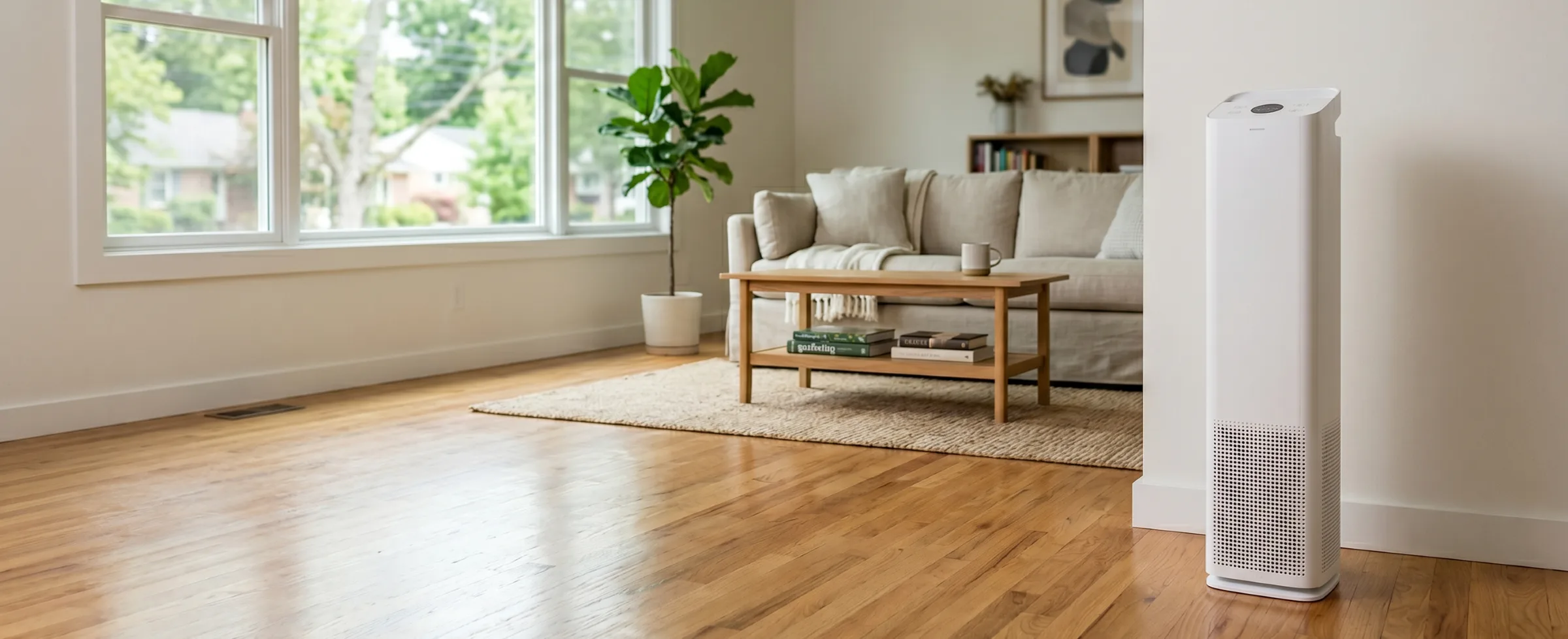
 Clearance like this on all sides is what lets the unit draw from and return to the room's full volume; tucked into a corner, the same unit delivers meaningfully less than its rated CADR.
Correct placement determines whether a properly sized unit actually delivers its rated performance. The unit draws air in through one side and expels filtered air through another; if either path is obstructed by furniture, walls, or corners, effective CADR drops. Prioritize rooms where mold presence is confirmed or suspected and where vulnerable household members sleep.
In mold-prone areas like basement spaces, run the purifier continuously rather than only when the room is occupied. Spores don't settle on a human-occupancy schedule.
Close doors to the room being treated. An open doorway to the rest of the home means the unit is drawing from a far larger volume than its CADR is sized for. Prioritizing a specific room matters most when mold indicators are concentrated there or a symptomatic household member sleeps in that space.
For bedrooms, run the unit on high for the first hour before sleep, then switch to low or auto mode. The initial high-speed run clears the existing spore load quickly. The lower sustained setting maintains the clean environment without the noise of high-speed operation.
Bedroom use offers a disproportionate benefit for people with mold and asthma or mold allergies: closing the door and running a properly sized purifier gives you 7–8 hours per night in a clean-air zone, which matters most for inflammatory and respiratory responses.
Air purifiers during and after mold remediation
During active mold remediation, run a True HEPA air purifier in rooms adjacent to the work area, not inside the containment zone. Inside the containment zone, contractors use commercial HEPA air scrubbers per IICRC S520 protocols that create negative air pressure; a consumer unit placed inside would be both ineffective and a contamination risk.
What homeowners should do during remediation is run a True HEPA unit in adjacent rooms, particularly those connected to the work area by shared HVAC returns or gaps around doors. This captures spores that migrate beyond the containment perimeter. It is also worthwhile during DIY mold removal for small areas under the EPA's 10 sq ft threshold, where professional containment is not in place.
After remediation is complete and clearance testing has passed, continue running a HEPA unit in the affected area for at least two to four weeks. This captures any residual spores that were not fully removed during remediation and settles before they can establish new growth. Clearance testing per IICRC S520 measures spore counts in the air; post-remediation filtration helps ensure those counts stay low.
Running a purifier is also appropriate in adjacent living spaces during active professional mold remediation work, to protect household members who remain in the home during work.
When an air purifier is not enough
An air purifier is not enough when there is active mold growth, a persistent moisture source, or visible contamination exceeding 10 square feet. These conditions require remediation, not filtration.
 Growth visible on a surface like this is exactly the point where a purifier stops being useful on its own; IICRC S520 classifies active growth as Condition 3, requiring professional remediation regardless of square footage.
The EPA's threshold for requiring professional intervention is 10 square feet of visible mold, as outlined in its mold cleanup guidance. The IICRC S520 standard formalizes this as Condition 1 (normal fungal ecology), Condition 2 (settled spores), and Condition 3 (active growth), with Condition 3 requiring professional scope regardless of square footage.
Specific situations where a purifier is insufficient and where mold inspection is warranted:
- Visible mold growth on any surface, regardless of area
- Musty odor that persists even when the room is well-ventilated
- Mold that returns after cleaning, which indicates an unresolved moisture source
- Water damage that was not fully dried within 48 hours
- Mold indicators in wall cavities, behind finished surfaces, or in the HVAC system
- Household members with asthma, mold allergies, or compromised immune systems showing persistent or worsening symptoms
In these situations, purchasing an air purifier first delays the investigation and remediation that the situation actually requires. When mold remediation is required, air filtration is a tool used alongside removal, not instead of it.
If the contamination involves Stachybotrys chartarum (black mold) or extends into structural materials, black mold removal protocols require professional containment and air scrubbing at a level that consumer units cannot provide.
The HVAC system is a specific case where air purifiers provide almost no benefit. Mold inside ductwork, on evaporator coils, or in air handlers circulates spores throughout the entire home with every blower cycle. A room-level purifier cannot counteract this. HVAC mold requires inspection and cleaning by an IICRC AMRT-certified technician following NADCA standards.
For long-term control, an air purifier is most effective when paired with moisture control measures: maintaining indoor relative humidity at 30%–50%, using exhaust ventilation in bathrooms and kitchens, and fixing leaks and water intrusion sources before mold has the opportunity to establish.
Frequently asked questions
Does an air purifier help with mold?
Yes, but only for airborne spores. A True HEPA air purifier captures mold spores floating in the air, which reduces the concentration you breathe. It cannot kill or remove mold already growing on walls, drywall, wood, or other surfaces. Fixing the moisture source and removing existing growth are still required.
What type of air purifier is best for mold?
A True HEPA air purifier combined with an activated carbon stage is the most effective configuration for mold. The HEPA filter captures spores in the 1–20 micron range. The activated carbon adsorbs the mVOC compounds that create musty odors. Ozone generators should be avoided: the EPA warns they can irritate the respiratory system and do not reliably remove mold spores.
What CADR rating do I need for mold?
Target a smoke CADR that delivers at least 4 air changes per hour in your room. Multiply your room's length, width, and ceiling height in feet to get the cubic volume. Divide that by your unit's smoke CADR to get minutes per air change. Divide 60 by that number to get ACH. A 300 sq ft room with 8-foot ceilings needs a smoke CADR of at least 160.
Can an air purifier replace mold remediation?
No. An air purifier reduces airborne spore concentration in the air you breathe, but it does nothing to stop mold from growing or spreading on surfaces. The EPA and IICRC S520 both require physical removal of contaminated materials and correction of the moisture source. An air purifier is a supplement to remediation, not a substitute.
Where should I place an air purifier for mold?
Place the unit near the center of the room with at least 6 inches of clearance on all sides. Avoid corners, which limit the area from which the unit can draw air. Close doors to the room so the unit is only cycling the volume it was sized for. In basements and high-humidity spaces, run it continuously rather than intermittently.
Are ozone generators effective against mold?
No. The EPA warns that ozone generators marketed as air cleaners produce ozone at concentrations that can harm lung tissue, and they are not reliably effective at removing mold spores. The California Air Resources Board has identified these devices as a source of indoor air pollution. Do not use ozone generators in occupied spaces.
Should I run an air purifier during mold remediation?
Run a True HEPA unit in rooms adjacent to the remediation area to capture spores that migrate beyond containment. Do not place a consumer air purifier inside an active containment zone; that role is handled by the contractor's commercial HEPA air scrubbers, which create negative air pressure in the work area.
How often should I replace the filter in a mold situation?
Replace HEPA filters more frequently than the manufacturer's standard schedule in mold-prone environments, typically every 6 months rather than annually. A filter loaded with mold spores and debris restricts airflow, reducing CADR and air changes per hour below the level you need.
- EPA: Should You Have the Air Ducts in Your Home Cleaned
- EPA: A Brief Guide to Mold, Moisture, and Your Home
- CDC: Basic Facts About Mold
- NIOSH: Dampness and Mold in Buildings
- IICRC S520 Standard for Professional Mold Remediation
- California Air Resources Board: Air Cleaners & Ozone Generating Products
- EPA: Ozone Generators Sold as Air Cleaners
- AHAM: CADR Certified Products
Sam Hickerson is the founder of RestoreAdvisor and writes consumer guides on mold remediation, water damage restoration, inspection, testing, and home recovery. His work focuses on helping homeowners understand costs, risks, and when to call a professional. He draws on guidance from the EPA, CDC, IICRC, and other authoritative sources to make complex home issues easier to navigate.