
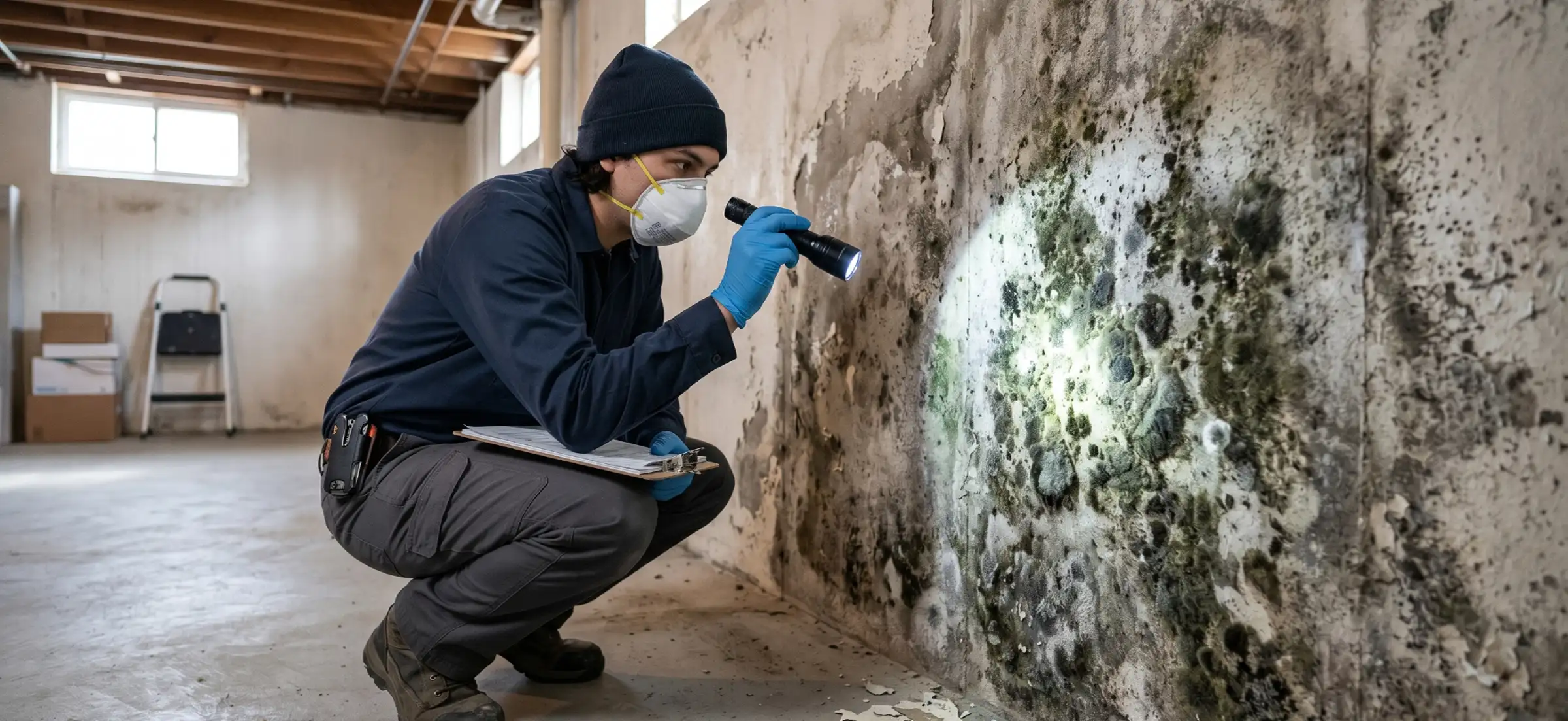

Dark green, gray, or black fuzzy growth with a velvety or suede-like texture is one of the most common mold presentations in homes, and Alternaria is one of the most likely culprits. It is also one of the most clinically significant: a leading fungal allergen worldwide, directly linked to severe asthma in sensitized individuals, and capable of colonizing damp surfaces faster than most indoor mold species. Identifying it correctly, understanding the real health stakes, and knowing when surface cleaning is enough versus when a professional is required are the three things this guide covers.
Alternaria is a genus of ascomycete fungi with over 300 known species. Per CDC: Basic Facts About Mold and ANSI/IICRC S520 guidance, it is one of the most common molds found in indoor environments and ranks among the leading fungal allergens affecting human health.
Key insights
Alternaria is a fast-growing outdoor mold genus that colonizes damp indoor surfaces, ranks among the top clinical allergens worldwide per ANSI/IICRC S520 and CDC guidance, and is directly linked to severe asthma exacerbations in sensitized individuals.
- Primarily an outdoor mold. Alternaria originates outdoors and enters homes through windows, doors, clothing, and HVAC systems. Indoor growth signals a moisture problem that gave outdoor spores a place to colonize.
- Top allergen ranking. Research published in the NIH/PMC database places Alternaria sensitization among children with asthma as high as 16.6% in some populations, making it one of the most clinically significant mold allergens worldwide.
- Named mycotoxins. A. alternata produces alternariol, alternariol methyl ether, and tenuazonic acid. These compounds show genotoxic properties in laboratory research, distinct from the allergenic response that affects a much larger population.
- Fast colonizer. Alternaria can grow at temperatures from 34–95°F and at relative humidity above roughly 62%, meaning it colonizes quickly after even brief moisture events, unlike Stachybotrys, which needs sustained saturation.
- Not the same as black mold. Dark coloration alone does not mean Stachybotrys. Alternaria, Cladosporium, and Aspergillus niger can all appear very dark. Lab testing is the only reliable confirmation.
- DIY scope is limited. The EPA's 10-square-foot threshold applies, and porous materials (drywall, carpet, wood framing) require professional removal regardless of area size.
What Alternaria mold looks like
Alternaria appears as dark green, gray-green, or black colonies with a fuzzy, velvety, or suede-like surface texture. Colony undersides are typically pale tan or olive. Under magnification, Alternaria produces characteristic club-shaped or beak-shaped spores (conidia) with cross-walls (septa) that form in chains, a morphology used by accredited labs following AIHA analytical standards to distinguish it from visually similar genera like Cladosporium and Aspergillus.
 The club-shaped spores forming chains in a sample like this are what accredited labs actually use to confirm Alternaria, since visual color and texture alone can't reliably separate it from Cladosporium.
Visually, Alternaria can be difficult to distinguish from other dark molds. Cladosporium tends to be powdery and dull olive-green to brown. Aspergillus niger is typically very dark, almost black, with a more granular texture. Stachybotrys chartarum is slimy and greenish-black, not fuzzy. Because these distinctions are subtle and unreliable by eye alone, visual identification should be treated as preliminary. Surface swab or air sampling analysis by an accredited lab is needed to confirm species.
| Species | Color | Texture | Moisture needed | Common indoor sites |
|---|---|---|---|---|
| Alternaria | Dark green, gray-green, black | Fuzzy, velvety, suede-like | Moderate (brief damp) | Bathrooms, drywall, carpet, window frames |
| Cladosporium | Olive-green, brown, black | Powdery, granular | Low to moderate | Carpet, textiles, HVAC |
| Aspergillus niger | Black, dark brown | Granular, dusty | Low to moderate | Insulation, ductwork, wood |
| Stachybotrys | Greenish-black | Slimy, wet-looking | High (sustained wet) | Water-damaged drywall |
Alternaria species in homes
Alternaria alternata and A. tenuissima are the two species responsible for nearly all indoor exposure and allergenic health effects. A. alternata is the primary mycotoxin producer and carries the Alt a 1 allergen that drives sensitization in clinical populations; it is also the most studied, with prevalence data from multiple European and North American cohort studies. Other species including A. infectoria and A. chartarum appear indoors but at lower frequency and with lower allergenic load.
| Species | Appearance | Common indoor locations | Mycotoxins | Health category |
|---|---|---|---|---|
| A. alternata | Dark green to black, fuzzy | Drywall, carpet, window frames, bathrooms | Alternariol, AME, tenuazonic acid | High allergenic, asthma trigger |
| A. tenuissima | Similar to A. alternata, often co-occurring | Bathrooms, basements, water-damaged materials | Alternariol, tenuazonic acid | Moderate allergenic |
| A. infectoria | Lighter brown, more compact | Grain, stored organic material, occasionally drywall | Lower mycotoxin production | Lower allergenic |
| A. chartarum | Dark, flat spreading | Damp paper, wallpaper, cardboard | Variable | Moderate |
Lab reports frequently group Alternaria species without distinguishing between them, which is acceptable for remediation decisions. Treatment and removal protocols are the same regardless of which Alternaria species is present.
Where Alternaria mold grows indoors
Alternaria primarily lives outdoors on plants, soil, and decaying organic matter, but it enters buildings constantly through air infiltration, open windows and doors, clothing, pets, and HVAC intake. Once inside, it colonizes any surface that stays damp long enough to support growth. Per ANSI/IICRC S520, porous materials like drywall, carpet, and wood are most vulnerable because hyphae penetrate below the surface where cleaning cannot reach.
 Growth spreading from a frame like this onto drywall crosses from a DIY-appropriate surface into porous material that needs professional removal, regardless of how small the drywall patch looks.
Growth requires a substrate containing organic material, moisture above roughly 62% relative humidity at the surface, and temperatures between 34–95°F. Unlike Stachybotrys, which needs persistent saturation, Alternaria can colonize surfaces that are simply damp from condensation or a leak that has since dried. This wider moisture tolerance makes it more common in homes than species associated only with severe water damage.
| Location | Primary cause | What to look for | DIY appropriate |
|---|---|---|---|
| Bathroom walls and grout | Poor ventilation, high humidity | Dark fuzzy patches near shower, along grout lines, behind toilet | Yes, if under 10 sq ft on tile |
| Window frames and sills | Condensation, air infiltration | Black or gray growth along frame edges, on sash and sill | Yes, if on non-porous frame |
| Drywall and wallpaper | Leak behind wall, condensation, high ambient humidity | Discoloration, bubbling paint, fuzzy growth | No (porous material, requires pro) |
| Under sinks and cabinets | Slow plumbing leaks, cabinet floor moisture | Dark growth on cabinet floor and back wall | No if extensive or with drywall involvement |
| Carpet and padding | Water damage, flooding, chronic humidity | Musty odor, discoloration of carpet face fibers | No (carpet requires replacement) |
| Basement walls and floor | Hydrostatic pressure, condensation, flooding | Gray-green patches on concrete block or painted walls | Limited; see below |
| HVAC system and ducts | Condensate pan overflow, duct condensation | Visible growth near registers, musty odor when system runs | No (requires HVAC professional) |
| Attic sheathing and insulation | Inadequate ventilation, roof leak, exhaust fans venting into attic | Dark staining on plywood or OSB, powdery surface growth | No (structural material, requires pro) |
The signs of mold in each of these locations often appear before visible growth: musty odor, staining, and bubbling paint are early indicators that Alternaria or another species has already established below the surface.
Alternaria mold health risks
Alternaria causes health harm through two distinct mechanisms: allergenic sensitization (IgE-mediated immune response) and mycotoxin production. The allergenic pathway affects a far larger population: the third U.S. National Health and Nutrition Examination Survey found approximately 12.9% of Americans aged 6 to 59 test positive to Alternaria alternata on skin prick testing. The mycotoxin pathway is an area of ongoing research with implications particularly for immunocompromised individuals.
 Symptoms this mild in a healthy adult look nothing like the risk profile for a sensitized child, where the same exposure carries documented odds of triggering severe, difficult-to-control asthma.
For most healthy people with no respiratory conditions, Alternaria exposure causes allergy symptoms that range from mild to moderately disruptive. The NIEHS mold guidance identifies people with asthma, allergies, and weakened immune systems as most at risk from any indoor mold exposure, and Alternaria specifically appears in clinical literature as one of the molds most strongly associated with asthma severity.
Allergenic effects
Alternaria alternata is one of the most potent fungal allergens known, with the Alt a 1 protein identified as the primary driver of sensitization. A 2021 review published in PubMed (PMC8539034) found sensitization rates of 4.4%–6.1% in European general populations, with the highest rates reaching 16.6% in children with asthma in high-exposure regions.
- Sneezing, runny nose, nasal congestion
- Itchy, watery, or red eyes
- Skin rash or hives
- Coughing and throat irritation
- Wheezing and shortness of breath in sensitized individuals
Asthma connection
The relationship between Alternaria exposure and asthma severity is one of the better-documented links in mold health research. Multiple studies associate Alternaria sensitization with severe, difficult-to-control asthma in both children and adults. A 2011 study published in the Journal of Allergy and Clinical Immunology found that Alternaria sensitization was associated with severe persistent asthma with an odds ratio of 3.4, meaning sensitized children were more than three times as likely to have severe asthma.
Thunderstorm asthma events, mass asthma attacks triggered by weather events that rupture and aerosolize spores, have been specifically linked to Alternaria and Cladosporium in research from Australia and parts of Europe. Severe presentations including ABPA and biologic treatment options are covered in depth under mold and asthma.
Mycotoxin effects
A. alternata produces several mycotoxins, including alternariol (AOH), alternariol methyl ether (AME), tenuazonic acid (TeA), altenuene, and altertoxins I, II, and III. Laboratory research has shown these compounds to be genotoxic and cytotoxic at relevant concentrations. Tenuazonic acid, one of the most studied, inhibits protein synthesis and has documented cytotoxic activity. However, the specific health impact of inhaled mycotoxin exposure from indoor Alternaria growth remains an area of active research, and dose-response data for indoor human exposure scenarios is limited. The broader mold health risks context, including IOM and WHO citations on mycotoxin mechanisms by population, covers this in depth.
Serious conditions (rare)
In immunocompromised individuals (those on long-term corticosteroids, undergoing chemotherapy, or living with HIV), Alternaria species can cause invasive infections classified as alternariosis. These manifest as:
- Cutaneous and subcutaneous lesions (most common form)
- Sinusitis and nasal infections
- Keratitis (corneal infection)
- Cerebral infections (rare, typically in severe immunocompromise)
These serious infections are uncommon in immunocompetent people, but any household member with a compromised immune system should avoid any possible Alternaria exposure and should consult a physician if exposure is suspected.
| Population group | Common symptoms | Serious risk | Risk level |
|---|---|---|---|
| Healthy adults | Nasal congestion, itchy eyes, minor cough | Low | Low |
| Children | Allergy symptoms, asthma exacerbation | Asthma hospitalization | Moderate–High |
| People with asthma | Worsened attacks, acute exacerbation | Life-threatening attack | High |
| Mold-allergic individuals | Rhinitis, hives, wheezing | Severe allergic reaction | High |
| Elderly | Respiratory irritation, immune decline | Respiratory infection | Moderate |
| Weakened immune system individuals | Any of the above | Invasive alternariosis | High |
Onset timing varies: IgE-mediated allergic reactions can begin within minutes of exposure, while hypersensitivity pneumonitis typically develops over hours to days. The diagnostic pathway for mold exposure symptoms includes skin prick testing, ImmunoCAP IgE blood testing, and pulmonary function testing depending on the presentation.
Alternaria mold allergy and asthma
Alternaria allergy is the only fungal allergy classified as having high clinical prevalence by the European Academy of Allergy and Clinical Immunology (EAACI), distinguishing it from most other mold allergens. Sensitization can develop at any age but is most likely to begin during adolescence, and persistent sensitization is associated with long-term asthma and rhinitis risk according to a UK birth cohort study tracking participants from age 4 to 26.
 Unlike outdoor pollen seasons, indoor Alternaria exposure in a humid home runs year-round, which means someone sensitized like this may have no symptom-free stretch without addressing the source directly.
The Alt a 1 allergen is considered a marker of primary sensitization. Its small molecular size allows it to penetrate deep into the lower respiratory tract, which partly explains its strong association with bronchial reactivity compared to allergens from larger particles. Unlike pollen seasons, indoor Alternaria exposure is year-round in humid climates, meaning sensitized individuals may have no symptom-free period without source control.
Diagnosis of Alternaria allergy involves skin prick testing with Alternaria extract, specific IgE blood testing (ImmunoCAP), pulmonary function testing for asthma assessment, and medical history review. Immunotherapy for mold allergies is available but the evidence base for Alternaria is more limited than for dust mite or pollen immunotherapy; the AAAAI considers it potentially effective, while EAACI guidance in children is more cautious.
When and how to test for Alternaria
Testing confirms whether Alternaria is present above outdoor baseline levels and whether concentrations are elevated enough to explain symptoms or warrant remediation. Per AIHA guidance, indoor air samples showing Alternaria counts significantly above a simultaneous outdoor sample, or counts exceeding 50–100 spores per cubic meter when outdoor levels are low, indicate indoor amplification requiring professional evaluation. Visible growth that has already been identified does not always need testing before remediation, but testing is appropriate when growth is suspected but not visible, symptoms suggest exposure without a clear source, post-remediation clearance is needed, or real estate transactions require documentation.
 A sample collected here only means something when compared against a simultaneous outdoor reading; the absolute spore count matters far less than whether indoor levels are elevated above what's naturally entering.
Professional mold testing uses three primary methods for Alternaria:
Air sampling collects spores on a cassette over a timed period and compares indoor counts to a simultaneous outdoor sample. Results are reported as spores per cubic meter and should be interpreted by a qualified professional alongside the outdoor baseline, because a high absolute count matters less than whether indoor levels are significantly elevated above what is entering from outside.
Surface swab or tape lift samples collect material from visible growth areas and identify species under microscopy. This method confirms the genus and, in some cases, the species. It is most useful when visible growth exists and species identification affects remediation decisions.
Bulk samples take a piece of the affected material (a small section of drywall, carpet fiber) for lab analysis. Useful for confirming deep penetration into porous materials.
A licensed mold inspector should collect samples, as collection method and timing affect results significantly. DIY mail-in petri dish kits detect the presence of mold but cannot provide species identification or actionable concentration data.
DIY Alternaria removal
Small Alternaria patches on non-porous surfaces can be handled by a prepared homeowner. The EPA's 10-square-foot guideline is the boundary: anything smaller than roughly a 3-foot-by-3-foot area on a cleanable surface can be a DIY job for a person without respiratory conditions. The IICRC S520 standard defines Condition 1 (normal fungal ecology) and Condition 2 (settled spores or actual growth without structural damage) as potentially appropriate for owner remediation at small scale.
 This scope holds only on the non-porous frame itself; if growth has migrated onto the surrounding drywall, the job has already moved past what scrubbing can resolve.
Before starting, fix the moisture source. Cleaning mold without correcting what caused it is temporary: growth returns to the same spot within weeks.
For small jobs, DIY mold removal supplies typically run $196–$407, including PPE, containment materials, and cleaning agents. The key steps specific to Alternaria on non-porous surfaces are:
1. PPE before entering the work area
N95 respirator, nitrile gloves, safety glasses. Do not use a dust mask, which does not filter spores. Anyone with asthma or a mold allergy should not perform DIY removal.
2. Containment
Close off the room with plastic sheeting over doorways. Keep HVAC turned off to avoid spreading spores through ductwork.
3. Mist before disturbing
Lightly spray the colony with water to suppress airborne spore release. Dry disturbing mold releases a burst of spores.
4. Clean the surface
Product choice depends on the surface type. Bleach is effective on non-porous surfaces like tile and sealed concrete but should never be used on drywall or wood, as it cannot reach hyphae below the surface and the water content can accelerate growth. For most non-porous surfaces, dish detergent followed by an EPA-registered antimicrobial is the safest combination.
| Product | Dilution | Dwell time | Best for | Limitation |
|---|---|---|---|---|
| Dish detergent + water | Several drops per quart | Scrub, then rinse | All non-porous surfaces | No residual antimicrobial effect |
| Sodium hypochlorite (bleach) | 1 cup per gallon water | 10 minutes minimum | Non-porous surfaces only (tile, glass, sealed concrete) | Does not penetrate porous materials; feeds mold on drywall |
| Hydrogen peroxide (3%) | Undiluted | 10 minutes | Tile, sealed surfaces | May lighten some surfaces |
| Undiluted white vinegar | Undiluted | 1 hour | Hard surfaces where bleach is not preferred | Weaker against heavy growth |
| EPA-registered antimicrobial | Per label | Per label | All cleanable surfaces | Cost; read label for porous surface guidance |
5. HEPA vacuum after cleaning
After surfaces are dry, HEPA vacuum all surrounding areas to remove settled spores. Standard vacuums redistribute spores rather than capturing them.
6. Dry completely before closing up
Use a fan or dehumidifier to bring relative humidity below 50% and moisture readings on porous materials below 16% (IICRC S520 drying threshold).
Three-condition completion test: The area should pass all three before you consider the job done: no visible growth remains, no musty odor, and moisture readings are below threshold.
When to call a professional
Professional mold remediation is required when the job exceeds DIY scope under IICRC S520. For Alternaria specifically, call a licensed contractor when any of the following apply.
 A conversation like this one becomes non-negotiable the moment anyone in the household has asthma, since spore release during cleanup creates a direct medical risk for someone already sensitized.
The affected area exceeds 10 square feet. This is the EPA threshold that separates normal owner maintenance from professional remediation scope. Alternaria spreads quickly on porous materials, so what appears small on the surface may have penetrated further.
The mold is growing on drywall, insulation, carpet, wood framing, or any other porous material. Bleach and surface cleaning cannot reach Alternaria hyphae that have penetrated into the substrate. Per ANSI/IICRC S520, porous materials with mold growth typically require physical removal, not cleaning.
Growth is linked to a water damage event. Water damage creates widespread moisture migration, meaning visible growth is rarely the full extent. Professional mold remediation involves more than surface cleaning, and a licensed contractor will use moisture meters and infrared thermal imaging to locate hidden growth that DIY cleaning misses.
Any household member has asthma, a mold allergy, or a compromised immune system. This is a non-negotiable professional trigger. Given Alternaria's specific link to severe asthma, exposing a sensitized person to spore release during DIY cleaning creates a direct medical risk.
Mold has returned after previous cleaning. Recurrence means the moisture source was not corrected, the growth was deeper than the surface treatment reached, or both. Recurrence is a signal to stop treating the symptom and address the cause with professional assessment.
Borderline situations (growth near but not over 10 square feet, or on semi-porous materials like painted concrete) are addressed in the when is mold remediation required decision framework, which applies the EPA's L1/L2/L3 contamination level classifications.
Alternaria mold removal cost
Alternaria mold removal costs $500–$3,500 for most residential jobs, placing it in the same range as other common household mold species. Unlike Stachybotrys chartarum, Alternaria does not carry a species-specific cost premium, because it does not require specialized containment protocols beyond standard IICRC S520 procedures. Cost is driven by area size, surface material, home location, and labor rates.
 Alternaria doesn't carry the containment premium Stachybotrys does, which is why a job like this prices in the same range as most other common household mold species.
Per-square-foot rates, cost by infestation size, and breakdowns by home location are in mold remediation cost data that covers national averages across all mold species. The Alternaria-specific ranges below reflect typical jobs.
| Scenario | Affected area | Typical cost | Notes |
|---|---|---|---|
| Bathroom tile and grout | Under 10 sq ft | $500–$900 | Non-porous surface; relatively simple job |
| Window frames and sill | 1–3 sq ft | $300–$600 | Often limited to surface cleaning |
| Drywall, single wall section | 10–50 sq ft | $1,000–$2,500 | Requires physical removal and disposal |
| Basement walls (block or poured) | 50–150 sq ft | $1,500–$3,500 | Sealer application adds cost |
| Multiple rooms or structural materials | 150+ sq ft | $3,000–$8,000+ | May require reconstruction |
| HVAC system contamination | System-wide | $1,500–$5,000+ | Duct cleaning plus biocide treatment |
Costs increase when the moisture source requires repair (plumbing, roofing), when structural materials need replacement, when clearance testing is required post-remediation, or when access is difficult (inside wall cavities, attic spaces).
Insurance coverage for Alternaria removal depends on the cause of the underlying moisture, not the mold species. Sudden and accidental water damage (burst pipe, appliance failure) may be covered under standard homeowners policies subject to mold sublimits, typically $5,000–$10,000. Gradual leaks and chronic humidity are generally excluded.
How to prevent Alternaria mold
Preventing Alternaria indoors means two things: reducing indoor humidity so spores that enter cannot colonize, and reducing entry pathways that bring outdoor spores inside at volume. EPA guidance sets 30%–50% relative humidity as the target range for mold prevention, and Alternaria specifically requires surface humidity above roughly 62% RH to establish growth. Since Alternaria is primarily an outdoor organism, completely eliminating it from indoor air is not realistic. The goal is keeping concentrations below the threshold where sensitization and colonization occur.
 Opening windows like this helps most of the year, but during peak outdoor spore season, late summer into fall, it actually works against the goal by letting more Alternaria in than it clears out.
Keeping indoor humidity below 50% removes the conditions Alternaria needs to colonize. The humidity and mold relationship operates consistently across all mold species, but Alternaria's outdoor origin means entry control (HVAC filters, window management during peak spore season) adds a second layer of prevention that purely indoor molds do not require.
| Action | Target | Frequency | Why it works for Alternaria |
|---|---|---|---|
| Maintain indoor RH 30%–50% | All spaces | Ongoing | Colonization requires RH above ~62% on surfaces |
| Run exhaust fans during and after showers | Bathroom | Every shower, 20 minutes after | Removes humidity before it can settle on surfaces |
| Fix leaks within 24–48 hours | Plumbing, roof, windows | Immediately on detection | Alternaria establishes quickly on damp substrates |
| Replace HVAC filters every 1–3 months | HVAC system | Monthly to quarterly | Removes incoming spores before they distribute |
| Keep windows closed during high outdoor spore seasons (late summer, fall) | Whole home | June–October in most U.S. climates | Reduces entry of outdoor Alternaria at peak season |
| Clean refrigerator drip pans and dehumidifier reservoirs | Appliances | Monthly | Standing water in humid environments supports growth |
| Use mold-resistant drywall and paint in high-humidity rooms | Bathroom, basement, laundry | At installation or renovation | Reduces substrate suitability for colonization |
| Inspect window frames and seals annually | All windows | Annually | Condensation on frames is a common Alternaria initiation point |
Seasonal awareness matters for Alternaria in ways that are less relevant for indoor-only molds like Stachybotrys. Outdoor Alternaria spore counts peak in late summer and early fall in most U.S. climates, coinciding with dry windy weather that disperses spores widely. During these periods, keeping windows closed and running air filtration reduces indoor infiltration. People with diagnosed Alternaria allergies should consider this timing when managing both their home environment and their medical treatment plan.
Frequently asked questions
The questions below address the most common searches around Alternaria mold identification, health risk, and removal scope. Alternaria alternata is the species most frequently identified in indoor air samples and, per NIH-published research, is associated with severe persistent asthma at an odds ratio of 3.4 in sensitized children.
What does Alternaria mold look like?
Alternaria appears as dark green, gray-green, or black fuzzy or velvety colonies with a suede-like surface. The underside of colonies is typically pale to olive. It closely resembles Cladosporium and dark Aspergillus species under casual observation, so visual identification alone is preliminary. Air sampling or surface swab testing through an accredited lab is needed to confirm the species.
Is Alternaria mold dangerous?
Yes, particularly for people with asthma, allergies, or weakened immune systems. Alternaria is ranked among the top fungal allergens in clinical research and is specifically associated with severe asthma and acute exacerbations. In immunocompromised individuals, it can cause invasive infections. Healthy adults without respiratory conditions typically experience allergy-level symptoms.
Is Alternaria the same as black mold?
No. Alternaria can appear dark and is frequently mistaken for Stachybotrys chartarum, but they are distinct genera. Stachybotrys requires sustained moisture saturation for weeks, grows in a slimy pattern, and produces trichothecene mycotoxins. Alternaria grows faster on briefly damp surfaces, has a fuzzy texture, and produces different mycotoxins. Lab testing is the only reliable way to distinguish them; Stachybotrys also requires more aggressive containment protocols than Alternaria. The black mold removal protocols and Stachybotrys-specific containment requirements are covered there.
Where does Alternaria grow indoors?
Alternaria grows on damp porous materials including drywall, window frames, carpet, wallpaper, fabrics, and wood. Common indoor locations are bathrooms (grout, caulk, behind tile), basements, under-sink cabinets, around condensation-prone windows, and areas that have experienced water damage. Because it originates outdoors, any surface with organic content and adequate moisture is a potential site.
Can I remove Alternaria mold myself?
Small patches under 10 square feet on non-porous surfaces can be handled with proper PPE, containment, and appropriate cleaning agents. The EPA sets 10 square feet as the threshold for owner-handled remediation. Growth on porous materials (drywall, carpet, wood), patches exceeding 10 square feet, any connection to water damage, or any household member with asthma or respiratory conditions all require professional remediation. Supply costs for a small DIY job typically run $196–$407, covering PPE, containment plastic, and cleaning agents.
What are the symptoms of Alternaria mold exposure?
Symptoms include sneezing, runny nose, nasal congestion, itchy or watery eyes, skin rash, coughing, and wheezing. People with asthma may experience worsened attacks or acute exacerbations. Serious complications include hypersensitivity pneumonitis and allergic fungal sinusitis. Immunocompromised individuals face risk of invasive alternariosis infections.
How do I test for Alternaria mold?
Air sampling with cassette analysis, surface swab samples, and bulk material samples all identify Alternaria. Air sampling is most useful for confirming indoor amplification above outdoor baseline levels. A licensed mold inspector should collect samples; DIY petri dish kits cannot provide species identification or actionable concentration data.
How much does Alternaria mold removal cost?
Most residential Alternaria removal jobs cost $500–$3,500, depending on the affected area, surface material, and location. Small bathroom patches run $500–$900. Larger infestations covering structural materials run $2,000–$3,500 or more. Per-square-foot rates are typically $10–$25, consistent with other common mold species. Alternaria does not carry the species-specific cost premium that Stachybotrys does.
- CDC: Basic Facts About Mold
- IICRC S520 Standard for Professional Mold Remediation
- NIEHS: Mold
- NIH/PMC: Alternaria as an Inducer of Allergic Sensitization
- NIH/PMC: Alternaria Allergy and Asthma in Children
- NIH/PMC: Mycotoxin Production by Alternaria
- EPA: Mold Cleanup in Your Home
- NIOSH: Dampness and Mold in Buildings
Sam Hickerson is the founder of RestoreAdvisor and writes consumer guides on mold remediation, water damage restoration, inspection, testing, and home recovery. His work focuses on helping homeowners understand costs, risks, and when to call a professional. He draws on guidance from the EPA, CDC, IICRC, and other authoritative sources to make complex home issues easier to navigate.