
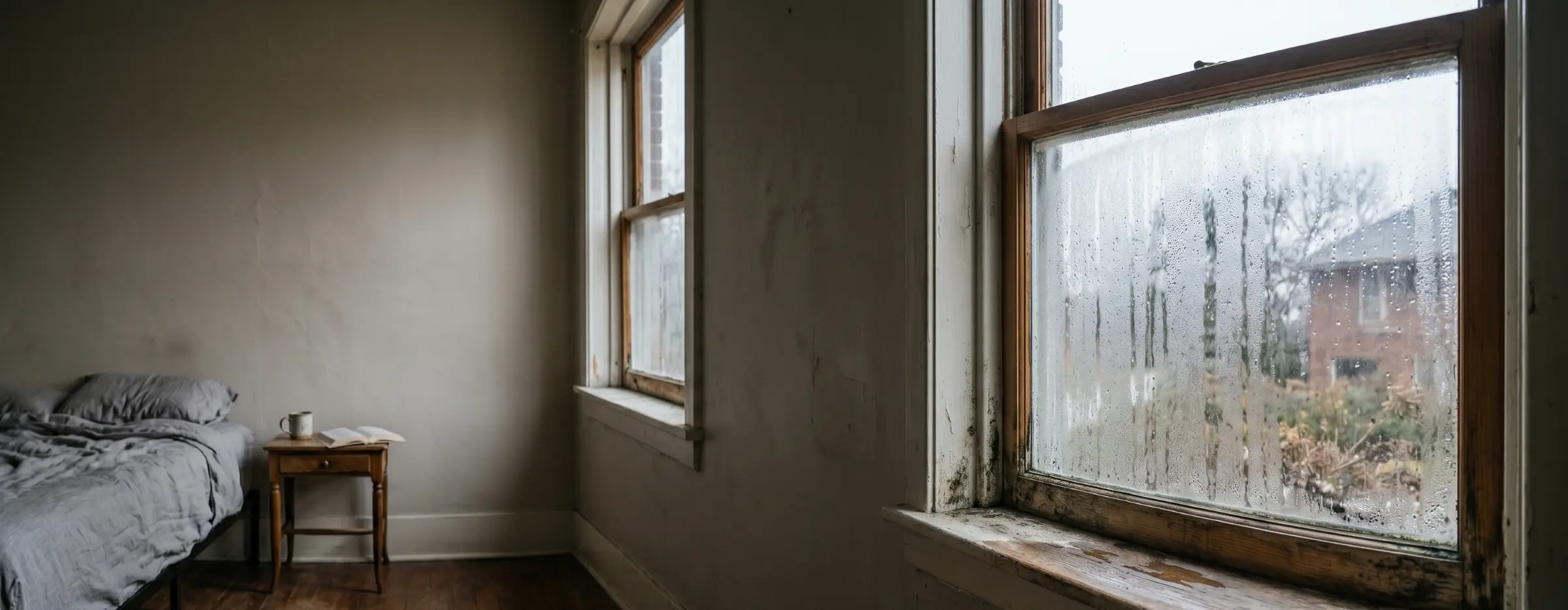

Condensation mold is one of the most frustrating patterns in home mold problems: you clean the spots, and they come back. Usually within weeks. That is because condensation mold is not a cleaning failure. It is a moisture problem disguised as a surface stain, and until the conditions that create condensation are corrected, the cycle will repeat no matter how thoroughly you scrub.
Mold from condensation forms when airborne water vapor deposits as liquid on surfaces colder than the surrounding air's dew point, creating a persistently damp microenvironment where spores germinate and grow. The CDC: Basic Facts About Mold identifies moisture control as the single most effective strategy for preventing indoor mold, and the ANSI/IICRC S520 standard for professional mold remediation treats condensation as a primary moisture source requiring correction before any remediation can succeed. This pattern is most common on single-pane windows, exterior wall corners, cold water pipes, and uninsulated closets.
Key insights
- Condensation, not humidity alone, triggers mold. Mold spores need liquid water to germinate. Relative humidity above 60% increases the odds that cold surfaces will drop below the dew point and produce that water.
- 24–48 hours is all it takes. Per EPA guidance, mold can begin growing on a wet surface within one to two days at typical indoor temperatures. Condensation that dries slowly or daily is enough to sustain growth.
- The coldest points are the highest risk. Window corners, exterior wall bases, and closets on outside-facing walls are consistently colder than the rest of the room. They are the first places condensation forms and the last places to dry.
- Interstitial condensation is harder to see. Moisture can also condense inside wall assemblies where warm indoor air meets a cold structural layer. This produces mold behind drywall without any visible surface wetness.
- Cleaning without fixing humidity accomplishes nothing lasting. Removing visible mold leaves spores in surrounding porous materials. As long as condensation recurs, those spores will germinate again.
- Professional remediation is required once drywall is affected. The EPA 10-square-foot threshold applies. Any condensation mold that has penetrated drywall, expanded beyond a small surface patch, or grown inside an HVAC system requires professional removal per ANSI/IICRC S520.
How condensation causes mold
Condensation forms when warm, humid air contacts a surface that is at or below the dew point temperature, the point at which air becomes fully saturated and water vapor converts to liquid. On a cold window or exterior wall, that liquid sits on an organic substrate (paint, wood, drywall paper, caulk, dust) and provides exactly what mold needs: moisture and a food source.
 Mold establishes on the wood frame and sill, not the glass itself. The porous organic substrate is what mold feeds on, while the condensation on the glass is the moisture source driving growth per ANSI/IICRC S520.
The EPA's Mold Course Chapter 2 describes this sequence directly. Indoor air always contains mold spores. When a surface stays wet for 24–48 hours, germination begins. If condensation forms on that surface daily because the underlying cold-surface problem has not been corrected, the mold colony grows continuously, interrupted only by occasional cleaning. The pattern repeats because the cause, not the symptom, was addressed.
The humidity threshold matters. According to EPA guidance, indoor relative humidity above 60% makes condensation on cold surfaces very likely and mold growth risk high. ASHRAE standard guidance places the interior surface condensation risk in wall assemblies in the same zone: when moisture migrates through an envelope and contacts a surface below the dew point, microbial growth follows. The target range to prevent condensation-driven mold is 30%–50% relative humidity year-round, measurable with a hygrometer available at most hardware stores for $15–$40.
Surface condensation vs. interstitial condensation
Surface condensation and interstitial condensation are two distinct problems that both cause mold, but they require different diagnostic approaches. Surface condensation is visible: water droplets on a window pane, a damp sill after a cold night, fogging on a mirror that never fully dries. It forms on the room-facing side of cold surfaces and is relatively straightforward to identify. The resulting mold is usually visible in corners, along frames, and on adjacent drywall.
Interstitial condensation is hidden. It occurs inside a wall assembly when warm humid air from the interior migrates into the wall cavity through gaps in the vapor barrier and contacts the cold structural sheathing or exterior layer. The dew point is reached inside the wall, moisture deposits on wood framing or the back face of drywall, and mold grows where no one can see it. Common indicators include a persistent musty odor without visible surface mold, unexplained respiratory symptoms that worsen at home, and soft or discolored drywall that shows no surface moisture. A professional moisture meter is typically required to confirm this pattern, and it is one of the reasons the mold inspection process includes probing wall cavities and reading moisture content at multiple depths.
Where condensation mold forms by location
Condensation mold forms at the coldest, least-ventilated surfaces in a home: window sills and frames, exterior wall corners, closets on outside-facing walls, cold water pipes, bathroom ceilings, HVAC supply registers, and uninsulated crawl space floor decking. These locations share two traits: they are colder than the surrounding air and they receive limited airflow that would otherwise dry condensation before mold can establish.
 Steam rising from the shower deposits on the cooler ceiling surface. If the exhaust fan cannot clear moisture within 20–30 minutes after each use, condensation accumulates daily and mold colonies establish within weeks.
The pattern is predictable once you know what drives it. Wherever a surface stays colder than the surrounding air and dries slowly, condensation mold follows, and the same locations produce it in home after home regardless of climate or construction era.
| Location | Primary cause | What to look for | DIY or pro |
|---|---|---|---|
| Window sills and frames | Interior pane colder than dew point of room air | Dark spots in corners, fuzzy growth on sill, staining at frame-drywall joint | DIY if surface only; pro if drywall is affected |
| Exterior wall corners (low) | Thermal bridging reduces corner surface temperature | Discoloration or fuzzy growth in wall-floor junction, often behind furniture | Pro if more than one small patch |
| Closets on exterior walls | Low air circulation + cold wall face | Black spots on back wall, musty smell confined to closet | DIY if surface only; pro if growth is extensive |
| Cold water pipes under sinks | Pipe surface temperature below dew point | Dark streaks on pipe, mold on cabinet floor or back panel | DIY pipe insulation; pro if cabinet materials are affected |
| Bathroom ceiling and upper walls | Steam condensation with poor ventilation | Fuzzy growth near exhaust fan or at ceiling corners | DIY small patches; pro if ceiling drywall is saturated |
| HVAC supply registers | Cold air from register cools surrounding drywall | Halo of dark growth around register on ceiling or wall | Always call a pro; indicates potential duct system involvement |
| Uninsulated crawl space floor decking | Cold subfloor meets humid indoor air from below | Mold on underside of floor joists, visible through crawl space | Always call a pro |
Window condensation mold
Window mold from condensation is the pattern most homeowners notice first. Single-pane windows are the most susceptible because the glass surface temperature tracks closely with outdoor temperature. In a room at 70°F with 55% relative humidity, a window surface at 45°F or below will produce condensation. The water pools in the corners of the frame where drainage is poor and airflow is minimal.
The mold that forms here is usually Cladosporium or Aspergillus, both common in indoor environments, but the risk escalates if condensation migrates into the surrounding drywall. Once the paper facing on drywall stays wet, Stachybotrys chartarum becomes a possibility. Window replacement with insulated, double-pane glass with warm-edge spacers raises the interior surface temperature and is the most effective long-term fix for windows that consistently produce condensation.
Exterior wall and corner mold
Thermal bridging is the structural cause of condensation mold on exterior walls. At wall corners and where framing members contact the exterior sheathing, heat loss is higher and interior surface temperatures drop. Per ASHRAE research on building envelope performance, surfaces experiencing thermal bridging can be several degrees colder than the adjacent wall, enough to cross the dew point when indoor humidity is elevated.
The resulting mold appears in predictable locations: the lower corners of bedrooms and living rooms on exterior walls, behind large furniture where airflow is blocked, and along the wall-floor junction on north-facing walls that receive limited solar warming. Because humidity and mold are directly linked at the surface level, this pattern worsens in winter when outdoor temperatures are coldest and people keep windows closed.
HVAC-related condensation mold
Cold supply air from HVAC registers can cool the adjacent ceiling or wall surface below the dew point, particularly in humid summer conditions. The result is a ring or halo of dark mold growth around the register. This is distinct from mold inside the ductwork itself, which is an HVAC-specific issue requiring separate evaluation, but it signals that the system is producing a condensation zone. If you see signs of mold around registers, check the duct insulation and confirm the system is not introducing unconditioned humid air.
Condensation mold vs. leak mold: how to tell the difference
The key diagnostic difference is location pattern: condensation mold appears at the coldest points of a room (window corners, exterior wall bases, closets on outside walls) regardless of rain or plumbing events, while leak mold tracks the path water traveled from a specific source. Condensation mold requires correcting humidity and cold surfaces. Leak mold requires finding and stopping the structural water entry first. Treating the wrong cause means the mold returns regardless of how thoroughly it was cleaned.
 Condensation mold has no tide line and no directional streaking. It clusters at cold points regardless of rain or plumbing events, while leak mold follows the path water traveled and is almost always accompanied by a stain above it.
Pattern location: Condensation mold appears at predictable cold points: window corners, exterior wall bases, closets against outside walls, and around cold pipes. Leak mold follows the path water traveled, appearing below a ceiling penetration, along a stud cavity from a roof leak, or at the base of a wall where a slab leak wicked up.
Seasonal behavior: Condensation mold is typically worse in winter when surface temperatures drop and indoor humidity is held inside sealed homes. Leak mold often corresponds to rain events, plumbing failures, or the mold after water damage timeline: initial wetting followed by growth within 48 hours.
Surface moisture: Condensation mold surfaces typically feel slightly cool or damp during cold weather but do not show active dripping or wet staining. Leak mold is frequently accompanied by water staining, visible tide lines, or soft drywall that has swelled from saturation.
The simple test: A moisture meter reading above 16% in adjacent wood framing, or above 1% in drywall by weight, indicates active or recent moisture. If the reading is elevated only on the surface and not in the material behind it, condensation is the likely cause. If moisture is elevated several inches into the material, a leak source needs to be ruled out.
Which mold species grow from condensation
The most common mold species found in condensation-driven growth are Cladosporium, Aspergillus, Penicillium, and Alternaria. All four thrive at the moderate moisture levels that condensation provides and grow readily on the organic substrates found in homes: drywall paper, wood, caulk, and accumulated dust. Stachybotrys chartarum can develop when condensation is sustained continuously rather than episodic.
 The circular colony pattern with powdery olive-green spore texture is characteristic of Cladosporium, the most common condensation mold species. Visual identification alone cannot confirm species with certainty; air sampling is required for a definitive result.
Cladosporium is the most common condensation mold in U.S. homes. It grows at relative humidity levels above 55%, tolerates a wide temperature range including cool surfaces, and appears as olive-green to dark brown or black powdery colonies. It is one of the primary triggers for mold allergy symptoms.
Aspergillus and Penicillium (often grouped as Asp/Pen in air sampling reports because they cannot be reliably distinguished visually) are the second most common group. Both grow readily in high-humidity conditions on drywall, wood, and insulation. Several Aspergillus species produce mycotoxins and are of concern for immunocompromised individuals.
Alternaria grows on damp surfaces including window frames, shower surrounds, and bathroom walls. It is a leading outdoor allergen that can establish indoors when condensation provides sufficient moisture.
Stachybotrys chartarum, often called black mold, requires sustained high moisture, typically above 90% relative humidity at the surface, for several weeks. It does not typically establish from intermittent condensation, but black mold removal protocols apply when condensation has kept a surface continuously damp for an extended period without intervention. Per CDC guidance, all indoor molds have the potential to cause health effects regardless of species.
Species identification matters most when choosing whether to clean or replace affected materials and whether to involve a professional. Aspergillus and Stachybotrys are more likely to warrant professional removal than Cladosporium or Alternaria at the same coverage area.
Knowing which species you are dealing with matters because health risk varies by genus, duration of exposure, and the health profile of occupants. Aspergillus and Stachybotrys carry mycotoxin risk that Cladosporium does not, and the health effects of mold are most severe for people with asthma, compromised immune systems, or young children in the household.
Stopping condensation at the source
Stopping condensation mold permanently requires two actions taken together: reducing indoor relative humidity to below 50% using exhaust ventilation and dehumidification, and raising cold surface temperatures above the dew point through insulation, window upgrades, or improved air circulation. Addressing only humidity or only surface temperature typically reduces but does not eliminate the problem.
 Weatherstripping the meeting rail seals the primary cold air infiltration point on a double hung window, raising the surface temperature of the surrounding frame and wall enough to prevent condensation from forming on adjacent drywall and trim.
Lower indoor humidity
The EPA target is indoor relative humidity below 60%, with an ideal range of 30%–50%. Humidity reduction is the primary tool for rooms where cold surfaces cannot easily be warmed. Practical steps:
- Run bathroom exhaust fans during showers and for 20–30 minutes afterward
- Run kitchen range hoods while cooking and for 10 minutes after
- Vent clothes dryers to the outside; never dry laundry on indoor racks or radiators
- Keep interior doors open and run ceiling fans on low to prevent humid air from concentrating near cold surfaces
- Use a dehumidifier in chronically damp spaces such as basements and crawl spaces
Sizing and placing a dehumidifier correctly depends on room square footage, baseline humidity, and whether the space is below grade.
Raise cold surface temperatures
Warming a cold surface above the dew point eliminates condensation at that location. Options include:
- Adding insulation to exterior walls through foam board, spray foam, or batt installation
- Replacing single-pane windows with insulated double-pane glass with warm-edge spacers, which raises interior surface temperature by 10–15°F
- Insulating cold water pipes under sinks and in unconditioned spaces
- Keeping heating registers under windows unblocked so warm air flows across cold glass
- Rearranging furniture to allow air circulation along exterior walls
Cleaning and removing condensation mold
The correct sequence is: fix the moisture source first, then clean the mold. Cleaning before correcting condensation conditions guarantees regrowth.
 Cleaning without fixing the condensation source guarantees regrowth. The EPA recommends detergent and water as the first-line treatment on nonporous surfaces, followed by thorough drying before the window is closed.
Nonporous surfaces (glass, tile, vinyl, painted metal): Wipe with detergent and water, rinse, dry fully. For persistent staining, apply a 3% hydrogen peroxide solution, allow 10 minutes of contact time, wipe, and dry. Bleach at a 1:10 dilution (approximately one cup per gallon) is effective on these surfaces if fully dried afterward, but is not appropriate for porous materials.
Semi-porous surfaces (wood window frames, painted drywall): Detergent and water with thorough drying is the first step. If mold has penetrated the surface, cleaning may not be sufficient. IICRC S520 notes that bleach cannot reach mold hyphae embedded in porous substrates. Sanding may be required for bare wood.
Porous materials (unpainted drywall, ceiling tiles, carpet): Per EPA guidance and ANSI/IICRC S520, porous materials with visible mold growth generally require replacement rather than cleaning. Attempting to clean mold from drywall paper typically spreads rather than removes spores.
Area size and containment: The EPA 10-square-foot threshold governs DIY scope. Patches smaller than 10 square feet on nonporous or semi-porous surfaces in accessible locations can often be addressed by a prepared homeowner. Any area larger than that, growth that extends into the wall cavity, or growth involving HVAC components requires professional remediation.
Regardless of which approach you take, confirm the affected surface is fully dry before closing up the area. Any residual moisture above 16% in adjacent wood framing, confirmed with a moisture meter, indicates the condensation source has not been resolved and regrowth is likely.
Homeowners handling small nonporous patches can follow the DIY mold removal process, which includes PPE requirements, supply costs, and a surface-by-surface cleaning table.
When to call a professional
Call a mold remediation professional when condensation mold covers more than 10 square feet, has penetrated drywall, is growing around HVAC registers, or when any occupant has asthma, a compromised immune system, or respiratory symptoms that worsen at home. The EPA's 10-square-foot threshold is the standard boundary between DIY-appropriate and professionally managed mold work under ANSI/IICRC S520.
 A moisture meter reading of 24.2% is above the 16% threshold where mold growth risk begins per ANSI/IICRC S520, and above the 19% warning level. Both are indicators that surface cleaning alone is insufficient and professional assessment is needed.
Drywall that has been affected shows as soft or discolored material, growth visible at the seams or outlets, or a moisture meter reading elevated in the wall rather than only on the surface. Drywall in this condition cannot be cleaned and must be removed.
HVAC mold has specific protocols. A contractor handling register or duct mold should hold both IICRC AMRT certification and NADCA credentials. A general contractor without those credentials should not be cleaning duct systems.
If the same patch has been cleaned and returned more than once, the condensation source has not been resolved. Recurring mold in the same location is a reliable indicator that the affected material has deeper contamination than surface cleaning reveals.
Professional mold remediation follows a structured sequence: containment, air filtration, material removal, treatment, and clearance testing. For condensation-related jobs, mold remediation cost typically runs $500 to $4,000 for contained surface and drywall work, rising when HVAC systems are involved.
Condensation mold prevention by location
Preventing condensation mold requires two simultaneous actions: reducing indoor humidity to below 50% relative humidity and raising cold surface temperatures above the dew point so condensation cannot form. Exhaust ventilation, insulation upgrades, and a calibrated dehumidifier are the primary tools, applied at the specific location where condensation is occurring.
 45% RH is the midpoint of the EPA's recommended 30% to 50% target range. Setting a dehumidifier to this level keeps indoor air dry enough that most cold surfaces in the home stay above the dew point year-round.
No single action works everywhere. Windows need warmer glass surfaces; bathrooms need faster moisture removal; exterior wall corners need insulation or improved airflow. Matching the right fix to the right location is what makes prevention stick rather than just temporarily reducing symptoms.
| Location | Prevention action | Frequency | What it targets |
|---|---|---|---|
| Windows (all rooms) | Wipe sills dry; keep interior blinds open to allow warm air to reach glass | Daily in winter | Prevents pooling; keeps glass surface warmer |
| Windows (recurring condensation) | Replace single-pane with double-pane insulated glass with warm-edge spacers | One-time upgrade | Raises interior glass temperature by 10–15°F |
| Bathroom | Run exhaust fan during shower and 20–30 min after; verify CFM rating matches room volume | Every use | Removes steam before it can deposit on cold tile or drywall |
| Kitchen | Run range hood while cooking and 10 min after; vent to exterior | Every use | Removes cooking steam that otherwise deposits on cooler surfaces |
| Exterior wall corners | Keep furniture 2–4 inches from exterior walls; run ceiling fan on low to circulate air | Continuously | Prevents stagnant humid air from concentrating near cold corners |
| Exterior wall corners (chronic) | Add continuous insulation or spray foam to cold wall areas; address thermal bridging | One-time improvement | Raises surface temperature above dew point |
| Cold water pipes | Wrap pipes with foam pipe insulation, especially under sinks in unconditioned spaces | One-time installation | Raises pipe surface temperature; eliminates condensation surface |
| Closets on exterior walls | Leave closet door ajar or install louvered door; avoid packing items against exterior wall | Ongoing | Allows warm air circulation to exterior wall face |
| Basement and crawl space | Run a dedicated dehumidifier sized to square footage; seal crawl space vents in humid climates | Year-round, serviced seasonally | Reduces humidity before it rises into living spaces |
| Whole home | Monitor indoor humidity with a hygrometer; target 30%–50% RH | Weekly in winter, monthly in summer | Early warning before condensation conditions develop |
An air purifier for mold can capture airborne spores to reduce the concentration available to germinate, but it does not address condensation itself. It is a supplementary tool, not a solution to the underlying moisture problem.
If the condensation source is a building deficiency rather than occupant behavior, the landlord or building owner is typically responsible for the fix.
Renters dealing with condensation mold caused by insufficient building insulation or a malfunctioning HVAC system have legal recourse under tenant mold rights that vary by state, including habitability standards and landlord repair obligations.
Documenting the problem thoroughly, including photos, written notice to the landlord, and moisture readings, strengthens any legal or insurance claim and creates a record if the situation escalates.
Condensation mold that has been professionally remediated should be confirmed through independent clearance testing. Post-remediation verification documents that spore levels have returned to normal fungal ecology and provides a record for insurance or resale purposes.
Frequently asked questions
Can condensation cause mold?
Yes. Condensation deposits liquid water on cold surfaces, and mold spores can germinate on a wet surface within 24–48 hours at typical indoor temperatures. Persistent condensation is one of the most common causes of recurring indoor mold, particularly on windows, exterior walls, and in low-ventilation spaces.
How do I stop mold from condensation?
Fix the moisture source first. Keep indoor relative humidity between 30% and 50% using exhaust fans and a dehumidifier, improve insulation on cold surfaces such as exterior walls and water pipes, and ventilate high-moisture rooms during and after activities that generate steam. Cleaning alone will not stop recurrence.
Is condensation mold dangerous?
It can be. Condensation most often feeds Cladosporium, Aspergillus, and Penicillium, all of which trigger allergic reactions and respiratory irritation. Sustained condensation on drywall can also support Stachybotrys chartarum if moisture is uncorrected for several weeks. People with asthma, allergies, or compromised immune systems face higher health risk from any indoor mold exposure.
What does condensation mold look like?
Condensation mold typically appears as dark spots or fuzzy patches in corners, along window sills, or at the base of exterior walls. It often has an olive, dark green, or black coloration and produces a musty odor. Early-stage growth may look like smudging or discoloration rather than distinct colonies.
Why does mold keep coming back in the same spot?
Mold returns because the cold surface or high humidity that caused condensation has not been corrected. Cleaning removes visible growth but leaves spores in surrounding porous materials. Until the underlying moisture dynamic is resolved, the cycle repeats.
Can condensation mold spread behind walls?
Yes. When condensation forms on the inner face of an exterior wall or around pipes, the moisture can saturate drywall paper and wood framing. Mold that begins on a visible surface can extend into the wall cavity within weeks if humidity is not corrected.
Should I call a professional for condensation mold?
Yes, if the affected area exceeds 10 square feet, if mold has penetrated drywall, if it is in the HVAC system, or if occupants have respiratory conditions. Small surface patches on nonporous materials such as tile or glass can sometimes be handled as a DIY job, but the moisture source must be corrected first regardless of who does the cleaning.
Sam Hickerson is the founder of RestoreAdvisor and writes consumer guides on mold remediation, water damage restoration, inspection, testing, and home recovery. His work focuses on helping homeowners understand costs, risks, and when to call a professional. He draws on guidance from the EPA, CDC, IICRC, and other authoritative sources to make complex home issues easier to navigate.