
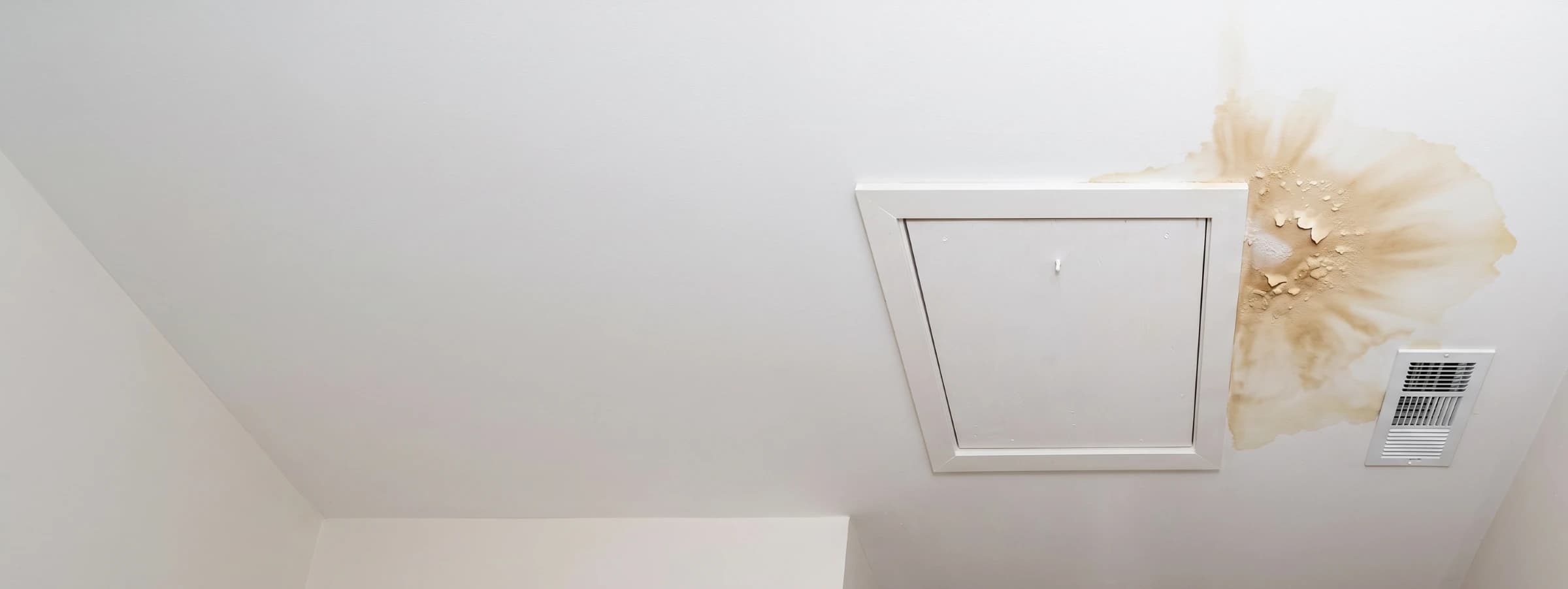

A ceiling stain that spreads below a closet air handler, or a puddle collecting next to the furnace, usually means one thing: the air conditioner's condensate system has failed. Unlike a burst pipe, this kind of damage rarely announces itself all at once. It develops over days or weeks while a drain line slowly clogs or a pan quietly cracks, and by the time it is visible, the water has often been traveling through insulation and drywall for a while already.
HVAC condensation water damage is water intrusion caused by an air conditioning or heat pump system's condensate removal failing, whether from a clogged drain line, a cracked drain pan, or a missing safety switch, and it is classified and restored under the same ANSI/IICRC S500 standard that governs every other cause of water damage restoration. Knowing whether you're actually dealing with condensate, rather than a roof or plumbing leak, changes who you call first and what your insurer is likely to say once you file a claim.
Key insights
- The failure point is almost always the drain line, not the pan. A clogged condensate line, choked with algae and biofilm, causes more HVAC water damage than a cracked pan or a failed switch combined.
- Insurers scrutinize this cause more than most. Because a slow condensate leak can look like a maintenance failure rather than a sudden event, claims for this cause get denied more often than claims for a burst pipe or a water heater failure.
- A float switch is required equipment on many installations. The International Residential Code requires an auxiliary shutoff or secondary drain on units installed in spaces where a leak would cause damage, and its absence is a common reason damage goes undetected for weeks.
- Attic-mounted units cause the costliest damage. Gravity carries water through insulation and ceiling drywall before a stain becomes visible from below, so attic condensate leaks are frequently caught later than closet or basement leaks.
- The water itself is almost always clean. Condensate starts as Category 1 water under IICRC S500, though standing water that sits for days can pick up contamination from dust and debris in the pan.
- HVAC repair and water damage cleanup are two separate jobs. Clearing the line or replacing the pan fixes the source; drying and repairing the ceiling, flooring, or insulation is a distinct scope with its own cost.
Signs of HVAC condensation water damage
The earliest sign is usually a ceiling or wall stain that appears only during the cooling season, directly below or beside where the air handler or ductwork sits. Because the leak is tied to the system running, the timing pattern is often the biggest clue before any visible water shows up.
 A wood platform that has absorbed condensate for weeks develops this kind of dark staining well before a ceiling stain ever becomes visible, since the closet is usually checked far less often than a living space.
None of these signs tends to appear in isolation for long. A musty smell that only shows up when the AC runs is typically the earliest indicator, and by the time a ceiling stain becomes visible, the leak has usually been active for one to several weeks already.
| Sign | What it indicates |
|---|---|
| Ceiling stain below a closet, attic, or second-floor unit | Water is traveling down through insulation and drywall from an unseen source above |
| Musty smell that appears only when the AC runs | Standing water in the pan or line is stagnant and growing biofilm |
| Water pooling next to the furnace or air handler | The primary drain pan or line has already overflowed |
| Warped, soft, or bubbling ceiling paint | Drywall paper has absorbed enough moisture to start losing structural integrity |
| Reduced cooling or ice forming on the refrigerant line | A frozen evaporator coil is about to thaw and overwhelm the drain pan all at once |
| Sagging insulation visible in an attic access panel | Attic insulation has been saturated for long enough to lose loft and begin compressing |
These indicators overlap with the broader set of signs of water damage that apply across every cause, so a stain or smell that doesn't fit the AC-only timing pattern likely points to a different source entirely. A single sign rarely confirms the source on its own, but two or more appearing together, especially a musty smell paired with a stain that only shows up during the cooling season, is a reliable enough pattern to start diagnosing from.
What to do right now
The moment you spot HVAC condensation water damage, shut the system off, protect anyone near standing water from electrical hazards, and get an HVAC technician and a restoration company involved before drying anything. Acting in that order prevents the leak from continuing while you assess the situation.
 Setting the system to off, not just the fan, stops the compressor from producing more condensate while the source of the leak is diagnosed.
Most HVAC condensate leaks stay small and contained, but if water is actively spreading across a floor or dripping steadily rather than just staining, treat it with the same urgency as any emergency water damage restoration situation and skip straight to extraction rather than waiting to see how bad it gets. A steady stain that hasn't grown in size over several days, by contrast, can usually wait for a scheduled HVAC appointment rather than an emergency call.
1. Turn the system off at the thermostat
Switch the thermostat to off, not just the fan, so the compressor stops running and no more condensate is produced while you assess the situation. Leaving the system running on a clogged line or a cracked pan only adds water to whatever has already accumulated.
2. Cut power at the breaker if water is near electrical components
If standing water is touching the air handler's electrical connections or a nearby outlet, shut off power at the breaker before touching anything. Water and electricity together are a shock hazard, and OSHA's guidance on flood response treats this as a first-priority safety step regardless of how the water got there.
3. Contain and remove standing water
Use towels or a wet-dry vacuum to soak up any pooled water on the floor or in a drain pan access area. Getting standing water off flooring and out of a closet quickly limits how far it wicks into baseboards and subflooring.
4. Photograph everything before cleanup begins
Take photos of the stain, the pooled water, and the unit itself before you move anything or start drying. This documentation matters more for this cause than for most others, since insurers will often ask for evidence of how long the condition existed.
5. Call an HVAC technician, and a restoration company if materials are wet
An HVAC technician needs to diagnose and fix the actual source, whether that's a clog, a cracked pan, or a failed switch, before any drying makes sense. If ceiling drywall, flooring, or insulation is wet, bring in a certified restoration company at the same time rather than waiting for the HVAC repair to finish first, and use the printable water damage restoration checklist to keep the extraction and drying steps in order.
What not to do
The first response also creates room for a few mistakes that make the damage or the eventual claim worse, not better. Each of these is a common instinct that works against the actual goal of stopping the leak and preserving evidence for a claim.
Don't restart the system to see if the leak has stopped
A stain that has stopped growing doesn't mean the source is fixed. It often means water found a slower path or a temporary blockage cleared on its own, and running the system again restarts the cycle.
Don't ignore a ceiling stain because it looks dry
A dry-looking stain can still have wet insulation and framing behind it. Surface dryness on paint or drywall is not the same as the material underneath being dry.
Don't patch or paint over the stain before confirming dryness
Painting over a water stain before the area is confirmed dry traps moisture and can restart mold growth within the same 24 to 48 hour window that applies to any other water intrusion.
Don't wait on insurance approval before drying the area
Mitigating damage promptly is generally expected of homeowners regardless of how a claim resolves, and delaying drying to wait for an adjuster typically makes the damage, and the eventual cost, worse.
Is it condensate, or something else?
Confirming the source matters because condensate damage, a roof leak, and a plumbing leak call for different professionals and lead to very different insurance outcomes. The clearest signal is timing: a leak that only appears while the air conditioner is actively cooling, and stops when the system is off, points to condensate rather than any other water source.
 Turning the system off for a full day and rechecking the stain by touch confirms whether it has stopped growing, the simplest way to tell condensate apart from a roof or plumbing leak.
A simple confirmation test settles most cases: turn the system off for a full day. If the drip or stain stops growing within that window, condensate is almost certainly the source, and if the water continues regardless, the cause lies elsewhere.
| Source | Timing pattern | Typical location | What confirms it |
|---|---|---|---|
| Condensate leak | Appears only when AC or heat pump runs; stops when off | Directly below or beside an air handler, closet, or attic unit | Water or staining follows the refrigerant line or drain path, not a roofline or plumbing fixture |
| Roof leak | Appears during or shortly after rain | Along a roofline, chimney, or valley, often on an upper-floor ceiling | Staining tracks with weather events, not system operation |
| Plumbing leak | Constant or intermittent, unrelated to weather or HVAC cycles | Near a supply line, drain, or fixture | Water traces back to a pipe or connection, not an HVAC component |
| Surface condensation mold | Appears at cold points like window sills, exterior wall corners, or around a supply register | Localized, small patches at consistently cold surfaces | No active water source; a halo of growth rather than a spreading stain |
That last row matters on its own. A ring of dark growth around a supply register without any spreading stain or pooled water is usually surface condensation rather than a drainage failure, and the underlying humidity problem behind it needs a different fix than a clogged line or a cracked pan.
Where the water travels
Where an HVAC condensate leak causes the most damage depends entirely on where the unit sits, since gravity determines the path water takes before anyone notices it. An attic-mounted air handler does the most hidden damage because water has the farthest distance to travel through insulation before reaching a visible ceiling surface.
 An attic-mounted air handler has the farthest distance for water to travel before a ceiling stain appears, since insulation absorbs the overflow long before it reaches the drywall below.
The same underlying failure, a clog or a cracked pan, produces very different repair bills depending on which of these paths the water travels. Materials on the receiving end of an attic overflow generally cost far more to open up and replace than a hard floor next to a closet unit, since insulation and drywall rarely dry cleanly enough to save once fully saturated.
| Unit location | Water path | Typical damage |
|---|---|---|
| Attic air handler | Drain pan overflow soaks attic insulation, then saturates ceiling drywall from above | Ceiling stains, sagging drywall, and in prolonged cases, partial ceiling collapse |
| Interior closet air handler | Pan overflow spreads across the closet floor and under the door | Flooring, baseboards, and adjacent wall drywall |
| Basement or garage furnace with cooling coil | Pan or line failure pools on the floor around the unit | Flooring, nearby stored belongings, and wall base if water spreads |
| Uninsulated or poorly sealed ductwork | Cold duct surface sweats where warm humid air contacts it | Localized wall or ceiling staining that traces the duct run rather than a single point |
A properly installed secondary, or auxiliary, drain pan is designed to make this path visible on purpose. Where a unit sits above a finished ceiling, that secondary pan typically drains to a conspicuous spot, often a soffit or an exterior wall, specifically so a homeowner notices the drip before water reaches the primary structure. If you've seen water at a marked secondary drain point, the system did exactly what it was built to do, and a leak caught there is usually far cheaper to fix than one that saturated insulation first. Understanding which water damage category applies also matters here, since condensate water almost always starts as Category 1 clean water regardless of which of these paths it travels.
In a condo, apartment, or any multi-unit building, an attic or closet air handler above shared living space can send condensate damage into the unit below rather than just your own. Your policy generally covers your own unit and belongings, while an HOA master policy typically covers the building's shared structure, and liability for damage to a neighbor's ceiling below is usually determined by the same maintenance evidence that decides sudden-versus-gradual on any other claim. Document your own HVAC service records regardless of who filed first, since that history is what separates a covered mechanical failure from a neglect claim on either side.
What causes HVAC condensate water damage
A clogged condensate drain line, choked with algae and biofilm that build up in the humid, dark interior of the line, is the single most common cause of HVAC condensation water damage. The line's narrow diameter and constant moisture make it an ideal environment for the same slime buildup you'd find in a shaded outdoor drain, and it typically takes months of gradual buildup before a full blockage forces water to back up into the pan and overflow.
 Algae and biofilm narrow the drain line's interior gradually over months, and this buildup, not the drain pan itself, is the single most common point of failure behind a condensate overflow.
Clogged condensate drain line
Algae, dust, and mold accumulate along the interior of the drain line's narrow tubing over months of use, eventually restricting or fully blocking flow so condensate backs up into the pan and overflows.
Cracked or rusted drain pan
Metal pans corrode over years of constant moisture exposure, and plastic pans can crack from age or a technician's misstep during a service visit, both of which let water bypass the intended drain path entirely.
Disconnected or improperly sloped line
A condensate line that was never sloped correctly, or that has come loose at a joint during a service call, allows water to pool in the line itself rather than draining away as intended.
Frozen evaporator coil that thaws
Low refrigerant, a dirty filter restricting airflow, or a failing blower motor can cause the evaporator coil to ice over. When the system shuts off or the ice melts, the sudden volume of water frequently exceeds what the drain pan and line can handle at once.
Missing or failed float switch
A float switch is designed to shut the system down automatically when the primary pan fills, and its absence, or a switch that has failed in the closed position, removes the one safeguard that would have stopped the leak early.
Failed condensate pump
Systems that can't drain by gravity, including many basement furnaces, some attic installs, and most mini-splits, rely on a condensate pump to push water out to a drain point. When the pump's motor fails, its float switch sticks, or its small reservoir clogs with algae, water backs up and overflows the same way a gravity-drain failure does, but often more suddenly, since the reservoir is smaller than a standard drain pan.
Oversized or high-efficiency unit producing excess condensate
An oversized system that short-cycles fails to run long enough per cycle to dehumidify the air adequately, sending more moisture back through the ducts than a correctly sized unit would. Modern high-efficiency systems have larger coils and move air more slowly across them, which pulls more moisture from the air per cycle and puts a correspondingly higher load on the drain line or pump.
Duct insulation failure causing sweating
Ductwork running through an unconditioned attic or crawl space needs adequate insulation to keep its exterior surface above the surrounding air's dew point. When that insulation degrades or was installed too thin, the cold duct surface sweats continuously and drips onto whatever sits below it.
Class matters less here than category, since most condensate scenarios stay confined to a small area rather than spreading across multiple rooms the way a burst pipe or flooding event does. Where the affected area does spread across an attic or closet floor, the same water damage classes used for every other cause still determine drying equipment and timeline.
Knowing whether your system drains by gravity or by pump matters for diagnosis. A gravity-drain system fails gradually as a line clogs over months, while a pump-fed system tends to fail more abruptly, since a dead motor or a stuck float stops drainage outright rather than slowly restricting it. If your air handler sits in a basement or a location with no gravity path to an exterior drain, check for a small pump reservoir near the unit before assuming a clogged line is the cause.
What it costs
HVAC condensation water damage repair typically runs $150 to $800 for the HVAC-side fix and $300 to $15,000 or more for water damage cleanup, with the total driven almost entirely by how long the leak ran before it was caught. A drain line cleared the same day a stain appears costs a fraction of what a saturated attic ceiling caught weeks into a slow leak requires.
 Once insulation and drywall have stayed saturated for more than a few days, replacement rather than drying is usually the faster and more reliable fix, which is what pushes a job into the highest cost tier.
Attic and second-floor jobs typically land at the higher end of any given range, since technicians need to access confined spaces and materials often have to be replaced rather than dried in place once insulation has stayed wet for more than a few days. A closet or basement job caught the same day tends to land at the bottom of each range instead, since a technician can usually dry hard flooring in place without removing any materials at all.
| Scenario | Typical cost | What's included |
|---|---|---|
| Caught early, drain line cleared, no visible damage | $150–$400 | HVAC service call only, no restoration work needed |
| Minor ceiling or floor stain, surface dry | $300–$1,200 | Spot drying, paint or minor drywall touch-up |
| Standing water requiring extraction and drying | $1,500–$4,500 | Extraction, air movers and dehumidification, moisture monitoring |
| Ceiling collapse or extensive drywall and insulation replacement | $5,000–$15,000+ | Demolition, insulation and drywall replacement, repainting, full structural drying |
These figures cover water damage cleanup and repair only. The HVAC-side repair is a separate line item: clearing a clogged drain line typically runs $75 to $200, a float switch installation runs $150 to $350, a full drain pan replacement runs $300 to $800, and evaporator coil replacement after a freeze-and-thaw event runs $600 to $2,000. National averages for water damage restoration cost across all causes provide broader context for these figures.
Discovering a leak while you were away
A condensate leak has the most time to cause damage during exactly the period a homeowner is least likely to catch it: a hot stretch of weather when the system is running constantly and nobody is home to notice a stain or a smell. Coming back from a week away to a soaked ceiling or a warped floor near the air handler is one of the more common ways this cause of water damage gets discovered.
 A sensor placed directly in the drain pan sends an alert the moment water appears there, catching a failure before it has to overflow the pan and reach the floor to be noticed.
A neighbor, house sitter, or property manager checking in periodically can catch a leak days earlier than a completely empty house would. A smart water sensor placed in or beside the drain pan sends a phone alert the moment water appears and closes this gap without requiring anyone to physically check the unit.
Once someone is on site to fix the source and start drying, what to expect during water damage restoration covers the noise, decisions, and day-to-day disruption of the days that follow. That gap between discovery and a crew's arrival is also the window worth using to start the insurance conversation, since an adjuster will often want to see the property before drying equipment changes what the damage looked like on day one.
Does insurance cover HVAC condensation water damage?
Homeowners insurance often does not cover HVAC condensation water damage, because standard policies cover water damage that is sudden and accidental, and insurers frequently classify a slow condensate leak as a gradual, maintenance-related condition instead. A burst pipe fails in an instant with no reasonable way to have caught it sooner; a clogged drain line, by contrast, is the kind of thing an adjuster can argue should have been caught during routine HVAC service.
 A service record showing a cleared drain line and functional system check is the kind of documentation that helps separate a covered mechanical failure from a claim an insurer denies as neglect.
This is the point where this cause differs most from nearly every other cause of water damage. Where insurers weigh entry point, duration, and maintenance history to decide sudden-versus-gradual on any water claim, condensate leaks land on the gradual side of that test more often than any other common cause, since the underlying mechanism, a slowly clogging drain line, is itself a maintenance issue by definition. Per NAIC guidance on homeowners coverage, the sudden-versus-gradual distinction, not the cause itself, is what most policies actually turn on.
Documentation works in your favor here specifically: HVAC service records showing regular maintenance visits, filter changes, and any prior repairs give an adjuster evidence that the failure wasn't neglect, which meaningfully improves the odds of a claim being paid. The sudden-and-accidental standard applied the same way across every cause, along with how to document and file a claim, is explained in full under homeowners insurance and water damage. There is no dedicated endorsement for condensate-specific coverage the way there is for sewer backup, so if your policy excludes gradual damage outright, no add-on exists to close that gap.
Who to call: HVAC technician or water damage company
Call an HVAC technician first to diagnose and correct the actual failure, since drying an area only to have it flood again from an uncleared drain line accomplishes nothing. If ceiling drywall, flooring, or insulation is already wet, bring in a certified restoration company at the same time rather than waiting for the HVAC repair to finish, since drying should begin as soon as possible after the source is controlled.
When selecting the restoration side, confirm the technician holds an IICRC water damage restoration certification, specifically the Water Damage Restoration Technician credential, and that the company can document moisture readings at the start and end of the job. Reviews, licensing verification, and the same red flags that apply to any water damage company also apply here. One added red flag worth watching for: a company willing to start drying before the HVAC side has been diagnosed and fixed is skipping a step that determines whether the drying even holds.
DIY vs. professional
Whether an HVAC condensate leak is DIY-safe comes down to how quickly it was caught and what it touched, not how much water was involved. A puddle wiped up the same day it appeared is a different job than water that has already reached drywall or insulation.
 A reading well above the 15 percent threshold confirms the framing hasn't dried on its own, the point at which drying should shift from a DIY towel-and-fan job to professional equipment.
Any uncertainty about whether a surface is actually dry should be resolved with a moisture meter reading rather than a guess, since materials that look dry on the surface can still hold enough trapped moisture underneath to support mold growth. A reading under 15 percent in wood framing or drywall is generally considered dry, while anything above that calls for continued monitoring or professional drying equipment.
| Factor | DIY-safe | Call a professional |
|---|---|---|
| Response time | Caught same day, water still visible on a hard surface | Discovered days or weeks after it started |
| Location | Small puddle on a hard floor near the unit | Attic, inside a ceiling cavity, or under carpet or padding |
| Materials affected | Hard flooring or tile only | Drywall, insulation, subfloor, or carpet padding |
| Confirmed dryness | You can verify the area is fully dry with a simple test | A moisture meter reads elevated behind or beneath a surface |
A small puddle on tile next to the unit, caught the same day, is reasonable to mop up and dry yourself. Anything that has soaked into drywall, insulation, or subfloor calls for professional drying equipment, since consumer-grade fans and dehumidifiers rarely pull enough air through a wall or ceiling cavity to fully dry it before mold has a chance to establish. The full DIY water damage cleanup process covers tools, safety steps, and the exact point where a DIY job should hand off to a professional.
Preventing HVAC condensation water damage
Preventing HVAC condensation water damage comes down to keeping the drain path clear and catching a failure early, which requires a mix of routine homeowner tasks and scheduled professional service. A twice-yearly HVAC service visit paired with a quarterly line flush catches most failure points before they produce any water damage at all.
 Flushing the line with distilled vinegar every three months during cooling season breaks down the algae and biofilm buildup before it narrows the line enough to cause an overflow.
Install or verify a float safety switch
A float switch shuts the system down automatically before a full drain pan can overflow. The International Residential Code's auxiliary and secondary drain system requirements call for a shutoff device or a secondary drain system on units installed above a finished space, so verifying yours has one, and that it functions, closes the single biggest gap that lets this kind of leak go undetected.
Flush the condensate line every three months during cooling season
Pouring a cup of distilled white vinegar into the drain line access point every few months breaks down the algae and biofilm buildup that causes most clogs before it becomes a full blockage.
Schedule HVAC maintenance twice a year
A spring and fall service visit lets a technician catch a partially clogged line, a corroding pan, or a failing float switch before any of them cause damage, and it produces the maintenance record that matters most if you ever need to document a claim.
Insulate ductwork running through unconditioned spaces
Properly insulated and sealed ductwork keeps the duct's exterior surface above the surrounding air's dew point, which stops the sweating that causes staining along duct runs in an attic or crawl space.
Install a water sensor at the drain pan
A battery-powered leak sensor placed directly in or beside the primary drain pan sends an alert the moment water appears, catching a problem well before it reaches the float switch's shutoff threshold.
Confirm proper drain line slope during any system replacement
A condensate line needs a consistent downward slope, typically a minimum of one eighth of an inch per foot, to drain by gravity. Confirming this with your installer during any new system installation prevents the standing-water conditions that lead to both clogs and overflow.
Full water damage prevention covers the year-round system beyond HVAC alone, including plumbing, appliances, and drainage, for anyone building a complete prevention routine rather than addressing one system at a time. Homes with more than one water-using system tend to fare best when every check runs on the same seasonal schedule rather than being handled as separate, unrelated tasks.
Frequently asked questions
Is HVAC condensate water dangerous?
No, HVAC condensate itself is clean water under IICRC S500's Category 1 classification. Water that sits stagnant in a pan or line for an extended period can pick up dust and debris, and any standing water left undried for more than 24 to 48 hours creates conditions where mold can begin growing, per EPA guidance.
Will homeowners insurance cover a clogged condensate line?
Usually not. A clogged drain line is typically classified as a gradual, maintenance-related condition rather than a sudden and accidental event, which is the standard most homeowners policies require for coverage. Documented HVAC maintenance history improves the odds of a claim being approved but does not guarantee it.
Why does my ceiling only leak when the air conditioner is running?
That timing pattern is the clearest sign of a condensate issue rather than a roof or plumbing leak. Condensate is only produced while the compressor is actively cooling, so a leak tied entirely to system operation, and that stops when the unit shuts off, points directly to the drain pan or line.
Can I keep running the AC if I just empty the drain pan myself?
No. Emptying the pan addresses the symptom, not the clog or crack causing it, and the pan will refill and overflow again on the next cooling cycle. The system should stay off until an HVAC technician identifies and corrects the actual failure point.
How is this different from mold I'm seeing around a vent?
A spreading water stain or standing water points to a drainage failure rather than surface condensation. A ring of dark growth confined to a register face with no active water source is usually surface condensation mold, which mold from condensation covers in full, including why it keeps returning if the underlying humidity isn't addressed.
How much does it cost to clear a clogged condensate line?
A standard drain line clearing by an HVAC technician typically costs $75 to $200. If the clog has already caused an overflow, that cost is separate from any water damage cleanup needed for the affected ceiling, flooring, or insulation, and if a contractor quotes a per-square-foot rate rather than a flat number, water damage restoration cost per square foot covers what a reasonable rate looks like for a job this size.
Do I need a restoration company for a small ceiling stain?
Not always. A small, surface-level stain on paint or drywall that dries out completely within a day or two, confirmed with a simple touch test, may not need professional intervention. Any stain on a ceiling below an attic unit, or one that doesn't dry within that window, warrants a moisture reading before you assume it's resolved.
Does my house need a secondary drain pan by code?
In most jurisdictions, yes, for air handlers installed in an attic, above a finished ceiling, or in any location where a leak would cause damage below. The requirement, and the specific auxiliary shutoff or overflow protection method used, varies by local adoption of the International Residential Code, so confirming with your HVAC installer or a local permit office gives you the exact rule for your area.
Could mold already be growing inside my HVAC system itself?
It's possible, particularly if the condensate issue has been ongoing for a while. Coverage of mold in HVAC systems explains how to recognize signs of internal contamination, when ductwork must be replaced rather than cleaned, and what that separate remediation process involves.
Sam Hickerson is the founder of RestoreAdvisor and writes consumer guides on mold remediation, water damage restoration, inspection, testing, and home recovery. His work focuses on helping homeowners understand costs, risks, and when to call a professional. He draws on guidance from the EPA, CDC, IICRC, and other authoritative sources to make complex home issues easier to navigate.