

A contractor or an insurance adjuster just quoted a price per square foot, and you want to know whether that number is reasonable before you sign anything or accept a settlement. Water damage restoration costs $3 to $7.50 per square foot for mitigation work under ANSI/IICRC S500 pricing conventions, and $20 to $37 per square foot when repairs and reconstruction are included. Which end of each range applies to your situation depends on the water category, the damage class, and which materials need to be replaced rather than dried in place.
Key insights
- Mitigation runs $3 to $7.50 per square foot. Clean water sits at the low end and contaminated water pushes toward the high end or above it.
- Repairs run $20 to $37 per square foot. This covers rebuilding what mitigation could not save, priced separately from extraction and drying.
- Hardwood costs the most to replace per square foot. Among common materials, hardwood flooring runs $7 to $25 per square foot, well above drywall or carpet.
- Larger jobs often cost less per square foot. Equipment setup is close to a fixed cost, so it gets spread thinner as the affected area grows.
- Category affects the rate more than class does. Contamination level moves the mitigation number; drying difficulty mostly moves the timeline and equipment count.
- A rate alone does not set your total cost. The affected square footage, measured correctly, is the other half of the equation.
What does water damage restoration cost per square foot?
Water damage restoration costs $3 to $7.50 per square foot for mitigation, the extraction and drying phase, and $20 to $37 per square foot once repairs and reconstruction are added. These figures follow IICRC S500's category-based pricing structure, where the contamination level of the water sets the baseline rate before class, materials, and region adjust it further.
 IICRC S500 calls for the water category and damage class to be confirmed before an estimate is finalized, since either number changes the per square foot rate applied.
The two numbers describe different work. Mitigation is what stops the loss from getting worse: pulling standing water, positioning air movers and dehumidifiers, and confirming materials have dried to a safe moisture content. Repair is what rebuilds the materials mitigation could not save, drywall, flooring, trim, and paint. A job that only needs mitigation might total $1,500 for a small bathroom leak, while the same square footage with a full teardown and rebuild can run several times higher once the repair rate applies.
These two rates sit within the broader scope of water damage restoration, which spans everything from the first emergency call through the final repair invoice. Knowing which phase a quote covers is what makes a per square foot number useful rather than confusing.
Cost per square foot by water category
Category, the contamination level of the water under IICRC S500, is the single biggest driver of the per square foot mitigation rate. Category 1 clean water mitigates at $3 to $4 per square foot, Category 2 gray water runs $4 to $6.50 per square foot, and Category 3 black water reaches $7 to $7.50 per square foot or higher once full PPE under OSHA's Bloodborne Pathogens Standard, containment, and disposal are factored in.
 IICRC S500 assigns category based on the water's contamination source, not its visible clarity, so a clear looking leak from a line near a sewage stack can still be priced as Category 2 or 3.
A single loss can carry more than one category if it reaches a second contamination source partway through. A supply line leak that starts clean but sits long enough to reach a floor drain or an area holding existing sewage residue gets rerated once that contact is confirmed, and the per square foot rate on the newly affected footage shifts with it.
| Category | Per sq ft (mitigation) | Why the rate is higher |
|---|---|---|
| Category 1 (clean) | $3–$4 | Minimal PPE, standard drying, no disposal of porous materials required |
| Category 2 (gray) | $4–$6.50 | Antimicrobial treatment, some porous material removal |
| Category 3 (black) | $7–$7.50+ | Full PPE, containment, and mandatory disposal of contacted porous materials |
An unknown-source loss, one where the origin cannot be confirmed on arrival, is typically priced and treated at Category 2 or 3 until testing says otherwise, since underestimating water damage categories costs more to correct later than pricing conservatively from the start. A contractor who writes "category unknown, priced as Category 2 pending test results" on the estimate is following that convention correctly, not padding the quote.
Cost per square foot by damage class
Damage class, the drying difficulty rating under IICRC S500, changes the equipment count and monitoring days on a job more than it changes the mitigation rate itself. A Class 1 loss with minimal absorption might need a single air mover for two or three days, while a Class 4 loss with deep saturation in low-porosity materials can need specialty drying equipment running for over a week. A rate rarely changes when a job is reclassified from a lower class to a higher one after work begins; what changes is the number of days that rate applies, since additional equipment and monitoring visits extend the billing period rather than the price per square foot itself.
| Class | Absorption | Typical equipment | Effect on cost |
|---|---|---|---|
| Class 1 | Under 5% | 1 air mover, standard dehumidifier | Baseline rate applies |
| Class 2 | 5%–40% | 2–4 air movers, LGR dehumidifier | Modest increase from added runtime |
| Class 3 | Over 40% | Full room saturation setup, ceiling included | Noticeable increase from equipment density |
| Class 4 | Deep, low-porosity materials | Specialty low-grain-refrigerant units, extended monitoring | Can exceed the typical mitigation range |
This is why water damage classes matter to your total bill even when the quoted per square foot rate looks identical to a lower-class job elsewhere. The rate on the estimate might match, but the number of days that rate gets billed will not.
Mitigation vs. repair cost per square foot
Mitigation ($3 to $7.50 per square foot) and repair ($20 to $37 per square foot) are priced on separate scales because they're different services, often handled by different crews at different points in the same job. The mitigation rate applies the moment extraction begins, while the repair rate isn't finalized until the scope of what needs replacing is confirmed, sometimes days or weeks later once drying is complete.
 The stack of removed, water-stained drywall in the foreground marks where mitigation ended and repair, billed at a separate per square foot rate, begins.
Confusing the two ranges is the most common reason a homeowner thinks they were overcharged. A $7 per square foot quote for a Category 3 loss is reasonable for mitigation alone. The same $7 per square foot number would be far too low if it were meant to cover full drywall and flooring reconstruction, since that work runs closer to $20 or more. Separate authorization for each phase is built into the water damage restoration process itself, and your estimate should reflect that same separation rather than blending mitigation and repair into one figure.
Not every job needs both. A Category 1 leak caught within hours might only need mitigation, no repair line at all, because nothing had to be torn out. A slow leak discovered after weeks behind a wall usually needs both phases, since the materials themselves failed before anyone knew water was present.
Cost per square foot by material
Material replacement costs vary far more than the flat $20 to $37 per square foot repair range suggests once you break it down by what actually needs to come out. Hardwood flooring costs the most to replace, $7 to $25 per square foot, while drywall costs the least among common materials at $1.50 to $3.50 per square foot.
 Hardwood costs more per square foot to replace than any other common material because species, finish, and whether the boards can be salvaged all affect the price, not just the square footage removed.
Not every affected material gets replaced. Category 1 water often allows drywall and subfloor to be dried and cleaned in place rather than removed, and cleaning costs a fraction of the replacement rate per square foot. An estimate should state which method applies to each material rather than pricing everything at the replacement rate by default.
| Material | Cost per sq ft | Notes |
|---|---|---|
| Drywall | $1.50–$3.50 | Includes tape, mud, texture match, and paint |
| Carpet and padding | $2–$8 | Padding is discarded regardless of category; carpet is sometimes salvageable at Category 1 |
| Plaster | $2–$10 | Repair cost varies with age and decorative finish |
| Subfloor | $3–$6 | Priced per the area actually opened, not the full room |
| Hardwood | $7–$25 | Wide range driven by species, finish, and whether refinishing can save the existing boards |
A quote that lists a single blanket per square foot figure for repairs, without naming which materials it covers, leaves you unable to check whether it matches the actual scope. Ask for the material breakdown before comparing two estimates against each other.
How to calculate your total cost using square footage
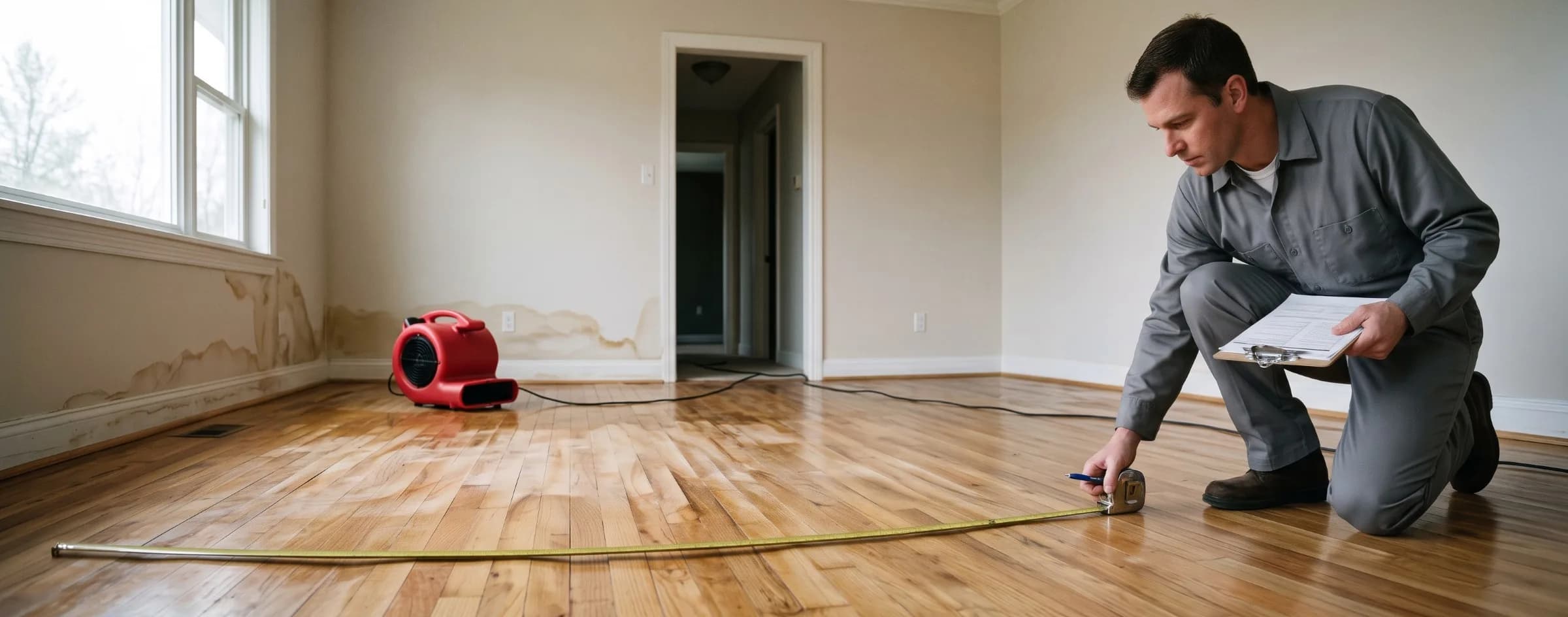
Multiply the affected square footage by the applicable per square foot rate, then add the two phases together if both apply. Measure the actual affected area, not the total room size, since a leak that only reached one corner of a 200 square foot room should be priced against the wet footprint, not the whole room. A few worked examples show how this plays out in practice, with repair applied only to the portion that needed reconstruction rather than the full mitigated area.
| Scenario | Sq ft | Category | Mitigation | Repair | Total |
|---|---|---|---|---|---|
| Bathroom supply line leak, mitigation only | 150 | 1 (clean) | $450–$1,125 | N/A | $450–$1,125 |
| Basement sump failure, mitigation plus repair on 250 sq ft | 400 | 2 (gray) | $1,600–$2,600 | $5,000–$8,750 | $6,600–$11,350 |
| Main floor sewage backup, mitigation plus repair on 600 sq ft | 1,200 | 3 (black) | $8,400–$9,000 | $12,000–$22,200 | $20,400–$31,200 |
These figures assume the square footage was measured after the category and class were confirmed, not before. A contractor who quotes a total price before assessing the source and testing the water is estimating, not pricing, and a technician from a properly vetted water damage restoration company should be able to explain which number changed once that assessment is complete.
Drywall removal is measured differently from the rest of the square footage on your estimate, which is where most math confusion happens. A flood cut, the strip of wet drywall removed along a wall, is billed by linear foot of wall (typically a 2-foot or 4-foot cut height under IICRC S500 flood-cut conventions) rather than by square foot of drywall surface. A quote listing "40 linear feet of flood cut" alongside a per square foot rate for flooring is using two different units correctly, not double-billing, and comparing the two directly will make the numbers look mismatched when they aren't.
How square footage is measured on multi-floor losses
A leak that travels from an upper floor down into the ceiling below is measured as two separate square footage totals, not one combined figure. The upper floor's affected flooring and subfloor area is counted on its own, and the ceiling below is counted separately, since it is a distinct surface with its own material and labor cost.
 A leak that reaches 150 square feet of flooring above and 200 square feet of ceiling below bills against 350 total square feet, since the two surfaces are counted separately.
Ceiling removal is also billed differently than a wall flood cut. Gravity spreads moisture across the entire ceiling panel rather than in a straight line, so ceiling drywall is typically removed in full sheets and billed by square foot of ceiling area rather than by linear foot the way a wall cut is. A single leak affecting a 200 square foot ceiling below and a 150 square foot section of flooring above bills against 350 total square feet on the estimate, even though one leak caused both. A quote that lists only one of the two areas is missing half the job.
What affects the price per square foot
Response time, region, job size, and hidden moisture are the main factors that move the price per square foot beyond category and class. Response time is one of the largest: a delayed call gives water more time to spread and saturate additional materials, and the EPA notes mold can begin growing within 24 to 48 hours of a water event, which raises both the affected square footage and the category if mitigation doesn't start quickly.
Job size works in the opposite direction from what many homeowners expect: because mobilization, setup, and the first pieces of equipment are close to fixed costs, a 2,000 square foot loss often prices lower per square foot than a 150 square foot one, even at the same category and class. Region moves the baseline rate by market, sometimes enough to shift a job into a different pricing tier than category alone would suggest, broken out in full below.
Hidden moisture is the factor most likely to change a quote after work has started. Visible signs of water damage at the first walkthrough, a stain, a soft spot, a musty smell, often understate the actual affected square footage once walls are opened, since moisture travels sideways through wall cavities well beyond the point where it entered.
Cost per square foot by region
Regional labor, disposal, and permitting costs shift the mitigation rate by a dollar or more per square foot between markets, even at the same category and class. High-cost metro areas commonly see $5 to $7.50 per square foot for Category 1 or 2 mitigation, the upper half of the national range applied to jobs that would sit at $3 to $4 per square foot elsewhere.
| Region | Per sq ft (Cat 1–2) | Why |
|---|---|---|
| West Coast | $5–$7.50 | High labor costs and stricter disposal and environmental compliance requirements |
| Northeast | $5–$7.50 | High labor costs and older housing stock that often needs more extensive drywall and plaster work |
| Midwest | $3–$4.50 | Lower labor costs and more restoration companies competing for the same jobs |
| South and Southeast | $3–$4.50 | Lower baseline labor costs, though hurricane and storm season demand can push rates temporarily higher |
| Rural and low-density areas | $3–$4, plus a possible response surcharge | Lower labor costs offset by fewer local companies and longer drive times to reach the job |
A quote well above or below its regional tier for a comparable category and class is worth questioning specifically on that basis, since region explains a real gap in price that category and class alone would not. Storm season demand in hurricane-prone regions also stretches how long water damage restoration takes to begin, so a higher regional rate during those months often comes paired with a longer wait rather than one or the other.
National average cost vs. per square foot pricing
A per square foot rate and a national average total cost answer two different questions, and neither one substitutes for the other. The national average cost of water damage restoration sits between $1,500 and $7,000 for a typical job, a figure built from combining a per square foot rate with a typical affected area, not a separate pricing method.
Use the per square foot rate to check math on your specific square footage once it's measured, and use the national average as a sanity check on whether your total quote falls within a normal range for a job of similar scope. A quote that is far outside the national average with square footage and category that look ordinary is worth a second estimate before you sign.
If the loss involved a policy claim, review how insurance coverage for water damage interacts with per square foot pricing, since insurers commonly estimate with their own software, most often Xactimate, rather than accepting a contractor's per square foot rate directly. A settlement built from Xactimate's line-item total can land several hundred dollars away from a contractor's per square foot quote without either figure being wrong.
How to verify a per square foot estimate
Ask for three things before treating a per square foot quote as final: the measured square footage, the category and class it's based on, and whether the rate covers mitigation, repair, or both. An estimate missing any of these three is incomplete, regardless of how professional the paperwork looks.
 A wall with no visible staining can still read wet behind the surface, which is why a category or class assigned without a moisture reading to back it up is an assumption, not a documented determination.
Confirm the technician measured the affected area rather than estimating it by eye, and ask what moisture readings support the category and class assigned, since those two numbers set the rate you're being asked to pay. A technician holding WRT or ASD, credentials detailed under water damage restoration certifications, has been trained specifically to produce this kind of documentation, and a company that can't produce moisture logs to back up its numbers is one worth a second opinion on.
A flat rate with no category or class attached is the clearest red flag on a per square foot quote. A number like "$5 per square foot, all-in" with no mention of contamination level or drying difficulty usually means the figure came from a generic rate sheet rather than an actual moisture reading and source inspection, and it's as likely to be wrong on the low side as the high side.
If you're still comparing companies at this stage, the full list of questions to ask a water damage restoration company includes what to ask about licensing, insurance, and scope before the crew ever measures a single square foot. Getting those answers before the walkthrough means the per square foot rate that follows is anchored to a company you've already vetted, rather than the other way around.
Frequently asked questions
Is water damage restoration priced per square foot or as a flat fee?
Most companies price mitigation per square foot and price repairs either per square foot by material or as a lump sum after the scope is finalized. A written estimate should separate the two rather than quoting one blended number.
What is a fair price per square foot for water damage restoration?
Three to seven dollars and fifty cents per square foot is a fair mitigation rate for most Category 1 and 2 losses. A quote well outside that range for a comparable category and class is worth a second opinion before you sign.
Does a bigger affected area cost more per square foot or less?
Less, in most cases. Equipment mobilization, setup, and the first air mover or dehumidifier are largely fixed costs, so spreading them across more square footage lowers the per square foot rate on larger jobs.
Why do two contractors quote different prices per square foot for the same room?
Different category or class determinations are the most common reason. A contractor who tests the water source and finds contamination will quote a Category 2 or 3 rate, while one who assumes Category 1 without testing will quote lower, sometimes incorrectly.
Does the per square foot rate include mold remediation?
No. Mitigation pricing covers extraction and drying only. If mold has already developed, that work is quoted and billed separately from the water damage mitigation rate.
Is drywall or flooring more expensive to replace per square foot?
Flooring, in most cases. Hardwood replacement runs $7 to $25 per square foot depending on the species and finish, while drywall replacement runs $1.50 to $3.50 per square foot including tape, mud, and paint.
Should I pay for water damage restoration by square footage or get one total price?
Ask for both. A per square foot rate lets you verify the math yourself once the affected area is measured, while the total price is what you actually owe, and the two numbers should match when multiplied out.
Does insurance pay the per square foot rate or a different amount?
Usually a different amount. Insurers typically use their own estimating software, most often Xactimate, which prices by line item and material rather than a single blended per square foot figure, so a contractor's quote and an insurer's line-item total can differ even when both describe the same job.
Sam Hickerson is the founder of RestoreAdvisor and writes consumer guides on mold remediation, water damage restoration, inspection, testing, and home recovery. His work focuses on helping homeowners understand costs, risks, and when to call a professional. He draws on guidance from the EPA, CDC, IICRC, and other authoritative sources to make complex home issues easier to navigate.