
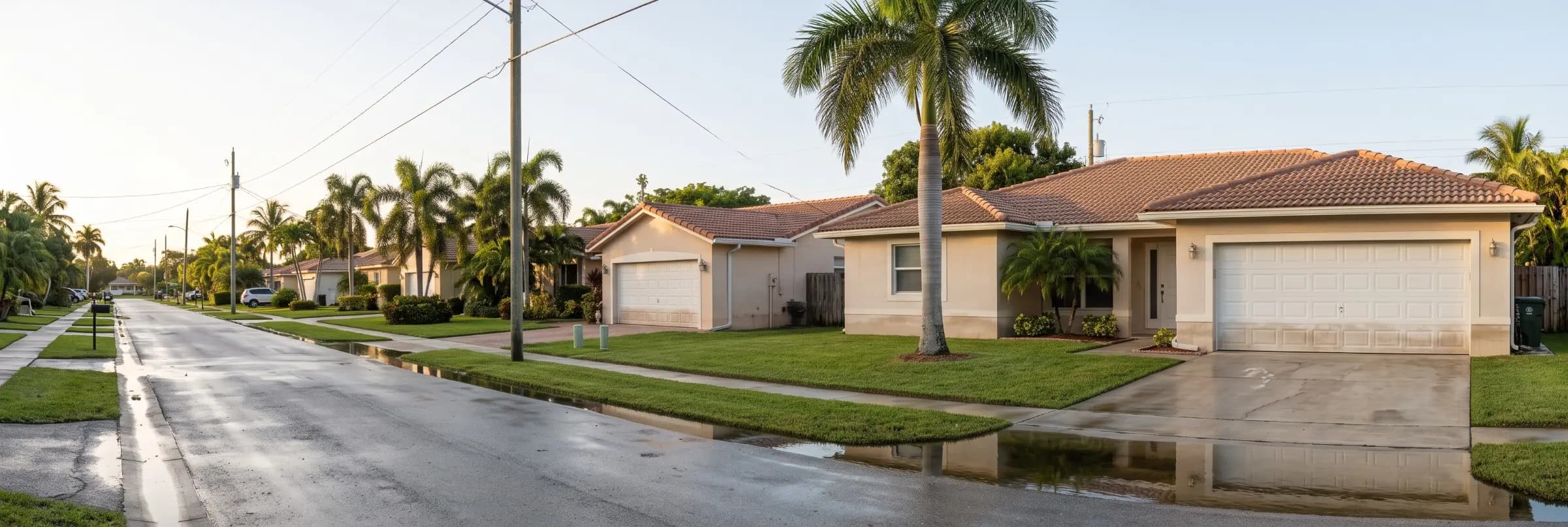

Finding mold in a Fort Lauderdale home is stressful, but what to do next comes down to four steps: stop the moisture, document it, confirm the contractor's Florida license, and compare bids for mold remediation against local prices. Single room jobs typically cost $1,500–$4,500, and a license check on the state's website is quick, so you can vet a contractor before agreeing to anything.
Mold remediation is the process of containing, removing, and cleaning mold-contaminated materials and correcting the moisture source, performed to the ANSI/IICRC S520 standard and, in Florida, by a contractor licensed as a mold remediator by the Department of Business and Professional Regulation (DBPR). As the CDC explains, mold grows wherever moisture lingers, so the work is complete only when the water source is fixed.
Fort Lauderdale recorded 25.91 inches of rain in 24 hours on April 12, 2023, which the National Weather Service classified as a 1-in-1,000-year storm. The EPA says to dry water-damaged areas and items within 24 to 48 hours to prevent mold growth. Water also arrives here through king tides, clogged air conditioner drains, and storm-damaged roofs, and each source leads to a different repair and a different insurance answer.
Key insights
- Typical cost. Mold remediation in Fort Lauderdale typically costs $1,500–$4,500 for a single room and $8,000–$25,000 or more for a flooded first floor with Category 3 water.
- Florida license rule. Florida requires a DBPR license for mold work on areas larger than 10 square feet, and under Florida Statute 468.8419 the company that assesses a property generally cannot remediate it for 12 months.
- Drying window. The EPA says to dry water-damaged areas and items within 24 to 48 hours, and warns that mold can grow on materials that stay wet for more than 24 hours.
- Record rainfall. Fort Lauderdale received 25.91 inches of rain in 24 hours on April 12, 2023, and homes repaired without confirmed drying can still hold hidden mold.
- Tidal flooding. King tides flood low streets and yards in September, October, and November, and canal water that enters a home is treated as contaminated.
- Insurance limits. Many Florida homeowners policies cap mold payouts at $10,000 or less and exclude flood, so mold from rising water usually requires a separate flood policy.
Why mold thrives in Fort Lauderdale
Mold thrives in Fort Lauderdale because warm temperatures, about 62 inches of annual rain according to National Weather Service Miami climate data, tidal flooding, and an air conditioning season that runs most of the year keep building materials damp. Mold needs only moisture and an organic food source such as drywall paper, wood, or dust, and the EPA warns it can grow on materials left wet for more than 24 hours.
 Water collecting in the auxiliary pan usually means the primary condensate drain is clogged or the coil is leaking. Clear the line and dry the area within the EPA's 24 to 48 hour window to prevent mold growth.
Property data puts the median Fort Lauderdale home at around 1969, which means original window seals, roof flashing, and supply lines are often decades old. Concrete block and stucco walls common in South Florida also wick ground moisture upward and admit wind-driven rain through hairline cracks.
| Driver | How it adds moisture | Where it shows up |
|---|---|---|
| Heavy rain and slow drainage | Short bursts of rain can exceed what street drains handle | Garages, slab level walls, flooring |
| King tides and canals | Tidal canals and waterways run through many neighborhoods, and the city's highest tides arrive in September through November | Yards, door thresholds, ground floor rooms |
| High groundwater | After heavy rain the water table rises, which the city says raises the chance of localized flooding | Damp slabs, buckled flooring, floor level odor |
| Air conditioning load | Cooling runs most of the year, creating condensate and cold surfaces that sweat in humid air | Air handler closets, ceilings, supply vents |
| Aging building envelope | Window seals, roof flashing, and supply lines installed decades ago fail gradually | Window frames, ceiling stains, wall cavities |
A clogged condensate drain sends water into the air handler closet and ceiling, and cold ducts in a humid attic sweat onto insulation, so mold in HVAC systems is one of the most common non-flood sources locally. Catching a slow drip early matters because the same line that drips today can saturate drywall within days.
Flood and king tide risk by area
Flood and king tide risk in Fort Lauderdale concentrates in the low neighborhoods named in the city's Fortify Lauderdale stormwater program, including Edgewood, River Oaks, Melrose Park, Victoria Park, and Southeast Isles. Homes in these areas can take on water from heavy rain, from tidal canals, or from both, and the water source determines how the cleanup is classified.
 Brackish tidal water is treated as contaminated, so wet drywall, insulation, carpet and padding it reaches should be cut out and discarded, not just dried. The City of Fort Lauderdale says NOAA predicts king tides on at least 40 days in 2026.
The April 12, 2023 storm put 25.91 inches of rain on the city in 24 hours. City officials estimated that about 700 buildings sustained major damage, including 279 homes in Edgewood alone, and the mayor said many affected residents had no flood insurance. King tides add a second pathway, because the City of Fort Lauderdale reports that NOAA predicts king tides on at least 40 days in 2026, enough to flood streets and yards without rain in areas such as Victoria Park and Southeast Isles. Brackish canal water leaves salt residue and silt in drywall and flooring, and those materials stay damp longer than they feel, which is why mold often appears days after a tide has receded.
| Neighborhoods | Why water gets in | First places to inspect |
|---|---|---|
| Edgewood and River Oaks | Low ground that receives runoff from the airport and the I-595 corridor, and the site of the heaviest 2023 damage | Lower walls, cabinet bases, and flooring replaced after 2023 |
| Melrose Park, Melrose Manors, and Riverland | Repeated street and yard flooding in heavy downpours, with Melrose Park ranked first among the city's second phase drainage projects | Garages, laundry rooms, and baseboards |
| Victoria Park, Southeast Isles, and Middle River Terrace | King tide flooding that reaches streets and yards without rain | Door thresholds, garage floors, and landscaping beds against exterior walls |
| Sailboat Bend and Riverside Park | Older neighborhoods near downtown that flooded in 2023 and are slated for drainage upgrades | Floor level drywall and under sink cabinets |
| Dorsey-Riverbend, Durrs, and Progresso Village | First phase stormwater targets with historic housing | Window frames, attic access, and lower walls |
| Downtown and beach high rises | Shared plumbing stacks, roofs, and exterior wall seals | Ceiling stains and shared wall dampness |
First 24 to 48 hours after flooding
Dry or remove wet materials within 24 to 48 hours of water entering a Fort Lauderdale home, because the EPA's mold and moisture publication sets that window and EPA: Flood Cleanup to Protect Indoor Air and Your Health warns that mold can grow on wood, drywall, carpet, and furniture left wet for more than 24 hours. Safety comes first, then documentation, then removal of wet porous materials, and then mechanical drying.
 Wet drywall can wick moisture well above the visible waterline, so readings should be taken higher on the wall than the stain. The EPA says wet materials need to be dried within 24 to 48 hours to prevent mold growth.
Because flood and canal water are classified as Category 3 under IICRC S500, wet drywall, insulation, and carpet are discarded instead of dried, and the structural drying that follows is the core of flood water damage restoration. Rain that enters through a damaged roof is treated differently, but the same 24 to 48 hour clock applies.
1. Keep power off and protect yourself
Stay out until electricity to the flooded areas is shut off at the main breaker, and have an electrician check any outlet or panel that water reached. Wear waterproof boots, gloves, and an N95 respirator, because flood and canal water can carry sewage and bacteria.
2. Stop the water source
Close the main water valve if a supply line or fixture failed, and wait for tide or rain water outside to recede before pumping out. If the source is a roof opening, cover it with a tarp so more rain does not enter.
3. Photograph everything before moving it
Take dated photos and video of waterlines, damaged materials, and belongings, and note the time water entered. Insurance adjusters and federal assistance applications ask for this record, as Broward County residents found after the 2023 disaster declaration.
4. Remove wet porous materials
Carpet, pad, insulation, and drywall that stayed wet beyond 24 to 48 hours should come out, with drywall cut at least 12 inches above the highest waterline. Bag the debris, and keep photos or a small sample of flooring for the adjuster before disposal.
5. Dry the structure with equipment
Run dehumidifiers and air movers, and confirm drying with a moisture meter instead of by touch. IICRC S520 verification treats framing near 16% moisture content as dry, so walls should stay open until readings reach that range.
6. Bring in licensed professionals
Hire a licensed mold remediator when the affected area exceeds 10 square feet or flood water was involved, and request the written protocol before demolition starts. If mold is visible and the cause is unclear, a licensed assessor should write that protocol first.
A licensed company offering emergency mold removal can start extraction and drying while the structure is still wet. That early work keeps a drying job from turning into a full remediation.
Mold remediation cost in Fort Lauderdale
Mold remediation in Fort Lauderdale typically costs $1,500–$4,500 for a single room, $3,500–$9,000 for multiple rooms or opened wall cavities, and $8,000–$25,000 or more for a flooded first floor with Category 3 water. Final bids depend on the affected area, how much drywall and flooring must be removed, containment needs, and how long drying equipment runs.
 Containment and air scrubbing are a main reason remediation cost rises with the size of the affected area, since each sealed zone needs setup, equipment time and teardown. Ask for an estimate that itemizes containment and equipment days.
Contractors usually price by affected area, and national mold remediation costs run about $10–$25 per square foot before minimum charges, demolition, and rebuilding are added. Minimum charges matter on small jobs because setting up containment and air filtration costs the same whether the patch is 8 square feet or 80.
| Job type | Cost | Why it lands there |
|---|---|---|
| Small contained area under 10 sq ft | $400–$1,000 | Professional minimum charge covers setup and containment |
| Single room, 10–100 sq ft | $1,500–$4,500 | Drywall removal, HEPA air filtration, and antimicrobial cleaning |
| Multiple rooms or opened wall cavities | $3,500–$9,000 | More demolition, longer containment, and extended drying |
| Air conditioning system involvement | $1,200–$6,000 | Coil, drain pan, and plenum cleaning, or duct replacement when the liner is affected |
| Attic after a roof or storm leak | $2,000–$7,000 | Sheathing treatment or removal and insulation replacement |
| Flooded first floor with Category 3 water | $8,000–$25,000+ | Demolition above the waterline, disinfection, drying equipment, and clearance testing |
Condo and high rise jobs add building access rules, certificate of insurance requirements, and containment between neighboring units, which lengthens labor even when the mold area is small. Bids also rise when mold sits behind tile, stucco, or cabinetry that must be rebuilt afterward, and reconstruction is billed separately from remediation.
| Part of the home | Usual bid | What adds cost here |
|---|---|---|
| Bathroom | $800–$2,500 | Humidity plus weak exhaust fans, with tile and grout work adding labor |
| Bedroom or closet wall | $1,000–$3,500 | Exterior stucco walls and closed closets trap humid air |
| Kitchen cabinets and sink base | $1,000–$4,000 | Cabinet removal and supply line repair |
| Garage or utility room | $800–$3,000 | Slab level moisture and rain or tide water at the door |
| Condo unit shared wall | $2,000–$8,000 | Board approval, neighbor coordination, and access limits |
Assessment and clearance testing are separate line items under Florida's rules: the typical mold inspection cost is $300–$700, and post remediation clearance sampling runs $200–$1,200 depending on the number of samples. Confirm whether each bid includes clearance sampling, since the assessor and not the remediator should run it.
Signs of mold in Fort Lauderdale homes
The earliest signs of mold in a Fort Lauderdale home are a musty odor, discoloration on walls and ceilings, bubbling paint, warped baseboards, and symptoms that ease when you leave the house. Most local cases begin at low points such as slab level walls, closets, and the air handler, because those areas stay damp longest.
 A stain ring with bubbling paint points to a moisture source, not just surface mold, so the source has to be found and fixed before any cleanup. Mold around a bathroom fan can trace to condensation from a disconnected or poorly sloped duct in the attic.
According to CDC: Basic Facts About Mold, nasal stuffiness, throat irritation, coughing, wheezing, and eye or skin irritation are common reactions to mold, and people with asthma, allergies, or weakened immune systems react more strongly. Symptoms that improve away from home are a useful clue for tracing the source.
| Location | Local cause | What to look for | DIY or pro |
|---|---|---|---|
| Air handler closet and supply vents | Clogged condensate drain or sweating ducts | Musty odor at startup, dark spots at vent covers, water in the drain pan | Pro for coils and ducts |
| Baseboards and lower drywall | Slab moisture, past flood, or rain against exterior walls | Staining, bubbling paint, swollen baseboard | Pro after any flood |
| Closets on exterior walls | Stagnant humid air and stucco moisture | Musty clothes, spots on the back wall | DIY if under 10 sq ft on hard surfaces |
| Bathroom ceilings and grout | Weak exhaust fans and long showers | Black or pink spotting, darkened grout | DIY for small patches |
| Attic sheathing and ceilings | Wind-driven rain and failed roof flashing after storms | Brown rings on ceilings, dark plywood | Pro |
| Window and door frames | Failed seals and rain pushed against stucco | Stains below sills, soft or wet drywall | Pro if moisture is inside the wall |
| Garage walls and utility rooms | Rain or tide water entering at the slab | White mineral crust, spotting near the floor | Pro if flood history exists |
Hidden moisture behind finished walls shows up with a moisture meter or thermal camera before it shows up as stains, which is why a licensed assessor's inspection starts with moisture mapping instead of only looking at visible growth. The written protocol that follows tells the remediator exactly which materials to remove.
When DIY is enough and when it is not
DIY cleaning is reasonable for mold under 10 square feet on hard, nonporous surfaces, according to the EPA, and larger areas or anything involving flood water, drywall, or the air handler belong to a licensed professional. In Florida, 10 square feet is also where mold licensing begins, so a contractor hired for a larger area must hold a DBPR license.
 A patch this small on a hard, nonporous surface is within what a homeowner can clean, wearing gloves, goggles and an N95 respirator. Florida requires a licensed remediator once the mold area passes 10 contiguous square feet.
Small nonporous jobs call for an N95 respirator, gloves, detergent and water, and complete drying, and the EPA advises against painting or caulking over mold before the moisture is fixed. Methods for DIY mold removal vary by surface, and porous materials such as drywall and ceiling tile usually need replacement instead of cleaning.
| Situation | DIY or pro? | Why |
|---|---|---|
| Under 10 sq ft on tile, glass, or sealed surfaces | DIY | The EPA treats small nonporous cleanups as manageable with detergent, water, and an N95 respirator |
| Under 10 sq ft on drywall, ceiling tile, or wood | Often pro | Porous materials hold growth below the surface and usually need removal |
| Any mold after flood or canal water | Pro | Category 3 water carries contaminants and calls for removal and disinfection |
| Mold at vents, in ducts, or in the air handler | Pro | Running the system spreads spores through the house |
| Over 10 sq ft anywhere | Licensed pro | Florida's license threshold for mold work begins at that size |
| Recurring mold at slab level or on an exterior wall | Assessment first | A hidden moisture source must be found or the mold returns |
| Household member with asthma, allergies, or a weakened immune system | Pro | The CDC identifies these groups as more sensitive to mold exposure |
A patch under 10 square feet that returns within weeks signals a hidden moisture source, which is one of the situations where mold remediation is required instead of optional. Wiping the surface again without fixing the moisture source just brings the mold back.
Florida mold licensing rules
Florida requires a state license from the DBPR to perform mold assessment or mold remediation on areas larger than 10 square feet, and the two licenses are separate: mold assessor and mold remediator. Under Florida Statute 468.8419, a company that assesses a property cannot remediate it for 12 months, with a narrow exception for certified Division I contractors.
 Under Florida Statute 468.8419, a company that assesses a property cannot remediate it for 12 months, so testing and cleanup usually come from separate licensed firms. Check the license type as well as the number, because an assessor license does not authorize remediation work.
Under the Florida mold licensing law, performing mold work without a license is a second degree misdemeanor for a first violation under Florida Statute 468.8419, and unlicensed operators advertise heavily after storms. Check the license type as well as the number, because an assessor license does not authorize remediation work.
1. Get the license number
Ask for the DBPR license number and the exact business name on it. A mold remediator holds an MRSR number, and a mold assessor holds an MRSA number.
2. Search the state database
Verify the number with the Florida Department of Business and Professional Regulation through its online license search. Confirm that the license type and name match the contract.
3. Check status and discipline
Confirm the status reads active, because a lapsed license is listed as null and void. Read any complaints or disciplinary actions attached to the license.
4. Confirm insurance and certifications
Request current general liability and pollution liability certificates directly from the insurer. Ask for IICRC AMRT and Certified Firm credentials, which can be checked in the IICRC locator.
An active license confirms legal status but says nothing about workmanship. IICRC AMRT certification and Certified Firm status show training to the IICRC S520 standard.
What to ask before you hire
Before signing, ask a Fort Lauderdale mold remediator for a verifiable DBPR license number, the name of the separate licensed assessor who wrote the protocol, a containment plan, and certificates for general and pollution liability insurance. Good answers are specific and in writing, and vague ones are a warning.
 Before signing, verify the license type and status with the Florida DBPR, not just the number the contractor gives you. Get the scope, containment and equipment in a written estimate that follows the assessor's protocol.
Comparing three written bids line by line exposes scope gaps faster than comparing totals, and the differences usually show up in containment, air filtration, and clearance testing, the factors that matter most when you choose a mold remediation company. A bid that does not address the moisture source is incomplete, even if it is the cheapest.
| Ask the contractor | Answer that holds up | Answer that is concerning |
|---|---|---|
| What is your DBPR mold remediator license number? | A number I can verify as active, matching the company name on the contract | No number, or a license held by a different business |
| Who wrote the assessment and protocol? | A separate licensed assessor, with the remediator working from the written protocol | The same company assessed the property within the last 12 months |
| How will you contain the work area? | Plastic barriers, negative air machines, HEPA filtration, and a plan for the A/C system | No containment, or fans pushing air through the house |
| How will you handle flood or canal water? | Treat as Category 3, remove porous materials, disinfect, and dry to measured targets | Spraying or fogging over wet drywall |
| Who performs clearance testing? | An independent licensed assessor | The remediator grades its own work |
| What insurance do you carry? | General liability and pollution liability certificates | Verbal assurance only |
A credible remediator describes containment, air filtration, and clearance in terms of the IICRC S520 standard and can explain whether the goal is Condition 1, normal fungal ecology, after settled spores or active growth were found. Contractors who cannot explain those terms often lack the training to follow them.
Any of these red flags is a reason to hire someone else:
- Cannot provide a DBPR license number you can verify
- Assessed and remediates the same property within 12 months
- Quotes by phone without inspecting or measuring moisture
- Offers to fog, paint, or encapsulate over mold instead of removing it
- Has no containment or air filtration plan
- Demands full payment before work starts
Insurance and flood coverage
Standard Florida homeowners policies cover mold only when it results from a covered sudden event, such as a burst pipe or storm-damaged roof, and many cap mold payments at $10,000 or less. Flood damage, including mold from rising rain or canal water, is excluded and falls under a separate flood policy such as one backed by the National Flood Insurance Program (NFIP) through FEMA.
 Photograph and video the damage, including waterlines and wet materials, before anything is moved or thrown out. Standard homeowners policies generally exclude flood, so rising tidal or storm water falls under a separate flood policy.
The National Association of Insurance Commissioners notes that standard homeowners policies exclude flood damage, which requires a separate policy. After the April 2023 flood, the federal disaster declaration in late April 2023 opened FEMA and Small Business Administration assistance, which matters most to owners whose policies fell short.
| Cause of water | Homeowners policy | Flood policy | What to know |
|---|---|---|---|
| Burst supply line or failed water heater | Often covered, with mold limited to a sublimit | Not applicable | Sudden and accidental leaks usually qualify, so record the date |
| Clogged air conditioner drain overflow | Disputed | Not applicable | Insurers may call a slow overflow a maintenance issue |
| Storm-damaged roof letting rain in | Often covered after a covered event opens the roof | Not applicable | The roof breach must come from a covered cause |
| Rising rain or canal water entering the home | Excluded | May cover | NFIP policies carry a 30 day waiting period |
| King tide or storm surge flooding | Excluded | May cover | Coverage depends on the flood policy terms |
| Slow leak or chronic humidity | Usually excluded | Not applicable | Gradual damage and neglect exclusions apply |
Reading the fungi, wet or dry rot, and bacteria wording before you file determines whether homeowners insurance covers mold in your situation, and a $10,000 sublimit is quickly consumed on a flooded first floor where costs run $8,000–$25,000 or more. Photographs, moisture readings, and the assessor's protocol all strengthen a claim.
When a claim falls short
Under FEMA home repair assistance, owner-occupied primary residences can get help only after a presidential disaster declaration, so second homes do not qualify. The aid is meant to make a home safe to live in, not to restore it to pre-disaster condition, and you file the insurance claim first and send FEMA the settlement or denial letter.
Homeowners and renters in declared disaster areas can also borrow from the Small Business Administration, up to $500,000 to repair a primary residence and up to $100,000 for personal property, at fixed rates not above 4% for applicants without other credit and with terms up to 30 years. Insurance proceeds can be deducted from the eligible amount, so keep the assessor's protocol, moisture readings, and invoices together, and remember that Fort Lauderdale's mayor warned after the 2023 flood that federal money might not make residents whole.
Condo and HOA mold responsibility
In a Fort Lauderdale condo, the association generally maintains common elements such as roofs, exterior walls, and shared plumbing under Florida Statute 718.113, while the unit owner generally maintains the unit interior, including floor and wall coverings. Where the mold started usually decides who pays, and a showing of negligence can shift the cost in either direction.
 Exterior wall leaks are generally an association issue under Florida Statute 718.113, but the declaration decides whether sliding doors and windows count as common elements. Report the leak to the board in writing and photograph the damage before cleanup.
Association master policies typically exclude floor coverings, cabinets, appliances, and personal property, so owners often carry their own HO-6 policy even when the association caused the leak. An engineer's report identifying the moisture source is the strongest evidence in a dispute.
| Source | Usually responsible | What can change it |
|---|---|---|
| Roof or exterior wall leak | Association | Owner alterations to windows or balconies can shift responsibility |
| Shared plumbing stack or riser | Association for the pipe and structure | Finishes inside the unit are typically the owner's to repair |
| Leak from a neighbor's appliance | Neighbor's insurance plus the association for common elements | Negligence by the neighbor can shift the cost |
| Water heater, A/C drain, or fixture inside your unit | Unit owner | Association duties apply only if a common element failed |
When mold in a shared wall crosses unit lines, written notice to the board, moisture mapping, and photographs become the evidence that decides who pays for condo mold remediation. Shared A/C ductwork and vertical plumbing chases can carry spores between units, so a recurring problem in one unit often points to a building level cause.
Mold in seasonal and vacant homes
A Fort Lauderdale home or condo that sits empty for weeks or months is at higher risk of mold, because humid outdoor air keeps entering while no one runs the air conditioning or checks for leaks. If cooling is shut off or set very high, indoor humidity can climb past the 60% ceiling the EPA recommends, and mold can grow on closet walls, upholstery, and books unseen.
 With the air conditioning off, indoor humidity in a vacant home can pass the 60% ceiling the EPA recommends, and mold can grow on upholstery, books and walls unseen. Keep the cooling running while you are away and leave a hygrometer where a helper can read it.
Hurricane season adds a second risk, because a roof or window leak during a storm can go unnoticed until the owner returns, and the EPA notes mold can grow on materials that stay wet for more than 24 hours. Most prevention happens before the owner leaves, and the first check on return catches anything that slipped through.
| When | What goes wrong | What to do |
|---|---|---|
| Before leaving for weeks or months | Cooling is shut off or set too high, and humidity rises indoors | Keep the air conditioning running at a setting that holds humidity below 60%, and leave a hygrometer where a helper can read it |
| Before leaving | A clogged condensate line overflows into the air handler closet while no one is home | Have an HVAC technician flush the condensate line and test the safety float switch |
| During hurricane season | Roof, window, or door leaks go unnoticed | Arrange a check by a trusted person within a few days of any storm |
| While away | A supply line or shared plumbing stack leaks | Shut off the main water supply and give your condo manager or a neighbor access |
| On return | Mold has grown in closets, the air handler closet, or under sinks | Smell for mustiness, open closets and cabinets, and check ceilings and baseboards before turning on fans |
Many homeowners policies limit coverage when a home sits unoccupied for an extended period, which affects whether homeowners insurance covers mold found on return, so read your policy's vacancy terms before a long absence. A leak that goes unreported for weeks is also easier for an insurer to treat as gradual damage.
Buying, selling, or renting with mold
Florida sellers who know of mold or water intrusion that materially affects value must tell buyers, a duty set by the Florida Supreme Court in Johnson v. Davis (1985) that an as-is clause does not remove. The seller's duty to disclose mold when selling a house also reaches known past flood damage, which matters in neighborhoods that flooded in 2023.
Homes renovated quickly after the 2023 flood can have drywall closed over damp framing, the situation where mold after flooding stays hidden longest, so buyers should ask for repair permits, drying logs, and any clearance report. A licensed assessor's pre-purchase inspection with moisture readings at slab level is the most direct way to test those claims.
Florida's landlord and tenant law, Chapter 83, Part II, requires landlords to comply with housing codes and to keep structural components and plumbing in good repair, which supports a tenant's request to fix leaks that cause mold. Written notice to the landlord creates the record that tenant mold rights depend on, and photographs of the mold and the moisture source support any later complaint or rent dispute.
Mold species in Fort Lauderdale homes
The mold types found in Fort Lauderdale homes follow the moisture source more than the neighborhood, so the same handful of genera appear after air conditioning leaks, wind-driven rain, and flood water. Cladosporium, Penicillium, and Aspergillus are the usual finds on materials that stay damp for days, while Chaetomium and Stachybotrys need sustained saturation and show up mostly after flooding or long-running leaks. No public survey ranks which species Broward assessors find most often, so species here are tied to moisture patterns, not local prevalence. A lab report that names a species also hints at how long and how wet the affected material was.
| Mold type | Moisture it follows | Where it shows up |
|---|---|---|
| Cladosporium | Humidity and condensation on cool surfaces | Air handler closets, vent covers, window frames, and closet walls |
| Penicillium and Aspergillus | Water-damaged materials that stay damp for days | Drywall, insulation, carpet pad, and duct lining after leaks or tides |
| Chaetomium | Soaked cellulose that stays wet for weeks | Drywall paper and wood behind walls after flooding |
| Stachybotrys | Chronic saturation of paper-faced materials | Wall cavities and ceilings with long-running leaks or unremediated flood damage |
Color does not identify a species. The CDC says you do not need to know the type of mold, and the EPA says sampling is generally unnecessary when growth is visible. What a licensed assessor writes into the protocol, such as containment level and clearance criteria, counts for more than the species named on a lab report.
Preventing mold in Fort Lauderdale
Preventing mold in Fort Lauderdale means holding indoor relative humidity between 30% and 50%, keeping air conditioner condensate lines clear, and drying any wet material within 24 to 48 hours. The EPA recommends keeping indoor humidity below 60%, and the lower range gives a margin during the wet season.
 The EPA recommends keeping indoor humidity below 60%, ideally between 30% and 50%. A hygrometer shows when a room is drifting out of range, and a dehumidifier can pull it back before mold has the moisture it needs.
Because cooling runs most of the year, a hygrometer costing about $15–$40 is the simplest early warning, and readings above 50% for more than a day or two deserve action. A dehumidifier sized to the room handles stubborn closets and garages that the central system does not reach.
| Action | When | Why it works |
|---|---|---|
| Have the condensate drain line cleared and the drain pan checked | Twice a year, including before May | A clogged line backs water into the air handler closet |
| Monitor humidity with a hygrometer | Weekly during the wet season | Readings above 50% show a problem before mold appears |
| Check thresholds, door sweeps, and garage seals | Before September | King tides and storm rain enter at the lowest openings |
| Inspect roof and flashing | After every named storm | Wind-driven rain exposes hidden attic leaks |
| Dry any wet material | Within 24 to 48 hours of every event | Mold needs about that long to germinate |
| Run bathroom and kitchen exhaust to the outdoors | Every use, and 20 minutes after showers | Indoor humidity is removed at the source |
| Keep furniture a few inches off exterior walls and vent closets | Monthly | Moving air prevents damp pockets on stucco walls |
Renovations are the best time to improve mold prevention by upsizing exhaust fans and choosing moisture resistant materials. Those upgrades matter most in bathrooms and kitchens, where humidity is generated indoors.
Frequently asked questions
How long does mold remediation take in Fort Lauderdale?
Most single room jobs take 2–5 days of active work, plus 24–72 hours for clearance lab results. Flooded homes take longer because framing must reach measured drying targets before walls are closed, and condo jobs add time for board approval and building access.
Can I stay in my home during mold remediation?
Usually yes for small, fully contained jobs. Plan to leave if the air conditioning system is involved, demolition covers several rooms, or anyone in the household has asthma, allergies, or a weakened immune system.
Is black mold common in Fort Lauderdale?
No, black mold is less common than Cladosporium and Aspergillus or Penicillium types. Stachybotrys chartarum needs sustained moisture, so it appears mostly where drywall or wood stayed wet for several days, and confirmed black mold removal requires stricter containment than ordinary surface mold.
When is mold season in Fort Lauderdale?
Mold grows year round, and risk peaks from June through November. South Florida's wet season runs from May through October, hurricane season ends November 30, and the highest tides arrive in September, October, and November.
Is a free mold inspection legitimate in Florida?
Rarely, and it deserves caution. Under Florida Statute 468.8419 a licensed assessor cannot accept referral payments from a remediator or charge fees tied to the findings, so an independent mold inspection is a paid service, and a free visit from a remediation company is a sales estimate.
Can I run the air conditioner if mold is in the system?
Not if mold is in the ducts or air handler. Running a contaminated system moves spores through the house, while shutting it off lets indoor humidity climb, so arrange professional cleaning quickly and run a dehumidifier in the meantime.
What is the difference between mold removal and mold remediation?
Mold remediation is the full process, and mold removal is only one step. Under IICRC S520, remediation returns a property to normal fungal ecology by removing contaminated materials, cleaning, correcting the moisture source, and verifying results, because no process eliminates every spore from indoor air.
- EPA: Flood Cleanup to Protect Indoor Air and Your Health
- CDC: Basic Facts About Mold
- IICRC S520 Standard for Professional Mold Remediation
- WLRN: Fort Lauderdale's April 2023 Rain Bomb
- Florida DBPR: Mold-Related Services
- Florida Statutes: Section 468.8419, Prohibitions and Penalties
- NAIC: A Consumer's Guide to Home Insurance
- FEMA: Home Repair Assistance
- SBA: Disaster Assistance Loans
- City of Fort Lauderdale: King Tides and High Tides
Sam Hickerson is the founder of RestoreAdvisor and writes consumer guides on mold remediation, water damage restoration, inspection, testing, and home recovery. His work focuses on helping homeowners understand costs, risks, and when to call a professional. He draws on guidance from the EPA, CDC, IICRC, and other authoritative sources to make complex home issues easier to navigate.