
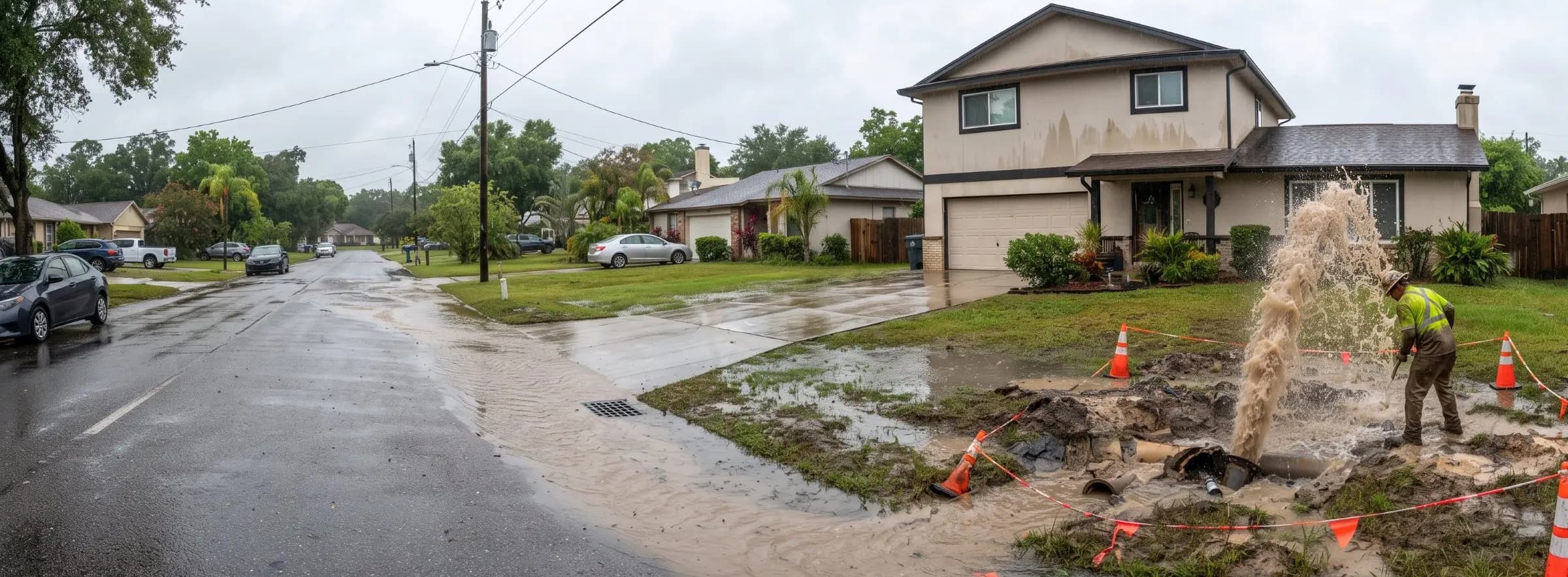

Water pouring from a broken main into a yard or across a basement floor is an emergency, and the first hour has two jobs: stopping the flow and building the record that decides who pays. Most water damage restoration jobs cost $1,500 to $7,000, and the total climbs the longer the water sits. A water damage restoration company can start extraction while you sort out whether the utility, a plumber or your insurer is responsible.
Water main break damage is structural and material damage caused by water escaping from a pressurized municipal water main or a private service line, and professional restoration follows ANSI/IICRC S500, the standard for water damage restoration. Unlike a burst pipe inside a wall, main break water arrives from outside, carries soil with it and crosses a property line, which changes how it is classified, who owns the repair and which insurance applies.
Key insights
- Ownership splits at the meter. The utility owns the main and the connection up to the meter or curb stop, while the homeowner owns the service line from that point to the house, though the exact boundary varies by utility.
- Most jobs cost $1,500 to $7,000. An extensive loss with structural repair costs $10,000 to $25,000 or more, and a broken service line adds its own repair bill on top of the water damage.
- Utilities pay only when liable. Public water utilities are generally protected by governmental immunity, so a claim usually has to show that the utility knew about a defect and did not act.
- Notice deadlines vary widely. New York City and Houston require notice within 90 days, Philadelphia within six months and Florida within three years, so the clock can start on the day of the break.
- The water category rises. Clean water from a main is Category 1 at the source, but it is usually treated as Category 2 or 3 under ANSI/IICRC S500 once it has soaked through soil and building materials.
- Report the loss to your own insurer. Some utilities, including Philadelphia's, pay only the losses that insurance did not cover, so notify your homeowners insurer even when the utility caused the break.
What to do when a water main breaks
Close your home's main shutoff valve, report the break to the water utility and switch off power only from a dry panel, in that order. Water that keeps flowing after your valve is closed is coming from upstream of it, on the service line or the utility's main, and only closing the curb stop in the street will stop it.
 Turning the wheel clockwise closes a gate valve, and if water keeps flowing afterward, the break is upstream of the valve and only the utility's curb stop can shut it off.
Water entering the structure qualifies for emergency water damage restoration, and after-hours crews can be dispatched while the utility is still locating the break. A same-day response matters because wet drywall, insulation and carpet padding start holding moisture within hours. One inch of water across a 1,000 sq ft basement floor is about 620 gallons, far more than a household wet vacuum can clear.
1. Locate where the water enters
Walk the yard, the foundation walls and the basement or crawl space to find where the water is surfacing. Then read the water meter: if the dial or low-flow indicator keeps moving with every fixture and appliance off, water is escaping somewhere past the meter.
2. Close the valve inside your home
Close the main shutoff valve, usually where the line enters near the front wall of a basement, garage or utility room. Turn a wheel handle clockwise, or turn a lever handle a quarter turn until it sits perpendicular to the pipe. If water keeps flowing after the valve is closed, the break is upstream of it, and the curb stop belongs to the utility, so call it rather than forcing that valve yourself.
3. Report the break to the utility
Call the utility's 24-hour emergency line, give the address and where the water is entering, and ask for an incident number. Write down the time of the call and the name of the person you spoke with, because that record is the first piece of evidence in any claim.
4. Switch off power only from a dry panel
Open the main breaker only if the panel is dry and you can reach it without stepping in water, since OSHA says to turn off the power at the main breaker or fuse on the service panel when water has reached electrical circuits. If water is touching outlets or the panel, stay out and call the utility or an electrician.
5. Photograph the water and the pipe
Take timestamped photos and video of the water source, any exposed pipe or hole, the water line on walls and floors, and the flow in the street. Record the water meter reading, and keep damaged items until the utility or your insurer has had the chance to inspect them.
6. Book extraction the same day
Call a restoration company the same day instead of waiting for the utility's repair crew or an adjuster, whose schedules are outside your control. Crews can document conditions with moisture readings that support both the utility claim and your insurance claim.
Drinking water after a main break
Do not drink tap water after a main break until the utility says it is safe, because a loss of pressure can let contaminated water enter the system. The CDC describes three kinds of drinking water advisories, boil water, do not drink and do not use, and a boil water advisory means bringing water to a full rolling boil for 1 minute, or 3 minutes above 6,500 feet.
A do not drink advisory calls for bottled water for drinking and cooking because boiling does not remove chemicals, and a do not use advisory means avoiding tap water contact entirely. After an advisory lifts, the notice usually spells out whether to flush the lines and replace filter cartridges, so follow those steps before drinking.
Water that looks clear is not proof of safety, because bacteria and chemicals cannot be seen. Discolored water right after service returns is usually sediment stirred up by the pressure change, but wait for the utility's all clear before drinking it. Ice, baby formula and pet water count as drinking water during an advisory, so use bottled or boiled water for them and throw out ice made while the advisory was active.
Water main or sewer main
A water main carries pressurized drinking water to the home, while a sewer main carries wastewater away, and a break in one produces different damage. Clean or muddy water from a pressurized line, a drop in water pressure and a moving meter point to the water side, and foul-smelling water backing up through floor drains, toilets or tubs points to the sewer side.
Sewage is Category 3 from the start, so a sewer line failure means protective equipment, removal of porous materials and a different insurance question. If the water smells like sewage or is coming up through a drain, treat it as sewage backup cleanup and keep people and pets out of the area until it has been cleaned.
A quick check is to turn off every fixture and watch the meter, because a dial that keeps moving points to a leak on the pressurized water side. Sewer problems usually show up in the lowest drains first, such as a basement floor drain or a shower, and the water often looks gray or dark. If both signs appear together, call the utility and a plumber, since two separate lines may be failing.
Who owns the broken water line
The water utility generally owns the main and its connection, and the homeowner owns the service line from the meter or curb stop to the house. The exact handoff differs by utility, so the published service line policy or one call to the utility settles who owns the section that broke before anyone authorizes excavation.
 In many systems the homeowner's responsibility starts at the meter, but some utilities set the boundary at the property line, so confirm where yours draws it before you call a plumber.
The meter usually sits in a box near the curb or property line, and the shutoff valve inside the house marks the other end of the private line. Ownership questions come up most often on older properties, where the line may cross a neighbor's lot or run to a meter set far back from the street, so ask the utility whether it has a record of where the line and meter sit.
| Component | Owner | What it means |
|---|---|---|
| Main under the street | Utility | The utility excavates and repairs it at no charge to the homeowner |
| Tap connecting the main to your line | Utility | The utility repairs the connection and restores the street |
| Curb stop and meter | Utility | The utility owns and operates the curb stop; the owner's side starts at the meter setting |
| Service line from meter to house | Homeowner | You hire a licensed plumber and pay for the repair |
| Shutoff valve and indoor plumbing | Homeowner | You repair it, and insurance may cover the resulting interior damage |
A break on the house side of the shutoff valve behaves like any burst pipe inside the home, with the plumber stopping the leak and the homeowner's insurer handling the interior damage if the policy covers it. A few utilities own the full service line or sell optional line protection programs, so ask before paying a plumber for a dig the utility may cover.
Signs of a service line leak
A service line leak shows up as a wet patch in the yard, low water pressure, running water sounds with every fixture off, or an unexplained jump in the water bill. A leak on a pressurized line can run for weeks underground before the surface shows anything, so check whether the meter's low-flow indicator moves with every fixture and appliance off.
- Soggy ground, a sinkhole or a strip of unusually green grass along the route of the line in dry weather
- Hissing or rushing sounds near the meter or where the line enters the house
- Muddy or discolored water at the tap
Lines that enter through the slab leak into the ground under the house, where the same symptoms show up as damp flooring and baseboards, which is the pattern of a slab leak. A leak under the slab needs leak detection equipment before anyone cuts concrete, and the repair often means breaking the slab or rerouting the line through the walls or attic.
Who pays for water main break damage
The water utility pays only when it is legally liable, and your homeowners insurer pays for covered sudden damage inside the home regardless of who caused the break. Liability generally requires proof that the utility knew about a defect and failed to fix it, and public utilities are usually protected by governmental immunity rules, so a claim against one faces notice deadlines and proof requirements that a claim against a private party does not.
 Take dated photos and video of every wet surface and damaged item before cleanup starts, because both the utility and your insurer will ask for proof of what the water damaged and when.
Utilities also separate a break they could not have predicted from one they already knew about. A main with a history of leak calls, a pressure complaint on file or a repair left open for days is the kind of record that supports a claim, so ask the utility for the incident history on that line and keep copies of any earlier report you made.
| Situation | Likely payer | Reason |
|---|---|---|
| Utility main fails and water enters your home | Your insurer first, the utility only if liable | Utility claims need proof of notice and negligence |
| Your service line fails and water enters your home | Your insurer for interior damage, you for the line | The homeowner owns the service line |
| Utility crew damages your property during the repair | The utility | The damage comes from its own work |
Some utilities pay only what insurance leaves uncovered. The Philadelphia Water Department, for example, requires residents to notify their own insurer, deducts insurance payments from any award and asks for a written denial from the homeowner's carrier before it considers the remaining damage. It also limits recovery to losses it considers reasonable, necessary and related to the break.
Filing a claim with the water utility
Send a written claim to the water utility as soon as the water is under control, because utilities set their own notice deadlines. Missing one can end a claim regardless of how clear the damage is, and the deadlines range from 90 days to three years depending on the city or state.
- The date, time and address of the loss and the utility's incident number
- Photos and video of the water source, the damage and the street
- Repair invoices from the restoration company and the plumber
- Your homeowners claim number and the insurer's written decision
- An itemized list of damaged belongings with age and replacement cost
File the homeowners claim at the same time instead of waiting on the utility, because a utility decision can take months and your policy has its own reporting and proof of loss deadlines. When filing a water damage insurance claim for a main break, add the utility's incident number to the file, because the adjuster will compare it with your photos, invoices and dates.
Homeowners insurance and main breaks
Standard homeowners policies cover sudden and accidental water damage inside the home but exclude flood, surface water and groundwater. Whether a main break is covered depends on your policy wording and how the water entered the house, and a break on your own service line that sends water through a wall or floor is the clearest case, because the water comes from a failed pipe.
 The declarations page and endorsement list show whether you bought service line coverage, so check them before the adjuster visit to know what the policy pays for the buried pipe.
As the NAIC consumer publication on home insurance notes, flood damage falls outside homeowners policies, so an insurer may argue that water crossing the yard and entering at ground level is surface water. The exclusions in the water damage coverage decide the argument, so read them before the adjuster visit.
Damage to the buried line itself is often excluded or capped, and many insurers sell an optional service line endorsement that covers the pipe and the excavation. The policy's declarations and endorsement list show whether you bought one. Ask the agent whether it pays to tear out landscaping and paving to reach the pipe, since excavation can be the largest part of the repair bill.
A flood policy generally does not respond to a one home main break either, because the NFIP definition of a flood requires two or more acres or two or more properties to be inundated, which decides flood insurance coverage under the NFIP. A broken main that floods several homes on one street can change that count, so ask the adjuster how the loss was classified.
Small claims court and lawsuits
Most main break losses are settled through the utility's claim process or a homeowners insurance claim, and a lawsuit is a last step after a written claim is denied or ignored. Small claims court handles disputes up to a dollar limit set by each state, from $2,500 in Kentucky to $20,000 or more in a few states, and usually does not require an attorney.
A lawsuit against a public utility usually follows the notice of claim, so the written notice deadline matters even if you plan to sue. An attorney who handles municipal liability can tell you whether the utility's notice of the defect and any damage caps in your state support a case, which is worth a consultation when the loss is large and the insurer has denied coverage.
| City or state | Notice deadline | What it means |
|---|---|---|
| New York City | 90 days | A notice of claim goes to the City Comptroller within 90 days of the incident |
| Houston | 90 days | The City Charter requires notice within 90 days after the damage, and missing it releases the city from liability |
| Philadelphia | 6 months | Written notice goes to the water department within six months of the date of loss |
| Florida | 3 years | A claim goes to the agency and the state within 3 years, and recovery is capped at $200,000 per person and $300,000 per incident |
New York City publishes its 90 day rule in the New York City Comptroller's filing instructions, Houston in the City of Houston's charter and legal department claim rules, Philadelphia in the Philadelphia Water Department's claim FAQs and Florida in Florida Statutes section 768.28. Houston's rules also note that state law bars liability for damage from a defective or clogged sewer line, so identifying the failed pipe as a water line or a sewer line can decide whether a claim can be paid at all.
Water category after a main break
Water from a main starts as Category 1 clean water under ANSI/IICRC S500 but is usually treated as Category 2 or 3 once it soaks through soil, foundation walls and building materials. The classification matters because it decides whether porous materials can be dried in place or must be removed.
Time and temperature push the category up as well, since clean water that sits long enough in a warm basement can degrade from Category 1 to Category 2. The IICRC water damage categories also drive the price on an estimate, so a line item marked Category 3 should come with a reason such as soil, sewage or contact with a contaminated surface.
When a break sends a muddy surge across the yard and through the foundation, it behaves more like flood water damage than a plumbing leak, and crews remove carpet, padding and wet insulation instead of drying them in place. Hard materials such as framing and concrete are cleaned and dried.
Where main break water does damage
Main break water does the most damage in basements, crawl spaces and slab foundations because it enters at or below grade and collects at the lowest point of the house. Water that surfaces in the yard first follows the grade toward the foundation, seeping in through wall cracks, floor joints, window wells and utility penetrations.
 Wet insulation holds moisture against the joists and subfloor, so crews check the batts and usually remove sagging ones before drying the framing.
The path the water takes decides how fast the damage spreads. Water entering through a slab joint spreads under flooring in a thin sheet that is easy to miss, while water entering through a basement wall collects at the lowest point and can stand deep enough to reach outlets and the furnace.
| Area | How water enters | What it damages |
|---|---|---|
| Basement | Wall cracks, floor joints, window wells | Finished walls, carpet, stored belongings, a furnace or water heater at floor level |
| Crawl space | Vents, rim joist gaps, foundation openings | Insulation, floor joists, subfloor, ductwork |
| Slab on grade | Slab joints and pipe penetrations | Flooring, baseboards, lower drywall |
| Garage | Door thresholds and slab joints | Stored items, drywall, door framing |
| Yard and driveway | Soil washout around the break | Landscaping, walkways, soil under slabs |
A finished basement takes the largest contents loss because carpet, drywall and stored belongings sit at floor level, and a furnace or water heater on the slab can be damaged if water reaches the controls. Drywall wicks water several inches above the visible line, so crews check readings above it before deciding where to cut.
Yard, driveway and sinkhole damage
A main break can wash out soil, crack driveways and sidewalks and leave a sinkhole in the yard, and the damage can appear hours after the water is shut off. Keep people, pets and vehicles away from any sunken or soft ground, because the soil beneath it may be hollow and can give way under weight.
Hours of water running along a foundation can wash soil out from under footings and slabs and leave the backfill saturated. New cracks, doors that stick or a floor that slopes afterward point to foundation water damage and should be checked by a structural professional before repairs are closed up.
Photograph the washout before any repair crew regrades it, and measure cracks and settling so later movement can be compared. The utility usually restores the street and sidewalk it excavates, but landscaping is covered only for named perils on most homeowners policies, and fences and private driveways are often limited too, so the utility claim is usually the main route for yard losses the break caused.
When to call a professional
Hire a water damage restoration company the same day when main break water has entered the structure, and call a licensed plumber for any break on your side of the meter. The two jobs can run at the same time, because the plumber stops the source while the restoration crew extracts water and starts drying.
 A glowing tester means the outlet is still live, so stay out of the room and call an electrician or the utility if outlets or the panel are wet.
Restoration companies carry equipment that plumbers do not, including moisture meters, thermal cameras and truck-mounted extractors, which is why neither trade can do the other's job. The water has to be stopped first, because drying equipment cannot keep up with a line that is still leaking, and the plumber or utility does that.
| Situation | Call first | Reason |
|---|---|---|
| Water in the street only | Utility | The utility owns the main and the street |
| Water entering the house | Restoration company and utility | Extraction cannot wait for the repair |
| Break on your service line | Licensed plumber and utility | The line is the homeowner's to repair |
| Wet panel or outlets | Utility or electrician | Power must be off before anyone enters |
Before signing, choose a water damage restoration company that holds IICRC certification, provides a written scope with itemized pricing and shares moisture readings daily, because those records support both the utility claim and the insurance claim. A contractor who asks you to sign an assignment of benefits or direction to pay form on the first visit deserves a closer read of its terms before you agree.
If mold shows up after drying, the work becomes a separate job, and the difference between water damage restoration vs. mold remediation changes who is hired, what the work costs and what insurance pays. A restoration company that dries the structure within the first days usually avoids that second job.
What water main break damage costs
Water main break damage typically costs $1,500 to $7,000 to dry out and repair, and an extensive loss that reaches the framing or several rooms costs $10,000 to $25,000 or more. The price depends on how many square feet got wet, how long the water sat and how contaminated it was when it arrived.
 Extraction and drying like this is billed at $3 to $7.50 per square foot, while rebuilding the cut wall and replacing the flooring is a separate charge at $20 to $37 per square foot.
Because main break water picks up soil on its way into the house, jobs are often priced at the Category 2 or 3 rate instead of the clean water rate. Breaks that are dried within a day also avoid the material replacement that drives most of the cost on larger jobs.
| Scope | Estimates | What it includes |
|---|---|---|
| Minor spot mitigation | $350–$1,500 | Extraction and spot drying with no material removal |
| Standard mitigation | $1,500–$4,000 | Extraction, structural drying and antimicrobial treatment |
| Mitigation plus basic repairs | $4,000–$7,000 | Drying plus drywall and flooring replacement in one or two rooms |
| Extensive loss with structural repair | $10,000–$25,000+ | Multi-room mitigation, framing repair and full material replacement |
Mitigation and repair are billed separately, with extraction and drying at $3–$7.50 per square foot and rebuilding work such as drywall and flooring at $20–$37 per square foot. The category assigned to the water sets the rate within that mitigation range. A drying job that stays inside one room usually prices near the low end, and a job that crosses several rooms or the whole basement moves toward the high end.
| Category | Estimates | When it applies |
|---|---|---|
| Category 1 | $3–$4 per sq ft | Clean water that is extracted and dried quickly |
| Category 2 | $4–$6.50 per sq ft | Water that has crossed soil or sat for a day or more |
| Category 3 | $7–$7.50+ per sq ft | A heavy soil surge through the foundation or contact with sewage |
A 400 sq ft wet basement with Category 2 water costs $1,600–$2,600 to extract and dry at $4–$6.50 per square foot. Replacing the drywall and flooring across 100 sq ft of it at $20–$37 per square foot adds $2,000–$3,700, which brings the total to $3,600–$6,300 and keeps the job inside the $1,500–$7,000 range.
After-hours calls typically add 25% to 50% to the daytime rate, which comes on top of the standard water damage restoration cost for the category and square footage involved. Ask the contractor to separate mitigation from repair on the estimate, since insurers often approve drying first and rebuilding after an adjuster inspection.
Service line repair costs
Repairing a broken service line is billed separately from the water damage, and a spot repair commonly runs about $350 to $1,700 in estimated plumber pricing. A full replacement typically falls between $1,700 and $10,000. A plumber prices the job by the length of trench, the pipe material and the depth of the line, and restoring the surface afterward is often the largest part of the bill.
Excavation drives the price on most jobs, and the depth of the line sets how much digging is needed. Lines in cold climates are buried below the frost line, which can reach five to seven feet in Minnesota while Florida lines often sit 12 to 18 inches down, so the same repair usually costs more in the north.
| Repair type | Estimates | Price drivers |
|---|---|---|
| Spot repair | $350–$1,700 | Depth of the break, soil conditions and access |
| Open trench replacement | $1,700–$10,000 | Line length, landscaping, driveways or sidewalks to cut |
| Trenchless replacement | $4,000–$12,000 | Entry pits and pipe bursting or lining equipment |
Locating the break is the first line item, and leak detection is often a flat fee charged before any digging starts. Pressure testing and acoustic or electronic detection find the break without trenching the whole yard. Permits are commonly required for service line work, and some utilities inspect the connection before the trench is backfilled.
Drying time and mold risk
Drying after a main break typically takes three to five days, and mold can grow on materials that stay wet for more than 24 hours. That threshold comes from the EPA flood cleanup recommendations, which list wood, drywall, carpet and furniture among the materials at risk. Starting extraction the same day is the most effective step to keep a main break from turning into a mold problem.
 Crews compare readings against an unaffected wall of the same material to set the dry goal, and drying continues until the wet area matches it.
Professional structural drying uses air movers and dehumidifiers to pull moisture out of framing, subfloors and wall cavities, and the work ends when moisture meter readings match the dry reference for each material. Daily readings should show falling moisture levels, and numbers that stall usually point to wet insulation inside a wall or a leak that is still active.
Moisture does not stay where it lands, because water wicks upward into drywall and baseboards above the visible line and travels under flooring into rooms that looked untouched. That is why a restoration crew checks the adjacent rooms and cabinet bases before closing out a job. Keep the drying equipment running until the final readings are logged, since pulling it early can leave moisture behind the walls.
Prevention
A homeowner cannot prevent a municipal main from failing, but the damage stays small with a tested shutoff valve and early detection of service line leaks. The Utah State University study reported by ASCE counted about 260,000 water main breaks a year in the U.S. and Canada, with an average failing main age of 53 years, so a break is a routine event in any neighborhood with aging pipe.
 A sensor only alarms once water reaches it, so set it on the floor at the low point where a leak would run, a foot or two from the water heater.
Photographing the meter, the shutoff valve and a finished basement before a loss gives the adjuster a baseline, and saving receipts for major contents makes an itemized claim list faster to build. Keeping a copy of the policy declarations with those photos saves time when the insurer asks for the coverage limits and deductible.
| Action | Frequency | Why it works |
|---|---|---|
| Close and reopen the main shutoff valve | Twice a year | A valve that moves freely closes when water is already flowing |
| Read the meter with all fixtures off | Monthly | A moving low-flow indicator reveals slow underground leaks |
| Place leak sensors near the water heater and basement walls | Test twice a year | Alarms catch water early where it collects |
| Call 811 before any digging | Before every dig | Utility locators mark buried lines so a shovel does not break one |
| Check the policy for service line coverage | At each renewal | The endorsement covers a pipe most policies exclude |
| Post the utility emergency number and a plumber's number | Once | The first call happens in seconds instead of minutes |
In cold climates, frozen ground puts stress on buried lines, and the pipes inside the house face their own risk from frozen pipes that can burst during the same cold snaps. Service lines should sit below the local frost depth, and a plumber can confirm the depth of an existing line whenever a leak is repaired.
Frequently asked questions
How long does a water main break repair take?
Most pipe repairs take about six hours or less once a crew is on site. A large transmission main, a deep pipe or frozen ground can stretch the work longer, and the street may stay closed for paving after water service returns.
Will a water main break raise my water bill?
Yes, if the leak is on your side of the meter, because the meter counts every gallon that passes through it. Many utilities offer a leak adjustment on the usage or sewer charges, usually limited to one every few years, so send the plumber's repair invoice with the request and ask about the deadline, since some utilities allow only about 30 days.
What if my insurer denies a water main break claim?
Ask for the denial in writing. The letter should name the policy provision the insurer relied on, and that provision decides whether the denial can be challenged. A denied water damage insurance claim can be appealed, and the most common main break dispute is whether the water counts as surface water or as a sudden discharge from a pipe.
When can I turn the water back on after a main break?
Turn it on once the utility confirms service is restored and any advisory has lifted. Open the main shutoff valve slowly, open the lowest faucet in the house first so air can escape, and check the meter and the ceilings for leaks before leaving the house unattended.
Why is my water brown after a main break?
Brown or cloudy water usually comes from rust and sediment stirred up when pressure changes in the pipes. Run the cold tap until it clears, avoid washing clothes while it is discolored, and call the utility if it has not cleared after the lines have been flushed.
Can I stay home during a water main break?
Yes, if the electrical panel is dry, no water is standing near outlets and the utility has confirmed the water is safe to use. Many households stay in the home during water damage restoration with drying equipment running in affected rooms, although a basement that has lost its furnace or power may need a temporary alternative.
Should I hire a public adjuster for a water main break claim?
Only for large or contested losses. A public adjuster works on the homeowner's side of the claim and is typically paid a percentage of the settlement, which makes the most sense on losses such as a flooded finished basement. On a small loss near the deductible, the fee can consume most of the difference.
Can I fix a leaking service line myself?
Not safely in most cases. Call 811 before any digging so buried utilities are marked, which is free and should happen a few business days before you start, and check whether the utility or local plumbing code requires a licensed plumber or a permit for line repairs.
- ANSI/IICRC S500
- EPA: Flood Cleanup to Protect Indoor Air and Your Health
- CDC: Drinking Water Advisories
- OSHA: Flood Preparedness and Response
- ASCE: Breaking Water Mains Present US, Canada With $452B Problem
- NAIC: Consumer Guide to Home Insurance
- Philadelphia Water Department: FAQs Following a Main Break
- NYC Comptroller: Filing a Claim with the New York City Comptroller
- City of Houston: File a Claim
- Florida Statutes: Section 768.28
Sam Hickerson is the founder of RestoreAdvisor and writes consumer guides on mold remediation, water damage restoration, inspection, testing, and home recovery. His work focuses on helping homeowners understand costs, risks, and when to call a professional. He draws on guidance from the EPA, CDC, IICRC, and other authoritative sources to make complex home issues easier to navigate.