
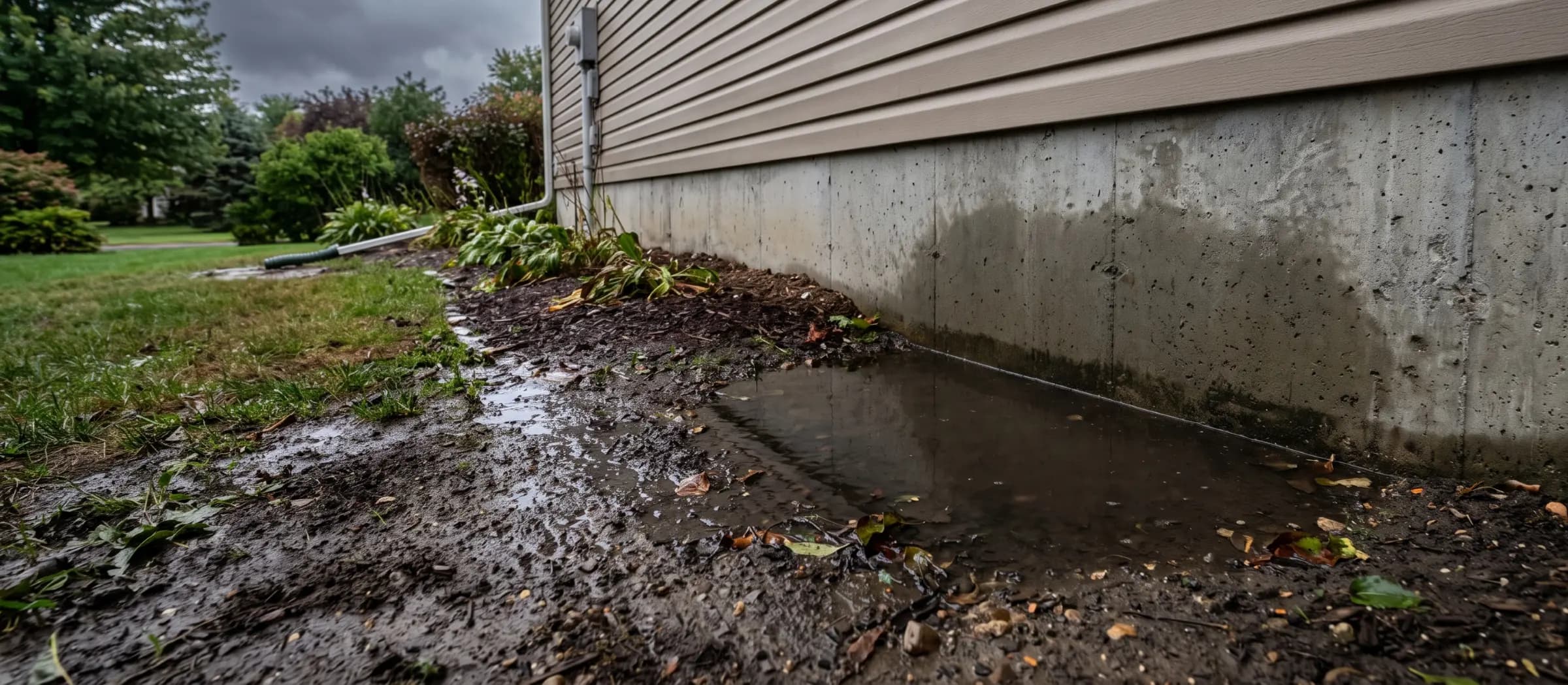

A damp basement wall, a hairline crack that keeps reopening, or a musty smell that never fully clears are the first signs that water is reaching your foundation instead of draining away from it. None of those signs on their own mean your house is at risk of collapse. They do mean water is doing something it shouldn't, and the earlier you figure out why, the less it costs to fix.
Foundation water damage is water intrusion through or against a home's foundation walls, footings, or slab, most often driven by soil pressure and poor drainage rather than a broken pipe. It is classified under IICRC S500, the same industry standard used across every water damage restoration case, by contamination category and by how much moisture the surrounding materials have absorbed. Catching it early, before a hairline crack becomes a structural one, is generally the difference between a few hundred dollars in drainage fixes and a five-figure repair.
Key insights
- Three mechanisms cause nearly all foundation water damage. Hydrostatic pressure, expansive soil, and poor surface drainage account for almost every case of water damage to a residential foundation.
- A wet foundation and a slab leak aren't the same problem. Foundation water damage comes from outside the house, groundwater and soil pressure, not a broken pipe, which is also why it's rarely a plumbing problem to begin with.
- Expansive soil is a nationwide issue. USGS mapping shows moderate to high shrink-swell clay soils across large parts of the central and western United States, not just Texas.
- Not every crack is a problem. A vertical hairline crack under 1/8 inch is generally normal curing; a horizontal or stair-step crack means the wall is under real structural pressure.
- Standard homeowners insurance rarely covers it. Gradual seepage, hydrostatic pressure, and earth movement are typically excluded under a standard HO-3 policy.
- Minor fixes stay minor when caught early. Regrading and gutter extensions run a few hundred dollars; full exterior waterproofing after years of neglect can run into five figures.
What is foundation water damage?
Foundation water damage is any water intrusion that reaches a home's foundation walls, footings, slab, or the soil pressed directly against them, causing dampness, cracking, or structural movement over time. It differs from most other water damage causes because the water tends to start outside the house rather than from a failed appliance or supply line.
 Identifying which mechanism is active determines whether the fix is a simple drainage correction or a full exterior waterproofing job.
A restoration company still assesses foundation water the same way it assesses any other water damage restoration case, by category and class, but the underlying cause sits in a different field entirely: drainage and geotechnical engineering rather than plumbing. Three mechanisms account for nearly all foundation water damage.
| Mechanism | What's happening | Common trigger |
|---|---|---|
| Hydrostatic pressure | Saturated soil pushes water through hairline cracks, mortar joints, and cold joints in the foundation wall | Heavy rain, poor grading, a high water table |
| Expansive soil | Clay-rich soil swells when wet and shrinks when dry, cracking and shifting the foundation with each cycle | Seasonal wet and dry cycles in clay-heavy regions |
| Erosion and poor drainage | Water washes soil out from under or beside the footing, removing support and letting the foundation settle unevenly | Clogged gutters, downspouts dumping at the foundation, missing grading |
Most real-world cases involve more than one of these at once, which is part of why two houses on the same street can have very different repair bills for what looks like the same crack. A home with clay soil and a clogged gutter, for instance, is dealing with expansive soil and erosion simultaneously, and a professional inspection is what actually separates the two rather than guessing from the crack alone.
Signs of foundation water damage
The signs of foundation water damage range from a musty basement smell to a door that no longer latches, and they typically show up in three places: on the foundation itself, inside the basement or crawl space, and in the structure above it. Catching them early, before cracks widen or floors shift, is what keeps a repair in the hundreds of dollars rather than the thousands.
 Efflorescence is mineral residue left behind as water migrates through concrete, not mold, and its presence means moisture is actively passing through the wall rather than sitting on the surface.
Signs also tend to cluster by mechanism. Hydrostatic pressure and erosion generally announce themselves with water you can see, staining, pooling, or a damp wall, while expansive soil movement tends to show up structurally first, a stuck door or a new crack, sometimes with no visible water at all.
| Sign | Where you'll see it | What it likely means |
|---|---|---|
| Standing water or wet soil | Directly against the exterior foundation wall after rain | Grading or drainage is sending water toward the house instead of away from it |
| Cracks wider than 1/8 inch, or growing | Foundation walls, especially corners and window wells | Active pressure or settlement, not just normal concrete curing |
| Bowing or leaning walls | Basement walls, usually at mid-height | Sustained hydrostatic pressure from saturated soil |
| Musty smell or visible mold | Basement, crawl space, or lowest-level closets | Moisture has been present long enough to support mold growth |
| White, chalky deposits (efflorescence) | Interior foundation walls and floors | Water is moving through the concrete and leaving mineral residue behind |
| Sticking doors and windows | Anywhere on the lowest level | The foundation has shifted enough to rack the door and window frames |
| Sloping floors or new drywall cracks | Near exterior walls | Uneven settlement, often concentrated on one side or corner of the house |
Mold is a useful signal but not a diagnosis. The EPA notes mold can begin developing within 24 to 48 hours once materials stay wet, so a musty smell in a basement that's been damp for a week points to active growth, not old moisture.
Foundation water damage vs. a slab leak
Foundation water damage and a slab leak are not the same problem, even though both involve water and a concrete foundation. Foundation water damage comes from outside the house, groundwater, rain, and soil pressure pushing in through the foundation wall or footing, while a slab leak is a broken supply or drain pipe leaking from inside the slab itself.
 Both problems can look identical as a warm or damp spot on the floor, which is why a moisture reading and the water's position relative to an exterior wall confirm the source, not appearance alone.
Confusing the two has a real cost. Hiring a foundation specialist to chase a slab leak, or a plumber to chase a drainage problem, means paying for a diagnostic visit that ends with a referral to someone else instead of a fix.
| Foundation water damage | Slab leak | |
|---|---|---|
| Source of the water | Soil and groundwater outside the foundation | A broken supply or drain pipe under the slab |
| Typical water category | Category 1, sometimes Category 2 | Category 1 on the pressure side, Category 3 on the drain side |
| Where it shows up | Along exterior walls, corners, and the base of interior foundation walls | A random warm spot on the floor, an isolated damp patch away from any wall |
| What fixes it | Grading, gutters, drainage systems, exterior waterproofing | Plumbing repair, rerouting, or pipe replacement |
| Who to call first | A foundation or waterproofing specialist | A plumber |
Both problems can produce the same first clue, a warm or damp spot on the floor, or a musty smell that won't clear, which is why a homeowner without a moisture meter can easily mix them up. If the wet area tracks along an exterior wall or worsens after rain, foundation water intrusion is the more likely explanation; if it's isolated to one spot with no relationship to weather, a slab leak is worth ruling out first, and a technician's water damage categories assessment during the first visit usually settles the question either way.
What type of foundation crack is serious?
A vertical or diagonal crack under about 1/8 inch wide is usually normal concrete shrinkage or minor settlement and rarely signals a structural problem on its own. A horizontal crack, a stair-step crack in a block wall, or any crack that's actively widening is a different matter and typically means the wall is under real pressure. Shape and location say more than width alone, which is why two cracks that look similarly sized can carry very different risk, and a horizontal crack a quarter-inch wide is a bigger concern than a vertical crack twice that size, since the direction reveals what kind of force created it.
| Crack type | Where it typically forms | What it usually means |
|---|---|---|
| Vertical, hairline (under 1/8 inch) | Poured concrete walls, often near the center | Normal curing shrinkage; monitor rather than panic |
| Vertical, wider than 1/8 inch or growing | Poured concrete walls | Settlement or hydrostatic pressure; worth a professional look |
| Diagonal | Corners, near window and door openings | Usually minor settlement, unless paired with other signs |
| Horizontal | Poured or block basement walls, usually mid-height | Soil or hydrostatic pressure pushing the wall inward; a structural concern |
| Stair-step | Concrete block or brick foundation walls | Differential settlement, one section of the foundation moving more than another |
Width alone isn't the whole story. A hairline crack that's actively growing, or one paired with a bowing wall, a sticking door, or water actively coming through it, moves out of the wait-and-monitor category even if it started small.
How serious is foundation water damage?
Most foundation water damage is a drainage problem, not a structural emergency, and correcting it early keeps it that way. A smaller share of cases involve real structural risk, and knowing the difference determines whether you're calling a gutter contractor or a structural engineer.
 A wall that has already bowed inward needs a structural assessment before any drainage fix, since sealing cracks does not reverse deformation that has already occurred.
A horizontal or stair-step crack
These indicate the wall itself is being pushed rather than just settling, and they don't self-correct with a grading fix alone.
A wall that's visibly bowing or leaning
Even a slight inward bow, checked with a straightedge or level against the wall, means the wall has already deformed under pressure and needs a structural assessment, not just a drainage fix.
Doors and windows that newly stick or won't latch
Especially when it happens over weeks rather than years, this points to active movement rather than the gradual settling every older home has to some degree.
A crack that's actively widening
Marking the ends of a crack with a pencil and date, then checking it again in a few weeks, is the simplest way to tell an old, stable crack from one that's still moving.
Water combined with a finished or occupied lower level
The urgency changes when standing water threatens finished flooring, stored belongings, or a bedroom rather than an empty utility space.
None of these signs alone means the house is at risk of sudden collapse; foundations rarely fail without warning. Any of them is still a reason to get a structural engineer or foundation specialist's written opinion rather than treating it as a weekend project, and that assessment runs a few hundred dollars either way.
How water gets into a foundation
Water gets into a foundation through hydrostatic pressure, expansive soil movement, or erosion from poor surface drainage, and most real cases involve more than one acting together. Knowing which one is driving the damage determines whether the fix is a $300 gutter extension or a $6,000 drainage correction.
 An unextended downspout is one of the most common and least expensive causes to fix, since redirecting it a few feet away often resolves the erosion before it reaches the footing.
Hydrostatic pressure
Hydrostatic pressure builds when soil around the foundation becomes saturated and has nowhere to drain. Water in the soil pushes against the foundation wall with enough force to work through hairline cracks, cold joints where the footing meets the wall, and porous points in the concrete itself, sometimes without any crack visible to begin with.
Expansive soil
Expansive soil, typically clay-rich soil, swells when it absorbs water and shrinks as it dries, and that repeated cycle stresses the foundation more than the water itself does. Data from USGS mapping shows moderate to high shrink-swell clay soils across large parts of the central and western United States, not just the Texas and Southeast markets most associated with the problem. Each swell-shrink cycle can crack a foundation wall or slab a little further, and the cracking itself then becomes a new entry point for water.
Erosion and poor drainage
Erosion happens when water washes soil out from under or beside the footing, removing the support the foundation depends on and letting it settle unevenly. Clogged gutters, downspouts that dump water within a few feet of the house, and ground that slopes toward the foundation rather than away from it are the three most common causes, and all three are correctable without touching the foundation itself.
Basement vs. crawl space foundation leaks
Basements and crawl spaces experience foundation water intrusion differently because of how each is built against the soil. A basement's poured or block walls sit fully below grade, so hydrostatic pressure pushes against a continuous vertical surface, while a crawl space's shorter walls and exposed dirt or vapor-barrier floor let water intrude from below as easily as from the sides.
A crawl space also tends to show signs later than a basement does, since no one walks through it daily, which is part of why a musty smell reaching the living space above is often the first thing a homeowner notices. For general water damage signs across every room of the house, not just below grade, signs of water damage walks through room-by-room indicators a homeowner can check without going underneath the house.
What to do about foundation water damage right now
If water is actively coming through a foundation wall or pooling on a basement floor, move belongings off the floor, contain the water, and cut power to any wet outlets before anything else. Documenting the damage and calling the right professional come right after that.
 Cardboard and untreated wood wick water quickly and often need to be discarded once soaked, which is why moving belongings off the floor comes before any other step.
1. Move belongings and furniture away from the wet area
Get anything on the floor, boxes, furniture legs, stored items, off the affected floor space and away from the leaking wall. Cardboard and untreated wood wick water quickly and often need to be discarded once soaked.
2. Contain and start removing standing water
A wet or dry shop vacuum or a few towels handle a small amount of water. Anything beyond a few inches on the floor calls for real extraction equipment rather than a mop and a bucket.
3. Cut power to any outlets or fixtures in the wet area
If water is near an outlet, switch, or fixture, cut power at the breaker before touching anything else in the room. Standing water near live electrical components is a shock hazard, not a manageable inconvenience, per OSHA flood-response guidance.
4. Photograph the damage before you clean anything up
Wide shots of the room and close-ups of the crack, stain, or pooling water give an insurer and a contractor a clear starting point. Note the date and, if you can, how long the area had been dry before this happened.
5. Call a foundation specialist and, if materials are wet, a restoration company
A wet foundation is usually two jobs: stopping the water at its source and drying out whatever it has already soaked. Waiting on one company to handle both often delays the drying start, which raises the mold risk the EPA associates with materials that stay wet more than a day or two.
Not every wet foundation is a true emergency, but a few signs mean it is: water spreading into more than one room, a visibly bowing wall, or standing water near an electrical panel. Those signs point to emergency water damage restoration territory, which covers exactly which situations qualify and how fast a legitimate 24-hour company should respond.
Once the source is contained, drying and documentation still need to happen correctly. The water damage restoration checklist works as a printable, step-by-step reference for those steps.
Who to call for foundation water damage
A foundation or waterproofing specialist fixes the water source; a water damage restoration company handles materials that have already gotten wet. Most homeowners only think to call one of the two, which is why the job so often gets done half right.
 A 29 percent reading is well above the 15 to 17 percent baseline for dry concrete, confirming moisture is actively present rather than just visible staining from an earlier event.
A foundation specialist assesses grading, drainage, and the crack or joint the water is coming through, and their fix addresses the cause. A restoration company handles what's already happened inside, extracting water, drying framing and flooring, and preventing mold, and its crews should carry the same water damage restoration certifications used for every other cause, IICRC's WRT credential in particular.
If cracks and drainage are the whole problem and nothing indoors got wet, a foundation specialist alone may be enough. If a basement floor stayed wet for more than a day or two, bring in both. Confirming IICRC Certified Firm status and general liability insurance is the first filter on the restoration side, a step choosing a water damage restoration company expands on, and a foundation specialist should separately carry general contractor licensing and, ideally, membership in a structural or waterproofing trade association.
DIY vs. calling a professional
Minor foundation water issues, a small crack you can seal yourself, redirecting a downspout, adding a splash block, are reasonable DIY projects. Anything involving a bowing wall, a crack wider than a credit card is thick, or water that returns after you've already tried to fix the drainage is a professional job.
DIY crack sealant and hydraulic cement handle small, stable cracks, but they don't fix the pressure or drainage problem that caused the crack, so the same spot often reopens within a year or two. For the interior cleanup and drying side once water has already entered, DIY water damage cleanup covers the tools, safety steps, and the point where a homeowner should hand off to a professional.
What does fixing foundation water damage actually involve?
Fixing foundation water damage usually means one of four approaches, in increasing order of scope: sealing the crack, adding an interior drain system, waterproofing the exterior wall, or reinforcing a wall that's already moved. Which one applies depends on whether the problem is a single crack or ongoing pressure across the whole wall.
 Exterior waterproofing is the most disruptive and expensive repair option, usually reserved for a wall with an active, ongoing leak that interior fixes have not resolved.
Crack injection or hydraulic cement
A contractor injects epoxy or polyurethane into the crack, or packs it with hydraulic cement, to seal a single, stable crack from the inside. This addresses the symptom, not the drainage or pressure causing it, so it's often paired with a grading fix.
Interior drain tile and a sump pump
A channel is cut along the interior perimeter of the basement floor and connected to a sump pump that collects and discharges water before it can rise up through the floor or walls. This manages water that's already reached the foundation rather than stopping it outside.
Exterior excavation and waterproofing
The soil is excavated down to the footing, a waterproof membrane or coating is applied to the exterior wall, and a new exterior drain tile is installed before backfilling. This is the most disruptive and expensive option, generally reserved for a wall with an active, ongoing leak that interior fixes haven't resolved.
Wall anchors or carbon fiber reinforcement
For a wall that's already bowing, anchors or carbon fiber strips add structural reinforcement to stop further movement. This is a structural fix, not a waterproofing one, and it's typically paired with one of the drainage methods above rather than used alone.
None of these require full underpinning or foundation replacement, which are separate, more involved repairs reserved for foundations that have already settled unevenly. For what daily life looks like once a restoration crew is inside the house drying out what the water already reached, what to expect during water damage restoration covers the noise, equipment, and decisions that come up in the first day or two.
Cost to repair foundation water damage
Foundation water damage repair runs from about $200 for a simple grading or gutter fix to $8,600 or more for a full exterior waterproofing system, with most single-issue repairs landing between $2,300 and $7,300. The interior water damage cleanup, if materials got wet, is a separate cost most homeowners don't budget for upfront.
 A written estimate should separate the exterior repair cost from any interior water damage cleanup, since combining the two into one figure makes it harder to catch an inflated quote.
Two variables move these numbers more than anything else: how long the leak went unnoticed, and whether finished materials, drywall, flooring, or a finished basement ceiling, were in the water's path. A crack caught the week it appears costs far less to address than the same crack after a year of seasonal cycling.
| Scenario | Typical cost | What's included |
|---|---|---|
| Crack sealing and grading correction | $200–$1,500 | Hydraulic cement or epoxy injection, downspout extensions, regrading near the foundation |
| Interior drainage system | $2,500–$8,000 | Interior drain tile, sump pump and pit, discharge line |
| Exterior waterproofing membrane | $3,500–$12,000+ | Excavation, membrane or coating application, exterior drain tile |
| Water damage restoration only | $500–$3,000 | Extraction, drying equipment, dehumidification for a single affected room |
| Combined foundation fix and interior restoration | $3,000–$15,000+ | Both the exterior or structural fix and the interior drying and repair |
The interior-cleanup portion of these numbers is broken out by category, class, and room in more detail within water damage restoration cost figures, since a scenario-based cost range blends the exterior repair with interior drying rather than separating them. A restoration estimate should also reflect the water's category and class, since heavier saturation costs more to dry than a Category 1 seep caught early.
Does insurance cover foundation water damage?
Standard homeowners insurance usually does not cover foundation water damage caused by gradual seepage, hydrostatic pressure, or earth movement, since most HO-3 policies exclude damage that develops over time rather than from a single sudden event. It will typically cover a sudden, accidental event, like a supply line bursting and soaking a foundation wall, using the same sudden-and-accidental standard applied across every other water damage claim.
 Adjusters weigh how long an area appears to have been wet, so photos taken as soon as damage is noticed carry more weight than ones taken after staining has had time to set in.
Adjusters generally look at how long the area appears to have been wet to make this call, not just the mechanism itself. A fresh water line and clean concrete around a crack suggest a recent, sudden event; long-term staining, efflorescence, or a soft, degraded slab suggest gradual seepage the policy is built to exclude.
| Cause | Typically covered? | Why |
|---|---|---|
| Sudden pipe burst that wets the foundation | Usually yes | Sudden and accidental event |
| Gradual seepage through a foundation crack | Usually no | Treated as a maintenance issue, not a sudden loss |
| Hydrostatic pressure from saturated soil | Usually no | Standard exclusion in most HO-3 policies |
| Earth movement, settling, or shifting | Usually no | Explicit exclusion in nearly all policies |
| Sump pump or water backup overflow | Only with an endorsement | Requires a separate water backup rider |
| Flooding from outside the home | Never under a standard policy | Requires a separate NFIP flood policy |
This is the single biggest gap homeowners misunderstand about foundation problems: homeowners insurance covers water damage from sudden, accidental sources using the same standard applied here, but foundation seepage rarely qualifies because insurers treat it as a maintenance issue. That distinction, sudden versus gradual, is what an adjuster is actually evaluating, not whether water damage occurred at all.
According to NAIC, most policies exclude earth movement and gradual water damage by name in the exclusions section, not buried in fine print. A separate water backup endorsement, typically $50 to $250 a year for $5,000 to $50,000 in coverage, is about the only way to add partial protection.
Preventing foundation water damage
Preventing foundation water damage means keeping water away from the foundation before it has a chance to saturate the soil against it, which is a far cheaper and more reliable fix than repairing the foundation afterward. Grading, gutters, and drainage account for most of what actually works.
 Extending a downspout four to six feet from the house costs very little and takes an afternoon, yet it is one of the most effective ways to prevent hydrostatic pressure from ever building up against the wall.
Grade the soil away from the foundation
The ground within the first 6 to 10 feet of the house should slope away from the foundation at roughly a 5% grade, about 6 inches of drop over the first 10 feet. Regrading a section that slopes toward the house is one of the least expensive fixes on this list and often the one with the biggest impact.
Extend downspouts at least 4 to 6 feet from the house
A downspout that empties directly at the foundation defeats the purpose of the gutter system feeding it. Extensions or splash blocks that carry water several feet away cost very little and take an afternoon to install.
Clean gutters at least twice a year
Clogged gutters overflow along the roofline and dump water straight down next to the foundation instead of channeling it away through the downspout. Fall and spring cleanings catch most of the debris before it causes an overflow.
Install or maintain an interior or exterior drainage system
A French drain, footing drain, or sump pump system gives water somewhere to go besides through the foundation wall. The International Residential Code's foundation drainage requirements call for this kind of system on foundations enclosing below-grade living space, and homes built before those requirements were common are the ones that benefit most from adding one.
Keep a working sump pump if the basement has one
A sump pump only helps if it's actually working when it's needed, which means testing it a few times a year, not just after the first flood.
None of these fixes require touching the foundation itself, and together they address both hydrostatic pressure and erosion, the two mechanisms responsible for most foundation water damage. The same grading, drainage, and inspection principles extend to plumbing, appliances, and freeze protection in water damage prevention, for a homeowner who wants a full seasonal maintenance system rather than just the foundation-specific pieces.
Frequently asked questions
Does homeowners insurance cover foundation water damage?
Usually no. Standard homeowners insurance excludes gradual seepage, hydrostatic pressure, and earth movement, and typically only covers a sudden, accidental event, such as a burst pipe that happens to wet the foundation.
What's the difference between foundation water damage and a slab leak?
Foundation water damage comes from outside the house, groundwater and soil pressure pushing in through the foundation wall or footing. A slab leak is a broken supply or drain pipe leaking from inside the slab, a different source that needs a plumber rather than a drainage fix.
How much does it cost to fix foundation water damage?
Most single-issue repairs cost between $2,300 and $7,300. Minor grading and gutter fixes run as low as $200 to $1,500, while a full exterior waterproofing system can run $12,000 or more.
Can I fix foundation water damage myself?
Small, stable cracks and simple drainage fixes like downspout extensions are reasonable DIY projects. A bowing wall, a widening crack, or water that keeps returning needs a foundation specialist, since those signs point to ongoing pressure a surface fix hasn't addressed.
Does sealing a foundation crack stop water from coming in?
Sometimes, but only temporarily unless the pressure or drainage problem gets fixed too. A contractor who seals the crack without addressing the grading or drainage outside is treating the symptom, so ask what's being done about the water source, not just the crack, before agreeing to a quote.
Is foundation water damage always caused by a plumbing problem?
No. Most foundation water damage comes from outside the house, hydrostatic pressure, expansive soil, or poor drainage, rather than a broken pipe. A slab leak is the plumbing-related exception, and it produces a different pattern of symptoms.
How long does it take for foundation water damage to cause mold?
Within 24 to 48 hours of materials staying wet, according to the EPA. That window is why drying matters as much as fixing the leak itself; sealing a crack without also extracting and drying whatever got wet just leaves the mold clock running in a space no one's checking anymore.
Will a sump pump fix a wet basement foundation?
Only as part of a larger drainage system, not on its own. A sump pump removes water that's already collected in a pit; it doesn't stop water from entering through the foundation wall, which still requires grading, gutters, or an exterior drainage fix. A stuck float switch or a tripped breaker are the two most common reasons the pump itself stops working, and sump pump failure covers the rest of that troubleshooting list.
Can foundation water damage cause a house to sink or shift?
Yes, in cases involving expansive soil or significant erosion. Repeated swelling and shrinking of clay soil, or soil washed out from under the footing, can cause uneven settlement severe enough to crack walls, jam doors, and slope floors.
Should I call a foundation repair company or a water damage restoration company first?
Call whichever addresses the more urgent problem: a restoration company if materials are actively wet and mold risk is climbing, a foundation specialist if the priority is stopping the water at its source. Many homeowners end up needing both, and neither one replaces the other.
Sam Hickerson is the founder of RestoreAdvisor and writes consumer guides on mold remediation, water damage restoration, inspection, testing, and home recovery. His work focuses on helping homeowners understand costs, risks, and when to call a professional. He draws on guidance from the EPA, CDC, IICRC, and other authoritative sources to make complex home issues easier to navigate.