
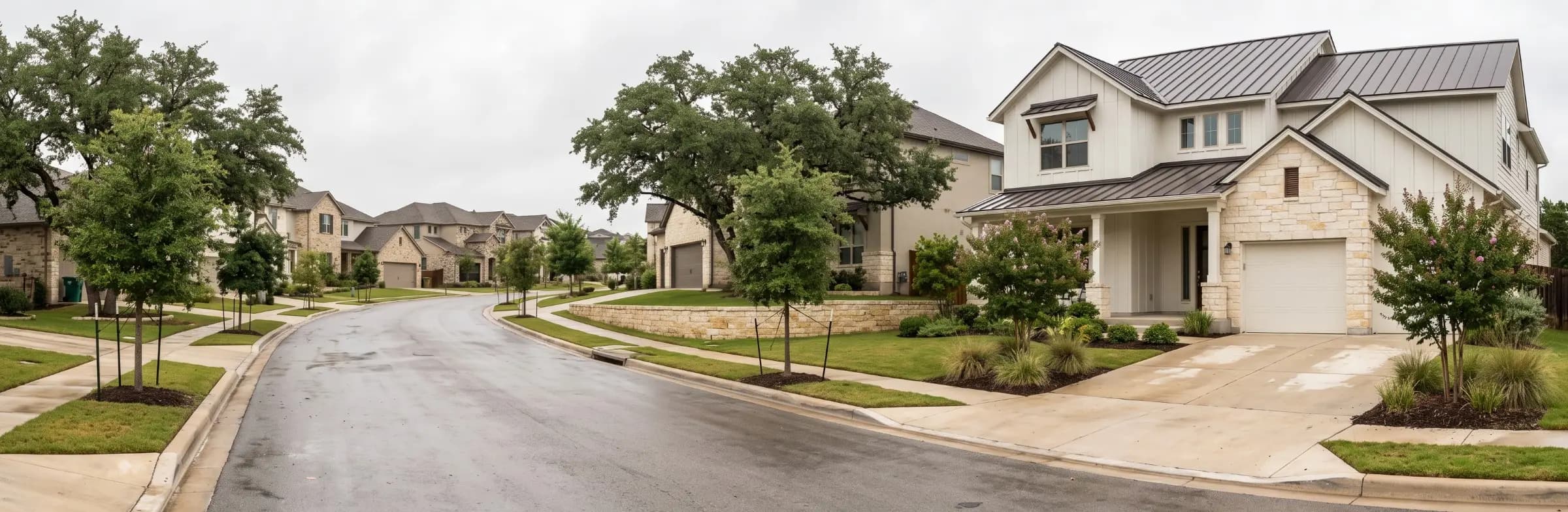

Most mold remediation jobs in Austin cost $1,500–$6,000, and Texas requires a licensed contractor once visible mold reaches 25 contiguous square feet. Any license can be checked online before you sign anything.
Mold remediation in Austin is the licensed removal of mold-contaminated materials and the correction of the moisture source behind them, performed under the Texas Mold Assessment and Remediation Rules and the ANSI/IICRC S520 standard. Texas splits the work between two license types, so an assessor writes the cleanup protocol and a separately licensed contractor carries it out.
Parts of the city sit in creek floodplains with a record that includes the Halloween Flood of 2013, clay soil east of I-35 strains buried plumbing, and the limestone to the west sheds rain quickly toward the creeks. These conditions decide where mold shows up and what an insurance claim covers.
Key insights
- License line. Texas requires a state-licensed remediator when a business remediates 25 or more contiguous square feet of visible mold, and every license is searchable on the TDLR website.
- Two separate professionals. A licensed assessor writes the protocol and checks clearance, and a separately licensed contractor performs the cleanup.
- Typical cost. Austin mold remediation usually costs $1,500–$6,000, or $10–$25 per square foot, and flooded first floors with Category 3 water can reach $25,000 or more.
- Flood exposure. The City of Austin reports more than 10,000 buildings and 300 bridges subject to flooding, and the city sits in Flash Flood Alley.
- 24-hour window. The EPA states that mold can grow on wood, drywall, carpet, and furniture that stay wet for more than 24 hours, so extraction and drying come before mold work.
- Coverage gap. Standard homeowners policies do not cover flood damage, so creek flooding requires a separate NFIP or private flood policy.
Why Austin homes get mold
Austin homes get mold when water reaches building materials faster than the house can dry them, and the city supplies that water in three ways: flash flooding along creek corridors, a long air conditioning season that loads condensate drains, and plumbing leaks in shifting soil. Each source shows up in a different part of the house.
 Clay that shrinks away from a slab and swells back after rain can strain buried supply lines, so an unexplained rise in the water bill can signal a hidden leak before any stain shows.
Austin sits where the Balcones Escarpment separates the Hill Country from the prairies to the east, and the NWS climate summary for Austin records 36.25 inches of rain a year at Camp Mabry, with May, October, and June the wettest months. Rain arrives in bursts, with more than 5 inches in several hours on record and a two-day record of 19.03 inches on September 9–10, 1921. NWS normals also show about 123 days a year at or above 90°F, which keeps air conditioners cycling from late May into September.
| Source | How water gets in | Mold locations | Check first |
|---|---|---|---|
| Creek and flash flooding | Rising creeks, overloaded storm drains, and runoff against the slab push water into the lowest level | Lower walls, subfloor, insulation, cabinets, garage | Waterline on drywall and moisture readings above it |
| Air conditioner condensate | A clogged drain line or full pan overflows during the long cooling season | Closets and attic spaces near the air handler, and ceilings below them | Drain pan, float switch, and condensate line |
| Storm roof and window leaks | Wind-driven rain and hail damage open paths into attics and wall cavities | Ceiling drywall, roof sheathing, insulation | Stains that spread after each rain |
| Slab and supply line leaks | Clay soil moves with moisture and can strain buried pipes and joints | Baseboards, flooring edges, closets on slab | Unexplained jumps in the water bill |
| Hard freeze pipe bursts | Winter Storm Uri in February 2021 burst pipes in homes across the city, and freezes can do it again | Wall cavities, ceilings, and flooring that stayed wet | Rooms that were wet after a freeze and never opened |
East of I-35 the soil is largely expansive clay, according to a University of Texas at Austin geosciences professor quoted by FOX 7, while the Hill Country to the west sits on limestone with thin soil. Clay moves with moisture and can strain buried pipes, and rocky slopes shed water toward the creeks, which is why homes east and west of I-35 fail in different ways.
Highest mold risk areas in Austin
The highest mold risk in Austin follows the creek floodplains, starting with lower Onion Creek in Southeast Austin and continuing through Williamson Creek and Shoal Creek. Neighborhoods outside any floodplain still carry risk from roof, air conditioner, and plumbing leaks, which is why a home that has never flooded can still grow mold.
 Water does not have to reach the living area to cause mold, because saturated ground can wet slab edges and crawl spaces, so homes beside a creek are worth checking after every flood warning.
The City of Austin reports more than 10,000 buildings and 300 bridges subject to flooding. In the Halloween Flood of October 31, 2013, nearly 10 inches of rain fell in 24 hours in parts of the city, five people died, and more than 500 homes were damaged, according to FEMA, which also notes the City authorized $60 million in September 2014 to buy out additional properties in the 100-year floodplain.
| Area | What raises mold risk | What to check |
|---|---|---|
| Lower Onion Creek, Southeast Austin | Flooded in 1998, 2001, and 2013, and the City has bought out many flood-prone homes in the floodplain | Repair permits and records from past floods, subfloor and wall cavity moisture, air conditioner closets |
| Williamson Creek, south and southwest Austin | Ranked second behind lower Onion Creek among the City's flood mitigation priorities in 2015 | Flood zone status before buying, garage and lower-level walls after heavy rain |
| Shoal Creek corridor, Allandale to downtown | A fast-rising creek: 10 inches of rain in 24 hours in 1981, and 5 inches in 4 hours in 2015 that lifted the 12th Street gauge to 20.76 feet | Lowest-level rooms and crawl spaces after any flood warning |
| Waller and Bouldin creeks, central and east Austin | Waller, East Bouldin, and West Bouldin are among eight watersheds where the City's 2016 master plan counted 1,981 structures in 100-year floodplains | Older drain lines and crawl spaces |
| Bull Creek and northwest Austin | Seven low-water crossings on Spicewood Springs Road sit in the Bull Creek floodplain, and a June 5, 2026 warning covered northwest Travis County with 3–7 inches already down | Garage and slab-edge moisture after heavy rain |
| West and southwest Austin, Barton Creek | Thin soil over limestone tends to shed rain quickly toward creeks and retaining walls | Drainage behind retaining walls and at slab edges on sloped lots |
| East and south Austin clay | Expansive Blackland Prairie clay can move foundations and strain buried pipes | Unexplained water bill increases and floor-level odor |
Mold risk in the greater Austin area
Mold risk in Austin's suburbs, from Round Rock and Pflugerville to Cedar Park, Lakeway, and Kyle, follows the same two forces as the city: which side of I-35 the home sits on and how close it is to a creek. East of I-35, deep Blackland Prairie clay shrinks and swells with moisture and strains buried pipes, while to the west thin soil over limestone sheds rain quickly toward creeks and retaining walls.
 Wood framing above 19% moisture content supports mold growth under IICRC S520, so a reading in the 20s at a wall base means the material needs drying and a closer look. Pin meters read drywall on a relative scale, so a licensed assessor should confirm the numbers.
Suburbs add their own flood histories and newer construction. The City of Round Rock built Dam 101 to reduce flooding along Lake Creek after Greater Round Rock West flooded from the creek during Tropical Storm Hermine in 2010 and again over Memorial Day weekend in 2015. Texas license rules apply the same way in every suburb, so the same assessor-then-remediator sequence applies wherever the home sits.
| Area | Soil and water pattern | What to check |
|---|---|---|
| Round Rock | Greater Round Rock West flooded from Lake Creek in 2010 and 2015 | Flood history and repair records, garage and lower-level walls |
| Pflugerville, Manor, and Hutto | East of I-35 on Blackland Prairie clay that shrinks and swells | Floor-level odor, unexplained water bill increases, slab-edge moisture |
| Cedar Park and Leander | West of I-35, where thin soil over limestone sheds rain quickly | Garage and slab-edge moisture after heavy rain, drainage behind retaining walls |
| Lakeway, Bee Cave, and Dripping Springs | Hill Country lots with limestone and fast runoff on slopes | Slab edges, retaining walls, and air handler closets |
| Kyle and Buda | Hays County took damage in the October 2013 flood, and the I-35 corridor mixes soil types by lot | Flood history, repair records, and drainage at the slab edge |
What to do in the first 48 hours
Stop the water source, cut power to wet areas, and start extraction within hours, because mold can grow on wood, drywall, carpet, and furniture that stay wet for more than 24 hours, according to the EPA's flood cleanup recommendations. Water mitigation comes first and mold work comes second, so the first call goes to a flood damage restoration company, and the mold assessor comes after the structure is dry.
 EPA flood cleanup guidance calls for removing standing water and drying wet materials within 24 to 48 hours, before mold growth takes hold. An air mover only circulates moisture, so run it with a dehumidifier and keep windows closed during Austin's humid months.
Central Texas has had repeated flood alerts this year. The National Weather Service issued a flash flood warning for northwest Travis County on June 5, 2026 with 3–7 inches already down, the City of Austin and Travis County declared preemptive disasters on July 14, 2026, and the emergency operations center activated for 2–3 inches of forecast rain on October 1, 2026. Floodwater from creeks and storm drains is Category 3 water under the IICRC S500 standard, which means wet drywall, insulation, and carpet padding from a flood are discarded rather than dried.
| Water event | First 24 hours | Who to call first | What comes next |
|---|---|---|---|
| Creek flood or flash flood | Cut power to wet circuits, photograph the waterline, remove standing water and wet porous materials | Water mitigation company with IICRC water restoration training | Assessment after the structure dries and before rebuilding |
| Roof leak after a storm | Tarp the opening, move belongings, remove wet insulation | Roofer to stop entry, then a water mitigation company | Assessment if stains return or odor appears after drying |
| Air conditioner overflow | Shut off the system, clear the drain line, dry wet drywall and insulation | HVAC technician | Check the ceiling below an attic unit for hidden dampness |
| Burst pipe or slab leak | Close the cut-off valve, or call Austin Water at 512-972-1000 if it will not close | Plumber, with leak detection for slab leaks | Dry wall cavities before they are closed |
| Sewer backup | Keep people and pets out of the area and avoid contact with the water | Sewage cleanup company | Discard porous materials the water touched |
The same recommendations call for an N-95 respirator, goggles, gloves, and boots during cleanup. They also advise waiting to run fans or dehumidifiers until visible mold has been gently cleaned once, so air movement does not spread it.
Signs of mold in an Austin home
The most reliable signs of mold in an Austin home are a musty odor, discoloration or fuzzy growth on drywall and trim, and moisture stains that return after cleaning. In Austin these signs cluster around air conditioner closets and attic units, the baseboards of slab homes, and rooms that were wet in a past flood or freeze.
 Mold behind furniture on an exterior wall usually points to a moisture source such as condensation or a leak, so find and fix that before any cleaning. In Texas, 25 contiguous square feet or more of visible mold requires a licensed remediator.
Visible growth understates the problem, because water travels along framing and under flooring before it stains a wall. Under the IICRC S520 standard, a moisture reading above 19% in wood framing indicates conditions that support mold growth, and readings near 28% indicate conditions that support decay.
| Where to look | What you see | Common cause | DIY or professional |
|---|---|---|---|
| Ceiling below an attic air handler | Brown rings, soft or bubbling drywall | Clogged condensate line or overflowing pan | Professional if drywall is soft or the stain is large |
| Baseboards and flooring edges on a slab | Staining, cupped hardwood, musty odor | Slab or supply line leak in shifting soil | Plumber first, then a professional |
| Garage and lower walls | Dark growth near the floor line after rain | Runoff at the slab edge or a past flood | DIY if small and on a cleanable surface |
| Closets on exterior walls | Fuzzy spots on drywall and shoes, stale air | Humidity and poor air circulation | DIY if small and on a cleanable surface |
| Crawl space in a pier-and-beam home | Growth on joists, damp insulation, standing water | Poor drainage or leaking pipes | Professional, because of confined access |
| Walls that were wet in the 2021 freeze or a flood | Odor that strengthens in warm weather, stains from the inside | Water that dried slowly inside cavities | Professional after moisture mapping |
Growth that follows water damage often hides in wall cavities that looked dry on the surface, so mold after water damage can surface weeks after cleanup. Photos and moisture readings taken early also support an insurance claim.
Mold species common in Austin homes
The mold species found in Austin homes depend more on the kind of moisture than on the neighborhood. Humidity and condensation favor Cladosporium and Alternaria, slow leaks favor Aspergillus and Penicillium, and long saturation after a flood or freeze favors Chaetomium and Stachybotrys.
 Olive-green to gray, velvety growth is typical of Cladosporium and Penicillium, two of the most common indoor molds, but only lab analysis confirms the species. Bubbling and peeling paint around the patch point to moisture behind the wall, which has to be fixed before any cleanup.
The species points to the water source, so a lab result is most useful to the assessor writing the protocol. Color cannot identify a species, so only a lab sample can confirm one.
| Species | Source | Where it shows up | What it points to |
|---|---|---|---|
| Cladosporium | Humid air, condensation, damp exterior closets | Fabrics, wood trim, window frames, ductwork | Humidity or a cooling problem more than a flood |
| Aspergillus and Penicillium | Slow leaks, air conditioner condensate, damp insulation | Drywall, attic materials, dust | A leak source that has been feeding growth for a while |
| Alternaria | Window and shower condensation, plumbing leaks | Window sills, sinks, tubs | Damp surfaces that stay wet between uses |
| Chaetomium | Drywall that stayed wet after a flood or pipe burst | Back of drywall, wall cavities | Slow drying, such as after creek flooding or the 2021 freeze |
| Stachybotrys | Paper-faced drywall or ceiling material saturated for days or weeks | Flooded walls, hidden long-term leaks | Sustained saturation, which only a lab can confirm |
DIY or professional mold removal
Texas lets people who are not licensed clean visible mold under 25 contiguous square feet, but the EPA's 10 square foot guideline is the safer limit for DIY work. Hidden growth, HVAC involvement, and flood water move a job to a professional at any size, and the moisture source and who lives in the home also decide when mold remediation is required.
 EPA guidance treats mold covering less than about 10 square feet as a possible DIY job, with an N-95 respirator, gloves and goggles without ventilation holes. Larger areas, or mold that returns after cleaning, point to a hidden moisture source and call for a professional.
A property owner doing the work on a building with fewer than 10 dwelling units faces no size limit under the state rules, while a business hired to do it needs a license once the area reaches 25 contiguous square feet. That gap between the state line and the EPA line trips up homeowners, because a handyman can legally scrub 20 square feet of drywall mold that the EPA guideline would send to a professional.
| Situation | DIY? | Why | Next step |
|---|---|---|---|
| Surface mold under 10 sq ft on tile, glass, or sealed wood with no active leak | Yes | Nonporous surfaces clean with detergent and water | Dry the area and watch for return |
| 10–24 sq ft on drywall or ceiling | Not advised | Legal for unlicensed work, but porous materials usually have to come out | Licensed assessor visit |
| 25 sq ft or more of visible mold | No | A business must be licensed for this work, and an assessor writes the protocol | Hire the assessor first |
| Any amount after creek flooding or a sewer backup | No | Category 3 water contaminates porous materials | Mitigation, then assessment |
| Mold in or near ducts or the air handler | No | The system spreads spores through the house | HVAC technician and licensed remediator |
| Recurring mold in the same spot | Not yet | The moisture source is still active | Fix the leak or condensate line first |
| A household member with asthma, a weakened immune system, or pregnancy | No | The EPA advises these groups to stay away from moldy sites | Licensed remediator |
Most DIY mold removal failures in Austin trace to a moisture source that was never fixed. Small jobs that hold up follow one sequence: stop the water, wear an N-95 respirator and gloves, wipe nonporous surfaces with detergent and water, and dry them fully.
Mold remediation cost in Austin
Mold remediation in Austin typically costs $1,500–$6,000, with small accessible patches near $500 and flooded first floors with contaminated water reaching $25,000 or more. Pricing follows the area affected, the materials that must be removed, and how hard the area is to reach, at roughly $10–$25 per square foot.
 Cutting out and replacing affected drywall adds labor, disposal and rebuild costs on top of the cleaning itself, which is why estimates climb once mold reaches wall materials. Ask for containment, disposal and rebuild to be itemized separately.
Austin adds three cost drivers: creek flood jobs carry Category 3 handling, attic air handler and ceiling work needs ladder time and containment, and crawl spaces in older pier-and-beam homes are slow because of confined access. Assessor fees are separate because Texas requires an independent assessor on larger projects, and the final mold remediation cost also includes rebuilding.
| Scope | Cost | What it covers |
|---|---|---|
| Small patch under 10 sq ft, accessible | $500–$1,500 | Containment, HEPA cleanup, minor drywall removal |
| Single room, 10–100 sq ft | $1,500–$4,500 | Removal of affected drywall and trim, HEPA vacuuming, drying |
| Multiple rooms or 100–300 sq ft | $4,000–$9,000 | Multi-room containment, air scrubbers, material removal |
| Attic or crawl space | $2,000–$7,500 | Access setup, sheathing or joist cleaning, insulation removal |
| HVAC system involvement | $1,500–$10,000 | Component cleaning or replacement, duct work |
| Flooded first floor with Category 3 water | $8,000–$25,000+ | Extraction, demolition, drying, and mold work |
Square footage alone understates the price when water has moved behind finished surfaces. A 30 square foot stain below an attic air handler can mean opening a much larger section of ceiling to find where the insulation is damp.
Contractors price small jobs at a minimum charge, so the effective mold remediation cost per square foot can exceed $25 on a 20 square foot patch. The $10–$25 range covers labor, containment, and disposal, and it excludes assessment and reconstruction.
| Add-on | Cost | Notes |
|---|---|---|
| Licensed mold inspection with moisture mapping | $300–$700 | Lab samples are billed per sample |
| Protocol writing for a project of 25 sq ft or more | Varies with project size | Required from a licensed assessor before work starts |
| Post-remediation verification sampling | $200–$1,200 | Performed by an independent assessor after cleanup |
| Replacement drywall, insulation, paint, and flooring | Billed separately | Usually done by a general contractor after clearance |
An assessor's visit is the cheapest step in the process and the one that sets the scope for everything after it. A licensed mold inspection with moisture mapping shows where water traveled, which prevents paying to remove material that tested dry or missing hidden damage that did not.
Texas mold license requirements
Texas requires a TDLR license for mold assessment and for mold remediation, and one licensee may not perform both on the same project. A licensed assessor inspects the home, writes a protocol that lists the materials to remove, the methods, and the cleanup criteria, and checks the result afterward, while a licensed remediator follows that protocol. The Texas Department of Licensing and Regulation publishes the Texas Mold Assessment and Remediation Rules and a searchable license database, and it accepts complaints about licensees and about unlicensed activity. It cannot require testing, order a landlord or neighbor to clean mold, or inspect your home for mold.
| Role | What the licensee does | What you receive |
|---|---|---|
| Mold assessment consultant | Inspects, samples if needed, writes the protocol, and performs the post-remediation assessment | Protocol, sample results, and a clearance statement |
| Mold remediation contractor | Carries out the protocol with containment, removal, and cleaning | Completed work and a Certificate of Mold Damage Remediation after clearance |
| Mold analysis laboratory | Analyzes samples taken by the assessor | Lab report |
TDLR sets the license types, written protocol, and clearance steps, and they apply to every mold job in the state. Unlicensed work above the threshold can be reported to TDLR through its complaint form.
What happens during remediation
A professional mold remediation job in Texas follows a fixed order: contain the work area, filter the air, remove contaminated materials, clean what stays, dry the structure, and pass clearance testing. The licensed remediator performs these steps under the assessor's written protocol, and the job is not finished until the assessor's post-remediation testing meets the cleanup criteria.
 Negative air equipment keeps the work area at lower pressure than the rest of the house, so spores are pulled out through a duct instead of drifting into clean rooms, a containment practice covered in IICRC S520. Ask any contractor how they will contain and exhaust the work area before you sign.
The mold remediation process is the same in a creek-flooded house and a leaking attic, but flood jobs remove more material because Category 3 water contaminates every porous surface it touches. Containment matters because disturbing colonies without it releases spores into the rest of the house.
Containment
Plastic sheeting seals the work area, and the HVAC system serving that zone is shut off and sealed so spores do not travel through the ducts. Workers enter through a zippered door or decontamination chamber so spores do not ride out on clothing.
Air filtration
Negative air machines with HEPA filters pull air out of the work area, so air flows from the clean house into the containment and not the other way. Air scrubbers with HEPA filters also run during the job to capture spores that become airborne.
Removal
Wet or colonized porous materials such as drywall, insulation, and carpet padding are cut out, bagged, and carried out of the home. Bagging the material inside containment keeps spores from spreading as it leaves, and the protocol sets how far past visible damage to cut.
Cleaning and drying
Framing and other surfaces that stay are HEPA vacuumed and damp wiped, then the structure is dried to the moisture targets in the protocol before anything is rebuilt. Drying often takes longer than the cleanup itself, especially after a flood.
Clearance
The licensed assessor inspects and samples, and the Certificate of Mold Damage Remediation follows when the project passes. If the samples fail, the remediator repeats the cleaning and the assessor retests.
How long mold remediation takes
Most Austin mold remediation takes 1–5 days of cleanup work, plus drying time and a clearance sample that returns in 24–72 hours, which puts most jobs at 1–2 weeks from protocol to certificate. Flooded homes take longer because demolition and drying come first, and crews follow the sequence set by the ANSI/IICRC S520 standard.
 Rebuilding starts only after the remediator finishes and the assessor clears the area, and each coat of joint compound has to dry before the next, so repairs often add days to the schedule. Ask whether the quoted timeline includes rebuild work or stops at cleanup.
Austin's summer humidity slows drying, and delays usually come from scheduling the plumber, roofer, or HVAC technician before the remediation crew can start. Ask the remediator for a written schedule that lists the drying target and the clearance date, since drying is the part of the job that varies most.
| Job type | Active work | Drying and lab time | Total |
|---|---|---|---|
| Small patch under 10 sq ft | 1 day | 1–2 days | 2–4 days |
| Single room | 1–3 days | 2–4 days | 1–2 weeks |
| Multiple rooms | 3–5 days | 3–5 days | 2–3 weeks |
| Attic or crawl space | 2–5 days | 2–4 days | 1–3 weeks |
| Flooded first floor | 5–10 days | 5–10 days | 3–6 weeks before rebuilding |
The independent check that the work met the protocol's cleanup criteria is post-remediation verification, and rebuilding starts only after it passes. Booking a general contractor while the protocol is still being written avoids idle weeks between clearance and reconstruction.
How to hire a mold remediation company
To hire a mold remediation company in Austin, start with a TDLR-licensed assessor who writes the protocol, then hire a separately licensed remediator and confirm the license number, insurance, and written scope before work begins. IICRC credentials, including Applied Microbial Remediation Technician (AMRT) training and Certified Firm status, add training beyond the state license, and the mold remediation certifications differ in what each one proves.
 Check a contractor's TDLR license number in the state license database before work starts, and remember the assessor and the remediator cannot be the same licensee on one project. Get the scope, containment plan and cleanup criteria in writing before you sign.
Demand for emergency mold removal rises after storms, and some companies arrive without a license or quote a price before anyone has measured the affected area. A written protocol from an independent assessor gives every bidder the same scope, which makes quotes comparable and limits the chance that a contractor expands the job.
Verify the license number
Search the contractor's name or license number in TDLR's license search at tdlr.texas.gov. Confirm that the license type is mold remediation and that the status is active.
Get the protocol first
Ask for the assessor's written protocol before comparing bids. A remediator who quotes without one, or who offers to write it, is a red flag because the same licensee may not do both.
Check insurance and scope
Ask for general liability and pollution liability coverage in writing, since standard liability policies may exclude mold. Confirm that containment, HEPA filtration, and debris disposal are written into the scope.
Ask who fixes the water source
Mold work done before the roof, plumbing, or condensate line is repaired fails clearance or comes back. Get the order of work in writing, including who coordinates the roofer, plumber, or HVAC technician.
Compare post-storm quotes line by line
Quotes written right after a storm vary widely. Compare square footage, materials removed, and the number of air scrubbers rather than the total.
A contractor who asks for most of the price before containment goes up is a poor bet. Written warranties should say what happens if clearance fails, so compare those terms across every bid before you choose a mold remediation company.
Does insurance cover mold in Austin?
Homeowners insurance covers mold in Austin only when the mold results from a covered sudden event, such as a burst pipe or storm-damaged roof, and many policies cap mold payouts or exclude them. Creek flooding is excluded under standard homeowners policies and needs separate flood coverage, according to the National Association of Insurance Commissioners, which also reports that most policies offer limited or no coverage for mold and sewer backup unless an endorsement is added.
Mold wording differs by insurer and policy form, so find the mold exclusion or sublimit in your policy before you file. A claim that barely exceeds the deductible can affect premiums and renewal, and insurers report claims to nationwide databases that future insurers can see, as the NAIC notes.
| Cause of water | Standard coverage? | Notes |
|---|---|---|
| Sudden pipe burst or supply line failure | Often yes | A mold sublimit may apply, and prompt reporting matters |
| Storm damage to the roof | Often yes | Policies exclude damage from neglected maintenance |
| Slow leak or long-term seepage | Often no | Many policies treat gradual damage as excluded |
| Creek flooding or surface water | No | Requires an NFIP or private flood policy, and NFIP policies carry a 30-day waiting period |
| Air conditioner condensate overflow | Depends on the wording | Document the date of the failure and the repair |
| Sewer or drain backup | No, unless endorsed | An endorsement can add coverage |
Keep the assessor's protocol, the clearance statement, invoices, and photos together when you file a claim, because the adjuster will ask for each. Late notice can also complicate a claim, so report the loss as soon as the damage is found.
Buying or selling a home with mold
Texas sellers of a single-family home must give buyers a written Seller's Disclosure Notice under Texas Property Code Section 5.008, and the form asks about previous flooding, floodplain status, flood insurance claims, and water damage not due to a flood. A buyer who does not receive the notice before the contract is signed may terminate within seven days of receiving it, and the form also asks about conditions that materially affect health or safety.
 Texas sellers must disclose known defects under Property Code 5.008, but attic staining is easy to miss, so buyers should have an inspector check it. If mold was cleaned up before, ask for the Certificate of Mold Damage Remediation.
Flood history is the first thing to check on an Austin home. Homes near lower Onion Creek, Shoal Creek, and Williamson Creek may have flooded and been repaired without visible damage, so ask for permits, repair invoices, and any Certificate of Mold Damage Remediation, and book an independent mold inspection with moisture readings before closing.
Sellers weighing whether to remediate before listing or disclose mold when selling a house as is should compare the remediation cost with the likely buyer concession. The assessor's clearance statement and the certificate give buyers a documented baseline that a verbal assurance does not.
What Austin tenants can do about mold
An Austin tenant with mold should send the landlord a written repair request by certified mail, because Texas has no mold-specific landlord statute and a tenant's rights come from the repair duty in Texas Property Code Chapter 92. Under that chapter a landlord must make a diligent effort to repair conditions that materially affect the physical health or safety of an ordinary tenant after receiving notice.
Ask for return receipt and keep a copy of the request, as TDLR's consumer sheet advises. Keep dated copies of every notice, because tenant mold rights in Texas turn on whether the landlord received written notice and a reasonable time to repair. The sheet also points tenants to city code compliance and local health departments.
After the February 2021 freeze, news reports described hundreds of Austin renters dealing with moldy apartments, and the Austin Code Department was reported not to conduct mold inspections itself. Report the underlying conditions, such as leaks, water damage, and failed repairs, when you contact Austin 3-1-1. Check an address in the Citizen Connect tool before signing a lease, since repeated unresolved code violations can place a rental in the Repeat Offender Program, which brings periodic inspections.
Who pays for mold in an Austin condo
In an Austin condo, the association pays for mold that starts in common elements such as the roof, exterior walls, and shared plumbing, and the owner pays for mold that starts inside the unit. Under Chapter 82 of the Texas Property Code the association maintains the common elements and each owner maintains their unit, although a condominium declaration can change those allocations.
Gray areas include windows, air conditioner equipment that serves a single unit, and leaks that start in one unit and damage another, so read the declaration to see which side owns each. Townhomes and single-family communities follow their own HOA covenants instead of Chapter 82, and those often leave the roof and exterior to the owner, so read the covenants before assuming the association will pay.
Report the leak to the association in writing, photograph the damage, and keep every mitigation receipt. Ask whether the association's master policy covers the building and what your own HO-6 condo policy's mold coverage includes inside the unit, since the two policies split the loss differently.
Preventing mold in an Austin home
The most effective ways to prevent mold in an Austin home are keeping indoor humidity at or below 50%, flushing the air conditioner condensate line and checking the drain pan each spring, and drying any wet material within 24 hours. TDLR's consumer sheet recommends keeping humidity as low as possible and no higher than 50% all day.
 A clogged condensate drain is one of the most common ways an air conditioner wets drywall and insulation, and Austin systems run for much of the year. Flush the line with vinegar every few months and make sure the drain pan stays dry.
Austin's wettest stretches arrive in May, October, and June, and the NWS puts the severe weather season for hail and wind in March through May. Schedule condensate line, roof, and humidity checks around that calendar, and sign up for the City of Austin's flood alerts if your home is near a creek.
| Action | When | Why it works |
|---|---|---|
| Flush the air conditioner condensate drain line | Every spring and again in midsummer | Clogs cause the overflows that wet ceilings and closets |
| Check the attic unit's drain pan and float switch | Spring | A working switch shuts the system off before water spreads |
| Keep humidity at or below 50% with a hygrometer | Year round, weekly in summer | Mold needs sustained moisture to grow |
| Inspect the roof after hail or wind storms | After each storm season | Small breaches let in water for months before a stain shows |
| Review the water bill for unexplained increases | Monthly | Slab and supply line leaks show up as higher use first |
| Check the garage and lowest level after heavy rain | After each flood watch | Water at slab edges is easy to dry in the first day |
Frequently asked questions
How much does mold remediation cost in Austin?
Mold remediation in Austin typically costs $1,500–$6,000. Small accessible patches run near $500, while flooded first floors with contaminated water can reach $25,000 or more, and the independent assessor and clearance testing are billed separately.
Does Texas require a license for mold remediation?
Yes, for visible mold covering 25 contiguous square feet or more. Under Texas mold licensing law, separate TDLR licenses are required for the assessor and the remediator on those projects, and owners of buildings with fewer than 10 units are exempt for their own property.
Does homeowners insurance cover mold in Austin?
Only when the mold results from a covered sudden event, such as a burst pipe or storm-damaged roof. Creek flooding is excluded from standard homeowners policies, and many policies cap or exclude mold payouts, so check your policy for a mold sublimit before filing.
Does dry weather stop mold in Austin?
No, dry weather only slows it. July and August are Austin's driest months, but air conditioner condensate, roof leaks, and plumbing leaks supply water whatever the forecast says, and mold that dries out goes dormant and regrows when moisture returns.
Is it cedar fever or mold?
It can be either, so timing matters. Mountain cedar season runs from December through February in Central Texas, while local pollen counts track mold every month of the year and show it rising after heavy rain. Symptoms that continue after cedar season ends, or that ease when you leave the house, point toward an indoor source, and an allergist can confirm with testing.
Is black mold common in Austin homes?
Not usually. Stachybotrys, the species called black mold, needs materials that stay saturated for days or weeks, so it appears after floods and long hidden leaks rather than from surface humidity. Color alone cannot confirm the species, and confirmed black mold removal follows stricter containment than routine cleanup.
Does bleach kill mold on drywall?
No. TDLR's consumer sheet states that applying bleach to drywall without removing the mold source is not a permanent solution, and painting over mold does not work either. Porous materials such as drywall, carpet, and insulation are removed and discarded rather than cleaned.
Can I stay in my house during mold remediation?
Often yes for small jobs, but not when the HVAC system is contaminated or several rooms are involved. The EPA advises people with asthma or weakened immune systems to stay away from moldy sites, and the decision depends on job size, location, and household health.
What is a Certificate of Mold Damage Remediation?
It is the document a licensed remediator issues after a project passes clearance, and it includes the licensed assessor's statement that the work met the protocol. Keep it with your home records, because buyers and insurers may ask for proof of past remediation. Work done outside the licensed process does not produce one.
Should I test for mold after a flood in Austin?
Usually not before drying. Wet porous materials from a flood are removed regardless of sampling results, and TDLR's consumer sheet notes the CDC does not recommend routine sampling. Air and surface samples taken after drying are the useful form of mold testing, because they confirm conditions once the structure is dry.
- TDLR: Texas Mold Assessment and Remediation Rules
- City of Round Rock: Dam 101 and Lake Creek Flooding
- TDLR: Mold Remediation Consumer Protection
- EPA: Flood Cleanup to Protect Indoor Air and Your Health
- IICRC S520
- NWS: Austin Climate Summary
- FEMA: Lower Onion Creek Flood Mitigation Buyout Project
- NAIC: A Consumer's Guide to Home Insurance
- Texas Property Code Section 5.008: Seller's Disclosure of Property Condition
- City of Austin: ATX Flood Safety
Sam Hickerson is the founder of RestoreAdvisor and writes consumer guides on mold remediation, water damage restoration, inspection, testing, and home recovery. His work focuses on helping homeowners understand costs, risks, and when to call a professional. He draws on guidance from the EPA, CDC, IICRC, and other authoritative sources to make complex home issues easier to navigate.